Archive | Uncategorized RSS feed for this section

“When I first tried the sunfield I looked like a big boob”

12 Sep

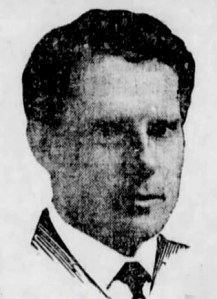
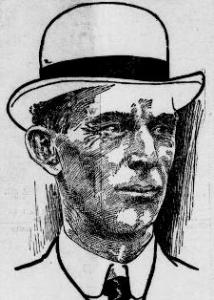
Harold “Speed” Johnson of The Chicago Herald asked:

“Does playing the sun field effect a ballplayer’s batting eye?

“’Yes,’ comes the answer in chorus!

Speed Johnson

Speed Johnson

“Diamond greats who have played the sunfield year after year…say the fellows who must go and get ‘em while looking Old Sol squarely in the face are bound to be handicapped in batting.

“The players who stand in the sun pasture then have to go to the plate immediately are especially handicapped gauging pitched balls.

“Sunfielders who hit .265 would clout 25 points higher each year if assigned to other fields, veterans declare…“The American League’s most difficult sunfields are in the parks at Chicago, Boston, St. Louis, Detroit and Philadelphia.  How Sam Crawford, playing the garden in Detroit for ages, has managed to keep above the .300 mark is one of the wonders of the national pastime.”

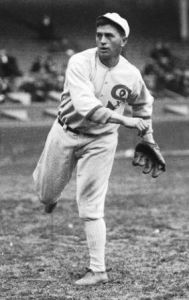
Harry Hooper of the Red Sox agreed, and told Johnson:

“’When I first tried the sunfield in 1909 I looked like a big boob.  I missed the first fly ball batted my way by 20 feet.  Fred Lake, our manager, decided I wouldn’t do and put me in left field.’

“’Later, I mastered the sunfield job, but about four years ago my eyes troubled me.  An oculist said I had strained both eyes by looking into the sun…I wore glasses for a year…My eyes haven’t troubled me, however, since I adopted the sunglasses invented by Fred Clarke.  Before I donned them I had to ‘take’ the first ball pitched whether I wanted to or not, after stepping directly from the outfield to the plate.’”

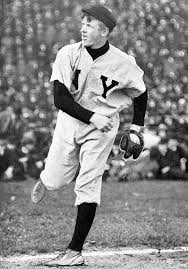
Hooper

Hooper

Hooper continued playing for the next decade for two clubs, the Red Sox and Chicago White Sox, with two of the most “difficult sunfields” in the American League.  He hit .300 or better four times and ended his career with a .281 average;  by Johnson’s estimation, the Hall of Famer would have hit around .306 if he spent his career in left field.

I would Pick the Country Boy in place of the City Chap”

9 Sep

In June of 1912, after being unable to return for his 23rd season, Cy Young headed to his farm in Peoli, Ohio, when he “wrote” an article for The Associated Press comparing players from the country versus those who grew up in cities:

“Other things being equal—and by ‘other things’ I mean natural ability, baseball brains and nerve—I would pick the country boy in place of the city chap for my ball team.”

Cy Young

Cy Young

Young said:

“I am not saying this because I am from the country and return here on the slightest provocation.  Still, I believe the fact that I was born and raised on a farm (not two miles from this spot, by the way) is largely responsible for myself as a pitcher.”

Comparing himself to “city” pitchers, Young said:

“I was naturally rugged, and my farm work as a boy tended to make me more so.  I have seen other pitchers who seemed to have a lot more stuff than I had fail, for the reason that they were lacking in reserve power.

“They would go along splendidly for a few innings, but when the real test came they were lost sight of, and now are all but forgotten, whereas they had the same early training I received they might have remained in the game as long as I have.”

Cy and friend

Cy and friend

And Young was buying any claims that players from the city were smarter:

“The argument that city boys think faster and are more independent is not a good one.  In fact, I believe it is entirely wrong.  The country boy must think as fast and as often as the boy in the city, and he is thrown upon his own resources much oftener.

“All in all, give me the boy from the country—the boy who have survived the hard knocks—for a diamond star.”

Despite his desire to always return to farm at “the slightest provocation,” Young worked out throughout the summer of 1912 with designs on getting back to the major leagues.

He told a reporter:

“I am not broken down by any means.  I am still better than three-fourths of the pitchers in the league…I am going to get up a couple of country games and pitch them, too.  Then if I am right I am going to report to (Boston Braves Manager Johnny) Kling…(D)on’t think I am through yet.”

Despite his best efforts in the summer of 1912, the “country boy” had played his final major league game.

“Some Players seem Terribly Stupid”

7 Sep

Henry Beach Needham was a journalist and fiction writer, best known for being a long-time friend, and occasional biographer of President Theodore Roosevelt.  In 1906, he approached Connie Mack with a request to travel with the Philadelphia Athletics and publish a profile of the manager and his players.

Needham

Needham

Initially apprehensive, Mack allowed Needham to accompany the club and two became close friends.

Over the next nine years (until he was killed in a plane crash in France while covering the war) Needham would write many profiles of his friend Mack in pages of “McClure’s Magazine,” and syndicated in many newspapers.

In 1911, just before the start of the World Series, he asked Mack:

“What is the first thing you demand in a youngster?’

“’Speed!’ replied Mack.  ‘Double plays are what lose you your games.  A slow man gets doubled up at first.  The only excuse for having a slow man—unless he’s a first-class pitcher or a splendid catcher—is that he can play the hit-and-run.  If he can’t signal to the base runner and then connect with the ball, he will hit into a double play—and there goes your game.”

Next, Needham asked if “baseball brains” were next in importance:

“’Y-e-s,’ replied Mack, with some hesitation, and then he qualified:

“’Hold on!  There’s something to be said about gray matter.  Some players seem terribly stupid.  Why—you can tell ‘em a thing over and over, and they will go into the game and do exactly opposite to what you have told them.  Then—all of a sudden it will come to them—and then they have it.  Why—I know a great player in our league.  For two or three years he was as stupid a player as you ever saw.  Then—suddenly it all came to him.  Now he won’t make the wrong play twice in a season.’”

Mack

Mack

Needham asked about players staying in condition:

“’I take that for granted,’ said Mack.  “Major league players have got to be in condition—or their clubs can’t win.  I haven’t any rules.  Why—I never have had any.  But my men always take care of themselves.  This may interest you:

“’Before the World Series last year I got my team in a room together.  Why—I told them that, no matter what the results, we didn’t want to have any regrets.  I reminded them how in other years it was said that the losing team hadn’t taken care of themselves.  Then I said that I wanted every man who could honestly promise to say that he wouldn’t take a drink until the series was over.’

“’Now, if there is one of you who can’t do without his drink,’ I said to them, ‘I want him to say so.’ Then I went down the line, and they all promised, every one of the 23.’

“’Why—I’m morally certain that not one of those 23 men touched a drop in those two weeks.  And a few of them are accustomed to have their bottle of beer every day of their lives.’”

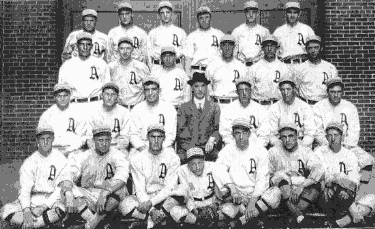
The sober Athletics

The sober Athletics

Needham said there was discipline on Mack’s club, but it was “discipline through force of example:”

“Connie Mack does not smoke or drink—merely because he cares for neither—and he is clean as a hound’s tooth.”

Needham, who said “No one can get (Mack) to prophecy” made a prediction about the manager, then 48-years-old:

“Twenty years may elapse before Connie Mack wins his last pennant.”

Mack did win his final  pennant twenty years later in 1931.

A Pair of Reveries

5 Sep

A couple of lost baseball poems on a holiday:

Grantland Rice, in The New York Tribune, 1919:

By Way of Revery

But yesterday I watched them start,

Young wonders all in serried row;

By now I’ve seen them all depart–

The years flow faster than we know

For I remember, young and slim,

How Matty gathered game by game;

Today how many mention him?

The years flow faster than all fame.

Matty

Matty

Where Wagner swung out for his blow–

Where Larry leaned against the ball–

How swift they were last week or so–

The years flow faster than them all.

Today, fresh from the corner lot,

We praise some youngster on the team;

Tomorrow’s page will know him not–

The years flow faster than we dream.

Grantland Rice

Grantland Rice

And five years earlier, Ed Remley of The Chicago Inter-Ocean was nostalgic for Cubs teams past:

Reverie

I was feeling both dusty and bare–

rocky and sober

And the stands were both

The stands were deserted and bare;

‘Twas a day like in lonesome October

And nineteen-fourteen was the year;

I was out at the Cubs’ lonely ballpark

And the ghosts of gone heroes were there;

It was out at the Cubs’ lonesome ballpark

And the Cubs played a ball game out there.

I was sleepy and fell in a trance;

I saw Tinker and Evers and Chance.

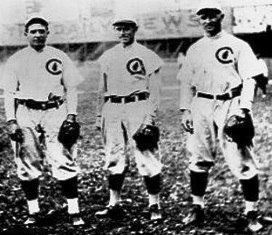
Tinker, Evers and Chance

Tinker, Evers and Chance

Is that Steinfeldt or just Heinie Zim?

Well, it looks much like Harry.  It’s him;

Old Mordecai Brown did a dance

On the rubber–a one-step and prance–

And the ball shot to Kling

Like a hell-possessed thing;

I saw all of this stuff at a glance.

But I woke–ouch, I woke from the dream

And I gazed at the laboring team–

Well, they looked pretty good,

But I wished that I could

See again the sweet team of my dream.

“Baseball will Never be a Science”

2 Sep

By 1912, Ed Remley of The Fort Worth Star-Telegram had had enough of talk of “scientific” and “inside” baseball, which he called a “Figment  of writers’ too active brains:”

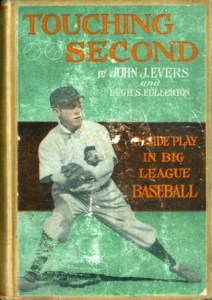
“This ‘Inside baseball’ stuff and statistical dope that is being given so much space in the low-priced magazines, makes us tired.  Yesterday we read a story in which an attempt was made to prove that when ‘Good Night’ (Frank) Baker came to bat against (Christy) Mathewson (in game 3 of the 1911 World Series) the chances were 367 and 2/5 to 1 against his making a home run.  Once we read a story by (Hugh) Fullerton and Johnny Evers in which those gentlemen attempted to prove that there were just three places, six inches each in width, where a ground hit ball could pass safely through the infield.

"Touching Second," Evers' and Fullerton's collaboration on "Inside Baseball."

“Touching Second,” Evers’ and Fullerton’s collaboration on “Inside Baseball.”

“This line of bunk listens well to the public who attend all their baseball games through the newspapers—we sometimes think they are a majority of the fans—but to the close follower of the game they look like far-fetched attempts to make a story where no story is.  Some of this stuff is so thin that even a schoolboy athlete will snort when he reads, but the magazine editors but it up and illustrate it with cuts borrowed from the sporting page.”

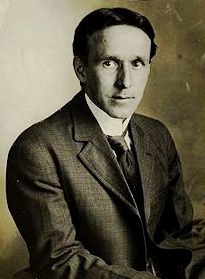
Fullerton

Fullerton

Remley said it wasn’t about baseball, but selling magazines:

“Five years ago about one baseball story in three years drifted into the covers of the big 10-cent monthlies.  Now scarce an issue of any of the popular ones is without its baseball yarn of some character.  It can betoken one of two things, either there is  a stronger interest in baseball  or else the magazine editors are just beginning to wake  up and see its possibilities as a feature.

“If baseball has become a magazine subject because of a natural public demand for that species of pabulum, well and good, and the more of it the public gets the better…On the other hand, if this writing all around the subject of baseball is a result of an exaggerated view of its value on the part of the editors it is going to do the game no good, for the public will soon tire of that kind of hysteria just as it does of anything else that is boomed too much—towns, religions, etc…”

The emphasis on statistics bothered Remley more than anything:

“Meanwhile the fact remains that you can’t reduce the game to figures.  Not even the most skillful statistician can make out the story of a game from the box score.  The figures are an interesting commentary, sometimes, but the real story of baseball will not fit within the box.

“Analyzing the factors which go up to make a successful baseball team, the following ratio is discovered: physical fitness, 20 percent; skill, 60 percent; chance, 20 percent.  That’s mere opinion, too, for the exact ratio never can be determined, but it is evident that some such ratio must obtain.  It is the existence of this large percent of chance in baseball which makes it impossible to reduce the probabilities of the game to figures.  By tossing a dime in the air 2000 times it will be discovered the coin will fall heads up approximately half the time.  Just so, by taking a large enough number of cases generalizations may be arrived at in baseball, but when the attempt is made to apply these generalizations to concrete  cases, the theory falls down. “

Remley concluded:

Baseball will never be a science, therefore, and the attempts to make it appear so are bound to be discredited sooner or later.  It is about time for the magazines to can this statistical dope from their pages.”

The following year, Remley left Fort Worth and joined the staff of The Chicago Inter-Ocean.  Tne Inter-Ocean and The Chicago Record-Herald were consolidated into The Chicago Herald in 1914, and Remley for a time–until his death from pneumonia in 1915–became a co-worker of Hugh Fullerton, whose “inside baseball” he so abhorred.


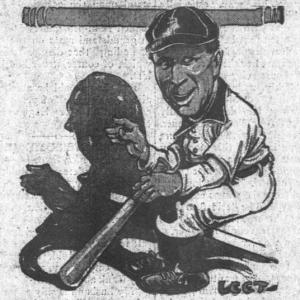
Lost Pictures–Frank Leet Caricatures

31 Aug

leetjohnson

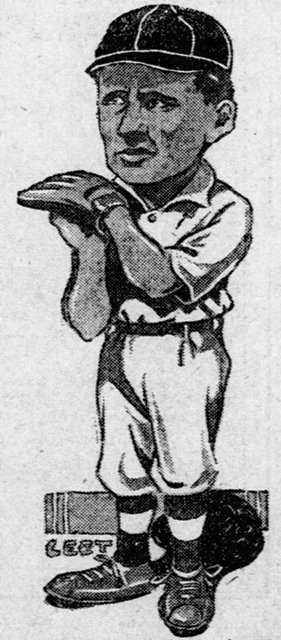
Walter Johnson of the Washington Senators, as depicted by Frank Rutledge Leet, a cartoonist for The Newspaper Enterprise Association, as well as the author of a number of children’s books, including one called, “When Santa was Late.

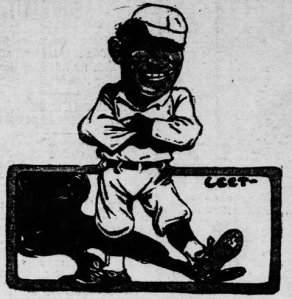
In 1912 and 1913 he provided caricatures for a number of articles featuring players telling their favorite baseball stories.  In addition to Johnson, Leet created images of Johnson’s teammate Germany Schaefer:

leetschaefer

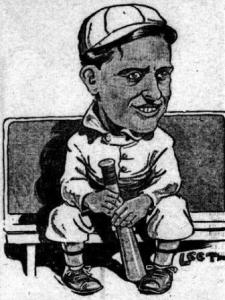
Chicago White Sox pitcher Big Ed Walsh:

bigedwalsh

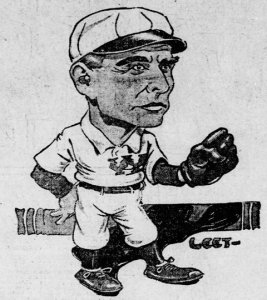
Johnson and Schaefer’s manager Clark Griffith:

leetgriffith

And, Detroit Tigers manager Hughie Jennings:

leethugh

“Steiny is Dead”

29 Aug

Harry Steinfeldt cheated death in 1904.

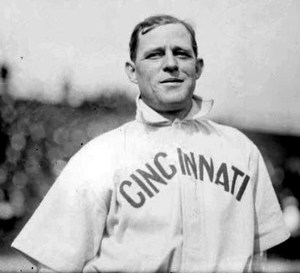
According to The Cincinnati Times-Star, the Reds third baseman, “suffering from a severe attack of lumbago,” returned home to the Biedebach Hotel after a road trip in St. Louis when he “accidently pulled down a chandelier, causing the gas to escape.”

Steinfeldt

Steinfeldt

Steinfeldt in “his crippled condition” failed to turn off the gas completely before going to bed.  Later in the evening, overcome by gas, “in a semi-conscious state,” he attempted to crawl out of the room and “cried for help.”

Fifteen-year-old Mabel Biedebach, the daughter of the hotel’s proprietor, sprang into action:

“She heard Steinfeldt’s cries and ran to his room, where she found him on is hands and knees trying to force himself out of the door.  With rare presence of mind, the young lady raised the ball player’s head and with one mighty effort dragged his body to the hallway.”

The incident sidelined Steinfeldt for five games, and a leg injury and the back pain that led to his near death experience, limited him to 99 games, and his batting average plummeted 68 points from 1903.

Ten years later, the 36-year-old died of a cerebral hemorrhage after a long illness that began during his final big league season in 1911.

Hugh Fullerton eulogized the third baseman, one of his favorite subjects when Steinfeldt played for the Cubs in the pages of The Chicago Herald:

“Steiny is dead.

“The first of the famous Chicago Cubs is gone and every one of that magnificent crowd of men who whirled through the National League to so many pennants will drop a tear.  There was no more beloved member of the team.

“It was Steinfeldt who completed the team and made pennants a possibility.  It was Steinfeldt who, steady, reliable, always in the game, carried them through those fierce campaigns.  It was when Steinfeldt was let out (before the 1911 season) that the old machine commenced to misfire and its tires flattened.  Three times he was selected as the All-American third baseman and many experts have picked him as the third baseman of the greatest team of all time.”

Fullerton compared Steinfeldt to more celebrated third basemen:

“Steiny was not great in the sense that Jerry Denny, Jimmy Collins or Billy Nash was great.  He was a different type; solid, strong, rather slow, but possessed of a wonderful throwing arm that enabled him to block down balls and throw out runners.”

Fullerton said Cubs Manager Frank Chance wanted Steinfeldt badly when he was still with the Reds in 1905:

“Chance forced President (Charles Webb) Murphy to get him.  Murphy made three trips to Cincinnati and each time returned to dissuade Chance and relate awful tales he had heard of Steinfeldt, but finally he surrendered, made a trade and got Steinfeldt. The day Steiny reported to the Cubs (in 1906) Frank Chance said to me:

“’Let’s have a drink.  We’ll win the pennant sure now.’ And he did.”

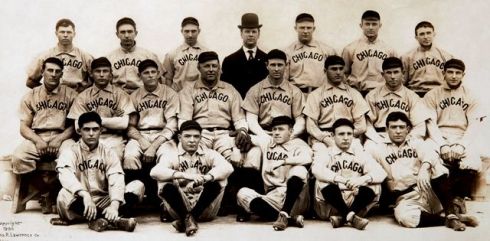
Steinfeldt, third from left, center row, with the 1906 Cubs

Steinfeldt, third from left, center row, with the 1906 Cubs

Fullerton said Steinfeldt was one of the game’s best storytellers as well—and his stories, like many of Fullerton’s were often more colorful than accurate:

“One I shall never forget.

“’The gamest guy that ever played ball, Steiny remarked, ‘was a fellow who played second base for Dallas when I was down there.  One day Dallas was playing Fort Worth and, in the first inning the Fort Worth center fielder tried to steal.  He was thrown out a block, but took a flying leap and lit on the second baseman’s foot with his spikes.  He limped around  a few minutes, said he was all right and went on playing.

“’In that game he had six putouts, nine assists, and no errors, was in three double plays, one of them a triple, and was all over the field.  After the game, he and I were walking out to the clubhouse and he said, ‘I believe there’s something in my shoe,’ and stooping down he took off his shoe and shook out two toes.’”

Fullerton said of his best quality:

“There never was an ounce of harm in Steiny. He was always for the weakest.  I saw him with tears rolling down his cheeks one day as he listened to a hard luck yarn and he was not ashamed to weep when one of the players was released.

“It was his discharge from the Cubs that broke Steiny’s heart and led to the breakdown that resulted in his death.

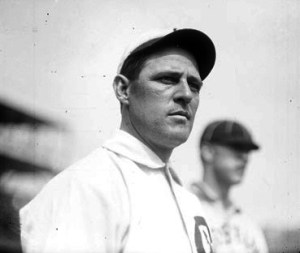
Steinfeldt, 1908

Steinfeldt, 1908

“When Steiny left the Cubs the reporters who had been with the team for years got up a little bit of parchment on which was inscribed:

“This is to certify, that we, the undersigned, testify that Harry Steinfeldt was a good fellow and a good ball player and that we will miss him even more in the first capacity than we will in the second.

“He treasured that, and perhaps no better obituary can be written for him.”

Lost Advertisements–“They all use The Spalding”

27 Aug


spalding1912

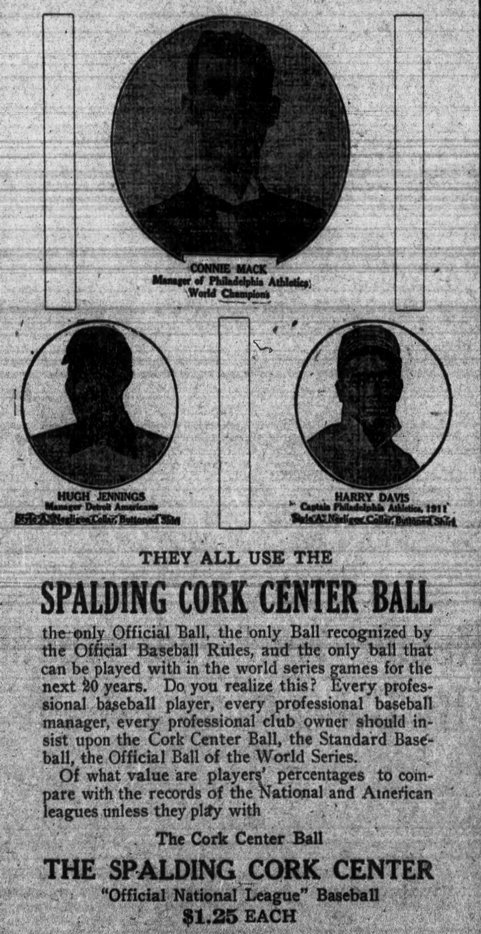
A 1912 Spalding advertisement featuring Connie Mack, Hughie Jennings, and Harry Davis that appeared in West Coast newspapers after the rubber-centered Goldsmith baseball replaced the cork-centered Spalding as the official ball of the Pacific Coast League:

“They all use the Spalding Cork Center Ball, the only Official Ball, the only Ball recognized by the Official Baseball Rules, and the only ball that can be played with in the world series games for the next 20 years.  Do you realize this?  Every professional baseball player, every professional baseball manager, every professional club owner should insist upon the Cork Center Ball, the Standard Baseball, the Official Ball of the World Series.

Of what value are players’ percentages to compare with the records of the National and American leagues unless they play with The Spalding Cork Center ‘Official National League’ Baseball $1.25 Each.”

spaldingcork

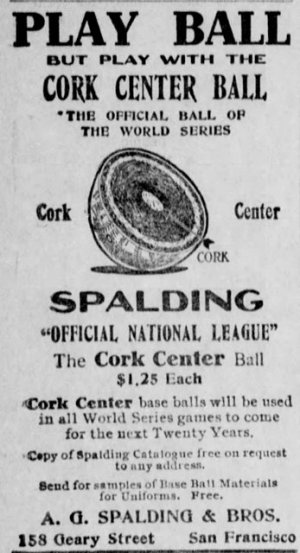
Another 1912 advertisement for the Spalding “Cork-Center Ball”

The PCL and the Goldsmith Baseball, 1912

24 Aug

In 1912 the Pacific Coast League opted to replace the Spalding cork-centered baseball, which they used the previous season, with the Goldsmith ball which had a solid rubber core.

The decision sparked an advertising war between the two companies in West Coast newspapers.

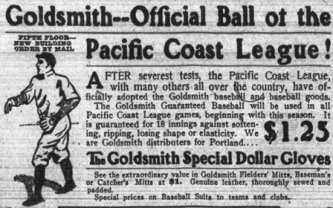
The Goldsmith ads bragged:

“After severest tests, the Pacific Coast League, with many others all over the country, have officially adopted the Goldsmith baseball…The Goldsmith Guaranteed Baseball will be used in all Pacific Coast League games, beginning with this season.  It is guaranteed for 18 innings against softening, ripping, losing shape or elasticity.”

Spalding countered with ads which said:

The Cork Center Ball is the only Ball recognized by the Official Baseball Rules and the only Ball that can be played with in the World Series games for the next twenty years.  Do you realize this?  Every professional base ball player, every professional base ball manager, every professional club owner should insist upon The Cork Center Ball.  The Official Ball of the World Series.

“Of what value are players’ percentages to compare with the records of the National and American Leagues unless they play with The Cork Center Ball.”

1912spaldingcork

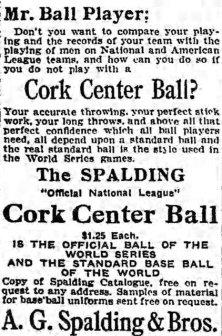
In another version of the ad addressed directly to “Mr. Ball Player,” the Spalding Company asked:

”Don’t you want to compare your playing and the records of your team with the playing of men on National and American League teams, and how can you do so if you do not play with a Cork Center Ball?  Your accurate throwing, your perfect stick work, your long throws, and above all that perfect confidence which all ball players need, all depend upon a standard ball and the real standard ball is the style used in the World Series games.  The Spalding.”

1912spaldingmr

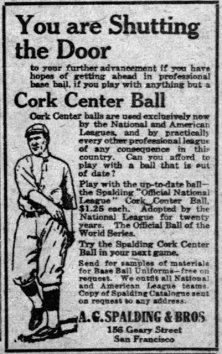
Spalding even warned players in another ad:

“You are shutting the door to your further advancement if you have hopes of getting ahead in professional base ball if you play with anything but a Cork Center Ball.”

1912spalding

While the company’s battled, The (Portland) Oregonian suggested a more sinister reason for the switch during spring training:

“When the czars of the Pacific Coast League adopted a new official ball for a period of five tears at Los Angeles last winter, little did the younger generation dream of an impending disaster.

“The opening of the practice season, however, reveals a deep, dire plot to rob the corner-lot Ty Cobb in embryo of his unlawful spoils, the ‘dollar an’ two-bit’ spheres fouled over the fences and so seldom returned.

“Every ball put out by the new Cincinnati firm (Goldsmith) has the name of the home club indelibly stamped into the horsehide, along with the signature and stamp of approval of President A. T. Baum…This safeguard means that Coast League moguls will be able to identify every ball sneaked away by the crafty kids of the sand heaps.

“When one stops to consider that close to 1000 balls, or approximately $1200, went scampering away to the rendezvous of the juveniles last season in Portland alone, the effect of a crimp in the visible supply can readily be seen at a glimpse.

“Of course a mere Bertillonizing (a reference to the criminal identification system developed by Alphonse Bertillon) of the ball cannot absolutely stop the depredations, but with the penalty of a stiff fine and possible imprisonment hanging over their heads like the sword of Damocles, the magnates believe the small youth will lay off the petty thievery from now on.”

The paper said Portland Beavers Manager Walter McCredie had received seven dozen balls, “and these are expected to last until the start of the season.”

There was no word on how many balls were recovered from young criminals as a result of the stamp.

At the end of the 1912 season The Oregonian said they had not:

“(H)eard any kicks on the Goldsmith ball, which is giving the old-line companies quite a scare all over the nation.”

There didn’t seem to be a significant impact on offense.  Twenty players hit better than .290 in 1911; 24 did so in 1912.  Buddy Ryan led the league with 23 home runs in 1911; Bert Coy led with 19 in 1912.  Six players hit 10 more home runs in 1911; eight did so in 1912.

After the five-year contract with Goldsmith expired, the Reach Baseball, which had a cork center, became the official ball of the Pacific Coast League

“The Story of Slattery is the Story of a Jinx”

22 Aug

Joe Slattery believed he was jinxed by an entire city.

Joseph Patrick Slattery was born on March 15 in 1888 or 1889—his WWI and WWII draft registrations give the 1889 date, early census data and his death certificate say 1888—in St. Louis.

He played with semi-pro teams in Mount Vernon and Kewanee, Illinois before playing his first professional game with the Dallas Giants in the Texas League in 1908.  Described by The St. Louis Globe as an excellent fielding first basemen with a weak bat, he lived up to that label during his first two seasons as a pro—hitting .125 and .199 with Dallas, the Brockton Tigers in the New England League.

In 1910, he joined the Rock Island Islanders in the Three-I League and began to hit.  He was hitting .300 in June when The St. Louis Post-Dispatch said:
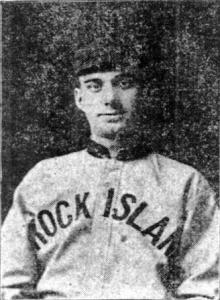
Joe Slattery, Rock Island, 1910

Joe Slattery, Rock Island, 1910

“(Slattery) may obtain a trial with the Browns.  Early this week, owner (Robert) Hedges dispatched Harry Howell, one of his scouts, to look over Slattery.  It is said that Howell made a favorable report.

“Hedges is not the only club owner who has been tipped off about Slattery.  The Pittsburgh Club has had a scout looking over Slattery while it is understood that the Brooklyn Club has made an offer for his release.”

Slattery immediately went into a slump and finished the season with a .216 average.  With Rock Island again in 1911, Slattery hit .280 and was sold to the Syracuse Stars in The New York State League (NYSL).  Slattery played for three teams in the NYSL from 1912 to 1915, hitting in the .290s.

Then he had his best season as a professional—one that has been incorrectly credited to another player with the same last name.

Slattery was sold to the Montreal Royals in the International League in 1916.  He hit .298 and led the league’s first basemen with a .991 fielding percentage, but most sources incorrectly credit those statistics to John Thomas “Jack” Slattery—who  actually played his last professional game in 1911.

Near the end of the 1916 season, The Washington Herald reported in October that Slattery’s contract was purchased by the Senators, but later the same day Clark Griffith told The Washington Times that the report was untrue.

Slattery hit .252 in 1917 for Montreal.  Before the 1918 season, he was sold to the Memphis Chickasaws the Southern Association and went to the city that “jinxed” him.

The (Memphis) Commercial-Appeal reported before the season opened that the Chickasaws would “have their new first sacker longer than expected.”  It had been expected that Slattery would be drafted before the season began, but the paper said his draft board in St. Louis now said he wouldn’t be entering the military until later in the summer.

All involved later wished the delay never happened.
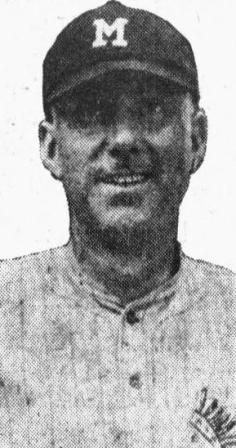
Slattery with Memphis, 1918

Slattery with Memphis, 1918

as the season progressed, The Memphis News-Scimitar said:

“Slattery is the greatest fielding first baser in the Southern today and he made stops and throws that would have done credit to Hal Chase…But Joe can’t get started hitting.”

Slattery appeared in 59 games for Memphis.  He hit .197 in 208 at bats and quickly became the most unpopular man in town

As he struggled, the paper said he was “the target for all verbal bricks the lower end of the stands could hurl.”  His “hitting fell off almost to nothing,” but the paper said it was “due for the most part to the panning the bugs handed him.”

Slattery thought he was jinxed and the newspaper agreed:

“The story of Slattery is the story of a jinx that has been camping on the big fellow’s trail…one of the niftiest first basemen in the game; Slattery from the outset has been handicapped by his inability to hit the ball.”

Slattery blamed the city:

“It’s a fact that I am absolutely jinxed in Memphis, I can hit the ball anywhere else in the world but Memphis, it seems.”

After being drafted, Slattery played first base for the Tenth Training Battalion at Camp Pike in Arkansas.  He returned to Memphis in the spring of 1919 and immediately stopped hitting again during exhibition games.

He told The New-Scimitar:

“When I was in camp at Camp Pike I hit for an average well in the .300 class, and I was hitting against good pitching, too.  But in Memphis, I’m helpless with the stick.  I guess I am too anxious to hit…Last season the jinx was astride my neck all year…I couldn’t hit at all like I used to…the jinx came back and got with me, and I have not been able to hit at all.”

Sold to the Tulsa Oilers in the Western League, he hit.263.  In July, Slattery was playing well in Tulsa, and The News-Scimitar reminded fans that his “jinx” was their fault.  The paper said from July 13 through July 17 Slattery was 8 for 23:

“Which goes to show that in the proper environment when he is not being ridden by the bugs as he was here, Slattery is a good hitter.”

He finished his professional career in 1920 where he started it in 1908, with Dallas in the Texas League.

Never to return to Memphis, he headed west.

He played semi-pro ball for the next decade, primarily with Brigham City Peaches in Utah.
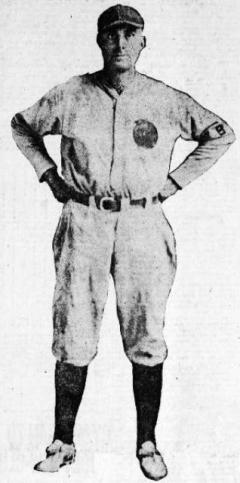
Slattery with the Brigham City Peaches, 1922

Slattery with the Brigham City Peaches, 1922

The once “jinxed” Slattery settled in Idaho where he died on June 14, 1970.