Archive | Uncategorized RSS feed for this section

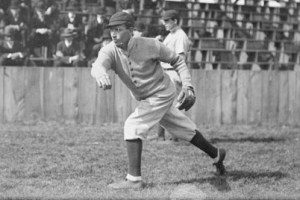
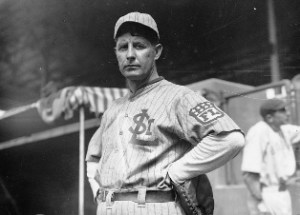
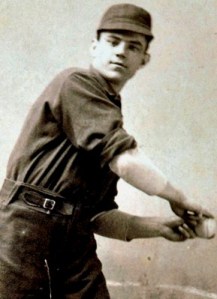
Buttons Briggs

3 Jun

Chicago Tribune sportswriter Hugh Fullerton claimed pitcher Herbert “Buttons” Briggs became a member of Cap Anson’s Chicago Colts as a 20-year-old in 1896 because as a 19-year-old he struck Anson out three times when the Colts visited Little Rock in April of 1895.

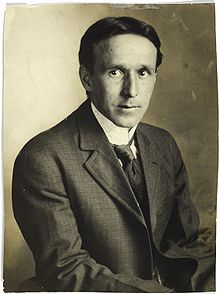
Buttons Briggs

Buttons Briggs

Like many of Fullerton’s stories, there was probably some embellishment; the box score from the game in question shows that Briggs only struck out two batters and was hit fairly hard—but he did make some kind of an impression and was signed by Anson.

Fullerton said Briggs was cocky when he joined the club and seemed to back it up in his first game, a 3 to 1 victory over the St. Louis Browns.  But, said Fullerton, Briggs learned some humility that day, courtesy of a veteran umpire:

“Briggs stood high in Anson’s estimation and Anson wanted to pitch him (in the season’s second series)…Briggs was fast, he had a speedy outcurve and a fast high one—but he was wild and some of the others didn’t want him to pitch.  But Briggs pitched.  He was chock-full of self confidence and freshness in those days, and all leagues looked alike to him.

“He wound up into a knot, whirled and shot the first ball across the heart of the plate, waist high, and so fast the catcher didn’t even see it.

“Before the ball fairly splashed into (Malachi) Kittridge’s mitt, Briggs with his arm still extended yelled ‘How’s that?’

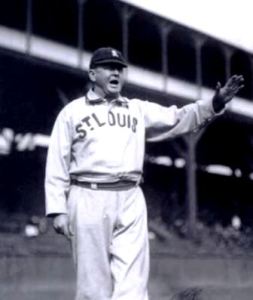
“(Jack Sheridan) who was umpiring looked the youngster over from head to foot and then remarked calmly ‘Under the circumstances that is a ball. Had you not asked me it would have been a strike.’”

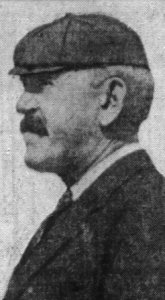
Jack Sheridan

Jack Sheridan

Fullerton claimed that incident brought Briggs down to earth, and he never “kicked” to umpires as a result.

Briggs struggled for three years with the Colts—he was 17-28 with a 4.85 ERA before being sent to the Western League in July of 1898.  After five minor league seasons he returned to Chicago and was 19-11 with a 2.05 ERA as a 2.05 ERA.  He was 8-8 with a 2.14 ERA in 1905 and was traded to the Brooklyn Superbas in the deal that brought Jimmy Sheckard to the Cubs.

Perhaps not completely broken of his early cockiness, Briggs refused to play for Brooklyn and jumped to an outlaw team in Ohio.  He never played in the major leagues again.

Rube in L.A.

1 Jun

Bobby Eager was a popular, if not enormously talented, catcher for eight seasons in the California and Pacific Coast Leagues.  After his career, when he wasn’t at his job with Standard Oil, The San Jose News said he could be seen in town “any afternoon when the weather is right, fanning with a bunch of fans.”

The paper decided he enjoyed telling stories about his career so much, they offered him an occasional column to tell his stories and share his opinions.

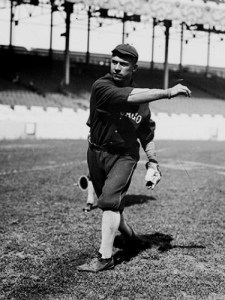
One of his favorite subjects was Rube Waddell, who spent part of the 1902 season on the West Coast.  Eager called him “The greatest southpaw pitcher” he had seen.

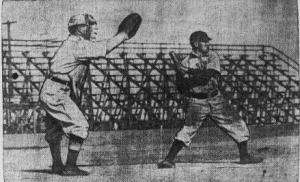
Eager behind the plate.

Eager behind the plate.

“When Rube Waddell was with Los Angeles he was the life of the club.  There was never a dull minute with Waddell on the bench.  If ever there was a nut he was it.  They called him a rube.  Don’t know where they picked up the name, but he was anything but what his name would indicate.  With all his antics Waddell was a wise coot, and if you think he wasn’t I would like to have the extra money it cost (Angels Manager) Jim Morley to keep him on the team.

“It was a cold day that Rube didn’t ‘touch’ Jim for a five-spot.  Rube was getting a fat salary—as fat as salaries went in those days… Never knew exactly what Waddell got, but I know it was more than any other player on the club pulled down.

Rube

Rube

“While Rube was on the club Morley slept with one eye open.  He was always afraid of losing him.  On this occasion, Waddell had just made a borrow off Jim of a twenty-spot when word drifted into Morley’s billiard parlor that Waddell was seen going toward the railroad station. The rumor was sufficient to stir Morley.”

The manager quickly took action.

“Morley rang up the depot and found a train left in 10 minutes for the East.  He dashed out on the street, jumped into the first carriage he saw and drove pell-mell to the train.  Into the Pullman car he hiked and sure enough, there was Waddell. He had bought his ticket and was going back to report to Connie Mack, who had come through with more money.  At first, Waddell denied he was leaving.  He said he just came down to see a friend off, but he soon had to admit that he had a ticket.

“Jim came through with another piece of change and Waddell surrendered his ticket and returned to the team.  But he wasn’t with it very long before he beat it.”

Waddell “beat it” for good on June 20, leaving the West Coast for Philadelphia.  He was 11-8 with a 2.42 ERA with the Angels, with the Athletics he was 24-7, 2.05–he pitched a total of 444 innings that season.

Eager said despite the money Los Angeles was out, “I doubt if Morley lost much on Waddell for he was always a drawing card when he pitched and one good thing about Rube he was never lazy.  He would pitch every day if you would let him.”

Letters from the Front–Joe Jenkins

30 May

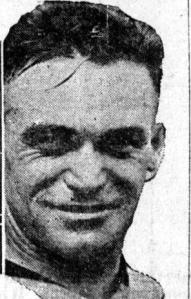
When Joe Jenkins, backup catcher for the Chicago White Sox, enlisted in the army shortly after the 1917 World Series, it didn’t cause much concern for the team’s prospects.  The Chicago Daily News said:

“With Ray Schalk behind the plate, the Sox could give away a dozen Jenkinses and not miss them.”

joejenkins

Joe Jenkins

Malcolm MacLean of The Chicago Evening Post said regardless of Jenkins’ value to the White Sox, the catcher was committed to the war effort.  He recounted a conversation with the usually “happy-go-lucky” Jenkins during Chicago’s spring trip to Marlin Springs, Texas before the 1917 season:

“(I) spied Jenkins sitting alone in the smoking compartment of the special car.  There was no smile on his face.  He invited us to have a seat.

“’”I’m thinking about this war,’ he said.  ‘It’s up to us young, unmarried fellows to get busy, and I’m going to be one of them within a few months.’”

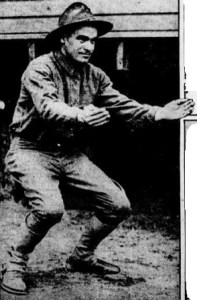
Jenkins went to officer’s training school at Camp Gordon, Georgia, and then to France as a second lieutenant with the 132nd Infantry Regiment, composed primarily of soldiers from Chicago’s South Side.

Jenkins at

Jenkins at Camp Gordon

Shortly after the armistice was signed in November of 1918, MacLean was a given a letter Jenkins had written to a friend in Chicago several weeks earlier.  MacLean said Jenkins had been “promoted, while under fire from second to first lieutenant.”

According to MacLean, “At one stage of the game, all the other officers of his company being disabled, Jenkins commanded his company in an advance,” and as a result received the promotion.  MacLean said Johnny Evers mentioned in a letter that he had met Jenkins in France shortly after the latter was promoted.

Jenkins also wrote two letters to White Sox President Charles Comiskey—as with the letter MacLean was given, both letters to Comiskey were written before the armistice, but received weeks after—and were printed in Chicago newspapers.

In the first, Jenkins wrote:

“My Dear Mr. Comiskey…I have been in the front line for four days, having gone up to look over the situation with the major.

“Believe me, I am a brave man, but I did not bargain to eat any of these high explosives.  One of the shells just missed me about ten feet.  It hit on top of the trench and had it hit in the trench I would not be writing to you today.

“To be honest with you, this is some league that I am in and it is a lot faster than the old American, for you know that when you boot one in this league you are through and can’t come back.”

Jenkins wrote to Comiskey again, approximately three weeks later:

“Well I thought you had forgotten me, but today I got your letter, and you may be sure that I was delighted to hear from you.  We have been scrapping for the past ten days on the Meuse, North of Verdun, and believe me, the fighting has been hot and sharp.  We have just been moved to a more quiet sector, the purpose for which is rest, and believe me we can use it nicely.  It is becoming apparent that Germany is through, and in the last offensive I was in their spirit and morale was at a very low ebb.”

Jenkins also assured Comiskey that the Chicago Southsiders in the 132nd “can go some.”

The catcher  told Comiskey he planned on joining the Sox at Mineral Wells in the spring of 1919 and promised:

“I will bring something back in the line of a trophy for your office with me as shipping it would be risky.  This trophy that I refer to was taken where the fighting was thickest.”

There is no record of what the “trophy” was or whether Jenkins brought it to Comiskey.

Jenkins said in closing:

“Give my regards to all the boys and tell them that in this league over here the pitchers all have plenty on everything that they throw.”

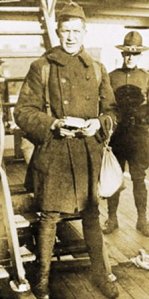
Jenkins made it back to the US on April 15, 1919—on the same ship as Sergeant Grover Cleveland AlexanderThe Chicago Tribune said:

“Jenkins fought in Flanders, the Argonne, and St. Mihiel.  He escaped unwounded and looks ready to play baseball at a moment’s notice.”

Sergeant Grover Cleveland Alexander

Sergeant Grover Cleveland Alexander

He didn’t make it to Mineral Wells but joined the Sox for their opener in St. Louis.  The Daily News said he told manager Kid Gleason he was available to pinch hit:

“’You know I’m a valuable man in a pinch, Kid.  When I came up to hit in a pinch over there the Kaiser lit out for Holland and he’s been there ever since.”

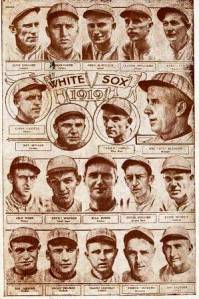
1919 White Sox, Jenkins is bottom left

1919 White Sox, Jenkins is bottom left

Ready to play or not, Jenkins appeared in just 11 games for the pennant-winning White Sox—four behind the plate—and had three hits in 19 at bats.

He remained with the Sox through the 1919 World Series—a member of two World Series teams, he did not appear in a game in either series—and was released that winter.

His big league career over, Jenkins played 11 more seasons in the minors, retiring in 1930.

Lost Advertisements–“Over There, Over Here”

27 May

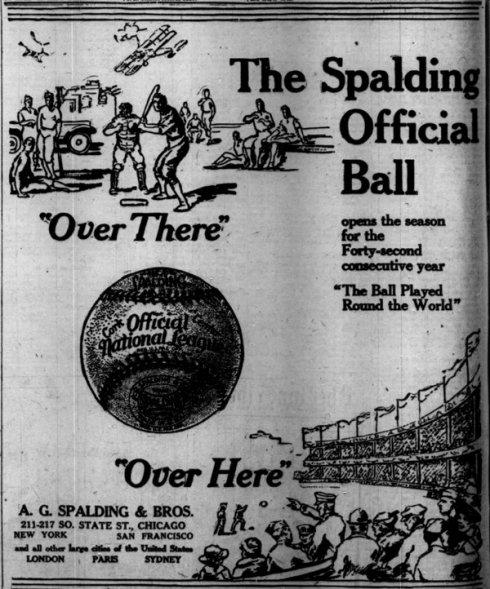
spaldingwwi

An advertisement for A. G. Spalding & Bros. that appeared during the opening weeks of the 1919 season; the first post-World War I:

“Over There” “Over Here”

“The Spalding Official Ball opens the forty-second consecutive year season for the forty-second consecutive year.”

“The Ball Played Round the World.”

Spalding Official National League Ball, circa 1919

Spalding Official National League Ball, circa 1919

Hundreds of Spalding balls went to troops “Over there” during the war through Washington Senators Manager Clark Griffith‘s “Ball and Bat Fund.”  The fund raised money throughout the country–including a donation from President Woodrow Wilson–and used it to purchase baseball equipment for servicemen.  In his final report for the fund, published in 1919, Griffith said Spalding and other “sporting goods houses” were “very patriotic, selling me goods for cost or even less.”

Clark Griffith presents a box of baseballs to US Army officers, 1917

Clark Griffith presents a box of baseballs to US Army officers, 1917

The 1919 “Spalding Guide,” said more than $102,000 was raised by the fund and:

“Wonderful good was done…even though the Huns did sink the Kansan (the Kansan was a merchant vessel sunk near Belle Ile, off the Brittany Coast of France)  with its load of equipment for the soldiers of the American Expeditionary Force.  The moment the news reached the United states, other equipment was provided as quickly as possible and dispatched on its way to France.”


Things I Learned on the Way to Looking Up Other Things #20

25 May

A Twist on the Hidden Ball Trick, 1909

Jack Fournier had a favorite story that The Chicago Daily News said he told so often that “fellow members of the White Sox give the warning ‘Capron story’” every time he retold it.

Fournier

Fournier

Fournier was playing first base for the Portland Cubs in Northwestern League in 1909 while former college football star George Capron was playing for the Seattle Turks.

“A Seattle runner was on first when Capron came to bat.  He rapped a hot grounder down to (Phil) Cooney, who was at short for Portland.  The latter whipped the ball to second, forcing the runner and then the ball was relayed to Fournier.

“Capron had crossed the bag and was making his turn back by the time the throw reached Fournier.

“Jack tossed the ball up and down in his glove as Capron came up.  ‘Can you beat that Capron?’ said Fournier ‘the ump called you out.’

Capron, known for his temper on the field, became enraged and ran towards the umpire who standing near second base.

“Fournier was right on his heels and didn’t catch him until they covered half the distance.  He tagged the amazed Capron with the ball.”

Asked if Capron was angry, Fournier would deadpan, “Well, rather.”

An Umpire’s revenge

In 1907, long-time American League umpire Jack Sheridan told a story that appeared in several newspapers, including The Chicago Evening Post, about how he quieted a “Chronic Kicker,” Fielder Jones of the Chicago White Sox:

Jack Sheridan

Jack Sheridan

During the previous season, Chicago was playing the Detroit Tigers when Jones got on base:

Charley O’Leary, the Tigers shortstop brushed Jones’ leg with the ball as he was sliding into second on a steal.  Sheridan called him out and Jones kicked; said he didn’t feel the ball touch him.  Sheridan told O’Leary to make him feel it the next time.  A few innings later Jones got on and again attempted to steal.  This time, O’Leary jammed the ball onto Jones’ head.”

Fielder Jones

Fielder Jones

Sheridan said after the shaken-up Jones was called out and recovered from the blow:

“(He) walked to the bench without a single protest.”

A Pitcher’s Plea, 1898

After not playing professional ball in 1896 and 1897, Matt Kilroy returned to the major leagues with the Chicago orphans in 1898.

A decade later, Revere Rodgers of The Washington Evening Star said Kilroy, who won 46 games in 1887, “was in the game long after his arm went back on him.”

Matt Kilroy

Matt Kilroy

He also had another talent:

“As a baseball player Matt was real classy, but as a poker player he was king, and the Chicago bunch in those days was the most rabid pasteboard handlers then traveling over the circuit.

“Kilroy was lucky with the cards, his skill was marvelous, and he must have done well judging from a conversation at the time he was handed the customer ten days’ notice (of his release in August 1898) by Manager (Tom) Burns.

‘”Oh, say, Burns,’ cried Matt, when he received the notice, ‘allow me to stay with the club.  You won’t have to give me a cent of salary, and what is more, I will pay all my traveling expenses, and help the club out at the bat or in the pitcher’s box.’”

Burns told Kilroy he could earn “three hundred a month in the Eastern League.”

“I know,’ said Kilroy, ‘But you see I like the poker game the boys play here.”

“If I ever get this Football Junk out of my Head”

23 May

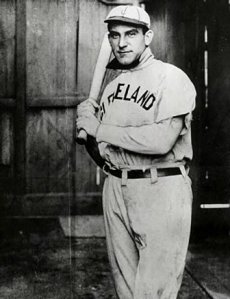
George Henry Capron had a brief and relatively undistinguished professional baseball career.  He said football was what held him back.

Capron first made a name for himself at the University of Minnesota in 1906.  He excelled at football, track and field and baseball, The Minneapolis Tribune called him “a ten-second track man, a weight thrower, and a splendid ballplayer.”

The Golden Gophers football team was 2-2-1 that season; Capron, the starting halfback and drop kicker scored 44 of the team’s 55 points.  He accounted for all 12 of his team’s points (three four-point field goals) in a loss to Amos Alonzo Stagg’s University of Chicago team.  The Tribune said Capron “Figured in two-thirds of the offensive plays” for Minnesota.
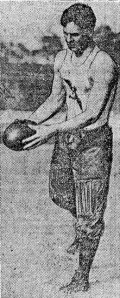
Capron

George Capron

The Chicago Daily News said of Capron:

“(He) is an athlete of exceptional muscular development, although not above the normal size (the 5’ 10” 185 lbs).  he can punt from 50 to 60 yards with little effort with either foot.  The ball after leaving his toe acquires a most peculiar spiral motion, which makes it exceedingly hard to hold…In the work of scoring fielding goals, which appears to be Capron’s specialty, he is unquestionably a star.”
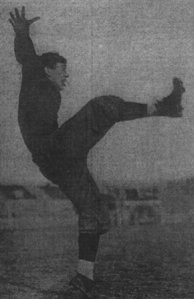
Capron kicking

Capron kicking

Early in 1908, there were rumors that Capron would leave Minnesota at the end of the baseball season and transfer to an Eastern school.  The New York Times said West Point football coach Bob Forbes was attempting to get Capron to accept an appointment, The New York Sun said he was headed to Dartmouth.

Capron chose instead to stay at Minnesota and was unanimously elected captain of the football team on September 14—although later the university would claim he wasn’t elected, but simply called local newspapers claiming an election had been held.  Two days after the “election,’ a scandal caused him to quit the team.

A story in The Chicago Tribune charged that Capron had played professional baseball for the Meridian Ribboners in the Cotton States League during the summer under the name “George Robb,” other reports said he played under the name “George Rapp.”  (The Sporting Life identified him as “Rapp” and “Robb” at various times in 1908).

The story also claimed that he met with “Captain Adrian C. Anson.  The later inquired of Capron’s ability as a ballplayer among local college men.”  Capron, the paper said, wanted to join the semi-pro Anson’s Colts.

Anson told paper:

“I didn’t sign Capron because he didn’t put on a suit and come out…I don’t remember that he said he played professional ball before.  I don’t care, anyhow.  There is no such thing any longer as a strictly amateur college team…They want their real names withheld.  I don’t care, I tell them.  (As long as) they can hit the ball on the snoot and can field decently.”

Sunday's "idol" "Cap" Anson

Sunday’s “idol” “Cap” Anson

Capron denied the charges.   He claimed he had never played professionally and “had never in his life” met Anson.  His denials were quickly dismissed, as his identity was something of an open secret in the South—his election as Minnesota’s captain was reported by several papers, including The Atlanta Constitution, The Atlanta Journal, and The (Nashville) Tennessean –each mentioned his election and that “he played (with Meridian) under the name of Robb,” and that his contract had been purchased by the Mobile Seagulls in the Southern Association.

Faced with overwhelming evidence, he admitted he had played professionally, but continued to deny that he had met with Anson.  It was also reported that Capron had been drafted by the New York Giants, The Minneapolis Tribune said:

(John) McGraw drafted Capron on the recommendations of one of the New York club scouts…but if McGraw was informed as to the real identity of the brilliant young diamond performer he has carefully kept the facts under his bonnet.”

He left school for good in September, and The Sporting Life reported he was “captaining a professional football team in Minneapolis” that fall.   He also admitted, in a letter to the National Commission that he had played professionally under the assumed names “Kipp” and “Katt” for the Mattoon Giants in the Eastern Illinois League in 1907 and in the Northern League with the Crookston Crooks 1905.

In the spring of 1909, The New York World said:

“Capron, the former diamond star of the University of Minnesota, has notified the management of the New York Nationals and of the Mobile Southern League team that he will not join either of them, but has decided to play outlaw ball.”

Capron signed with the Seattle Turks of the Northwest League and immediately went on a tear.  The Seattle Post-Intelligencer said he was hitting a league-leading .324 in his first 19 games.

He also found time to elope with the former Ednah Race, a Minneapolis resident.

At the end of the season, with his average down to .275, Capron told a reporter for The Post Intelligencer:

“’If I ever get this football junk out of my head, I’ll make good in baseball yet.’”

The problem he said, was taking out his frustration:

“’When I got mad when playing football I could charge the line or make a fierce tackle and let off steam,’ continued the greatest kicker Minnesota ever had, ‘but when I get mad playing baseball it is back to the bench for me with a fine plastered on me like as not.’

“’It doesn’t do a man a bit of good to get mad while playing baseball…that rough stuff does not go.”

The paper agreed:

“So many times during the season just closed, Capron was no good to himself or the team because he could not see anything but red and he wanted to fight someone or something.

“Capron had a world of natural ability.  He is far above the ordinary as a fielder and he is a dangerous man at the bat.”
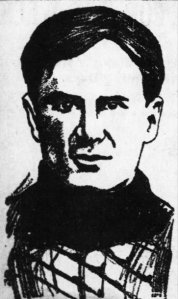
Capron

Capron

Capron was sold to the Vancouver Beavers the following season, but was limited to 35 games as the result of a knee injury.  He hit just .207.
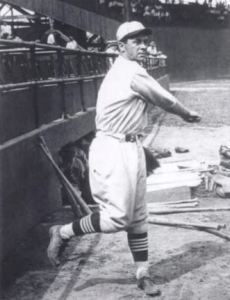
The following spring, the 25-year-old said he was finished.  He told The (Portland) Oregonian:

“No more baseball for me.  I am going to retire.”

The paper said “His teammates sniffed” and were sure he would return, but noted that “he is being sought by several clubs of the Northwest league this year and was tendered contracts by Seattle, Vancouver, and Tacoma, but has returned them unsigned.”  He said his new wife had encouraged the decision.

Capron left baseball and football for real estate.  He sat out the 1911 season.

In January of 1912, The Pittsburgh Gazette-Times said Barney Dreyfuss, president of the Pittsburgh Pirates sent a personal letter and contract to Capron:

“The contract is a ‘blank’ paper with the salary figure to be filled in by the recipient.

“Apparently, Dreyfuss was prompted in this move by some strong boosting out on the Pacific Coast, for in his letter he told George that information had reached him that a first-class ballplayer was going to waste.”

But despite the blank contract, Capron told The Oregonian:

“I guess (Dreyfuss) knows I can murder (right-handed pitching).  My wife says no, however, so it’s me for the bleachers.”

Capron also told the paper he expected his brother Ralph—a former Minnesota Quarterback– to make the major leagues soon—Ralph played one game that season with the Pirates and two the following year with the Philadelphia Phillies.  Following in his brother’s footsteps, Ralph abruptly quit baseball at age 25, before the 1915 season.  George told The (Spokane) Spokesman-Review, his brother “expects soon to marry the daughter of a wealthy Minneapolis merchant, who is strongly opposed to a professional athlete for a son-in-law.”  Opposition from his father-in-law doesn’t appear to have stopped Ralph from dabbling in professional football.

Capron moved from the Pacific Northwest to Long Beach, and later Fresno, California, and found real estate to be more lucrative than either baseball or football.  In 1964, he was worth more than $30 million dollars, when, after 55 years of marriage, Ednah was awarded a $16 million dollar divorce settlement which The Associated Press said was “the largest ever.”

He died on October 26, 1972.

“I Believe Beyond Doubt he would be the Greatest Manager of All Time”

20 May

By 1911,  “Honest John” McCloskey was in his 22nd season as a manager; five in the major leagues.  Those five seasons were less than successful.

John

John

He led the Louisville Colonels to a 35-96 record in 1895, and was dismissed the following season after a 2-17 start; In three seasons with the St. Louis Cardinals from 1906-1908, he was 52-98, 52-101, and 49-105—he also apparently had a bizarre aversion to blond hair.

In those 22 seasons, he won just two championships–in class “B” Pacific National League, but despite a rather inauspicious record, Hugh Fullerton believed McCloskey one was one of the greatest minds in the game.

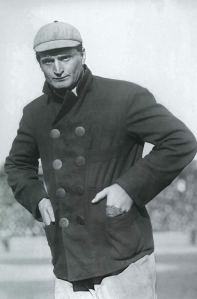
Hugh Fullerton

Hugh Fullerton

Writing in “The American Magazine” that summer, Fullerton said:

“John McCloskey, one of the greatest tacticians in baseball, has worked out the theory of coaching, both from the bench and from the lines to an exact science.  Yet McCloskey has not been successful because the players lack the quickness and the brains to follow his orders.  If he could find men who could think and act quickly enough to obey his signals.  I believe beyond doubt he would be the greatest manager of all time.”

McCloskey’s genius, according to Fullerton, was enough to overcome one thing:

“One great trouble in the McCloskey system is that players are not yet educated to the point where they cease independent thinking and obey orders…After every blunder of a ballplayer, the reason assigned is ‘I thought.’ Besides that, the fewer brains a player has and the less he knows of the science of the game, the more liable he is to scoff at the theorist and ridicule or ignore the wigwag system.”

As an example of McCloskey’s players not living up to their manager’s intelligence and ridiculing his “system”, Fullerton related a story from the previous season when McCloskey led the Milwaukee Brewers to a 76-91 sixth place finish in the American Association.

“(A) Milwaukee batter drove a ball down into the left field corner of the grounds.  The ball was in the shortstop’s hands when the runner reached third base.”

According to Fullerton “the excited coacher” missed McCloskey’s signal to hold the runner:

“(H)e urged (the runner) onward, and he was thrown out 30 feet from the plate.  McCloskey…slid down until the back of his head was resting on the bench and his feet were six feet away on the ground, his body rigid.  A cruel substitute, gazing at his manager, asked: ‘What’s that, Mac, a signal to slide feet first?’”

McCloskey’s Butte Miners finished third in the Union Association in 1911.  He managed 13 more seasons in the minor leagues through 1932.  He won just one more pennant, leading a team to the class “D” Southwestern  League championship in 1924—not only was the team “educated” enough to “cease independent thinking” and win for McCloskey, but they did so playing home games in three different towns;  they played in Newton, Kansas until July, relocated to Blackwell, Oklahoma for a month, then finished the season in Ottawa, Kansas.


Things I Learned on the Way to Looking Up Other Things: Predictions

18 May

Salaries

Ed Barrow, general manager of the New York Yankees, was sure of one thing in 1930, and according to Joe Williams of The New York Telegram, he was so sure of it his declaration “caused the window panes to shiver in the frenzy of a maddened Simoon.”

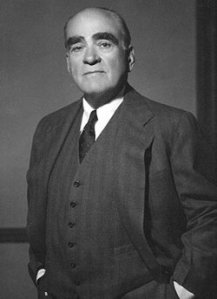
Joe Williams

Joe Williams

The Yankees had signed Babe Ruth to the largest contract ever, and Williams asked, “whether baseball would ever see another $80,000 hired hand.”

“’No, you will never hear of another ballplayer getting that kind of money,’ said the gentleman who functions as the watchdog of the treasury of the richest ballclub in the game.”

Ed Barrow

Ed Barrow

Ruth being Ruth, he said, would ensure that no player would ever be paid as much:

“’Even if another Ruth came along he wouldn’t be able to command it, because he would be just another Ruth, and that means he would not be a novelty.  He came along at a time when the receptivity of the fans welcomed a change from few-run games to batting orgies.  It was a situation into which he fitted perfectly.’

“’It isn’t possible for a similar situation to occur twice in the course of baseball.  All the great hitters in the future are going to suffer by comparison to Ruth, and this is going to operate against them as drawing cards.  Nobody prefers a copy of the original.’”

Babe Ruth

Babe Ruth

Barrow remained general manager of the Yankees until 1945, and baseball economics combined with the Depression and then a World War allowed his prediction to hold true throughout his career, but just four years later, his former club proved him wrong when Joe DiMaggio became baseball’s first $100,000 player.

Night Games

In August of 1930, Al Munro Elias, of the Elias Baseball Bureau, had some predictions about night baseball that he shared with The Brooklyn Eagle:

“’Night baseball (in the minor leagues) is succeeding now because it is a novelty.  It will prosper as long as the novelty lasts, that is if the novelty doesn’t last too long.  If it does, I fear there won’t be enough players to satisfy the customers’ desires.  Make no mistake about it, the night game is hard on the players.  The pitchers especially are going to feel the difference.  The old throwing arms need the hot sun.  Legs of all players’ need the sun…Night baseball isn’t real baseball.  Real baseball needs the sun and plenty of it.”

Al Munro Elias

Al Munro Elias

His brother, and partner, Walter B. Elias, who had yet to see a night game, had another concern:

“Now it’s a novelty and the fans flock to it…Night games can’t begin until 8 o’clock or so, and now while it is a novelty the men come to it, but wait until you hear the holler that the missus will put up when her husband stays out several nights to go to the ball game.”

Five years later the novelty expanded to the major leagues.

“One of the Most Mysterious Cases in Baseball”

16 May

Before the 1925 season, Billy Evans, the American League umpire and syndicated columnist, said St. Louis Cardinals pitcher Allan Sothoron was:

“One of the most mysterious cases in baseball.”

sothoron

Evans said the 32-year-old who had spent parts of nine seasons in the major leagues:

“Here was a pitcher who was recognized as one of the richest prizes ever found.  He had a fast ball, a spitter, a curve, a change of pace; control—well, just everything that a great pitcher requires.

“And Sothoron lived as a pitching star, but not for long.  A weakness was discovered.  Show the opposing side a weak spot and it plays through it.

“Sothoron, with an iron arm are rare intelligence, could not control his throw once he fielded the ball.”

During five seasons in the American League from 1917-1921, Sothoron made 50 errors in just 356 total chances.

“On bunts or easy taps hit straight to him he lost his bearings.  With one swish of his arm, he threw—threw in any direction which usually was yards away from his fielder.

“To first, second, third base or the plate, Sothoron aimed and fired.

“And eventually, he threw himself out of the American League.”

Evans said Indians manager Tris Speaker “thought he could correct the fault’ when he acquired Sothoron in June of 1921, and for a time he thought he had–Speaker told The Cleveland News when he acquired the pitcher that the problem was Sothoron “throwing flat-footed.”

Tris Speaker

Tris Speaker

He won 12 and lost four, with a 3.24 ERA for Cleveland—although he did commit four errors in just 36 total chances.  But in 1922, Speaker “gave up the job” after Sothoron appeared in just six games—he was 1-3 with a 6.39 ERA and made one error on six chances.

Evans said after he was released by Boston:

“Sothoron, disgusted with himself, retired from baseball.”

He returned to baseball in 1923, with the Louisville Colonels in the American Association.  Despite a 6-9 5.92 season with the Colonels, Evans said:

“The scene changes.  Branch Rickey, as manager of the St. Louis Browns in 1914, discovered Sothoron.  And he refused to believe that such an evil could not be corrected.  He took a chance and purchased Sothoron for his St. Louis Cardinals in 1924.”

Branch Rickey

Branch Rickey

And the pitcher responded:

“The story is not closed.  Sothoron was one of the few pitchers with a perfect fielding average in the National league last season.”

He was 10-16 with a 3.57 ERA, but handled 37 total chances without an error, which included “making 35 perfect throws in aiding in the retirement of batters or runners.”

Evans attributed Sothoron’s fielding to:

“Branch Rickey’s system of training… (Rickey) saw that Sothoron…simply scooped in the ball and made his throw.  He did not steady himself.

“For days and weeks, Sothoron was put through such a course—fielding a ball, pausing, steadying himself, then following through with the throw.”

Evans suggested that “after 10 years of drifting” Sothoron had “finally found himself.”

It did not last.

He pitched for the Cardinals for two more seasons, he was 13-13 with a 4.09 ERA, and he committed five errors in just 31 chances.   He finished his career with an .871 fielding percentage.

Nap Lajoie “How I Win”

13 May

Napoleon Lajoie spoke to Joseph B. Bowles in 1910 for one of the syndicated journalist’s series of articles called “How I Win.”

Lajoie said:

“It is hard to tell how any man wins a ballgame, because winning depends so much upon other members of the team.  I think that the biggest factor in winning, in my case at least, is in having what I think is the baseball instinct.  Whether that instinct is natural or acquired, or merely the result of quickness of eye, or what I do not pretend to know.  But I believe that a great part of a ballplayer’s success both in batting and in fielding is the result rather of instinct than of anything else.  Many times players  do things almost without thinking that are exactly right, and many times when they think out a thing carefully they do exactly the wrong thing.”

Napoleon Lajoie

Napoleon Lajoie

But after saying he wasn’t sure how he won, Lajoie decided he did know:

 “As far as I am concerned, I win games by hitting.  It seems to me I always could hit, and in spite of the fact that some pitchers think otherwise, I hit almost any kind of ball equally hard.  I have often wondered why this was.  Perhaps it was natural.  I never want to know what a pitcher is going to pitch and would much rather figure out for myself what ball is coming than have a coacher or anyone else tell me.”

Lajoie said he had determined that his ability to hit was “a natural gift” which required practice to refine:

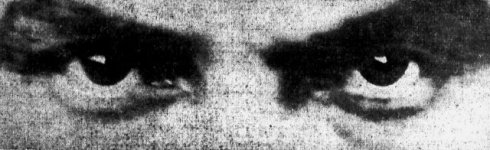
“Position at the bat is a big thing in hitting.  A batter should be firmly on his feet, with the balls of his feet holding the ground tightly, and he should not shift position while striking. ..I do not try to hit the ball as hard as possible, but rather to meet it squarely, and in this I think a quick and steady eye helps.”

laj

Lajoie’s eyes

Lajoie said he was “striving always” for an advantage at the plate:

“It is a guessing match between the pitcher and the batter at the best, and experience ought to show a batter just what a pitcher is likely to pitch to him on any given ball.  When runners are on bases batting becomes more of an art…I think my position at the bat and long, steady, sweeping stroke helps me very much in the hit-and-run game, for I am able to hit balls that other batters would miss entirely.  Even if I am certain of missing the ball I swing at it hard so as to cause the catcher to lose a step or a foot or two of ground in making his throw.”

Lajoie

Lajoie

In the end, the man in the midst of a season in which, at age 35, he led the American League in games, at-bats, hits, doubles, total bases, and batting average, said:

“Keen eyesight, close observation and attention to every detail is necessary to win ballgames.  Anyone who grows careless or indifferent ceases to be a winner.”