Archive | Uncategorized RSS feed for this section

“Dummies Don’t Make Good”

15 Dec

Clark Griffith, while managing the New York Highlanders, provided The Washington Post with his insights on pitching—as well as sleeping and eating.  Griffith, “essentially a great a thinker,” shared “numerous cogent truths” with the paper:

“When I was working regularly, I prepared myself for games under a perfect system.  The day after I had been in the box I made it a point not to do any pitching whatever.  I would go to the outfield and develop my wind by chasing the ball out there.  The next day I would assume pitching practice until limbered up; then stop and do no more until I went in the box the next day.

“I was always careful what I ate, especially at lunch on the day I was going to pitch, as are most of the pitchers of the present day.  They can’t be good pitchers unless they are.  I always keep an eye on the man I am going to send in the box, though a majority of the pitchers know enough to pick out the right kind of diet.  As they have the most work to do in a game, and more depends on them than on any one man, they have to take better care of their stomachs than the others.

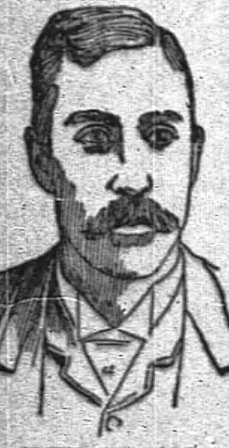
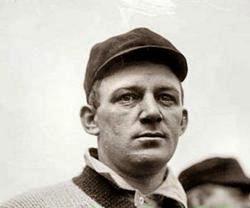
Clark Griffith

Clark Griffith

“I always found it a good plan to take a nap after lunch on the day I was going to pitch.  That brings a man’s faculties all back.  I don’t mean lie there until you get dopey, just a light sleep.  A heavy sleep knocks a man out.  The average ballplayer is a late riser.  He gets up anywhere from 9 to 10 as a rule, and as he eats a heavy breakfast, his luncheon ought to be a light meal and over by not later than 12:30.  He has to go light on pastry.  On the road, in particular, he has to be careful or he will have indigestion. When on the road he eats a number of hurried meals, and then his stomach needs watching more than any other time.  What with hurried meals and the wear and tear of traveling, a team on the road is playing on its spirit.

“”The successful pitcher has to be a thinker and always trying to get something out of the batter.  Dummies don’t make good, because they are up against a smart bunch of hitters who are always sizing a pitcher up.  The pitcher must be thinking constantly, and for that reason the slow pitcher is not the dull-witted pitcher.  When you see a man who is a slow worker in the box you can bet that he is trying to place every ball and is figuring out where every ball should go and why.

“The easiest games to pitch are the shutout games.  You wouldn’t think that a pitcher had had an easy time when he had kept the other side from scoring, but as a matter of fact those are the very kind of games that are the softest for him.  Take a game where the score is 4 to 0 or 5 to 0, and the winning pitcher has been taking it easy the last part of the game.  The chances are the other side was going out in one, two, three order.  In any event, few of them were on the bases, and this gave the pitcher something to work on—that is, a chance to ease up and not be on the watch all the time.  The 5 to 4 and 8 to 7 games are the hardest on a pitcher.  They mean that men are on the bases a good deal  and that the pitcher is always working hard to keep them from scoring.

“I have been called a hard loser in baseball, and I guess that’s so.  Nobody can amuse me after I have pitched a losing game, my appetite is completely gone, and I would not go to the best show on earth if I had a private box.”

“’Amos, old Boy, don’t Forget the left foot Racket.’

12 Dec

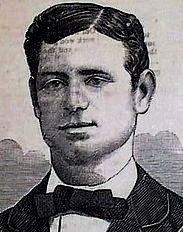
Long after “Dasher” Troy’s last professional game in 1888, he remained a good source of quotes for sportswriters; at the Polo Grounds, or after 1900, at his Manhattan tavern.

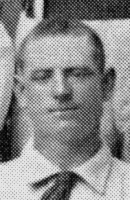
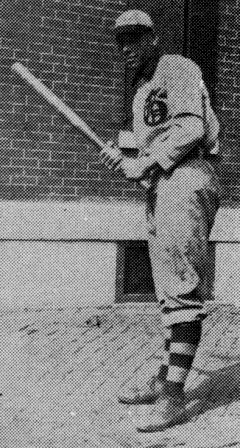
Dasher Troy

Dasher Troy

When he wrote a series of columns for “Baseball Magazine” in 1915 the magazine said about him:

“There was a day when John (Dasher) Troy was one of the bright lights of the diamond.  Advancing age has long since driven him from his favorite haunts. But, though, as he admits, he has “had his day and that day is a long time past,” still he has ‘seen more baseball games than any other player in the country,’ and remained throughout a close student and observer of the game.”

And, humility was not his strong suit.

Four years before he was given credit for fixing Hughie Jennings broken nose, Troy took credit for another player’s success.

After Amos Rusie’s great 1894 season—36-13, 2.78 ERA–Troy told The New York Sun:

“Very few people know just what made the big pitcher so effective last season, but can explain it… (Rusie) had a wrinkle last season that was of my own invention…I had noticed that every League batsman, barring one or two like (Ed) Delehanty(Dan) Brouthers, and a few more, stepped back from the plate whenever Amos pitched a fast ball.  So I went to the big fellow one day and said:

“’Amos, when you see a batter’s left foot—providing he is a right-handed hitter—move back a trifle, just drive that fast straight ball or your outshoot, over the outside corner of the plate, and you’ll find how easy it is to fool these ducks.  Just try it and see if I ain’t right.’

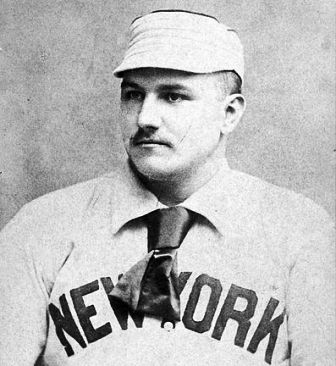
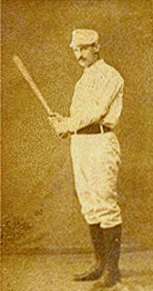
Amos Rusie

Amos Rusie

“Well, Amos did just as I told him the next game he pitched, and he was laughing in his sleeve.  The minute he saw a batter’s left foot move back, he grinned all over.  Then he let ‘er go.  The ball whistled like a small cyclone up to and over the outside corner of the plate, and the batter made such a wild stab at it that the crowd roared.  But nobody knew what the wrinkle was.

“By and by, when I saw that Amos had mastered the trick to perfection, I thought it was time to gamble a little on it.  So I just took a seat back of the home plate among a lot of know-alls and watched the batter’s feet closely.  Whenever I saw a left foot move back I just took out my coin and yelled:

“’Three to one this duck doesn’t make a hit!’

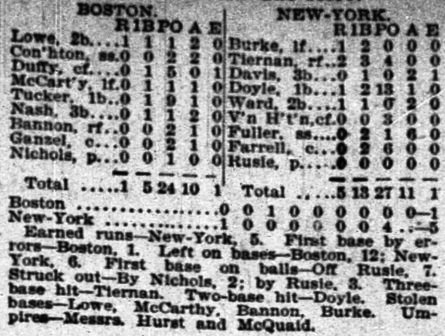
“There were lots of fellows around me who would take up the short end, and as a result I had a good thing on hand right along.  But the cinch came when the Bostons came over here on August 31 to play off a tie game with the New Yorks.  There were nearly 20,000 people on the Polo Grounds, and Amos was slated to pitch.  He was as fit as a fiddle, and just before the battle began I leaned over the grandstand and whispered to him:

“’Amos, old boy, don’t forget the left foot racket.’

“He said, ‘All right,’ and then he began his work.  Every one of the Bostons stepped back from the plate—even (Hugh) Duffy, (Tommy) McCarthy and (Tommy) Tucker.  Amos just grinned, and sent that ball over the corner until the champions were blinded.   Laid three to one against each Boston batter and during the entire game the champs made but five scattered singles.”

The Box Score

The Box Score

Twenty years later, in one of the columns he wrote for “Baseball Magazine,” Troy again took credit for Rusie’s performance in the Boston game, but embellished the details further:

“There were a lot of my friends there that day trying to show me, so they said how much I knew about the game. So I thought I would take a look at my old friend, Amos Rusie, who was pitching for the Giants.  He never had more speed, and his inshoot was working fine on the inside corner of the plate… I sent one of my workmen down to Amos on the players’ bench with a note.   In this note I told him not to pitch his inshoot, that nearly every one of the Boston Club was pulling his left foot back from the plate, and that the batter could not hit a ball out of the diamond if he would put them low and over the plate.

“Hugh Duffy was the first man up for the next inning, and he hit a slow grounder to the first baseman; the second batter hitting to the second baseman, and the third to the third baseman. When Amos was walking to the bench he looked up toward the bar on the grandstand, which was behind the catcher at the back of the stand, and he had a big broad smile on his face. Any player who pulled his left foot back, or left-hander who pulled his right foot back, never hit Amos very hard after that.”

There’s no record of Rusie having credited Troy as the reason for his greatest season.

Troy remained a popular figure in New York baseball circles, and a popular story teller, until his death in 1938.


Hughie Jennings’ “Doctor”

10 Dec

On October 6, 1898, Hughie Jennings, who, for the fifth straight season was the National League’s leading hits batsman, faced Jouett Meekin, the New York Giants’ notoriously wild pitcher —Meekin hit 89 batters in nine major league seasons and walked 1056 while striking out 901.

Hughie Jennings

Hughie Jennings

The New York Times said:

“Meekin began the game by hitting (John) McGraw on the head.  It was only a glancing blow, however.  Jennings followed McGraw, and the first ball pitched struck him on the nose, breaking it.  Jennings, after he was hit, staggered and then fell.  It was a swift in-curve, and the players on both teams rushed to the plate thinking he had been fatally injured”

The concern was warranted.  In June of 1897 Jennings was hit in the head with a pitch thrown by Meekin’s’ teammate Amos Rusie during the first inning of a game.  While the Rusie beaning was serious, it was likely not as serious as some sources claim–it has been said he was unconscious for three or four days, and near death.  These claims are belied by contemporary news reports, as early as the next day that said, while serious, the injury was neither life-threatening nor caused a days-long coma.

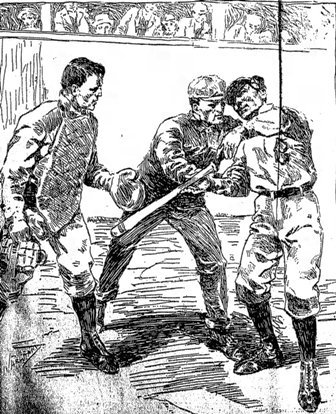
A newspaper rendering of Jennings' beaning by Rusie. The catcher is Jack Warner, Hank O'Day is the umpire.

A newspaper rendering of Jennings’ beaning by Rusie. The catcher is Jack Warner, Hank O’Day is the umpire.

The New York Sun:

“Last night the doctor said he was suffering from a slight concussion of the brain and a temporary paralysis of the right arm, but he declared his injuries would not prove serious and that Jennings would be able to play again in a few days.”

Jennings was back in the Orioles lineup in a week.

Still, there was reason for concern, Jennings had been hit by nearly 200 pitches since 1894, and according to The Sun, “his face was covered in blood.”  The previous season he had “pluckily continued in the game” after the Rusie beaning, until the second inning; this time he was immediately taken to the clubhouse.

It was there that his broken nose was attended to in an unusual way.

Enter John Joseph “Dasher” Troy, a major league infielder in 1880s, a member of the 1884 American Association champion New York Metropolitans.

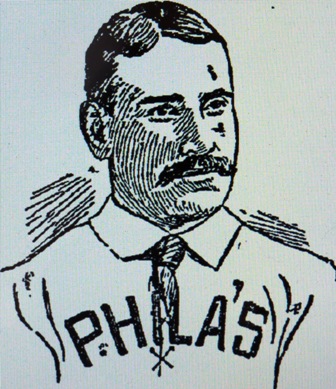
Dasher Troy

Dasher Troy

In 1891, Troy had been granted a liquor concession, “running the bar under the grandstand” at the Polo Grounds.  Three years later The Sun said Giants owner Edward Talcott “quietly ousted Troy,” after the former player’s “attack on a grandstand gatekeeper and his threatened attack on Mr. Talcott.”

Despite being ousted from the business, Troy remained a fixture at Giants games—and would eventually reclaim the business after Talcott sold his interest in the Giants to Andrew Friedman, running it until 1900.

The New York Telegraph picks up the story:

“(Troy) was at the Polo Grounds when Jennings, of the Baltimores, had his nose broken by a pitched ball. Jennings was assisted to the clubhouse and a physician summoned.  The ‘Dasher’ followed in after the doctor, and pushing the latter aside, said to Jennings:

“‘Hughie, will you let me fix that for you?’

“Hughie looked embarrassed and said:

‘Yes, Dash, but here’s the doctor.’

“’Oh, to hell with him,’ answered Johnny, with his usual impetuosity.  “I can fix that nose in two minutes.  I have fixed noses before, and broken ‘em too,’ said Troy as he threw out his chest and glanced severely at the doctor.

“’Here boy, go out and get me a couple of pebbles.’

“The (doctor) brought back two small stones, and Troy put one on each side of Jennings’ injured nasal organ, and began to press.  The damaged nose was one sided, the cartilage being badly out of place.  Jennings said he could feel the grating as Troy gradually pressed on the stones and, sure enough, when the pebbles were removed the nose was as straight as it ever was.

“’There,’ said Troy, looking again fiercely at the doctor, ‘could you do better that that?  You doctors make me tired.’

“The doctor, however, when he had collected himself, said Jennings had better go to a hospital for further treatment, apparently not being fully satisfied with Troy’s treatment, or possibly his winning ways.

“Jennings did not follow the doctor’s advice that night, but (the following day) he went to Mt. Sinai Hospital.  A physician then examined the injured nose, felt of it carefully and said:

“’There is nothing out of place there.  Who set it for you?’

“’Oh, some doctor up at the Polo grounds,’ answered Jennings.

“’Well, said the hospital physician, ‘I never saw a cleaner or better piece of work in my life.”

Regardless of having his nose successfully fixed by Troy, Jennings’ all-time record for being by pitches 287 times took a toll.  He had turned 30 years-old just a month before the 1888 broken nose, but only played more than 100 games  once more—in 1900—and was, essentially finished as a player by 1902.

Another story about Jennings’ “doctor” Dasher Troy on Friday

“I’ll Break your Head if I ever get out Again”

8 Dec

Before a game against the Philadelphia Quakers in 1883, Providence Grays outfielder Samuel “Cliff” Carroll was drinking from a hose.  He then turned the hose on a Providence fan named Jimmy Murphy.

After the game, an 8 to 4 Grays victory, Murphy returned to the Messer Street Grounds with a gun.

Cliff Carroll

Cliff Carroll

The Providence Evening Press said:

“Shortly after the ball game, Wednesday afternoon, the neighborhood of Messer Street was thrown into a state of great excitement by the announcement that a member of the Providence baseball club had been shot.”

The paper said the initial hysteria included reports that the player had been killed.

“A well-known baseball crank named “Jimmy” Murphy, has been in the habit, for some time past, of frequenting the ball grounds during the hours of practice, and imagining himself to me a player of extraordinary merit.  Owing to his eccentricities he was a source of great amusement to the players, and was made by them the butt of many practical jokes.  ‘Jimmy,’ who is said to be slightly ‘off’ mentally speaking, occasionally resented his treatment, but never until Wednesday did he report to violent means.”

The Evening Press said after Carroll “thoroughly drenched” Murphy with the hose:

“Murphy immediately departed, nursing his wrath, and in the afternoon returned, and waited outside the grounds until the players issued, after the game.  Carroll came out with a number of men, among whom was (Joe) Mulvey, the change shortstop, and ‘Jimmy’ at once drew a pistol and deliberately fired at Carroll, but owing no doubt to his excitement, he missed his man, and the bullet struck Mulvey in the right shoulder, inflicting a painful, though not dangerous wound.”

Murphy, the shooter, fled from the scene, and was pursued by police, citizens, and Grays second baseman Jack Farrell.  He managed to escape, but was arrested later in the evening.  Neighbors told the paper “Murphy is a ‘crank’ in other matters besides baseball, and is not considered responsible for his actions.”

It was later learned that the wound to Mulvey was superficial, the ball never penetrating his skin:

“Mr. Mulvey quietly walked to his home on Crary Street, congratulating himself upon his narrow escape.”

The following day in court, Murphy was found “probably guilty in the justice court,” and “bound over to the court of common pleas.”  While being led out of the courtroom, Murphy spotted Carroll and said:

“I will get even with you yet, I’ll break your head if I ever get out again.”

The eventual adjudication of Murphy’s case is lost to history.

Carroll was part of the 1884 “World Champion” Grays team, and remained with Providence until the club folded at the end of the 1885 season. He played with five more National League teams through 1893; although he sat out the 1889 season to operate a farm in Bloomington, Illinois.

There is no record of Murphy having ever having the opportunity to “get even.”

Carroll died in 1923 in Portland, Oregon.  The Oregonian said:

“One of the greatest baseball players of the game died in Portland recently, but so modest was he that few even knew he had been spending his last years here.”

The Providence Morning Star reported on the day of the shooting that Grays Manager Harry Wright had agreed to “loan” Mulvey to the Quakers.    Mulvey joined Philadelphia in early July.  He was switched to third base, and was a member of the Quakers through 1889, he played until 1895

Joe Mulvey

Joe Mulvey

Mulvey remained in Philadelphia after his playing days and worked as a watchman at Shibe Park.  The Associated Press said on August 20, 1928, the man who had a brush with death at a ballpark in 1883, “attended a boxing show at the ballpark,” and “was found dead of heart failure in the club locker room,” the following morning.

“It would increase the Batting, both in a Scientific and Slugging way”

5 Dec

After finishing in second place with a 73-38 record in 1884, the Boston Beaneaters slipped to 46-66 with a fifth place finish the following year; among the reasons for the decline was the team’s batting average which dropped from .254 to .232.

The Sporting Life’s Boston Correspondent said local fans had proposed numerous “wild ideas for proposed changes in the way the game is played,” to remedy the hitting woes.  Of those, one was “worthy of consideration.”

The paper said many “prominent base ball men and a number of players and all have expressed approval.”  Among those consulted were John Morrill, the Beaneaters’ manager, and Arthur Irwin, shortstop for the Providence Grays, both who said the plan would result in more “safe hitting.”

John Morrill

John Morrill

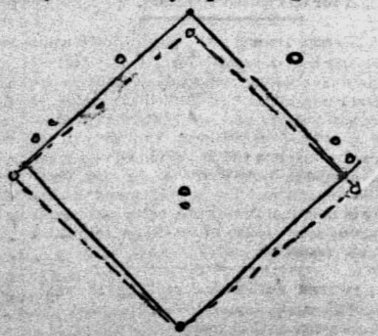
The Sporting Life said “The idea is to make what is now called a diamond but is actually a square a true diamond,” and included a crude diagram:

The Sporting Life's rendering

The Sporting Life’s rendering

 “(T)he catcher would be brought ten feet nearer second base, which would prevent free stealing, and would also enable the second baseman to return a thrown ball to the catcher in time to cut off a base runner.  The pitcher would be placed back five feet, thus reducing the distance between him and second base…the batsman is five feet further from the pitcher, and could therefore more easily hit the ball, thus reducing the number of strikeouts considerably and making livelier fielding by giving more chances.

“The distance from third to first would be increased, thus giving scientific batters and good runners a better chance to beat the ball to base.  The change of foul lines would lessen the number of tedious foul balls; would give more chances to drive the ball between the infielders; would save many pretty hits now called foul; would spread the outfielders more, thus increasing the number of safe hits, and, besides, enable them to make, with the increased territory, more difficult running catches; would give chances for longer hits; it would lessen the damage from errors and make more earned runs, as base runners would have to hug their bases more closely, depending on hitting to score.

“It would but slightly reduce the effectiveness of pitchers without laming them, and give the catcher a better chance to play his position as it should be played.

“To sum up, it would increase the batting, both in a scientific and slugging way; lessen the work of the battery without seriously affecting effectiveness; compel runners to exercise good judgment with speed and increase the work of the fielders over fifty percent.”

The Sporting News suggested that Albert Spalding would “introduce the plan at the League meeting this week and doubtless it will be given thorough consideration,” but none of the coverage of the meeting included any mention of the plan being considered.

Like the “the proposed new diamond,” briefly championed by Chicago Colts President James Aristotle Hart, seven years later, the 1885 plan went the way of dozens of other 19th Century “innovations.”

“He’s a Loafer and a Drinker”

3 Dec

Bill Lange and Elmer Foster were likely the two favorite subjects of sportswriter Hugh Fullerton, who continued to write about both long after their careers were over. Another favorite subject was Bill Dahlen, who spent eight of his 21 big league seasons in Chicago, and received numerous mentions in Fullerton’s columns.

Bill Dahlen

Bill Dahlen

Fullerton claimed during the 1890s he worked for an editor who was “a wild baseball crank.” The editor had an assignment for Fullerton after watching Bill Dahlen play a particularly bad game for the Chicago Colts one day:

“(He) summoned me and said, sharply: ‘Go after that fellow, Dahlen, and drive him out of town. He’s a loafer and a drinker.’”

Fullerton said, “there wasn’t a chance to argue,” and he let his friend Dahlen know he would “pan the life out of him and drive him off the team, explaining the circumstances.” Dahlen, he said, “wished me success.”

Fullerton said after writing critically about Dahlen for two weeks, the two were together on a train as the Colts headed to the East Coast:

“Dahlen and I slipped away from (Cap) Anson’s ever watchful eye and sought the buffet car and liquid refreshment. While we were thus engaged the editor entered the car, addressed me, inquired whether the team was on the train and was introduced to Dahlen. I left them at 11 o’clock, the editor ordering more beer and talking baseball with Dahlen. The following morning the editor stopped at my berth.

“’I was much mistaken in that young man, Dahlen,’ he remarked. ‘He is a smart, intelligent and interesting young man. I believe these stories about his drinking have been exaggerated. I fear we have been misled by the talk of cranks. I wish you would write a story suggesting him as the logical successor of Captain Anson as manager of the team.’”

On several occasions Fullerton told another story about Dahlen, this one involving a run-in with umpire Hank O’Day; there were always slight variations in the dialogue:

“Billy Bull Head Dahlen perhaps has been driven to the the bench oftener than any player in the country. Dahlen is a nagger. He keeps right after an umpire from the time he gets displeased with a decision until the game ends, and then starts over again the next day.”

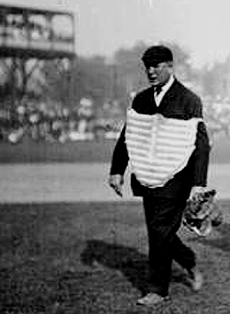
Hank O'Day

Hank O’Day

Fullerton said Dahlen approached O’Day before a game in New York:

“Say, Hank, if I run at you in the first inning and call you a blank, blank, blank and step on your toes with my spikes and push my glove into your face, what’ll you do?’

“‘Do?’ said Henry, getting roiled up. ‘Do? I’ll chase you off the lot faster than you can run.’

“‘All right,’ said Dahlen, calmly, ‘no hard feelings. I just want to get put out quick, so i can get to Harlem in time to get a bet down on the fourth race.’

“‘You can’t get put out of this game in a thousand years, not if you spike me in the face.’

“Nor could he, although he did everything he could think of O’Day made him play out the string, and the horse he wanted to bet on won the race at heavy odds.”

“This kind of Argument is the Veriest kind of Twaddle”

1 Dec

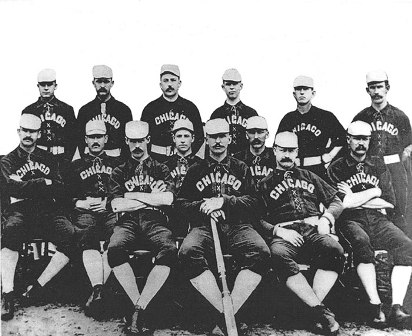
After just one season in the National League—a 24-36 record and a fifth place finish in 1878–the Indianapolis Blues disbanded.  Four members of the Blues joined the Chicago White Stockings—Silver Flint, Joe Quest, Ned Williamson, and Orator Shafer.
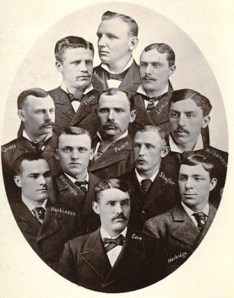
The 1879 White Stockings

The 1879 White Stockings

The White Stockings had been a disappointment in 1878, finishing in fourth place with a 30-30 record under Manager Bob Ferguson.  President A.G. Spalding, who had named Ferguson as his successor when he retired from the field, announced that first baseman “Cap” Anson would replace Ferguson for 1879.

The changes gave the Chicago press high hopes for 1879.

But, The Cincinnati Enquirer did not agree.  The paper said while the Chicago club was “greatly strengthened where it was very weak,” they would still finish no better than fourth place unless they were “properly managed.”  Boston Red Stockings Manager “Harry Wright could take this team and run it up to second place at least.”

In January The Enquirer implied that in addition to questionable management, Chicago’s new players were going to be a detriment:

“A prominent baseball official of Boston, in a private letter written recently, sententiously remarks: ‘Look out for the Indianapolis element in the Chicago Club next year.’  There’s a text for everybody’s thoughts.”

The Chicago Tribune quickly fired back with an article under the headline:

“Harmony” vs. Energy

 “There has been a great deal said at one time and another concerning ‘harmony’ in nines, and those who had the most to say on the subject contended that it was an essential point to be carefully looked after in the formation of any club which hoped for success on the diamond field.  Now The Tribune does not wish to set itself up in opposition to the judgment of men who have made baseball and the management of those who play it a study and a business venture, but it does say that many of them have harped so long upon this matter of ‘harmony’ that it has become a kind of second nature, whereby their judgment has been sadly warped.  Of late a paragraph, started in Cincinnati, has been going the rounds, in which the general public is solemnly warned to ‘look out for the Indianapolis element in the Chicago Club’ during 1879.

“Now the President and Manager of the Chicago Club are probably about as astute and far-seeing as any in the business and in view of this fact and reflection on their judgment or sagacity is in bad taste, and the parties who make ill-advised criticisms on the course of any club in hiring men, are very apt to undergo the unpleasant experience of persons not brought up in New Zealand who indulge in the pastime of throwing boomerangs; their weapons may come back and inflict considerable damage on those who threw them.  Whether or not the White stocking nine of next season will be a ‘harmonious’ one, it is doubtful if anybody knows, and still more doubtful if anybody cares.

“At the risk of being howled at by several papers, the baseball columns which are presided over by young men whose practical ignorance of the game is exceeded only by their ability to construct tables which not even themselves can understand when printed.”

One of the “Young men” referred to was The Enquirer’s sports Editor Oliver Perry “O.P.” Caylor.
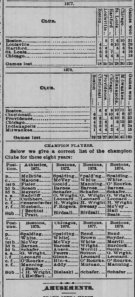
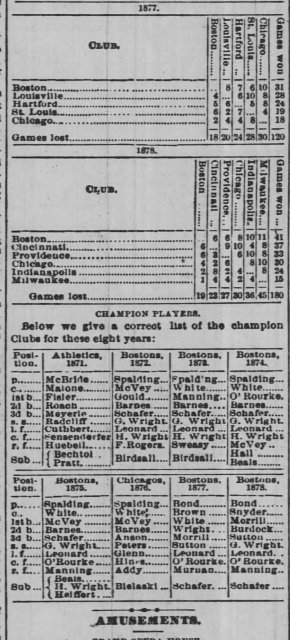
One of O.P. Caylor's tables "which not even themselves can understand when printed.”

One of O.P. Caylor’s tables “which not even themselves can understand when printed.”

The Tribune will say that the question of whether or not the Chicago nine of next season ‘harmonizes’ will probably make very little difference with its play.  Some of the men who enjoy the reputation of being first-class kickers and disorganizers are nevertheless very handy individuals to have around when a base hit or good field play in wanted.  Without intending either to arouse the wrath or flatter the vanity of the very amiable and stalwart young man, Anson, it may be said that his reputation as an experienced and prolonged kicker is one that any man might be proud of; but, in spite of those who preach that harmony is everything, he is acknowledged to be one of the best and most useful ball-players in the country.  (Cal) McVey, of the Cincinnatis, can also make quite a conspicuous kick, even when not specially called upon to do so; still he is a good ball-player.

Lip Pike is a disorganizer of the first water, but last season, when he used to hoist a ball out among the freight cars on the lake shore, people who were presumed to know a good player yelled themselves hoarse in his praise.  The list could be extended indefinitely, but such action is not necessary.  Those who organize nines on the basis of ‘harmony’ alone will never grow rich at the baseball business.  It is not possible to get together nine men who could travel around the country eating, sleeping, and playing ball together that would never get out of tune.  Nine angels could not do it, much less nine mortals, subject to the little idiosyncrasies that human nature is afflicted with. “

The Tribune likely assumed the “prominent baseball official of Boston,” was Manager Harry Wright, and next turned its attention to him, his brother, and his championship teams.

“Harry Wright has always been the prophet whom the ‘harmony’ men delighted to honor, and the success of the Cincinnati and Boston Clubs under his management has been laid entirely to the dove-like dispositions of the men engaged by him.  This kind of argument is the veriest kind of twaddle, and the history of the Boston Club proves the truth of this assertion.  George Wright and Tommy Beals went many a day without the interchange of a friendly word, and George and (Charlie) Gould did the same thing.  For one whole season Ross Barnes and Gould never exchanged a word, and glared at each other like opposing game chickens, but the Boston’s won the pennant that year (1872—National Association) all the same harmony or no harmony.

“Other instances of like character could be adduced were there any necessity therefore, but these, from the fountain head of ‘harmony,’ will suffice.  If a club wins the championship it will be because its men play ball, not because they are ‘goody-goody’ boys.  Your man who gets hot at something during a game, and then relieves his feelings by making a two or three base hit, is much more valuable than one who, although possessed of a Sunday-school temperament at all times, manifests a decided aversion to reaching first base., when the occupancy of that particular bag of sawdust would be of some value to the men who pay him high wages for playing ball.”
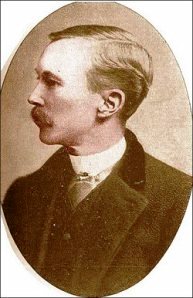
O.P. Caylor

O.P. Caylor

Caylor would not let the insult to him and to Harry and George Wright, go unchallenged:

The Chicago Tribune published some strange statements against the argument that in harmony there was always strength.  To prove that harmony was not always necessary to create strength in a baseball club, the writer made bold to say among other things that Tommy Beales [sic] when a member of the Boston Club, went many a day without the interchange of a friendly word with George Wright, and that the same feeling existed between George and Gould.  The writer knew from the first these statements were fiction, but in order to crush the fallacious argument our reporter left it to George Wright himself for an answer.  The letter is before us from which we quote, though we half suspect George would demur to its publication out of modesty if he knew it. “

Wright wrote to Caylor:

“(The Tribune) said Tommy Beales [sic] and I went many a day without the interchange of a friendly word, and that Gould and I did the same thing.  While they were with the Boston nine they were about my best friends.  Most of the time Beales [sic] boarded at my house, while Charley and I roomed together on trips.  I think the reporter was wrong in his argument against ‘Harmony’ as it was the great cause of the Boston Club’s success.  The credit for this mostly belonged to Captain Harry Wright.”
George Wright

George Wright

Although it appears Wright spelled the name of his good friend Tommy Beals incorrectly, he got the spelling right 12 months later when he named his son—tennis Hall of Fame member –Beals Wright after his former teammate.

The Tribune allowed Wright, and Caylor, the last word, and dropped the dialogue regarding “harmony.”

Despite Caylor’s prediction, the White Stockings, under Manager Cap Anson, led the National League from opening Day through August 15.  Anson became ill during July, and as his performance slipped, so did the team’s fortunes.

Suffering from what The Tribune called “an acute affection of the liver…that had sadly impaired his strength and capacity for play,” Anson left the club on August 26 with a 41-21 record, in second place, just a game and a half back.

With Silver Flint serving as manager, and without Anson’s bat—he led the team with a .317 average—the White Stockings were 5-12 in the last 17 games, and a fourth place finish.

Harry Wright’s Boston Red Stockings finished second; his team, winners of the previous two National League championships lost some of the “harmony” that made them winners when his brother George Wright and Jim O’Rourke signed with the Providence Grays.  George Wright, in his only season as a manager, led the Grays to the 1879 National League championship.

“The Best First Sacker in the Game”

27 Nov

Raymond V. Wilson was one of the biggest stars of early black baseball. The Freeman said the captain and manager of the Philadelphia Giants was, at the plate, “styled the colored Hans Wagner,” and “in his heyday the best first sacker in the game.”  The paper also said he was one of the game’s best base runners:

“Ray Wilson gives no indication of speed or race, but he possesses these two qualities in a surprising degree, and his stealing is magnificent.  His strong point, however, is avoiding the man with the ball.  He has a slide which carries him outside the base and around, his spikes clinging to the base.”

Ray Wilson

Ray Wilson

It is unclear where Wilson was born, but he lived for a time in Harrisburg, Pennsylvania before he became a member of the Cuban X-Giants in 1898.  The Harrisburg Telegraph said, the following season, in announcing that local catcher Clarence “Wax” Williams had joined the X-Giants “Ray Wilson, of this city, is playing first base on this crack team.”

The Telegraph said that Wilson played for several teams in Harrisburg, initially as a second baseman, “but his ability was soon learned and he was sent for.”

Wilson remained with the X-Giants through 1906, and then joined the Philadelphia Giants where he played for the remainder of his career.

It came to an end in the mid summer of 1910.

In a game at Bronx Oval, Wilson and the Giants were playing the Brooklyn Royal Giants.  The New York Age said Wilson was at bat, facing Brooklyn’s Harry Buckner and “was hit on the head near the temple and received a fracture which necessitated his retirement from baseball.”

By late July he began exhibiting strange behavior.

Other sources, including The Associated Press, said he received the injury earlier in his career, as a result of being “hit on the head by a swift line drive.”

The Freeman attributed some of the reason for Wilson’s becoming “somewhat demented” on his reaction to the death of his friend, Giants pitcher Sy “Bugs” Hayman, who was hit by a car on his way to a game, and died on July 4, 1910.

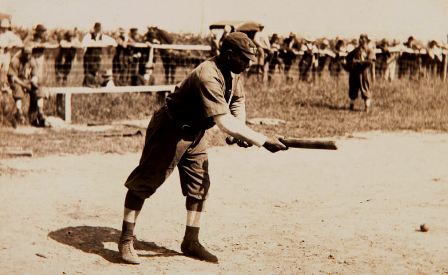
Bugs Hayman

Bugs Hayman

The injury, regardless of how it happened, as well as any other contributing factors, left Wilson nearly incapacitated, and he was sent to his mother’s home in Pittsburgh.

Just a week after arriving in Pittsburgh, The Associated Press reported that he had disappeared:

“(H)is relatives have asked the police to find him. Warning is given by the relatives that Wilson is insane and that he may not be captured without trouble.”

According to those relatives he was suffering from hallucinations:

“One of Wilson’s hallucinations was that someone batted a ball at him and that it broke through his hand and hit his head.  On such occasions he would lie down for hours, helpless from pain from the imaginary blow.”

On the day he disappeared, Wilson “picked up a newspaper to look at the ball scores.  He saw something which stirred him, and dashed from the house shouting that his head was hurting.”

Several days later he turned up in Tyrone, Pennsylvania, more than 100 miles from Pittsburgh.  The Tyrone Daily Herald said he had been arrested by railroad police “after insisting on going on to Harrisburg without paying his fare.”  Wilson was held in the Tyrone city jail until his identity was determined.  The paper said it was unlikely he would be prosecuted because he was “temporarily deranged, this accounting for his strange actions on the train.”

He was committed to the Pennsylvania State Hospital in Harrisburg where he died in September of 1912.  Most sources give Wilson’s year of birth as 1870, which would have made him 42 years-old at the time of his death, The Harrisburg Telegraph, in their brief death notice, listed his age as 35.

There was an intriguing claim made by Wilson’s hometown newspaper during his 1910 disappearance—although it was probably a conflation of the story of Charlie Grant.   The Telegraph said:

“While (John) McGraw was manager of the Baltimore team he endeavored to get Wilson into the major league by claiming the Negro was an Indian.  The subterfuge was discovered and Wilson was forced to remain in the Negro nines.”

With statistics being incredibly scarce, it is impossible to judge just how good Wilson was.  But, 15 years after his death, George “Chappie” Johnson—who had been in the game for more than 30 years was interviewed by W. Rollo Wilson of The Pittsburgh Courier:

“You want an all-time team you say?  I’ll pick you one and will challenge anyone to name a better outfit.  On this team of my choosing will be nothing but smart men. Every one will be able to hit, to bunt, to think…Here is your team, and note that old-timers are few and far between:

Chappie Johnson

Chappie Johnson

“Catchers (James “Biz”) Mackey, (Bruce) Petway, (George “Tubby”) Dixon; pitchers George Wilson of the Page Fence Giants, Nip Winters, Joe Williams, (Charles) Bullet Rogan;  first base, Ray Wilson of the Cuban X-Giants, second base John Henry Lloyd;  shortstop Dick Lundy;  third base Oliver Marcelle, utility, John Beckwith;  outfield Pete Hill, Oscar Charleston, Jess Barbour, (Cristobal) Torriente.”

Note:  While it seems unusual that John Henry Lloyd, almost unanimously considered the greatest shortstop in Negro League history, was placed at second, Johnson told The Courier:

“Among the men John Henry Lloyd stands out as the greatest second baseman of all time, and he is supreme at that bag yet.  Of course he made his greatest reputation as a shortstop, but I always thought second base was where he belonged.”

“The Farce of the Season”

26 Nov

In November of 1885 Topeka, Kansas was scandalized by a baseball game.

The Daily Capital said:

“A social game of baseball, whether the contestants are skilled professionals of ambitious amateurs, is always a matter of some interest and pleasure both to the participants and the spectators; but a sensational exhibition, such as was witnessed at the fairgrounds yesterday afternoon, is another and quite a different thing.  The fact that it attracted a crowd of several hundred men and boys does not divest the spectacle of its questionable character, and it is surprising that an outfit of this kind should receive such substantial encouragement in a city like Topeka, where a claim to ordinary civilization is advanced and where the spires of nearly a hundred churches cast their shadows upon an enlightened and progressive people.”

The Daily Commonwealth was more succinct:

“The farce of the season was the game of baseball played yesterday afternoon.”

The cause of the outrage was “The Fairies of the Field,” a traveling female team.

The Daily Commonwealth noted that the team arrived in Topeka on a “Sante Fe train, traveling in a special car, painted red, perhaps because their advent into a town causes the town to assume that color.”

Neither of the Topeka papers were impressed with the ball-playing ability of the visitors, who faced a “picked nine” of local male amateurs and semi-pro players.

The Daily Capital:

“The nine females who formed the principal attraction were awkward and scrawny and had no knowledge whatever of the national game they were abusing.”

The Daily Commonwealth:

“The ‘belles’ can’t throw any better than any other woman can, and can hit a ball with about as much force as a ten year old boy.”

The Daily Capital didn’t bother to disclose the final score, “The details of the game are not worthy of extended notice.” The Daily Commonwealth gave the final score, but attributed the Fairies’ 19 to 7 victory in the four-inning game to “assistance” from the umpire, and the generousness of “The home nine (who) gave them every opportunity to make runs.”

Despite the reception in Topeka, the team was popular and performed to large crowds the previous year at the World’s Fair in New Orleans, then spent the summer and early fall of 1895 barnstorming across the Midwest.  The Fairies were generally received with more respect and enthusiasm than what they faced in Topeka, but the reviews of their skills varied.

The Minneapolis Tribune gave the team a glowing notice after a game in August of 1885 “attended by 700 men and eight women,” and said:

“The Fairies of the Field were in fine form and flitted coyly over the luxuriant sward as blithe and chipper as a Mayday butterfly.”

The paper said one of the Fairies—Genevieve McAllister—“wields the willow after the style of Jim O’Rourke,” and Clara Corcoran, who played third base was said to be the niece of Chicago White Stockings pitcher Larry Corcoran.”  The Tribune said of the team’s pitcher:

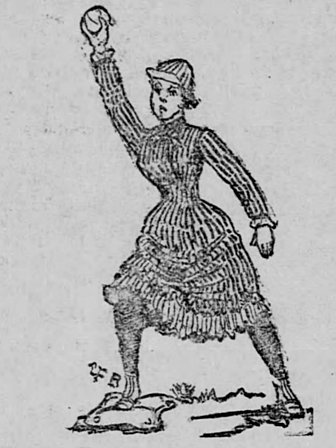
“Miss Royalston—“the expert and lady-like pitcher of the visitors…formerly lived at Detroit, and learned the art from the study of (Frederick “Dupee”) Shaw, the wizard.  She takes a graceful three-lap pirouette on the left toe, and while the batsman is dazzled by the rapidity with which the stripes on her polonaise fly by, the ball comes out from somewhere and the umpire calls a strike.”

The St. Paul Globe's rendering of one of the 'Fairies.'

The St. Paul Globe’s rendering of one of the ‘Fairies.’

The Fairies defeated the Minneapolis men 8 to 7.

The St. Paul Globe said after a loss at Stillwater, Minnesota “witnessed by a crowd of 1,200 or 1,300 persons,” composed of “Every profession in Stillwater, excepting the clergy, from street urchin to the capitalist, was represented.”

The Globe said of the visitors:

“The girls, seven brunettes and two blondes, were attired in red hose, plaid dresses reaching to the knee, red caps and slippers.  All wore belts, and two or three black jerseys, and were powdered and panted like ballet fairies.”

But the St. Paul paper was not as impressed with the Fairies as their counterparts in Minneapolis, summing up their performance in Stillwell:

“They can’t play ball a little bit.”

When 1,500 turned out for a game in St. Paul, The Globe was equally unimpressed:

“Four innings were played, the score being 14 to 4 in favor of the picked nine, who could have made it 44 to 4 if they chose.  At the close of the fourth inning the manager called, ‘Game! Grab your bases,’ which each basewoman did and the fairies vanished, leaving behind the most disgusted audience that ever went to see a game of baseball.”

Handbills that promoted the team’s appearances read “Have never been here before, may never come again.”

True to the advertisements the Fairies of the Field disbanded shortly after their ‘farce’ in Topeka, and never came again.

“I guess I am Rotten”

24 Nov

It was in doubt where Pete “The Gladiator” Browning would play in 1892.

There is no record of exactly how he parted ways with the Cincinnati Reds—Released by the Pittsburgh Pirates, Browning hit .343 for the Reds in 55 games in 1891 after signing with the club on June 29—but, by January of 1892 there were a steady stream of rumors about where he would sign.

Pete Browning

Pete Browning

Speculation included the Baltimore Orioles and St. Louis Browns, but Browning opted to return home to Louisville, and signed with the Colonels—he was released again after an early spring salary dispute, but signed a new contract with the team a week into the season.

Browning returned Louisville with much fanfare.  The Courier-Journal said, after he contributed two singles and two sacrifice hits in a 7 to 2 victory over the Chicago Colts:

“Prodigal Pete…walked out—‘Prods’ do not return in carriages—to his old home in left field at Eclipse Park yesterday afternoon, where he had spent a happy, happy youth before the false adulation of the outer world called the Gladiator away.”

After am 11-3 start, the Colonels were returning to form, and were beginning to look like the ninth place team with a 63-89 record they would be at season’s end.

To make matters worse, “Prodigal Pete” struggled after his first game, hitting just .247—94 points less than his career average—in 21 games.

Browning explained his sump to Harry Weldon of The Cincinnati Enquirer:

“’I guess I am rotten. I guess I ought to be out of the business,’ said Pietro Gladiator Browning, as he walked on the field.  ‘Old Gladdy ain’t to his speed yet, but he’s hitting ‘em, and hitting ‘em good, but not as good as he will hit ‘em though, cause he’s got the catarrh, and is stopped up in the head.  When you’re stopped up your ‘lamps’ ain’t right.  Wait until the sun gets hot and the catarrh leaves the old hoss.  Then the pitchers will have to look out.  Will I lead the league in hitting?  Why not?  Look out for me.  None of ‘em are getting away from me in the outfield.  Did you read about me going up in the seats and pulling down a fly that saved the game?  I can do it right along.  None of them big stars, Jim) McAleer, Curt Welch or any of the rest of them fellows have the best of old Pete on fly balls.  The old boy is still ready money, and worth one hundred cents on the dollar.”

Within days the Colonels gave up on the Gladiator and handed him his release on May 18.

For a time Browning got his “lamps’ right again.  After signing with the Reds again, he hit .303 the rest of 1892.  He returned to Louisville in 1893 and hit .355 in part-time role.