Archive | Uncategorized RSS feed for this section

“I was Large and McCarthy was Quick Tempered”

16 May

In 1912, Pennsylvania Governor and former major league pitcher John Tener, told William Phelon of The Cincinnati Times-Star about how a minor league team made a payroll during his playing days.
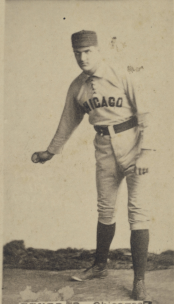
John Tener

John Tener

 “Such a thing as one day’s pay wouldn’t exactly break or worry me, that is wouldn’t worry me know, and it has been some years since I have had occasion to fret about losing one day’s wages.  Yet believe me there was once a time when I was robbed of one day’s salary, and that one day’s salary seemed to John K. Tener, as big as the First National Bank to the average young clerk at the present time.  And—just to show what strange things happen in this world—the man who took away John K. Tener’s poor little one day’s pay was in the after years Justice (William Henry) Moody, of the (United States) supreme court bench—that’s how life really happens in this republic of ours, and, I’m sure, the one day’s pay he saved on me looked as big to him right then as half a million did a few years subsequently.

“It was long, long ago when the world was very young, and I was a pitcher for the Haverhill team (1885) Tommy McCarthy, who afterwards grew so renowned as one of the headiest players of the champion Bostons, was one of the Haverhill outfielders, and Justice Moody was one of the chief officials of the Haverhill club.  The season was drawing to a close, the Haverhill team was losing money, and it seemed doubtful whether the exchequer could be so replenished that everybody would get what was coming to him at the final settlement.

Tommy McCarthy

Tommy McCarthy

“The days ran along and finally but one more day remained.  That night the stockholders of the club held a meeting, inspected the books, and did some great figuring as to ways and means.  Towards 11 o’clock, they found that they would lack only a few dollars of enough to settle up—but where were they going to find those few dollars?  That was the question, and they were debating on passing the hat when a great thought struck Mr. Moody.  ‘Gentlemen,’ he said, ‘I have it!  Upstairs, in the hotel, our two highest salaried players, Tener and McCarthy, are now asleep.  If we could save one day out of their wages we would have just enough to see us through.  Let’s release them and save tomorrow’s salaries.

“The stockholders carried the suggestion by acclamation, and releases were duly carried out.  Then a glance at the clock showed it was 11:30.  In half an hour or more it would be too late—a new day would begin, and we would have to have our full day’s pay.  Mr. Moody was deputed to bring us the news—which was considered a ticklish task, as I was large and McCarthy was quick tempered.  Somewhat bashfully, he came upstairs, woke us up, and gracefully handed us our releases.  Then he fled before Tom and I could get our heads clear and realize the situation.

“And, believe me, in those days I was so short of money that it just about broke my heart to lose that one day’s pay.  But I had to lose it, just the same, and Mr. Moody was the winner.  Did I ever get it back?  Not the money I didn’t—but I have often made Justice Moody buy enough good wine to pay for that several times over.”

Tener served in the United States House of Representatives, was Governor of Pennsylvania and President of the National League, but his short career as a player remained important to him.  A story made the rounds in many newspapers (although at least a decade after he left office) that when signing a bill into law while governor, a legislator said:

“Governor Tener, I think that’s one of the best things you ever did.”

Tener was said to have replied:

“You’ve got it all wrong–I once shut out the Giants.”

On his 81st birthday, July 25, 1944, The Associated Press asked about the “move to get Tener’s name added to the roll of immortals in Baseball’s Hall of Fame.”  Tener, and another former National League President, John Heydler had been an early and ardent supporter of the establishment of the Hall of Fame.

“(Tener) laughs that off.  ‘I don’t belong there.'”


The Occidentals

14 May

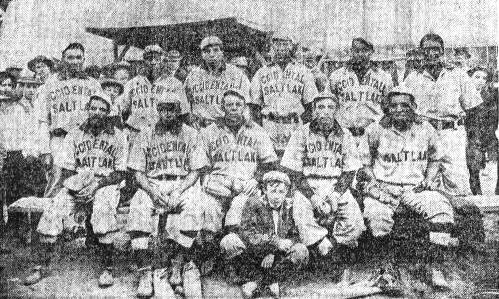
Billed as the “Colored World Champions” during their barnstorming tours of the West, The Salt Lake City-based Occidentals were also members of the otherwise all-white Utah State League.  Despite being forced to play additional road games, the team was very competitive.  In 1908 The Deseret News said:

“The colored boys have paid no attention to handicaps under which they had to enter the league; they have played good, earnest ball and provide the fans with their money’s worth every time they play.”

The paper acknowledged that the team’s manager Frank Black was correct when he said the team could “make more money by traveling throughout the inter-mountain region on a pick-up schedule than he will make in the league,” and made a “plea for fair play to all men, no matter who they may be.”

In 1909, the Occidentals won the Utah State League and then headed west.

The team arrived in Los Angeles in late October.  The Los Angeles Herald said:

“The Occidentals are a colored team, and after cleaning up everything in sight in the Mormon state decided that Southern California would afford new fields to conquer.”

Among the players on the Occidentals’ roster were second baseman/manager Black and pitcher/outfielder Louis “Ad” Lankford (contemporaneous accounts, including coverage of his brief boxing career in Salt Lake City, usually call him “Langford”)—in December catcher/first baseman Bill Pettus joined the team.

The Occidentals--Frank Black is standing far left, Ad Lankford is seated second from left.

The Occidentals–Frank Black is standing far left, Ad Lankford is seated second from left.

The team opened their tour with a series with the Los Angeles Giants billed as the “Colored Championship of the Pacific Coast.”  The Occidentals swept the best of five series with 9 to 2, 7 to 1 and 4 to 2 victories.

After winning the series, the team from Salt Lake City played a team dubbed as the “Japanese All-Stars of Los Angeles,” organized by Los Angeles Angels catcher Jesse Orndorff—the team was all Japanese except for the battery which consisted of Orndorff and Angels’ pitcher Bill TozerThe Herald said, “The game was fast and witnessed by a crowd of 1500.” The Occidentals won 7 to 3.

Jesse Orndorff

Jesse Orndorff

Two days later the barnstormers lost 6 to 1 to the Angels (the team was billed as the Los Angeles Angels, but was more accurately a current and former Pacific Coast League all-star team), with St. Louis Cardinals pitcher John Raleigh on the mound.

The Occidentals spent another six weeks in Los Angeles and had three well-publicized games with  McCormick’s Shamrocks, managed by local pool hall operator and promoter Jim McCormick.  The teams met for the first time on Thanksgiving and were tied 0-0 after five innings when the game was called.  The two teams met again at Chutes Park on Christmas.

The two managers tried to build attendance with quotes in The Herald, and The Los Angeles Times.  Black said:

“If you want to be a few beans ahead when the sun goes down on Christmas day, put a few cartwheels on the colored boys to win from the Winter League aggregation.”

McCormick countered:

“Nothing to it but shouting, and we will win in a walk.”

McCormick promised to get the “Occidental’s goat.”

When the sun set on Christmas The Herald said: And Manager Black’s goat is still grazing unmolested at Chutes Park.”  The Occidentals won 3 to 2.

Frank Black poses at Chutes Park with Jim McCormick's "goat" after the victory.

Frank Black poses at Chutes Park with Jim McCormick’s “goat” after the victory.

After a New Year’s Day rain out, the teams met again on January 8.  The McCormick’s recruited Tozer from the Angels to pitch; the game was tied 1 to 1 when called after twelve innings.

The following day the Occidentals played another twelve inning game, this one a 0-0 tie against an all-star team composed of Pacific Coast League, California League and major league players, including William “Brick” Devereaux, Eli Cates, Ed McDonough, Charles “Truck” Eagan and Elmer Rieger.

According to The Herald the team was 14-2-2 on the California tour when they departed for San Diego on January 22, where they lost 1-0 in 10 innings.

The final game of the trip was played against the Santa Ana Winter League Team—the Yellow Sox– which was made up of Pacific Coast League players including Arnold “Chick” Gandil—then a second baseman, as well as St. Louis Cardinals outfielder George “Rube” Ellis and future Hall of Famer Walter Johnson on the mound.

Johnson shut out the Occidentals 2 to 0, striking out 15 (The Times said he finished the winter league season 9-0—with nine complete games, giving up just 21 hits and 5 runs in 81 innings) The Herald said the team “did not take very lovingly to the slants of the mighty Walter, who had them well in hand throughout the contest.”

The team was generally well received by fans on the coast—notwithstanding The Herald’s habit of referring to them as “the dinges.”

Black and the Occidentals returned to Salt Lake City and rejoined the Utah State League for the 1910 season, finishing in second place.

The following year Frank Leland’s Chicago Giants entered the California Winter League, posting a 10-7-2 record.

“I am thoroughly Disgusted with the Business”

12 May

Robert Vavasour “Bob” Ferguson shares claim, with Brooklyn Atlantics teammate Jack Chapman, to the nickname “Death to Flying Things,” although it will likely never be resolved which had the name attached to him first.

Bob Ferguson

Bob Ferguson

What is clear is that Ferguson was an important figure in 19th Century baseball –a player, manager, umpire and executive, and the game’s first switch hitter.

Ferguson was, given the reputation’s of 19th Century  umpires, uniquely popular.

The St. Louis Republican said he was “about the most brilliant of any…He never allowed his word to be questioned and was the most successful umpire in that regard ever in the profession”

The Louisville Post said “Ferguson plays no favorite from the time he calls play.  He sees all men alike and tries to do justice to them.”

The Sporting Life said he was “The only umpire who can satisfy New York audiences.”

In May of 1886 Ferguson resigned from the American Association’s umpire staff to manage the New York Metropolitans, until May of 1887, when he was let go by New York and returned to the association staff.  The Philadelphia Times said his services were so sought after that he was offered “$1200 for the remainder of the season.  This is much in excess of the regular umpire’s salary, but (the Cleveland Blues, Brooklyn Grays and St. Louis Browns) have agreed to stand the additional expense if Ferguson will accept the position.”

Even when criticizing Ferguson for possessing “a whole barrel full of that commodity known as mulishnessThe Cincinnati Enquirer said, “There is no disputing his honesty.”

Intractability was the one major criticism of his work, but Ferguson thought it an asset.  Shortly after returning as an umpire in 1887 The Washington Evening Star said during a game between New York and Philadelphia, a runner starting from second base, noticing Ferguson’s back turned after a passed ball cut third base and scored easily.  Ferguson was alleged to have said:

“I felt morally certain that he did not go to third base, as he scored almost as soon as the base runner who was on third at the time.  But before I could do anything in the matter the crowd began to hoot and I declined to change my decision.  Let an umpire be overcome just once by the players or the crowd and he never will be acknowledged afterward.”

But, despite the respect he sought and received, on and off the field, in 1888 Ferguson told  a reporter for The New York Mail and Express—which said Ferguson was noted for his “bluntness and firmness” as a player– how he really felt about being an umpire:

 “I did not choose it; that is to say, I did not seek it very earnestly.  I had been active on the ball field for so many years that I knew it would be only a question of a short time when my efficiency as a player would be impaired to the extent of my being forced to retire, and the position of umpire being possible for me to obtain and in fact offered to me, I accepted it that I might surely be able to continue upon the field, where I have spent most, and in a general way the happiest years of my life.

“How do I like it?  I do not like it at all.  An umpire, not withstanding newspaper talk regarding his being master of the field, is practically a slave to the whims of players.  He does not, as is generally supposed, go upon a field, and upon the slightest provocation fine a player to any amount simply because that man does not act in accordance with his ideas.  He is not there for that purpose.  He is simply the representative of the officers of the association in which he happens to be employed.

“I give all clubs, whether weak or strong, an equal chance.  The position of an umpire is one that no self respecting man can hold long without wondering whatever possessed him to accept it, and wishing to be free from it.

“But everyone has to earn a livelihood, and I am endeavoring to earn mine, but I will say I am thoroughly disgusted with the business and will welcome the day when I can say: ‘Robert, you are free; your slavery days are over; you can now enjoy the fruits of your labor.’  Don’t misquote me now and say that I am disgusted with the national game, for it would be utterly untrue.  I am fond of baseball, as my many years on the diamond will attest; but to be a player, which position I loved, is one thing; to be an umpire is another.”

Ferguson remained in the American Association through 1889, then joined the Players League as an umpire in 1890, and returned to the American Association for the 1891 season, his last; The Sporting Life said “the Association soured on him” because “his expense bill” was much larger than any other umpire.”

Ferguson tried to get a position with the National League in 1892, but according to The Chicago Tribune he “does not seem to be much sought after.”

Ferguson retired to Brooklyn where he died in 1894 at the age of 49.

Oliver Perry Caylor said in The New York Herald said he was “an umpire of recognized fairness and merit…His honesty was always above suspicion, and scandal never breathed a word against his upright life professionally.”

Birmingham Sam— The Last Great Star of the Indianapolis Clowns

9 May

Richard “King Tut” King’s illness, which led to his retirement in the spring of 1959, left a void with the Indianapolis Clowns— James “Nature Boy” Williams, was popular, but the barnstormers needed someone with Tut’s charisma. They finally found him in 1962; his name was Sam Brison

The St. Petersburg Times described one of his early appearances:

“A limber fellow raced across the diamond in an Indianapolis Clowns uniform and bowed in the direction of teammate first baseman extraordinary Nature boy Williams. Minutes later fans were acclaiming a new star…he shows signs of becoming one of the all-time greats”

Given his resemblance to King Tut; Clowns owner Syd Pollock originally billed Brison “King Tut Jr.” The excellent book “Barnstorming to Heaven: Syd Pollock and his Great Black Teams,” by Pollock’s son Allan and James Riley told the story of how he was renamed. Brison approached Pollock and said he had a problem with the name:

“Problem is, I didn’t even know the man. Seen his picture on the bus. He musta been popular as God. Fans keep asking me, ‘How your Daddy?’ and I got no answer. Ain’t gonna lie, ain’t gonna say, ‘My Daddy fine, I’ll tell him you be asking.’ These people feel strong about King Tut.”

When Pollock asked if he just wanted to be called by his name, Brison said:

“No, I figure Birmingham Sam be good. People ask me about how Birmingham is. I can answer that.”

“Birmingham Sam” would be the team’s biggest draw during his 16 years with the team. Following the example of many members of the clowns throughout the team’s history, Brison also spent his winters playing basketball, first with Goose Tatum’s Harlem Road Kings, then with the Harlem Globetrotters—on the basketball court he said he “had a lot of showmanship about me…I did a lot of hollering.”

Never one for understatement, some of Pollock’s press releases described Brison as “one of the best fielders in baseball and hailed as the greatest comedian in sports history. “ The six-foot-two-inch Brison would often begin performances by “unpacking” two-foot-seven-inch Dero Austin from a suitcase at home plate.

In 1969 The Associated Press reported that Brison had secured a spring training tryout with the Boston Red Sox’ Carolina League Winston-Salem franchise, Brison told the wire service:

“I just want to get to Florida and show my stuff.”

Brison said an injury earlier in the spring had led to the cancelation of a tryout with the Cincinnati Reds—there’s no record of the whether the Red Sox try out ever took place. The Associated Press story incorrectly said the 29-year-old Brison was only 23—his real age would have made it especially difficult for him to break into organized ball in 1969.

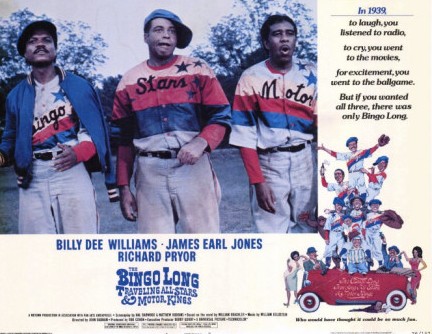
In the mid-1970s, during the beginning of the end for the Clowns as a viable business, Negro League Baseball was becoming the subject of renewed interest. In 1976, the barnstorming tradition of teams like the Clowns made the big screen with the release of “The Bingo Long Traveling All-Stars and Motor Kings.”

In order to add authenticity to the baseball scenes stars Billy Dee Williams, James Earl Jones and Richard Pryor were joined in the cast by Leon “Daddy Wags” Wagner (two-time American League all-star), Jophrey Brown (pitched in one game for the 1968 Chicago Cubs, then became a well-respected Hollywood stuntman), and “Birmingham” Sam Brison.

“Bingo Long” movie poster

Brison played shortstop Louis Keystone in the movie.

“Birmingham” Sam Brison is seventy-two-years-old and lives, appropriately enough, in Birmingham, Alabama.

Update: “Birmingham” Sam Brison passed away in April of 2014.

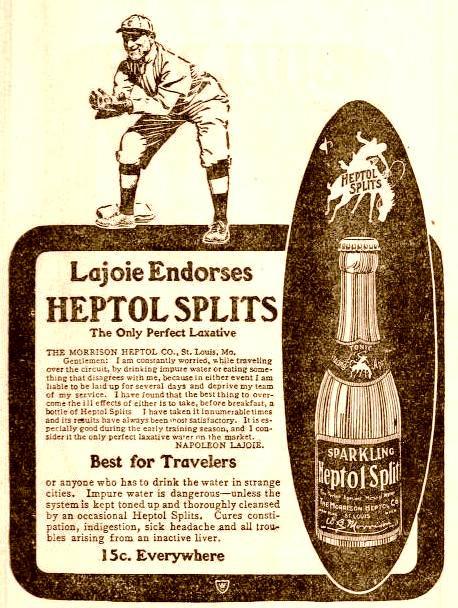
Lost Advertisements–“Lajoie Endorses Heptol Splits”

9 May

lajoieheptol

Cleveland Naps second baseman Napoleon Lajoie appeared in as many advertisements as any of his contemporaries during his career, including one for a “sparkling laxative.” This is a 1906 advertisement for Heptol Splits “The only perfect Laxative.”

“Gentlemen:  I am constantly worried, while traveling over the circuit, by drinking impure water or eating something that disagrees with me, because in either event I am liable to be laid up for several days and deprive my team of my service.  I have found that the best thing to overcome the ill effects of either, is to take, before breakfast, a bottle of Heptol Splits.  I have taken it innumerable times and its results have always been most satisfactory.  It is especially good during the early training season, and I consider it the only perfect laxative water on the market.”

The image of the cowboy on the bronco used for Heptol Splits’ logo was created by artist Charles Marion Russell.

Lajoie’s endorsement does not appear to have done much good for the brand which appears to have disappeared from drug store shelves within a couple of years.

A version of the advertisement appeared in the inaugural, 1906 edition of Napoleon Lajoie’s Official Base Ball Guide— an attempt  to compete with the Spalding and Reach Guides.

The 1906 Lajoie Guide

The 1906 Lajoie Guide


The Cleveland Press said upon the publication of the 1906 guide:

“”Lajoie’s Guide is especially interesting because it is the first work of this kind that has ever been attempted by a ball player while still in active service on the diamond…Lajoie is the champion batsman of the world and a great authority on the national game.  His book should find a ready sale.”

When Lajoie’s Guide ceased publication after the 1908 edition The Press said:

“After two years as editor of the American League Publishing Company, getting out the Lajoie Guide, he declares the others are too strong for competition, and only farm life for him in the winter months from now on.”

Miah Murray

7 May

Jeremiah “Miah” Murray appeared in only 34 major league games, with four teams between 1884 and 1891.  In 31 games a catcher, he made 29 errors and was charged with 28 passed balls.

During that short career, he also became the subject of two stories which highlighted his shortcomings behind the plate.  Both stories appeared after the fact, so are subject to the usual caveats of 19th-century baseball stories.

Jeremiah "Miah" Murray

Jeremiah “Miah” Murray

In 1894 The New York Sun wrote about the most embarrassing episode Murray’s career—said to have taken place during his rookie season, 1884:

“(Murray) tells about a game he once caught in at Buffalo when he was a member of the Providence team.  There were three men on bases and he threw to (Jerry) Denny to catch a man napping, but the ball never got there.  It hit Jim O’Rourke, who was the batsman, on the side of the head and bounded into the grandstand, three men scoring and winning the game for Buffalo.  Jim staggered and cried out with pain, but the crowd simply cried with glee, O’Rourke’s hurt being entirely lost sight of in the enthusiasm.”

Murray’s manager during that 1884 season was Frank Bancroft who led Providence to the National League championship and a three games to zero victory over the New York Metropolitans of the American Association earning for the first time the title “World Champions” from The Sporting Life.

Frank Bancroft

Frank Bancroft

Bancroft compiled a 375-333 record over parts of nine seasons as a big league manager, before becoming an executive with the Cincinnati Reds.

It was while serving as the Reds’ Business Manager that Bancroft related another story about Murray’s brief time with Bancroft’s championship team.  The story first appeared in The New York  American in 1915:

“’Take it from me,’ said Frank Bancroft, while some of the fans were discussing famous bonehead plays, ‘the old timers pulled some bones that had all you youngsters blocked off the map.  Best I recollect, right now, was sprung by Miah Murray when he was catching for me…With a runner on first Miah steamed back to the stand a made a magnificent catch of a foul fly.  The crowd broke into roars of applause; Murray, leaning against the stand, took off his cap and bowed right and left—and the runner, sizing up the situation, lit out from first, kept right on going, and came all the way around while Miah kept bowing and the rest of the team were screeching and raving, all in vain.”

Murray later became a National League and college umpire; he was also a prominent boxing promoter and matchmaker in Boston where he operated the Lincoln Athletic Club of Chelsea, and later the Armory Athletic Club.  He died in Boston in 1922 at age 57.

Bancroft retired as business manager of the Reds in January of 1921; he died two months later at age 74.

Tragic Exits 2

5 May

Charles Rapp

Charles “Adonis” Rapp was a left-handed pitcher (he also played first base and outfield) who began his career with the Austin Senators in the Texas League in 1898.  For the next several years he played for a variety of Midwest based clubs (Fort Wayne, Saginaw, Grand Rapids) in the Interstate and Michigan State Leagues.

Contemporary newspaper reports say he was also a member of the South Bend Greens in the Central League, but he is not listed on any surviving rosters; he was also said to have been “tried out by Milwaukee, when that city was in the old Western League (1903).”

Rapp’s trail goes cold after the 1903 season until 1909.  Rapp was living in his hometown of South Bend, Indiana.  The Indianapolis News reported on May 17:

“Charles Rapp, former ball player, and well known throughout the city, killed his mother late Saturday and then committed suicide.  The weapons used were a hammer, a dull paring knife and a small pair of shears.  It is said that Rapp had a tendency towards insanity, that the tendency had been marked during the last few days and that he undoubtedly deranged when he attacked his mother.

“Rapp did not die until several hours after the double crime had been committed and after he had been removed from the Rapp home to the St. Joseph County Jail.  Before death came, and in reply to a query about the crime, Rapp said: ‘I tried to get the whole family.’

“The last person to see Mrs. Rapp alive and the first one to discover the body of the woman and the dying son was Charlotte Benz.  Mrs. Benz had spent the day at the Rapp home and left the house late in the afternoon…On her return she stopped at the Rapp place, entering by the rear door…and then suddenly a sickening sight met her gaze.  Lying in a pool of blood at one side of the sitting-room were Rapp and the body of the mother.  The heads were close together and as Mrs. Benz entered the young man cried out: ‘Get out of here, Lottie, get out of here.’  It was evidently his intention to kill the Benz woman, but Rapp was unable to move from loss of blood.”

The Associated Press said of the incident:

 “Until Rapp fell a victim to the liquor habit he was one of the most popular young men in the city.”

Henry Long

Henry Long was born in Chicago in 1870 or 1871 (cemetery and death records disagree), he was the younger brother of  Herman who had a 16-year big league career.

Herman Long

Herman Long

Little is known about Henry’s early life, or when exactly he began playing professional baseball.  Based on newspaper reports he appears to be the “Long” who played with the Battle Creek Adventists in the Michigan State League in 1895.

Before the 1896 season he was signed by the Lewiston team in the New England League.  The Lewiston Daily Sun said:

“Manager (Michael) Garrity has signed pitcher Henry Long of Chicago, a brother of Herman Long of the Bostons, and is said to be a good pitcher, a hard hitter and a good all-around man.”

Long didn’t last in Lewiston, he was 0-2 in just three games before he was released.  Long then appeared in one game for the Shamokin Actives in the Pennsylvania State League, and then joined the Hagerstown Lions in the Cumberland Valley League.

The right-handed pitcher started seven games for the Lions and was 4-3 with a 1.29 ERA.

On July 10 he missed the team’s train for a game in Hanover, Maryland.  The Philadelphia Times said he attempted to hop a freight train and fell; his right arm was crushed under the wheels.  His arm was amputated “but Long sank rapidly and died in the hospital” in Hagerstown.  While contemporary news reports said the body was to be shipped back to Chicago, where it would be “received by his brother Herman,” he was instead buried in Maryland

Matt Barry

In 1900 The Sporting Life said Matthew “Matt” Barry had been “the first player from Rhode Island to receive money for playing ball.”

Information on where he played is sketchy—he was the Rhode Islands in the New England League in 1877 and Springfield (MA) of the International Association in 1878–but beyond that, there are few references to where he played during his career.

The Providence News-Democrat called Barry, who was born in Providence in 1850, a “well-known ballplayer and one of the best-known members of the sporting fraternity in the state.”

Barry eventually returned to his hometown, Providence where he operated the Empire Saloon, on Empire Street.

After the turn of the century, Barry suffered a series of financial setbacks.   On August 30, 1907 The News Democrat said:

 “(Barry) attempted suicide by inhaling illuminating gas in his room in the Essex house, at 23 Burrill Street.”

Barry was discovered by the owner of the house:

 “The room was locked, but the door was forced, and then Barry was seen unconscious on the bed with gas streaming from an open unlighted jet…as Barry’s usual custom was to sleep with all the windows open , the fact that they were closed , indicated that he had prepared to take his life.”

He was taken to Rhode Island, where he died on September 2.

Barry’s friends disputed the story that he had taken his own life, claiming his “financial embarrassments” had been overstated and that he “was in better condition financially than he had been for years.”  His friends instead said Barry, who “had been troubled with insomnia” and took morphine to sleep, turning off the lights “at that time the morphine would begin to get in its work,” had accidentally turned on the gas when he meant to turn off the light “which was on the same chandelier.”

The cause of death was never officially determined.

“Why don’t you make Latham keep still?”

2 May

After winning the first three games of the 1894 season, the Cincinnati Reds dropped six of their next seven.  The Cincinnati Enquirer’s Harry Weldon said most of the players weren’t “fighters.”

“To be a ‘fighter’ in the sense that this term is applied in baseball does not necessarily mean that you must be a leg breaker, a rib crusher or indulge in billingsgate or profanity to your opponent.  It simply means that your mind must be on the game every minute and every second while it is in progress.  It means that you must watch every movement and point and be alert for any opening, however small.

“The Reds are as gentlemanly a team as there is in the league, and it is to their credit that they are so; but there is such a thing as carrying the matter too far.  There is an old adage about ‘fighting the devil with fire’ that some of our local players would do well to follow.  This advice is apparent.  There are times when ‘Excuse me please,’ and ‘I beg your pardon,’ won’t do.  The men to whom they are addressed don’t know what that sort of language means.  In other words, when you are in Rome do as Romans do.”

Weldon said some players were critical of the behavior of Reds third baseman Arlie Latham.  Latham was a Weldon favorite; the two had been friends since Weldon served as secretary for St. Browns President Chris Von der Ahe while Latham played there:

Arlie Latham

Arlie Latham

“There are a few growlers and soreheads who find fault with Latham for talking too much.  I cannot sympathize with such criticism.  Latham does not coach because he likes it or to be ‘funny’ and ‘work the grand stand,’ as many of his detractors would have people believe it.  I once heard one of the soreheads say to Captain (Charlie) Comiskey: ‘Why don’t you make Latham keep still?’

“’Do you want me to put him out of the game?’ replied the Reds’ captain.

“’No, I only want you to make him stop talking.’

“’Well, if I did that, he might as well be out of the game, for he would lose his interest.’

“Every word of this is true.  Latham is too much interested to keep still.  Hardly a ball is pitched in the game by the Reds’ pitchers that Latham from third base doesn’t have something to say.  Scarcely a movement is made at the bat, on the bases or the coaching lines that Latham doesn’t deliver some wordy instructions.

“He is in the game from start to finish.  He couldn’t be funny ‘to order’ to save his life.  The ludicrous and witty sallies he makes from the coaching lines just bubble out of him.  He doesn’t ‘day dream’ or ‘build air castles’ while a play is in progress as some players do.

“His mind is right on the business on hand.  He is a fighter all over.  There are others on the Cincinnati team who would do well to follow his example.  The Pittsburghs and Clevelands are examples of what fighters can do.  Every member of those teams was in the game all the way through when they were here.  Not a play occurred that they were not on their feet hustling and shouting.  The Reds should fall in beside (Latham) from now on and back him up with spirit and noise.

“Nothing pleases a crowd of local enthusiasts more than a scrappy game.  If you have got to go down, boys, do it with all your banners flying.  Fight it to the last-ditch, and then if you are whipped you’ll know how it occurred.”

Harry Weldon

Harry Weldon

The Reds never started fighting in 1894, and finished in tenth place with a 55-75 record; it was Comiskey’s final season as a major league manager, and his least successful.  The following year he purchased the Sioux City franchise in the Western league, and moved the team to St. Paul.

Latham, who hit .313 in 1894, had his final productive season the following year, hitting .313 for an improved Reds club (66-64) managed by William “Buck” Ewing.

Weldon was sports editor of The Enquirer until he suffered a stroke in February of 1900 at age 45, he died two years later.  Ren Mulford Jr., who succeeded Weldon as editor said:

“No more forceful writer on sports topics ever played upon the keys of a typewriter.”

“The life of a Baseball Player is Extremely Unsatisfactory”

30 Apr

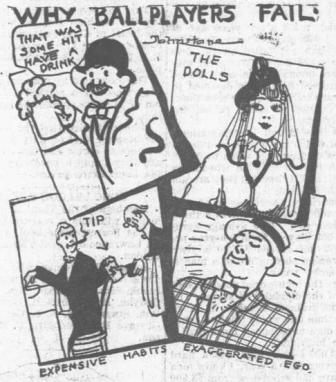
After more than two decades covering baseball, Hugh Fullerton told fathers “Don’t send your boy into professional baseball.”  In response to a letter he said he received seeking his advice from a father who said his 19-year-old son wanted to play pro ball, Fullerton said in The Chicago Herald-Examiner  in 1915:

Hugh Fullerton

Hugh Fullerton

“The life of a baseball player is extremely unsatisfactory.  I have lived with them for more than 20 years and have found few good men in the profession who would not have been better off in any other.

“Your boy is at the age when the majority come into the upper leagues.  Usually they are swell headed because they have been applauded and cheered as the best in their own class.  Among the veteran ballplayers they are looked upon with scorn, chiefly through this tendency to freshness.  If they are sensitive or lack determination they are broken in spirit and courage right at the start.

“I made a list a few years ago of nearly 1000 players—and about 98 out of each 100 failed on the first trial to make good.  The great majority are doomed to failure.  Those who succeed finally are destined to temporary failure.  I have seen thousands broken in spirit, ruined entirely by this.

“The life is full of temptations, chief of which are women and drink.  Swarms of fans urge them to drink, seek to buy them wine when they succeed, and if they fail they are apt to drink as a solace.

"Why Ballplayers Fail" The illustration that accompanied Fullerton's column

“Why Ballplayers Fail”
The illustration that accompanied Fullerton’s column

“Financially, about one in 40 succeeds moderately and one in a thousand gets rich.  The average earnings of 500 players for a ten-year period will not exceed $1000 a year.  The average playing life of a man is about seven years.

“Even the high-priced players complain of the difficulty of saving.  The constant drain of expenses is much higher than one would think.  A semi-public man must spend more than a private individual.

“A 3,000-a-year man has a hard time saving $500 a year.  I know men who have had salaries of from $3,500 to $7,500 for seven or eight years who have only a few thousand laid by.

“The worst feature, however, is that your boy, starting at 19, probably would be done when he was 32 or 33—done and out of employment, with expensive tastes, expensive acquaintances, no knowledge of any trade or business and really just where he is now.  He probably would be worth $20 a week.

“His one chance is that he has, during his baseball career, formed the friendship with some wealthy or prominent man who can place him in a ‘soft’ job.  To me this seems undesirable.”

Within days Fullerton was again writing columns about the joys of the drunken exploits of players like Elmer Foster.

Tragic Exits

28 Apr

George Frazee

George Donald Frazee, listed on Baseball Reference as “G. Frazee” with the Shreveport Sports in the Texas League in 1928, was a three-sport star at Texas Christian University.

Born November 21, 1904 in Fort Worth, Texas, Frazee played outfield for the baseball team, halfback and fullback with the football team, and was a guard on the basketball team from 1923-1925.  After graduation he played basketball with a team representing the Fort Worth, Texas YMCA which played throughout the Southwest and Mexico.

It’s unclear where Frazee played baseball in 1926 and ’27, but in 1928 he started the season with the San Angelo Red Snappers in the West Texas League, there are no surviving statistics for his time there, but after being transferred to Shreveport he hit .301 in 32 games. Frazee signed with Shreveport for the following season.

On January 24, 1929 Frazee was flying from Ft. Worth with World War I flyer Willoughby Alvous “Al” Henley and another Fort Worth man, to attend the opening celebration for San Angelo’s new airport.  The United Press wire story said:

 “Tragedy marred the formal opening of the municipal airport today, claiming the life of Al Henley…one of the nation’s most skilled pilots.  Henley, Donald Frazee, professional baseball player, and W.E. Shytles…were killed when their cabin monoplane crashed in an attempted landing.”

The Brownsville Herald said:

 “He was an outfielder, fast, big and aggressive.  Shreveport lost an outfielder who was certain to make good this year.”


Chief Wano

William “Chief” Wano was born on Oklahoma’s Pottawatomie reservation on May 12, 1896.  He played semi-pro ball in Oklahoma City and in the army while serving with the 79th Infantry, 15th Division at Camp Logan, Texas.  After his discharge in early 1919 the twenty-three-year-old began his professional career with the Tulsa Oilers in the Western League.

Wano struggled during his first season, hitting just .195, but joined the Little Rock Travelers in the Southern Association the following season—and along with fellow Oklahoman, and former classmate and teammate at the Chilocco Indian School– Moses “Chief” Yellow Horse; he helped lead Little Rock to the pennant.

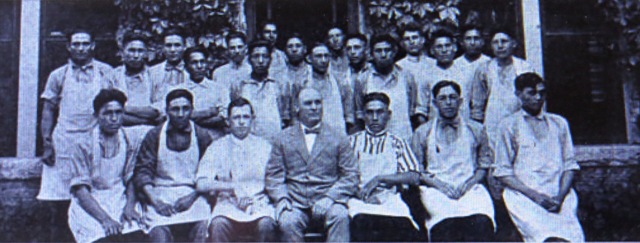
William Wano,

William Wano, back, fourth from right, at Chilocco Indian School

Wano was a consistent hitter throughout the 1920s (.317 in 11 seasons in class-A leagues), but was an erratic fielder and never made it to the major leagues.

After hitting .331 for the St. Joseph Saints in the Western League in 1930 Wano left organized baseball, first playing semi-pro then he accepted a position managing Ben Harjo’s All-Indian Baseball Club—Harjo was a millionaire and full-blooded Creek.   The team, based in Harjo’s hometown Holdenville, Oklahoma, barnstormed the Midwest and Southwest, and with Wano as player-manager won the Denver Post Tournament in July 1932.

Chief Wano

Chief Wano

Wano quit two months later after a dispute over two players Wano signed.  Harjo hired Jim Thorpe to manage the club the following season.

Wano moved to Dallas after his career.  According to The United Press he spent World War II working at the North American Aircraft plant in Dallas, and living at the home of Kal Hill Segrist Sr., his former Dallas Steers teammate (and father of Kal Segrist, who played with the New York Yankees in 1952 and the Baltimore Orioles in 1955).

On July 30, 1945 Wano was in the Dallas City Jail (reports varied on why he was there), when according to The Dallas Times-Herald another prisoner “slugged Wano on the chin, Wano fell, striking his head on the concrete floor.”  Other reports said Wano was trying to break up a fight when he was hit.

William “Chief” Wano died that night in Dallas’ Parkland Hospital.  A month later a grand jury chose not to indict the man who threw the punch.


Gene Gaffney

Eugene “Gene” Gaffney was one of the better hitters in the Florida State League during his brief career (1920-23), he was also a manager’s nightmare.

Gaffney hit .335 in 60 games for the league champion Orlando Tigers in 1921, but was suspended for several days in July by Manager Joe Tinker.

The following season he joined the Jacksonville Indians, managed by former major leaguer George Stovall.  The team struggled, and Gaffney, had his only sub .300 season, hitting just .277.  And, according to The St. Petersburg Evening Independent, a car caused a major riff between the outfielder and his manager:

“Has a baseball player a right to ride to and from the park in his own automobile?  George Stovall says no.  He suspended Gene Gaffney because Gaffney had bought an automobile and insisted on being his own bus.

“Stovall insisted he should parade to the park in the team bus.  Gaffney told Stovall to go jump; that if the team would win enough games so that he wouldn’t be ashamed to wear the uniform on parade it might be different.  At last accounts Gaffney was off the ballclub, but riding his automobile to his own intents and purposes, while Stovall still was trying to get the rest of the Jacksonville team somewhere on the field.”

Gaffney played just one more season; he hit .357 for the Daytona Beach Islanders in 1923.

After baseball, Gaffney tended bar in Orlando until August 12, 1937—The Associated Press said:

“Gene Gaffney, about 43, local bartender who once led the old Florida State League in batting, was believed today to have been the victim of foul play.

“His automobile, its windshield shattered and other windows broken, was found mired in mud on the shores of an almost inaccessible lake just across the Orange County line in Seminole County, with evidence of a struggle having taken place.

“His eye glasses were found in the mud about 20 feet from the car.”

Gaffney’s body was found the following day.  His death was ruled a homicide.