“Topeka” Jack Johnson and the Negro National League

19 Jun

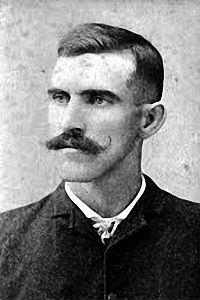
Ten years before Rube Foster organized it in 1920, Jack T. Jackson called for the creation of the Negro National League.  Johnson was variously nicknamed “Topeka Jack,” “Chicago Jack,” and “Kansas Jack,” and was occasionally confused with another Jack Johnson, the World Heavyweight Champion who also dabbled in baseball—“Topeka” Jack also did some boxing, further confusing the issue.

As a result of the common name and the confusion with his more famous namesake, there is very little biographical information available about him and no information survives regarding his birth or death, but for about a decade at the beginning of the 20th Century, he was an important figure in black baseball.
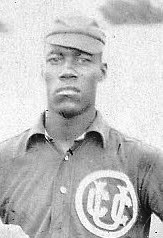
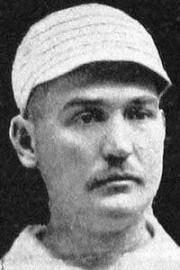
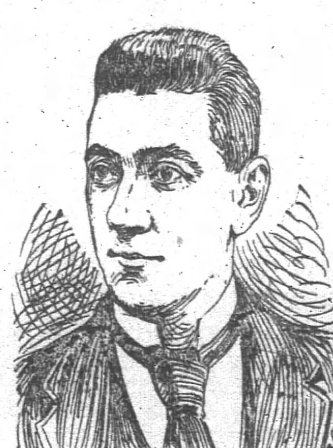
Jack T. Johnson

Jack T. Johnson

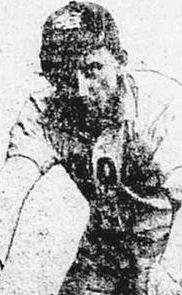
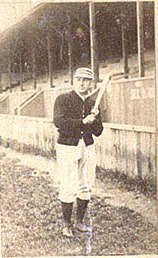
A shortstop and outfielder, he organized teams  in Topeka before going north and joining the Chicago Union Giants, and then the Minneapolis Keystones.  In 1909, he returned to Kansas to manage the Kansas City Giants, owned by Tobe Smith, and the following season he played for and managed the rival Kansas City (MO) Royal Giants owned by Kansas City businessmen M.B. Garrett and George Washington Walden.
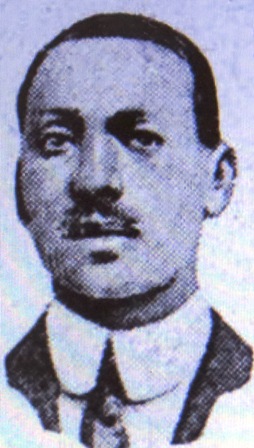
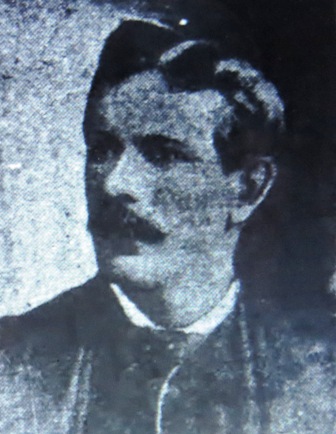
George Washington Walden

George Washington Walden

On the eve of the 1910 season, with two rival franchises in Kansas City, and Chicago’s Rube Foster and Frank Leland battling over control of the Leland Giants, Johnson attempted to form a Negro National League.  He wrote an article which appeared in The Freeman, The Chicago Defender, and other papers:

“To my idea it will be one of the greatest things that has ever happened for the Negro, if it goes through.  There is no one that knows from the actual experience, better than I, under what trying conditions the Negro has been existing in baseball…in other words it has been very discouraging for the colored player.”

Johnson said the teams suffered at the box office because games were arranged on an ad hoc basis and often clubs would “show up with about one-half of the lineup being green youngsters that had never played a game together before,” and said many great players had quit the game because of the lack of organization.

“I contend that these conditions are not likely to occur with the clubs of the league as each club would practically be intact the season through, would have something to fight for and each manager would consequently show more interest.

“It has certainly been proven from the big leagues on down to the minors, that there is nothing in the world that beats organized baseball and harmony.  Of course we cannot expect to cope right along with the big leagues the first season or two, but we can follow their method and system as far as we go.  Good judgment can be used in adopting a schedule in regard to the shortest jumps, conflicting dates with white league clubs, etc…From the fact that most cities of the league would put out good, strong clubs, would be attractions that would draw at any time and at any place where baseball is known at all.  So many times the white fans have been heard to remark, ‘I would rather go to see those colored boys play than one of the big league games.’  To prove this look how they used to pass right by the White Sox gate at 39th Street to get to Auburn Park at 79th street to watch the Lelands.

“Then look at the prestige, standing and rating it will give each club under the heading ‘Negro National League.’  What a great thing it would be to have an official record and per cent kept of each club and player.  Then we will not have to argue and squabble as to the real merits (of Negro League players).”

The type of league Johnson envisioned was a decade away.

Johnson and George Washington Walden would have a bitter split after the 1910 season with Johnson leaving the Royal Giants and returning to the Kansas City (KS) Giants—the two resolved their differences the following year, according to The Freeman:

“At last war in Kansas City has come to a happy ending.  (Walden and Johnson) have at last got together and will give Kansas City the strongest baseball team she has ever had.”

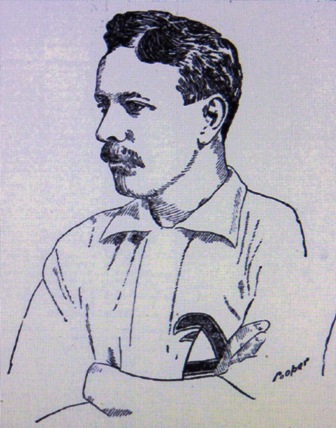
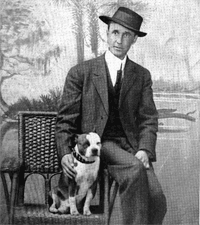
Jack T. Johnson and George Washington Weldon, 1912
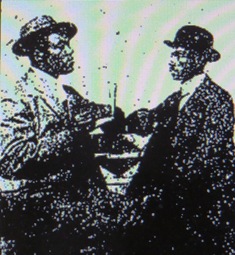
Jack T. Johnson and George Washington Weldon, 1912

The newly formed Kansas City club operated as an independent barnstorming team and faded away by the early teens; Jack Johnson also faded away, his date and place of death unknown.
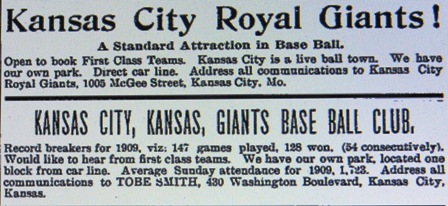
Competing advertisements for the Kansas City Royal giants and Giants in The Freeman, 1910

Competing advertisements for the Kansas City Royal Giants and Giants in The Freeman, 1910

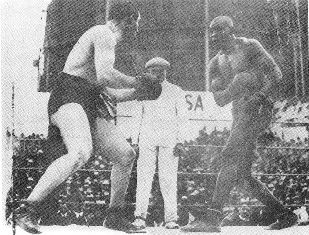
In 1920, while the former Heavyweight Champion Jack Johnson was serving his sentence at Leavenworth, Kansas for violation of the Mann act, he fought two exhibition matches on November 25, knocking out a Chicago fighter named Frank Owens and then “sparring” four rounds with a fighter billed as “Topeka Jack Johnson.”  Some sources have identified the fighter as the same “Topeka Jack,” but, at least, three different professional fighters (and likely more) used that name between 1900 and 1925, and none of the newspaper reports indicate it’s the same Johnson.
jackjohnsonb

The other Jack Johnson, fighting Tommy Burns in 1908
Brought the League “Discredit throughout the South”

18 Jun

In the final weeks of the 1886 Southern Association season, second place Savannah travelled to Atlanta for a four game series against the league leaders.

Hours before the August 18 game, umpire John McQuade left Atlanta by train.  The Macon Telegraph called the circumstances of his departure “Mysterious.”  The Atlanta team said the umpire left town because he was bribed to throw the game by Isaac G. Haas, owner of Savannah.

The Telegraph said McQuade’s departure was the result of his being followed by a detective hired by Stephen Andrew Ryan, a wealthy Atlanta businessman who was one of the directors of the Atlanta team.

The paper quoted a Detective Jones:

“I was hired by Mr. Steve Ryan to shadow McQuade, and I did so.”

Jones went on to say that he saw the umpire speak with various people, including Haas, Savannah catcher John “Tug” Arundel and Ryan’s brother John, who claimed he tried to convince McQuade to stay and work the game.

Savannah pitcher Hank O’Day said the umpire told him “he had been offered money by Mr. Ryan, of the Atlantas, to stay and umpire the games in Atlantas favor and said that he would not and could not do so.”  Arundel said McQuade had told him he had been offered money by “one of the Atlanta officers.”

After McQuade left, Atlanta installed backup catcher Joe Gunson as umpire.  Atlanta shut out Savannah 2-0, The Constitution said “Gunson gave every close decision against Atlanta…his evident desire to be fair, carried him, frequently, too far.”

Joe Gunson, umpire for a day

Joe Gunson, umpire for a day

Savannah disagreed.   Haas demanded that, as had been done earlier in the year, when an umpire did not arrive in Savannah for a series—the teams selected umpires on alternating days.  Atlanta refused; claiming league rules gave them the right to name the umpire, and chose a former local player named George Whitlock to work the second game.

When Atlanta took the field at 3:30 PM the following day in front of a large crowd, the Savannah team was not present, The Telegraph said:

(Frank) Wells fired nine balls over the plate, which were caught by Gunson, and the umpire gave the game to the Atlanta by a score of 9-0.”

The Constitution said Savannah’s Hass “without cause declined to permit his men to play.”  The Atlanta police also got involved, arriving at the depot before the Savannah team was able to board a train and arresting five members of team, including O’Day and Arundel.

Arrested in Atlanta--Hall of Famer Hank O'Day

Arrested in Atlanta–Hall of Famer Hank O’Day

The Savannah Times said the police attempted to arrest the entire team, “but some of them dodged the officers and got away,” the five players were charged with “disorderly conduct and using profane language,” they were fined between $5 and $10 each and released.

The Times also claimed that Haas, and other Savannah team officers and fans were being “roughly handled,” and “pretty severely abused,” on the streets and in the hotels of Atlanta.

Within days McQuade made a statement under oath “that no Savannah director had endeavored to induce him to leave the city or bribe him in any way.”  McQuade also sent a letter to The Sporting Life and Southern newspapers claiming that Atlanta’s Ryan had tried to bribe him:

“Mr. Ryan, of the Atlanta club, came to me and said: ‘Here Mac, we must have the games; we have got to have them, and will give you one hundred dollars for each game.”

Regardless of the charges, and aided by the forfeited and canceled games, Atlanta won the Southern Association championship.  The season was over, but the allegations were not.

McQuade’s story was given additional credence after the end of the season.  Benjamin F. Young, a former Southern Association umpire, sent a letter to same publications McQuade had, and told a similar story.  Young’s letter implicated another prominent Atlanta citizen:  Henry Woodfin Grady, editor of The Atlanta Constitution, and a long-time supporter of baseball in Georgia.

Young said early in the 1886 season, while in Atlanta, Grady approached him and mentioned the hardship of umpire being responsible for their own travel expenses.  According to Young, Grady claimed he could “fix him up’ and said:

“’I can get passes for you on about every road you’ll have occasion to use.’  Knowing my reputation for honesty and fearing he had said too much, he failed to say ‘why’ he wanted me to take the passes, but it is evident he wanted me to favor Atlanta…Now a good many may say that Grady did not mean tany harm in offering me the passes.  If he had offered me money then of course, it would be a serious matter.  But Grady knew better than to offer me money, so he thought he could come to me in a roundabout way with the passes.”

By the turn of the century, charges such as these would have resulted in an investigation, but in Southern baseball in 1886, it was little more than a ripple.

At the end of season league meeting, the championship was “officially” awarded to Atlanta.

A resolution was introduced by the owners of the Charleston Seagulls which said Atlanta’s “treatment of visiting clubs, and behavior of their players,” had brought the league “discredit throughout the South,” and called for the team to be “censured and reprimanded.”  The resolution was adopted only after Charleston “was induced” to change “Atlanta” to “some club” in the text.

There were consequences; however, interest in baseball waned in Atlanta, and the city would not have another professional team until 1889.

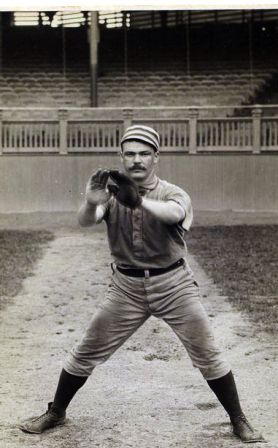
Atlanta manager “Blondie” Purcell earned a return to the big leagues, finishing the 1886 season with the Baltimore Orioles in the American Association.  He played four more years, finishing with the Philadelphia Athletics in 1890.

Blondie Purcell

Blondie Purcell

Umpires McQuade and Young both finished 1886 in the American Association, and appear to have never again been approached with bribes.

Henry Grady, newspaper editor, segregationist, and “Spokesman for the New South,’ died three years later.

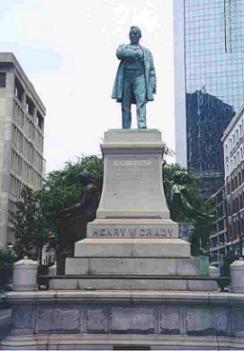
Henry Woodfin Grady statue in Atlanta

Henry Woodfin Grady statue in Atlanta

Stephen Ryan’s dry goods business collapsed in 1891, with debts anywhere from $500,000 to $2 million depending on the source, including losing $16,000 on the Bob Fitzsimmons /Jack “Nonpareil” Dempsey fight.  Accused of hiding assets he was jailed for 13 months.  Upon his release he rebuilt his business only to suffer a similar collapse with a year.  He died in Atlanta in 1908.

“Atlanta’s Baseball Bullies”

17 Jun

During the 1885 season, Lewis Henke of the Southern League’s Atlanta Atlantas was killed during a game; the death was attributed to on-field rowdyism by the Southern press who hoped the death of the popular player would help end brawling behavior in the league.

In January of 1886, the Atlantas hired a new manager, William Aloysius “Blondie” “Billy” Purcell.   Purcell had split the 1885 season between the Philadelphia Athletics in the American Association and the Boston Beaneaters in the National League, hitting .279 in 87 games.  The Sporting Life said:

 “Billy will make a good manager, and is capable of securing a team—even at this late date—to win the championship. “

William "Blondie" Purcell

William “Blondie” Purcell

Purcell came to Atlanta with an excellent reputation, The Philadelphia Inquirer described him as being “Of a genial, happy disposition,” who was very popular when playing for the Athletics, and in 1883 and ’84 as a member of the Quakers.

That changed quickly, just two weeks into the season The Macon Telegraph said under the headline “An Alleged Conspiracy against Purcell,” that the new manager had incurred the wrath of his players by “ruling the team with an iron hand.”

After the rough start, the team appears to have turned their wrath towards their opponents and became the most hated team in the league.

Over the course of the next four months, Southern papers chronicled the bad behavior of the Atlanta squad.

It started with a game against the Charleston Seagulls when Purcell was accused of cheating, The Charleston News and Courier said:

“Manager Purcell was playing in the left field and the Charleston team was at the bat.  During the inning one of the Charleston team batted a ball to left field.  It went over the fielder’s head and, after striking the fence, rebounded and then went into the ditch.  The fielder started for it, but after running only a short distance took a ball from his shirt pocket and through it to the diamond.  The remarkable rapidity with which the ball was fielded was loudly applauded at the time…The fielder subsequently went to the ditch, picked up the ball and tossed it in the diamond…The incident was witnessed by several people, and the statement can be substantiated if the proof is demanded.”

Cheating turned to “bullying” as the season progressed.

The Savannah Times dubbed the team “Purcell’s Plug-Uglies,” and said of them after a July game:

“From the start of the game yesterday the Atlantas began their rowdyism, (Tom) Lynch was running to first in the first inning, the ball got there just ahead of him, Lynch deliberately struck (Jim) Field with his fist…from then on the whole team began to kick and try to hack the umpire.  In this Purcell was ably assisted by (John “Monk”) Cline and (John “Cub”) Stricker, two of the rowdiest  ball players that have been seen on our field…The conduct of the Atlanta club was most reprehensible, and has placed them in an exceedingly unenviable light.”

Tom Lynch, one of Atlanta's bullies

Tom Lynch, one of Atlanta’s bullies

Earlier that month after a couple of close wins over the Seagulls, The News and Courier again criticized the Atlantas saying the team “ought to be kicked out of the league,” and said:

“(T)here was an immense crowd present to witness the game, but their afternoon’s pleasure was completely spoiled by the disgusting behavior of the visitors, whose kicking and sharp practices are sufficient to drive any respectable audience from a ball field.”

After another game in Charleston, The News and Courier said Purcell’s team used “blasphemous and obscene language,” and:

“Those who attended the game this afternoon are outspoken in their condemnation of the disgraceful behavior of the Atlanta team, and declare that either they should not be allowed to continue in the league, or that they should be made to behave themselves at least decently in the presence of the communities where they have to play.”

The Macon Telegraph called the team “Atlanta’s Baseball Bullies,” and said after a game in which Purcell was fined $10 “for his ungentlemanly remarks,” that Atlanta played “good ball,” but that it was “marred” by their conduct.  The paper also said:

“The Atlanta team is evidently akin to the bulldozing idea.  The bullies and braggarts who compose the team have evidently been taught that an umpire is a very insignificant personage and to be influenced by blackguardism.”

Similar charges of “rowdyism” and “bullying” were made throughout the season.

The Atlanta Constitution saw nothing wrong with the team and blamed the criticisms from the papers in other Southern Association on “jealousy” over the team’s success.

With Atlanta holding on to a small lead for the league championship, the most serious charges would wait until the final weeks of the season, and include two of Atlanta’s most prominent citizens …tomorrow.

A Thousand Words—Deacon McGuire’s Left Hand

14 Jun

mcguirehand


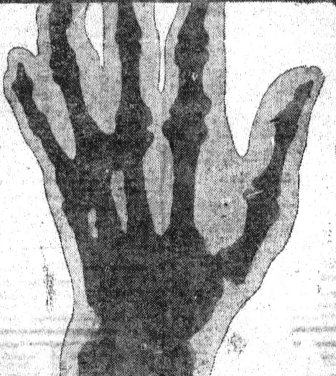
James “Deacon” McGuire caught more than 1600 games in a career that spanned parts of 26 seasons between 1884 and 1912.  He broke every finger on both hands and suffered thirty-six separate injuries to his left hand.  In 1906, his x-ray was acquired by the New York papers after yet another injury.

The New York World said doctors were “amazed to see the knots, like gnarled places on an old oak tree, around the joints, and numerous spots showing old breaks.”

Deacon McGuire

Deacon McGuire

“A Baseball with a Mystery Attached to it”

13 Jun

The Chicago Tribune’s Hugh Fullerton claimed that somewhere at Chicago’s West Side Grounds, home of the Cubs, “if it has not decayed, there is a baseball with a mystery attached to it.”

Hugh Fullerton

Hugh Fullerton

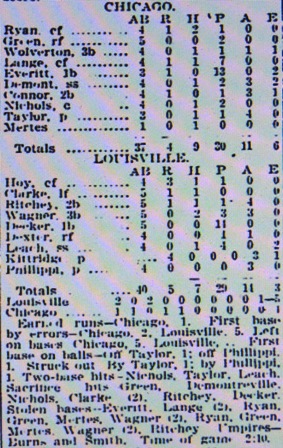
The incident took place on May 11, 1899 “in the middle of a hot game between Louisville (Colonels) and Chicago…this ball disappeared—and as far as anyone knows never yet has been found.”

Fullerton said:

“The score was 4 to 4 in the seventh inning, with Chicago at bat, when Arthur Nichols, the little catcher, came up with one man out. He whanged into the ball and drove it safe to right.  Charlie Dexter threw to second and Nichols slid safe just as the ball arrived.  Tommy Leach was covering second base, and as Nichols slid he lost sight of the ball.  He said it struck his forearm and fell to the ground, and when he started to pick it up it wasn’t there.  He thought it was under Nichols and waited until the runner arose. The ball was not there.

“Nichols waited and held the base, fearing the ball was hidden and he would be tagged out. (Claude) Ritchey and Leach were busy hunting for it.  Everybody joined in.  Still Nichols feared a trick and stuck to the bag.  After five minutes umpire (William) Smith, who was working on the bases, called the Louisville players down, and after accusing them of hiding the ball threw a new one into play.  Chicago kicked and Nichols was ordered to run home.  He ran, but Smith sent him back to second and ordered play begun with a new ball.”

Art Nichols

Art Nichols

Pitcher Jack Taylor singled to right, and Nichols was thrown out at home plate by Dexter.  Louisville went on to win the game 5-4 in ten innings.

Fullerton said:

“Leach, Nichols and Ritchey, the only men near the ball, vowed they never saw it.  What really became of it no one seems to know.”

The Box Score

The Box Score

“All Men were his Friends”

12 Jun

Among the reasons Rube Levy remained one of the most popular figures in West Coast baseball was his refusal to accept offers to play for teams outside of California.  The San Francisco Chronicle said:

“With all his vast experience on the baseball diamond, the young man has never ventured beyond the confines of the state in which he was born…Time and time again Rube has received princely offers from Eastern magnates bidding against each other, but he always declined their advances.  He knew that California needed him, and he said he never would desert the state.  This sacrifice on his part is what has endeared Reuben in the hearts of the populace and why he is always greeted with plaudits.”

Reuben "Rube" Levy

Reuben “Rube” Levy

Levy disappeared from professional rosters after the 1896 season, but appears to have remained active as a player and umpire in semi-pro baseball in San Francisco.

Levy, along with his brother David who also played professional ball on the West Coast in the 1880s and 90s, also worked for the San Francisco Fire Department.  A  city report from 1898 shows the brothers working out of Engine Company 14 on McAllister Street.  Reuben, badge number 187, was an assistant foreman, David, number 184, a hoseman.

In 1899 he became an umpire in the California League.  Early in the season The Sporting Life said “he is not altogether conversant with the playing rules,” and later said he “is umpiring in style, but is a little off on balls and strikes.”

The following season Levy returned as a player with the San Francisco Brewers in the California League.   On April 2, 1900 The Chronicle, which incorrectly said he had been away from professional ball for seven years, said of the crowd:

“It applauded every move made by Rube Levy, who played out in the western prairie for San Francisco, and made one hit and four putouts and otherwise distinguished himself before rooters who used to yell for him years ago.  Old timers referred to the epoch when Rube used to be the darling of the kindergarten bleachers at the old Haight Street Grounds, when 2000 shrill-voiced youngsters, at 10 cents a voice used to go into ecstasies over Rube.”

The article said of the 37-year-old, “(He) chased flies and caught them as cleverly as though he were Rube’s grandson.”

Levy appeared in 87 games in 1900, hitting .205, and returned to umpiring the following season.

In 1903 he joined the newly formed Pacific Coast League.  It’s more likely he acquired the position because of his brother-in-law, rather than based on his reputation as an umpire.  Levy’s wife was the former Rebecca Fisher, sister of Mike “Mique” Fisher one of the league’s founders and owner/manager of the Sacramento Senators.

"Mique" Fisher, Levy's brother-in-law.

“Mique” Fisher, Levy’s brother-in-law.

The reviews of his work as an umpire never improved, The San Francisco Call said about one game: “He did not give either nine the worst of it, He was just impartially rank.”   The Los Angeles Times was especially critical of his work, calling him “notoriously incompetent.”

He managed to remain on the league umpire staff through the 1904 season.

The Spokane Daily Chronicle summed up his career as an arbiter:

“He was anything but a success as an umpire, but he had the reputation of being one of the few men in the business who refused to get mad.  The players started in time and again to bait him and get him mad, but Rube always preserved his abundant good humor.”

After the 1904 season Levy opened a cigar store on Fillmore Street in San Francisco.  On February 8, 1907 the 42-year-old Levy died after a brief illness, his death was attributed to a brain tumor.

The Sporting Life said of his death:

“(T)here was never a more popular ball player in San Francisco, and of whom it can be truly said that all men were his friends.”

“The Idol of the Haight Street Grounds”

11 Jun

Reuben “Rube” Levy was one of the first Jewish professional players, and one of the biggest stars in the early days of West Coast baseball.

Born in 1862 to Prussian-Polish immigrants, Levy worked as a shoe cutter and began his professional career as a teenager, playing left field for the San Francisco Californias in the New California League in 1881.

A good fielder, but not particularly fast, The San Francisco Morning Call once described him chasing a ball: “Reuben Levy, following the ball as it sped gleefully along, looked like a cow chasing a coyote across a pasture.”

Reuben "Rube" Levy, 1888

Reuben “Rube” Levy, 1888

Levy quickly became a fan favorite.

The Morning Call, and The San Francisco Chronicle called him “the hero of the kindergarten” during the years he played at Haight Street Grounds; the title referred to the section of the grandstand adjacent to left field occupied mostly by young fans.  The Sporting Life said “there never was a more popular player in San Francisco,” and called him “The idol of the Haight Street Grounds.”

Years later, The South of Market Journal recalled that the “kindergarten” fans “applauded the genial Rube for any kind of play.”  The paper said one reason why Levy was the most popular West Coast player with children was because in the days when baseballs were a valuable commodity he would:

“Get hold of a ball that he would bide and save till the game was over, when the kids would swarm down the field and gather around their idol. He would take a ball from his pocket; toss it high in the air with hundreds of healthy youngsters, among them future greats, in a big drive to capture it. Believe us, many a spunky kid emerged from this huddle with something other than a smile, yes, more like a blue forget- me-not under the eye in the struggle for the possession of the prize. Then away Rube, the idol of the Kindergarten would gallop lo the clubhouse joyful in the thought that his juvenile admirers were
made happy for the day.”

In 1890 The Sporting Life said Levy had won a contest for the most popular player in the California League, beating out popular Oakland Colonels infielder, and fellow San Francisco native, Jim McDonald:

 “(A)t the eleventh hour the friends of Rube Levy executed a grand coup by unloading three thousand votes into the ballot box, thereby flooring McDonald and other favorites ‘out of sight.’  Sixth Street and the Kindergarten by a straight stroke had outwitted Mac’s friends and landed their boy first under the wire, and distanced all others. Well, Levy deserves it, as he is a quiet, unobtrusive gentleman and first-class ball player, and Jim would rather have been beaten in the race by his old neighbor than by any other player.”

San Francisco's Haight Street Grounds

San Francisco’s Haight Street Grounds

Levy was said to have a good arm, and while with the San Francisco Metropolitans in 1892 manager Henry Harris decided to use the left-hander on the mound in an early season game.  The Chronicle said:

“The Los Angeles (Seraphs) team has a majority of left-handed batters in its make-up, and they generally hit the ball on the seam for bases. Harris is a firm believer in the theory that a southpaw is particularly effective against this class of hitters.”

The experiment failed.  The Chronicle said Levy “with the speed of a (Amos) Rusie, but without control…entered the box against (Bob) Glenalvin‘s men (and) gave them the game in the first few Innings.”

Harris used Levy three more times on the mound, but the results were no better.  He ended up 0-2, giving up 12 hits, three walks and 14 runs (although only 2 earned) in six innings.

Levy pitched at least one more game each during the 1893 and ’94 season.  The Chronicle said of his 1894 effort pitching for the San Francisco Hot Peanuts against the Californias of San Francisco:

“Rube Levy was elected to do the twirling yesterday and in consequence of the arrangement the San Francisco team was defeated.  Throughout the afternoon Reuben’s opponents at the bat straightened out his curves for long-distance jolts, and stole bases on him unawares.  Levy’s work in the box was so ineffective that the crowd was continually provoked to offering him words of cheer and comfort.”

Levy pitched a complete game, losing 18-10, the Californias had 17 hits, stole seven bases, and the Peanuts committed 11 errors behind him.

Levy was generally described as a clutch hitter, but almost no statistics survive.   Baseball Reference lists his 1892 and ‘93 averages at .237 and .283.

Levy, unlike other pioneering Jewish players seems to have been spared  of anti-Semitism and Insensitivity, perhaps owing to San Francisco’s large Jewish population (second only to New York during his career).

While the San Francisco based Breeder and Sportsman referee to his “little Hebraic curve,” in an article about one of his pitching appearances, nothing seems to have risen to the level of what Zeke Ferrias faced when pitching in the Three-I and other Midwest leagues during the first decade of the 20th Century.   It was not unusual for newspapers, like The Dubuque Telegraph-Herald to attribute a victory to Ferrias’  “Jew luck,” and conversely, when he began to fade as a pitcher to mention that “his Jew luck had quit him.”

The first part of Rube Levy’s career came to a close when he retired after the 1896 season; the second part tomorrow.

“The Deterioration in the Morale of the Players”

10 Jun

The Chicago Tribune had had enough:

“The deterioration in the morale of the players has been followed by deterioration in that of the spectators.  The latter relish the obscene profanity and the slugging exploits of the hulking brutes of the baseball field.”

The Tribune provided an “account of the more disgraceful of the many rows witnessed by spectators of baseball games,” during the just-ended 1899 season:

“May 2—Row at Pittsburgh—St. Louis game.  (Frank) Bowerman was put out of the game.  (Jack) O’Connor was taken off the field by the police, and the crowd chased umpires (Tom) Burns and (William) Smith.

May 19—Umpire Burns put (Giants’ William “Kid”) Gleason out of the game at St. Louis.  Gleason’s protest was so strong Burns forfeited the game to St. Louis.

June 1—Row on the grounds at Washington.

June 16—After a long wrangle and continued rowing on the field at New York.  Umpire Burns forfeited the game to Brooklyn.

June 16—(Fred) Clarke and (Clarence “Cupid”) Childs fight on the field in Louisville.

June 27—Rowdy action of players caused the crowd at the Pittsburgh game to mob umpire (James “Chippy”) McGarr.

July 18—(Tommy) Corcoran slugged (John) McGraw at Baltimore after being first attacked, and his action started a riot.

July 26—(Emerson “Pink”) Hawley, (Fred) Tenney, and (Hugh) Duffy engaged in a game of fisticuffs at Cincinnati.

Aug 16—(Oliver “Patsy”) Tebeau, McGraw and (George “Candy”) LaChance fought at Baltimore

Aug 18—Riot at Baltimore game started by (Tim) Donahue throwing a handful of dirt at (Steve) Brodie’s face.

Sept 1—Childs and Aleck Smith fight on the field in Louisville.

Sept 7—Riots at St. Louis and Brooklyn.

Sept 15—Clarke taken off Philadelphia grounds by police.

Sept 16—Chicago players jerked (Ed) Swartwood around the diamond because he called the game in the eighth inning on account of darkness.

Oct 9—(George “Win”) Mercer assaulted (Al) Mannassau at Washington.

Oct 14—(Jimmy) Scheckard assaulted umpire (John) Hunt, refused to retire, and Hunt forfeited the game to Brooklyn.”

Cupid Childs, repeat offender

Cupid Childs, repeat offender

Al Mannassau, assaulted by Win Mercer in Washington

Al Mannassau, assaulted by Win Mercer in Washington

In addition to the fans, The Tribune blamed team owners:

 “For the multifarious minor acts of blackguardism and rowdyism of which the hired men of the club owners were guilty there is no room.  It is sufficient to say that they, like the graver offenses mentioned above, did not wound the feelings or jar on the nerves of the proprietors of these baseball roughs.  Those proprietors seem to have come to the conclusion that audiences like these ruffianly interludes.”

Like hundreds of predictions before and thousands more to come over the years, The Tribune saw dire consequences for baseball given the current state of the game:

“There was a time when Chicagoans went to see the games of the Chicago club because they had a feeling of proprietorship in that organization.  That day is over.  Men do not go to see games out of local pride, nor do they go to see fine playing.  They go to listen to the language of the slums and to witness the horseplay and brutalities of the players or performers.  When these have lost their attractions professional baseball will disappear. “

Gus Dorner’s Spitball

7 Jun

dorner1 dorner2

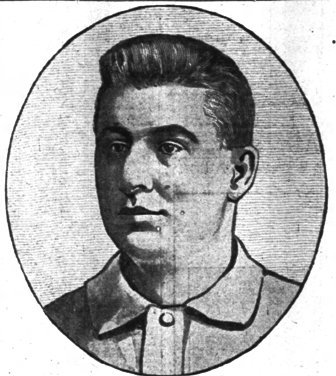
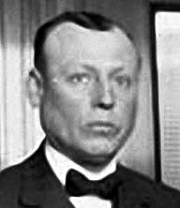
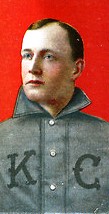
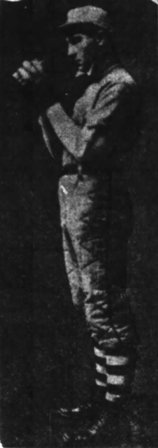
Augustus “Gus” Dorner suddenly became a successful pitcher in 1904.  He had brief trials with Cleveland in the American League in 1902 and ’03, he was 6-6 and control was a problem; on May 23, 1903, walked 11 batters in a game against the Philadelphia Athletics.  He finished the 1903 season with the Columbus Senators in the American Association posting a 7-7 record.

The next two seasons in Columbus Dorner was 18-10, and 29-8.  The Fort Wayne Daily News said:

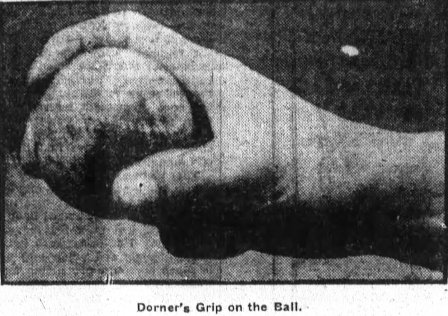
“The big German attributes his success to condition, control, study of the batsman and mastery of the spitball.”

Dorner said, “I use the spitball a great deal.”  As a result of his new pitch he said:

“(I) have not had the slightest trouble with my arm this year.  I have worked hard to get control and perfect the spit ball.”

The magic was short-lived.  Dorner earned a return to the big leagues in 1906 but was a combined 8-26 with the Cincinnati Reds and Boston Beaneaters.  Overall he was 29-62 in parts of four seasons with Boston.

Gus Dorner

Gus Dorner

He didn’t fare much better in the minor leagues, going 25-29 his last three seasons as a professional.  After his release from Boston in May of 1909, he finished the season with the American Association’s Kansas City Blues with a 9-18 record.  The last two years of his career were spent with the Wilkes-Barre Barons in the New York State League and the Harrisburg Senators in the Tri-State League.

Ernest Nichols

6 Jun

Ernest Nichols seemed destined for stardom.  He was the subject of a bidding war before he ever pitched in a professional game.  The San Francisco Chronicle said that his hometown San Francisco Seals wanted to sign him, but had a lot of competition:

Parke Wilson wanted him for the Pacific Coast League in Seattle (the Siwashes), Matt Stanley recommended him to (Dan) Dugdale for the opposition team in Seattle (the Chinooks of the Pacific National League), and Spokane came along with a contract calling for a large figure and took Nichols away from the other bidders.”

Ernest Nichols

Ernest Nichols

The 21-year-old, six-foot, 190 pound right-hander was in high demand after pitching for the amateur Reliance Athletic Club team of Oakland in Northern California’s Mid-Winter League, and an independent team in Vancouver in 1902.  The Chronicle said:

“Speed and control were Nichols’ strong suit, and he had the remarkable record of thirty-five strikeouts in two consecutive games (with Vancouver).”

Upon joining the Spokane Indians Nichols immediately lived up to the hype.  By mid July he had started 24 games, winning 20.  During a one week stretch in June he beat the Tacoma Tigers four times.  The Chronicle said Nichols, who supported his mother and sisters had his salary “raised voluntarily by the Indians.”

On July 20 Nichols and two teammates went swimming at the pool in Natatorium Park, park of the amusement park that also included the Indians’ ballpark.   After swimming, the three began to watch a ballgame between two local teams.  The Spokane Spokesman-Review said:

“(Nichols) complained of cramps.  The three started to walk to catch a car.  When a car arrived he was lifted aboard and speeded to Dr. Kimball’s office.  The doctor saw that he was dead.”

He died of septic endocarditis.  Two days later The Spokesman-Review said:

“The last sad rites were rendered to the remains of pitcher Ernest Nichols yesterday afternoon by his friends and associates who knew him intimately and by a great mass of the public who knew him only through his baseball fame. “

Nichols’ body was returned to San Francisco and plans were quickly made to play a benefit game in his honor in Spokane.  The game between the Indians and the Butte Miners raised $1025.

In October of 1903 The Chronicle said:

“In all the league averages no box man is found with a record approaching that of the late Ernest Nichols, the San Francisco boy who won 20 out of a possible 24 games before death called him.”