“Calvo May Come Out But No One Cares”

5 Jun

Jacinto Calvo and San Francisco Seals owner Charlie Graham were unable to come to terms on a contract for 1918, and the local press quickly turned on the outfielder.

The San Francisco Chronicle said:

“(Calvo) is a simple-minded Cuban boy…When he is hitting he can go around the bases in nothing flat.  When he has a batting slump, he develops water on the knee and can hardly limp up to the plate.”

He remained in Cuba and served as a police officer in Havana.

It was rumored again in 1919 that Calvo might return to the Seals, but The Chronicle, under the headline “Calvo May Come Out But No One Cares,” made it clear that twelve months had not softened opinions about the holdout outfielder:

“Calvo has written friends that he wants to come back, but if he stays in that dear old Havana until Charlie Graham coaxes him back, he will grow whiskers a foot long.  Graham really tried to get Calvo last year, for he was in a bad way for lack of outfielders, but if there is any coaxing to be done this year, Calvo will do it.”

Calvo
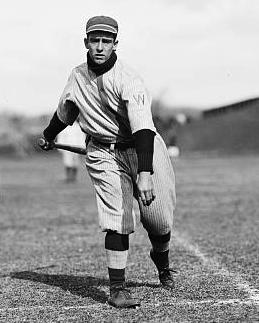
Calvo

Terms were not reached for 1919, and Calvo remained in Havana for another year.

In February of 1920 The Chronicle said Calvo, “Who bobs up every year about this time,” had written Graham saying he wanted to return to the Seals, then in March the paper reported that “The Havana World” said that Calvo “has joined the Franklin, PA independent team together with (Manuel) Cueto.”

Neither report proved true; instead, Calvo was signed by Clark Griffith for a second tour of duty with the Washington Senators.  In 17 games he had only one hit, a triple, in 23 at-bats before being sent to the Little Rock Travelers in the Southern Association in July.

Calvo could not hit American League pitching, but no one questioned his throwing arm; except teammate Stanley “Bucky” Harris.  The future Hall of Famer wrote in 1925, in a series of articles he wrote for The North American Newspaper Alliance, that his doubts about Calvo’s arm almost cost him his career:

“I thought I could hurl a baseball farther than anyone on the club and entered into a contest with Jack Calvo, an outfielder.  The Cuban has a reputation for having a great arm.  I had won a long-distance throwing contest…while with the Buffalo club.  That convinced me I could hold my own.”

Despite being warned against taking on Calvo by teammate Clyde Milan, Harris went ahead with the contest, the two stood in the infield:

“(Calvo) cut loose.  He threw the ball over the right field bleacher wall.  I realized it was a truly wonderful peg.”

Harris said he was concerned about being caught by manager Clark Griffith and rushed his throw:

“My elbow cracked as the ball left my hand.  It sounded to me as if a board had been broken across a fence…The ball dropped yards inside the park.”

Harris said for three weeks he “wondered if I ever would be able to throw a ball again.”  By the time Harris returned to the lineup, Calvo was on his way to Little Rock where he hit .306.

From 1921 through 1926 Calvo spent his summers playing baseball in the states; most notably in Fort Worth, where he helped lead the Texas league Panthers to two Dixie Series victories over the Southern Association champions in 1923 and ’24.  His winters were spent working as a lieutenant in Havana’s Harbor police and playing baseball in the Cuban League.

Calvo’s career ended abruptly in September of 1926.  The San Antonio Light reported that the former Fort Worth outfielder, then with the Memphis Chickasaws in the Southern Association “must forego baseball…and return to his job, his leave of absence was about to expire, and he packed up and beat it for a boat.”

Calvo played briefly in Cuba that winter but never played professionally again.  He was elected to the Cuban Baseball Hall of Fame in 1948 and died in Miami in 1965.

“Calvo has been the Victim of a Cruel and Merciless Conspiracy”

4 Jun

When he signed 18-year-old Jacinto “Jack” Calvo Gonzalez, Washington Senators manager/owner Clark Griffith was no stranger to Cuban players, having managed Armando Marsáns and Rafael Almeida with the Cincinnati Reds, but Calvo’s signing was the beginning of Griffith’s 40-plus year commitment to signing players from Cuba.  During his tenure the Senators signed more than half of the 63 Cuban players in the major leagues.

Calvo was “discovered” while playing with Almendares in the Cuban National League, where he hit .342 in 19 games.  He made even more of an impression during a series Almendares played against the New Orleans Pelicans of the Southern Association, Calvo hit .400 and his older brother Tomas hit .385.

???????????????????????????????

He also hit .400 during a six-game series with the Philadelphia Athletics, The Associated Press said he didn’t compile those numbers facing minor league pitchers picked up for the series, but “against (Eddie) Plank, (Jack) Coombs, and (Charles “Chief”) Bender.”

When rumors circulated that Washington might have signed Calvo, Bender said:

“I never saw a faster youngster in my life; he can hit too, and looks for the entire world like a class ball player…If Griffith has signed him he will never regret it, for there is no chance for him to be a failure.”

By December of 1912 Griffith had Calvo under contract.  The Pittsburgh Press said:

“The young Cuban sent a letter to Griff, written in Spanish.  ‘They did not teach Spanish where I went to school,’ said The Old Fox, ‘so I can’t translate the missive.  However, as he signed his contract I guess everything is alright.’”

The Boston Red Sox signed Tomas Calvo later in December.

While Tomas never made it in Boston, Jacinto made his debut with the Senators on May 9; he hit only .242, but everyone noticed his arm.  After a June game with the St. Louis Browns, The Associated Press said:

“The youngster astonished the bugs yesterday with his remarkable throwing arm.  At one time he heaved the ball from the right field fence directly to (Germany) Schaefer’s hands at second.”

On August 13 Calvo was sent to the Atlanta Crackers in the Southern Association and made his first appearance with the team the following day, batting seventh, going 1 for 4.  The Atlanta Constitution said “He’s fast, fields pretty well, throws like a shot and meets the ball squarely.”

Calvo only lasted 10 days in Atlanta.  He was hit on the right arm with a pitch thrown by Charles “Curly” Brown of the Montgomery Rebels.  He was returned to the Senators and did not appear in another game that season.  (Some sources show Calvo with the Long Branch Cubans in the New York New Jersey League—it was most likely his brother Tomas, an infielder, rather than career outfielder Jacinto, who played shortstop for the team in 94 games).

Calvo started the 1914 season with the Los Angeles Angels in the Pacific Coast League.  After only 11 games (he was 4-8 with one double, one triple and a stolen base) he was sent to the Victoria Bees in the Northwestern League.  Later in the season a story came out explaining his abrupt departure from Los Angeles.

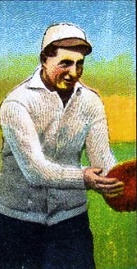
Calvo with the Washington Senators

Calvo with the Washington Senators

The Spokane Spokesman-Review said, “Calvo has been the victim of a cruel and merciless conspiracy,” despite the fact that “in the exhibition games last spring against the White Sox Calvo loomed up head and shoulders above the other Angel gardeners, out hitting them by a wide margin and displaying more speed on the bags than the whole Angel team combined.”

The paper claimed that a female reporter:

“(o)n one of the local papers…dragged out of him the fact that his father was a rich sugar planter in Havana, and that he played baseball for fun and not for money…That was the beginning of the end for little Calvo. “

The story said fans began harassing Calvo, and:

“Instead of coming to his rescue, the players on the Angel team ‘rode’ the boy unmercifully.  It was pathetic to see the friendless little Cuban trying to get into the good graces of his teammates.  One day, in the clubhouse the boy sat down on a bench and cried before them all.  His spirit was broken.”

Calvo hit .289 for Victoria in 1914, and spent the spring of 1915 with the Senators before being release before the beginning of the season.  After his release he played with his brother Tomas for the Long Branch Cubans, by then a member of the Independent Negro League; he also played for Havana in the Cuban-American Negro Clubs Series.

Calvo next played for the Vancouver Beavers in the Northwestern League and the San Francisco Seals in the Pacific Coast League, hitting .329 in 1916, and slipping to .263 in 1917. After the 1917 season, the outfielder returned, unsigned, the contract sent to him by Seals owner Charlie Graham.

Calvo had been very popular in San Francisco during his nearly two seasons with the Seals, but was criticised by fans and local press for his holdout, especially because he was holding out on the even more popular Graham.  The San Francisco Chronicle said:

“He sent his terms, and as they were exactly what he asked for before.  (Charlie) Graham is wondering why the Cuban went to the trouble to wire at all.”  The paper criticised Calvo for “asking for more money than he got last year,” while “better players than he have submitted to a salary slash on account of war conditions.”

San Francisco Seals owner Charlie Graham

San Francisco Seals owner Charlie Graham

The Chronicle lamented the fact that Seals outfielder Biff Schaller would miss the entire season with an injury, otherwise “Calvo could have stayed in Havana for all that anyone here cares.”

As it turned out, Calvo did stay in Havana.  For all of 1918 and ’19, not returning to the states until 1920.  Tomorrow–Jacinto Calvo’s return.

Luke Easter, Sausage King

31 May

???????????????????????????????

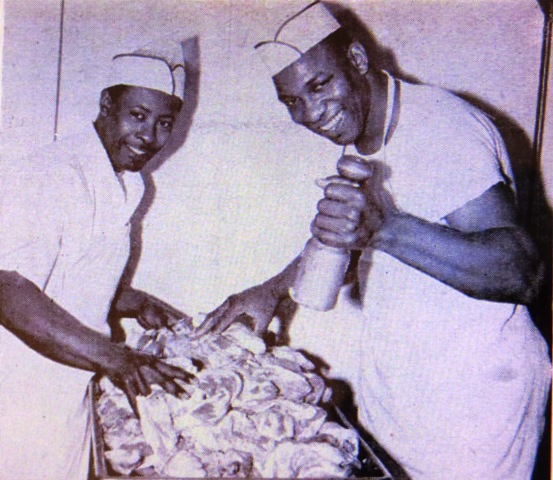
Between the 1952 and ’53 season, Cleveland Indians first baseman Luke Easter (r) went into the sausage business with his brother-in-law Raymond Cash (l).  The business, Ray’s Sausage still operates in Cleveland.  In a Jet Magazine article  Easter said they only managed to sell 20 pounds their first week, but by January of 1953 they were selling 2,300 pounds a day.  The article said Easter had “taken out a license to place his sausage on sale” at Indians games.  He said:

“I can make this business go by hitting lots of home runs (but) even if our sausage makes a million dollars I won’t quit baseball, I’ll stay in baseball as long as I can walk.”

During the fourth game of the 1953 season Easter was hit by a pitch, breaking a bone in his foot, as a result the 37-year-old, who had hit 31 home runs with 97 RBIs in 127 games the previous season, dropped to 7 and 31 in 68 games;  his career with the Indians ended after only 6 games in 1954.  But while Easter didn’t hit “lots of home runs” in Cleveland after starting the company, he did stay in baseball for almost “as long as (he could) walk.”

Playing primarily in the International League with the Buffalo Bisons and Rochester Red Wings, Easter remained in baseball until 1964, hitting more than 235 homes runs.

Easter was killed in a hold up in Cleveland in 1979.  The Cleveland Plain Dealer editorialized the day after his death:

“For all of his huge size and great strength, Luke Easter was a gentle man.  It is a contradiction to the way in which he lived that his life should be ended violently.

“He had courage.  He played first base for the Cleveland Indians from 1949 to 1954, a time when it was far from easy to be a black athlete in the major leagues…He was shot dead yesterday at age 63, victim of a cowardly attack from ambush outside a bank office .

“It is a wound to the community.  Luke Easter, athlete and gentleman, will be missed.”

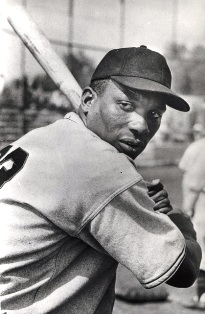
Luke Easter, 1949

Luke Easter, 1949

“The Speed of Rusie”

30 May

Hall of Famer Amos Rusie “The Hoosier Thunderbolt,” was famous for his fastball; it’s been estimated that he threw in the high 90s.  In only nine full seasons he led National League pitchers in strikeouts five times.

Amos Rusie

Amos Rusie

Sports writer William A. Phelon contended that Rusie was the fastest pitcher he had seen, and in 1913 he told a story by James Tilford Jones who played for the Louisville Colonels in 1897, and was still a fairly well-known minor league player.

The likely apocryphal story (Jones only had one at bat as a pinch hitter that season, and did not strike out)  appeared in The Cincinnati Times Star, and according to Phelon, Jones said:

“ Don’t tell me that Walter Johnson, or any other pitcher of the present time, is faster than Rusie, or even that any man has the speed that Rusie used to throw…That man was unique and individual –there was never one like him before his time, and none since.  I don’t think there ever will be.

“My first experience with Rusie happened a long, long time ago, when he was in full swing and I was playing with Louisville, then a member of the big circuit.  I was warming the bench that particular afternoon, and wasn’t specially noticing the work of the other side, when our manager (Fred Clarke) beckoned me.  ‘Joensey’ said he, ‘you go up and bat for the pitcher.  Two on, two down—we just gotta have this game.  Go up there and lay the bat against the leather.’

“’All right sir’ I assented.  I’ll pickle one outside the lot if he puts it over.’  And up I strode, with a fat bat in my hands.  I saw a very large, red-faced man standing out there on the pitching line and I saw him raise his right arm.  I was wondering why on earth he didn’t throw it, when heard something go POW, just like that, behind me.  I looked around.  It was the thud of the ball ramming into the big mitt, and the umpire said, ‘One strike.’

“I watched the big man keenly, and again he raised his arm while I set myself to annihilate the ball.  An instant later I saw a ball going by me, and swung at it.  It was the ball being returned by the catcher, and I thought it was coming up instead of going away.

“By this time I was furious, also desperately determined.  So I set myself almost upon the plate, with the bat jutting out, and watched the big man very closely.  Then something crashed into my bat, ripped it from my hands, and drove it round against the back of my neck—and I knew no more.

“Two or three days later, the situation was exactly the same—Rusie pitching, our pitcher up, and dire need of a pinch hitter.  Again the manager beckoned me. ‘Go up and hit him, Jonesey’ growled he.

“I marched up to the plate, but went up empty-handed— didn’t even pick up my bat—and calmly stood there in the batter’s box, with nothing but my bare hands.  ‘Hey you,’ yelled the manager, ‘where’s your bat.’

“’Don’t need it,’ I shouted back.  ‘I can’t see them anyway, and it is a whole lot safer with nothing in my hands than be up here with a chunk of timber that he might drive clear through my head!’

“Oh, yes, yes.  Rusie had some speed when he wanted to use it, and I never remember seeing him any time when he wasn’t inclined to use it, either.”

Jones only appeared in two games during the 1897 season; in his first game he pitched 6 2/3 innings in relief in a 36-7 loss to the Chicago Colts, giving up 22 runs, 14 earned—the Colts’ 36 runs are still the Major League record.

Jimmy Jones

Jimmy Jones

Jones became a full-time outfielder in 1900 and returned to the National league with the New York Giants in 1901; he appeared in 88 games for the 1901-02 Giants, hitting .209 and .237.

He returned to the minor leagues and continued playing until 1914, and finished his career managing the Maysville (KY) Burley Cubs in the Ohio State League in 1916.  He served as Laurel County Clerk for twenty years, and died in London, Kentucky in 1953.

Rusie retired with a 245-174 record, striking out 1,934 and walking 1.704.  He died in 1942 and was elected to the Hall of Fame by the Veterans Committee in 1977.

“A Man Can’t Play Ball When He ain’t Getting no Money for it”

29 May

In January of 1890 Louis Rogers Browning, Pete, “the Gladiator,” the biggest star, even if no longer the best player, of the 27-111 Louisville Colonels of the American Association, jumped to the Cleveland Infants in the Players League.

Browning, illiterate, alcoholic, superstitious, and nearly deaf as a result of an untreatable ear condition, had quickly become popular among his hometown fans—despite being called out for on-field drunkenness as early as 1882 by The Louisville Courier-Journal.

Browning had won two American Association batting titles (1882, 1885), but had slipped to .313 in 1888 and .256 in 1889 playing in 99 and 83 games.

The New York Sun said the signing caused a “sensation” in Louisville despite that:

“(I)t has been said for two years that he had lost his usefulness by reason of his  defective eyesight and intemperate habits.”

Browning’s “defective eyesight” was said to be the result of his belief that stating into the sun would improve his “lamps.”

Pete Browning

Pete Browning

The Sun said Browning provided a “funny explanation” (all grammar errors are from the original text) for leaving his hometown to sign with Cleveland:

“I have been waiting for this chance for four years.  They ain’t treated me right here since 1886.  I used to play great ball for ‘em till they put the screws on me so hard, then I just quit.  I don’t mean that I didn’t play honest ball, but I just got discouraged and couldn’t do it.  A man can’t play ball when he ain’t getting no money for it.  I tell yer they have been socking it to me ever since 1886.  I’ve been fined so heavy that my salary ain’t ever been over $1,000, when I could have been making $2,000 and $3,000 from other clubs.  Newspapers have done me up so that people in the East have thought I was no more good.”

Browning said that after financially troubled owner Mordecai Davidson turned the Louisville franchise over to the American Association in July of 1889, and the league secured new, local ownership, he thought his situation would improve.

“They said my peeps was out of condition and I couldn’t hit a balloon.  Well, you ought to a ‘seed me line ‘em out.  They couldn’t put the ball nowhere I couldn’t get ‘em.  I played the game of my life.  I knocked the cover off the ball right along.  When I come home (from a road trip in August) I thought they would meet with a brass band.  Well I got a letter from (the Colonels new management) sayin’ I was laid off.  The papers said I had been drinkin’ when I hadn’t touched a drop for months.  They wouldn’t give old Pete a chance.”

In the fall of 1889 Browning played for a team in Knoxville, Tennessee, The Sporting Life’s “Louisville correspondent” said he had stayed out of trouble:

 “I understand that Pete’s conduct while recently with the Knoxville Club was quite exemplary, and tat be drank nothing but water.  Since his return to Louisville he has behaved himself in the same manner. Pete, however, always had a strange way of keeping sober during the winter and getting drunk in the spring when it was time to play ball.”

Browning told The Sun that his performance in Knoxville had earned him several offers from other teams, that he was in great shape, and that Louisville management was to blame for a lot of his problems:

“I give you my word of honor I haven’t touched a drop of anything for seven months.  I know that I have gone wrong sometimes, but if they had come to me an’ talked to me like gentlemen, I’d a done anything for ‘em: but they don’t do it, an’ they run off to the papers with another story of old Pete bein’s on a tear.  That just made me worse.  Do you think I’ve got no feelin’s left?

“Well I’m goin’ away, an’ you just watch me.  Talk about my peeps, there was never nothin’ the matter ‘em.  It was my nerve that was weak…Pete knows his biz, and he’ll get a chance someday.  An’ he has.  Keep an eye on me this season.”

Presumably Browning’s “peeps” were not completely ruined yet by his staring into the sun; he hit .373 and won the Players League’s only batting championship.

He would play through the 1894 season, compiling a lifetime .341 average.  The sad story of Browning’s post-baseball life and his death in Louisville in 1905 are well documented elsewhere.

Jim Lillie

28 May

The Sporting Life described Jim Lillie as “one of the most sensational of right fielders,” and “the rival of Mike (King) Kelly in the position.”  The New Haven Register said he earned his nickname “grasshopper”  as a result of his “agility in the outfield.”

His career was brief, and his short post-baseball life was tragic.

The 21-year-old Connecticut native was said to have been discovered by “Orator Jim” O’Rourke “on the lots and commons of New Haven.”  He played his first professional game on May 17, 1883 with the Buffalo Bisons in the National League.  Lillie appeared in 50 games, hitting .234. In November his hometown newspaper, The New Haven Register, got his position wrong (saying he was used primarily as a catcher—he caught in two games), but said “his record was highly credible,” and that he had already signed for the 1884 season.

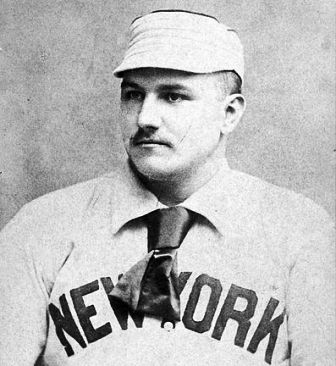
Jim Lillie

Jim Lillie

Lillie spent two more seasons in Buffalo; leading the team in games played both seasons.  In 1884 he led National League outfielders with 41 assists; his 40 errors also led the league.  He committed 33 errors the following season; he hit .223 and .249 for the Bisons.  When the team disbanded after the 1885 season, his contract was assigned by the National League to the Kansas City Cowboys, who had been admitted to the league on a trial basis.

He had, for him, a typical season in the field: 30 errors (third in league), 30 assists (second) and 199 putouts (third).  He also had one of the all-time worst performances at the plate; hitting .175 in 426 at bats, with only nine extra base hits (all doubles), he finished the season with 82 total bases—for identical .197 on base and slugging percentages.

The 30-91 Cowboys were dissolved in February of 1887, with the players being sold to the league.

Lillie remained in Kansas City, and had the best season of his career with the Cowboys, now in the Western League.  He also met an 18-year-old woman named Nellie O’Shea, the daughter of a wealthy Kansas City contractor and said The Kansas City Star, “a young lady highly spoken of.”

Lillie, playing primarily in left field, hit .369; a hitter’s haven, the Western League leader, Jimmy Macullar hit .464, and Lillie’s average was good for 34th best in the league.

On December 29, 1887 Lillie married Nellie O’Shea.

He joined the Fort Worth Panthers in the Texas League around June 1 of 1888, but left the team in less than two weeks.  The Dallas Morning News said he was released, The New Haven Register said he left Texas to be with his wife and go to work for his father-in-law, “(Lillie) promised her to settle down,” and planned on returning to baseball for the 1889 season.

He never had the chance to return to the game.  On September 10, 1888, the Lillie’s child was stillborn.  Two days later, a fire broke out in their home.  The Associated Press said:

“(Nellie) was making preparations for supper when the accident occurred…She had moved the gasoline stove too near the cooking stove and in filling the reservoir with gasoline some of it became ignited.  The flames at once enveloped her…(Lillie) entered at that moment or (she) would have been burned to death…Lillie did not notice his own condition until after he had summoned  a physician.”

Mrs. Lillie lingered for nearly three weeks before dying of her injuries on October 4.  Lillie, who had attempted to remove his wife’s burning clothes, had his hands burned “down to the bone,” and initial reports said he’d have to have some of his fingers amputated.  There’s no record of how well his hands recovered, but he never played baseball again.

He stayed in Kansas City and according to The Kansas City Star “managed (Nellie’s) estate.”  Within two years he would contract typhoid fever, and he died November 9, 1890.  The Star said his last words were to a friend at his bedside:

“I am afraid, Charlie, it is three strikes and out.”

Memorial Day—Major League Baseball’s First World War Casualty

27 May

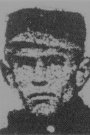
By the time he enlisted in the United States Army in July of 1917, Edward Leslie “Harvard Eddie” Grant had retired from baseball to practice law in Boston.

He attended Harvard, but only played baseball as a freshman; he was declared ineligible after being paid for playing with a semi-pro team.  After that Grant played intramural baseball at Harvard and played with Northeastern outlaw teams during the summer.

In 1905 Grant made his Major League debut when the visiting Cleveland Naps recruited him to fill in for two games at second base for Hall of Famer Napoleon Lajoie against the Boston Americans—he was 3 for 8 and made one error.

He was with the Jersey City Skeeters in the Eastern League in 1906, hitting .322, which earned him a contract with the Philadelphia Phillies.  He would spend the next nine seasons in the National League, also playing for the Cincinnati Reds and New York Giants.  Grant was never a star, but he was popular with fans and the press.  The New York Times said:

“He was a handy utility player and could fill in any position on the infield.  While never a heavy batsman, he was skillful fielder and a smart baserunner.”

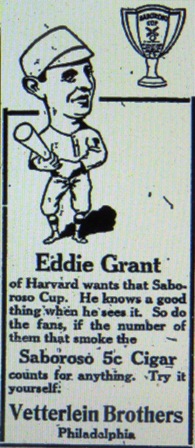
1910 Advertisement for the  Vetterlein Brothers Cigar Company; the Saboroso Cup mentioned in the ad was presented to the phillies or Athletics player with the highest batting average.

1910 Advertisement for the Vetterlein Brothers Cigar Company; the Saboroso Cup mentioned in the ad was presented to the Phillies or Athletics player with the highest batting average.

Grant was among the first wave of prominent athletes to join the military, making his enlistment news.  A wire service article under the headline “Eddie Grant Joins Uncle Sam’s League” appeared in numerous papers across the country.

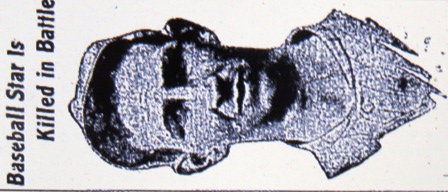
On October 5 1918, he would become the first Major League player to be killed during World War I, The Associated Press said:

“Captain Edward Grant, former third baseman of the New York National League Club, and attached to the 307th Infantry, was killed by a shell when leading a unit to the aid of the famous ‘Lost Battalion.’

“The battalion was surrounded for five days in the Argonne Forest and Captain Grant was killed in one of the attempts to reach it.”

Grant was originally buried in the Argonne Forest, and his body was later moved to the Meuse-Argonne American Cemetery.

“Manager McGraw makes Flight in Army Airplane”

24 May

mcgrawplane


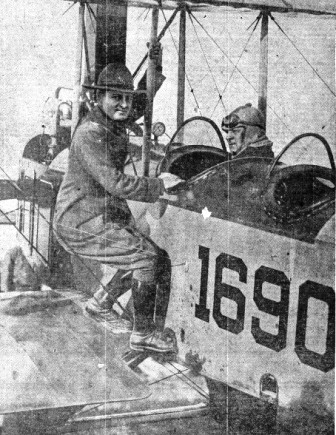
In 1918, the new York Giants traveled to Marlin, Texas for spring training.  In April, the team from the Air-Service Pilot Training Center at Richfield Aviation Camp came from Waco to Marlin to play an exhibition game with the Giants.  After the game Giants, Manager John McGraw took up Colonel Archibald Miller on his offer of a flight.  That’s McGraw in the forward seat of a Curtiss biplane, with Miller on the wing.  Newspaper reports said McGraw thought the 20-minute flight was “one experience he needed.”

McGraw, and most of the Giants, flew again with Miller and his colleagues two-years later, when after a game with the aviators’ team, The New York Times said, “McGraw and most of his regulars, most of the rookies, Dr. Birs, the club dentist, and three of the newspaper men accompanying the club made flights.”

Chicago’s Lakefront Park 1878–The First Game

23 May

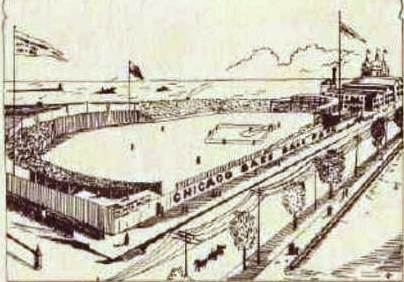
The Chicago White Stockings left Twenty-Third Street Park and relocated to Lake Front Park near the corner of Michigan Avenue and Randolph Street.  The old Union Baseball Grounds had stood at the same spot, but was destroyed in the Great Fire of 1871.

Lakefront Park

Lakefront Park

The ballpark opened on May 14, 1878 with a 3:45 pm “game between the Indianapolis nine (Blues) and the home nine.”  The Chicago Inter Ocean said:

“Although the day was very chilly and exceedingly unpleasant for out-door sports, fully 2,500 people assembled to witness the game and listen to a very ‘queer’ band, provided by President (William) Hulbert to officiate at the opening and funeral services of his white-hosed boys.”

——

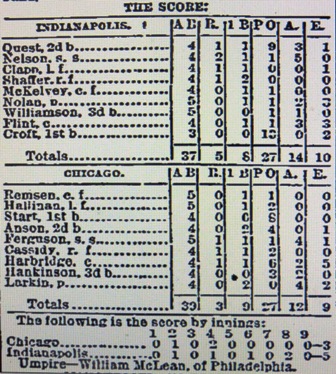
“The game was not particularly interesting except from the fact that from the first inning until the twenty-seventh man had been retired it was extremely doubtful which club would win.  The play of (Joe) Quest of the Indianapolis (sic) was by far the most brilliant of the game.  He covered the position of second base with greater ease and accuracy than any player that has been seen for many a day.  He won the game for his club by a very clever double play in the ninth inning.  The game stood 3 to 5 in favor of Indianapolis with one man out and all the bases full.  (Jimmy) Hallinan came to the bat and hit a high ball to the right of second base which Quest succeeded in catching, and by very fast running reached the base before (Terry) Larkin

Edward “The Only” Nolan got the victory for Indianapolis but “did not particularly distinguish himself in the field,” making three errors.

Of the White Stockings, The Inter Ocean said:

(Frank) Hankinson played third without an error, and received very (sic) deserved applause for a number of excellent plays.  Hallinan was brilliant in the left field, and (Cap) Anson was remarkably stupid at second.”

None of the newspaper accounts of the game elaborated on Anson’s play at second.

The Inter Ocean did elaborate on Hulbert’s band:

“(T)he dismal music furnished by the band appeared to affect almost to tears the Chicago ball-players.  Another game will be played tomorrow afternoon at the same hour, and a far different result is expected.  There will be no band.”

The Box Score

The Box Score

The White Stockings would go on to win three straight National League Championships 1880-82) at Lakefront Park (sometimes referred to as Lakeshore Park).  The ballpark was expanded after the 1882 season and remained the White Stockings’ home until they moved to West Side Park in 1885.

Things I Learned on the Way to Looking Up Other Things #4

22 May

A Ballplayers Hands

Joe Ardner played second base in the National League for the Cleveland Blues in 1884 and the Cleveland Spiders in 1890; he played another 12 years in the minors.  In 1888 he was with the Kansas City Blues in Western League and provided the following explanation of the care and maintenance of an infielder’s hands:

“A ballplayer’s hands should not be hard, they should be soft.  When my hands are in perfect condition they are almost as soft as a lady’s.  Hard hands on a ballplayer will crack and get sore, but when the skin is pliable and tough there is little danger of the hands bruising, cracking or puffing.  Some folks imagine a ballplayer’s hands to be as hard as a board, but they are wrong.”

Joe Ardner

Joe Ardner

They have realized that the Umpire is Almost Human

National League President Harry Clay Pulliam was very pleased with how civilized his league had become by 1908.  In an interview with The Chicago Tribune he said:

“The game is getting cleaner all the time.  Why, I’ve only suspended about half a dozen men this year, to about forty last year, and I want to say that the players are trying harder to keep the game clean…They have realized that the umpires are almost human.  It’s business with the player now, and they’re banking instead of boozing…It’s a grand game, clean, wholesome, and it’s the spirit of contest that gives it its virility.  Civic pride is another vital adjunct to it.  Every town likes to have its own team a winner.  Sort of local pride or another form of patriotism, I call it.”

Harry Pulliam--National League President

Harry Pulliam–National League President

Soo League Night Games

The Copper Country Soo League was recognized as a league for the first time by the National Association of Professional Baseball Leagues in 1905; its last season in operation.  The four-team league located in Michigan’s Upper Peninsula was made up of mining towns along the Soo Line Railroad: the Calumet Aristocrats, the Sault Ste. Marie Soos, the Hancock Infants and the Lake Linden Lakers.

Nearly no records or roster information survives, other than that three future Major Leaguers played in the league: Donie Bush and Fred Luderus played for Sault Ste. Marie and Pat Paige played for Calumet.

In an effort to boost sagging attendance in June, the league first  attempted to merge with the Northern League, and when that effort failed announced a scheduling change.

The Duluth News-Tribune said:

“An innovation…will be introduced by managers of the clubs comprising the Copper Country Soo League.  Owing to the peculiar conditions which exist in some of the cities, it has been decided to play some of the games after supper as an experiment as it is believed the attendance will be larger.”

The Chicago Tribune‘s Hugh Fullerton said:

“(I)n the copper country baseball depends on miners for support…the plan proved quite a success…The miners would come out of their shift at 6 o’clock, the games were called at 6:30 and finished about 8:30 at twilight.  There were few games called by darkness.”

While the move helped three of the teams at the gate, the Sault Ste. Marie Soos failed to draw fans and disbanded late in August.

Calumet won the championship, and along with Hancock and Lake Linden  merged with the Northern league to form the Northern-Copper Country League–Calumet won the league’s first championship in 1906, playing a schedule of day games.


Future Phillies star Fred Luderus was a 19-year-old rookie with the Sault Ste. Marie Soos

Future Phillies star Fred Luderus was a 19-year-old rookie with the Sault Ste. Marie Soos