A Thousand Words “Cool Papa” Bell

3 Jul

cool

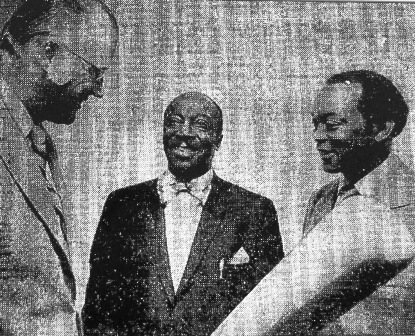
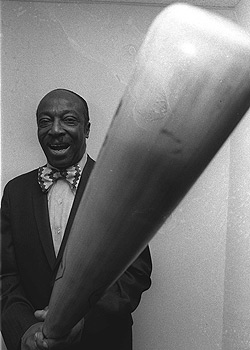
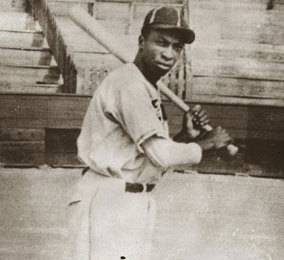
James “Cool Papa” Bell (center) poses with an oversized bat, Commissioner Bowie Kuhn (left) and Monte Irvin, in 1974 after Bell was inducted into the Hall of Fame by the Negro league Committee.  Irvin was inducted the year before.

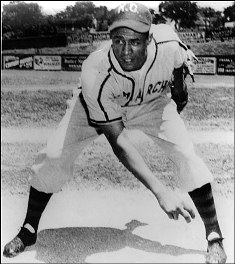
In 1984 Negro League pitcher Chet Brewer said of Bell’s legendary speed:

Chet Brewer

Chet Brewer

“In Mexico, he was on the same team that I was on.  The first game that he played in, he was on first base and the next hitter hit a ball into right field.  Cool Papa went into third base so fast that they stopped the game and said he cut across behind the pitcher.  The said, ‘it’s impossible, no pasaria, it just couldn’t happen.  Nobody could go from first to third that fast.”

bell cool2

Lost Advertisements–Ed Walsh, “Gillette wins the Pennant”

2 Jul

edwalshgillete

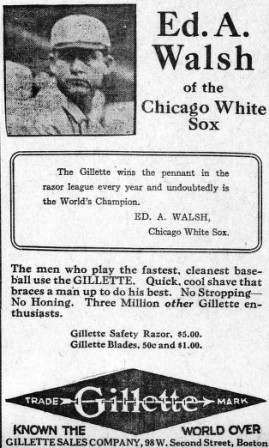
A 1910 advertisement for Gillette featuring Chicago White Sox pitcher, Hall of Famer  “Big Ed” Walsh.

“The Gillette wins the pennant in the razor league every year and undoubtedly is the World’s Champion.”

“The men who play the fastest, cleanest baseball use the GILLETTE.  Quick, cool shave that braces a man up to do his best.”

A Thousand Words–Joe Tinker

1 Jul

Quick hits Monday through Friday this week for the holiday–regular items will return next week.

joetinkerkids

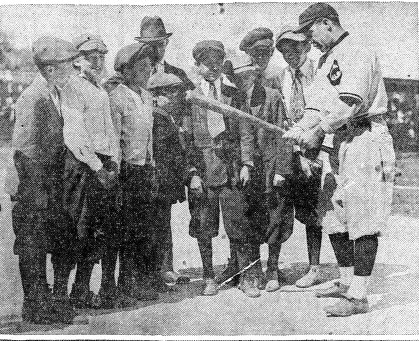
Joe Tinker, manager of the Chicago Cubs shows boys from the Chicago Schools Baseball League the finer of points of hitting before a July 1916 game with the Boston Braves.

Tinker returned to the Cubs in 1916 after having managed the Chicago Whales to the Federal League pennant the year before.  Whales owner Charles Weeghman purchased the Cubs after the Federal League folded and installed Tinker as manager.  Chicago fans had high expectation for Tinker’s team, because in addition to the manager, Weeghman brought most of the key players from the Federal champions to the Cubs.  But after a 9-17 record in July.  Rumors began to swirl that Weeghman would replace Tinker as manager after the Cubs owner traded for catcher Art Wilson on July 29; Wilson had been a Weeghman favorite when he caught for the Whales.

In August, Tinker blamed the Cubs disappointing season on third baseman Heinie  Zimmerman, telling The Chicago Daily News:

“Zimmerman is no good to the ball team.  he does not take any interest in his work and does not care whether the club wins or loses.  He did not report for practice yesterday and on other days is always the last one out for work.  Most of the players feel he does not belong on the team.  He is killing the harmony we had and that is why I would prefer to dispose of him.  He won’t play ball and does not use any judgment and with a man like that a flag cannot be won.”

Tinker survived the season, Zimmerman did not.  He was traded to the New York Giants on July 28.

The Cubs finished in 5th place, 67-86.  Tinker was let go after the season, he was not replaced by Wilson, as rumored, but instead by Fred Mitchell, who after a fifth place in 1917 led the Cubs to the National League pennant in 1918.

Tinker managed, and was a part owner, of  the Columbus Senators in the American Association in 1917 and ’18.

A Thousand Words–Ray Schalk/George Sisler

28 Jun

cracker1916sisler

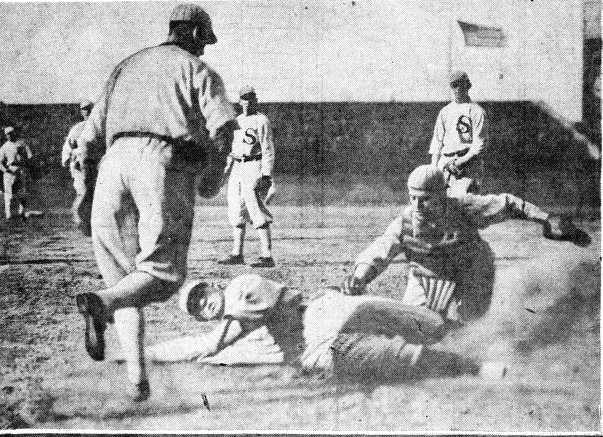
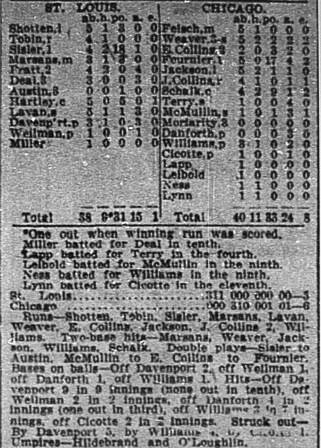
A rare 1916 photo of two Hall of Famers.  Chicago White Sox catcher Ray “Cracker” Schalk tags out George Sisler at first base ending a rundown after the St. Louis Browns first baseman was caught off first by Sox pitcher Claude “Lefty” Williams.  The play, which also included  leftfielder “Shoeless” Joe Jackson, was scored 1-3-4-3-6-1-7-2–Williams-Jake FournierEddie Collins-Fournier-Zeb Terry-Williams-Jackson-Schalk.  The White Sox won the April 17 game 6-5.

The Box Score

The Box Score

“The Sudden Reappearance of ‘Silver’ King”

27 Jun

Oliver Perry “O.P.” Caylor wrote in June of 1896 in The New York Herald:

“One of the baseball surprises of the season is the apparently successful reappearance of ‘Silver’ King upon the National League diamond.  Without any warning the Washington club sent him in against the Pittsburgh team, and he not only won his game, but held the latter down to six hits, Of course all this caused a great deal of gossip wherever baseball is a subject of interest.”

When Charles Frederick “Silver” King (born Koenig), took the mound for the Washington Senators and beat the Pittsburgh Pirates 8 to 1 in the second game of a May 30 doubleheader, it was his first appearance in professional baseball in nearly three years.

King had been one of baseball’s best pitchers of the 1880s, with a 142-70 record from 1887-1890 while playing for Charlie Comiskey, first with the St. Louis Browns in the American Association and then following Comiskey to the  Chicago Pirates in the Players League.

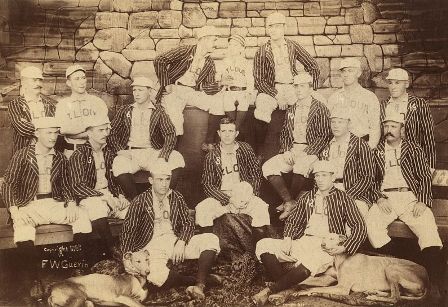
Comiskey (8) and pitcher Silver King (14) with the 1888 St. Louis Browns, King would follow Comiskey to the Chicago Pirates in the Players League in 1890

Comiskey, seated center(8) and Silver King standing second from right (14) with the 1888 St. Louis Browns, King would follow Comiskey to the Chicago Pirates in the Players League in 1890

Caylor said that during Flint’s heyday:

“His most successful delivery was what is known as ‘the cross fire,’ first used effectively, I believe, by (Charles “Old Hoss”) Radbourne and at present the prominent stock in trade of (Wilfred “Kid”) Carsey of the Philadelphias (Phillies).  It consists of standing on the extreme end of the pitcher’s plate, stepping away still farther from the direct line towards the batsman and sending the ball across the home base at an angle, which, although small, is very bothersome to the man with the bat.”

Silver King

Silver King

Caylor said King was “put out of the business” in 1893 when “the pitcher’s box was set back five feet,” (to the current 60’ 6”).  While King’s record slipped during the last two seasons the distance was 55 feet to a combined 36-53 while pitching for the Pirates and New York Giants, he had respectable ERAs of 3.11 and 3.29.  After the rule change King went 8-10 with a 6.08 ERA pitching for the Giants and Comiskey’s Cincinnati Reds in 1893, and then disappeared.

Caylor thought there was “a great deal of significance to King’s return to the diamond,” and predicted a trend:

“It means managers, having exhausted the new crop and finding nothing before them worth a trial, are forced to look behind and try to rekindle some of the half burned out embers. Washington not only took up King, but they gave (Les) German a trial after the New York club let him go.  (Cap) Anson (Chicago Colts) went back to (Fred) Pfeffer after finding (Algernon “Algie”) McBride, (Josh) Reilly and (George) Flynn wanting and was even forced to put himself into his nine to fill out the weak spots.”

Caylor said it was “astonishing  to look over the list of new material which was brought into the National League last spring and notice how small a part of it has been able to keep ‘in the swim.’  Every day one hears that some younger player has been released or that another has been loaned or farmed to a minor league club.”

Caylor’s prediction of success for the “trend,” and the players named was a mixed bag.  Anson, who had never really gone away, hit .331 in 108 games, for the Colts, but Pfeffer hit just .244 in 94 games. German fared the worst, he was 2-20 in 1896 and 3-5 the following season before being released in August.

King managed to post a 16-16 record for the Senators in 1896 and ’97 but never found his early career form.  After the 1897 season, he returned to St. Louis where he died in 1938.

Caylor would become ill the following season, and died in October of 1897.

The Curve and The Spitter

26 Jun

Hugh A. “Hughey” Reid only appeared in one professional game; he went 0-4 and played right field in a game for the American Association’s Baltimore Canaries against the White Stockings in Chicago in August of 1874,  as was the practice at the time, Baltimore recruited Reid, a local semi-pro player to fill in for the injured Oscar Bielaski.

Reid wasn’t known in the amateur and semi-pro leagues in Chicago as an outfielder.  He was considered one of the best pitchers in town, and played for the Chicago Aetnas, one of the premier teams in the city, and according to The Chicago Tribune “The champion amateur team of 1869.”

Hugh Reid

Hugh Reid

Among Reid’s teammates with the Aetnas were future big leaguers Jimmy Hallinan and Reid’s brother-in-law and catcher Paddy Quinn.

Reid worked as a stereotyper (made metal printing plates), for The Chicago Evening Post after his career ended.

In 1920, Reid was interviewed by Alfred Henry “Al” Spink, founder of The Sporting News.  By 1920, Spink, who had played amateur baseball in Chicago against Reid with a team called the Mutuals (named for the more famous aggregation in New York), had relocated to Chicago and was writing for The Evening Post.

Al Spink

Al Spink

The occasion was “field day exercises of the old timers” at Pyott Park at the corner of Lake Street and Kilpatrick Avenue in Chicago; the days events were followed by a banquet.  “Cap” Anson, Charles Comiskey, Hugh Nicol, and Fred Pfeffer were among the dozens of former pro, semi-pro, and amateur players who attended.

Spink described the 70-year-old Reid; “same old smile, same old swagger, same old don’t care a tinker’s, same old Hughey.”

Nine years earlier Spink had credited William Arthur “Candy” Cummings with originating the curveball in his book “The National Game,” but by 1920 others were making the case for different candidates.  Spink asked Reid his opinion:

“Without a doubt Cummings was the first pitcher to put the curve on the ball.

“As Cummings was using the outcurve as early as 1867, and Bobby Matthews only broke into the game at Baltimore in 1869, there is very little doubt as to who discovered the art of curving.

“In fact, it was not until years later, when the rules allowed the pitchers to raise their arm above the waist, that Matthews became master of the curve.”

Candy Cummings

Candy Cummings

Reid also talked about the pitch Mathews did introduce:

“I am quite sure that Mathews was the first to work the delivery mow bearing the insanitary name

“Before delivering the ball he would rub it hard on his trousers, always on the same spot, where the seams are the farthest apart…he would draw his two fingers across his lips, take the ball with two fingers and a thumb and send it in with only fair speed.  He had perfect control and usually sent the ball about waist-high for a player calling for a low ball.  The break came just in front of the plate and the ball usually went into the ground or very high in the air.  Few line drives were made off of Mathews.”

Bobby Mathews

Bobby Mathews

Reid also talked about Alphonse Case “Phonney” Martin.  At the same time that Spink was making the case for Cummings in “The National Game,” Martin told William Aulick of The New York Globe that he developed the pitch. Aulick concluded:

“Some people say this was the first cousin of the curve ball, but they don’t say this when old Alphonse Martin is around.  He insists it wasn’t anyone’s cousin–it was Mister Curve himself.”

Reid disagreed, he described Martin’s pitch as a “freak ball,” and said:

“I first saw Martin pitch down on the old lake front grounds in Chicago against the original White Stocking team.  He simply threw a slow lob ball that came so slow you had to nearly break your back to hit it.  But, at that, his delivery was a success, and most of the balls hit from it went high in the air and came down in some fielder’s hands…He threw a slow teaser that reached the plate about shoulder-high and dropped while still spinning.”

Alphonse "Phonney" Martin

Alphonse “Phonney” Martin

Reid insisted Martin’s pitch was not a curve:

“Cummings and Cummins alone was the originator of the curve.”

Browning and Delahanty

25 Jun

John Anthony “Honest Jack” Boyle played in the American Association, Players League and National League from 1886 to 1898.

Boyle’s career was on the decline by the end of the 1898 season (he had only appeared in six games with the Philadelphia Phillies that year), but was effectively ended in November when he was the victim of a mysterious knife attack in his hometown of Cincinnati.

The Cincinnati Commercial Tribune said Boyle was “attacked from behind by an unknown man, who, before the player could defend himself, plunged a knife into his shoulder.”

A piece of the knife broke off in Boyle’s shoulder and he didn’t play regularly again until 1905 when he appeared in 101 games for the Toledo Mud Hens in the American Association ; he was a player-manager for the Terre Haute Hottentots in the Central League the following season.

Jack Boyle

Jack Boyle

By 1910 Boyle, who was operating a saloon in Cincinnati, told William A. Phelon of The Chicago Tribune that the two best hitters he ever saw were Pete Browning and Ed Delahanty, and provided a window into the minds of two of the biggest stars of the 19th Century:

“(T)here never were two men more radically different in their ideas of and their opinions of the game than these two great sluggers.  They looked at the game from totally different angles, and they regarded their occupation with widely varying views.

“Pete Browning was an artist.  To him baseball was an art or a profession and batting an absorbing passion.

“Delahanty was a workman.  Baseball to him was labor or a trade, and batting simply part of the daily toil.

“When Browning left the field the game wasn’t over.  He continued to talk batting, theorize on batting, figure out new ideas on batting, and I think, dreamed of batting all night long.

Pete Browning

Pete Browning

“When Delahanty left the ballpark the game was all through for the day, exactly as if he was a laborer going home to supper.  He ceased to think baseball.

Ed Delahanty

Ed Delahanty

“If Browning failed to make a hit at the time of need, he would have tears in his eyes and would bitterly bewail his misfortune.  If Delahanty fell down in the pinch, he shrugged his shoulders, hoofed back to the bench and began to talk racing or the weather.

“When an outfielder galloped to the fence and pulled down one of Browning’s mighty drives, Pete would regard it as a personal insult, and glower at the outfielder like a baffled tiger.  When a fielder robbed Del of a home run, Ed would grunt ‘Good catch, boy, didn’t think you’d get it’ and forget it forever.

“If you had told Pete Browning that the business was losing money, and that you would have to cut his salary next season, he would have accepted the money rather than lose the chance to play the game.  If you handed that talk to Delahanty, he would have sneered scornfully and remarked that you’d have to come up with 500 more beans before he’d even look at a contract.

“Neither Pete nor Del cared much where their teams finished on the season.  Pete thought only of hits and the glory of making them.  Del thought of a comfortable winter life on the money he had made in the summertime.”

Boyle said the only thing the two really had in common was an inability to bunt:

“Del wouldn’t simply try.  Pete, with much groaning and protestation, would be coaxed to make the attempt, but his attempts were fizzles.”

Boyle, or Phelon, omitted the other thing the two had in common: serious drinking problems that hurt them on and off the field and contributed to their early deaths.

Boyle died in Cincinnati in 1913.

Baseball’s “Growing Evil”

24 Jun

By 1913 newspaper articles under the byline of a famous player were common in newspapers across the country, and most of the game’s biggest stars were represented.

Most fans of that era assumed the players did their own writing until an expose appeared in The Washington Herald in March of 1913.  Sports Editor William Peet wrote:

“The dear old public fell for this stuff and swallowed hook, bait and sinker.  An article under the signature of Christy Mathewson led three-fourths of the fans to believe that the great pitcher himself wrote it.”

According to Peet, players were paid between $250 and $1000 for each story “and not one of them wrote a single word,” but it was still a good investment:

“The newspapers themselves regarded these feature articles as good investments, for the reason that the stories were syndicated to 25 or more outside publications and the revenues derived not only paid the amount guaranteed the baseball player for the use of his name, but left a handsome profit.”

Peet exposed the writers behind the articles “written” by the game’s biggest stars:

Christy Mathewson and Jeff Tesreau/John Wheeler, The New York Herald

Walter Johnson/Ralph MacMillan, The Boston Journal/The Boston Herald

John McGraw/Walter Turnbull, The New York Evening Sun

John “Chief” Meyers/Jim McBeth, The New York American

Richard “Rube” Marquard/Bill Farnsworth, The Atlanta Georgian/Hearst Newspapers

Denton “Cy” Young/Sam Carrick, The Boston Post

Tris Speaker/Tim Murnane, The Boston Globe

“Smokey” Joe Wood/Jim O’Leary, The Boston Globe

Ty Cobb/Roger Tidden, The New York World

Hughie Jennings/George “Stoney” McLinn, The Philadelphia Press
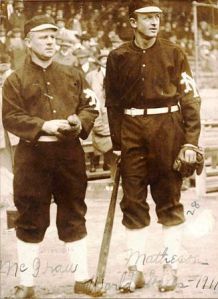
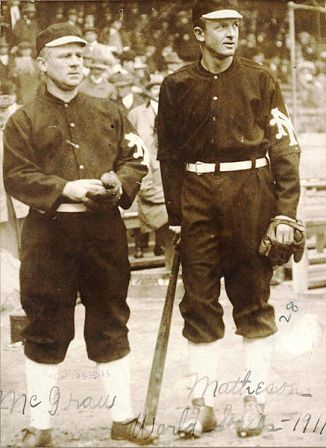
John McGraw and Christy Mathewson

John McGraw and Christy Mathewson

Peet called the practice dishonest, and said it had gone too far, and in New York and Boston the practice   had “become a mania.”  Peet singled out an article “written” by John McGraw criticizing “Chief” Myers that caused an “explosion,” and said the articles featuring “Rube” Marquard’s byline, and written by Farnsworth got Marquard “in bad with his teammates, for Farnsworth spared no one is his scathing criticisms.”

Pittsburgh Pirate manager Fred Clarke disagreed with the practice, telling Peet:

“I do not think it is any ball player’s place to butt into the newspaper end of the game…I think it is foolish for any player, especially those who take part in the world’s Series, to write about the games.”

As a result of Peet’s revelations the American League club owners condemned the practice of players’ names appearing on articles they did not write, but came just short of officially banning the practice. In September, the Baseball Writers Association petitioned the National Commission to end the “growing evil” of players authoring or appearing to author articles during the upcoming World Series.

The commission agreed, and American League President Ban Johnson informed Philadelphia Athletics manager Connie Mack on the eve of the World Series that star players Eddie Collins and Frank Baker “have been instructed not to write baseball stories or give the impression they are writing them.  If they ignore this request, a way of punishing them would be found. “
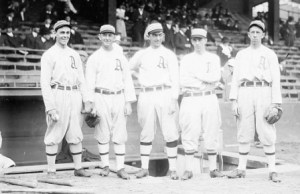
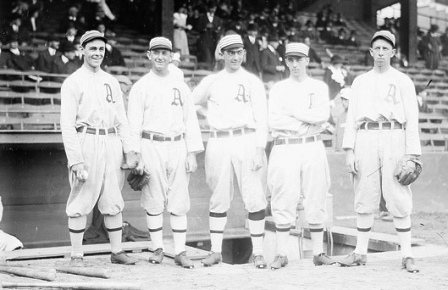
Frank Baker, center, Eddie Collins, far right,

Frank Baker, center, Eddie Collins, far right,

Johnson even threatened “Collins and Baker would not be permitted to take part in the World Series,” if they wrote articles or permitted their names to be attached to articles.

At one point Johnson and National Commission Chairman August Hermann said they would consider calling off the series if players refused to comply.  Dave Fultz, the former player, practicing attorney, and president of the Fraternity of Baseball Players, said members of the commission could be personally liable for damages if the series was cancelled.  Johnson and Herman’s threat to cancel the series as a whole was put to rest.

Mack argued that the players had contracts with newspapers and that Johnson had said earlier that players who were “capable” of writing their own articles would be permitted to do so, but as he prepared his team to play the New York Giants, he prepared for the worst, telling The Associated Press:

“(I)f the commission decides the players must not write under any conditions and players decide not to abide by the ruling, I will be prepared to put a team on the field,” The AP speculated that utility infielder John “Doc” Lavan  would play second base  and outfielder Rube Oldring would be moved to third base, with Amos Strunk taking Oldring’s place in the outfield.

Mack’s adjustments weren’t required.  Collins was allowed to write for The Philadelphia Record because his deal with the paper predated the commission’s ruling, and Baker did not write articles.  Together they led the Athletics to a 4-1 Series win, hitting .421 and .450.

Ghost written articles, and articles actually written by players never disappeared, but the practice became much less popular after the revelations and battles of 1913.

Satchel Paige Night, 1952

21 Jun

???????????????????????????????

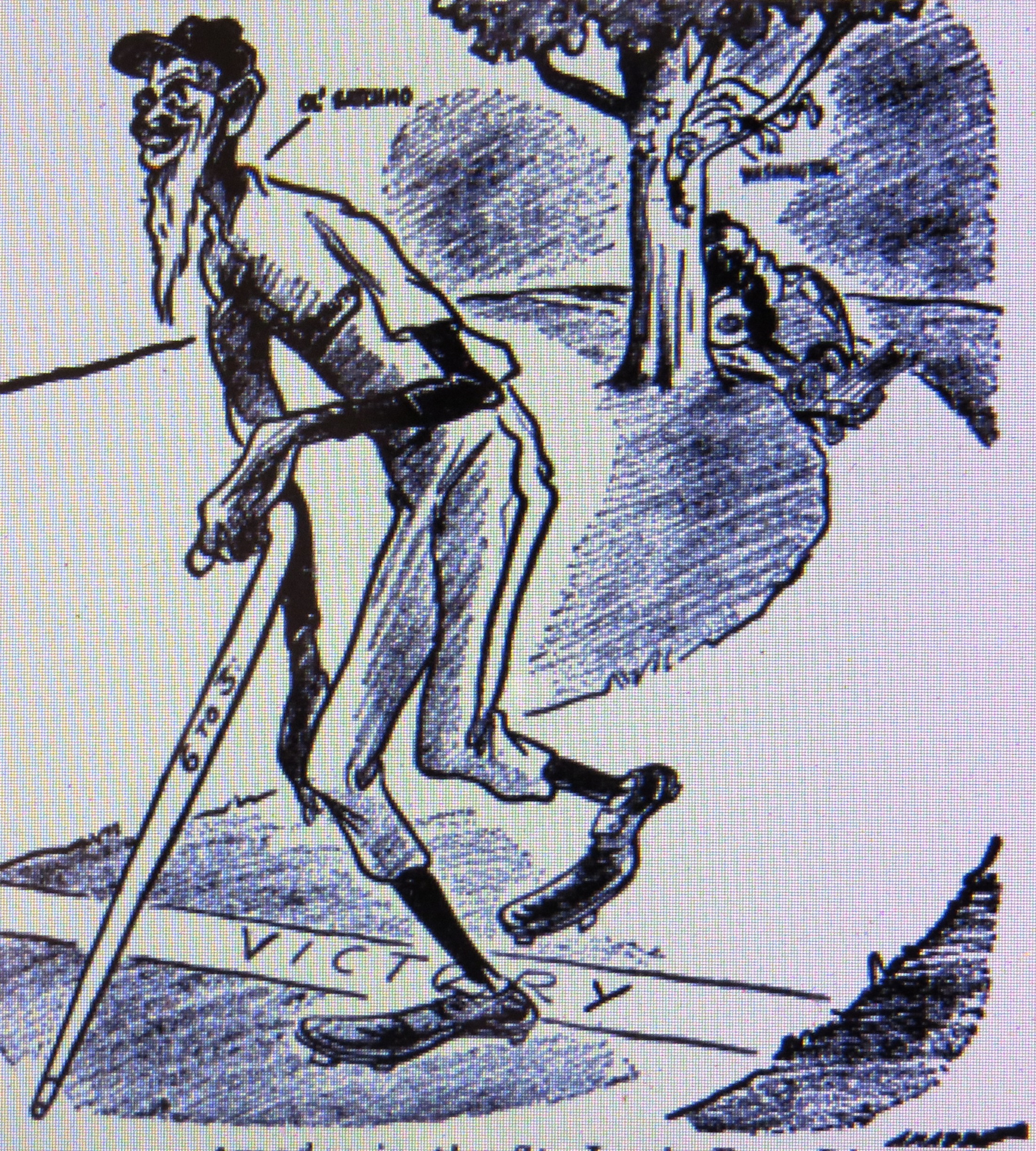
This cartoon of Satchel Paige  appeared in The St. Louis Post-Dispatch on July 29, 1952; drawn by the paper’s cartoonist Amadee Wohlschlaeger, who celebrated his 101st birthday last December.

Paige was primarily used as a reliever in 1952, but made one of his six starts the evening before against the Washington Senators on “Satchel Paige Night” at Sportsman’s Park in St. Louis.  The Associated Press said:

“A bearded player in a wheelchair was introduced as Paige’s first battery mate.”

Owner Bill Veeck gave him a boat called “Ole Satch 1,” a television, and a camera; his teammates presented him with a rod and reel.

Paige pitched 6 2/3 innings and was credited with the win in a 6-3 victory against the Washington Senators.

Later that month Senators manager Bucky Harris said in The Washington Afro-American:

“I swear to God, we would be in first place if we had Satchel Paige.”

???????????????????????????????The Box Score

“To be Hissed and Hooted at in the East is too much”

20 Jun

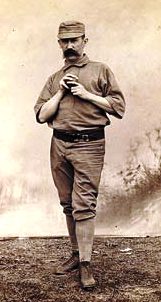
In 1886  Thomas Jefferson “Tom” York retired after a fifteen-year career.   As a 20-year-old he joined the Troy Haymakers in the National Association in 1871, he was with the Hartford Dark Blues for the National League’s inaugural season in 1876, and finished with the Baltimore Orioles in the American Association; he also served two brief stints as a player/manager with the Providence Grays.

York, who suffered from rheumatism, had considered retiring before the 1894 season after the Cleveland Blues sold him to the Orioles, but The Baltimore American said he was induced to continue playing with a $5000 salary and “the scorecard and cushion (concession)” at Oriole Park.  After hitting just .233 in 1884, he was only able to play in 22 games the following season before calling it quits.

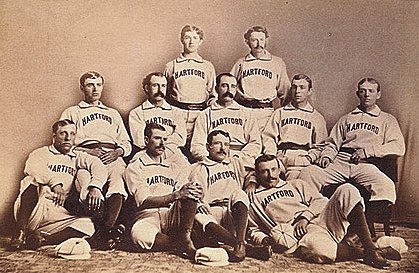
Tom York, middle row, far right, with the 1876 Hartford Dark Blues

Tom York, middle row, far right, with the 1876 Hartford Dark Blues

Just before the beginning of the 1886 season York was hired as an American Association umpire.  After the May 22 game in Baltimore which the Orioles lost 2-1 to the Louisville Colonels, The Baltimore Sun said:

“(York) received a dispatch yesterday ordering him to Brooklyn.  Instead of going he telegraphed his resignation.  His reason for doing so was the abuse he received from some of the spectators of Saturday’s game.  In fact, he was nearly equal to that of John Kelly, ‘the king of umpires.’  He declared (Pete) Browning’s hit near the foul line a fair hit.  He was in the best position to know, but, as it was made at a critical point, some of the audience objected, and York came in for pretty severe abuse.”

The paper said York also made a “questionable decision,” when he “evidently forgot that it was not necessary to touch a runner in a force,” and incorrectly called a runner safe at second:

“York became discouraged and the Association lost a good umpire.”

Within weeks York became a National League umpire; that didn’t last long either.

On June 30, the Kansas City Cowboys lost at home to the New York Giants 11-5, The Chicago Inter Ocean said York “was escorted from the grounds by the police on account of disapproval manifested over his umpiring.”

Less than a month later, after York was “roundly hissed” at the Polo Grounds after making “some very close decisions against the New Yorks,” in a July 22 game against the Philadelphia Quakers, he sent a telegram to National League President Nicholas Young resigning his position.  York told The New York Times:

“I have been badly treated in the West, but to be hissed and hooted at in the East is too much.  I have often heard that an umpire’s position was a thankless one, but I have never realized it before.  It’s bad enough to be hissed and called a thief, but in the West when the local club loses an umpire in fortunate if he escapes with his life.  Of all the cities in the league Kansas City is the worst.”

York said there was another incident Kansas City the day before he was escorted from the field by police:

“On June 29 when the New York men beat the Cowboys 3 to 2 (William “Mox”) McQuery hit a ball over the fence, but it was foul by 25 feet, and I declared it so.  After the game Vice President (Americus) McKim, of the Kansas City club wanted to know how much money I would get from the New Yorks fir That decision.  I remarked that I received my salary from the league and did not take a penny from the New Yorks or any other none.  Then he grew furious, and said he would end my days.  This in conjunction with other things incidental to the life of an umpire has made me tired of the business, and I intend to make room for some other victim.”

Despite quitting both leagues within two months, The Baltimore American said the American Association sent York a telegram in two months later “asking him if he wanted an appointment as umpire.”  The paper said “York replied no, emphatically, as his past experience was sufficient to justify his remaining at home.”

York remained at home for the rest of the season and the next, but while he never worked as an umpire again he returned to baseball in 1888 as manager of the Albany Governors in the International Association.  Over the next decade he was connected with several East Coast minor leagues, including the Connecticut State League, the New York State League and the Eastern Association, as a manager and executive.

York retired to New York where he became one of the many former players employed at the Polo Grounds at the behest of manager John McGraw.  In 1922 The New York Telegraph described his position:

“York has the pleasant post of trying to keep the actors, tonsorial artists and plumbers out of the press stand.  It is old tom who examines your pink paste board and decides whether you are eligible for a seat in the press cage.”

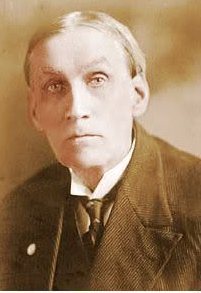
Tom York, 1922

Tom York, 1922

In February of 1936, as preparations were being made for York, along with James “Deacon” White, George Wright, Tommy Bond,  to be honored that summer at the  All-Star Game  as the last four surviving players from the National League’s first season, the former player, manager, executive and umpire died in New York.