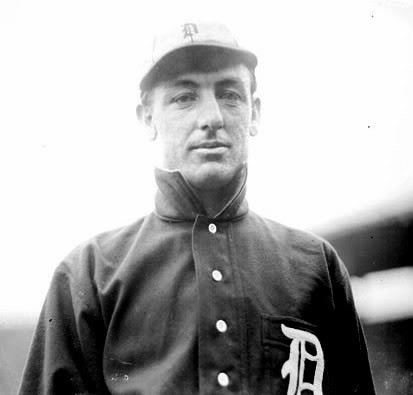
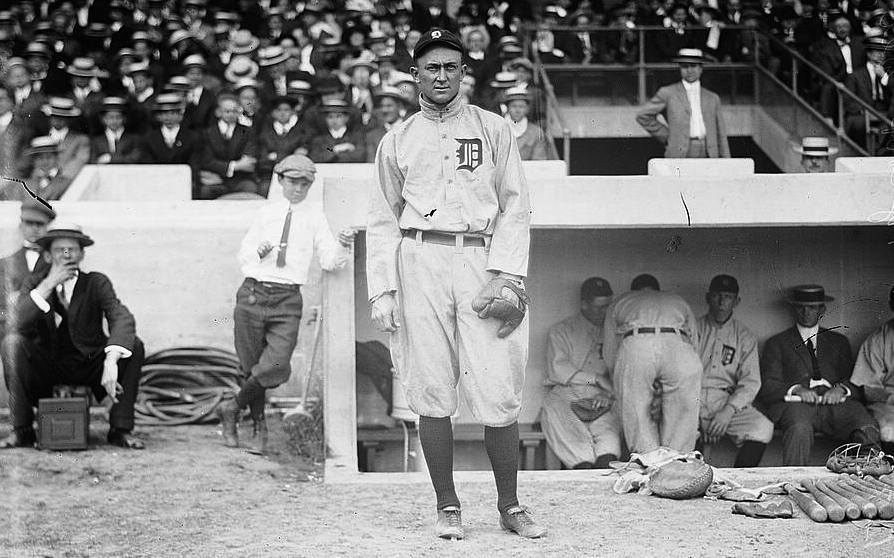
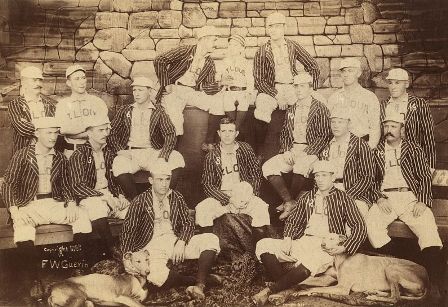
“Mique” Fisher 2

7 May

On October 12, 1906, with the World Series between the Chicago White Sox and Chicago Cubs deadlocked at two games apiece, August “Garry” Herrmann, President of the National Commission, received a telegram from Fresno, California:

“Fresno will give $25,000 guarantee; guarantee 40,000 fans and sunshine for deciding game of World Series.

–Mike Fisher”

Fisher said the offer to bring the series and Fresno native Frank Chance to town was backed by “the businessmen here.”

It is doubtful Herrmann took the offer seriously, and it’s probably just as doubtful that Fisher took it seriously, but it was picked up by newspapers across the country, and Fisher enjoyed the publicity.

It was a last bit of publicity before his career in organized baseball ended.  Later in the month he was dismissed as manager of the Fresno Raisin Eaters, and the team was dropped from the Pacific Coast League (PCL) the following spring.

Within weeks Fisher had moved on to a new project; he announced that he was in the process of forming a team to travel to Hawaii.  The San Francisco Call said “It will be the first American ball team to make the trip across the Pacific in a little over nineteen years,” since Spalding’s world tour.

In conjunction with Jesse Woods, a Honolulu promoter, Fisher organized a tour of the Hawaiian Islands with a team of PCL stars.

Mike Fisher

Mike Fisher

Upon his return, Fisher got more ink on the West Coast, when he headed to Nevada with Charlie Irwin of the San Francisco Seals; the two met with businessmen in the mining towns of Goldfield and Tonopah to discuss forming a professional league—Fisher told The San Jose Mercury News that he was now “against organized baseball,” and if he got involved in the league “it will be an outlaw organization.”

Fisher chose not to get involved in the new league, but immediately went to work on an even more ambitious tour than the 1907 Honolulu trip.

With the sponsorship of the Reach Sporting Goods Company, Fisher would accompany a group of stars to China, Japan and the Philippines.  Early publicity promised the travelers would include Ty Cobb, Hal Chase, and Frank Chance.

When the ship set sail in November of 1908 those three stars were not on board, but “several hundred fans and friends” were present when the steamer China left the port in San Francisco to see the group off.  The team was substantially the same as the one that toured Hawaii the previous year—an aggregation of PCL stars and a few National and American League players– and consisted of: Jim Delahanty, George Hildebrand, Bill Burns, Pat Flaherty, Jack Bliss, Babe Danzig, Harry McArdle, Nick Williams, Joe Curtis, Heine Heitmuller, Jack Graney and Bill “Brick” Devereaux.

Despite the failure to land Cobb, Chase or Chance for the tour, the West Coast press applauded Fisher for even attempting the trip, The Call said:

“The undertaking which he has fathered and which is so successfully underway at the present time is a big proposition.  With the single exception of the around-the-world trip of the A.G. Spaldings years ago, nothing on as big a scale as this has ever been attempted.  To take a team of American baseball players over a journey that will total 10,000 miles before they return, to play games in China, Japan, Manila and Honolulu is something that two or three years ago would have been laughed at as an impossibility.”

The tour lasted more than three months, with the team barnstorming through Japan, China, the Philippines and Hawaii, playing local and US Service member teams.  Though reports varied, the team played between twenty and thirty games, and lost no more than four.

While they drew large crowds throughout the trip, the newspapers back home reported that the tour was a financial disaster; when the players arrived back in San Francisco on February 15, 1909 aboard the Tenyo Maru, Fisher responded to the reports:

“I hear that it has been said that the trip was a financial frost.  Well, anybody who says that is a liar.  We broke even in Japan and made money in Manila and Honolulu.  I am satisfied with the trip.”

Fisher didn’t mention the financial results in China; likely because that leg of the tour was a disaster financially.  Years later he would tell a story about the team’s experience there, complete with his usual exaggerations:

“In one game we played in Canton we had 150,000 people inside, and as the gatemen had been instructed to accept Chinese money it required the combined efforts of the entire team to tote the money up to the hotel.  A special staff of accountants was busy all night totaling it up and in the morning we discovered we had $46.15.”

Fisher promised to take a team to Australia the following year.  The trip never took place; instead Fisher purchased a Seattle dance hall called the Dreamland, and quickly became the target of the pious women of the city.  Early in 1910 Fisher was indicted by “The King County grand jury, as a direct result of the activity of the Women’s Clubs,” for violating liquor laws, allowing “unescorted women” into his dance hall, and other assorted charges.  A special prosecutor, Justice William Henry White, one of the most respected jurists in Washington State, was appointed to prosecute Fisher and other club owners targeted by the women.

Ever the promoter, Fisher used the indictment to promote his dance hall and rally public support.  After the indictment was handed down Fisher sponsored a “Sermon in the Dreamland rink.”  According to The Seattle Times, Fisher engaged Reverend Frank Herthum, who “has liberal ideas about amusements.”
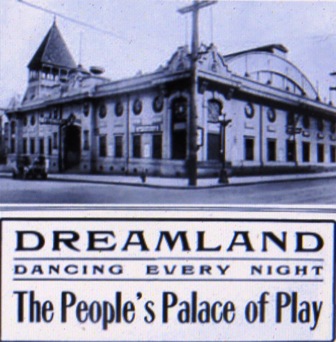
Mike Fisher's Dreamland Dancehall, Seattle

Mike Fisher’s Dreamland Dance Hall, Seattle

Herthum preached, and Fisher presented a free vaudeville show.  The paper said Fisher had stirred up a “protest against the effort to close the dance hall without having provided a substitute where clerks, servant girls and employees in the shops may pass an evening to their liking.”  At the same time The Times noted that the prosecutor was becoming impatient with the women who brought the charges because they continually promised to provide evidence that “has not yet come to light.”  The charges were quietly dismissed within weeks.

Fisher left Seattle sometime in 1911 and began operating the Arcadia Dance Hall in San Francisco.
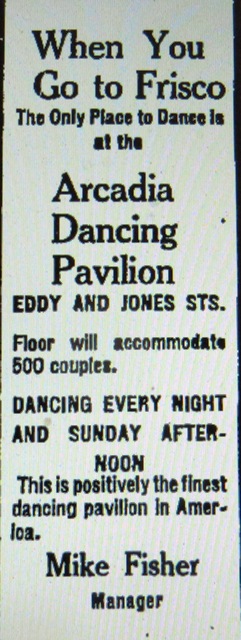
Advertisement for Fisher's Arcadia Dancing Pavilion.

Advertisement for Fisher’s Arcadia Dancing Pavilion.

In January of 1917 Fisher made headlines in California when he announced that he was directing an effort to restart the California State League, which had folded after the 1915 season.  He said he would have clubs in Sacramento, Fresno, Stockton and San Jose.  Within two weeks Fisher abandoned the plan.  The San Jose Mercury News was not surprised:

“Mr. Fisher, the wonderful getter of publicity, has his publicity and is through.  Probably he has done wonders for his dance emporium or whatever it is he runs.”

The following year the San Francisco Seals of the Pacific Coast League came on the market; the first name reported as a potential buyer was Mike Fisher.  Fisher again got his headlines, but it was his old friend Charlie Graham who got the team.  Graham, and a group of investors purchased the Seals and the former catcher was installed as manager.
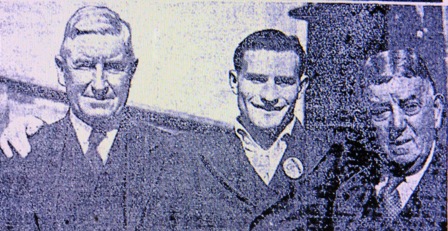
Charlie Graham, left, Mique Fisher, right, with World Middleweight Champion and actor Freddie Steele.

Charlie Graham, left, Mique Fisher, right, with World Middleweight Champion and actor Freddie Steele.

With his friend in charge The Mercury News said Fisher became a fixture “around the San Francisco ballpark ever since Graham bought in on the Seals in 1918,” he would remain a fixture at Recreation Park, and later at Seals Stadium for more than 20 years , and continued to provide copy for West Coast s sports writer

As a result of his friendship with Graham, who recommended he get the honor, 77-year-old Fisher was selected to travel to Cooperstown to represent the PCL at baseball’s centennial celebration in 1939.  The man who so loved seeing his name in the paper  received headlines one more time, when he died in San Francisco on June 6, 1943.

“Mique” Fisher and the PCL

6 May

Michael Angelo “Mique” Fisher is one of the forgotten pioneers of the Pacific Coast League (PCL).  Fisher had no given middle name, but adopted the name Angelo “after the famed painter he admired.”

Born in New York City in 1862, Fisher’s family relocated to Sacramento, California shortly after the end of the Civil War.  Fisher was a semi-pro outfielder with teams in San Francisco, Oakland and Sacramento, and in 1884-85 played for the San Francisco Haverlys in the California League.  Sometime later in the decade he joined the Sacramento police force.

Fisher’s only connection with baseball from 1885 until he was nearly 40-tears-old was as a fan and as a friend of a young catcher named Charlie Graham who had played at Santa Clara University and in the California League.

In 1902 Detective Captain Fisher made a career change.

The Sacramento Gilt Edges in the California League were owned by a local businessman named Arthur Beebe.  Beebe, according to The Sporting Life “incurred the displeasure of his associates in the league owing to his continual kicking against the umpires appointed by President (James T.) Moran.”

At a league meeting in February the franchise was taken away from Beebe and awarded to Fisher.  The San Francisco Call said Beebe blamed the move on San Francisco owner Henry Harris, who he said “is backing Mike Fisher.”

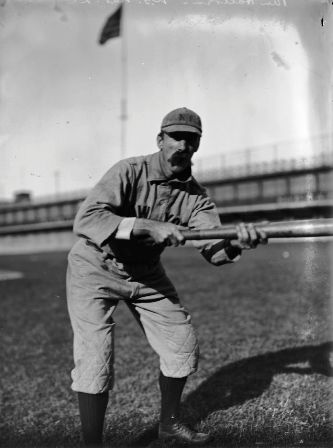
Michael Angelo “Mique” Fisher, circa 1905

Michael Angelo “Mique” Fisher, circa 1905

There’s no contemporary reference to why Harris preferred Fisher to Beebe, but within a year Harris would spearhead the effort to expand the California League to the Pacific Northwest—forming the PCL, and might simply have wished to pack the league with allies for the planned expansion.

The new Sacramento owner’s first move was to sign Charlie Graham, who played for Harris in San Francisco in 1901; Graham was named captain.  The Gilt Edges got off to a horrible start, but according to The Sporting Life “managed to replace the weak ones with men that worried other clubs at all stages, and finally crawled up into the .400 class.”

In December of 1902 The Seattle Times reported that Harris’ scheme was official:

“The California League will be known next year as the Pacific Coast League.  It will expand and take in Seattle and Portland.”

The Los Angeles Angels won the first PCL championship, but it was another Los Angeles team that caused the most excitement for Fisher and Sacramento in 1903.

In March three of Fisher’s players, Win Cutter, Charles Doyle and George Hildebrand jumped to the Los Angeles team, in the newly formed Pacific National League—they were said to have been recruited by former teammate Elmer Stricklett.  Hildebrand agreed to return, but Fisher took action as the other two prepared to board a train for L.A.  The San Francisco Call said:

“There was a sensational scene at the railway depot this afternoon, when Michael Fisher, manager of the Sacramento baseball nine, appeared with a police officer armed with warrants and caused Cutter and Doyle, two of the start players, to be placed under arrest on charges of obtaining money under false pretenses.”

The players were held in jail until they agreed to return to Fisher’s club, and the charges were dropped.

After the 1903 season Fisher relocated the franchise to Tacoma, Washington; the move brought better geographical balance to the league, and gave the PCL a foothold in a city that had just been vacated by the rival Pacific National League.

Charlie Graham remained team captain and the pitching staff was improved with the addition of Jim St. Vrain and Orval Overall.  Fisher’s Tacoma Tigers took the pennant, winning both halves of the split season schedule.

Charlie Graham

Charlie Graham

it was Graham, not Fisher, who was generally given credit for the success of the team.  As The Portland Oregonian later said:

“Mique Fisher in the strict sense of the term never was a great manager.  In a general way he knew baseball, but as a master of the fine points of the game as it should be played he was not up to the big thing…It was Graham who taught the players how to play the game.”

The paper did concede that Fisher was a good players’ manager:

“His players liked him and worked hard for him and that always helped a whole lot.”

Other tended to dismiss Fisher, The Spokane Daily Chronicle called him:

“The man who has acted as the original blast furnace for the hot air factory.”

Fisher not only had his baseball acumen questioned, but the move to Tacoma turned out to be disastrous from a business standpoint. The Oregonian said the Tigers won in 1904 despite “little enthusiasm,” from the city of Tacoma.  Fisher also began to run afoul of his investors, according to The Daily Chronicle:

“It is no secret  the stockholders have been losing money and blame for that is laid on the manager.”

The 1905 Tigers started strong, winning the first half—again playing to small, indifferent crowds, then fell apart in the second half, finishing last.  The Tigers were badly beaten five games to one in a postseason series by the Los Angeles Angels.

In September of 1905, Fisher announced that a six-game series with the Oakland Oaks would be played in Spokane, Washington, giving rise to rumors that the team would relocate there the following season.  The rumor also stirred up a conflict with the Northwestern League, who laid claim to Spokane and took their case to the National Commission.

Fisher initially denied that the team had designs on Spokane, but in October he this telegram to The Spokane Chronicle:

“To Sporting Editor…Spokane has been awarded to the Coast League by the National Commission.”

The San Francisco Bulletin said the league needed to abandon Tacoma and:

“It certainly seems that the admission of Spokane is the only logical course for the league to pursue.”

Logic did not win out.  By November Fisher had negotiated a deal to move the team to Fresno, California, a town with roughly one-third the population of Spokane—the PCL made it official in January of 1906 that the Tacoma Tigers would become the Fresno Raisin Eaters.

Fisher had owned a half interest in the team in Tacoma, he gave up his ownership stake in Fresno and signed a three-year contract with the club.

It turned out to be another bad decision.

Fisher, for the first time, managed a team without Charlie Graham by his side.  The catcher started the season with the Boston Americans (his only big league season), but left the team in May to return to San Francisco a month after the 1906 earthquake—various sources attributed his departure to being homesick, wanting to be near family, or to attend to his wife who was ill; in any case he never returned east and signed with the Sacramento Cordovas in the California League in August.

Fresno was a last place team from wire-to-wire, finishing with a winning percentage well below .400.

The new ownership fired Fisher, who eventually sued the team to recover $500 he said he was promised if terminated before his three-year contract expired.  He never collected the $500 and told reporters:

I was gypped out of the franchise.”

Wallace “Happy Hogan” Bray was named to succeed Fisher as manager, but Fresno was dropped from the PCL after the Seattle Siwashes withdrew from the league, in order to maintain an even number of teams.

Fisher’s managerial career was over, but his baseball career was not; more on that tomorrow.

Lewis Henke

3 May

Lewis Henke played first base for the Atlanta Atlantas in the Southern League in 1885. The Atlanta Constitution said:

“He was the swiftest and most baring baserunner on the Atlanta nine.”

And

“(A) favorite not only in Atlanta, but wherever he was known…perhaps the most popular player in the Southern League.”

On August 14 Atlanta was hosting the Nashville Americans, when according to The Macon Telegraph:

“In the fourth inning Henke, in making the first base, ran violently against the knee of (Charles “Lefty”) Marr, of the Nashvilles, the knee joint striking him apparently full in the stomach. Henke showed immediately that he was badly hurt, and in a moment was lying stretched out almost on the base. He was carried from the field to the dressing room…Although he had clearly made his base after heavy hit, no one of the players, no one of the great crowd looking on, knew that the infallible umpire above had decided differently, and called him out.”

Henke’s liver was ruptured in the collision and the Cincinnati native died of the injury the following day.

The New York Times blamed the death on “Bad feelings” between the two teams, which resulted in “much ugly work on the field, such as tripping each other, etc..”

Henry “Red” Bittman was Henke’s teammate, fellow Cincinnatian and best friend; they had come to Atlanta together in 1884 to play for the city’s entry in the Georgia State League. He was at his friend’s bedside.

According to The Times:

“Henke observing his friend by his side this evening whispered to him: ‘Bitt, do not play today; I feel that I am dying.’ ‘What shall I tell your wife for you?’ Bittman inquired. ‘Just tell her I got hurt in yesterday’s game and died from it,’ he replied as he again closed his eyes, and in three minutes he was dead.”

The Telegraph said that later that evening:

“At half past ten the manager (Gus Schmelz) escorted the remains to the depot, and walked beside the undertaker’s team through the streets with barred (sic) heads. The dead man’s comrades, rough and hard, were deeply afflicted, and some of the cried like children over the coffin…Henke, the dead baseballist, was carried west on the 10:40 train tonight on the Western and Atlantic to Cincinnati.”

???????????????????????????????

Lewis Henke, standing–Henry “Red” Bittman, seated

While some attributed Henke’s death to the “bad blood” and “ugly work on the field,” no one publicly singled out the popular “Lefty” Marr for blame. Years later, Edward Cuba Bruffey, a long-time reporter and editor for The Atlanta Constitution said:

“The death of Henke completely prostrated Marr, and it was several days before he was able or willing to return to the game. I am not certain now, but I think Marr was one of the men who accompanied the body to Cincinnati for the funeral.”

The Southern League owners pledged to play benefit games to raise money for Henke’s wife and child.

Tickets for the Atlanta benefit went on sale the final week of August. The Constitution said:

“Henke’s wife and child are destitute. There is not one of the thousands who have seen him play and applauded him his pluck and skill who could not afford to buy tickets to the benefit…every dollar taken in will go to his family.”

The benefit became a bit of a scandal in Atlanta; and it’s unclear whether games were played throughout the league as promised.

The Atlanta game raised $159.85 for the widow, but it took more than six months for the money to get to her. Ownership of the Atlanta franchise changed hands after the 1885 season and the former management of the club never gave the money raised from the game to Henke’s family.

In February of 1886 The Macon Telegraph said the new chairman of the Atlanta Baseball Association, Steve Ryan had advanced the money to the widow and “received a guarantee that he will be reimbursed” by the former owners. According to The Telegraph:

“(Ryan) saved the old directorship from a very ugly legal squabble. With the remittance Mr. Ryan forwarded to Mrs. Henke a spicy and sympathetic letter…It would be rich and rewarding reading as it touches up the old directorship interestingly. “

Henke’s best friend Henry Bittman played five more seasons in the minor leagues; including 87 games as “Lefty” Marr’s teammate with the Nashville Americans in 1886. In 1889 he appeared in four games with the Kansas City Cowboys in the American Association. He died in Cincinnati in 1929 at the age of 67.

Charles

Charles “Lefty” Marr

Marr played professional ball until 1898, including parts of four seasons in the American association and National League. His best seasons were with the Columbus Solons in 1889 and the Cincinnati Reds in 1890. The left-hander played 129 games at third base and 29 at shortstop in the big leagues. He died in Connecticut in 1912.

The Ross Barnes Case

2 May

Charles Roscoe “Ross” Barnes was one of the greatest players of his era, and largely forgotten today.

Barnes was a member Harry Wright’s Boston Red Stocking teams in the National Association from 1871-1875 and won the National League’s first batting title hitting .429 in 1876 as a member the Chicago White Stockings.

Ross Barnes

Ross Barnes

Teammates and contemporaries had no doubt about how good he was.

“Orator Jim” O’Rourke called Barnes “the greatest second baseman the game ever saw.”  In 1896, A.G. Spalding “declared Ross Barnes to have been the greatest ballplayer in America,” and Tim Murnane said of Barnes:

“His left-handed stops of hard-hit balls to right field were the prettiest stops ever made on the Boston grounds. As a base-runner no man of the present day is his equal, and as a batsman he must be reckoned very high.”

1871 Red Stockings. Spalding, standing second from left, Barnes, standing far right, O'Rourke, seated far left.

1871 Red Stockings. Spalding, standing second from left, Barnes, standing far right, O’Rourke, seated far left.

Some of Barnes’ success was due to the rule at the time regarding  balls that rolled foul in the infield, The Sporting Life said:

“It was Barnes who was the first to master the fair-foul hit. He was able to drive the ball so that it would land fair and then swing in foul just outside of the reach of the third baseman.”

Barnes became ill in 1877, although he started the season with the White Stockings, The Chicago Inter Ocean said in early May “he is now, and has been all spring, very sick with few signs of improvement.”  After a slow start, Barnes was out for more than three months before returning in late August.

The Chicago Tribune said:

“Barnes made his reappearance with the Whites, and played his old position at second base,  but he showed evidence of physical weakness and lack of practice,”

Barnes appeared in only 22 games, hitting .272.

The second baseman,  who was earning $2500 for the season, and as was often the case in 19th Century baseball,  was not paid for the time he missed.  Early in 1878 Barnes filed a lawsuit against the White Stockings to collect more than $1,000 the team did not pay him while he was ill.

Cook County Judge Mason B. Loomis heard the case, which The Inter Ocean said:

“(I)s a new one in the experience of ball clubs, and the result is looked forward to with some interest  in sporting circles.”

The result was not favorable for ballplayers.  Judge Loomis ruled against Barnes, The Tribune said:

“This makes clear the point that players are not legally entitled to wages when laid off by sickness.”

While some owners did pay players during time missed due to illness and injury, teams had the right, after 15 days, to suspend any player without pay; and the legal precedent established in Barnes’ case remained until 1916 when the “injury clause” was rescinded.

Barnes attempted to return to the White Stockings in 1878, but The Tribune said he “has never fully recovered,” from the illness, and was released.

He played with and managed the London Tecumsehs in the International Association in 1878, then made two comeback attempts with the Cincinnati Reds in 1879, and the Boston Red Stockings in 1881, his career was over at age 31.

Barnes retired to Chicago and was working for Peoples Gas, Light and Coke Co. when he died in 1915 at age 65.

Lost Advertisements—1870s “Buy your Base Ball Supplies”

1 May

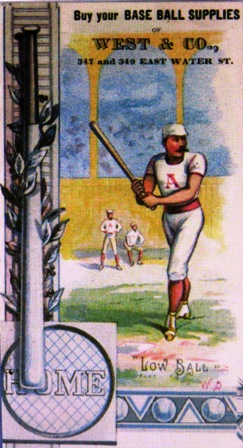
west&co

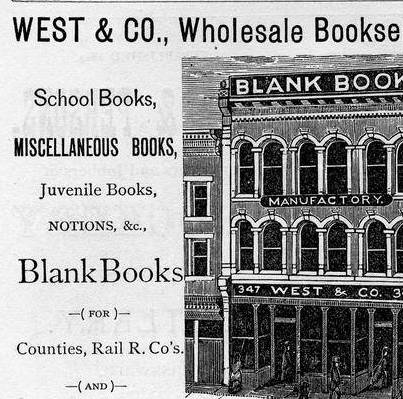
This advertisement from around 1870 was for West & Co., a book and stationery business founded by Henry Harris West in 1857.  West was instrumental in forming the first post-Civil War team in Milwaukee.  The Milwaukee Cream Citys were organized in October of 1865, with West serving as the team’s first president.

The Cream Citys were a dominant amateur team in 1866 and ’67, playing in Wisconsin and Illinois—although they lost

By the time this ad appeared the Cream Citys had declined in stature.  They joined the National Association of Base Ball Players (NABBP) in 1868, and while remaining an amateur team, were  badly beaten by quasi-professional teams, losing 67-13 to Brooklyn Atlantics and 43-16 to the Unions of Morrisania (South Bronx).

When openly professional clubs were admitted to the NABBP in 1869, things got even worse for the Cream Citys, they were beaten 85-7 and 84-17 by the Cincinnati Red Stockings in two July games.

Milwaukee would have its first fully professional team in 1877 when the West End club joined the League Alliance.

West died in 1893; the company would eventually be renamed H.H. West & Co. The  East Water Street headquarters was destroyed by fire the following year.

H. H. West & Co., 1870s

H. H. West & Co., 1870s

“California Wonder”

30 Apr

Two West Coast ballplayers dubbed “California Wonder” by the press made their Major League debuts less than a week apart in 1887.  One went on to be one of the best leadoff hitters of his era; the other remains almost completely unknown.

George Van Haltren was a 21-year-old left-handed pitcher, outfielder and first baseman who had played two seasons with the Oakland franchise in the California and California State Leagues.

James McMullin, birth date unknown, had pitched for Mike Finn’s San Francisco Pioneers in 1886.

Mike Finn, manager, San Francisco Pioneers

Mike Finn, manager, San Francisco Pioneers

Van Haltren’s rights were acquired by the Pittsburgh Alleghenys, but because of his mother’s illness he said he would instead play for the San Francisco Haverlys.  The Chicago White Stockings traded for Van Haltren in April, but he still refused.  The Sporting Life said “the California Wonder will not come east,” quoted him saying:

“No, I will not play with Chicago this season; but if my left arm holds out and my parents are blessed with good health I will be open to Eastern engagements next season.”

The White Stockings threatened to have him blacklisted for not reporting but Van Haltren dug his heels in; only changing his mind after his mother passed away in May.

The Chicago Inter Ocean announced that he had arrived in town on June 25 and would be making his debut for the White Stockings on the two days later:

“(Van Haltren) at one time retired the Pioneer Club of San Francisco with a hit, and struck out seventeen men.  If he can continue this record here the Chicagos will come out of the race this season with another set of figures to put on the big flag at the park.”

Van Haltren’s debut was not good.  He walked 16 Boston Beaneaters and lost 17 to 11.  He finished the season 11-7, and would spend one more season as a full-time pitcher; going 13-13 in 1888 (he was 15-10, splitting time between the mound and outfield with the Brooklyn Ward’s Wonders in the Players league in 1890).  Van Haltren would distinguish himself as one of the game’s best leadoff men, hitting better than .300 every year from 1889-1901, except for 1892 when he hit .293.

Van Haltren ended his career in 1903 with 2544 hits.

George Van Haltren

George Van Haltren

McMullin’s debut was no better than Van Haltren’s.

He began the 1887 season with the Pioneers, but was acquired in June by the new York Mutuals of the American Association.

When McMullin joined the club The Sporting Life said:

“The Mets have got their new California pitcher and like him well in practice.  He has plenty of speed.”

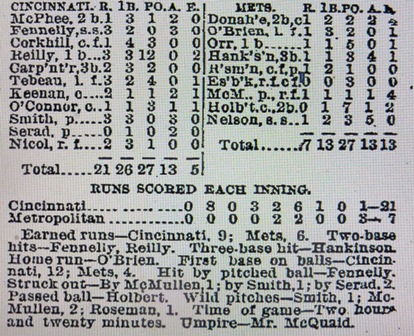
McMullin made his debut on July 2 against the Cincinnati Red Stockings.  The New York Times said of his performance, under the headline, “A ‘Wonder’ Exploded.  The Mets’ California Pitcher A Failure:”

“The debut of McMullen, the ‘California Wonder,’ was made (in Cincinnati) today in the presence of nearly 7,000 people, who went into hysterics from laughing at the awful exhibition given by the Wonder and his support.  He was utterly unable to get the ball over the plate and was miserably supported in the field.  After the third inning he retired to right field and there made a couple of errors.”

He gave up eight runs, made four errors and had two wild pitches in a 21-7 drubbing.

The box score from McMullin's debut.

The box score from McMullin’s debut.

McMullin only made two more appearances for the Metropolitans, and while he was credited with wins in both games his performance was no better; in his eight-day, three-game career he pitched 21 innings, gave up  25 runs (18 earned),  25 hits, walked 19, and struck out 2.  He made a total of five errors, and had one hit in 12 at bats.  The Mets released him on July 10.

And with that McMullin disappeared—there is no record of him having pitched anywhere after he left New York, there’s no record of whether he  threw and batted left-handed or right-handed, no pictures survive, and no record of when or where he died.  Another enigmatic figure of professional baseball’s early years.

“I Have a Profound Contempt for the Game”

29 Apr

Samuel Porter Jones was one of the country’s most prominent Evangelists from the late 1870s until his death in 1906—the Ryman Auditorium in Nashville, home of The Grand Ole Opry, was originally called The Union Gospel Tabernacle and was built for Jones’ ministry.

Jones was not a baseball fan.

Speaking at a tent revival in his hometown of Cartersville, Georgia in 1885 Jones stirred up a crowd with his attack on the game.

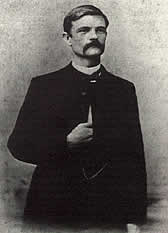
Evangelist Samuel Porter Jones

Evangelist Samuel Porter Jones

According to The Atlanta Constitution, Jones read a note from one of the flock which said, “Our children have often gone off to the baseball grounds during this meeting and grieved our hearts,” and asked Jones for his opinion.  The preacher first said he’d hold his comments about the game for a later date, and then proceeded to give his views:

“In this town this year one poor wretch went into the baseball business regularly neglected his work and finally stopped doing anything whereby he could make a living.  His wife had to go to her father’s to get something to eat.  Yes, my views on the baseball question are very clear, and I intend to give those views with a vengeance at some future time.”

And then he continued again:

“I have a profound contempt for the game.  All that agree with me say ‘amen.’”

The Constitution said there were several ‘amen’s’ repeated in the tent:

“It is all very well for little boys under ten years of age to play baseball, but for men it is a crying shame and an abominable sin.  Why, I would not get mad with a man if he should kill my dog if he found him on a baseball ground.  My boy can play baseball until he is 10-years-old, but after that time I will give a hundred lashes every time he plays. ..If this meeting breaks up baseball in this town it will do well; if it does nothing else.  In three years no decent man will be found in the baseball business, if the game is carried on as it is now.”

The evangelist, and others who railed against the game in the late 19th Century did little to curb the growing popularity of the game..

Jones is buried in Cartersville.

Cartersville’s other connection to baseball is seven time American League all-star Rudy York, who played for the Detroit Tigers, Boston Red Sox, Chicago White Sox and Philadelphia Athletics.  York’s family moved there in his teens, and he played ball on a company team at the local textile mill and for the Atlantic Transportation Company team in nearby Atco, Georgia, before being signed for the Tigers by scout Eddie Goostree in 1933.

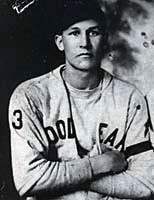
Rudy York, circa 1930, with local textile mill team.

Rudy York, circa 1930, with local textile mill team.

York died in 1970 and is buried four miles away from Jones in Cartersville.

Eddie Goostree, signed York for the Tigers

Eddie Goostree, signed York for the Tigers

Things I Learned on the Way to Looking Up Other Things #3

26 Apr

Tools of ignorance

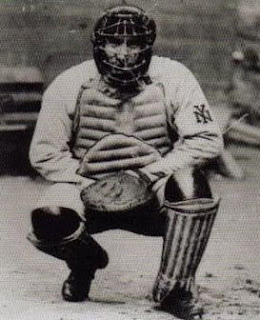
As catchers began to wear more equipment the was widespread disapproval.  In 1884 The New Haven News said:

“With his frontal liver-pad, his hands cased in thick gloves and the familiar wire helmet on his head, the average baseball catcher looks for all the world like an animated combination of a modern bed-bolster and a medieval knight.”

Roger Bresnahan, 1907, more than 20 years after catcher's began to look like "medieval knights."

Roger Bresnahan, 1907, more than 20 years after a catcher began to look like a “medieval knight.”

Cuban Giants Challenge

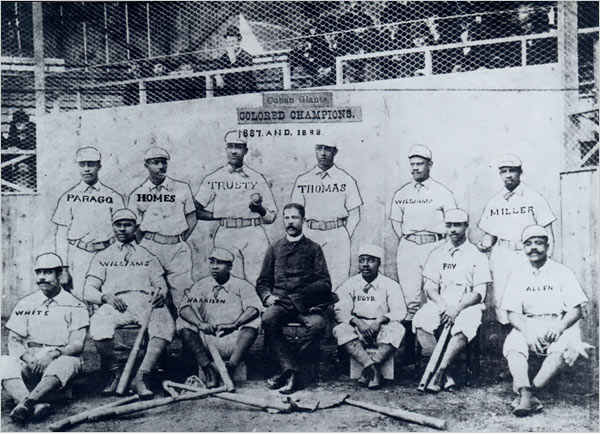
In August of 1888, The Freeman declared the Cuban Giants “virtually the champions of the world.”

The paper said that the first professional black baseball team, were willing to take on any ballclub, but:

“The St. Louis Browns, Detroits (Wolverines) and Chicagos (White Stockings) afflicted with Negrophobia and unable to bear the odium of being beaten by colored men, refused to accept their challenge.”

1887-88 Cuban Giants--"virtually the champions of the world."

1887-88 Cuban Giants–“virtually the champions of the world.”

The Elizabeth Resolutes

The Elizabeth (NJ) Resolutes were one of the worst professional teams of baseball’s infancy.  The 1873 National Association team only played 23 games, losing 21, and from the beginning of the season, the franchise was on the verge of demise.

The New York Herald summed up the general feeling about the team in an August article:

“The Resolute Club, whom everyone hoped had disbanded, as was reported, put in an appearance on the Union grounds yesterday afternoon and played the (Brooklyn) Atlantics, committing, as usual, about five hundred errors.”

It was the first, and last, game on the mound for pitcher Len Lovett.

The Herald concluded:

“The game was a most wretched affair.”

dougallison

Catcher Doug Allison who hit .300, and his brother Art, who hit .320, were rare bright spots for the resolutes.

More Superstitions

25 Apr

Billy Evans, “The Boy Umpire,” joined the American League staff at the age of 22.  Before becoming an umpire, Evans was a reporter for The Youngstown Vindicator and continued to write occasional, syndicated newspaper articles throughout his career.

Billy Evans

Billy Evans

In a 1907 article he wrote about superstitions:

“Baseball players are the most superstitious class of people in the world.  There are many superstitions in general in which all members of the profession have implicit confidence and nearly every player has some pet belief that is all his own.”

Evans mentioned one of the most superstitious players of all-time, Detroit Tigers pitcher “Wild Bill” Donovan, who as mentioned in an earlier post, believed that striking out the first batter he faced was bad luck.  According to Evans he also had a strange belief about the first game of the season:

“Donovan has a dread of working in shutout games on his first appearance.  He believes it a season hoodoo and would do almost anything to prevent it.”

Evans worked as an umpire in Donovan’s first start of the 1907 season, and the pitcher took a shutout into the ninth inning:

“I happened to be working back of Donovan that day and noticed that he seemed to let up in the ninth , also that he used nothing but a straight fast ball.  A pass, an error and a cracking hit by Charley Hickman sent a couple of tallies over the pan.”

Evans said he asked Donovan after the game if he “(lost his stuff,” in the ninth, Donovan said no:

“I have no desire to win a shutout game right off the reel…shutouts on your debut are not lucky.”

Bill Donovan

Bill Donovan

Evans said Fred “Lucky” Glade, a St. Louis Browns pitcher who had just been traded to the New York Highlanders, had a phobia of pitching if the sun wasn’t out:

 “According to Glade, he has never during his career won a game on a dark day.”

The pitcher also “started each inning…by tossing a ball to (Browns first baseman) Tom Jones.  Next year he will have to use (Highlanders first baseman) Hal Chase

Chase must not have been an adequate substitute; Glade struggled with arm and stomach problems, posted an 0-4 record in five starts for the Highlanders, before returning home to Nebraska in June.  He signed a contract for 1909, but never reported and never pitched again.

Fred Glade

Fred Glade

Ty Cobb had numerous superstitions; one had to do with the “position of the broom with which the umpires use to dust off the plate.”  Evans said:

“The umpires find it handy to keep the broom to the left of the plate, while Cobb, when at the bat, always desires it to the right.  Whenever he steps to the plate Cobb always picks up the broom and tosses it to the right side of the batter’s box.”

Additionally:

“When in a batting slump Cobb always makes three crosses as he takes his position at the plate.  When Cobb reaches first base on his journey from right field to the bench he always gives the bag a terrific kick in the direction of the plate…Cobb insists that the short distance he moves the bag toward the plate with his kick often is the means of winning a close decision at first for his team.’

Ty Cobb

Ty Cobb

Evans said of superstitions in baseball:

“No doubt a close investigation would reveal that every player from the smallest bush league up has his pet theory.”

“The Greatest Team Ever Organized”

24 Apr

Hopes were high for The Players League, and for Chicago’s franchise, the Pirates, in the newly formed baseball brotherhood.

Rumors had been reported for more than two months, but finally on January 18 The Chicago Daily News said that Charlie Comiskey “came to town yesterday morning, and at 4 o’clock signed…for three years,” to serve as captain and manager; the contract was said to be worth “$5,000 per annum.”

President Charles A. Weidenfelder had built a strong ballclub, with major assists from Fred Pfeffer, Chicago White Stockings second baseman, who encouraged most of that team to jump to the new league, and Frank Brunell, a former Chicago newspaper man who was secretary of the new league, and traveled to St. Louis to encourage Comiskey to jump to the brotherhood.

There was an embarrassing moment in March when Chicago newspapers reported that the carpenters union was complaining that non-union labor was being used to build the team’s ballpark at Thirty-Eighth Street and Wentworth Avenue.    The secretary of the union was quoted in The Chicago Tribune saying  Brunell had “promised to make it right.  But he didn’t.”

Despite the  irony of a league borne out of the game’s first labor movement betraying organized labor (there were similar difficulties in Boston and Philadelphia), enthusiasm for the new league was high; in Chicago the expectations were higher.  A week before the season opened The Chicago Tribune said:

“The elements which go to make up a great team are united in the Chicago Brotherhood Club, which, on paper, is the greatest team ever organized.”

Comiskey’s club opened the season on April 19 in Pittsburgh.  According to The Chicago Inter Ocean:

“It was a great day for the Players League…There were 9,000 people by the turnstiles’ count to see the fun…It was by all odds the biggest crowd that had ever turned out to witness an opening game of ball in Pittsburgh.”

The pregame festivities included a parade through the streets of Pittsburgh featuring both teams, league officials and a Grand Army of the Republic brass band.

“(Pittsburgh) Manager (Ned) Hanlon was presented with an immense floral horseshoe, Comiskey with a big floral ball on a stand of floral bats, Pfeffer with a basket of roses…(Chicago’s Arlie) Latham ‘stood on his head, with a smile well-bred, and bowed three times’ to the ladies.  (He had) the legend ‘We are the people’ in great black letters on (his) broad back.”

After the fanfare, “Pfeffer and the boys played a particularly brilliant game,” as Chicago defeated Pittsburgh 10-2.

Box Score--Chicago Pirates/Pittsburgh Burghers, Opening Day, 1890.

Box Score–Chicago Pirates/Pittsburgh Burghers, Opening Day, 1890.

Opening Day was the high point for Chicago. The league as a whole struggled financially and attendance dropped sharply after the initial excitement wore off.  Only eight games into the season, barely 500 people attended Chicago’s game in Cleveland on May 1.

Comiskey’s “greatest team ever organized,” was never able to keep pace with the league champion Boston Reds and finished fourth in the eight team league, 10 games back.

The Chicago Times lamented the team’s poor showing and blamed it on a “lack of discipline,” (the article appeared in slightly different form in several newspapers):

“The outside world cannot fully realize the bitter disappointment felt here over the poor showing made by Comiskey’s team during the season just closed.  Surely it was strongest aggregation of players ever collected in one club, but its lack of success was mainly from two causes—lack of discipline and the miserable condition of certain members of the club.

“There has been absolutely no discipline in the team, and some of the men paid as much attention to Comiskey’s orders as they would to a call from some church congregation.  An order to sacrifice was met with a smile of scorn, and the ball was hammered down to an infielder, who made an easy double play.”

The Times said “(Tip) O’Neill, Latham, Pfeffer, (Jimmy) Ryan and others utterly ignored Comiskey’s mandates, and in consequence there was continual disorder.”

The paper’s primary target was shortstop Ned Williamson.  The criticisms might have been unjustified: the former White Stockings favorite had struggled with the knee injury he sustained on the 1888-89 world tour, and might have already been ill as his health would decline rapidly, and he’d be dead by 1894; the victim of tuberculosis:

“Williamson played a game of which an amateur should have been ashamed, and was thirty pounds overweight throughout the season.”

The paper promised “there will be numerous, changes in the club, provided the players League is still in existence,” in 1891.

It was not to be.  By November league secretary Brunell told The Chicago Herald:

“The jig is up.  We are beaten and the Brotherhood is no more.”

Brunell attempted to put a positive spin on the news, telling the paper it was mistaken to infer the “Brotherhood has weakened.”  Rather “we began to see that the interest in baseball was on the wane, and in order to prevent it from dying out entirely…we finally concluded that a consolidation of forces (with the National League and American Association) would be better for all concerned.”

The Herald wasn’t buying Brunell’s statement:

Brunell’s talk has finally let in the light on a subject previously enveloped in darkness.  It appears now that the Players League folks actually courted a knockout, and bankrupted themselves from pure patriotic motives.  The ex-secretary is a funny little man.”

Brunell would go on to found The Daily Racing Form in 1894.

Comiskey returned to the St. Louis Browns in the American Association.  Tip O’Neill, who also jumped the Browns to join the Players League, returned to St, Louis with his manager.

Comiskey (8) was joined in Chicago by three members of his American Association championship teams in St. Louis.  Arlie Latham (7), Tip O'Neill (11), and pitcher Silver King (14) who posted a 30-22 record.

Comiskey (8) was joined in Chicago by three members of his American Association championship teams in St. Louis. Arlie Latham (7), Tip O’Neill (11), and pitcher Silver King (14) who posted a 30-22 record.

Fred Pfeffer stayed in Chicago, spending one more turbulent season with Cap Anson, before being traded to the Louisville Colonels.

Arlie Latham, “The Freshest Man on Earth” went to the Cincinnati Reds in the National League.

Ned Williamson never played again.