Profiles of Members of Spalding’s World Tour, “The Stonewall Infield”

23 Apr

While with the players who took part in the world tour between the 1888 and ’89 seasons, Si Goodfriend observed:

 “My experience in traveling with baseball clubs, the circumstances of which necessarily brings about a close association, has impressed me with the fact that most of them are, as a rule, men of far more intelligence and better manners than they are generally given credit for.”

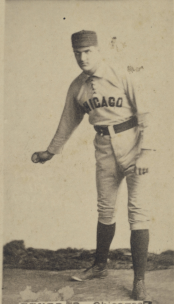
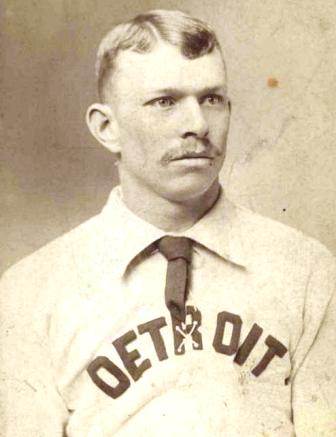
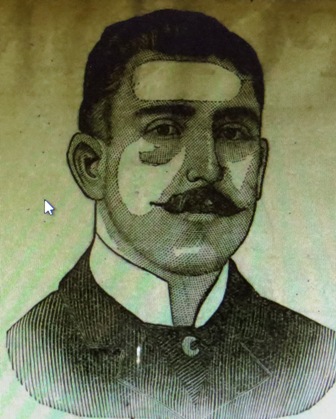
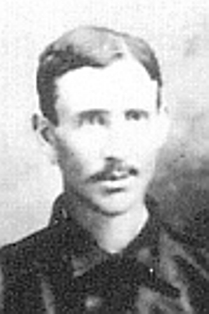
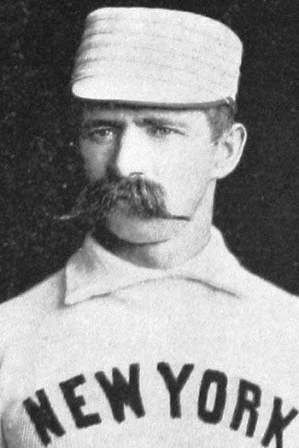
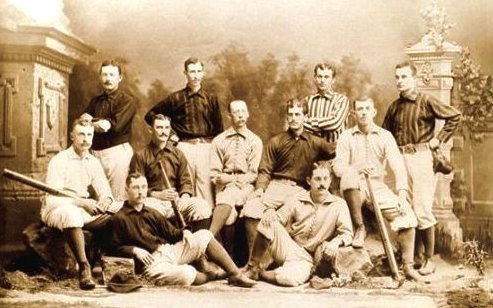
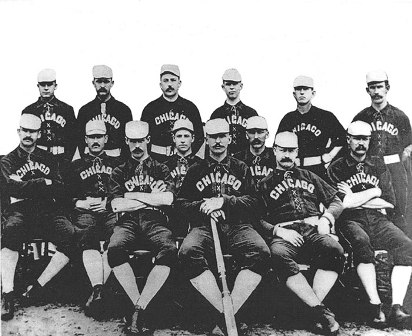
Among those players were all four members of the Chicago White Stockings “Stonewall Infield:” Adrian Constantine “Cap” Anson, Nathaniel Frederick “Fred” Pfeffer, Edward Nagle “Ned” Williamson, and Thomas Everett “Tom” Burns.

Goodfriend said of Anson:

“Decidedly the most unique and interesting figure of all is that of Captain Anson.  He shows the same peculiarities of temperament off as on the ball field.  He takes advantage of every point he sees and, and holds it…He may not admire a fellow baseball player personally, but this will not induce him to detract from his skill or standing as a player.

“’Old Anse’ has genuine sporting blood in him, and will bet on anything that turns up…There isn’t anything (aboard)the ship he won’t bet on if he has a fair chance of winning.  Anson’s nature is not nearly as harsh as some people imagine.  The rippling water in the moonlight or the graceful soaring of a bird will draw out the greatest sentiments from him.”

Like John Tener, Anson would enter politics, but was less successful.  After being elected Chicago’s city clerk in 1905, he was defeated in the Democratic primary for Cook County (IL) Sheriff in 1907

"Cap" Anson

“Cap” Anson

Of Pfeffer he observed:

“(He) is handsome and has no striking mental characteristics.  He has a long, flowing, brown mustache and soft brown eyes, both of which would readily come under the head of a womanly ‘lovely.’  To show the nature of the man I need only mention a little incident that is causing him much worry at the present time.  His only relative is his mother who lives in Louisville.  Before leaving on the trip he promised to write to her regularly and while on the ocean he promised to cable home from every point possible.  He did not know there was no cable from Honolulu, and now he is worrying himself that his old mother will be anxious about him until he can cable from Auckland.  It will seem an age to him until that city is reached.”

Pfeffer, along with “Monte” Ward was a leader in baseball’s nascent labor movement, Pfeffer was frequently at odds with Anson, and led the exodus of most of the White Stockings’ starters to the Players League.  Despite that, in 1918 Anson called Pfeffer the game’s all-time greatest second baseman after sportswriter Grantland Rice said Eddie Collins of the White Sox was the best ever.
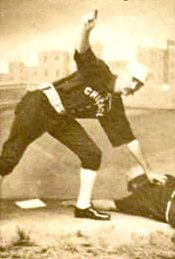
Fred Pfeffer

Fred Pfeffer

Williamson, he said, was “unassuming” and:

“(A) big tender-hearted fellow, whom everybody likes.  He writes in an exceedingly clever and interesting style, and can ‘fake’ a good story like a veteran journalist.”

Ned Williamson with White stockings mascot
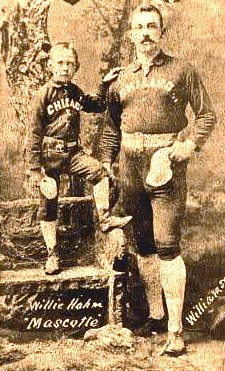
Ned Williamson with White stockings mascot

Williamson wrote his own dispatches from the tour which became popular features in Chicago papers.  He injured his knee on the tour and A.G. Spalding refused to help him with medical expenses; the 36-year-old Williamson jumped to the Players League in 1890, but his health began to deteriorate that year while playing for the Chicago Pirates.  He died of tuberculosis in 1894.

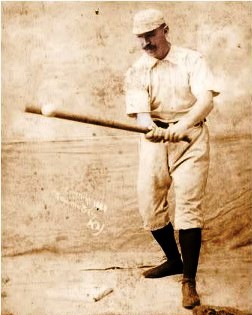
Goodfriend on third baseman Burns:

“(He) is a bright, intelligent man, who spends most of his time in reading; works of a standard heavy and weighty character being favorites.  He has the reputation of being a great dresser, and is said to have as many trunks with him as a New York belle would carry to Saratoga.”

Tom Burns

Tom Burns

Nearly a decade after the tour, Burns would be the man who replaced Anson as manager of the Chicago National League ballclub.  Burns took the reins of the “Orphans” in 1898, ending Anson’s 19-year run as manager.

Burns was named manager of the Jersey City Skeeters in the Eastern League in 1902, but died just weeks before the beginning of the season.
Profiles of Members of Spalding’s World Tour

22 Apr

Among those who joined A.G. Spalding’s world tour between the 1888 and 1889 seasons, was Simon “Si” Goodfriend, a sports writer for The New York World who later became a theatrical agent.  In 1935 The New York Times said of Goodfriend “has watched baseball as a fan and a sportswriter since the days of the Civil War.”

Simon "Si" Goodfriend

Simon “Si” Goodfriend

Throughout the trip Goodfriend wrote brief profiles of some of the players:

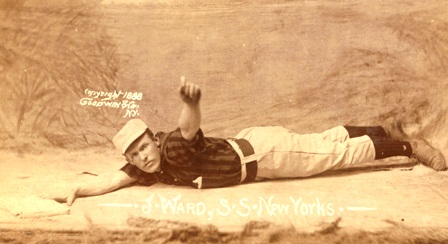
On Hall of Famer John Montgomery “Monte” Ward:

“Ward is a credit to the professional brotherhood of ballplayers.  He is not only ambitious to elevate the standing of the profession but he is equally ambitious personally.  He is exceedingly studious and never visits a strange city (without visiting) the art galleries, museums and libraries and takes copious notes of what he sees.  He presents the same disposition on the sea voyage.  He is a busy person both with his pencil and at his ball practice.”

Ward, who had spearheaded the effort to create the first player’s union in 1885 and the creation of the Players League in 1890.

John Montgomery Ward

John Montgomery Ward

Of John Kinley Tener, White Stockings pitcher and future United States Congressman and Pennsylvania Governor:

“I was going to allude to John K. Tener as a typical handsome American gentleman, but unfortunately I learned, but a day or two ago, that he was born in Ireland and came to America with his parents when he was 9-years-old…His features are clear cut, regular and refined.  His manners are gentle and cultured. Baseball players secured a worthy brother professional when he joined their forces, and there is a to be regretted possibility that he may retire again next season…Anson can be relied on to make a great effort to hold him back.  On the trip Mr. Tener acts as a secretary and treasurer to Mr. Spalding.”

John Tener

John Tener

Tener jumped the Cubs to join the Pittsburgh Burghers in Players League in 1890; after posted a 3-11 record with an ERA of 7.31 Tener left baseball for the banking business, and ultimately politics.

Jimmy Manning, who would quite possibly save an umpire’s life in Kansas City in 1890, was also on the tour:

“(He) is another modest young man with a blond mustache, of which he is proud.   He recently graduated from the Boston college of Pharmacy.”

Jimmy Manning

Jimmy Manning

Philadelphia Quakers outfielder Jim Fogarty:

(Monte Ward) mentions in his book on baseball (that Fogarty was) probably the best right fielder in the country, is a bright looking young fellow with an exuberance of spirits, unquestionably inherited from the land of Erin, and that apparently has no limit.  It is said that he is writing for a Philadelphia paper.  If his letters are half as bubbling and genial as he is at sea they will make interesting reading.  With the exception of (Charlie) Bennett of the Detroits, Fogarty probably has as bad a pair of hands from hard knocks in baseball games as any player in the country.”

Fogarty also jumped to the Players League, joining the brotherhood team in Philadelphia; however he became ill during the season would die of tuberculosis in May of 1891.

Jim Fogarty

Jim Fogarty

Of Billy Earle, “The Little Globetrotter,” McClure said:

“Little William Earle…has already proven himself a first-class backstop (and) is still quite a lad, being only 21 years old.  He is heavy-set has a jolly round face, an habitual smile and tightly curled hair.  He rarely smokes, doesn’t drink and would almost sooner play ball than eat.

Billy Earle

Billy Earle

Some of Goodfriend’s observations about Earle would prove to be wrong, as discussed in an earlier post.

Goodfriend’s profiles of the White Stockings’ “stone wall infield” tomorrow.

Lost Advertisements–John Evers, Gillette

19 Apr

eversgilette


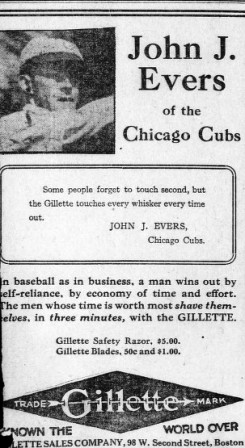
1908 Gillette advertisement featuring Chicago Cubs second baseman, Johnny Evers.

“Some people forget to touch second, but the Gillette touches every whisker every time out.” John J. Evers, Chicago Cubs.

“In baseball as in business, a man wins out by self-reliance, by economy of time and effort.  The men whose time is worth most shave themselves, in three minutes, the GILLETTE.”

Filling in the Blanks, Pearson, Minneapolis Millers, 1884

18 Apr

Baseball Reference lists “Pearson” as a pitcher for the Minneapolis Millers in the Northwestern League in 1884.

Edward Pool Pearson’s professional career was brief and ended dramatically.

Born in Waterloo, New York in 1859, Pearson attended Hobart College, where he studied mathematics.

He pitched three seasons with the Hobart team—his battery mate there was James Adelbert McCauley, who also made his professional debut with the Millers in 1884, and went on to play with the St. Louis Browns, Buffalo Bisons, Chicago White Stockings and Brooklyn Grays in the National League and American Association.

jim McCauley, Pearson's teammate at Hobart and with Minneapolis

jim McCauley, Pearson’s teammate at Hobart and with Minneapolis

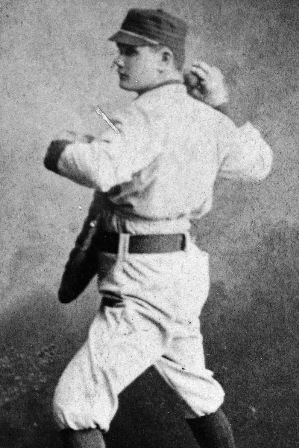
Pearson was 5-7 with a 1.54 ERA in 13 appearances with the Millers when he took the mound to pitch against the Milwaukee Brewers on August 7.  According to The Associated Press:

“Pearson, the pitcher for the Minneapolis Club, while delivering the ball, broke his arm above the elbow.  It broke with a snapping sound that could be heard all over the diamond, the ball rolling along the grass to the Captain’s line.  Pearson uttered a loud cry of pain and fell to the ground.  He was immediately carried to a doctor’s office, where the broken bone was set…The accident will necessitate his retirement from the diamond, as he has no desire to ever play ball again.”

After the injury he  returned to Hobart, graduated in 1885 and received a Master’s Degree in 1889.  Pearson died in 1932.

“The ‘Original’ up-behind-the-bat Man”

17 Apr

Douglas L. Allison was largely forgotten by 1907.

He caught for Harry Wright’s Cincinnati Red Stockings from 1868-1870, joined the newly formed National Association as a member of Nick Young’s Washington Olympics in 1871, and was an inaugural member of the Hartford Dark Blues during the National League’s first season in 1876; in total he played for parts of 10 seasons in the American Association, National League, and National Association.

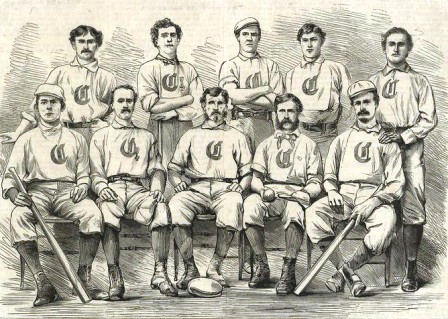
Doug Allison, standing third from left, with the 1869 Cincinnati Red Stockings

Doug Allison, standing middle, with the 1869 Cincinnati Red Stockings

It was the death of a contemporary that brought him back into the public eye.

On April 21, 1907, Nathan Woodhull “Nat” Hicks died in Hoboken, NJ.  Hicks had also been a catcher, having played for the New York Mutuals, Philadelphia Whites and Cincinnati Reds in the National Association and National League from 1872-1877.

Hicks’ obituary, including the one in The New York Times, gave him credit for being the first catcher to stand directly behind the batter:

“To catch behind the bat without the elaborate protection of mask, protector, great glove, and shin guards, as Nat Hicks was the first to do, required a grit and endurance that few of the high-priced artists of the diamond today would care to emulate.  Hicks created a sensation by catching behind the bat with his naked hands and body unprotected.”

Doug Allison couldn’t let that stand, and he contacted a reporter from The Associated Press to set the record straight:

“Nat Hicks was a great catcher for the short period that he stood in the limelight of public opinion, but the press of the country is away off in giving him credit as the ‘original’ up-behind-the-bat man.”

While coming forward to claim the distinction, Allison insisted it wasn’t important to him:

“Not that I wish to claim any such record, for after all it does not carry any great weight or glory, but just the same I think figures will prove that I was among the first, if not the first, of any of the backstops  to attempt that trick that was the mystery of the game.”

Allison said that while catching for a team in the Manayunk neighborhood of Philadelphia he developed a “theory,” and “began to believe it possible to get close up to the bat,” in order to prevent runners from stealing:

“I put my theory in action, and that was way back in 1866…My success in this style of play was remarkable, and naturally the talk of the place, until our game began to draw crowds simply because ‘Allison was behind the bat.’  This is not egotism, but the fact, and my method soon had lots of imitators.”

Allison said the following season while playing with the “Gearys, the leading amateur team of Philadelphia,” he was discovered by “that greatest of all baseball generals—Harry Wright.” And while with the Red Stockings he “continued up under the bat with plenty of success.”

As for “my friend Nat Hicks,” Allison said:

“(He) did not break into the game until 1870 and could not have started that play for which so many newspapers have been giving him credit, and while disliking to cloud their stories, it seems right to correct the popular impression of this important epoch in the history of baseball.”

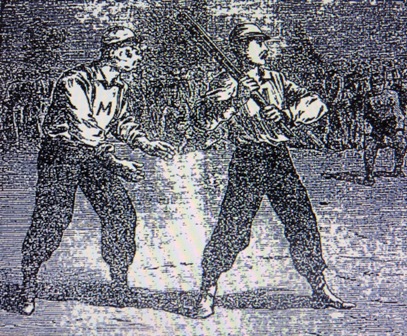
A print from the 1870s depicting "Nat" Hicks "behind the bat" with the New York Mutuals.

A print from the 1870s depicting “Nat” Hicks “behind the bat” with the New York Mutuals.

Having set the record straight, Allison returned to his job in the dead letter office of the United States Post Office in Washington D.C.  He died in 1916 at age 70.

Alamazoo Jennings

16 Apr

Alfred Gorden Jennings earned his nickname the day after his only professional game, as the catcher for the  Milwaukee Grays in 1878; and it was given to him by on of the most famous baseball writers of the era.

The Grays had three catchers in 1878; Charlie Bennett, Will Foley and Bill Hobart, all of whom were injured on August 15 while Milwaukee was in Cincinnati for a series with the Reds.   Grays Manager Jack “Death to Flying Things” Chapman found Jennings, who had been playing with local semi-pro and amateur teams for a decade, and put him in the lineup for the August 15 game.

Pitcher Mike Golden was on the mound for Milwaukee, and Jennings told sportswriter Rem Mulford Jr. years later:

“We were all mixed in our signs.  I signed for an outcurve and got an inshoot which broke a couple of fingers.  ‘Go ahead,’ I said, ‘ I’ll stay here all day even if I have to stop ‘em with my elbows.  You can’t drive me away.’  Well they didn’t.”

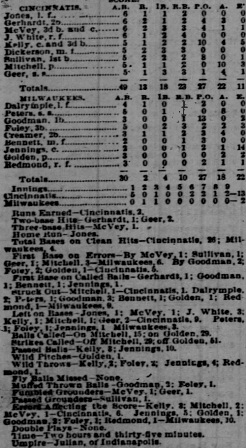
Jennings was officially credited with 10 passed balls (he claimed he had 17), a record that stood until 1884.

The morning after the game in The Cincinnati Enquirer, the headline on Oliver Perry “O. P.” Caylor’s story read:

Alamazoo Jennings Makes His Debut Behind the Bat

His Gall Holds Out but His Hands Weaken

Caylor said:

“(Jennings) looked so large and handsome and very like a catcher that Manager Chapman was mashed, and straightaway engaged him, and clinched the bargain with a dinner.  When Al pulled on his sole- leather gloves and poised near the grandstand at three o’clock, the crowd scarcely breathed.  Zip came the ball from Golden’s hand; bang it went against the backstop because Al had stooped too late to pick it up.  It took several minutes for him to gauge the speed of Golden’s pitching, but he got it down fine at last, and stopped a ball every once in awhile.  But, the low comedy parts came in when the new catcher went up close behind the bat.  A batter had but to get on first base and a run was scored.  They went to second and third without danger, and tallied on a passed ball.”

Jennings told Mulford his reaction to Caylor’s story:

“I read a few lines and wanted to fight.  I read a few lines more and had to laugh.”

The Box Score

The Box Score

That game was the end of Jennings’ one-day professional career.  Shortly afterwards he began a more than 10-year run as a minor league umpire in the Bluegrass, Southern, Northwestern and Interstate Leagues.  He also served as an umpire in the Union Association in 1884, his only season in a major league.

Mulford would occasionally update his readers about Jennings, of whom he said:

“With all his peculiarities, Amamazoo is a good fellow, and he has as many friends in and out of the profession as anybody ever connected with the great national game.”

By 1891 he gave up umpiring to become “The Parched Corn King of America,”selling his product in “three cities–Cincinnati, Covington and Newport—and netting every day ten times the amount of the original capital invested in the enterprise.”

by November of 1894 Jennings had moved on from the “parched corn” business, to “pushing an insect killer,” when as The Sporting Life said: “Death entered another victory upon his scorebook.”  He was 43-years-old.

The Enquirer said for his funeral his friends ordered a “floral piece…over seven feet high.  It is made of beautiful flowers.  Two large floral bats cross each other above, and below then are two floral balls, and at the bottom of the piece the inscription: ‘His Last Decision.'”

“Phil Powers Seems to be Dead to the World”

15 Apr

Phillip J. Powers again left the National League umpire staff at the close of the 1888 season.  In 1889 he returned to London, Ontario to manage the Tecumseh’s, quit in May to become an umpire in the International Association, and then resigned from that job to return to the National League as an umpire in July.

Phil Powers

Phil Powers

The Detroit Free Press said the former and current National League arbiter “would never be a success as an umpire.”

Within weeks he was again at the center of controversy.

After the Boston Beaneaters beat the Philadelphia Quakers on July 25, The Philadelphia Inquirer placed the blame for the home team’s loss squarely on the shoulders of one man:

“Anyone who saw Phil Powers umpire yesterday would set him down as incompetent or dishonest.  While he is neither of these he gave a combination of glaring decisions which robbed the Philadelphia club of the game…It was a hard game to lose and it was no wonder that nearly every one of the 6,7000 spectators joined in hooting at Powers.”

The Inquirer would continue to criticize Powers for the remainder of his career; a few sample quotes.

From 1890:

“Umpire Phil Powers seems to be dead to the world.”

From 1891:

“The rank work of umpire Powers.”

From 1892:

“Umpire Phil Powers has been unanimously elected a member of the Society for the Promotion of Riots.”

The Sporting Life joined the chorus and derided as a “decided detriment to the game,” his work in the Giants-White Stockings series in early August:

“Mr. Powers is not a competent umpire…He does not know the rules, and judging from his decisions on the bases his eyesight is certainly impaired.”

 The Chicago Daily News quoted “Cap” Anson saying Powers “ didn’t know his business.”

Powers did have one defender.  “Orator” Jim O’Rourke, of the New York Giants, wrote a long letter that was reprinted in The Sporting Life, and other papers, making the case for the “High opinion in which Mr. Powers is held by the majority of professionals”, and using the opportunity to heap scorn on Anson:

“No man ever filled the position to better advantage and with more honor and credit to himself.   Mr. Powers is conscientious, faithful and absolutely fearless in voicing his convictions; neither can there be any doubt of his intentions to discharge impartially the irksome duties which the office entail upon him.

“Anson’s hate of such a man is only limited by the capacity of his nature for hate. Now why is this so? Because this cross-grain brow-beater, with the swaggering air of a Mexican bandit, who is so susceptible to becoming red-headed In the presence of umpires and spectators, is forced by this honest referee to have the result of a game settled by the contesting clubs upon its merits and not by his disgusting methods, which have made him the laughing-stock of all players, not even excepting his own.”

Jim O'Rourke--Defender of Powers

Jim O’Rourke–Defender of Powers

Despite O’Rourke’s defense, the criticisms of Powers continued, but he managed to stay on the National League staff in 1890 and ’91.

The Sporting Life updated readers about the umpire through the 1891 season:

“(Powers) has been catching it along the Western line from spectators, players and reporters.”

“(The Pirates) ready to meet Anson’s team to the call of Umpire Phil Powers, who has never pleased Pittsburgh’s audiences”

“Western critics are unanimously of the opinion that Phil Powers argues too much with the players.”

“(Cleveland papers) roasted Phil Powers to their hearts’ content.”

In August of 1891 Powers was released as an umpire by the National League.  He died in New York City in 1914.

A postscript:

A story that has appeared in several books and articles (all citing previous secondary sources) claims Powers pulled a gun on enraged fans in either 1888 or ’89.  While similar stories have been attributed to other umpires (for example umpire Joe Ellick, in 1886, was escorted off the field in Philadelphia by police who drew their weapons to protect him from an angry mob) and there are numerous contemporaneous references to irate fans at games, some with Powers as umpire,  none mention the gun incident.

It is probably a conflation of stories such as Ellick’s and a wire service article that appeared in several newspapers in 1906, shortly after “Buck” Ewing’s death, and described another incident involving Powers and Ewing.

“It was in 1889 that one of the worst rows in the history of baseball was precipitated at Cleveland by “Buck” Ewing.  Phil Powers was umpiring and his weakness whenever a critical decision came up was so apparent that the crowd was on pins and needles as to which way the cat would jump.

“(Jimmy) McAleer hit for two bases.  After he had got (sic) to second, Ewing said something to Powers, and the umpire hesitated a moment and then declared McAleer out for not touching first base…(Powers) was not looking at first when McAleer passed, having turned his head as somebody yelled at him from the opposite side of the field.  This was plainly evident to the crowd, and the moment that the spectators understood why McAleer was out they bolted from the stands and made a rush for the umpire.

“(Powers) took one look at the approaching mob and fled to the players’ clubhouse.  The police cleared the field after a while and Powers was induced to come forth and finish the game, but with police protection on either side of him.”

According to the story (which makes no mention of a gun), Powers later admitted that he had no idea whether McAleer had touched first base and simply took “Ewing’s word for it.”

Jimmy McAleer, called out on Ewing's word

Jimmy McAleer, called out on Ewing’s word

“Leather-Fisted Phil”

12 Apr

“Leather –Fisted Phil” is what Phillip J. Powers was called in his 1914 Associated Press obituary which said:

“(Powers) was famous for his ability to stop the swiftest throws of the league’s star pitchers.”

He most likely earned the nickname in 1877 when, like many other catchers of the era, he began using a small, leather pad on his hand while with the London Tecumsehs of the International Association.

After the London team disbanded in August of 1878 Powers joined the Chicago White Stockings.  According to The Chicago Inter Ocean:

“He is a tall young fellow…He is described as a good catcher, but liable to get hurt, fair at the bat, and a genial man on the grounds.”

Powers would spend parts of seven seasons and 155 games in the National League and American Association with the Boston Red Stockings, Cleveland Blues, Cincinnati Red Stockings and Baltimore Orioles, hitting .180.  In between his engagements as a player Powers was an umpire.

It was as an umpire that he made a name for himself, but it probably wasn’t what he had in mind.  Few umpires, even in an era when members of the “profession” were poorly trained and underpaid, were the target of as much criticism as Powers.

In 1881 he began the season as a National League umpire.  By July he had become a target in several cities,

The Detroit News said:

“Phil Powers has acquired reputation enough in the last two weeks to last him a lifetime.  The erroneous umpiring he did here, people were inclined to regard as errors of judgment, but to say the least his ‘mistakes’ have become so numerous that his utter unfitness for the position he holds is unquestioned.”

The Cleveland Plain Dealer took the criticism even further:

“Powers is said to have been offered $150 to play ball (for the Detroit Wolverines) for one month, but refused it.  As an umpire he cannot, if square, earn more than $15 or $20 a week and expenses; and must take the chance at that of being chosen an umpire.  He preferred to be an umpire.  Several of his decisions on Saturday were grossly unfair, and, what is worse, they bore heavily on Cleveland.  They were so one-sided that many of the spectators believed he deliberately purposed to give the game to Troy.”

Despite the ill feelings in Cleveland, Powers joined the Blues in August and caught five games for the team after Michael “Doc” Kennedy was injured and John Clapp was “called away by an illness in his family.”   He finished the season with the New York Metropolitans in the Eastern Championship Association.

Powers again became a full-time player from 1882-1885, and was part of the Red Stockings American Association championship team in 1882.  He was released by Cincinnati in July of 1885, signed with the Baltimore Orioles and was again released the following month.

1882reds

1882 Cincinnati Red Stockings, Phil Powers standing 2nd from left

Powers was signed by the St. Louis Browns in the spring of 1886, but released before the beginning of the season, and was added to the National League umpiring staff in August.  He again worked as an umpire through the 1887 season, left to return to London, Ontario to manage the Tecumsehs in the International Association, but again returned to the National League as an umpire in August of 1888.   He came back just in time to find himself in the middle of a controversy involving two Hall of Famers.

New York Giants catcher/captain William “Buck” Ewing was hit on the wrist by a ball during a game with the White Stockings in Chicago.  In 1888 the opposing team’s captain had to agree that an injury was serious to necessitate a substitution; Chicago’s “Cap” Anson said he did not agree to a substitution when backup catcher “Big Bill” Brown entered the game in the 6th inning.  Anson appealed to the umpire, and according to The Chicago Inter Ocean, “(Powers) said that Captain Ewing was not so badly hurt that he could not play.”

After a heated argument, during which The Inter Ocean said Ewing acted “in a childish and fatuous manner,” Powers declared the game “forfeited to Chicago by a score of 9 to 0.”

Buck Ewing acted “in a childish and fatuous manner”

Buck Ewing acted “in a childish and fatuous manner”

Powers had been involved in a similar situation in 1886, refusing to allow Philadelphia Quakers catcher “Deacon” McGuire to leave a game after an injury.  The Chicago Tribune said Quakers captain Arthur Irwin “told McGuire to catch ‘away back’ (from the plate).” The Tribune said Irwin’s actions created a “scene” and “pandemonium reigned,” until Anson agreed to allow Philadelphia to replace McGuire.  White Stockings President A.G. Spalding “preferred charges against umpire Powers” for losing control of the game.

The substitution rule was changed in 1891, putting an end to controversies regarding the replacement of injured players.

But controversies involving Powers continued.  More on Monday.

Lost Advertisements—Old Underoof Whiskey, 1909 World Series and 1910 A.L. Race

11 Apr

oldunder1909ws

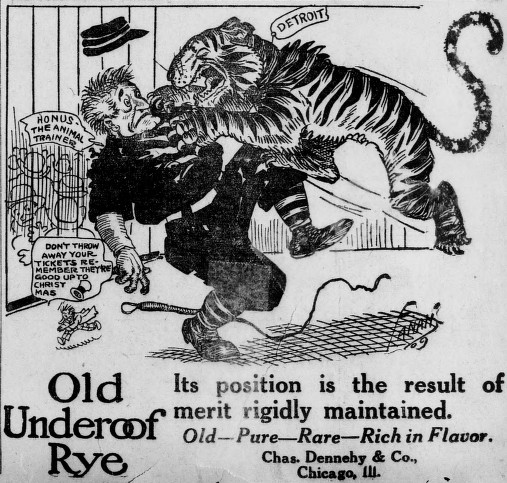
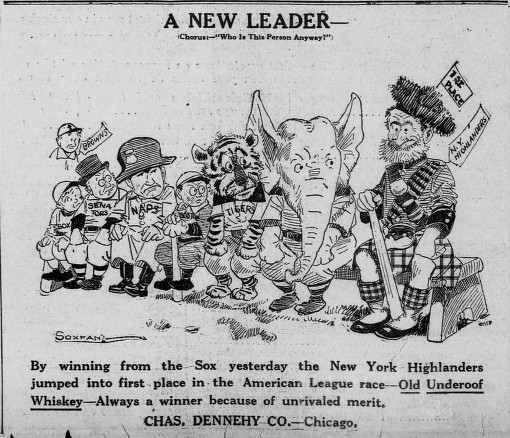
During the first decade of the 20th Century cartoon ads from Chas. Dennehy & Co., distributor of Underoof Bourbon and Rye Whiskey appeared regularly in Chicago newspapers.  Most focused on the Cubs and White Sox, the two featured today do not.

The ad above appeared after game 4 of the 1909 World Series when the Detroit Tigers evened the series with the Pittsburgh Pirates at two games apiece on George Mullin’s a five hitter;  Pirate star Honus Wagner, who would hit .333 for the series was held hitless by Mullin.  The Pirates would go on to win the series in seven games.

The one below was published on June 6, 1910 when the New York Highlanders, after winning two of three in a series with the White Sox, moved into first place.  The Philadelphia Athletics quickly overtook New York and would win the American League Pennant by 14 1/2 games.


oldunder1910Highlanders

“Barnie’s Phenom”

10 Apr

The Baltimore Orioles needed pitching in 1889; Billy Barnie’s team had finished in 5th place in the American Association with a 57-80 record, and a 5.69 team ERA.

The Baltimore papers thought he had found a solution in April of 1889, The Sun said:

“Yesterday a big six-footer strolled up to the ball grounds while the Baltimore boys were at play.  He put on a suit and went in to pitch.  The ball-players laughed at first, but soon found that they could not hit the stranger.  He placed the ball in every conceivable position, and his curves and in-and-out shoots were remarkable.  When he picked up the bat he made the ball and the centre-field fence come together.  Mr. J.M. Ritter, a traveling salesman, had seen the young pitcher at play in Virginia and brought him to Baltimore.”

The Baltimore American was also enthusiastic:

“Great things are expected of Goetz, the Greencastle giant.”

His full name was George Burt Goetz, a 24-year-old house painter from Greencastle, Pennsylvania, who had played semi-pro ball in Virginia and Pennsylvania.

His first outing was against Pennsylvania University at Oriole Park; The Sun said Goetz “delighted 1,000 persons yesterday afternoon by his work in the box.” He pitched five shutout innings, giving up just two hits in a 20-1 victory; he also hit four singles, The Sun raved “He gives promise of becoming a great pitcher, batter and runner.”

The Sun said Goetz’ arrival was almost biblical:

“(He) has apparently created almost as much of a sensation among the local ball enthusiasts as David did when he strolled in among the embattled hosts of the Hebrews and offered to take the Philistine champion down a peg or two. ..Let us hope for the honor of the Baltimore Club that Mr. Goetz will prove a Baltimore David, and that the big champions of opposing teams may fall before his lightning delivery and Heaven-inspired curves.”

Within a week Goetz had been brought back to earth when he was pounded in an exhibition game against the National League’s Boston Beaneaters in Baltimore, he gave up 15 hits, 12 runs (6 earned), and committed three errors in a 12-5 loss.

The Sun conceded that “David met Goliath and came out second best this time,” but remained hopeful:

“(T)here’s life in him yet, which the season may develop into full growth.”

As quickly as he had arrived, it was reported that Goetz had returned to Pennsylvania to recover from an unknown illness; The Sporting Life simply said “Barnie’s Phenom Goetz is sick and recuperating in Greencastle.”

Oriole Manager Billy Barnie

Orioles Manager Billy Barnie

Goetz made it back to Baltimore and pitched in a June 6 game “Between two nines composed of Baltimore club players…for the benefit of the Johnstown (flood) sufferers.”  The Sun said “Goetz was too much for them,” allowing only four hits.

That outing appears to have earned him a shot for his professional debut; eleven days later Goetz started the first game of a double-header against the last place Louisville Colonels.  The Sun said:

“With a hard, steady work and a display of intelligence he may become a success.  At times he would fire the ball over the plate with a speed like a rifle shot, but when men were on bases he was nervous.  He was twelve times safely with a total of seventeen bases.”

Goetz gave up six runs (four earned); Baltimore tied the game with a three-run ninth inning, and won it with four in the tenth, earning Goetz the victory, Bert Cunningham pitched the tenth inning for the Orioles.

It would be his only appearance.

On July 4 the Orioles released Goetz. With little fanfare or explanation Barnie’s phenom was through.

Goetz signed with the York franchise in the Middle States League later in 1889.

He dropped out of sight until 1892 when The Sun reported that Goetz was “the sensation of the Wisconsin-Minnesota League,” pitching for Hayward, Wisconsin, and had recently struck out 19 in a game with the West Superior team.  The paper facetiously noted “It was reported Goetz had drowned in the Johnstown flood, but seems to have turned up again.”

Goetz’ catcher in Wisconsin was a Baltimore native named Milton K. Osborn; the two would play again the following season with a team in Little Falls, Minnesota and both joined the Lynchburg Hill Climbers of the Virginia League in 1894.  No statistics survive for any of Goetz’ post-Baltimore stops.

His trail goes cold after 1894.  There are many listings in city directories for George B. Goetz’ throughout the country for the next several decades, and there are reports that he was in California as late as 1912—but nothing else is known about “Barnie’s phenom”