Dero Austin

10 Jan


dero

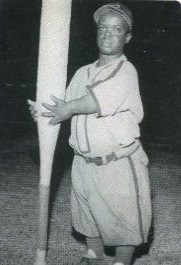
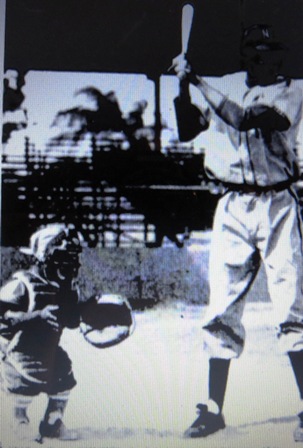
Dero Austin Jr. was one of the few Negro League “players” who was born too late; he was added to the Indianapolis Clowns in 1964 to try to recreate the fame of one of his predecessors, Spec Bebop, who had top billing with the team well into the 1950s.

Spec Bebop, circa 1952

Spec Bebop, circa 1952

Austin quickly joined  James “Nature Boy” Williams as one of the most popular members of the barnstorming team, but the Clowns were well past their heyday when they filled ballparks across the country.  Occasionally they still drew well, in Austin’s first season, 1964, 15,797 fans saw the Clowns in Chicago’s Comiskey Park on July 10; across town 13,556 fans watched the Cubs play the San Francisco Giants.

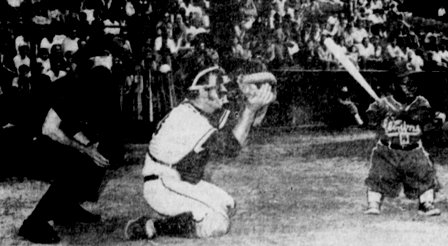
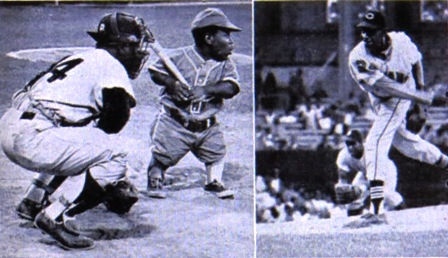
Austin would usually bat first in each game, replicating Eddie Gaedel’s appearance for Bill Veeck’s Saint Louis Browns in 1951–occasionally Satchel Paige would pitch to Austin.  While he appeared in publicity photo’s playing the field, he never appeared in the field during a game.

Satchel Paige pitching, Dero Austin at the plate.  Comiskey Park 1966

Satchel Paige pitching, Dero Austin at the plate. Comiskey Park 1966

Austin never became as popular as Bebop, and the Clowns continued playing to smaller crowds in smaller towns until they disbanded in the 1980s.

dero

Austin stayed with the Clowns well into the 70s and by 1974 was billed as the team’s manager.  The 31-inch tall Grandfield, Oklahoma native died in July of 1987 at age 39.

“Big, Good-Hearted and Foolish”

9 Jan

Almost immediately there was trouble for manager John McGraw after the New York Giants acquired Larry McLean from the St. Louis Cardinals, August 6, 1913—it was one of the few times in his career when the trouble wasn’t McLean’s fault.

With Chief Meyers hurt McGraw needed a catcher and traded the popular Doc Crandall to the Cardinals for McLean.  The day after the trade The Cincinnati Commercial Tribune reported that McGraw had “exchanged fisticuffs” with five of his players:

“Crandall was very popular among the club members, and there was much bitterness felt at his loss…The players passed hot words (at McGraw), and several blows were struck.”

McGraw was left with a bloody nose from the fight, and less than two weeks later reacquired Crandall from St. Louis.

McLean thrived in New York, a United Press story said:

“The big lad has been slamming the horsehide at a terrific gait, and has been displaying wonderful form behind the plate…Larry is said to be behaving himself better than he ever has since joining the big show.”

McLean hit .320 for the pennant-winning Giants and went 6 for 12 in their World Series loss to the Philadelphia Athletics.  He earned the praise of McGraw and despite diminishing skills, remained a model citizen for all of 1914 and part of 1915.

That all changed in June of 1915.  McLean had a clause in his contract which would have earned him an additional $1000 if he did not drink during the season.  McGraw’s right-hand man, scout Richard “Sinister Dick” Kinsella, had accused McLean of drunkenness and as a result was suspended for 10 days by McGraw.

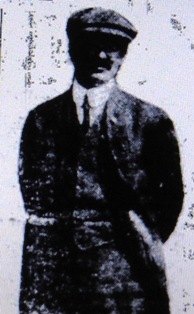
Larry McLean, 1915

Larry McLean, 1915

In the lobby of the Buckingham Hotel in St. Louis, McLean accused Kinsella of making up the charge that he’d been drinking in order to cheat him out of the promised bonus.  Words were exchanged and then a fight broke out.  There was the McGraw-Kinsella version and the McLean version.

McGraw and Kinsella said McLean was carrying a length of gas pipe, and “came into the lobby with a number of rough companions.”

Kinsella’s version was as colorful as it was questionable:

“I picked up a chair and broke it over McLean’s head.  That frightened his gang of ruffians and they fled.  McLean continued to fight until McGraw and I chased him into the street, where he jumped into an automobile filled with women and begged for protection.”

McLean told reporters “I whipped McGraw and all of his associates with my two fists, I did not use a gas pipe, and he “exhibited his bruised right hand as evidence.”

McLean was finished with the Giants.

In March of 1916 The Associated Press reported that McLean had purchased the New Haven Murlins of the Eastern League and said “Larry will manage the club and catch.”  Either the report was erroneous or the deal fell through.  McLean never again played professional baseball and spent 1916 playing with semi-pro teams in New York.

Before the 1917 season baseball writer Ren Mulford reported that McLean might be signed by the Reds:

 Wouldn’t it be odd if Big Larry would come out of the swamp and stick to his spikes into dry ground?  Larry McLean, big, good-hearted and foolish, always his own worst enemy might come back if he willed it so.”

McLean never joined the Reds.

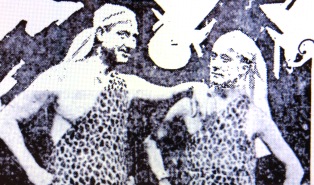
Also in 1917 several newspapers reported that McLean was becoming an actor, The New London (CT) Day said McLean “is now a real moving picture actor,” and included a picture of McLean with another actor “as Egyptian slaves in ‘The Siren,’ a movie soon to be released.”  (The film “The Siren” is described on IMDB as a western—what film, if any McLean actually appeared in is unknown)

Larry McLean, 1915

Larry McLean as an Egyptian slave in a 1917 film

In 1919 McLean was “in serious condition,” in a New York hospital as a result of burns received in a Turkish bath when he lost consciousness after entering a room.  He had been suffering from pneumonia and was in a weakened condition.”

That was the last that was heard of McLean until March 24, 1921.  McLean and a friend named Jack McCarthy were in a bar in Boston’s South End.  The bartender (John Connor) claimed McLean became enraged when he refused to give him cigarettes and threatened to “beat him up:”

 “McLean started to climb the bar to attack him.  McCarthy was helping McLean over the counter when Connor reached for a pistol, and fired… McLean staggered out to the sidewalk where he fell.”

Connor claimed that the previous evening McLean had chased another bartender “up and down the barroom…and forced him to leave to save himself from a beating.

McCarthy was also shot and died in the hospital six days later.  (Some recent sources, such as Bill James in “The New Bill James Historical Baseball Abstract” erroneously identify McCarthy as John Arthur “Jack” McCarthy, a former Major League player.  The McCarthy who was shot with McLean was John F. McCarthy.  Incidentally, John Arthur McCarthy is one of a very few Major League players for whom death information is unknown)

Connor was being held without bail at the time of McCarthy’s death and, according to The Boston Post, eventually pleaded guilty to manslaughter and was sentenced to one year in prison.

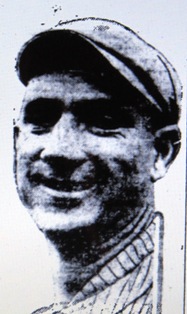
Larry McLean

8 Jan

At 6’ 5” John Bannerman “Larry” McLean is still the tallest catcher to have played in the Major Leagues nearly a century after his final game.  Born in New Brunswick, Canada, McLean’s ability was mostly overshadowed by his frequent off-field troubles during his career.

McLean bounced between the minor leagues, semi-pro teams, and trials with the Boston Americans, Chicago Cubs and Saint Louis Cardinals from 1901-1904.  McLean joined the Portland Beavers in the Pacific Coast League in 1905 and it was here that he developed into a good ballplayer and a first-rate baseball character.

Larry McLean

Larry McLean

McLean hit .285 in 182 games with Portland in 1905, but also started to show signs of the troubles that would plague him for the remainder of his career; Portland added a “temperance clause” to his contract and McLean, who had originally planned on a boxing career, loved to fight.

In 1906, while hitting .355 for Portland, and catching the eye of the Cincinnati Reds who would purchase his contract in August; McLean announced that he was going to become a professional fighter.

The wire report which ran in The Bakersfield Daily Californian said:

“McLean the giant catcher of the Portland team…He is so big that umpires walk out behind the pitcher so they judge balls and strikes…announces that he will fight any man in the world, Big Jeff (Jim Jeffries) not barred.”

The story said McLean was training with Tom Corbett (older brother of “Gentleman Jim” Corbett) and Corbett said he “has a ‘sure ‘nuff’ champion in the big catcher.”

Talk of a ring career temporarily ended when McLean joined the Reds, but McLean’s legend grew.  In November of 1906, he caught a murderer while in a subway station with his wife.  The Boston Post said the suspect:

“Was seen to pull a gun and pump five bullets (into the victim)…Larry started after him and collard him just outside the entrance.  (McLean had the suspect) pinioned so he could not move.  The police soon arrived and took charge of McLean’s prisoner.”

McLean was a huge hit with Havana fans the following winter when the Reds touring Cuba; The Sporting Life said:

“Larry McLean was the favorite and every time he caught a ball the crowd applauded. McLean has been dubbed by the baseball fans ‘Chiquito.’”

McLean and Chicago White Sox pitcher Frank Smith were mentioned at various times as possible opponents for heavyweight champion Jack Johnson; boxing writer Tommy Clark said in 1910 that McLean “Thinks he has a good chance of lowering Johnson’s colors.”

But while McLean was a fan favorite he regularly ran afoul of Cincinnati management and none of the managers he played for was able to keep him out of trouble.

While with the Reds McLean was arrested at least four times–for disorderly conduct, passing a bad check and two assaults.  In one case, at the Savoy Hotel in Cincinnati, McLean knocked a newspaper man from Toledo unconscious after the man “Reproved McLean for using a vile name.”

While serving a suspension for breaking team rules in 1910 McLean Said:

“When I get back to Cincinnati there will be 25,000 fans at the depot waiting to shake hands with me.”

Frank Bancroft, Reds secretary and former manager said in response:

“Twenty-five thousand, why, they’ve not that many barkeepers in Cincinnati”

McLean had worn out his welcome by 1910, but Cincinnati was not able to find any takers for the catcher.  Pittsburgh Pirates owner Barney Dreyfuss said, “I wouldn’t give 30 cents for Larry McLean.”

McLean stayed with the Reds for two more seasons, but when Joe Tinker took over the team one of his first moves was to sell McLean to the Saint Louis Cardinals in January of 1913.  McLean said he had finally learned his lesson and promised to behave with the Cardinals:

“They didn’t want me around because they said I was a bum. Now I’m going to fool Tinker.”

McLean did behave himself in Saint Louis and seemed to appreciate the opportunity he was given by his former Reds teammate, manager Miller Huggins, even earning a “good behavior” incentive in his contract, and was hitting .270 for the Cardinals, but the cash-strapped team went with the younger, cheaper Ivey Wingo behind the plate and traded McLean to the New York Giants for Pitcher Doc Crandall.

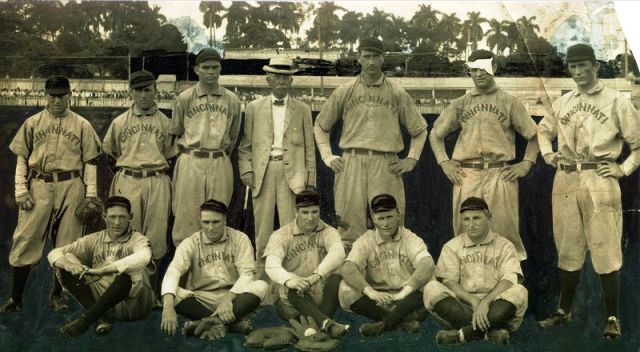
Larry McLean, standing end right, Miller Huggins, standing end left, and Frank Bancroft, standing middle (in suit) on the 1908 Cuban tour.

Larry McLean, standing 5th from left, Miller Huggins, standing end left, and Frank Bancroft, standing middle (in suit) on the 1908 Cuban tour.

The rest of the McLean story tomorrow.

Filling in the Blanks—F. Bassett

7 Jan

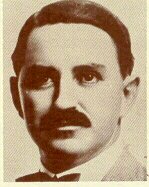
Baseball Reference lists the manager of the 1903 Hopkinsville Browns of the Kentucky-Illinois-Tennessee League simply as F. Bassett—something of a slight to a man whose obituary in The Chicago Tribune called him “The Father of the Kitty League.”

Dr. Frank Houston Bassett was born in Stephensport, Kentucky in 1873, and grew up in Hopkinsville.

Bassett, who came from a wealthy family, played with semi-professional teams in Hopkinsville in his 20s.  Late in 1902 Bassett began trying to line up cities in Kentucky, Illinois, Tennessee and Indiana to form a new professional league; by February of 1903 the eight-team league was formed.

Frank Houston Bassett

Frank Houston Bassett

Bassett owned, managed and played for the Browns.

Very few records survive for the Kitty League’s first season and no statistics for Bassett can be found.  The only reference to his abilities as a player came years later in an article in The Kentucky New Era which included a quote from Scott Means.  Means, a well-known amateur and professional player in Hopkinsville who played in the Kitty in 1913, saw Bassett play:

“Doc Bassett was a very good fielder.  Only trouble was he couldn’t hit.”

Bassett continued to own the Hopkinsville franchise, renamed the Hoppers for 1905 until the team was dropped from the league in July in order to keep a balanced schedule after the Henderson Hens disbanded.  The first incarnation of the league ended the following season.

Bassett maintained the Hoppers as a semi-professional team for the 2nd half of 1905 and all of 1906.  He then became an umpire in the Cotton States League and the Southern Association.  He also entered medical school.

In the spring of 1909, Bassett was the subject of a feature in The Chicago American after he had umpired an exhibition between the Cubs and the Nashville Volunteers.  The article said Bassett was worth more than $100,000 and had an income from investments of “$500 a month…and umpires for the love of it.”

The American noted that Bassett owned a car, “a forty horsepower French machine,” and drove it 72 miles from Hopkinsville to umpire Southern Association games in Nashville.  Bassett said:

 “I run over in the machine every day before the game and return in the evening.”

In 1910 Bassett helped to resurrect the Kitty League and was named President before the 1912 season; as he would continue to do throughout the league’s many incarnations Bassett used his personal fortune to keep the league afloat by financing the Evansville Yankees.

Frank Houston Bassett

Frank Houston Bassett

He was re-elected president for the next two seasons, but the financially troubled league folded again after the 1914 season.  An attempt to revive the league in 1915 failed, and after being revived again for 1916 the league folded in August.

Bassett seems to have temporarily lost interest in professional baseball in Kentucky and turned to politics.  He became a city commissioner in Hopkinsville in 1916 and became mayor in 1918; he served until 1922 when he was elected Court Clerk of Christian County.

In 1922, he again helped to revive the Kitty league; this version lasted for three seasons but was plagued by the same financial difficulties that doomed its predecessors.

Bassett tried again after a decade and was the driving force in reorganizing the league in 1935.  He was named president, secretary and treasurer of the new six-team league.

Bassett served for three seasons as president.  The league meeting after the 1937 season was contentious and several league owners felt Bassett had been a weak leader, and objected to his indifference in maintaining accurate statistics for the league and his opposition to night baseball.

There are a number of versions of what transpired.  Most sources say that after being re-elected Bassett left the meeting and team owners then voted him out; others say he, in effect, resigned by leaving—sometimes even the same source disagrees.  Some accounts in The Kentucky New Era said Bassett was ousted; others said he “became disgusted” and resigned.

In either case, night baseball was the primary issue that ended Bassett’s presidency.  The league would not survive without it and Bassett was dead set against it.   The New Era said:

 “The good doc contends that if baseball was supposed to be played after supper, nature would have made it light enough to see.”

With the exception of a few occasions when he was honored in Hopkinsville, Bassett seldom attended games after 1937 citing his hatred for night baseball.

He continued to serve as Christian County’s court clerk until his death in 1950.

Two weeks after Bassett’s death the Hopkinsville Hoppers held a memorial for him before their game with the Owensboro Oilers—it was a night game.

The Man who Dried up Memphis

4 Jan

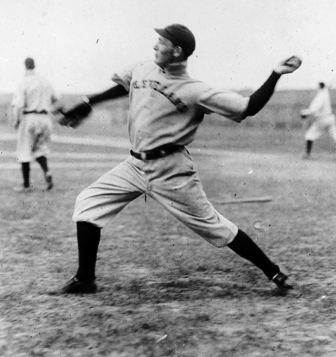
Finis Albert “Fin” Wilson had a brief, unsuccessful Major League career.  After four minor league seasons—two with the Knoxville Reds in the Appalachian League and two with the New Orleans Pelicans in the Southern Association—and a brief spring trial with the Cleveland Indians, Wilson signed a contract to play with the Brooklyn Tip-Tops in the Federal League in September of 1914.

Appearing in two games that September, Wilson went 0-1 with a 7.71 ERA.  Despite a respectable 3.78 ERA in 1915, Wilson‘s Major League career was over after a 1-8 season for the Tip-Tops.

Wilson signed with the Atlanta Crackers in the Southern Association in 1916, but became sick in April and missed most of the first half of the season.  He returned to the team in July and ended the season with a 4-6 record.
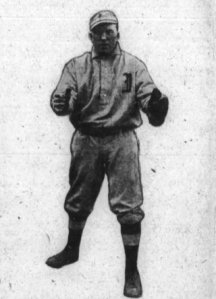
Finis Wilson 1914

Finis Wilson 1914

He returned home to Greensburg. Kentucky and served two terms in the Kentucky General Assembly.  In 1928 he was appointed as a federal prohibition administrator in Memphis, Tennessee, primarily responsible for stopping the transportation of illegal liquor on the Mississippi River.

Wilson was very popular in Atlanta because while pitching for New Orleans in 1913 he beat the Mobile Sea Gulls on the last day of the 1913 season securing the championship for the Crackers and shortly after his appointment he was the subject of a glowing profile in The Atlanta Constitution:

“In an office at the custom-house here in old Shelby County with the Mississippi meandering by just outside the window I found the man who won the 1913 pennant for the Atlanta Crackers. Finis E. Wilson, who left a bank presidency in Kentucky to battle Shelby county bootleggers, does not look like the young left-handed pitcher who gave the greatest exhibition of courage the Southern Association ever saw. His hair is gray now and he looks positively genial.”

He was on the front line of the government’s battle with moonshiners.  In one raid Wilson, according to The Associated Press he:

 “Dried Memphis up… (Wilson) directed the greatest cleanup Memphis ever experienced…more than 150 persons were arrested and confiscated 1,500 gallons of whiskey, 800 gallons of wine and 20,000 quarts of home-brew.

In another raid two of Wilson’s boats were bombed as agents destroyed 1300 gallons of liquor and arrested six men.  Wilson told The Associated Press:

“If it’s war the moonshiners want it’s war they’ll get.”

And it was a war; 16 agents were killed and 183 were injured in 1928 and ’29 alone; and while corruption among agents was widespread, it appears that no agents under Wilson were charged with any wrongdoing.

Wilson left government service sometime after the repeal of the Volstead Act in 1933, and died in Coral Gables, Florida in 1959.

Finis Wilson circa 1930

Finis Wilson circa 1930

Blame it on the Uniform

3 Jan

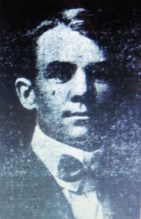
Justin Titus “Pug” Bennett could hit.  After playing baseball at tiny Blackburn College in Carlinville, Illinois, in 1895 and ’96, there’s no record of him again until 1899 when, at 25-years-old, he played with the Indiana-Illinois League franchise that began the season in Kokomo, Indiana and finished in Mattoon, Illinois.

Pug Bennett circa 1904

Pug Bennett circa 1904

Back-to-back .300 seasons with the Nashville Volunteers in the Southern Association and the Seattle Siwashes in the Pacific Coast League earned the 32-year-old his first shot in the Major leagues.  The Bennett hit .248 for two seasons with the Saint Louis Cardinals and returned to the minor leagues with Seattle, now in the Northwestern League.
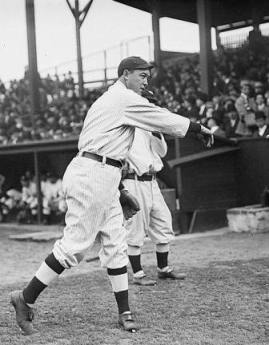
Bennett returned to his old ways for two seasons, hitting .305 and a league leading .314 in 1908 and 1909.

1910 was not going well for Bennett, the perennial .300 hitter was hovering around .240 all season.

The Spokane-Spokesman Review provided an explanation late in the season:

“(Bennett) claims the white uniform worn by the umpires is the principal stumbling block in the way of batting averages this year.  Bennett says the light suits shade the white ball and make any pitcher with a crossfire or a sharp break much more effective.”

Bennett might have had a point.  There was not a single hitter in the Northwestern League with more than 50 at bats who hit .300;  Lou Nordyke led the league with a .290 average.

The following year the umpires’ uniforms were changed.  Ten players hit over .300 and Art Bues led the league with a .352 average.  The 37-year-old Bennett, with the Vancouver Beavers, rebounded with a .300 season.

Pug Bennet, t-206 card with Vancouver

Pug Bennet, t-206 card with Vancouver

Bennett continued playing in the Northwestern League until 1917.  He lived in Washington until his death in 1935.

Fighting Jimmy Burke

2 Jan

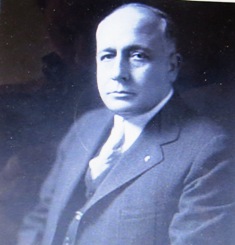
James Timothy Burke had a stormy tenure with the Saint Louis Cardinals from 1903-1905, including a disastrous 35-56 record as player-manager in 1905, replacing Kid Nichols (who remained on the pitching staff)—Burke resigned in August, and the Cardinals were in such disarray that owner Stan Robison eventually took over the team for the remainder of the season.

Burke had been with five teams from 1898 through 1902 before being traded to the Cardinals.

Jimmy Burke

Jimmy Burke

During his time with the Cardinals Burke had various fights and feuds, it was said he was the ringleader in a group of players trying to undermine manager Patsy Donovan in 1903; he had a long-standing feud with shortstop Dave Brain and the two seldom spoke, and he feuded with Robison throughout his short tenure as manager.  After his resignation he said:

“When I took charge of the team it was with the understanding that I was to be manager or nothing.  I have suffered as Donovan and Nichols with too much interference.”

Burke also had trouble with a Saint Louis sportswriter named Joe Finnegan.  Their contentious relationship came to a head at the Victoria Hotel in Chicago in September of 1904 after Finnegan had written an article in which he called Burke “a cow’s foot,” (apparently those were fighting words circa 1904).

The Pittsburgh Press provided the colorful blow-by-blow of the fight:

“First round–Burke hit Finnegan in the lobby, and followed the blow with a left hook on the back of the neck, breaking the scribe’s collar.  Burke pressed the advantage and struck Finnegan near the cigar stand.  Finnegan blocked cleverly, uppercut with the left and caught Burke in the snout.  Finnegan crossed his right and landed on Jimmy’s potato-trap.  Burke jolted Finnegan in the rotunda and followed with a short swing near the Turkish parlor.  Finnegan shot the right to the ear, and the left to the lamp.  They clinched.  Terrific short-arm fighting, completely wrecking Finnegan’s collar and cuff.  Johnny Farrell separated the men. Time.

“Second round—The house detective threw both fighters out in the alley.  Time.  Decision to Finnegan.”

Burke’s Major League career ended after the 1905 season.  New Cardinal manager John McCloskey said he wanted to retain Burke as his third baseman, but Robison, against his manager’s wishes (and continuing the pattern which led papers to call Cardinals managers “figureheads”) waived Burke.

Burke became a successful minor league manager and returned to the Major Leagues as a coach with the Detroit Tigers in 1914.  He also served as a coach with the St. Louis Browns and managed the team for three seasons.

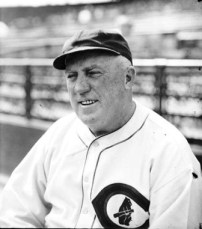
Jimmy Burke, Cubs coach

Jimmy Burke, Cubs coach

Burke served as Joe McCarty’s right hand from 1926-1930 with the Chicago Cubs and followed him to the New York Yankees where they continued together until a stroke necessitated Burke’s retirement after the 1933 season.  McCarthy had played for Burke with the Indianapolis Indians in the American Association in 1911.

Burke died in St. Louis in 1942.

A Thousand Words—Atlanta Osceolas

1 Jan

???????????????????????????????

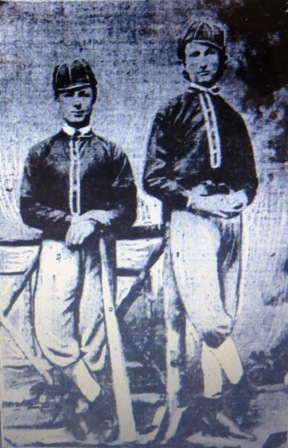
George E. Johnson and Edward T. Payne were members of the Atlanta Osceolas in 1872.  The previously undefeated champions of Georgia met their Waterloo at Rome, Georgia.

The Atlanta Constitution said years later that the Osceolas:

“(W)on great fame glory and renown, but alas there came a day of disaster.  There was no rule about getting outside players.  So the club at Rome, GA which had been organized by the late Henry W. Grady (famous Georgia journalist) secured a professional pitcher from New York City.  The Osceolas never made but one measly hit…The erstwhile champions were ingloriously and ignominiously defeated and they returned home to disband and to play no more.”

Many of the players went on to be some of Atlanta’s most prominent citizens.  George Johnson became Atlanta’s recorder and Edward Payne the city’s tax collector.

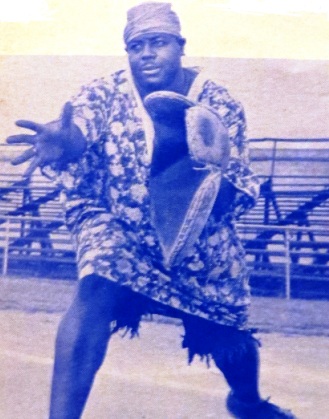
“Nature Boy” Williams

31 Dec

natureboy

By the time James “Nature Boy” Williams joined the Indianapolis Clowns in 1955 the team had become a full-time barnstorming attraction, having dropped out of the Negro American League which itself was in its death throes.

Later that season The Washington Afro-American said:

 “Williams already has become the fans’ number one idol.  His side-splitting antics and peculiar catches around first base have won rave notices.”

The 6’ 2” 220 pound Williams spent more than a decade with the clowns and was known for batting barefoot, playing with the large glove–as pictured–and dancing at first base with umpires.

Jet Magazine reported in 1964:

“Williams played the entire 1963 season with his right eye completely blind due to an off-season accident and without even his teammates knowing his condition.”

natureboywilliams

The Clowns played their last full season of tour dates in 1988, the team officially disbanded after playing a few games in 1989.

Williams died in Maryland in 1980 at the age of 50.

“Bugs” and Trains

28 Dec

Arthur “Bugs” Raymond was one of the most talented pitchers to end his career with a sub .500 (45-57) record.  Known more for his drinking problems and erratic behavior, Raymond was dead by 30.

John McGraw, the only manager who even for a short time, managed to get the best out Raymond, told sportswriter Grantland Rice that he had the best motion he’d ever seen and “Even half sober Raymond would have been one of the greatest.”

Rube Waddell, whose eccentricities were the standard by which all players of his era were judged, weighed in about Raymond, saying about Bugs something he could have said about himself:

“It’s a shame that fellow doesn’t take care of himself.  He would be a wonder if he would just keep in condition and pay strict attention to business.”

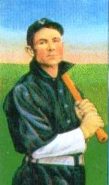
Bugs Raymond

Bugs Raymond

While Waddell was fascinated with fire and on many occasions assisted fire fighters (although there is no evidence supporting the long-held myth that Waddell left the mound during a game to follow a fire wagon), Raymond was enamored of trains.

According to the Hall of Fame sportswriter Hugh Fullerton III Raymond loved trains:

“The moment he enters a sleeping car he begins to take possession of the train and it isn’t long until he’s captured it.  Usually he begins by borrowing a blue coat with brass buttons and a uniform cap from some trainman or porter who admires baseball players, and arrayed in these he saunters through the train trying to collect fares, issuing orders and generally enjoying himself.”

Fullerton wrote about a 1907 road trip:

“(R)ushing through the darkness in two sections.   The St. Louis Cardinals were traveling in the rear car of the first section and the other section was following five minutes behind.  Suddenly there was a jarring of the brakes, the shrilling of air, the jar of sudden stoppage, and the second section jolted to a sudden standstill shaking sleepers out of their berths and awaking everybody.”

According to Fullerton the sudden stoppage and near accident of the following train was explained in the report issued several days later by the railroad:

“Raymond, who was looking for amusement, had stationed himself on the rear platform of the first section and amused himself touching off the red flare which is carried for use as a warning s and danger signals…the second section saw the warning and stopped.”

Hugh Fullerton

Hugh Fullerton