“A Vain and Foolish Kick”

23 Nov

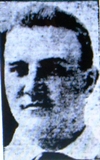
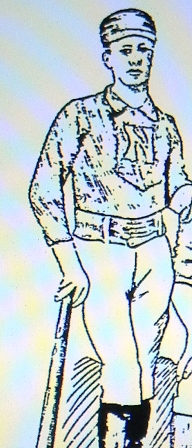
The Brooklyn Bridegrooms won the 1890 National League Championship by 6 ½ games over the Chicago Colts behind pitcher Tom Lovett who posted a 30-11 record.

Just three years earlier there was speculation that Lovett’s career might be over due to overwork.
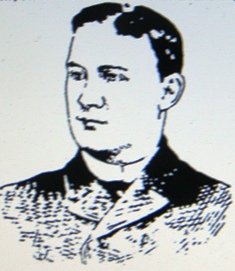
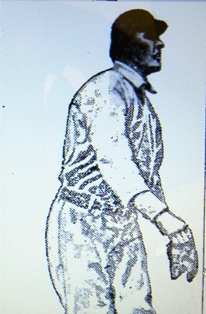
Tom Lovett, 1890

Born in Providence, Rhode Island in 1863, Lovett began his professional career with Waterbury in the Connecticut State League in 1884.  He appeared in 16 games for Philadelphia Athletics in the American Association in 1885 and was in the New England League with the Lynn/Newburyport Clamdiggers.

In 1887 he signed with the Bridgeport Giants in the Eastern League and dominated the league in May and early June.  Despite getting off to a fast start (the team was 20-5 in May), Bridgeport was suffering a decline in attendance and the franchise was in trouble.

At the same time community leaders in Oshkosh, Wisconsin were determined to win the Northwest League championship, and they put enough money together to offer to purchase Lovett who was 21-3, as well as Tug Wilson, Bridgeport’s catcher and leading hitter, and shortstop Dan Shannon, the Eastern League’s leading base stealer.

Lovett was 20-2 for Oshkosh (40-7 for the season) and they easily won the championship, but he did not pitch during the season’s closing days; The Sporting Life reported that “Lovett is said to be lame in the arm.”

Despite speculation well into the next spring that his arm was permanently “lamed,” Lovett recovered and posted a 30-14 season in 1888 with Omaha in the Western Association.   In the fall of 1888 he was purchased by Brooklyn, then in the American Association.

Lovett was 17-10 in his first season with Brooklyn, and followed that with his pennant-winning performance in 1890.  He then dropped to 23-19 in 1891 as the team fell to 6th place; Lovett threw a 4-0 no-hitter in June against the New York Giants.

After the 1891 season Brooklyn attempted to cut his salary to $2800 (various sources say he either earned $3000 or $3500 in 1891).  Lovett demanded $3500 and turned down a compromise offer of $3200.

He said he could earn more money operating his tavern in Providence and chose to sit out the 1892 season.

The Sporting Life called it, “A vain and foolish kick against salary reduction.”

In this case the critics might have been correct.  The Lovett-less Grooms improved from 61-76 in 1891 to 95-59 in 1892.

Hat in hand, he returned to Brooklyn for the 1893 season signing for $2400.

Lovett pitched in only 14 games and had a 3-5 record before hurting his arm again.  The following season he pitched for the Boston Beaneaters until he was released in July.  His Major League career over, Lovett finished 1894 in the Eastern League with the Providence Clamdiggers and spent 1895 with the renamed Providence Grays in the same league.
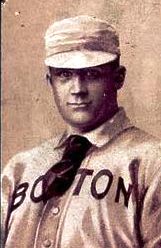
Lovett, with Boston 1894

Lovett, most likely baseball’s first true hold out, spent the rest of his life in Providence and died in 1928.
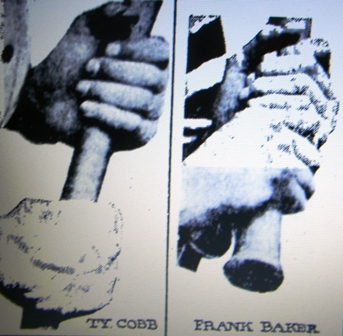
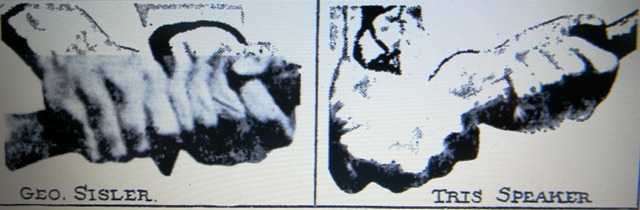
Hall of Fame Batting Grips

22 Nov

A quick one for Thanksgiving.  The batting grips of  Hall of Famers Ty Cobb, Home Run Baker, George Sisler and Tris Speaker:

:

“The Man who Ate Himself out of the American League”

20 Nov

Frank Frederick Schneiberg was born in Milwaukee in 1882 (Baseball Reference lists his year of birth as 1880, but all available documents say 1882).

He began playing baseball for amateur teams in the Milwaukee city league, and after playing for the Pabst Brewery team in 1903 signed with the Springfield Hustlers in the Three-I League.  No records survive, but according to The Milwaukee Journal Schneiberg “won 19 out of 21 starts.”  He played with the Freeport Pretzels in the Wisconsin State League in 1905 and according to the Journal “won 12 straight.”

Frank Schneiberg

He won 22 games the following season with the La Crosse Pinks, which earned him a shot with the Detroit Tigers.

It didn’t go well.

Schneiberg was released to the Milwaukee Brewers before the beginning of the season.

The Associated Press said:

“He has the earmarks of a great pitcher…speed, curves, control and a pretty good collection of baseball brains…but Schneiberg was lazy…He wasn’t eager to pitch.”

The story quoted Tigers manager Hugh Jennings:

“He knows how (to pitch) but he won’t exert himself, I don’t want anybody who will not hustle.”

The Toledo News-Bee blamed his release on something else:

“He is known all over the country as the man who ate himself out of the American League.”

It is unknown whether either or both versions of his time with the Tigers is accurate, in either case, Detroit did try to claim that Schneiberg was still their property later that season when he was pitching well for the Brewers.  The claim was denied and he remained in Milwaukee.

Schneiberg pitched for the Brewers for three seasons compiling a 40-48 record.

While a fan favorite in Milwaukee, Schneiberg appears not to have been popular in at least one other American Association city.  The Toledo News-Bee accused him of being a head hunter in 1908:

“Schneiberg has the reputation of threatening to ‘bean’ batters.”

The following season The News-Bee claimed the Brewers were trying to trade the pitcher and said the team was:

“(V)ery anxious to trade the German, who does not work with any spirit, but the player is not highly regarded around the circuit.”

Regardless of the opinion in Toledo, The Brooklyn Superbas thought highly enough of Schneiberg to draft him from the Brewers at the end of the 1909 season.

He appeared in his only Major League game. On June 8, 1910, with Brooklyn trailing the Cincinnati Reds 4-0, Schneiberg relieved Nap Rucker in the top of seventh inning.  He walked four, gave up five hits and allowed 7 runs (Baseball Reference shows Schneiberg giving up eight runs, with seven earned—the box score from the game shows 7 total).

Schneiberg was lifted for a pinch-hitter in the bottom of the seventh.  Within days, he was traded to the Des Moines Boosters in the Western League.

He retired after the 1910 season, but in February of 1913 signed with the Memphis Chickasaws of the Southern Association.  He appeared in two games and was released, and in June signed with the Springfield Watchmakers in the Three-I League.  It’s unclear whether he appeared in any games with Springfield.

Frank Schneiberg 1932

Schneiberg retired to Milwaukee after the 1913 season, he became an asbestos worker and an official in the Asbestos Workers Union.  He passed away in Milwaukee in 1948.

Lost Team Photos

19 Nov

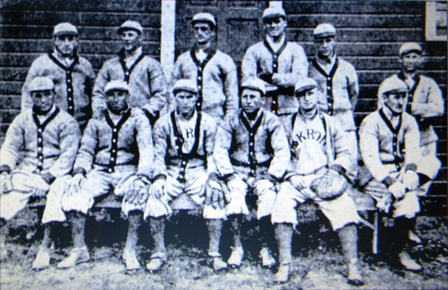
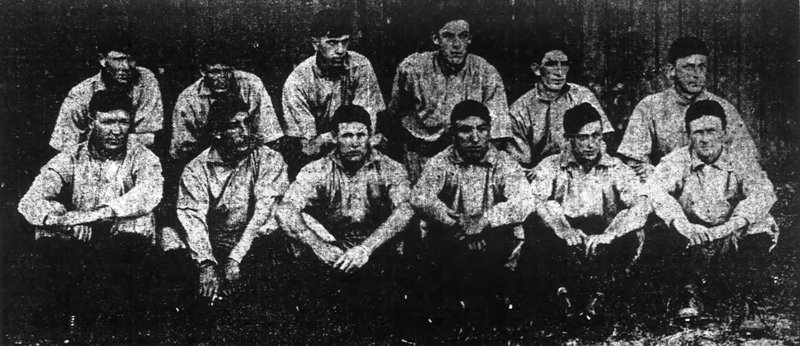
Another photo I’ve never seen published before, the 1908 Akron Champs, Ohio-Pennsylvania League Pennant Winners.

Top left to right:

Dick Breen—a minor leaguer for 12 seasons, his career overlapped with another career minor leaguer named Dick Breen—this Breen’s career came to an end in 1917, when while playing for the Reading Pretzels in the New York State League he got in a fight with Wilkes-Barre Barons  manager Jack “Red” Calhoun.  Both men were suspended indefinitely; Breen was released several days later, neither ever appeared in organized ball after that season.

Bill Speas—longtime minor league player and manager, Speas hit.284 in 22 seasons and won three Mississippi Valley League pennants as a player/manager with the Cedar Rapids Bunnies and Dubuque Dubs.

John Brackenridge—appeared in seven games for the Philadelphia Phillies in 1904, Brackenridge pitched in the Pacific Coast League from 1909-1913.

Fred “Buff” Ehman—a 6’ 4” (some sources list him an inch shorter) right-handed pitcher, the enigmatic Ehman was 81-36 for Akron from 1906-08, but according to The Akron Beacon Journal, was known for disappearing for days at a time and “sulking.” He had multiple trials with Major League clubs; according The Mansfield (OH) Daily Shield he never stuck with a team because of “his refusal to exert himself.”  Through 11 minor league seasons he won 214 games.

Wilbur Good—spent parts of 11 seasons in the Major Leagues: Joe Tinker said of him, “He is one of the fastest runners in the National League and still one of the poorest base runners.”

Edward Murphy—a light hitting catcher, Murphy played five seasons in the Ohio-Pennsylvania League.

Bottom left to right:

Bill Kommer—there is no listing for Kommer on any minor league data base.  He was left-handed pitcher who played for many amateur and semi-pro teams in Ohio during the first decade of the 20th Century;  he was released by Akron in July, there is no record of his statistics for the ’08 season.

William Hille—“Silent Bill” was a shortstop who played until 1917 primarily in the Texas and South Atlantic League.

Jim Callahan—his Major League career consisted of one game with the 1902 New York Giants; played three seasons for Akron (1906-08), was reported to have played in the Western League in 1909, but no records exist.

Matt BroderickThe Reading Eagle called him “one of the best shortstops who ever played on a minor league field,” Broderick played two games in the Major Leagues with Brooklyn in 1903—played minor league and amateur baseball for the remainder of the decade while working for Carpenter Steel Works in Reading, PA.

George Texter—one of the first players to sign with the Federal League in 1913, Texter played for the Indianapolis Hoosiers/New Jersey Pepper during the Fed’s two seasons as a Major League (1913-14).  Managed teams throughout the 1920s in the Ohio-Pennsylvania League (no longer recognized by the National Association, the OPL was nonetheless a strong semi-pro/industrial league during that period).

Cecil Armstrong—a dominant right-handed pitcher, first with the Youngstown Ohio Works team in 1905 during his three seasons with Akron (64-33 from 1906-08), Armstrong spent 1909 and 1910 with New Bedford Whalers in the New England League. Armstrong retired to Akron after the 1910 season.

”The Dreadful Rumor is Probably only too True”

16 Nov

The unpredictable, eccentric George Edward “Rube” Waddell made several attempts to parlay his baseball fame into an off-season sideline in the theater.

Waddell’s stage debut was December 5, 1900, in Brookville, Pennsylvania as part of “Hindman and Kummers’ Union Scout” touring company.   The Sporting Life did not approve, their headline read:

“Rude Waddell to Make a Clown of Himself for Cheap Theatrical Gain.”

The touring variety show appears to have been a success and included Waddell leading a brass band in a street parade and performing in skits.

Rube Waddell

Waddell’s next foray into the theater was in 1903.  He played a detective in a melodrama called “The Stain of Guilt.”   Waddell the actor was as difficult to control as Waddell the pitcher.  According to The Pittsburgh Press:

“On several occasions he has been numbered with the missing when the curtain has come up.”

The Chicago Tribune reviewed the play which made its debut at the city’s Alhambra Theater:

“Rube has what may be classified as a thinking part, for he isn’t called upon to say much.  In the four acts of the play he delivers himself of twenty-four words.”

The review ended with the facetious assertion that in the fourth act Waddell, “Fairly shines…he hurls twelve whole words at the cowering villain and grateful hero.”

The universally negative reviews might have dissuaded a lesser man than the self-proclaimed “Greatest baseball pitcher in the world.”  But Waddell was back the next year.

The Butler (PA) Times said:

“More alarming than the news of the probabilities of war between Russia and Japan, is the announcement that Rube Waddell, the notorious baseball player, is to join his ability as an actor…in the production of “A Daring Woman.”

The Times suggests hopefully that the announcement is a publicity stunt but concluded:

“A New York special says that Rube is in that city taking part in the rehearsals of the play, so that dreadful rumor is probably only too true.”

The play does not appear to have actually been staged.

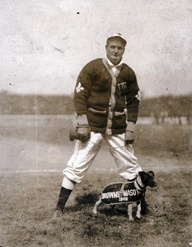
Waddell with St. Louis Browns Mascot


Salaries–1897

15 Nov

After Amos Rusie ended his year-long holdout, the issue of salaries was, as it has been throughout the history of the game, hotly debated—some thought ballplayers were grossly overpaid during a period when the average annual salary in the United States was just under $675.

Amos Rusie

The Fort Wayne Gazette published the following in an effort to address “much questioning as to the salaries paid young players at the present time.”

According to The Gazette National League players averaged $175 to $250 a month “all the way up to $5000 for veterans.”

Other league salaries:

Eastern League: $100-$150 for young players $200-$250 for stars

Western League: $75-$150, up to $300 for stars

Atlantic League: $75-$250

Western Association: $65-$115

Southern League: $75-$100

New England League: $75-$125

Interstate League: $65-$150

The Gazette came down on the side of the players:

“It is customary to speak of the high salaries and easy lives of National League players but the kickers seldom realize that the man who now supports his little family in comfort on $300 a month—probably had to slave two years for perhaps $75 a month, $450 a year…and a probable loss of salary whenever the little league he played with disbanded in arrears.”

Filling in the Blanks–Yeager

14 Nov

Baseball Reference lists “Yeager” appearing in three games 1884 Reading Actives in the Eastern League.

Edward Yeager was born in Reading, Pennsylvania on July 26, 1859.  He played on several local amateur teams including the Keystones of Reading.   In 1884 Yeager signed a contract with the Houston Nationals in the Texas League.  According to the Reading Eagle, who called Yeager “a star third baseman and hard hitter,” he returned home near the end of the season and joined the Actives.

Edward Yeager, circa 1884

Yeager appears to have returned to amateur baseball in 1885.  At the same time he joined the fire department and became active in local politics.  Yeager served three terms in the Reading city council and was the Democratic candidate for mayor in 1899, losing by 58 votes.

Yeager ran again in 1902 and was elected Reading’s 24th mayor, serving until 1905 (at the time Reading mayors were limited to one, three-year term).  He attempted to run again in 1908, but was defeated.  Yeager served as city treasurer after his tenure as mayor.

Yeager, 1898

He passed away in Reading April 30, 1933.

A Thousand Words–New Orleans Pelicans

13 Nov

Another picture I’ve never seen published before—the 1906 New Orleans Pelicans of the Southern Association.

Top, Left to right.

Bill Phillipshe spent seven seasons in the Major Leagues with a 70-76 record; and won 256 games in a minor league career that began in 1890 and ended in 1909.

Mark “Moxie” Manuelwas said to have appeared as a both a left and right-handed pitcher for New Orleans in 1906 and 07, Manuel was a combined 37-26, earning him a second trip to the Major Leagues in 1908, where he posted a 3-4 record in 18 appearances for the Chicago White Sox.

Milo Stratton—a weak hitting (career .185) catcher who played in the minor leagues from 1903-1914.

William O’Brien—a .215 hitting first baseman in 1905 with the Toronto Maple  Leafs in the Eastern League and with the Pelicans in 1906.

Jake Atz—played for the Washington Senators in 1903 and the Chicago White Sox 1907-1909, a minor league manager for 21 seasons he won more than 1900 games.

Art Brouthers—a third baseman who played in 37 games for the 1906 Philadelphia Athletics, Brouthers managed the 1913 Paducah Indians to the Kitty League championship.  After his baseball career he was a hotel detective in Charleston, South Carolina.

Front, left to right

Whitey GueseGuese had several strong seasons in the minors, but in his lone Major League season with the Cincinnati Reds in 1901 he was 1-4.  The Youngstown Vindicator said, “He is a twirler who belongs to the disappointing species known as ‘morning glories.” And, “Seemingly has a heart like a canary.”

Joe Rickert—“Diamond Joe” Rickert stole 77 bases for the Pelicans in 1904; he played 15 games in the Major Leagues with the Pittsburgh Pirates and Boston Beaneaters.

William Blake—an outfielder with 13 different minor league teams from 1902 to 1910 and native of Louisville, Kentucky, little else is known.

Punch Knoll—another long-time minor league manager.  Knoll appeared in 79 games for the 1905 Washington Senators, he appeared in 3 games as a pinch hitter, collecting one hit, at 48-years-old while managing the Fort Wayne Chiefs in the Central League

Chick Cargo—brother of Major Leaguer Bobby Cargo, Charles “Chick” Cargo was a shortstop and 3rd baseman who played 19 seasons of minor league ball.

George Watt—Watt had three good seasons for the Little Rock Travelers, with a 53-34 record from 1902-1904.  He slipped to 20-37 in 1905-06 with Little Rock and New Orleans.  By 1907 he had dropped from “A” ball to “D” ball with the Zanesville franchise in the Pennsylvania-Ohio-Maryland League.  In 1908 he pitched for the Zanesville Infants in the Central League, was release in August after posting a 6-15 record and disappeared.

The League That Billy Sunday Helped Shut Down

12 Nov

The Eastern Illinois League began with great promise in the spring of 1907 to fill the void created by the collapse of the first incarnation of the Kitty League.  Joe “Wagon Tongue” Adams, an Illinois native who appeared in one game for the 1902 St. Louis Cardinals, was said to be the guiding force behind  the league, he was also manager on the Pana Coal Miners.  Adams had helped create the Central Illinois League two years earlier with teams from many of the same cities—unlike the 1905 effort, the Eastern Illinois League was granted membership in the National Association.

The six-team league had franchises in Centralia, Charleston, Mattoon, Pana, Shelbyville and Taylorville, and elected Charles Welvert, a Pana businessman  league president.  Midway through the 1907 season the Centralia team relocated to nearby Paris, Illinois, and replaced Welvert as league president by Louis A. Godey Shoaff (often incorrectly spelled “Schoaff”), editor and publisher of The Paris Gazette.

The teams in Charleston, Mattoon, Pana and Paris were supported, as The Associated Press said, “In great part from saloon interests.”

The league made news in August, when during a heated series between the Mattoon Giants and the Pana Coal Miners, The Sporting Life reported that Mattoon second baseman Fred Wilson during a dispute with  Pana manager Adams:

“Wilson put Adams down with a straight jab on the jaw. The manager came up, but another blow in the same place fractured his chewing apparatus.”

The Mattoon Giants won the 1907 championship, led by the pitching of future Major Leaguer Grover Lowdermilk, who posted a 33-10 record with a 0.93 ERA.  Although records for the league are nearly nonexistent, contemporary newspaper accounts mention other past and future Major Leaguers who appeared in the league including Harry Patton, Joe Yeager (after his release from the St. Louis Browns in 1908), Cecil Coombs, and Hosea Siner.

The league appeared to be in good shape heading into 1908, adding teams in Danville, Illinois and Vincennes, Indiana.  But as it prepared for the beginning of its second season other forces were ensuring it would be its last.

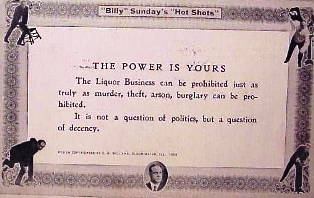
William Ashley “Billy” Sunday, the former outfielder for the Chicago White Stockings, Pittsburgh Alleghenys and Philadelphia Phillies, turned evangelist and temperance supporter was spending the early months of 1908 holding a five-week long  revival in Decatur, Illinois and advocating for citizens throughout Illinois to vote their towns dry during local option elections in April.

Sunday’s revival was a huge success, according to The Associated Press “there were 5,843 conversions;” and the service “on ‘booze’ was attended by 8,000 enthusiastic local optionists.”

When the polls closed on April 7, six of the league’s eight towns were voted dry.  The Associated Press said:

“With the saloons out of business, subscriptions of new stock (in the teams) will be cancelled in many instances.”

The league was in trouble.  It got worse worse when Sunday moved his revival to Charleston in April and began a new crusade against playing games on Sunday.

The 1908 season was chaotic.  New investors were scarce.  Some Sunday games were played, but attendance was down.  In July the Danville Speakers relocated to Staunton and the Pana Coal Miners moved to Linton, Indiana (incorrectly listed on Baseball Reference as Linton, Illinois).  Early in August the Mattoon Giants were on the verge of collapse.  The league finally disbanded on August 20, 1908, the Speakers were declared 1908 champions.

Professional baseball never returned to Charleston, Pana, Linton, Staunton, and Shelbyville.  Taylorville had a team in the Illinois-Missouri League in 1911.  Vincennes was part of the reformed Kitty League in 1910-11 and 1913.  Beginning in 1910 Danville was in and out of the Three-I League for the next forty years.  Mattoon did not have a professional team again until 1947, Paris until 1950.

A Few Veteran’s Day Remembrances

9 Nov

Lester Wirkkala

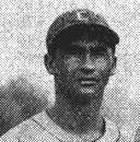
PFC Lester Rudolph Wirkkala, pitcher for seven seasons in the Northern League, Nebraska State League, Ohio State League and American Association; killed in action near Gravelotte, France, September 7, 1944.

Roman Wantuck

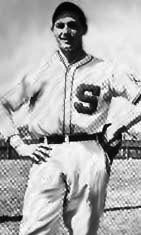
PFC Roman Wantuck, 34-13 record in two seasons with the Sheboygan Indians in the Wisconsin State League; killed in action on Biak Island, New Guinea, June 16, 1944.

James Whitfield

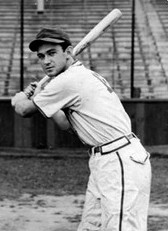
Staff Sergeant James J. Whitfield, outfielder for the Albany Cardinals in the Georgia-Florida League in 1941; killed in action Angaur, Palau, September 22, 1944.


Support Homes For Our Troops.