“A Star of the First Magnitude”

8 Nov

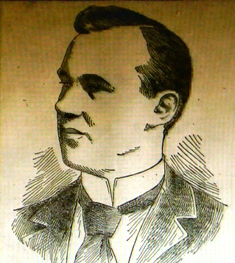
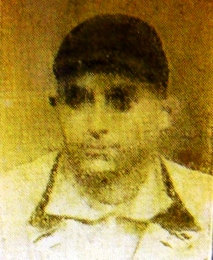
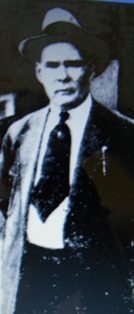
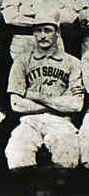
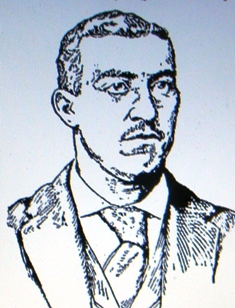
Huyler Westervelt was going to be the next big thing.

By January of 1894 the New York Giants had been trying to sign the 24-year-old Westervelt for more than two years.   Considered the best amateur pitcher on the East Coast, he pitched for a number of top teams including the Englewood Field Club, New Jersey Athletic Club, and Orange Athletic Club. Westervelt came from a prominent family in Tenafly, New Jersey and said repeatedly that he’d never play professionally.
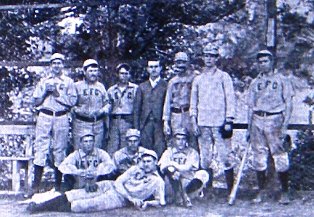
Huyler Westervelt, standing second from right, with the Englewood Field Club team circa 1893

When Giants owner E.B. Talcott finally convinced Westervelt to play professionally he simply signed a piece of paper which said:

“I hereby agree to play with the New York Base Ball Club for the season of 1894 at a salary of $1800.”

Westervelt made his debut for the Giants on April 21, losing 4-3 to the Baltimore Orioles; but beat the Boston Beaneaters 5-2 on May 5, holding the defending champions to three hits and earning the fawning praise of New York Sporting Times columnist O.P. Caylor who said Westervelt was:

 “(A) newly discovered jewel who has flashed out in the baseball firmament as a star of the first magnitude.

“(On May 5) young Westervelt became famous, and his name flashed over thousands of miles of wires that night, while next day the whole country was reading about his triumph.”

Westervelt struggled for the remainder of the season; prone to wildness he finished with a 7-10 record and 5.04 ERA, but still figured into the Giants future plans.  He refused to sign a contract for 1895 which reduced his salary to $1500—Westervelt was added to Giants’ reserve list, where he would remain for several years.

Westervelt continued playing for amateur teams in New York and New Jersey, while working for the Overman Bicycle Company, and attempted to get the Giants to trade or release him.  He filed an appeal contending that he never signed a National League contract, only the piece of paper he signed with Talcott, and therefore the Giants had no right to put him on the reserve list.  He lost the appeal.
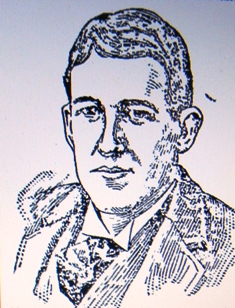
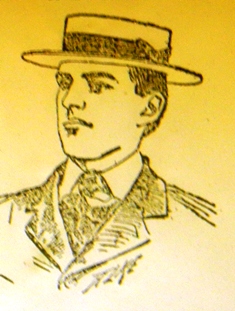
Huyler Westervelt

There were reports in early 1896 that Baltimore Orioles manager Ned Hanlon was trying to acquire the pitcher, they never panned out.  In April The Sporting Life said Westervelt was done with professional baseball, but later in the year he joined the Derby-Shelton Angels in the Naugatuck Valley League; no statistics survive other than a brief mention of a seemingly less than successful August game against the Torrington Tornadoes, “(Westervelt) received the warm reception of 16 hits.”

Westervelt returned to the amateur leagues, playing well into the first decade of the 20th Century, and went to work as a broker on Wall Street.  He remained on the reserve list of the New York Giants through the 1901 season, prompting The Sporting Life to say:

 “By the way, did you notice that New York still reserves Huyler Westervelt?  That is one of the standing jokes of each season.”

Westervelt made one more appearance in professional baseball; according to Baseball Reference he played 17 games for the Bradford Drillers in the Interstate League in 1905; while he is not listed on the roster of the Utica Pent-Ups in the New York-Penn League in 1905, he appeared in at least one game for that team, losing a 5-4 decision to the Troy Trojans on June 23.

While Westervelt never achieved the stardom Caylor predicted for him, he remained an important figure in amateur baseball circles until his death in 1949 at the age of 80.
The Human Rain Delay

7 Nov

 “Baseball stars may come and they may go, but the name of Nig Cuppy will live forever.  There will be greater pitchers than Cuppy—but no slower ones.”—The Pittsburgh Press, 1910.

George Joseph “Nig” Cuppy (born Koppe) lived in the shadow of teammate Cy Young—Cuppy won 150 games for the Cleveland Spiders and St. Louis Perfectos from 1892-1899, Young won 231.

While Cuppy was successful, he was best known for being the slowest working pitcher of his era.

How Slow?  “Painfully slow,” according to The Toledo News-Bee; other contemporary accounts mention crowds counting in unison as they timed Cuppy between each pitch.  It was not unusual for a Cuppy pitched game to last more than two hours during an era when shorter games were the rule.

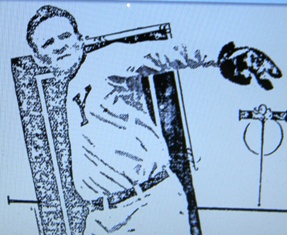
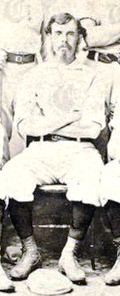
George “Nig” Cuppy

Almost all mentions of Cuppy attribute his success to his slow work.  Jake Morse’s Baseball Magazine described the effect he had on batters:

“(Cuppy) stood holding the ball, and holding it, and holding it some more. The maddened batsmen fumed and fretted and smote the plate with their sticks; the umpires barked and threatened; the fans counted and counted, often up to 56 or 59—and then Cuppy let go of the ball. By this time the batter, if at all nervous or excitable, was so sore that he slammed wildly at the pitch, and seldom hit it.”

While Cuppy remained a very good pitcher throughout the 1890s, he never quite matched his rookie numbers (28-13, 2.51 in 1892), and suffered from the 1893 elimination of the pitcher’s box.

Cuppy’s numbers dropped off dramatically after 1896, and his career came to an end with his release from the Boston Americans in August of 1901.  He rejected several minor league offers and returned home Elkhart, Indiana.

Cuppy and his former catcher and fellow Elkhart native, Lou Criger opened a pool hall called The Lucky Horseshoe.  Cuppy operated that business and a cigar store until his death in 1922.


Joe Gunson’s Mitt

6 Nov

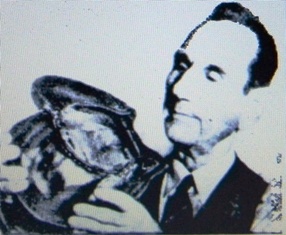
The photo above was taken in 1939.  Former Major League catcher Joe Gunson was donating the mitt he created in May of 1888 to the Baseball Hall of Fame.  Gunson caught for the Kansas City Blues in the Western League and made the mitt after a foul tip split his finger.  He told the Associated Press:

“We had a doubleheader scheduled the next day and Charlie Reynolds, who shared the catching with me, had sustained a similar injury…I got the idea to fashion some kind of glove to protect my hand.”

According to the United Press:

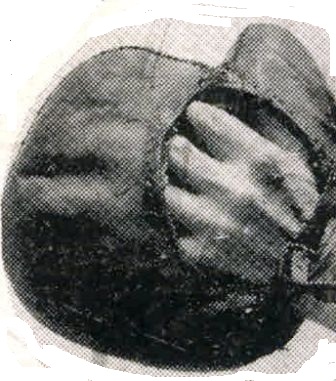
“(Gunson) improvised the mitt from a piece of leather, the belt from a Norfolk jacket, a bit of wire, sheepskin padding, and a buckskin covering.”

When Gunson died three years later the Associated Press and United Press called him the originator of the catcher’s mitt.

Over the years, other newspaper articles credited Albert John “Doc” Bushong with developing the catcher’s mitt.  In 1915, The New York Times said:

“(Bushong) wore the largest glove he could find, an added pads until it looked like a pillow…Out of bushings idea grew the idea of the mitt.”

Bushong’s glove was also mentioned in The Brooklyn Eagle in October of 1887, seven months before Gunson said he made his.

Bushong died in 1908, Gunson lived until 1942—longevity gave him a decided advantage in the number of times he was given credit for the mitt in newspaper articles during the first half of the 20th Century.

Currently, baseball historians remain split over which catcher should get the credit.

The Gunson Mitt

The debate may never be resolved. The most likely answer is that catchers in the 19th Century, who like Gunson, according to The Sporting Life, “has hands which for knots and gnarls rival the famous battered-up paws of Silver Flint,” might well have independently and nearly simultaneously developed equipment to protect their livelihood.

Sammy Strang

5 Nov

Samuel Strang Nicklin, “The Dixie Thrush,” was one of baseball’s great renaissance men.

Born in Tennessee in 1876, he was the scion of one of Chattanooga’s most prominent families.  His father John Bailey Nicklin served in the Union Army during the Civil War, moved to Chattanooga in 1866, and served as mayor from 1887-1889.

Sammy Strang

Samuel Nicklin spent one year at the University of Tennessee where he starred on the football and baseball teams. He also had two short stints in professional baseball 1893 and 1896, which included 14 games with the Louisville Colonels in the National League when he was 19.  Late in 1896, he enlisted as a private in the Tennessee Volunteers, served in Spanish-American War and rose to the rank of captain.

After leaving the service, Nicklin signed a contract with Cedar Rapids Bunnies in the Western Association and dropped his last name; he was known as Sammy Strang for the rest of his career.

The Milwaukee Journal said of the name change:

“(Strang) came of a rich southern family with deep prejudices against professional ball.”

This “prejudice” likely had nothing to do with it given that in addition to serving as Chattanooga mayor, the elder Nicklin was active in professional baseball, serving as president of the Southern Association in the 1890s.

A career .269 hitter, Strang was best known for being one of baseball’s first regular pinch-hitters while playing for John McGraw’s New York Giants from 1905 until June of 1908.  According to The Associated Press:

“McGraw noted the regularity with which he hit in pinches.  So he called him a ‘pinch hitter’—and the term stuck.”

During the 1909 season, Strang began coaching the baseball team at West Point.  He retired from baseball after playing from 1908-1910 with the Baltimore Orioles in the Eastern League, to study opera.

Sammy Strang

During his baseball career, Strang was known for writing songs and singing but decided to seriously pursue a music career in 1910.  He traveled to Paris where he trained under Jean De Reszke, one of the greatest male opera stars of the 1890s.

Upon returning from Paris, he chose not to accept an offer to join an opera company and instead returned to West Point, where he continued as coach until 1917.

Strang returned Tennessee shortly before his father’s death in 1919 to manage and take over ownership of the struggling Chattanooga Lookouts in the Southern League.  While the Lookouts did not win a league championship during Strang’s tenure, he was credited with turning the franchise around and sold the team, for which he paid nothing 1919, for a reported $75,000 in 1927, while retaining ownership of the stadium, Andrews Field.

Unfortunately, Strang’s most ambitious plan–to sign Satchel Paige in 1926–never materialized.

According to Larry Tye’s book “Satchel Paige: The Life and Times of an American Legend,”   Strang failed in an attempt to sign Paige for $500 to pitch a game against the Atlanta Crackers. Paige said of the deal:

“I just had to let him paint me white.”

Samuel Strang Nicklin died in Chattanooga in 1932.

Filling in the Blanks— H. Pipp

1 Nov

Baseball Reference lists H. Pipp with the 1887 Big Rapids team in the Northern Michigan League.  Five years later he became a minor sensation in Chicago.

In January of 1892 Cap Anson announced that he had found a new second baseman for the Chicago Colts.  The signing of Henry L. Pipp of Kalkaska, Michigan was described by The Sporting Life:

“The good Captain dug up his latest phenom in the wilds of Michigan…Pipp is 26 years old, 6 ft. 2 in. high 205 pounds heavy, and as quick as a cat.”

The Chicago Daily News called Pipp “Anson’s great find.”

The Chicago Tribune was less impressed, and concerned that the untested Pipp might replace the popular Fred Pfeffer (sent to Louisville after a dispute with Anson) at second base:  “That would be a dangerous thing to do.  Second base is key to an infield as Anson learned to his cost in 1890,” (the Colts finished in second place with Bob Glenalvin at second after Pfeffer jumped to the Players League).

In March Pipp went to Hot Springs, Arkansas with the Colts, but the reviews were not good.  New York Giants shortstop “Shorty” Fuller said:

“Anson’s team (can’t win) unless he gets a second baseman.  He must have a man to take Pfeffer’s place that can play ball.  That man Pipp won’t do.  We played against him at Hot Springs and he is slower than molasses in January.”

Henry Pipp

With much less fanfare than his signing, Pipp was quietly let go before the season began, the Tribune simply said, “Pipp could not play the position.”

Henry Pipp returned to Michigan.

He owned a hardware store, received a U.S. patent in 1917 for a “Holding device” he invented, and played baseball for more than 20 years in Michigan based leagues.

There is another “Pipp” listed on the 1887 Big Rapids roster—it is most likely Pipp’s brother William.

William left Michigan in the early 1890s for Chicago.  His son, Henry’s nephew, became famous as the man replaced as New York Yankees first baseman by Lou GehrigWally Pipp.

Henry Pipp died in Benton Harbor, Michigan on February 16, 1936.

Alonzo Hedges and the Hunting Dog

31 Oct

In 1903 Alonzo Hedges briefly became a baseball sensation.

“Pongo” Joe Cantillon, manager of the pitching strapped Milwaukee Brewers in the American Association acquired fellow Kentuckian Hedges in August from the Paducah Chiefs in the Kitty League (no roster exists for the team, but Hedges is listed in multiple box scores in Kentucky newspapers).

Said to be a 19-year-old, Hedges started his first game for Milwaukee the day after his arrival and shut down the Columbus Senators–he took a no-hitter into the ninth inning, giving up a single with two outs.

After another shutout in his second game, Hedges, “The Boy Pitcher of Milwaukee,” appeared headed for stardom.  He wasn’t.

Alonzo Hedges

First, The Chicago Tribune revealed in mid August that “The ‘boy pitcher’, whom a number of clubs are after, is really 23-years-old.”   Then Hedges faltered.  While posting a 5-4 record he was hit hard in last 11 games with Milwaukee, after being nearly unhittable in the first two.

Back in the Kitty League with the Springfield Hustlers in 1904, Hedges was effective and helped lead the team to the league championship (again, no statistics survive), but he was no longer mentioned seriously as prospect.

Newspaper accounts indicate he was the “Hedges” who appeared in four games for the Webb City Goldbugs in the Missouri Valley League in 1905—although an arm injury ended his career early in the season.   Hedges signed with the Springfield Senators of the Three-I League in 1906, but it appears that he never played for the team.

How Hedges ended up with Springfield after his brief time in Milwaukee is the real story.

One of the stories that has been told and retold about the colorful Joe Cantillon is that in 1915, while part owner and manager of the Minneapolis Millers, he traded a player, “outfielder Bruce Hopper,” to the Chicago Cubs for a hunting dog.

There are two problems with the oft-repeated story:  “outfielder Bruce Hopper”  is actually pitcher Bill “Bird Dog” Hopper, and contemporaneous accounts mentioning that Hopper was once traded for a dog provide no details of the transaction and predate Hopper’s tenure playing for Cantillon.

Joe Cantillon

However, such a trade might have taken place, but it happened more than ten years earlier and the player traded was Alonzo Hedges.

A 1910 article in The Milwaukee Sentinel mentions that Milwaukee Brewers owner Charles Sheldon Havenor kept a photo of Cantillon on his desk, along with a letter.  The letter read:

“The mother of the dog in the picture is the one I received in exchange for Alonzo Hedges, the pitcher.”

The story went on to tell the story of the trade:

“Cantillon went to Springfield, IL, to see a friend of his who owned the Springfield club and ran a cafe on the side.  During the course of the afternoon the friend showed Joe a couple of dandy setter puppies.”

Later in the discussion when the Springfield owner mentioned his need for pitching, Cantillon offered to sell him Hedges, and Cantillon said “I’ll let you have the fellow for one of those dogs.”

The Sentinel concluded:

“Mr. Hedges may not have been much of a bear cat as a pitcher, but he probably has the distinction of being the only ball player in captivity ever traded for a dog.”

One more note on Hedges.  The Chicago Tribune might have been wrong, the 23-year-old “Boy Pitcher,” might have actually been 26-years-old.  While Hedges grave lists his birth date as 1880, all extant records, including Hedges’ death certificate and census data, indicate he was born on 1877.

Hedges passed away January 12, 1928 in Paducah, Kentucky.

Tom Colcolough

26 Oct

Thomas Bernard “Coke” Colcolough (his name was pronounced “Cokely”) posted a 14-11 record in parts of four seasons in the National League with the Pittsburgh Pirates and News York Giants.

His greatest baseball achievement has been lost to history.

Before the 1893 season, professional baseball eliminated the five and a half by four-foot pitcher’s box and replaced it with the rubber, while moving the distance to the current 60 feet, six inches.  Intended to increase offense the change had the desired effect increasing batting averages throughout baseball.

Not everyone immediately took to the new rule.  The Boston Globe and Cleveland Plain Dealer predicted the rule would be eliminated.  They were wrong, it was there to stay.

One consequence of the new rule was the sharp decline in no-hitters.  In the National League seven no-hitters were thrown between 1890 and 1892.  From the beginning of the 1893 season until Cy Young’s in September of 1897, there was but one:  On August 16, 1893, Bill Hawke of the Baltimore Orioles no-hit the Washington Senators.

Hawke’s was not the first professional no-hitter after the change.  That belonged to Charleston Seagulls pitcher Tom Colcolough on June 23 against the Montgomery Colts in the Southern Association.  The Sporting Life said:

“Colcolough, the rising young pitcher of the Charleston Club, has the honor of being the first pitcher under the new rules to dispose of an opposing team without a safe hit in a full game.  He accomplished the feat against the hard-hitting Montgomerys.”

Colcolough was 16-11 for Charleston and earned his first trip to the Major Leagues.   Prone to wildness (166 walks in 319 1/3 Major League innings), Colcolough was returned to the minor Leagues in 1895, pitching for the Wilkes-Barre Coal Barons in the Eastern League from 1895 through 1898.

Tom Colcolough

Colcolough earned one more shot in the National League with the Giants in 1899 posting a 4-5 record.  He was sent to Jim O’Rourke’s Bridgeport Orators in the Connecticut League in July and was released at the end of the season.

Colcolough returned to Charleston, South Carolina and served as a city councilman.  He passed away there in 1919.

A Thousand Words

25 Oct

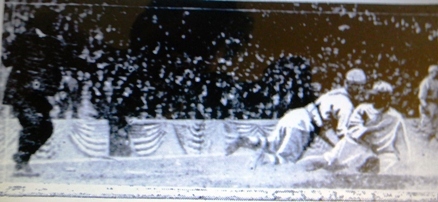
Occasionally you come across a photo that hasn’t been published anywhere in almost 100 years.  This one is from game 2 of the 1917 World Series.  New York Giant rightfielder Dave Robertson slides past Chicago White Sox Hall of Fame catcher Ray “Cracker”  Schalk, beating the throw home to score the first run of the game.  The umpire is Hall of Famer Billy Evans, “The Boy Umpire,” who at 22-years-old in 1906 became the youngest umpire in Major League history.

The White Sox went on to win the game 7-2 and won the series in 6 games.

Fall from Grace

24 Oct

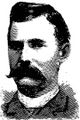
Grayson S. “Gracie” Pierce played parts of three seasons in the major leagues and was a National League umpire selected to preside over the final game of the 1886 championship series.  It went downhill from there.

Pierce was born in New York City in 1860.  Nearly every contemporaneous newspaper account referred to him as “Grace,” not “Gracie.”

Grayson Pierce

Pierce hit .186 playing for five different teams in the American Association and National League during his brief big league career; he was only slightly more successful during his single minor league season playing with the Hartford Babies and Binghamton Bingoes in 1885.

During his playing career there are references to Pierce occasionally serving as an umpire in college and professional games, and according to The Cincinnati Commercial he worked as a longshoreman in New Orleans each winter; he became a National League umpire in 1886,

In October of 1886, The Chicago White Stockings of the National League met the St. Louis Browns in the 1886 World Series.  Pierce was selected to serve as umpire in game 5, but according to The St. Louis Globe- Democrat, “(H)e was not on the grounds, as a long search revealed.”

Pierce got his chance the following day—with St. Louis leading the series 3-2, he was again selected to serve as umpire.  It didn’t go well for the White Stockings or Pierce.

Chicago blew a 3-0 lead in the eighth inning and lost the game in the tenth.  Pierce’s performance was universally panned.  The Globe-Democrat said:

 “For Umpire Grace Pierce of the League staff had been selected.  His judgment was weak and his decisions throughout the game gave rather poor satisfaction.”

The Globe-Democrat’s assessment was echoed elsewhere as well.  The Chicago Inter Ocean said that among the crowd:

“There was much loud talking and opinions of Pierce were quite freely expressed.”

Pierce was not a member of the National League staff the following year and instead worked in the International Association.  In September, a variety of charges were made against Pierce by the owner of the Syracuse Stars.  The complaint, filed with the league, said Pierce was drunk at games in Syracuse and Newark, and also claimed as reported by The Rochester Post-Express:

 “(Pierce) had forced Con. Murphy (Cornelius Murphy) to drink against the latter’s will and that he took (Tom) Lynch out of bed at 10 o’clock at night and started out ‘to do the town’  both returning in the morning ‘boiling drunk.’”

Pierce denied the charges saying Murphy concocted the story after Pierce had ejected him from a game and fined him $3 in Newark.  The Post-Express sided with Pierce and said:

“Grace is not a total abstainer, but in his long career on the ball field he has never been charged with drunkenness.  So far as Con. Murphy is concerned it has never been known before that he would have to be forced to take a drink.”

As for the charges regarding the drinking binge with Lynch, Pierce said:

“I was going home I found Lynch drunk in the street, I took him home and put him to bed.”

There is no record of what became of the charges, but Pierce did continue working as an umpire on the East Coast through the 1891 season.

The Sporting Life reported that Pierce did not have a position with a league for the 1892 season.

He disappeared for two years and  was not heard from again until July of 1894 when The New York Times reported:

“(Pierce) formerly a baseball player and umpire, was arraigned before Justice Burke in the Harlem Police Court yesterday morning charged by Barney Brogan a liquor saloon keeper…with stealing $35 from his cash drawer after the saloon was closed.”

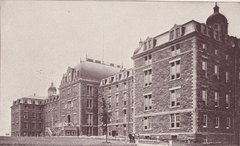
Pierce, who The Brooklyn Daily Eagle described as being “in a half-dazed condition” in court,   denied the charges but was unable to post the $1000 bond.  He was sent to Blackwell’s Island (the prison located on what is now Roosevelt Island). He became ill and died at City Hospital on Blackwell’s Island six weeks after his arrest.

City Hospital, Blackwell’s Island

A Really Bad Idea II

23 Oct

Last week I told you about Chicago Colts President Al Hart’s connection with the proposed rule to change the shape of the diamond.  He wasn’t the only baseball pioneer who considered adopting rule changes which would have completely changed the game.

William Henry “Harry” Wright, called by many “The Father of Baseball,” was among the most respected figures of baseball’s first two decades.  The Philadelphia Record described his importance:

 “Harry Wright has done more than any other man to bring baseball to its present high standing.”

Wright’s story has been told many times and in many places.  This lesser known story focuses on two rules changes he championed.

Harry Wright

After the 1893 season Wright’s contract was not renewed as manager of the Philadelphia Phillies he accepted the position of “Chief of Umpires” of the National League.  The Philadelphia Record reported on a number of rule changes he advocated, including this:

 “Harry Wright thinks that players should not be allowed to question an umpire’s decision during the progress of a game, or to speak to him while the ball is in play, and that he should have the power of taking out of the contest any player (or manager) who breaks the rule.”

While not necessarily a bad idea, if adopted Wright’s idea would have drastically changed the game for several generations of famous umpire baiters.

One other rule change Wright promoted, as reported by The Sporting Life, would certainly have been a bad idea:

 “(A)llowing a base runner to run on a fly ball instead of returning and registering at the base.”

While Wright’s idea never was seriously considered for incorporation into the rule book, it had advocates as late as 1899, four years after his death.

Washington Senators Manager Arthur Irwin endorsed the rule with this colorful description:

 “Uncertainty is the life of the game, and the more uncertain the uncertainty the higher does the interest key itself…for instance (John) McGraw, one of the most daring base runners in the league Is on first base with two men out, and a run needed to win the game (Wilbert) Robinson follows with a fly to center field, and at the stroke of the bat away scuds Mac. His get-away is the cue that brings the spectators to their feet.  ‘Will he score?  Can (Joe) Kelley field that ball home to cut him off at the plate?’ Around the runway fly the twinkling feet of the little Napoleon of the Orioles.   It’s a chase of life and death between Mac and the ball. Kelley swings the sphere on two bounds to Duke Farrell at the plate.  Mac slides into the rubber, and beats the throw by an abbreviated whisker.

“Can you imagine a more intense climax to a game of ball? Why, the game would be full of such play if the idea of running on a fly ball became a rule.  It would increase the base running, produce more plays in the field, and keep the outfielders almost as busy as the inner circle, when the bases were occupied.”

Of course Irwin failed to consider the scenario where the winning run is on third base and scores on a routine fly ball with two outs.

Arthur Irwin