Cooney Snyder

22 Oct

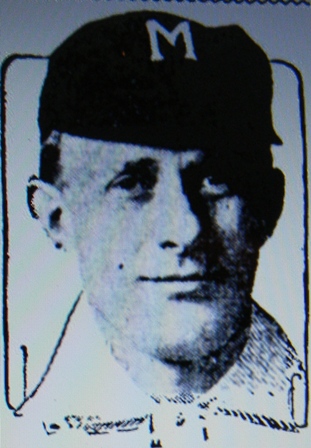
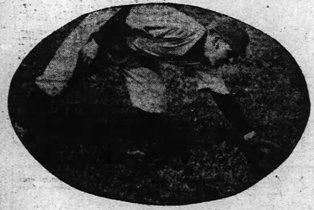
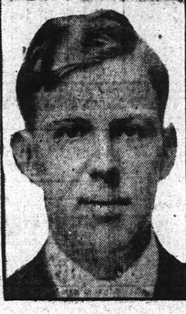
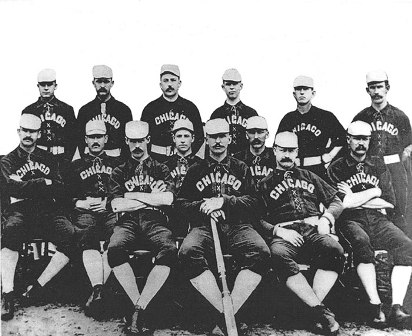
“Cooney” Snyder‘s Major League career lasted only 17 games for the 1898 Louisville Colonels in the National League.

Born in Canada in 1873, Abraham Conrad Snyder was most frequently identified as “Frank” Snyder during his career.

Snyder played in the Western Association in 1884 and he is mentioned frequently in contemporaneous news stories as a member of the 1885 Guelph Maple Leafs in the Canadian League, although no records survive.

Snyder earned his shot in the Major Leagues after hitting .333 for the London Cockneys in the Canadian League and .340 for the Toronto Canucks in the Eastern League in 1897.

The Sporting Life said, “Snyder is credited with an extraordinary throwing arm as well as a strong swing as a batsman,” and attributed his strength to the job he held before playing professional ball:

 “Snyder acquired this strength in a peculiar way.  Before he became proficient in base ball “Cooney” was a keeper in a Canadian insane asylum. His daily task was to wrestle with the patients who showed a desire to buck against the rules of the institution.”

Snyder was Drafted by the Washington Senators, then sold to the Colonels before the 1898 season.  After hitting a disappointing .164, Snyder was released by Louisville and returned to the Canucks, then finished the season with the St. Thomas Saints in the Canadian League.

Snyder finished his career with the Reading Coal Heavers in the Atlantic League in 1899.

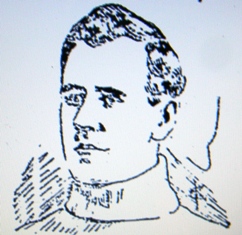
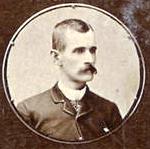
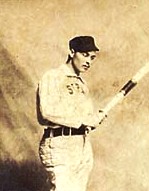
“Cooney” Snyder, 1899

After the 1899 season, it was reported by The Reading Eagle that Snyder had accepted a job at a hotel owned by former major leaguer, and Reading resident Larry Ressler.  The article said Snyder was “Considering offers from several Eastern League teams,” but it appears he never played again.

Snyder made the news one more time before eventually returning to Canada and passing away there in 1917; in December of 1899 when The Reading Herald reported on Snyder’s heroic actions during a factory fire at the Nolde and Horst Hosiery Mill:

 “For nearly an hour he stood under a burning building breaking the fifteen-foot fall of many factory girls, who were penned in the blazing structure like rats in a trap. His position was one of the greatest peril, as red hot brick and burning embers were failing all around him.”

The Reading Times said he caught at least six women in this manner.

A Really Bad Idea

19 Oct

James Aristotle Hart (his middle name is incorrectly listed as Abner on Baseball Reference) was an influential figure in shaping baseball’s rules.

Hart managed the Louisville Colonels in 1885 and ’86.  He then purchased the Milwaukee franchise in the Western League, and helped A.G. Spalding organize the first baseball teams to go on world tours.  He returned to the National League to manage the Boston Beaneaters in 1889.

James Hart, 1886

In 1890 he went to England and Scotland to help launch a professional baseball league, and upon his return he became secretary of the Chicago Colts and served as an intermediary in the 1890 fight between the National League the nascent Players League.  He became president of the Chicago club the following year, succeeding Spalding, and served in that capacity until 1905.

The New York Times said:

“Many rules now deemed indispensable were championed by Hart.  The foul strike rule, one of the most important, was his final effort in the rule making.  He was largely responsible for…defining the coachers’ box, changing the pitchers’ box and substituting the slab, altering the shape of the home plate, requiring the catcher to play close up to the plate all the time, abolishing the foul tip and covering the players’ bench.”

One rule that Hart considered seriously enough to release to the press “with earnest request for publication and comment,” would have completely changed the game as we know it.

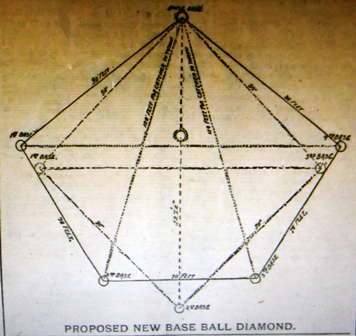
The idea, proposed by a man from Rollo, Missouri named Cliff Spencer and submitted to Hart, called for a redesign of the baseball diamond.

The Sporting Life said of the design:

“The proposed new diamond is a startling innovation, but the more it is studied the more favorably it impresses.”

The new diamond would increase the number of bases from three to four and while the distance between the bases would remain 90 feet:

“(T)he new base lines would throw first and fourth bases about ten feet further out than the present base lines. Thus making a very much larger area for fair balls.”

After several more paragraphs espousing the virtues of the new design, The Sporting Life concluded:

“No decided disadvantages are apparent in this proposed new diamond except that it may operate to the extreme in batting, base running and run-scoring.  (The) objection, could however be easily overcome by deadening the ball somewhat more should the batting become too heavy.”

The article concluded:

“The proposed new diamond, if adopted, would be a radical innovation.  But it maybe that a radical remedy is requisite to restore the base ball patient to entire health and vigor. It is generally conceded that some changes in the game are urgently needed in order to make it more attractive, to lift it out of the rut of pitcher-domination.”

Diagram of the proposed new diamond laid over traditional diamond–home plate is at the top.

Even the glowing review of the proposed plan in The Sporting Life stopped short of absolutely endorsing the idea:  “It is not intended here to advocate, either reservedly or unreservedly, the adoption of this radical innovation,” because it was conceded that there were much less radical measures that could be adopted to increase run production.

Within a week The Sporting Life, and every other newspaper who had published a story about the new diamond concept, had concluded that the idea would never be adopted.

Hart, a long time advocate of increasing run production, was not known to have ever again commented on the new diamond.

Rooney Sweeney

18 Oct

John “Rooney” Sweeney was better known for his unpredictability and for making  good copy for the 19th Century press than for anything he did on the baseball field.  He remains one of the few Major League players for which a date of death is unknown.

Born in New York City in 1858, Sweeney’s first professional experience was in 1881 in the Eastern Championship Association, a league which only lasted one season.  Like many of the short-lived leagues of baseball’s first 30 years, the ECA had no fixed schedules and no control over player movement making it impossible to keep full rosters.  Sweeney played with four teams in the league: The Brooklyn Atlantics, New York Mets, New York Quick Steps and New York New Yorks.

There’s no record of where Sweeney played the following season, but in 1883 he played for Camden Merritts in the Interstate Association and made his Major League debut with the Baltimore Orioles in the American Association.

Although there is no other source for the claim, a 1910 article on the origin of catcher’s equipment in The Freeman claims that Sweeney was playing on the West Coast in Oakland for part of 1883 and was one of the first catchers to wear a mask, “The day he placed it on his head and went up behind the bat he was ‘Booed’ until he took it off in disgust.  Later the fans began to see the benefits of the wire covering.”
John “Rooney” Sweeney”

Sweeney then played with the Baltimore Monumentals in the Union Association in 1884.  He appeared in three games for the St. Louis Maroons in the National League in 1885 before being released.

According to The Sporting Life:

“When Rooney Sweeney was recently released by (Maroons owner Henry) Lucas he had quite a roll. So before leaving St. Louis, just to blow in a dollar or two, Rooney… hired a fine team of grays and a park wagon from a livery stable.  This was at ten o’clock Thursday morning.  At three o’clock Friday morning, eleven hours behind time, a messenger boy drove the team into the stable. Both the grays looked ready for the bone-yard and the owner at that moment would have sold them for a song. Their whole appearance showed that they had been driven nearly to death.

“Several men in the stable armed themselves with clubs and horsewhips and started out in search of Rooney. He must have been told of their coming, however, for before daybreak he took a train. It was lucky for him that the train started out before the livery men caught him.”

Rooney’s never again appeared in the Majors, but was said to have joined a team in Troy, New York after leaving St. Louis.  In 1887 and ’88 he played in the New England League, and then dropped out of sight, and apparently out of baseball, again.

In 1890, Sweeney signed with the London Tecumsehs in the International Association.

Official records indicate that he only appeared in one game—The Chicago Tribune, on May 12 reported on his debut:

 “Rooney Sweeney’s return to the diamond was not a success.  In his opening game nine bases were stolen on him and he had three errors.”

Things went downhill from there.  Sweeney was released in mid-May but apparently remained in London.  In June, it was reported that he had been arrested for stealing $40 from London pitcher James Maguire.

He received four months in jail and as the judge handed down the sentence The Sporting Life said, “Sweeney wept copiously.”

It was reported that Sweeney spent his time in jail writing letters to friends, one of which found its way into several newspapers.  Regarding the crime he was convicted of, Sweeney wrote:

 “We were all playing poker in a room up here and there was a big pot on the table.   Just then somebody flung a big black cat square on the table.  Of course the cat was scared and in her hurry to get away scattered the chips every which way and knocked down the stacks that were standing in front of the players.   Well, I just grabbed what I thought was my share, the same as any man would do, and it got me into jail, that’s all.”

After his release from jail, there are no records that indicate he ever again played in a professional game, but nearly every article written about him mentions that “He is not averse to playing baseball again.”

In 1892, Sweeney became involved in boxing, claiming he was going to manage fighters.  Just weeks later he was reported he was through with boxing and said:

 “I thought ballplayers was (sic) the ungreatfullest (sic) lot on earth, but they ain’t in it with fighters.”

And of course, the articles said, “Rooney is going to try his hand again at catching.”

Within a year of Sweeney’s foray into the boxing world both of his parents and his brother, New York City police officer Jeremiah Sweeney, died, and it was reported that he had inherited a great deal of property in New York and New Jersey, but of course in between collecting rents he said he’d like to play baseball again.

Sweeney was next heard from in September of 1897 when The Sporting Life said:

 “John Sweeney, a once famous base ball player, more popularly known as “Rooney” Sweeney  is dying in the Hudson Street Hospital as the result of injuries sustained by a fall in Battery Park last night.

“For some past Sweeney has been assisting the boatmen at the Battery…last night, while seated on the excursion pier, he was seized with an epileptic fit, and fell heavily to the ground, sustaining a concussion of the brain. An ambulance was rung up, and he was hurried to the hospital.  Sweeney has played with many of the principal base ball clubs both in the East and West, being at one time a member of the famous Metropolitan nine. He was also identified during his career with the St. Louis and Indianapolis.”

But that might not have been the end for Sweeney.  Three years later it was reported that he was working as a “Fireman on a tug boat.”

Sadly, that’s the last bit of information about the enigmatic Sweeney.  Whether he had succumbed to his illness in 1897 or he recovered and ended up aboard that tug boat we may never know.  No records of his death are available.

Stallings Stealing Signs

17 Oct

George Stallings had turned the New York Highlanders around.

Hired by owner Frank Farrell after New York’s disastrous 51-103 season in 1908, Stallings guided the Highlanders to 74-77 record in 1909.

George Stallings

American League President Ban Johnson said he knew why Stallings’ team had improved.

During a series with the Highlanders in the summer of 1909 Washington Senators Manager Joe Cantillon thought he noticed something unusual past the center field wall in Hilltop Park.  He passed his suspicions on to Detroit Tigers Manager Hughie Jennings.

Tiger Manager Hughie Jennings

The Highlanders hit Detroit pitcher Ed Summers hard during the first game of Detroit’s next series in New York.  Jennings sent pitcher Bill Donovan out to center field to investigate, but according to The Sporting Life:

“Bill returned without having shown any ability as a Sherlock Holmes.”

Jennings then assigned trainer Harry Tuthill to the job.  Tuthill noticed that the letter “H” in a hat advertisement on the center field fence was moving, scaled the fence and made a discovery.

Initially the Tigers did nothing, Jennings had more on his mind; Detroit was headed to the World’s Series and despite New York’s improvement they were a fifth place team.

But rumors spread and the story was picked up by The Sporting Life, getting the attention of  the American League president.

Johnson sent a telegram to Tuthill threatening to bar him from the league if he did not provide the his office with a full report of what he knew.  Tuthill said that after he noticed the letter in the sign moving he went to the center field wall and upon climbing to the other side discovered a small area behind the sign where a man sat with a pair of field glasses.  According to Tuthill “The man ran out as I came in, I think I know who it is but can’t be positive.”

In other reports Tuthill said he was sure who the man was but would not reveal his identity—it was later alleged to be former Major League pitcher Gene McCann.

Trainer (and detective)  Harry Tuthill with Tigers first baseman Del Gainer

Jennings was convinced the Highlanders were stealing signs all year as did The Sporting Life:

“It has been a noticeable fact all season that the Highlanders always hit like fury at home and were punk batters on the road.”

The Highlanders scored 338 runs in 76 homes games; 251 in 75 road games.

The Sporting Life also speculated that Stallings, who had a poor relationship with the American League president, might be expelled from the league as a result of the allegations:

“President Johnson has conclusive evidence…and it is all but natural to suppose that the man in charge of the team which benefited by the system employed knew of its existence, and it is on this theory that Stallings’ resignation will be asked.”

Despite the speculation there was no rule at the time which prohibited stealing signs in the manner the Highlanders were accused

At the winter meetings that December the American League Board of Directors exonerated Stallings, but in their ruling vowed that any team official found stealing signs in the future would be “Barred from baseball for all time.”

Stallings was at the helm of the Highlanders for most of the 1910 season, and became embroiled in another sign stealing controversy in late July when “Big Ed” Walsh and several members of the Chicago White Sox accused the Highlanders of stealing signals in the same manner.

The Chicago Tribune said:

“There is not a player on the Sox club who isn’t confident the catcher’s signs are being tipped off.”

Stallings again denied the charges and said the White Sox pitching staff was tipping their pitches:

“What are you going to do when practically every Chicago pitcher insists on giving his own signals from the box and the signals get familiar, they are repeated so often?”

Stallings was again cleared of wrongdoing, but in spite of a guiding the Highlanders to a 78-59 record through September 19, he was replaced as manager after losing a struggle for control of the team with first baseman Hal Chase, who was named as his replacement.

Stallings went on to manage the World’s Series winning Boston Braves in 1914.

George Treadway

16 Oct

A small item in the Louisville Courier-Journal near the end of the 1893 season created a major stir.  And while the story was almost immediately shown to be untrue, several books and articles over the years have tried to imply that it’s still an open question.

The story about George Treadway was written by Courier-Journal Baseball Editor Sam McKee who was traveling with the Baltimore Orioles of the National League:

“There can be little doubt that Treadway, Baltimore’s right fielder is a Negro…all the players say he is.”

Treadway attributed the story to a former teammate he refused to name, and told The Baltimore News:

“The story is the result of a piece of spite work on the part of a former member of the Baltimore team, and knowing the man as I do, I am not surprised that such a thing could emanate from him.”

Treadway went on to say that he had information about the player which would “Kill him eternally, as far as the baseball profession is concerned, but I prefer not to act in that underhanded way.”

Treadway said the story about him came out of an incident when he was playing with Denver in the Western Association when an opposing player had directed a racist epitaph at Treadway.

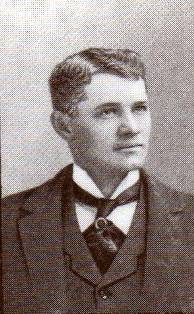
George Treadway

Both The Baltimore Afro-American and baseball columnist O.P. Taylor reported that the story was investigated and was untrue.  At the same time it came to light that Baltimore owner Harry Vonderhorst and manager Ned Hanlon had heard similar rumors and conducted an investigation before signing Treadway, The Sporting Life said:

“Manager Hanlon felt satisfied the report was without truth and Treadway was made a member of the team.”

The story quickly went away, but in recent years has been revived, and mostly in the absence of the facts.  For example:

“. . . the writers . . . compared Joe (Jackson) to Treadway . . . but they did not mention that Treadway had been driven out of baseball by opposing players and fans who bombarded him with taunts and slurs about his alleged or real Negro blood.” – From Say It Ain’t So, Joe!: The True Story of Shoeless Joe Jackson

This reference to Treadway, like most, ignores critical facts.  The taunts and slurs must not have been very effective—Treadway remained in the Major Leagues for two full seasons, and part of a third after the story broke, and he was “driven out of baseball” a full 11 years later at the age of 37.

Had there been any evidence that Treadway was African-American his tenure in professional baseball would have been similar in length to that of William Clarence Matthews a decade later.

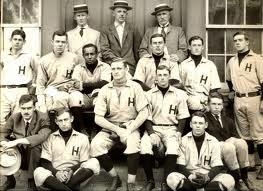
As the starting shortstop for Harvard University, Matthews faced four years of racial tension and boycotts—when the Crimson faced Georgetown in 1903 Georgetown’s manager,  and the team’s catcher, Samuel H. Apperious (Baseball Reference lists him as “William”) refused to participate in the game.

After graduating Matthews attempted to play professional baseball, signing with the Burlington team in the Vermont-based “outlaw” Northern League.  Upon arriving in Burlington Matthews was faced with another player boycott led by the same Sam Apperious, who was playing for the Montpelier-Barre team in the lead.  While there were rumors that Matthews might play Major League ball it never rose beyond speculation.

Matthews was, in effect,  “driven out of baseball.”

William Clarence Matthews with Harvard Baseball Team

George Treadway was in and out of professional baseball until 1904, but his absences were about the economics of early baseball and not questions about his race: from 1899-1901 Treadway played baseball for various teams in the Chicago area, including the White Rocks in the Chicago City League, while working for the Pullman Palace Car Company.

After leaving Chicago, Treadway played in the Pacific Northwest League and Pacific Coast League.  He stayed on the West Coast and settled in California until his death in 1928.

Matthews became an attorney, was actively involved in politics and served as legal counsel for Black Nationalist leader Marcus Garvey.  He also passed away in 1928.

Southern Association Pennant Race Scandal

15 Oct

The Memphis Egyptians collapsed in the final three weeks of the 1907 Southern Association race.  After leading the league from the beginning of the season, poor play in the last weeks led to them being overtaken by the Atlanta Crackers.

Vague rumors circulated that Memphis might have thrown the race—but became a full blown scandal on June 2 of 1908 when the rumors became formal allegations.

Former Memphis pitcher Otis Stocksdale, who had been released following the ’07 season and signed with the Mobile Sea Gulls, said Memphis manager Charlie Babb:

“Threw the pennant…to the Atlanta club, and did so deliberately and for business reasons.”

Stocksdale alleged that he had been forced to pitch while he was sick and that players were instructed by the manager “Not to win games.”  Stocksdale charged that Babb, who also played 3rd base, had deliberately misplayed balls during games in Nashville.

If there was any doubt, Stocksdale doubled down on his charges later the same day, telling reporters:

“Every word of this charge is true, and, what is more, I am going to prove the correctness of what I say and by affidavit…I am not going to stop, now that I have started, until this thing is given to the public and Babb gets the punishment he deserves.  The thing was done in order to make a closer race for the flag and get the money in the gates.

“Charley (sic) Babb has no right to be a manager in this league.”

Stocksdale also claimed that two additional players Richard James and Robert “Nick” Carter could, and would corroborate the charges.

Babb denied the allegations.  Atlanta Manager William Smith said, “The league will have to blacklist either Babb or Stocksdale, and I don’t think it will be Babb.”

Atlanta Mayor Walthall Joyner asked Southern Association President William Marmaduke Kavanaugh for an immediate investigation.

A hearing was scheduled for the following week in Memphis.  Stocksdale promised to make his case.

He didn’t.

According to The Sporting Life:

“He had no witnesses.  He had no affidavits.  He merely entered formal denial of the published statements.”

Stocksdale blamed reporters for misquoting him.

The Memphis club presented their case which included live testimony and dozens of statements refuting the charges, including one from Nick Carter, who Stocksdale had said would affirm his allegations.

Stocksdale was suspended indefinitely for, as The Sporting Life said, “Besmirching Baseball’s Fair Fame.”

Otis Stocksdale, the accuser

It was speculated that 36-year-old Stocksdale’s career was over, and that even if he did manage to play again that he would be blackballed from the Southern Association; however, when the suspension was lifted before the 1909 season after a petition drive that collected more than 1000 signatures in each Southern Association city, Stocksdale returned to the Sea Gulls and stayed in the league through the 1910 season.

Stocksdale finished his career as a player-manager with the Lynchburg Shoemakers in the Virginia League in 1912.

Babb remained as manager of Memphis until 1910 and continued managing in the minor leagues until 1913.

Charlie Babb, the accused

An interesting Postscript involving Atlanta Manager William Smith who vigorously defended Babb and insisted Stocksdale’s allegations were false.  After leading the Crackers to another league title in 1909 Smith was fired.  The deposed manager claimed the reason for his firing was his refusal to rein his team in the final weeks in order to increase gate receipts.  Smith’s complaint was dismissed by the league.

Murphy Calls Out an Umpire

12 Oct

Three years before Chicago Cubs President Charles Murphy ousted legendary manager Frank Chance, he picked a fight with the most powerful and respected umpire in baseball.

In September of 1909 the second place Cubs had just taken three of five games from the league-leading Pirates in Pittsburgh.

On September 9 Murphy filed a formal protest with the league over the fourth game of the series (won by the Pirates 6-2) charging that umpire Bill Klem “(D)eliberately acted as a conspirator, robbing the Cubs of any reasonable chance for victory.”

The Cubs had argued several calls by Klem during the game and Manager Frank Chance and Cubs’ infielders Joe Tinker and Harry Steinfeldt were fined for comments made to the umpire.

Murphy questioned Klem’s honesty and demanded that he not be allowed to serve as umpire in any games played by his team and that the game be replayed.

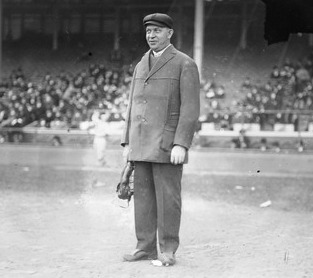
Klem was an unlikely person to have his integrity questioned.  Generally credited with professionalizing umpiring, he had come forward with fellow umpire Jim Johnstone the previous season to report they had been offered a bribe to help determine the outcome of the October 8 Cubs game with the New York Giants to decide the pennant (the make-up game for the September 23 “Merkle’s Boner” game).

While the league never released specific details of the bribe attempt, the allegations made by the umpires were found to be true and barred the “unnamed conspirators” from any Major League ballpark. Both umpires were commended by the league for demonstrating to the “American public the honesty and integrity of our national game.”

League President John Heydler (appointed after the suicide of Harry Pulliam) immediately announced his support for Klem in the dispute.  Murphy responded by announcing he would ensure Heydler would not be reappointed president of the league that winter—Murphy would be successful spearheading the effort to replace Heydler.

Murphy was never able to cite any specific reasons for his charges and was pressured to drop the protest, which he eventually did, but Klem remained indignant and asked to have his name cleared.  According to newspaper reports:

“The umpire does not propose to let the matter rest.  He considers that his reputation has been attacked, and he therefore will ask the league to investigate him.”

There’s no record that the investigation was ever conducted.

Klem attended that year’s winter meetings in order to be on hand when Murphy was pressured to make a formal, public apology.

Chicago Cubs President Charles Murphy

More on Murphy and his feuds in the coming weeks.

“The Rube Waddell of the Central League”

11 Oct

Edward S. Van Anda was the most talented pitcher in the Central League from 1904 to 1908; he was also the most erratic personality in the league–and was often compared to baseball’s most eccentric pitching legend “Rube” Waddell.

Van Anda was born June 6, 1881 in Wapakoneta, Ohio. He pitched for independent teams in Ohio from 1900-1903, getting as much attention for his enormous ego and behavior as he did for his pitching.

Nicknamed “Lord Chesterfield,” or simply “Chesty,” Van Anda would disappear for long stretches and his shameless self promotion made him unpopular with teammates He was signed by the Fort Wayne Railroaders in the Central League in 1904. His statistics for that season are lost, but according to The Youngstown Vindicator: “(H)e won every game he pitched except one toward the close of the season.”

In 1905 Van Anda again pitched for Fort Wayne (the team relocated to Canton, Ohio during the season) and posted a record of 20-14. The Fort Wayne News described Van Anda’s abilities as a ballplayer:

“There is only one thing Van Anda can do and that is pitch. He cannot hit a balloon and he runs bases like an ice wagon.”

The Fort Wayne Gazette said:

“He is rather erratic but has great pitching caliber in him.”

Every article about Van Anda described him as “eccentric,” or as the Toledo Bee put it:

“That Freak Van Anda.”

And the Bluffton (IN) Chronicle said:

“Van Anda is the name of the latest freak to break into baseball.”

A story about his self promotion that made the rounds in newspapers in 1905 was retold several years later in column by former major league pitcher Al Demaree:

“I used to know a fellow named Van Anda…he’d go out into the bleachers, and if the pitcher in the box began to falter, he’d yell “Put in Van Anda he’s the best pitcher on the club. Then he’d move over back of third and start up the same cheer in the crowd.”

The 1905 version of the story included his fellow pitchers, angry at Van Anda’s antics, setting him up

But he could pitch, and appeared destined for the Major Leagues. The Youngstown Vindicator said at the close of the 1905 season:

“Van Anda, known on account of his eccentricities as “the Rube Waddell of the Central League,” has been drafted by the Cincinnati Reds.”

At the close of the 1905 season Van Anda pitched for the local Wapakoneta team in an exhibition against the Reds, the Major Leaguers got 14 hits and beat Van Anda 12-0, it was the last time he faced a Major League team.

After a strong 1906 season with the Grand Rapids Wolverines (23-13), Van Anda was acquired by the Trenton Tigers in the Tri-State League. His time there was short; during a spring training game Van Anda walked off the mound and led the field in the middle of a game, which led to his immediate release.

According to The Fort Wayne News Van Anda “Known all over the Central as an eccentric …was given a bus ticket and returned to Fort Wayne.”

Edward Van Anda

Van Anda pitched for neither Trenton nor Fort Wayne during the 1907 regular season, but signed with the Central League South Bend Greens in June. He only appeared in one game, losing 7-1 to the Wheeling Stogies. He was released a few days later, not resurfacing until the following season.

In 1908 he went 15-11 for Fort Wayne and was purchased by the Montgomery Senators of the Southern Association and posted a 6-5 record. Early in the 1909 season Van Anda was suspended indefinitely by Fort Wayne for “insubordination.” The Fort Wayne News reported that Van Anda signed with the Galveston Sand Crabs of the Texas League, but there is no record he ever played for that team.

Van Anda became a traveling salesman in 1910. He remained in Fort Wayne until his death on October 17, 1965.

A Really Complete Chronology, and Quite a Reason to End up on the Disabled List

10 Oct

The Reach Guide, founded by Major Leaguer turned sporting goods magnet Alfred Reach in 1883, along with the Spalding Guide, founded by Major Leaguer turned sporting good magnet Albert Spalding in 1878, were the annual bibles of baseball.

Both publications prided themselves on providing the most complete chronology of the previous season.

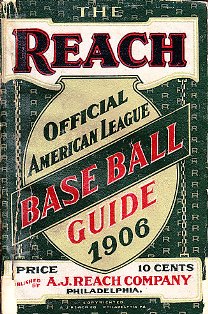
An example of just how complete the Reach Guide could be is found in the 1906 edition.

The entry is about a young pitcher named Gus Bonno.

Bonno was born November 27, 1882 (Baseball reference incorrectly lists his birth year as 1881) in Ohio.  Records for his career are spotty.  After playing for a semi-pro team in Urbana Ohio in 1901 and part of ’02, late that season Bonno appeared in two games with the Toledo Mud Hens in the American Association.  Bonno returned to semi-pro the following season and played for the Paducah Indians in the Kitty League in 1904.

Bonno pitched for the Newark Sailors in the Eastern League and Norwich Reds in the Connecticut State League in 1905.

The Kentucky New Era referred to the Bonno as: “The handsome black haired, black-eyed debonair Italian twirler.”  In fact, nearly every contemporaneous newspaper article about Bonno referred to his ethnicity, which underscores the domination of players of Irish and German heritage in 19th and early 20th Century baseball.

Back to the Reach Guide.

On page 160, for the date September 23, 1905:

“Pitcher Gus Bonno at Cincinnati broke his ankle jumping from a second story window of a young woman’s home to avoid being shot by a jealous rival suitor.”

1906 Reach Guide

Bonno recovered enough to join the Augusta Tourists in the South Atlantic in the spring of 1906, but was sold to the Norfolk Tars of the Virginia League at the beginning of season.  He continued to pitch until 1911 with stops in the Western League and Bluegrass League.

He passed away in Cincinnati in 1964.

Assumed Names II

9 Oct

Players using assumed names were common enough during professional baseball’s first four decades that some players still exist in the record books as separate individuals.

John Berkel is one such case.  He has four separate listing on Baseball Reference.

The “official” record for John H. Berkel begins in 1910 with the Atlanta Crackers of the Southern Association and ends in 1914 with the Fort Forth Panthers of the Texas League.

That was the second half of his career.

Under the name John Bierkotte he started playing pro ball with the Mattoon-Charleston Canaries in the Kitty League when he was 20 years old.

A slick fielding, weak hitting shortstop and third baseman, Berkel, as John Bierkotte, played with the Jacksonville Jays and Augusta Tourists of the South Atlantic League from 1907-1910 (further complicating the trail of Berkel-Bierkotte is that Baseball reference lists him as “Bierkortte” on the Jays’ 1909 roster with a unique player listing).

John Bierkotte with the Augusta Tourists, 1909

On June 30, 1910 John Bierkotte was acquired by Atlanta from Augusta.

John Bierkotte made his debut with the Crackers on August 1.  On August 2 the Atlanta Constitution said:

“John Berkel.  You fans will have to learn to call our new shortstop by that name, for that is really his name…When he first broke into baseball he was trifle afraid he might not make good and rather than cause the laugh to be thrown on him, he decided to change his name.  This he did, and he chose Bierkotte, a weird name, as the one.”

John Berkel 1910

Berkel received high marks for his fielding but struggled at the plate and hit only .207 for Atlanta.  At the end of the 1910 season he was sold to Albany in the South Atlantic League.  From there he went to the Scranton Miners in the New York Penn League in 1912.  The “official” listing for Berkel only adds 10 games with Fort Worth in 1914.

The rest of his career is under the listing “Berkel.”

Berkel spent 1914 on the West Coast, playing for the Fresno Packers of the California State League.  After those 10 games in Fort Worth he played for the Decatur Commodores in the Three-I League, and then was sold to the Peoria Distillers in the same league.  Berkel was offered a contract by Peoria for 1915, but chose to retire and move to the west coast.

The Berkel trail runs cold until 1926 when he turns up as a 40-year-old infielder for the Spokane Eagles in the semi-pro Idaho-Washington League.

Berkel continued to live in Spokane until his death in 1975.  There is no record of why he chose the name Bierkotte.