“A Yellower Effort at Baseball has not been Seen Here”

4 Dec

The doormat of the eight-team 1898 Pacific Coast League (also contemporaneously referred to as the Pacific State League)  was the Oakland Reliance.

Their 26-2 loss to the Sacramento Gilt Edges on April 17 resulted in this game recap which appeared in The Sacramento Record-Union:

They Called It Baseball

But If So, It Was The Oakland Quality

Sacramento’s Gilt Edge Players Up Against a Lot of Kindergartners

“A yellower effort at baseball has not been seen here since the Boston Bloomer Girl Aggregation waddled around the bags, than that offered by the Oaklands of the Pacific State League yesterday. A dozen pick-up teams in this city could give them cards and spades and win out easily.

“Probably 1,100 or 1,200 persons sat the essence of misery through several innings, and the many absconded, and the cranks who were not present played in luck.

“The Oaklanders did not know the game, and many disgusted enthusiasts present were willing to make affidavit that they could not distinguish between a baseball and a pumpkin.  In a game between that same aggregation of alleged Oakland players and the Young Cherub Teas of this city–all of the members of the latter club being under 12 years of age—the betting would be dollars to doughnuts with the Cherubs as favorites.

“The score was 26 to 2 and even the most inveterate gambler who saw the slaughter would have been unwilling to venture a white chip on what it would have been had the Gilt Edges let out a link and played the game to a finish.  But the locals tired of the fun before the end, and during the last three innings ran on everything and often on nothing, and, more’s the pity, they usually scored.

“The Oaklands have gone home.  There let them rest in peace, forever and a day, or until they are taught that there is a game called baseball, and that there are several thousand people in Sacramento who know the game, and are willing to render unto Caesar those things which are his, but who are willing to call sere, yellow, punk ball by its right name.

“None of the foregoing applies to the Gilt Edges, who were in the best of practice and ready to play the game of the season.  But the Gilts were handicapped, and to pile up runs against the Oakland infantiles reflected small honor upon them.  They had nothing to do but touch the ball.  Anything was good for a base, and even a cripple might have stolen any number of bases and come out without a scratch.”

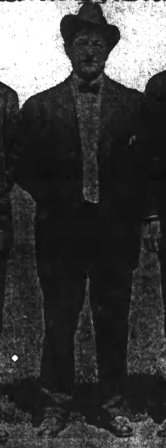
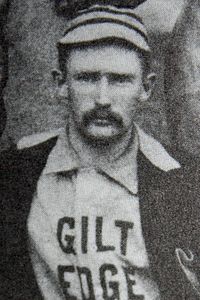
Ervin "Zaza" Harvey had four hits for Sacramento

Ervin “Zaza” Harvey had four hits for Sacramento
In May the Pacific Coast League consolidated with the California League and this incarnation of the PCL disappeared after 1898.  Five years later it was reborn, and remains in operation.
“The Great Baseball Question has been what will Capt. Comiskey do next Season”

3 Dec

In January of 1890 The St. Louis Globe-Democrat said what was on the minds of every baseball executive, writer, and fan:  “The great baseball question has been what will Capt. Comiskey do next Season”

For weeks there was speculation about whether Charles Comiskey, captain and manager of the St. Louis Browns, would remain in the American Association or join the Players’ National League of Professional Baseball Clubs (Players League), the league borne out of baseball’s first union the Brotherhood of Professional Base-Ball Players.

Charles Comiskey, against slang in baseball stories.

Charles Comiskey

On January 15, in a letter to The Sporting News, Comiskey announced his decision:

“During the past few weeks many interviews have appeared with me in different newspapers of the country relative to my having signed a contract with the St. Louis and Chicago Brotherhood clubs.  Up to this writing I am mind and fancy free.  But before Saturday night, January 18, I will have signed a contract to play at first base for the Chicago Brotherhood team.  I take this step for the reason that I am in sympathy with the Brotherhood.

“I believe its aims are for the best welfare and interest of the professional players.  I believe that if the players do not this time stand true to their colors and maintain their organization they will from this day forward be at the mercy of the corporations who have been running the game, who drafted the reserve rule and give birth to the obnoxious classification system.

“I have taken all the chances of success and failure into consideration, and I believe that if the players stand true to themselves they will score the grandest success ever achieved in the baseball world.

“But besides having the welfare of the players at heart I have other reasons for wanting to play in Chicago.  My parents and all my relatives reside there, and the all the property I own is located in the city.  I was raised there and have a natural liking for the place.  But, outside of all these reasons, my relations with the management of the St. Louis club have, during the past year been so unpleasant I do not care to renew them.  I have many friends in St. Louis, and for their sake I hate to leave here, but the other reasons out-balance this friendship, so I will cast my lines with the Chicago club.

“This is the first letter I have written on the subject which seems to have interested the baseball world throughout the whole of the present winter.

“Yours respectfully, Chas. Comiskey”

A week before the season began The Chicago Tribune said Comiskey’s new club “on paper, is the greatest team ever organized.”   Despite the hype, Comiskey’s Chicago Pirates finished in fourth place.  The Players League lasted only one season and dissolved in November of 1890.

Comiskey’s backing of the Brotherhood against “the corporations who have been running the game” would probably have come as a surprise to many of those who played for him when he owned the Chicago White Sox.  Arnold “Chick” Gandil, banned from baseball for his role in the 1919 Black Sox scandal said of Comiskey in a 1956 article in “Sports Illustrated:”

“ He was a sarcastic, belittling man who was the tightest owner in baseball. If a player objected to his miserly terms, Comiskey told him: “You can take it or leave it.” Under baseball’s slave laws, what could a fellow do but take it? I recall only one act of generosity on Comiskey’s part. After we won the World Series in 1917, he splurged with a case of champagne.”

Chick Gandil

Chick Gandil

“Evans, who, at the Least, is Incompetent”

2 Dec

William George “Billy” Evans was nicknamed “The Boy Umpire” when he was hired by the American League at the age of 22.  After 21 seasons  he became a front office executive, working for the Cleveland Indians, Boston Red Sox and Detroit Tigers; he was also president of the Southern Association, authored two baseball books and in 1973, 17 years after his death, was elected to the Baseball Hall of Fame.

Billy Evans

Billy Evans

But during his first season as an umpire, 1906, he was not held in high esteem in Chicago.

On September 10 the White Sox were in second place, a game behind the New York Highlanders.  The Sox trailed the Tigers 2 to 1 in the 9th inning.  Chicago shortstop George Davis laid down a bunt and was called out at first by Evans.  Every Chicago paper said Evans beat the throw by “at least a step.”

The call precipitated a near riot.  The Chicago Tribune said:

“Instantly a shower of bottles from the first base bleachers drove the umpire, coacher, and players away from the vicinity of the base.”

After the next two batters were retired:

“Evans walked off the field amid another volley of bottle from the third base stand.”

The Tribune and The Chicago Inter Ocean said Evans and fellow umpire Tommy Connolly were mobbed by fans as they attempted to leave the ballpark with a police escort.  Both papers said “one or two blows” from fans connected with the umpire during his retreat.

The Inter Ocean said, “Evans has been the most heartily reviled arbiter that ever worked in any league.”

The Tribune said two weeks earlier Evans cost the Sox a game in Philadelphia.  After Chicago scored two runs in the top of the sixth inning to take a 5 to 4 lead, Evans “let the Athletics take advantage of his inexperience,” and stopped the game on account of rain with two men out in the bottom of the inning.  The Inter Ocean said, “(Sox Manager Fielder) Jones and (second baseman Frank) Isbell nearly came to blows with the umpire and members of the Athletic team.”

After a half hour, the game was called and the score reverted back to the end of the 5th inning, giving Philadelphia a 4 to 3 victory.

The next day, September 11, the Sox played the St. Louis Browns at South Side Park.  Evans worked the game along with Jack Sheridan.  The newspapers said Sox owner Charles Comiskey had discontinued the sale of “bottled goods” at the park that day.

The Browns won 7 to 3, and the Chicago press put much of the blame for the loss on the rookie umpire.

The Tribune said:

President (Ban) Johnson’s persistence in sending Evans, who, at the least, is incompetent, is giving baseball a black eye in Chicago.  Half the crowd believes the charges that Evans is working under instructions from Johnson to beat Chicago.  These charges undoubtedly are founded on mere prejudice, yet, had Evans been under instructions and trying to beat Chicago, he could not have done better than he did yesterday.”

The Inter Ocean said the Browns “were aided and abetted by Umpire Evans, the boy wonder…Why Ban Johnson insists upon sending the joke to officiate at important games is more than any sane man can see.”

But the Evans’ most ardent critic was William A. Phelon, sports editor of The Chicago Journal:

“Umpire Evans is the worst that ever yet came down this or any other pike in the history of the modern universe…And Ban says he is the best in the game.  We are not selfish and we are willing to let some other city endure him.  We can get over the shock of his removal.  If he doesn’t move he may have a statue down on the lake front, a statue 200 feet high made of bottles.  Give us liberty, give us death, give us any old thing, but, by the snakes of old Ireland, give us an umpire!”

Phelon also said Evans “seems to be a gentlemanly individual, whose place in life is evidently a long ways from the profession of umpiring.”

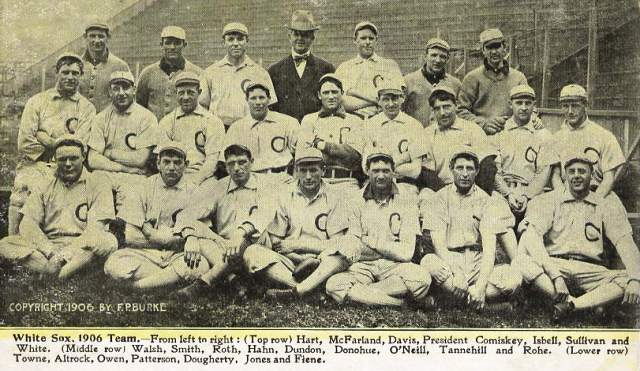
1906 White Sox

Despite the blame heaped on the young umpire in the press, the White Sox went 17-7 the rest of the season and won the pennant by three games.  They went on to beat the Chicago Cubs 4 games to 2 in the World Series.

Things got better for Evans as well.  He worked his first World Series in 1909—the youngest umpire to do so– and participated in five more from 1912 to 1923.  He was the third umpire to be elected to the Hall of Fame; Connolly and Bill Klem were the first two.

Lost Advertisements–President McKinley, Spalding League Ball

29 Nov

mckinleyspalding


An April 1897 advertisement for the Spalding.  The advertisement appeared in several papers across the country–including The Chicago Inter Ocean and The Chicago Daily News.

President McKinley Formally opened the Base Ball Season yesterday at Washington with the Spalding Official League Ball…

It seems very appropriate for the American game of Base Ball to be formally opened by the President of the United States, as was done yesterday at Washington by President William McKinley, in breaking the seal and tossing to the umpire the Spalding Official League Ball.”

While the advertisement ran on April 23 so did a story from The Associated Press which said the president was a no-show:

“It was expected that President McKinley would favor the Senators with his presence, he having promised the Washington players if his duties did not prevent he would toss the first ball to the umpire, but he evidently was too busy entertaining office-seekers, and as a result players and spectators alike were greatly disappointed.”

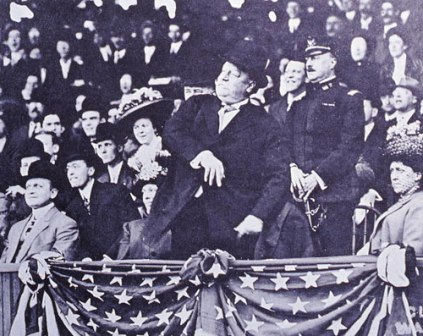
The Brooklyn Bridegrooms defeated the Senators 5 to 4.  It would be 13 years before  William Howard Taft became the first president to throw out the first ball on April 14, 1910, in Washington.

William Howard Taft throws out the first pitch in 1910

William Howard Taft throws out the first pitch in 1910

“A Clever Adaptation of the Great American Game”

28 Nov

msgame


By 1898 there were many tabletop baseball games on the market, including Chief Zimmer’s which was introduced in 1893–a history of such games can be found here.  But not everyone could afford the commercially produced games, so it was not uncommon for newspapers and other publications to provide instructions for creating an inexpensive version at home.  The one above, called “Parlor Baseball,” was in The Marion (Ohio) Daily Star.

The paper called it:

“A clever adaptation of the great American game.

“It takes a stretch of the imagination to adapt the robust American game to household entertainment, but this is what is done in Parlor Baseball.  Take a large sheet of cardboard and draw on it a baseball diamond, showing the home plate, first, second and third bases.  At each of the bases mark off a circular space for the base runners.  Each player is supplied with nine pieces, each separate nine being a distinct color.  On another rather large piece of cardboard draw a circle divided off into 15 spaces, the lines of division coming together, of course, in the center.  Attach an arrow or any other form of indicator to the center of the cardboard.


“The Experiment Was a Failure, But the Crowd Laughed”

27 Nov

In July of 1890 the Hartford franchise in the Atlantic Association–occasionally but not officially dubbed the “Nutmeggers” by the local press—were struggling financially.  So much so that the public was called upon to help raise enough money to meet payroll and get the team through the season.

The Sporting Life said a “meeting for the revivification” of the team was held on July 21, and a fundraising picnic was planned for August.  But the team’s best hope to raise enough money was  July 24: a game by electric light.

The first nighttime game was played a decade earlier, but the novelty of two professional teams playing under lights was enough that 4000 fans attended the exhibition game against the Baltimore Orioles at Ward Street Grounds.

The consensus opinion of the contest was summed up in The New York World headline:

The Experiment Was a Failure, But the Crowd Laughed

The paper said the game was lighted using “nine arc lamps in different sections of the field,” but the “light was dim and the players could hardly be distinguished…The game was a farce, but everybody was good-natured and the enterprise proved a first-class benefit for the home club.”

Only four innings were played.  The final score is in dispute.  Most recent accounts say Hartford won 20-19.  Most contemporary accounts, including The World and The Sporting Life said the score was 26-19.

The Baltimore Sun said Hartford’s net profit of $300 from the game enabled “management of the club to pay the players in full to July 15.” However, The Sun said there was a cost, Hartford catcher George Stallings was injured and “unable to play today as a result of last night’s so-called ballgame.”

George Stallings

George Stallings, injured in “so-called ballgame”

The proceeds from the night game and public contributions were not enough.

On August 14 Hartford was unable to come up with the $75 guarantee for the visiting Wilmington Blue Hens, and the game was cancelled.  Two days later, despite what The Sporting Life called “the club’s gallant fight,”  Hartford disbanded.

“The Cleverest bit of Quick Thinking I ever Witnessed”

26 Nov

Hugh Fullerton was one of baseball’s most influential writers; his career began in 1889 and he was active into the 1930s.  Widely credited as the first writer to directly quote players and managers, he is the source of hundreds of stories. Some, like the story the story of Bill Lange’s fence-crashing catch, are likely untrue.  Others may be apocryphal, or exaggerated.

Hugh Fullerton

Hugh Fullerton

This one is about Hall of Famer John Alexander “Bid” McPhee:

“The cleverest bit of quick thinking I ever witnessed was years ago in Cincinnati, and Bid McPhee, the ‘King,’ pulled it off.  How fast he thought only can be guessed.  It must have been instantaneous.  Bid was on first base with nobody out, when somebody drove a ball straight at ‘Wild’ Bill Everitt who was playing first for Chicago.  Bill dug up the ball, touched first, and made one of his copyrighted throws to second to catch Bid, having plenty of time for the double play.

Bid McPhee

Bid McPhee

“The ball disappeared.  (Bill) Dahlen, who was on second, never saw it.  He thought the ball had hit Bid.  The umpire, crouching to see the play at the base, lost the ball.  Bid hesitated at second, glanced around, saw the entire Chicago infield running around wildly and tore for third.  At third, after turning the base, he hesitated again, looked back, and then tore for home.  From his actions both at second and third any spectator would have sworn Bid was as ignorant of the whereabouts of the ball as were the Chicago players.

“The Chicago team was wild with excitement and the crowd was mystified.  No one knew where the ball was.  The only clue was a yell of amusement from the Cincinnati bench.

“The ball had disappeared utterly and the umpire threw out a new one.  After the game we learned what had become of the ball.  Everitt hit Bid with it.  The ball had struck him under the arm, and holding it tight against his body Bid carried it entirely around the bases and to the bench while acting as if he didn’t know where it was.”

Morrie Rath

25 Nov

In August of 1913, the Chicago White Sox sold second baseman Morris “Morrie” Rath to the Kansas City Blues of the American Association.

Morrie Rath

Morrie Rath

The Chicago Eagle said the sale wasn’t the result of Rath’s .200 batting average, or 16 errors, but because of his performance coaching first base during a game in Philadelphia earlier in the month:

“Morris was coaching at first base and (Manager Nixey) Callahan was at third.  (Harry) Lord was at bat.  He hit a bounder to one of the infielders and as it was a slow hit he figured he could beat it out.  He ran with every ounce of speed and strength that he possessed.  The play was mighty close.

Harry Lord

Harry Lord

“’Out,’ cried the umpire.

“Lord figuratively hit the ceiling.  He threw his cap down and jumped upon it.  He picked it up and threw it down again.  He howled and he scowled.  He allowed that if there ever was a blind umpire that he was working on the bases that day.  He assured the ump that in all his experience as a ball player it was the worst decision he ever saw.  Then up spoke Rath.  His voice was as gentle as could be:

“’Yes, you were out Harry.’

“And Lord collapsed.  That beat the other thing.  Never in his experience as a ball player had he heard another player agree with the umpire when it meant that one of his pals was out instead of safe.  That was beyond the comprehension of Lord.  He just wilted and staggered to the bench.

“By this time Callahan was over there.  There was fire in his eye, and he was fighting mad.  ‘Of all the—‘ he started in and then stopped.  For the umpire was laughing.

‘What’s the matter?’ howled Cal.

‘Why Rath here agrees that he was out,’ laughed the ump.

“What did Cal do?  What could he do?  He also was dazed.  It was a new one on him.  He had been around ball fields for many years, but never before had a member of his team taken sides with the ump against a teammate.”

It was a long road back to the big leagues for Rath.  He played for Kansas City until June of 1915 when he was sold to the Toronto Maple Leafs.  In 1916, He joined the Salt Lake City Bees in the Pacific Coast League, after hitting .300 and .341 he was drafted by the Cincinnati Reds after the 1917 season in the Rule 5 Draft.

After spending 1918 in the United States Navy where he was captain of the baseball team at the Philadelphia Navy Yard, Rath finally joined the Reds for the 1919 season.  He was Cincinnati’s regular third baseman in 1919 and 1920 and appeared in all eight games of the 1919 World Series against his former team.

Rath finished his career with the San Francisco Seals in the Pacific Coast League in 1921.

After his career, he operated a sporting goods store in Upper Darby, Pennsylvania.  In 1945, suffering from ill-health, he committed suicide.

Lost Advertisements–“Kid” Gleason for Cat’s Paw Rubber Heels

22 Nov

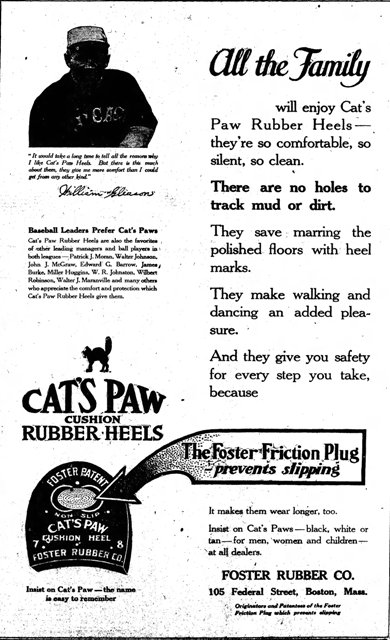
cat'spawA 1920 advertisement featuring William “Kid” Gleason, manager of the defending American League Champion Chicago White Sox–the ad appeared in July, two months before the first grand jury was convened to investigate the 1919 World Series.

“It would take a long time to tell all the reasons why I like the Cat’s Paw Heels.  But there is this much about them, they give me more comfort than I could get from any other brand.”  William Gleason

Baseball Leaders Prefer Cat’s Paws

Cat’s Paw Rubber Heels are also the favorites of other leading managers and ball players in both leagues–Patrick J. Moran, Walter Johnson, John J. McGraw, Edward G. Barrow, James Burke, Miller Huggins, W.R. Johnston, Wilbert Robinson, Walter J. Maranville and many others who appreciate the comfort and protection which Cat’s Paw Rubber Heels give them.

“The fans make us the ‘goat’ for Everything”

21 Nov

Chicago Orphans Manager Tom Burns suspended pitcher Bill Phyle without pay in August of 1899, even after Burns was replaced by Tom Loftus, Phyle remained in limbo.

Tom Loftus

Tom Loftus

In January Hugh Fullerton said in The Chicago Tribune that Loftus “probably will give him a chance.”  But in early February The Chicago Inter Ocean said even though Phyle had met with team President James Hart nothing had been resolved.  Phyle told the paper he was offered a contract but was “in no hurry to sign.”

Phyle finally signed at the end of the February, but The Tribune said Chicago would most likely trade him “although Loftus thinks highly of him.”

The team trained in West Baden Springs, Indiana, where according to The Tribune Phyle was “sarcastically called ‘Lucky,’ because of his proverbial hard luck, (he) rarely escapes a day without being hurt.”  He also managed to alienate his new manager.

After several days of poor weather in Indiana, Loftus decided to take the team further south, to Selma, Alabama on March 18.  According to The Tribune Phyle was not on the train:

“Phyle may not be with the team in Selma.  He left Friday (March 16), announcing he was going to see the fights in Chicago.  Manager Loftus hunted up the pitcher before he departed and told him it was a bad plan to start the year in such a manner.  Phyle then said he was ill and was making the journey in order to consult a physician in Chicago.”

Phyle did return from Chicago (where he claimed he had an unspecified operation), and joined the team on the trip south.  Upon his return he continued to suffer a series of illnesses and injuries, which included a bad reaction to a vaccination and a being hit in the knee with a thrown bat, both of which kept him inactive for several days.

Phyle was left in Chicago when the team opened the season in Cincinnati, and his imminent trade or release was speculated upon nearly daily in the Chicago press; he was finally traded to the Kansas City Blues in the American League with Sam Dungan and Bill Everitt for John Ganzel on May 18.  Phyle refused to report to Kansas City and spent the season playing for Chicago City League teams and a semi-pro team in DeKalb County, Illinois.  He was also a regular attendee at Chicago’s boxing venues and was said to own a piece of featherweight contender Eddie Santry.

Phyle returned to the National League in 1901 posting a 7-10 record for the New York Giants.  In 1902 he went to the California League as an infielder and never pitched again.  After his controversial exit from Memphis in 1903—and the aftermath—he continued to play until 1909.

Phyle worked as a boxing referee and as an umpire for more than 20 years in the Canadian, Eastern and Pacific Coast and International  Leagues, and was involved in two final controversies.

Bill Phyle, 1913

Bill Phyle, 1913

In 1920 a grand jury was impaneled in Los Angeles to investigate charges of game fixing in the Pacific Coast League.  Players Harl Maggert, William “Babe” Borton, Bill Rumler and Gene Dale were implicated.  While all criminal charges were eventually dismissed, the four were banned from baseball in 1921.

Phyle was called to testify in front of the grand jury, and said umpires were often blamed when players were crooked:

“The fans make us the ‘goat’ for everything that goes on during the ball game.  How many times we have suffered to suit the whims of a ballplayer who might have been working with the gamblers will never be known.  They just slough us around, call us whatever names they please and yell murder when we happen to fire them out of the game or have them suspended.

“An umpire should have the same authority as a referee has in the prize-ring.  If he believes a ballplayer isn’t giving his best toward the game, he ought to have the privilege of ousting him without taking the manager into confidence.”

In July of 1923 Phyle was working an International League game between the Baltimore Orioles and Rochester Tribe.  Phyle called a Rochester runner safe at first, then immediately reversed his decision.  He was dismissed the following day by league President John Conway Toole.

As a result of the dismissal, four other umpires resigned in sympathy.  Toole, who was attending the game, claimed he had not released him because of the blown call, but because Phyle had failed to work a double hitter he was assigned to earlier in the month.   The decision was upheld, and within three days the four other umpires withdrew their resignation.

Phyle ended his career back in the Pacific Coast League in 1926, and died in Los Angeles in 1953.