Fred Abbott

9 Oct

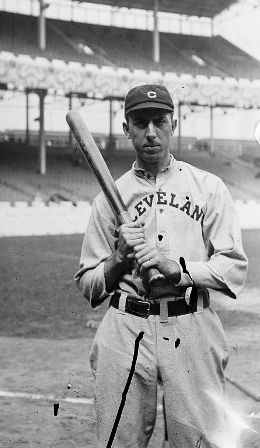
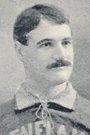
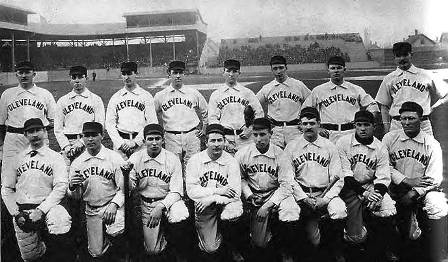
Fred Abbott (born Harry Frederick Winbigler) spent more than a decade in the minor leagues before the Cleveland Naps purchased his contract from the New Orleans Pelicans prior to the 1903 season.  The 28-year-old rookie appeared in 77 games for the Naps.
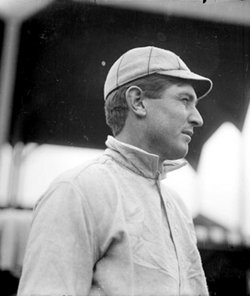
Fred Abbott

Fred Abbott

After his first big league season he told The Cleveland Press about his most embarrassing moment with the Naps:

“I was behind the bat in a game at Washington one day last summer when the batter hit a ball straight up over my head.  I should judge it went nine miles high.  As I tore off my mask a bleacherites flashed the sun’s rays in my eyes by aid of a looking-glass.  It nearly blinded me.

“’I can’t see it,’ I shouted, expecting either (Earl) Moore, who was pitching or Hick (“Cheerful” Charlie Hickman), who was at first, to take the ball.  But neither man stirred.  Instead Cheerful took my latitude and Earl my longitude.

“’Go toward first two steps,’ yelled Moore.  I did.

“’Go back about three feet,’ shouted Hick.  I did.

“Now put your hands straight over your head,’ howled both men in chorus when they had got me placed.  I did.

“And although my eyes were shut tight, the ball dropped straight into my hands.”

Abbott played one more season in Cleveland, and played for the Philadelphia Phillies in 1905.  The Phillies sold his contract to the Toledo Mud Hens in the American Association (AA).

Abbott laid down roots in Toledo.  He played five seasons there and operated a bowling alley and pool hall on Euclid Avenue with his teammate Harry Hinchman; until Hinchman took over as Mud Hens manager.

The Pittsburgh Press said:

“Rather tough on a baseball player when your own business partner releases you and sells your ability to play to a club on the other side of the country? “

Hinchman had succeeded James “Ducky” Holmes as manager late in the 1910 season; Abbott was sold to the Los Angeles Angels in the Pacific Coast League shortly after the season ended:

“One of Hinchman’s first managerial duties was to sell his partner to the Los Angeles club, Hinchman believing that Fred had been connected to the Toledo club too long and that both he and the club would be benefited by the change.”

Abbott wasn’t thrilled, but took the news in stride:

“Gee, I had been in Toledo so long that I had about made up my mind that I was going to die in the harness there…It’s a good move sending me to Los Angeles, but I will have to put in a longer season there than in the AA, and the pay offered is just the same.  I didn’t like that angle to the case very well, but they have got us ballplayers where they want us and I suppose it is up to Fred to run along and play.”

Fred Abbott with Los Angeles Angels 1911
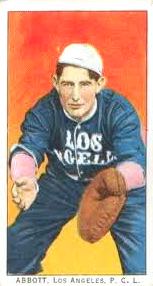
Fred Abbott with Los Angeles Angels 1911

Los Angeles apparently grew on Abbott; he only spent one season with the Angels before retiring, but remained in L.A. until his death in 1935.
“In Baseball there is no such Advantage”

8 Oct

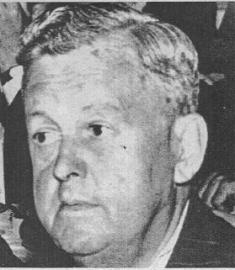
John Henry Mohardt was, with George Gipp, a member of the backfield on Knute Rockne‘s undefeated 1920 Notre Dame football team, and would go on to play for the Chicago Cardinals, Racine Legion and Chicago Bears in the NFL.

He also played baseball in at Notre Dame and was a highly sought after prospect.  Contemporary reports said he received offers from the Pittsburgh Pirates, Cleveland Indiana, Cincinnati Reds, Chicago Cubs, St. Louis Cardinals and Detroit Tigers.  He signed with the Tigers and manager Ty Cobb.

When it was announced that he would open the season as a member of the Tigers Mohardt was asked by reporters which sport was more difficult:

“Baseball, of course.  Football is team play, baseball largely individual effort.

“In football there is time enough to get set after each signal.  The calling of the signal tells you just what you are expected to do to put over the play.  Every player has a chance to firmly concentrate on his task.

“In baseball there is no such advantage.  There is never an opportunity to get set.

“In baseball the great weight is on the individual.  When I go to bat I am up there along.  I cannot depend on anybody but myself for help. “

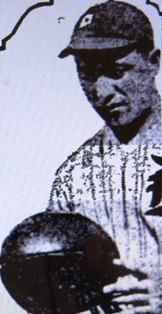
Johnny Mohardt

Johnny Mohardt

Mohardt had never played football before entering Notre Dame and “Inside a week he was a first-string player,” as a result he said:

“It is easy to make football players, but from what I know of baseball it is necessary to have natural ability and also be able to think quickly.  Developing football players is easy.  If a fellow is physically fit the coach will do the rest.

“I have seen Coach Rockne make stars almost overnight at Notre Dame.  Every season brings forth scores of new stars in the football world.  In baseball I understand a new star a year is the exception.”

Mohardt was not the exception; he was 1 for 1 with a walk and 2 runs scored for the Tigers in five games in April, and after he was released hit .185 in 21 games for the Syracuse Stars in the International League—then returned to football.

Mohardt became a physician, served in the military in World War II and died in 1961.

An excellent biography of Mohardt written by Dan Cichalski appears on Gary Joseph Cieradkowski’s Infinite Baseball Card Set blog.

“Fans Inclined to be Fair find it Difficult to side with Wickware”

7 Oct

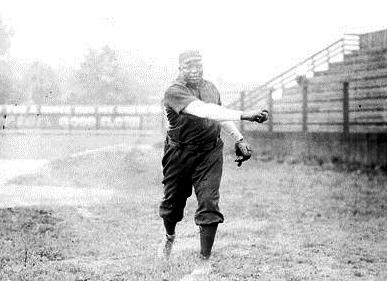
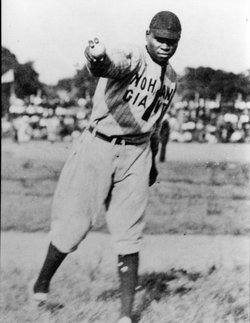
Frank Wickware is best remembered for defeating Walter Johnson and a team of minor league players 1 to 1 in Schenectady, New York in October of 1913.  He was pitching for the Mohawk Giants, and the game was very nearly cancelled after the pitcher and his teammates initially refused to take the field, claiming they were owed six weeks of back pay.

Frank Wickware

Frank Wickware

The New York Times said the crowd of 6,000 nearly rioted, the police were called to control the crowd and more than an hour after the game was scheduled to begin “the financial difficulty was settled and the game started.”

As a result of the “strike,” and the late start, the game was called after only five innings.

The incident in Schenectady wasn’t the first time in 1913 that Wickware took center stage in a controversy over money—the first time it contributed to the cutting short a much anticipated series of games.

On July 17 the Rube Foster’s Chicago American Giants were to begin a five-game series with the Lincoln Giants in New York.

Rube Foster

Rube Foster

Roderick “Jess” McMahon, the owner of the Lincoln Giants, went to Schenectady before the series and signed Wickware, who he intended to start in the first game.

The New York Age said:

“Thursday afternoon before the game…McMahon spied Wickware all togged up in and American Giant suit.  He inquired of the pitcher why he was not in a Lincoln Giant uniform.  Wickware promptly told him that he was going to pitch for the American Giants.

“McMahon protested to Rube Foster against Wickware playing on the American Giants in view of the fact that he had given him money (allegedly $100), but the manager of the American Giants insisted that Wickware do the pitching for his team.  The two managers argued for over an hour, when the game was called off.”

The series was resumed the following day without Wickware.  The Lincoln Giants were ahead in the series 2 games to 1 before the game scheduled for July 22.  McMahon recruited Charles Earle of the Brooklyn Royal Giants to play left field in place Robert “Judy” Gans who was ill.  Foster objected to the substitution and refused to play the game despite there being “A large crowd.”

The Age said Wickware and both teams were doing damage to the future of black baseball:

“Fans inclined to be fair find it difficult to side with Wickware or regard him as a hero.  To accept money from one manager and then want to play for another is a piece of reasoning which does not favorably impress those who believe that one should keep his word at all times.  Just such conduct of Wickware’s will do much to injure the progress of baseball among colored clubs.”

“The sooner the managers of the colored teams get together and agree upon a working basis for their mutual protection the better.  Manager McMahon seems to have developed a habit of borrowing players from other clubs which should not be permitted. “

Roderick ":Jess" McMahon

Roderick “:Jess” McMahon

Wickware would remain one of the dominant pitchers in black baseball into the 1920s.  He continued to jump when teams when a better offer came—he played for four clubs in 1914, jumping a contract each time.  In 1925 Wickware was in a bar on 135th Street in New York with Lincoln Giants teammates Oliver Marcelle and Dave Brown.  After an altercation in the bar, a man named Benjamin Adair was shot and killed in front of the bar.

One report in The Freeman said witnesses claimed Adair was with the three players when a fifth man ran from building “shouted ‘I got you,’ and fired point-blank at Adair,” The New York Amsterdam News said “four men were quarreling on the sidewalk, when one drew an automatic.”

In either case, Brown disappeared and was assumed to me the shooter.  Wickware and Marcelle were never charged; there has been much mythology about Brown and speculation about the date and place of his death, but no definitive evidence has been presented.

McMahon and his brother Ed sold their controlling interest in the Lincoln Giants in 1914 and owned the Lincoln Stars from 1914-1917.  The McMahon’s were also boxing and wrestling promoters—which continues to be the family business.

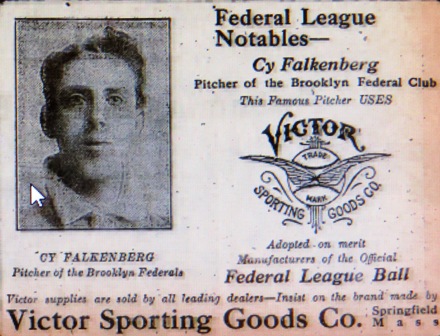
Lost Advertisements–Federal League Notables–Cy Falkenberg

4 Oct

???????????????????????????????

One in a series of several 1915 advertisements from the Victor Sporting Goods Company featuring Federal League players.  Victor produced the league’s official baseball.

Frederick “Cy” Falkenberg made one of baseball’s great comebacks.  After an injury plagued 1911 season (8-5 in just fifteen games) the Cleveland Naps sold Falkenberg’s contract to the Toledo Mud Hens in the American Association.  The 32-year-old pitcher developed a pitch that saved his career; Hal Sheridan of The United Press said Falkenberg had begun “tossing a sand-papered sphere to the batters.”

Once he started throwing the Emery Ball Falkenberg went 25-8 with a 1.95 ERA at Toledo, and after returning to Cleveland the following season he was 23-10 with a 2.22 ERA.  Falkenberg jumped to the Indianapolis Hoosiers in the Federal League in 1914; he was 25-16 with a 2.22 ERA for the pennant-winning Hoosiers.

By the time this ad appeared the Federal League had banned the Emery Ball and Falkenberg had split the 1915 season between the Newark Peppers (the relocated Hoosiers) and the Brooklyn Tip-Tops; he was a combined 12-14 with 2.86 ERA.

Russell Ford, who pitched in the American and Federal Leagues from 1909-1915, is generally credited with developing the Emery Ball, but at least one American League pitcher said Ford didn’t deserve credit for the invention.  Bill Steen told The Pittsburgh Press in 1915 that John “Wee Willie” Sudhoff had shown him how to throw the pitch in 1907:

“He had a strip of emery paper glued on the heel of his glove and rubbed the ball on it.”

Sudhoff had retired after the 1906 season, so it’s unclear where and exactly when he would have shared the pitch with Steen.

Cy Falkenberg

Cy Falkenberg

“Who told you you were a Ladies’ man, Mr. Viau?’

3 Oct

Leon A. “Lee” Viau (pronounced vee-o) was the first player from Dartmouth College to make it to the major leagues.

Listed at only 5’ 4” and 160 pounds Viau was 83-77 in five big league seasons.  The Cleveland Leader said of his time pitching for the Spiders:

“(Viau) with comparatively little speed but with curves well mixed with gray matter, got out of lots of tight places where an ordinary twirler would have been knocked out of the box.”

In addition to having attended an Ivy League school, he was best known for his looks, and for being one of the best-dressed players in baseball.

The Philadelphia Inquirer called him “The Adonis of the diamond.”  When he played for the Patterson Silk Weavers in the Atlantic League The Patterson Weekly Press called him “the Beau Brummell of the club.”

Lee Viau

Lee Viau

A story, perhaps apocryphal, made the rounds in several newspapers during the first decade of the 20th Century about how “the grandstand was filled with ladies…when the handsome Viau was in the box.”

On this particular occasion, as recounted in The Kansas City Star, Viau was pitching for the Spiders against “Cap” Anson and his Chicago Colts in Cleveland:

“The score stood 4 to 2 in the last half of the ninth inning, and in Cleveland’s favor.  There was a Chicago man on second and one on third, while Anson was at the bat.

“He was madly anxious to bring in those runs, and he swung viciously at the first ball pitched. ‘Strike one!’ yelled umpire (Thomas) Lynch.

“Anson gritted his teeth and waited for the next one.  Lee sent up one of those slow, deceptive drop balls for which he was noted, and again Anson swung wildly.  ‘Strike two!’ cried Lynch.

“At this there was a veritable uproar among the female occupants of the grandstand.

“’Strike him out Lee! Oh, do strike him out!’ they shrieked in chorus.

“Hearing these cries, the grim old Anson, with a sneer on his face, sardonically inquired: ‘Who told you you were a ladies’ man, Mr. Viau?’

“Lee maintained a haughty silence, wound his arm slowly about his head and then, taking a wide swing, shot the ball up to the plate, and Anson took the third swipe at it and missed.

“’Now’ remarked Lee, as he advanced toward Anson, ‘I will answer your question.  The same person who told you you could bat.’”

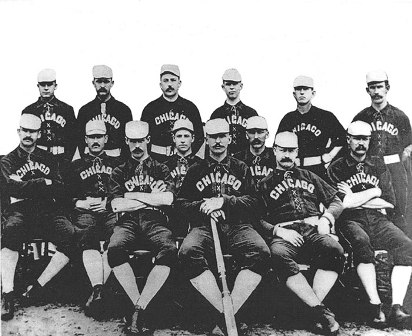
Lee Viau, front row third from right, with 1892 Cleveland Spiders

Lee Viau, front row third from right, with 1892 Cleveland Spiders

Filling in the Blanks—O’Laughlin, 1913 Owensboro Distillers

2 Oct

Baseball Reference lists “O’Laughlin” with the Owensboro Distillers of the Kentucky-Illinois-Tennessee (Kitty) League.

”William “Bud” O’Laughlin (misspelled O’Loughlin by some sources) was born near Owensboro, Kentucky in 1888 and became a well-known amateur and industrial league player for teams in Western Kentucky and Southern Indiana. In 1913 he played third base for the Owensboro Distillers in the Kitty League and the following year was, for a time, with the Evansville River Rats in the Central League, but he apparently did not appear in any games with the team.

On January 16 of 1918 O’Laughlin became one of several professional players who shared a similar cause of death; shot by a jealous husband.

The Lexington Herald said O’Laughlin was on the street in Boonville, Indiana with a woman when he was approached by a man named Clyde Barnhill:

“O’Laughlin was in the company of Barnhill’s wife and they were on the way to a show when it is alleged that the woman’s husband walked behind the couple and fired a bullet into O’Laughlin’s head.  He fired two bullets at his wife who fled down the street.”

O’Laughlin died early the following morning.

The Cincinnati Enquirer said:

“After Barnhill was caught and overpowered he attempted to shoot himself…there were cries of ‘Lynch him, lynch him’ from the mob that gathered on the streets.”

The Indianapolis Star said that Barnhill “will plead the ‘unwritten law.’ It is said Mrs. Barnhill was insanely in love with her husband’s victim.”

Newspapers in Kentucky and Indiana reported all the scandalous details two months later when Barnhill stood trial for killing O’Laughlin, who The (Hopkinsville) Kentucky New Era called “a favorite with Kitty League players.”

Barnhill testified that he simply approached O’Laughlin and his wife to “compromise the matter” when “O’Laughlin turned and put his hand in his pocket to pull a thirty-eight-caliber blue steel revolver…It was a question of who shot first.”  As for shooting at his unarmed wife, Barnhill said “I guess I was crazed.”

After 17 hours of deliberation the jury found Barnhill guilty of manslaughter; The Indianapolis News said: “The defendant was well pleased with the light verdict and was congratulated by  numerous friends after it was read.” He was sentenced to serve from two to twenty-one years in prison.

O’Laughlin, the former Kitty Leaguer is buried in Boonville.

Note: Baseball Reference lists a “Bud O’Loughlin” with an incorrect death date of January 19, 1915  in Booneville (Sic), Indiana as a member of the 1911 Spokane Indians in the Northwestern League—that O’Loughlin was a pitcher, and it is highly unlikely he is the same player.  (This same incorrect date and misspelled town appeared in The Sporting Life in 1916)

Road Trip High Jinks, 1891

1 Oct

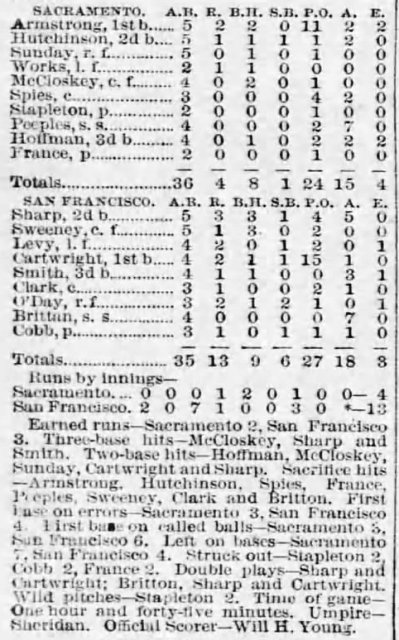
The Sacramento Daily Record-Union described the 50-mile road trip the California League’s Sacramento Senators and San Francisco Metropolitans took to play a game in Stockton, on the box car of a freight train:

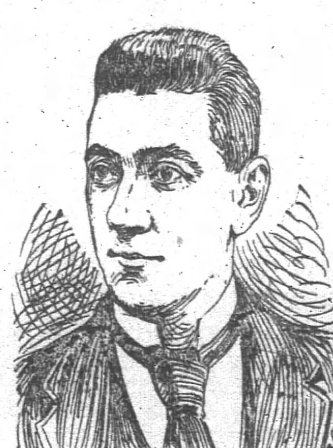
 “(The players) commenced to playing craps…The San Francisco players and also umpire (John) Sheridan were on the train, and everyone was betting his ‘chicken feed.”  Big (Edward “Jumbo”) Cartwright borrowed ten cents to start on, and came out (with) over $7…Sheridan won about the same amount, but did not stop playing and dropped $3 of what he had won.  Red (Frank) Armstrong was intensely interested in the game, except for an intermission of about five minutes, when he poked a drunk’s hand through a window in the caboose.

“At Stockton both clubs were accorded a royal reception; but the heat was sweltering and everyone was in a half-way stupor.  Just about then ‘Rube’ (Reuben) Levy and ‘Bony’ (James Peck) Sharp and a couple of others came running up the middle of the street with their coats off yelling ‘Fire!’   They ran about four blocks and when they stopped the population was running at a lively rate.  But there was no fire, except in the air”

Reuben "Rube" Levy

Reuben “Rube” Levy

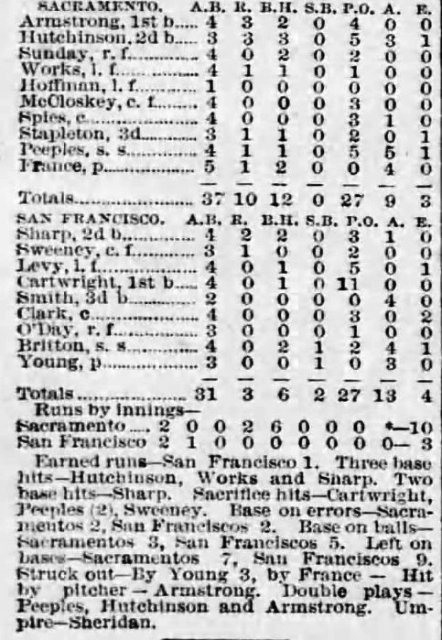
The teams played that morning in Stockton, Sacramento winning 10 to 3.  Immediately after the game, the teams re-boarded the freight train (there was no description of the return trip) and played an afternoon game in Sacramento.  San Francisco won that game 13-4.

Game 1 Box Score

Game 1 Box Score–played in Stockton

Game 2 Box Score

Game 2 Box Score–played in Sacremento

Page Fence Giants

30 Sep

The Page Fence Giants would become one of the great early teams in black baseball; some sources say they played 156 games, winning 118 their first year.  But things did not go well in their first game.

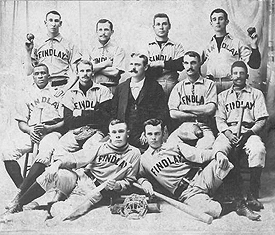
Organized by John “Bud” Fowler and Grant “Home Run” Johnson, the team represented the Adrian, Michigan-based Page Woven Wire Fence Company; at the time the nation’s largest fence company;  Augustus “Gus” Parsons served as the team’s business manager and scheduled their games (he’s often misidentified as the team’s manager).

Grant "Home Run" Johnson, left center row and John "Bud" Fowler, right center row, with the independent Findley (OH) Sluggers in 1894.

Grant “Home Run” Johnson, left center row and John “Bud” Fowler, right center row, with the independent Findley (OH) Sluggers in 1894.

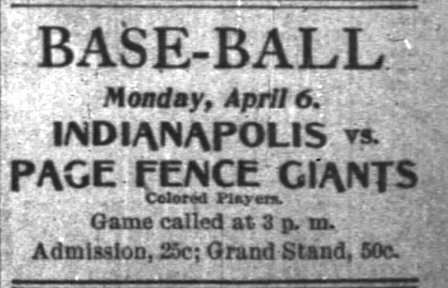
Their first game was scheduled for April 10 against the Western League’s Indianapolis Hoosiers.

The Indianapolis News said of the Giants:

“Besides playing ball they perform feats of tumbling, and there is a quartet among them that sings between innings.”

The team also would arrive in towns riding bicycles in parade formation (the Giants’ other sponsor was the Monarch Bicycle Company).

While they often played for mostly white crowds The News said the stands “were very nearly peopled” with black fans; they did not get the show they had hoped for:

“In the first inning the Indianapolis team had fourteen men to bat and scored eight runs.  It seemed evident that one more inning of slaughter like the first would precipitate a race riot, and President (and manager William “Bill”) Watkins diplomatically let up.  The ease with which Indianapolis did everything it wanted to, and the “rough deal” the colored team received at the hands of umpire Andrews conspired to make the score look like the original report of the Armenian massacre…The one-sided score, which misrepresents both teams as far as figures are concerned.”

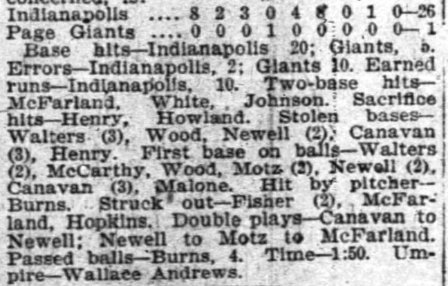
Page Fence lost 26-1.

The Box Score

The Box Score

They also lost two games against the Cincinnati Reds, then lost Fowler and pitcher George Wilson to the Adrian Reformers in the Michigan State League (where they were teammates of Honus Wagner).

The Giants returned to Indianapolis in 1896, losing 16-3 to the Hoosiers

The Giants returned to Indianapolis in 1896, losing 16-3 to the Hoosiers

Despite their first game, the Giants continued drawing crowds and winning games until they disbanded in 1898—with most of the players joining the newly formed Chicago Columbia Giants.

Lost Advertisements–Leading Baseball Players Indorse

27 Sep

caldwell's


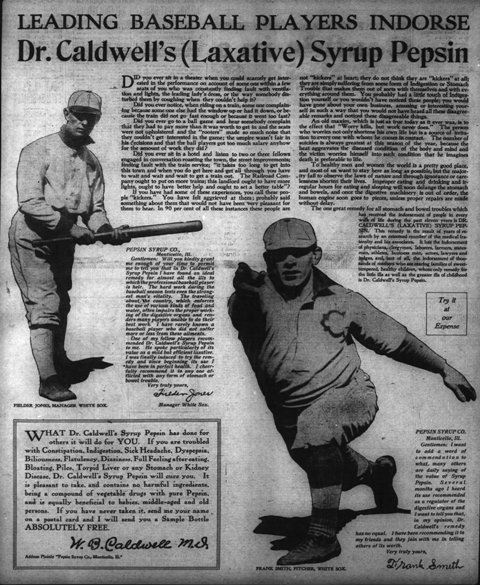
A 1904 advertisement for Dr. Caldwell’s Laxative Syrup Pepsin Company in Monticello, Illinois featuring Fielder Jones and Frank Smith.

Fielder Jones:

“I have found an ideal remedy for almost all of the ills to which the professional baseball player is heir.  The hard work during the baseball season tests even the strongest man’s vitality.”

Frank Smith:

“Dr. Caldwell’s remedy has no equal.”

In 1904 Jones replaced James “Nixey” Callahan as manager of the Chicago White Sox after 42 games.  He led the team to a third place finish.  The White Sox finished second in 1905 and his “Hitless Wonders” won the 1906 American League pennant and defeated the heavily favored Chicago Cubs 4 games to 2 in the World Series.

Frank “Piano Mover” Smith won 104 games for the White Sox between 1904 and 1910, including two 20-win seasons.

Dr. Caldwell’s Pepsin Syrup Company remained in business until 1985.


“Anson, the Baseballist, would like to see some Changes”

26 Sep

Some of baseball’s pioneer’s had ideas for rule changes that would have if adopted, dramatically changed the game.  In 1896 Adrian Constantine “Cap” Anson proposed two such changes.

Anson’s Colts had not finished better than fourth place in the National League in the previous five seasons, and the manager apparently thought two radical changes would improve his team’s chances and simplify the game.

"Cap" Anson

“Cap” Anson

The Chicago Record said:

“Anson, the baseballist, would like to see some changes in the present system of playing ball.”

Anson said he wanted to make a change to the 1893 rule that established the distance from the pitcher’s mound to home plate and replaced the pitcher’s box with the rubber:

“He is in favor of putting the pitcher’s slab in front of the pitcher, instead of having it behind him.  He wants this done in order to stop the interminable bickering that is going on in almost every game as to whether the pitcher was in position.  It is much easier to see whether the rule is conformed to when the slab is in front of the pitcher, and he dare not stop over it.”

Anson’s other rule change would have led to complete chaos, and would have made it an adventure to fill out a scorecard:

“Another radical change that Anson is in favor of allowing the captain to put players back into the game after they have been taken out…(Anson)  wants all restrictions removed, the manager being allowed to play his men just as he sees fit, taking them out and putting them back just when he wants to.”

The issue of introducing free substitution into baseball has occasionally been raised in the years since Anson advocated for it.

Montreal Canadians coach Dick Irvin suggested it to Kennesaw Mountain Landis as a solution to player shortages when the baseball commissioner attended an NHL game during World War II.   Lew Fonseca made a pitch for the rule in the 1950s, and Walter “Red” Barber, long-time Dodger and Yankee broadcaster suggested in the 1960’s that the rule would help keep baseball from being “as exciting as watching paint dry.”

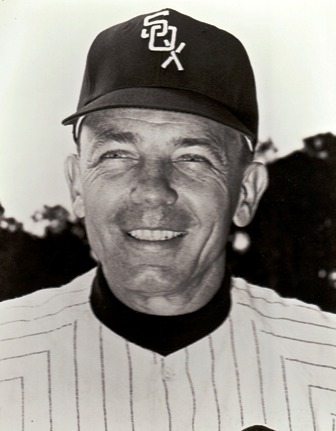
In 1967, Eddie Stanky of the Chicago White Sox was given permission from the American League to experiment with a crude form of what would become the designated hitter rule six years later.  The convoluted rule, according to The Milwaukee Sentinel, said:

“(T)he Sox and their spring opponents will be allowed to call on a pinch hitter twice provided that he is designated before the game is not used twice in the same inning.”

Eddie Stanky

Eddie Stanky