Another Rube Waddell Story

31 Jul

There are probably as many stories about George Edward “Rube” Waddell as any player in the history of baseball; and some of them might be true,

This one was told by Hugh Fullerton in The Chicago Tribune, and is about the contract Waddell signed to join the Chicago Orphans in 1901.

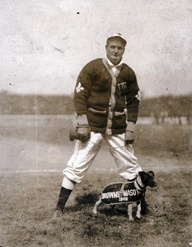
Waddell with St. Louis Browns Mascot

Rube Waddell

Despite the erroneous story, told through the decades, that the Pirates were so anxious to rid themselves of Waddell that they let him go for a cigar (or a box of cigars in some versions), there was actually a great deal of interest in Waddell and while the sale price was never disclosed, The Chicago Daily News said Chicago paid “good money” for the pitcher.

In addition to Chicago, other contemporaneous reports said the Boston Beaneaters were very interested in obtaining Waddell.

Fullerton told a good story, maybe just as erroneous as the cigar story, of how Chicago manager Tom Loftus was able to sign Waddell and thus beat Boston to the punch of purchasing his release from Pittsburgh:

“(Rube) was threatening to annihilate several members of the team and he was on one of his periodical rampages.  Boston wanted him badly—and so did Chicago.  Boston offered to give him $3,500 for the remainder of the season, and Chicago was willing to pay him only $2,400 and Loftus was delegated to sign Rube and make him be glad to knock off $1,000 from his earnings from the end of May to the middle of October.  Loftus cornered George Edward and commenced jollying him.

“’I’ll tell you, Tom,’ said Eddie, ‘I’d rather play with you than with Boston, but they offer me $1,100 more.

“’That’s all right,’ said Tom.  ‘Don’t let a little thing like that stop you from joining a good ball club with a lot of good fellows.”

Fullerton said the two discussed the pros and cons of Waddell accepting Chicago’s offer when Loftus finally said:

 “’I’ll tell you, Eddie, what I’ll do.  You sign that contract, and when we get to New York I’ll buy you the best Panama hat in town.

’“’All right,’ said George Edward.  ‘Just put that in the contract.’”

Fullerton said the deal was made and “When they got to New York Loftus bought him the $1,000 Panama hat—for $28.”

Tom Loftus

Tom Loftus

Waddell’s time in Chicago was brief, and typically bizarre.  After posting a 14-14 record and a 2.81 ERA for Loftus and the Orphans, Rube received an offer he couldn’t refuse in September.

The Tribune told the “pitiable little story, this tale of ‘Rube’ Waddell and his love of nature.”  Waddell had deserted the team to play for an amateur club in the town of Grayslake, Illinois, about 40 miles north of Chicago.  The Tribune said Waddell was induced to go north with the promise of being able to fish six days a week, if he pitched on the seventh.

The Orphans suspended Waddell for the remainder of the season.  In December he jumped Chicago to join Los Angeles in the California League.

“Good day—Double Crosser”

30 Jul

Hap Myers’ abrupt exit from the Boston Braves was never fully explained; the Boston press said he simply didn’t get along with manager George Stallings, Myers said it was because of his activities as one of the leaders of baseball’s most recent labor movement.

"Hap" Myers

“Hap” Myers

Two articles from The Associated Press about George Stallings that appeared after the braves won the World Series might have shed some light on the relationship between the two—one mentioned an incident that took place during a game, and the other had to do with Stallings’ well-known and strange superstitions.

The first article was about “a game played in Boston in the summer of 1913,” (box scores indicate it was most likely, the second game of a double-header with the Cincinnati Reds on July 22).

“Two men were out and the Braves had a man on first and another on second…A long hit would either tie the score or win the game.  ‘Hap’ let the first one pass—and bunted the second.  He was thrown out by at least 10 feet and the game was over.  The Braves had lost.

“’Hap’ in terror over a possible rebuke…escaped into the clubhouse.  Stallings was there, enshrouded in deepest gloom.  Baseball never knew a harder loser that Stallings.  But Stallings never said a word to Myers then, and Myers ducked out.

“The next morning found Stallings at Myers’ home.  Myers had just gotten up.”

When Myers answered the door, Stallings asked him why he had bunted with two on and two out.  Myers told his manager that he thought he’s “double-cross the other fellows…catch ‘em asleep.”

Stalling blew up at the first baseman:

“Well, let me tell you this Myers, if you ever again try any of that ‘double-crossing’ stuff there’ll be a funeral in this particular neighborhood.  Good day—double crosser.”

The second article said that during a losing streak in June of 1913 the superstitious Stallings blamed the “jinx” on a colorful necktie Myers wore—the only tie the first baseman owned.  According to the article, Stallings told his equally superstitious owner James Gaffney:

“That necktie of his—that horrible looking sight, that drapes down from his collar.  No wonder we can’t win.  No wonder we are jinxed.  That necktie would hoodoo anybody.”

The story said Stallings stole the tie from Myers, and after the Braves won the following day told Gaffney:

 “Told you so, didn’t I?”

The Boston Globe told a slightly different version of the story in 1931 in an article about Stallings.

By the time these stories were published, Myers was in his second season with the Brooklyn Tip-Tops in the Federal League.  He hit a disappointing .220 in 1914, but stole 43 bases.  In 1915 he hit .287 and was suspended for several days in June after he and Chicago Whales player-manager Joe Tinker “exchanged blows.”

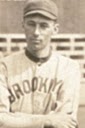
"Hap" Myers Brooklyn Tip-Tops

“Hap” Myers Brooklyn Tip-Tops

When the Federal League folded Myers returned home to California and signed a contract with the San Francisco Seals, who already had veteran William “Chick” Autry at first.  When Myers arrived in San Francisco, The San Jose Mercury News said:

“The fight for the job will be a battle which will be watched with more than passing interest by San Jose fans, for most of them remember Myers as an elongated youngster who wielded a ferocious bat when he first broke into professional ball in this city.”

Myers hurt his arm and the battle never took place; he only appeared in three games, and was hitless in two at bats.  He would never play organized baseball again.

Where Myers spent the remainder of the 1916 season is unknown; The Mercury-News said he went to Ray, Arizona to join the Tri-Copper League, but no reference to Myers can be found in league statistics—whether he played in Arizona or not, he did spend time in the Southwest that year.

In November of 1916 Myers and two other men were arrested in Los Angeles on a warrant from El Paso, Texas.  The Associated Press said Myers was “wanted by the El Paso Police on a charge of highway robbery…one resident (was robbed of) a $1500 diamond ring and $48 in cash, and another resident, a diamond ring valued at $325,”

In January of 1917, when the trial took place, highway robbery was punishable by death in Texas.

On January 23 Myers and his co-defendants were acquitted.

Myers, now a free man, remained in the Southwest and went to work as a metallurgist with a copper mining company in Grant County, New Mexico.

In 1918 the 31-year-old Myers enlisted in the military; joining Company B of the Field Signal Battalion at Camp Lewis, Washington.   He played baseball at Camp Lewis and in France with the United States Army—among Myers teammates were professional players Ten Million, “Coaster Joe” Connolly, Howard Mundorff and Charlie Schmutz.

After returning from France Myers worked as an insurance adjuster in Seattle and later in automobile financing back in his hometown of San Francisco.

“The elongated first baseman” died in San Francisco in 1967 at age 80.

Hap Myers

29 Jul

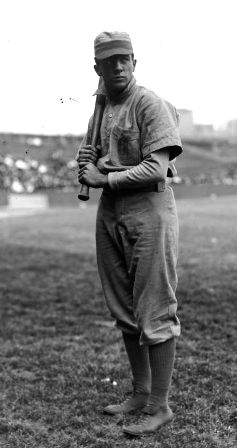
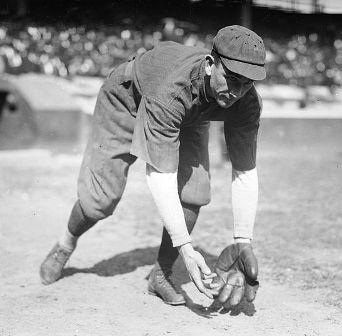
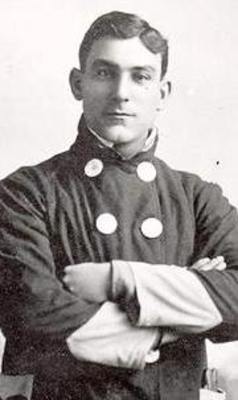
When the 6’ 3” 175 pound Ralph Edward “Hap” Myers was let go by the Boston Braves after the 1913 season a reporter told Braves shortstop Rabbit Maranville he was sorry to see Myers go.  Maranville joked:

“Well, you might be, but I’m not.  Do you know that guy is so thin that every time I picked up a grounder I had to shade my eyes with my gloved hand to locate him before throwing the ball.”

Myers began his professional career after graduating from University of California, Berkeley in 1909, where he also played baseball.  The San Francisco native hit a combined .311 playing for the Sacramento Sacts in the Pacific Coast League, and the San Jose Prune Pickers and Santa Cruz Sand Crabs in the California League.

Myers went east in 1910 after being purchased by the Boston Red Sox, but became ill, with scarlet fever, and as a result appeared in only six games in Boston before being  sent first to the Toronto Maple leafs in the Eastern league, then the Louisville Colonels in the American Association.

Despite hitting just .240 with Louisville, Myers was selected by the St. Louis Browns in the Rule 5 draft.  The Red Sox claimed Myers still belonged to them and his contract was awarded to Boston, where he began the season, was sold to the St. Louis Browns, who quickly released him despite hitting .297 in 11 games, then back to the Red Sox where he hit .368 in twelve games before being sent to the Jersey City Skeeters in the Eastern League.

It was never clear why, in spite of hitting .333 in 81 at bats in 1910-1911, Myers couldn’t stick in the American League.

In 1912 he returned to the West Coast to play for the Spokane Indians in the Northwestern League where he led the league in hits, and runs, hit .328, and led all of professional baseball with 116 stolen bases.  The Portland Oregonian said:

“Myers base stealing smashes any previous performance in Northwestern League history.  You have to go back 20 years in official guide books to find any record to compare…and that includes every league in organized baseball.”

Spokane owner Joe Cohn went overboard in his praise of Myers in The Spokane Spokesman-Review:

“Best ballplayer in the Northwestern League by a long shot.  He is the greatest ballplayer I ever saw.  Boy I tell you this Myers is a wonder.  Ty Cobb, Hans Wagner, Tris Speaker and all of them have nothing on Myers…I think Myers has it on Cobb, Wagner, Lajoie, Jackson and the whole bunch.”

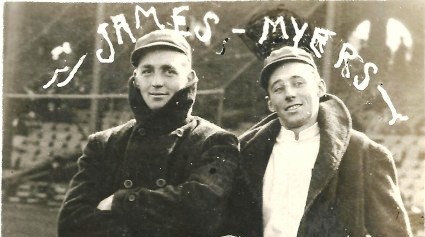
Myers, and Portland catcher Rex DeVogt were purchased by the Braves from Portland, Devogt would only last for three games, and six hitless at-bats in April of 1913.  Myers would become the Braves starting first baseman.  Another Pacific Coast League player, pitcher “Seattle Bill” James also joined the Braves.

hap3

“Seattle Bill” James and “Hap” Myers

Myers got off to a slow start; he was hitting just .224 in early July, but was leading the National League in steals.  An article in The Tacoma Times said:

“When Hap Myers, recruit first baseman of the Boston Braves is in full stride stealing bases, he covers nine feet…the average stride of a sprinter is six feet. “

The article said the average player took 13 steps, roughly seven feet per step, between bases but Myers took only ten steps:

“Myers is something of a baseball curiosity, and his work is watched with interest by the fans.  If the time comes that the big fellow climbs into the .300 class as a batter, he is apt to become a veritable terror of the paths.”

He was also said to use “a bat of unusual length,” but the size was never mentioned.

After the slow start, Myers hit well in the second half of the season, ending with a .273 average and 57 stolen bases (second to Max Carey of the Pittsburgh Pirates who stole 61).  Despite his strong finish, Myers was replaced at first base for 22 games in August and September by Butch Schmidt, who was purchased from the Rochester Hustlers in the International League.

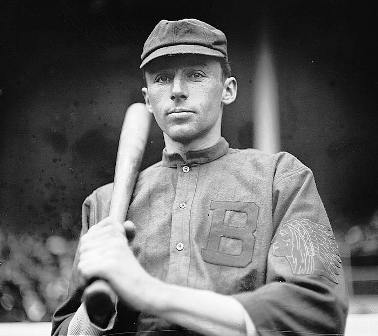
"Hap" Myers

“Hap” Myers

At the end of the season Myers was sold to the Hustlers, the deal was, in effect, a trade for Schmidt.  The Boston press simply said Myers did not get along with manager George Stallings; Myers told a reporter in San Francisco that there was another reason; baseball’s labor unrest:

  “I was assigned by the fraternity to get as many Braves as possible into the fraternity, and succeeded in enrolling nearly the entire team.  The powers that be evidently didn’t relish my actions for soon my every move began to bring calldowns and I was not surprised to read in the newspapers a little later that I had been sent to Rochester.”

Myers jumped Rochester to join the Federal League; his signing was reported months before he actually signed.  The Associated Press said in March of 1914:

“Although it has been generally understood that Hap Myers, last season’s first baseman of the Boston National has been under a Federal League contract for some time, the elongated first sacker did not put his name to a contract until yesterday afternoon.  Myers originally expected to play with Larry Schlafly on the Buffalo Federals, but was transferred to Brooklyn, and seemed altogether pleased with the move.”

Myers got off to a strong start, and The Sporting Life said:

“Brooklyn fans cannot understand why Hap was passed out of the National League. They have had a chance already to give his successor at first base on the Boston team (Butch Schmidt) the once over, and the general opinion is that- Hap Myers “lays all over.”

His success in Brooklyn didn’t last; in 92 games Myers hit just .220.

Hap’s story continued tomorrow.

Lost Advertisements–“Our ‘Pennant’ Hat Looks well on ‘Dut’ Chalmers

26 Jul

chalmers

George “Dut” Chalmers, pitcher for the 1915 National League Champion Philadelphia Phillies in an advertisement for Geo. B. Wells Hats.

“Our ‘Pennant’ Hat Looks well on ‘Dut’ Chalmers

“As full of graceful curves as the shoots Chalmers puts across!

“You’ll find the right hat for your head in our very high-grade offerings at $2 and $3.”

Chalmers is one of only eight big leaguers to have been born in Scotland.  He was 8-9 with a 2.48 ERA in 26 games for the Phillies in 1915, and lost game 4 of the World Series 2-1 to the Boston Red Sox–Boston won the Series 4-1.

Chalmers was 29-41 in seven seasons, all with the Phillies.

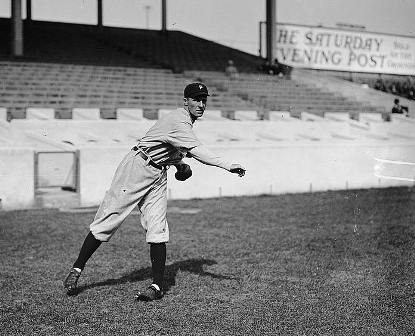
George "Dut" Chalmers

George “Dut” Chalmers

Butcher Boy Schmidt

25 Jul

Charles John “Butch” “Butcher Boy” Schmidt was credited by Connie Mack with being the catalyst for the Boston Braves World Series upset of Mack’s Philadelphia Athletics in 1914; one year later Schmidt walked away from baseball in his prime.
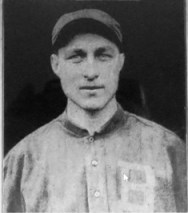
Butch Schmidt

Butch Schmidt

He was born in Baltimore in 1886, and played amateur ball while working in the family meat market, which earned him his nickname.

Schmidt signed as a pitcher with the Baltimore Orioles  in the Eastern League and assigned to the Holyoke Papermakers in the Connecticut State League, where he posted a 10-9 record.  In late August the Orioles recalled him, and he went 5-1 in 11 games with Baltimore.

The New York Highlanders drafted Schmidt and the 22-year-old pitcher started the 1909 season in New York.  He appeared in only one game, on May 11, giving up 10 hits and eight runs, four earned, in five innings.  Early in June he was returned to the Orioles.

After appearing in eight games on the mound with the Orioles, Schmidt was moved to first base.  After hitting .244 for the remainder of ’09, he hit .292, .291, and .274 the next three seasons, and was sold to the Rochester Hustlers in the International League, where he hit .321; he was purchased by the Boston Braves on August 22, and hit .308 in 22 games playing in place of Ralph “Hap” Myers.

At the end of the 1913 season Boston sold Myers’ contract to Rochester; The Boston Post reported that Braves manager George Stallings simply didn’t like Myers.  (Myers had a different theory for his release—that story next week)

Schmidt was installed as the Braves first baseman in 1914, and as Boston made their improbable run to the National league pennant Schmidt   hit .285 with 71 RBI and .990 fielding percentage, and finished 16th in the voting for the Chalmers Award, for the most valuable player in the National League; teammates Johnny Evers and Rabbit Maranville finished first and second in the voting.

Grantland Rice said in The New York Tribune:

“There are few greater first basemen in baseball and none who is steadier or a better fighter.  For Schmidt is also of the aggressive type and a hustler every second.”

The New York Times didn’t think quite as highly of Schmidt and on the eve of the World Series said the “advantage favors the Athletics” at first base:

(John “Stuffy”) McInnis makes exceptionally brilliant plays…has been through Worlds Series fire and proved just as cool as if he were playing an exhibition game in the springtime.  Schmidt has yet to face the strain and tension of the big baseball classic…While Schmidt is not a scientific batsman, he is a free swinger and hits the ball hard, but he doesn’t hit it often.”

The pressure of the series didn’t seem to bother Schmidt, the Braves first baseman hit .294 with five hits, two runs and two RBIs in the four game sweep of the Athletics; McInnis hit just .143.

In game one he made a play in the first inning that Connie Mack said set the tone for the series and “sparked the Braves.”  With runners on first and second with one out, Athletics third baseman Frank “Home Run” Baker hit a foul pop-up into short right field.  Athletics outfielder Eddie Murphy tagged up and attempted to go to third; The Associated Press said Schmidt made a “great throw…from a difficult angle,” to third baseman Charlie Deal to retire Murphy.
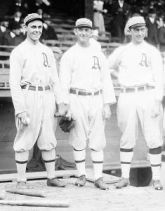
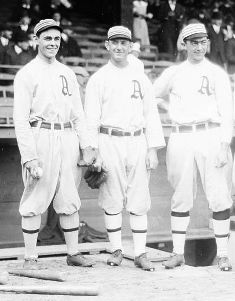
Stuffy McInnis, Eddie Murphy and "Home Run" Baker,

Stuffy McInnis, Eddie Murphy and “Home Run” Baker,

Early in the 1915 season Braves manager George Stallings called Schmidt “The best first baseman in the game,” but his performance at the plate slipped.  Schmidt hit just .251 with 60 RBIs.  The Braves again found themselves in 8th place in July, and while they made another strong run, finished 2nd, seven games behind the Philadelphia Phillies.

Despite the mediocre season at the plate, it was assumed the 28-year-old Schmidt would remain the Braves first baseman.  Schmidt shocked Stallings, Boston fans, and all of baseball when he announced in January of 1916 that he was retiring from baseball.
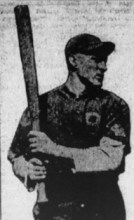
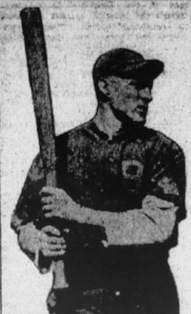
Butch Schmidt at bat

Butch Schmidt at bat

The Associated Press said Schmidt was leaving “to devote his entire time to his private business.”

Grantland Rice said Schmidt’s business included “six meat markets in Baltimore,” and that he earned $8000 a year from his stores.

The Sporting Life said it was just as likely that Schmidt, listed at 200 pounds, retired because:

Hard work in that old rubber shirt to get down to weight, especially when the extra weight comes off slowly, more slowly each succeeding season, is a trial that anyone would like to sidestep if he could. “

Boston manager George Stallings filled the void left by Schmidt by purchasing Ed Konetchy from the Pittsburgh Rebels from the newly defunct Federal League.

The Boston Post said the change at first base would not hurt the Braves:

“Konetchy, a heavier hitter than Schmidt, is just about as capable in other ways.”

Despite the confidence of The Post, Stallings was not convinced and continued to try to induce Schmidt to return; his efforts were unsuccessful.

After Konetchy hit .260 for the third place Braves in 1916 it was reported that Schmidt would return to the team.  After several weeks of speculation, Schmidt told The Boston Globe “no offer” could induce him to return to Boston.

Konetchy hit .272 and .236 the next two seasons, and each off season it was rumored Schmidt would return, and every year he stayed home where he continued to run his business and play semi-pro ball in Baltimore’s Inter-City League.

Before the 1919 season Konetchy was traded to the Brooklyn Robins and the Braves acquired Walter Holke from the Cincinnati Reds.  Holke hit .292 for the Braves in 1919, but rumors continued that Schmidt, out of organized baseball for four years, would be returning to Boston.  The Associated Press said:

“George Stallings of the Boston Braves is trying to get Charlie “Butch” Schmidt, the Baltimore butcher boy who played first base for the world’s champions of 1914, to return to the Boston Braves.  Schmidt is reported to be in wonderful condition as he has kept in practice since his retirement.”

Schmidt never returned to professional ball, and was finally removed from Boston’s reserve list in 1922.

Butch Schmidt walked away from professional baseball and never looked back; he died in 1952 of a heart attack while inspecting cattle at the Baltimore Union Stock Yards.

“There was probably none so Unique as Shreve”

24 Jul

Leven Lawrence “Lev” Shreve II came from a prominent family in Louisville, Kentucky.  His great-uncle, and namesake, had been president of the Louisville Gas and Water Company, and the Louisville & Nashville Railroad.

The 19-year-old made his professional debut in 1886, playing with Savannah, then Chattanooga; he was a combined 12-9 with 1.52 ERA.  Shreve was signed by Billy Barnie to join his young pitching staff with the Baltimore Orioles in the American Association.  He came to Baltimore with great expectations.

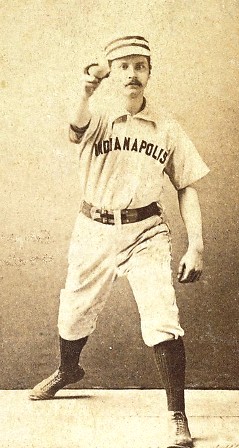
Lev Shreve

Lev Shreve

The Baltimore Daily News called him “Barnie’s phenom.”  In wasn’t the first time a relatively unknown pitcher was given that name by the Baltimore press.

Shreve had trouble getting as Barnie primarily relied on 21-year-old Matt Kilroy and 22-year-old Phenomenal Smith; Shreve, and fellow 20-year-old Ed Knouff saw limited action in the first two months of the season.

The Sporting Life said he wasn’t happy:

 “Shreve, the Louisville boy…complains that he does not get a fair deal.  He affirms that his arm is in fine trim, but that he is not allowed to pitch. Shreve is an ambitious ball player, and desires to show what is in him.  He says he will quit if Barnie does not play him.”

The Baltimore Sun said

“People are asking why Shreve isn’t given a chance.”

The Sporting Life, perhaps, provided an explanation for the lack of work later that month:

“Cigarette smoking is said to be impairing the efficiency of two Baltimore pitchers, Shreve and Knouff”

It would not be the last mention of cigarettes and Shreve in The Sporting Life;  the pitcher was also said to be “a cigarette fiend,” and “as noted for his cigarette habit” as his pitching.

Neither Shreve, who was sold to the Indianapolis Hoosiers in the National League, nor Knouff, who was sold to the St. Louis Browns, would finish the season with Baltimore; it’s unknown whether smoking was the cause.

Shreve was 3-1 with a 3.79 ERA in five games in Baltimore.

The sale to Indianapolis didn’t seem to hurt Shreve’s confidence according to George Myers, his catcher with the Hoosiers.  Meyers, two decades after playing with Shreve, said the pitcher was talented, cocky and erratic, and described Shreve’s first National League game; a 4-1 10-inning victory over the first place Detroit Wolverines on August 19:

“There was probably none so unique as Shreve…My, but he was a fresh youth…He had awful speed and good curves and perfect control of the ball.  His confidence and egotism were astounding.  I remember one day we were to play against Detroit (Wolverines).  It was when the big four, (Jack) Rowe, (Deacon) White, (Hardy) Richardson and (Dan) Brouthers were on the team.

“Mr. Shreve, who had been assigned to pitch, strutted to the box with the swagger that would have made John L. Sullivan look cheap when John L. was monarch of all in the fistic business.  ‘Just watch me fellows, and see what I do to those swell-headed guys from Michigan,’ said the smiling Shreve.  ‘I am going to make ‘em look like a lot of suckers.’

“Richardson was the first batter up…’So you are the great invincible Hardy Richardson, eh?’ drawled Mr. Shreve.  ‘Well Hardy, old chap, I’m going to show you that you are easy for a good pitcher…Shreve let go the first ball and it went around Hardy’s neck like a shot.  He struck at it after I had it in my hands.  Bang goes the second, also a strike, and the third a wide, slow, outshoot, fooled the great batter completely and Shreve said mockingly: ‘Back to the bench Hardy, I told you that you were easy.

“Big Dan Brouthers, who was always a terror to pitchers, came next and he had blood in his eye…’so this is the terrible Mr. Dan Brouthers,’ grinned the fresh pitcher.  ‘Hate to tell you Dan, how soft a mark you are’…Dan missed the first two, which went close to his chin, and the next he hit like a shot at the pitcher.  Shreve caught it in easy style and gave Brouthers the ‘ha ha’ in most tantalizing fashion as Dan ambled to the bench.

“Deacon White came next and Shreve kidded him unmercifully.  ‘Deacon who told you that you could hit anything?’ was the greeting white was given.  The Deacon scowled and muttered ominous.  ’Duck soup is what you are for me.’ Sand Shreve, as White missed the first ball by several inches.  ‘Oh, how easy,’ was the next rejoinder, and Deacon smashed blindly at an outshoot, a moment later striking out on one of those speedy ones such as had sent Richardson to the bench.

“The Big Four could do absolutely nothing with Shreve’s delivery, and the other members of their team were just as helpless…This fellow Shreve was one of the best pitchers I ever met, but he was an erratic chap, and dreadfully hard to handle.”

George Myers

George Myers

After beating the eventual National League champions in his first start, Shreve ended up a disappointing 5-9 with a 4.72 ERA for Indianapolis.

Myers said on another occasion Shreve approached him before pitching against the Chicago White Stockings, who had won the National League championship in 1886:

“’Say, George, what team is this we are up against today?’

“I immediately began to read him a lecture, telling him that a young man just starting in on his career as a professional ballplayer shouldn’t deport himself in such a manner. ‘The idea of you coming on to the grounds when the champion Chicagos are here, and not knowing it, why—‘  ‘The champion Chicagos,’ interrupted Shreve, ‘Never mind, George, just watch me.  Oh just wait and see what I will do to that bunch.”

Myer s said Shreve shutout the White Stockings.  (This story appears to be either apocryphal or conflated with another incident as Shreve did not shutout Chicago that season).

Shreve was 11-24 in 1888 and 0-3 in 1889 when he was released by the Hoosiers.  He played three minor league seasons and was out of professional baseball by the age of 24.

Myers said his former teammate was “erratic as Rube Waddell,” and:

“I could tell story after story about this man Shreve.  If he had taken care of himself he would have been the greatest pitcher in baseball history.”

“Is the Best the Game has Known”

23 Jul

Joining the Boston Braves for the 1914 season provided second baseman Johnny Evers with the opportunity to appear in one more World Series, and gave him the chance to take a very public swipe at one of his most famous former teammates, shortstop Joe Tinker.

In December of 1912 the Chicago Cubs traded Tinker to the Cincinnati Reds, and depending on which version of the story was to believed, Tinker and Evers had not spoken a word to one another for either five or six years.

Johnny Evers

Johnny Evers

Tinker said the two stopped talking in 1908 after Evers jumped in a horse-drawn cab leaving Tinker and other teammates behind before an exhibition game in Indiana leading to an on-field fight between the two later that day; Evers said a year earlier Tinker initiated the bad blood between the two by throwing a ball so hard to the second baseman on a force play that it injured his finger.

Evers said years later:

“I yelled to him, you so-and-so. He laughed. That’s the last word we had for-well, I just don’t know how long.”

The 1914 Braves got off to a horrible 4-18 start, and were still in eighth place on July 18, but surged to second place by August 10, winning 18 of 21 games.  By September 2 the Braves had first place to themselves, and ended up running away with the pennant, beating the second place New York Giants by 10 ½ games, and sweeping Connie Mack’s Philadelphia Athletics in the World Series.

Evers, named Boston’s captain by manager George Stallings, led National League second basemen in fielding; hit .279 for the season, and .438 in the World Series.  Evers received baseball’s last “Chalmers Award,” a forerunner of the Most Valuable Player Award, which was presented from 1911-1914.  The award was sponsored by the Chalmers Motor Car Company and was presented to Evers along with a new car.

The runner-up for the Chalmers Award was Evers’ teammate, shortstop Walter James Vincent “Rabbit” Maranville.  Maranville, Evers and first baseman Charles “Butch” Schmidt were an excellent double-play combination throughout the season; Evers participated in a career-high 73 twin killings, more than he’s ever turned in a season with Tinker and Frank Chance.

Years later Maranville said of Evers:

“It was just Death Valley, whoever hit a ball down our way.  Evers with his brains taught me more baseball than I ever dreamed about.  He was psychic.  He could sense where a player was going to hit if the pitcher threw the ball where he was supposed to.”

Two days after the Braves won the World Series; Evers took the opportunity to take a swipe at his former teammate Tinker.  Evers told William Peet, sportswriter for The Boston Post that:

“(Maranville’s) the best shortstop the game has ever known.

“Better than Joe Tinker; your old side partner?

“Yes, he’s better than Tinker.”

Joe Tinker

Joe Tinker

Peet sad:

“Evers has been given credit for making Maranville the great player he has shown himself to be this season, but Johnny declares this s untrue, stating that Maranville learned the game and all its fine points unaided.”

Peet said Evers’ claim that Maranville “is a greater shortstop than Tinker is about the highest praise anyone can shower on the peppery little chap who was such a prominent factor n the Braves’ victory.”

Rabbit Maranville

Rabbit Maranville

Evers and Peet failed to mention where Honus Wagner would be ranked if Maranville was, in fact, “the best shortstop the game has ever known.”

No response from Tinker was recorded.

Evers and Tinker would not speak again for another decade.  In 1924, the two finally spoke when they were summoned to California by Chance, their former teammate and manager, who was dying.

Tinker, Evers and Chance

Tinker, Evers and Chance

Tinker, Evers and Chance were inducted into the Hall of Fame together in 1946 by the veterans committee; Maranville was elected by the Baseball Writers Association of America in 1954.

“Gallant Larry Lajoie and his Bludgeon Knouted and Lashed the Mackmen”

22 Jul

In the summer of 1913 the editors at The Chicago Record-Herald said they were tired of the “vernacular slang” that accompanied most baseball stories, and proposed that their readers vote about whether they would prefer “the use of correct English” in baseball stories.

As the example of the overuse of slang, clichés and “baseballese” The Record-Herald presented this “horrible example” from Gordon J. MacKay of The Cleveland Leader:

“Gallant Larry Lajoie and his bludgeon knouted and lashed the Mackmen into submission this afternoon at Shibe Park, and in the swirl of the attack by the Gallic Goliath the myrmidons of the lean leader were tumbled in a gulch of whitewash.”

Napoleon Lajoie

Napoleon Lajoie

While the paper’s readers were sending in their votes the newspaper was polling baseball men and college professors, who according to The Philadelphia Inquirer were “going at one another hammer and tongs,” over the issue.

Chicago White Sox owner Charles Comiskey was on the side of “plain English,” telling the paper:

“What readers want to know is who won the game and how it was won.  When the facts are covered up with a lot of useless words the reader is apt to grow tired.”

Charles Comiskey, against slang in baseball stories.

Charles Comiskey, against slang in baseball stories.

Most of the players, managers and executives polled by the paper were in agreement with Comiskey.

The professors were nearly unanimously on the side of slang.  Nathaniel Butler of the University of Chicago said:

“I think it would be pretty tame to report baseball in plain, ordinary English.  There is a species of humor on the sporting page which is enjoyable. “

After a month of opinions from baseball and academia, and newspapers across the country, the result of The Record-Herald’s balloting were made public.  The New York Times said:

“Slang as a means of the proper description of baseball games in the newspapers came out a little behind straightforward English, according to the verdict of several thousand readers in a test vote taken in a Chicago newspaper.”

By a close margin of 2004 to 1926, readers voted for “the English proscribed by the dictionaries,” but The Times said the results were:

 “(Q)ualified by several thousand voters who expressed themselves in favor of the use of a moderate amount of snappy, descriptive phrases, not limited necessarily to dictionary words, however.  Many voted in favor of slang, but advocated the elimination of nicknames.”

Vaudeville comedian and songwriter Junie McCree, writing for “Baseball Magazine” presented his version of how all baseball stories should be presented as a result of the vote:

The first athlete of the opposing aggregation was unable to locate the exact proximity of the ball and smote thrice in vain.

The next member was more fortunate in his endeavor and expelled the ball with such force that its destination was problematical to the guardian of latitude left, so the runner with some exertion and much rapidity voyaged to the third station without being molested.

At this point an urchin in one of the open stands requested vehemently that the home pitcher should be escorted to the suburbs of the enclosure and someone of animation be installed in his stead. His request was unheeded, much to his chagrin.

The third station being occupied by an invader caused the infielders to become more intimate with the domestic china to prevent foreign registration.

At this moment an attempt was made to execute the famous “Caress Play,” and in the unbiased opinion of the populace was frustrated by the marvelous dexterity of the “receiving teller” of the home team, but the magistrate of strikes and balls decided to the contrary, thus bringing on himself much verbal abuse. Among the ensuing verbiage one individual intimated in stentorian tones that the umpire was a facsimile of the principal ingredient in lemonade.

The contest from here on was uneventful until the seventh inning, at which time it becomes the duty of the resident assemblage to arise en masse and exercise the elasticity of limb and body.

While the home aggregation were at bat the visiting hurler became excited and ascended into nature’s oxygen.  A florid-faced individual in the grandstand arose and shouted all sorts of adjectives until someone volunteered the recommendation that he “lease or engage an auditorium.”

The various stations were congested before a single demise had occurred. A huge gentleman of pure American birth, reservation, extraction and much muscular appurtenances approached the plate and poised himself in a very hostile attitude; he attacked the sphere with a savagery known only to the ancient Romans, and with one blow the leathered globule wandered forth into undiscovered regions of remotest territory, thereby cleansing the stations of its human debris, and totaling a quartet of tallies to the frantic delight of those present.

This gave the Hosts an advantage which their guests were unable to overcome, and the contest was decided in favor of the natives. Score, 4 to 1.

P. S.—The same gentlemen participate in another exhibition on the morrow.

Lost Advertisements–“Baseball Players won $10,550 for ‘Hitting the Bull’ Last Season”

19 Jul

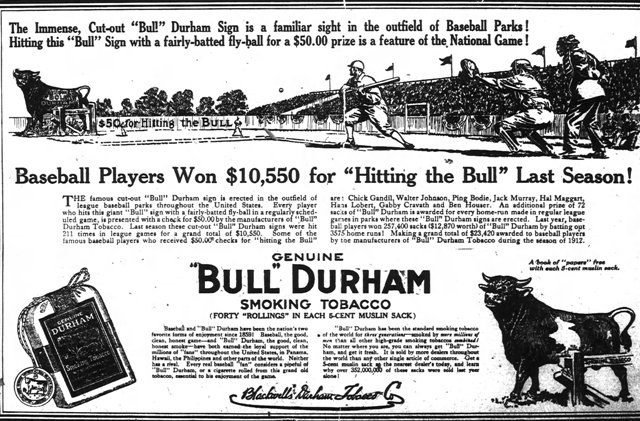
bd1913


A 1913 advertisement for Bull Durham Smoking Tobacco.

“The Immense Cut-out ‘Bull’ Durham Sign is a familiar sight in the outfield of Baseball Parks!

“Hitting this ‘Bull’ Sign with a fairly-batted fly-ball for a $50.00 prize is a feature of the National Game!”

In 1912 the Bull Durham signs were hit 211 times, among the players who collected $50 that season were: Chick Gandil, Walter Johnson, Ping Bodie, Red Murray, Harl Maggert, Hans Lobert, Gavvy Cravath and Ben Houser.

Bull Durham also gave “72 sacks of ‘Bull’ Durham,” for every home run hit in a ballpark with one of their signs.

“Last year, baseball players won 257,400 sacks ($12,870 worth) of ‘Bull’ Durham by batting out 3575 home runs!”

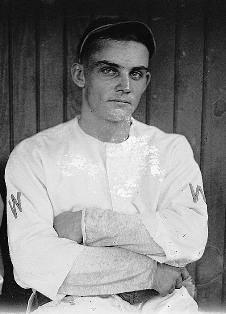
Chick Gandil hit the Bull Durham sign in 1912

Chick Gandil hit the Bull Durham sign in 1912

“He was Not Crazy as Reported”

18 Jul

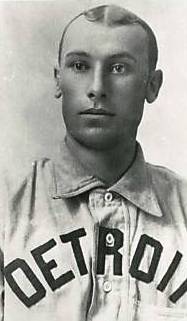
Ervin Thomas “Erve” “Dutch” Beck hit the first home run in the American League; on April 25, 1901, the second day of the season, as a member of the Cleveland Blues; Beck homered off White Sox pitcher John Skopec at Chicago’s South Side Park.

It was a highlight in a short, promising career, like many at the turn of the 20th Century, destroyed by alcoholism.

Beck was considered the best young player in Toledo, Ohio when he joined the Adrian Reformers in the Michigan State League as a 16-year-old in 1895, then for the next five seasons, he was the star of his hometown Toledo Mud Hens in the Interstate League.  For the two seasons in Toledo for which complete records survive, Beck hit .298 in 1898 with 11 home runs and, a league-leading .360 with 15 home runs in 1900.

Erve Beck

Erve Beck

Earning the Nickname “Home run Dutch” in the Toledo papers, Beck was credited with 67  during his five seasons with the Mud Hens;  he would remain the team’s all-time career home run leader until 2007 when Mike Hessman (currently with the Louisville Bats in the International League) hit his 68th as a Mud Hen.

Beck also had a brief trial with the Brooklyn Superbas in the National League in 1899, hitting .167 in eight September games.

It’s unclear exactly when Beck’s problems with alcohol began, but according to fellow Ohioan Ed Ashenbach (alternately spelled Ashenback by several contemporary sources), a minor league contemporary who wrote a book in 1911 called “Humor among the Minors”,  it was well-known during Beck’s career that he was “addicted to strong drink,” and as a result suffered from “hallucinations.”

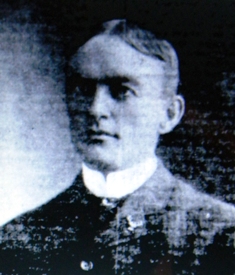
Ed Ashenbach

Ed Ashenbach (Ashenback)

Before the 1901 season, Beck, whose rights were held by the Cincinnati Reds, jumped to the Cleveland Blues in the newly formed American League; the twenty-two-year-old hit .289 and accounted for six of Cleveland’s twelve home runs.

Beck jumped back to the Reds before the 1902 season and received rave reviews early in the season.  The Cincinnati Tribune seemed to like him more at second base than veteran Heine Peitz:

“Erve Beck looks more like a second baseman than anyone who has filled the position since (Bid) McPhee went into retirement (in 1899).  He covers the ground, seems to know where to play and is capable of swinging the bat with some effect.”

His teammate, pitcher Frank “Noodles” Hahn claimed Beck hit the ball “harder than (Napoleon) Lajoie.”

Beck hit better than .300 playing second base in May but went to the bench when Peitz, who was filling in behind the plate for an injured Bill Bergen returned to second.

In June first baseman Jake Beckley missed a week with an injury and Beck filled in there; The Cincinnati Enquirer’s Ren Mulford said:

“(Beck) played the bag in splendid style…In handling ground balls Beck is as good as Beckley, and he is a better thrower… Beck gave another display of his versatility by plugging up a hole in right field.  He made one catch that was a lollapalooza…Most players would have lost heart when benched as Beck was, but he remained as chipper as a skunk during his term of inactivity, and gladly accepted the opportunity to get back into the swim. Beck is a phlegmatic soul, who takes life, as he finds it without a growl.”

In spite of a .305 batting average in 48 games and the great press he received, Beck was released by the Reds in July.  Whether the release was simply because he was the odd man out with Peitz, Beckley and right fielder Sam Crawford healthy or as a result of drinking is unknown.

Beck was signed almost immediately by the Detroit Tigers where he took over at first base after Frank “Pop” Dillon was sent to the Baltimore Orioles.  He hit .296 in 41 games but was again released at the end of the season.

Beck would never return to the big leagues.

In 1903 he .331 for the Shreveport Giants in the Southern Association, he jumped Shreveport the following season and played for the Portland Browns in the Pacific Coast League.   He returned to the Southern Association with the New Orleans Pelicans in 1905.  After starting the 1906 season in New Orleans, he was released in July and signed by the Nashville Volunteers; his combined average with both Southern Association teams was .211.

Beck’s drinking was, according to Ashenback and contemporary newspaper accounts, common knowledge by the time he wore out his welcome in Nashville in August and was sold to the Augusta Tourists in the South Atlantic League.

That stop would last for only one game.

The 27-year-old, four years removed from the American League, played first base for the Tourists on August 6.  Augusta second baseman Ed McKernan said, “It was evident when he reported there was something amiss with him,” and claimed Beck chased “an imaginary flock of geese away from first base” during the game.

The following day, according to The Augusta Chronicle, Beck “created a sensation in the clubhouse…causing all but two of the players to leave the house.”  As a result, Augusta released him.

The following day The Chronicle said:

“(Beck) ran amuck this morning and created great excitement on the street.

“While in a room on the third floor of the Chelsea hotel the big infielder suddenly began to see things and sprang from the third story window to the ground below.  Only two intervening telephone wires and a rose bush saved his life.

“He then darted down an alley and hid himself in a store.  He was finally captured and came quietly back to his room with a policeman and (Tourists outfielder Frank) Norcum.”

The Sporting Life assured their readers that Beck “was not crazy, as reported, but only suffering from the effects of a (drunken) spree.”

McKernan said “During his convalescence…Beck would smilingly avow his determination to abstain from strong drink.”

There were varying reports regarding the extent of his injuries, and it’s unknown whether he was physically able to play after the fall, but Beck would never play professionally again.

He returned to Toledo where he operated a tavern and appears to have been unable “to abstain from strong drink;” he died in 1916 of Articular Rheumatism complicated by Hepatic Cirrhosis.