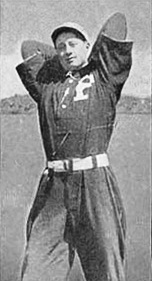
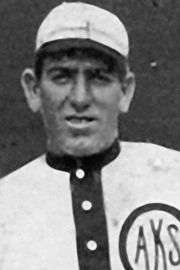
Roy Spruell

14 Aug

Throughout the first half of the 20th Century there were thousands of independent and industrial league baseball teams that operated across the country; the only distinction, in many cases, between the quality of these teams and their players and those in “professional” leagues was the “professional” teams were recognized by The National Association of Professional Baseball Leagues.

Given the economics of the game, which usually required players to be employed during the off season, it was often as profitable, or even more so, to play with an independent or semi-professional team that either paid the same or more as the “professional” leagues or provided the player with a job.

As a result, there are thousands of players, who while well-known names in the towns, cities and regions where they played, have been largely forgotten.

Roy Layton Spruell is one of them.

From 1920 until 1939 Spruell was a fixture in Southern baseball, specifically on the Gulf Coast, although his “official” statistics only indicate limited “professional” appearances between 1924 and 1936.

Spruell appears to have been born January 25, 1900 in Birmingham, Alabama according to state records and census data, (his grave lists his birth year as 1902, but like many players of his era, he likely subtracted a couple of years at some point during his career and the new date stuck).

Raised in Mobile, Alabama, he first made a name for himself in 1920 pitching with industrial teams at the Southern Kraft Paper Mill and White Swann Laundry Company in Mobile.

Two years later he was a member of an independent team in Mississippi, the Ocean Springs Regulars.  In addition to Ocean Springs, the loosely affiliated semi-pro league included independent teams from nearby Mississippi towns Biloxi, Gulfport, Pascagoula  and Wiggins, and industrial teams out of New Orleans, including the Choro Colas (later renamed RC Cola), the Tokay Teas.

The following season Spruell played for another Southern Kraft Mills team; contemporary newspaper accounts alternately called the team either the Moss Point or the Kreole Papermakers—the mill was located in Moss Point, Mississippi, but the team appears to have played home games in nearby Kreole.  Spruell’s older brother Harvey was his teammate with the Papermakers.
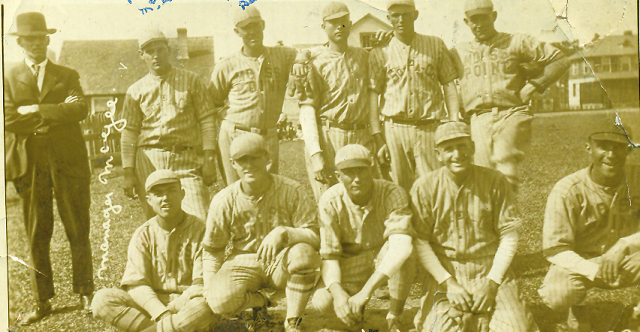
The 1923 Papermakers, Roy Spruell is standing second from right.  His brother Harvey is in the middle of the front row.   The other players are identified as: Standing at left - Manager McGee 2nd from left  - Pat McGee 3rd from left  - Matt Delmas 4th from left-unidentified. 6th from left - Sam Leslie   Seated at left - Johnnie Cunningham 2nd from left - Brother Nelson 4th from left - John Bell

The 1923 Papermakers, Roy Spruell is standing second from right. His brother Harvey is in the middle of the front row. The other players:: Standing Manager McGee, Pat McGee, Matt Delmas, unidentified, Roy Spruell, and Sam Leslie
Seated Johnnie Cunningham, Brother Nelson, Harvey Spruell, and John Bell.


In 1924 he signed his first professional contract, posting an 11-12 record for the fifth place Laurel Lumberjacks, in the six-team Cotton States League.  The following season, pitching for the last place (51-70) Alexandria Reds, Spruell was 14-10.
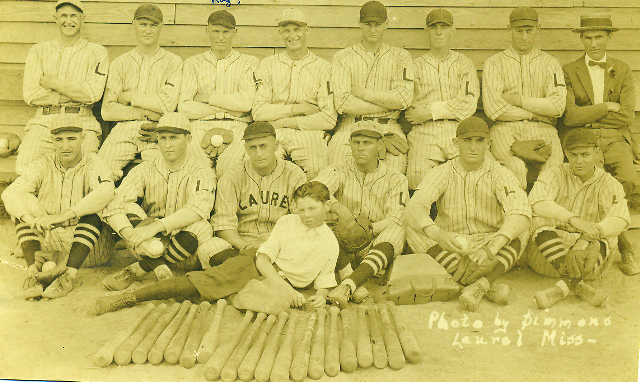
1924 Laurel Lumberjacks.  Roy Spruell is in the top row, third from left.  The player seated on the far left in the front row appears to be future big league pitcher Ray Moss who pitched for the Brooklyn Robins and Boston Braves.

1924 Laurel Lumberjacks. Roy Spruell is in the top row, third from left. The player seated on the far left in the front row appears to be Ray Moss, the only member of the Laurel club to play in the big leagues,; he pitched for the Brooklyn Robins and Boston Braves.

Spruell had his best professional season in 1926 as a member of the Hattiesburg Pinetoppers.  He led the team to the Cotton States championship with a 22-8 record, and got his name in newspapers across the country in August.  The Associated Press said:

“Friday the 13th was far from unlucky for Roy Spruell, pitching star of the Hattiesburg club of the Cotton States League, Spruell hurled the first no hit, no run game of his career.”

Spruell allowed just two walks (shortstop/manager Herschel Bobo also made an error) to the Monroe Drillers, but still only faced the minimum 27 batters.
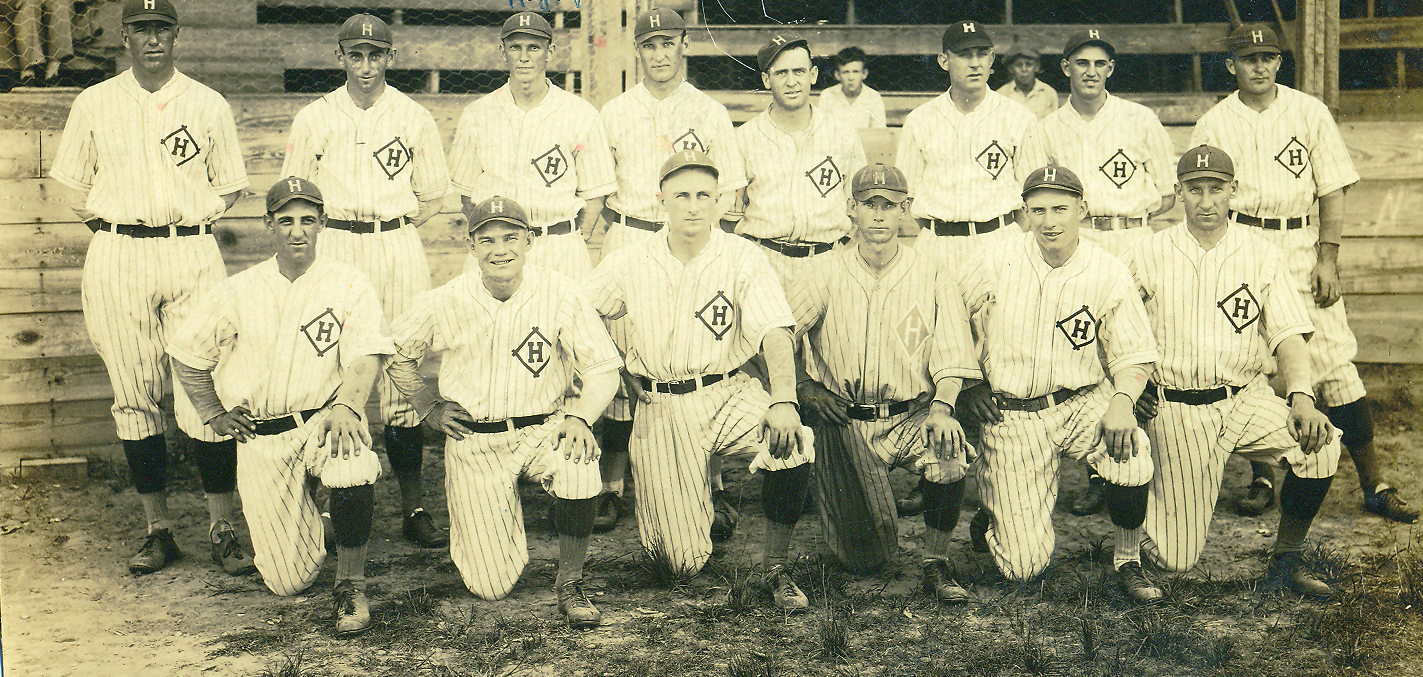
The 1926 Cotton States League champion Hattiesburg Pinetoppers.  Roy Spruell is standing third from left.  Manager/shortstop Herschel Bobo is kneeling far left.

The 1926 Cotton States League champion Hattiesburg Pinetoppers. Roy Spruell is standing third from left. Manager/shortstop Herschel Bobo is kneeling far left.

At the end of the 1926 season Spruell was purchased by the Houston Buffaloes of the Texas League, but never played in Texas.  He started the season with the Memphis Chickasaws in the Southern Association and was released to the Knoxville Smokies in the South Atlantic League in May of 1927.  He was 10-10 in Knoxville and also appeared in 20 games in outfield.  The Spartanburg Herald called Spruell “the elongated righthander,” (he was listed variously from 6’ to 6’ 2”).

Spruell returned to the Smokies for the 1928 season, but a hand injury led to a slow start and with a 1-3 record at the end of May he was released and returned to the Cotton States League. He pitched professionally through the 1930 season, but struggled with injuries his last three seasons and pitched for several teams:  Laurel and Hattiesburg again (he also pitched for the Baton Rouge Essos when the Hattiesburg franchise relocated there during the 1929 season) as well as the Jackson Senators in the Cotton States League, and the Jacksonville Tars in the Southeastern League.

Spruell spent the next decade playing with and managing independent and industrial league teams in the South.  He played from 1931 to 1935 in the Mississippi Coast League, a strong semi-pro league with teams sponsored by union and industrial interests.

He left the Gulf Coast the following year, relocating in Savannah, Georgia where he played for and managed the Union Baggers—the company team of the Union Bag and Paper Company, operator of the world’s largest paper mill.  The team was considered one of Georgia’s best semi-pro and industrial teams, playing in the Coastal League, which included teams in Georgia, Florida and South Carolina.

The Union Baggers, circa 1937.  Roy Spruell, standing second from right.

The Union Baggers, circa 1937. Roy Spruell, standing second from right.

Spruell’s baseball career appears to have ended around 1940.

He eventually relocated to Pensacola, Florida and worked for the Florida Pulp and Paper Company; he suffered a heart attack at work and died in 1950
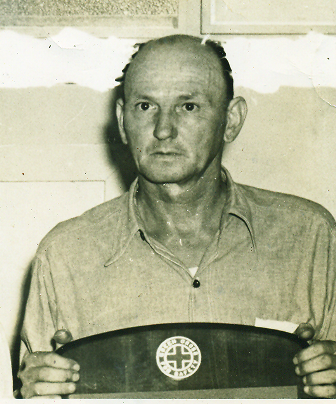
Roy Spruell shortly before his death in 1950.

Roy Spruell shortly before his death in 1950.

Like thousands of others who played baseball in small and large towns, and small and large leagues, throughout the country, Roy Spruell’s career brings to mind a passage from W. P. Kinsella’s great novel “Shoeless Joe:”

“For some reason, I recall the question at the bottom of the form sent by the Baseball Hall of Fame to everyone who has ever played professional baseball: ‘If you had it to do over again, would you play professional baseball?’  The historian at Cooperstown, Clifford S. Kachline, said he couldn’t recall even one ex-player answering ‘no’ to the question.  I wonder if any other profession can say the same?”

Thank you to Roy Spruell’s grandchildren, Paula Grady and Bob Gattis for sharing the photographs used in this post as well as a copy of Mr. Spruell’s obituary. 
“Figures of your kind are Pathetic”

13 Aug

John McGraw made news for an “innovation” in 1909.  The Associated Press said:

“McGraw has adopted an innovation in baseball which will appeal to fandom throughout the National league circuit and probably prevent (Fred) Merkle and others from running to the clubhouse before they ‘touch second.’ The innovation is the signing of the once famous player Arlie Latham as coach for the base runners.”

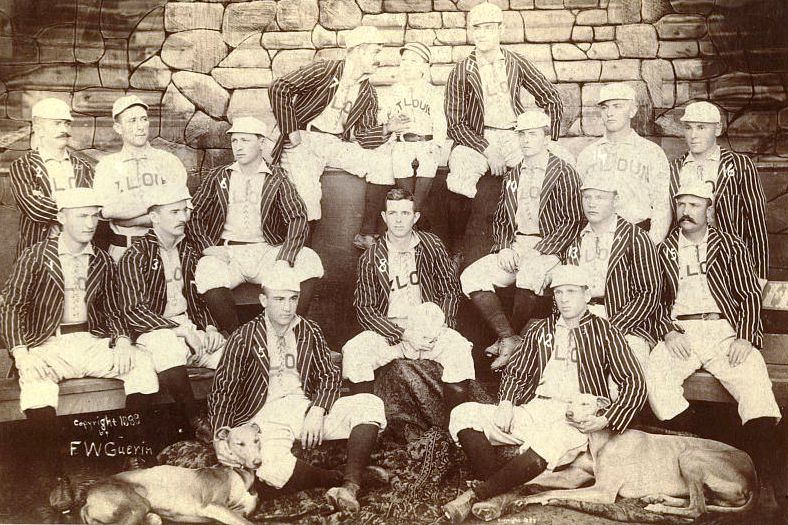
Arlie Latham, top center, facing team mascot, with 1888 American Association champion St. Louis Browns

Arlie Latham, top center, facing team mascot, with 1888 American Association champion St. Louis Browns

Walter Arlington “Arlie” Latham, was “particularly known for his humor” in the 1880s and 90s.  Primarily a third baseman with the St. Louis Browns in the American Association, the Chicago Pirates in the Players League and the Cincinnati Reds in the National League, Latham was nicknamed “The Freshest Man on Earth.”

The Associated Press said Latham:

“(B)rought much enjoyment to spectators of the Cincinnati club’s games and the Reds kept Latham a long while after he deteriorated as a player because of his drawing power as a comedian and humorist.

“Latham will don the uniform of the Giants and take his place in the coacher’s box while the Giants are at bat and between coaching the baserunner and batsmen and ‘getting the goat’ of the opposing pitchers will furnish an interesting sidelight to the New York games.”

Things did not go smoothly when Latham joined the team.  During spring training in Marlin, Texas Latham and McGraw were returning to their rooms at the Arlington Hotel when Giants outfielder James “Cy” Seymour, according to The St. Louis Post Dispatch, “knocked him down, and then bit him on the cheek.”  The article said McGraw and Latham did not know the “reason (Latham) was attacked,” but McGraw announced that Seymour was given his unconditional release.  McGraw said:

“Seymour is done with the New York club, and that goes.  It was the worst thing I ever saw pulled off.  Nothing like that can go on the New York club.”

Despite what he said McGraw did not release Seymour; the outfielder was suspended for the first week of the regular season, and The Dallas Morning News said McGraw made Seymour pay “his own expenses in Texas after the unpleasant episode.”

Arlie Latham, New York Giants coach

Arlie Latham, New York Giants coach

Latham was often criticized for his antics and even more often for the quality of his work as a coach, which became such a running joke that The New York Times said after the Giants had beaten the Cardinals in a September 1910 game:

“Arlie Latham’s team won it with their eyes shut, 11 to 3.  Latham’s coaching was invaluable yesterday.  He advised the players to touch every base and this tip won the game for them.”

The Sporting Life said:

“(Latham) undoubtedly lost a lot of games by bad coaching.  He got so unreliable that in a tight pinch McGraw would shift him from third to first and take the third line himself.”

The Sporting Life also said that Latham served as McGraw’s spy;  a position that would later be filled by another colorful McGraw coach, Dick Kinsella.

Giants outfielder Fred Snodgrass told Lawrence Ritter in “The Glory of their Times,” that Latham “was probably the worst third base coach who ever lived.”

It looked like the end of the line for baseball’s first full-time coach after the 1910 season.  The New York Herald said Latham “will not wear a Giant uniform next season,” and:

“He may amuse old timers, who remember him as a great ball player with (Charlie) Comiskey’s St. Louis Browns, but the new generation of fans seems to regard his efforts with disfavor.”

Despite the criticisms and predictions of his impending firing, Latham was back with Giants in 1911.  After the Giants pennant winning season Latham again joined the Giants for spring training in Texas in 1912, but in March, according to The Associated Press:

“(Latham) was carried as one of the twenty-five men permitted on the payroll.  McGraw did not want to let Latham go, but needed the place on the payroll for a real player.”

While McGraw didn’t want to lose his coach, most of baseball thought the end of Latham’s coaching career was a good thing; but even the New York press was not as harsh in their assessment of Latham as was Ed Remley, the baseball writer for The Fort Worth Star-Telegram:

“Arlie Latham has passed.

“May he rest in peace, for he is truly dead…Arlie has been called the fool of baseball and with much justice.  He was not the fool in any modern sense but more like the professional jesters who were kept in the courts of kings in the middle ages.

“Today, reading descriptions of the position of the court jesters, their crude horseplay jokes, we are not filled with laughter but with pity…The crude vassals of a former generation thought the brutal jokes of the court fool were funny; the bleacherites of today laugh at Arlie Latham pretending an engrossing interest in a game which he cannot even play himself…Vale, Latham—You have our sympathy, but we are not really sorry you are gone.  Figures of your kind are pathetic and pathos has nothing to do with baseball.”

Latham was next heard from when he accepted a coaching position with Patrick “Patsy” Flaherty’s Lynn Fighters in the New England League; that job only lasted until June.  Latham managed to run afoul of the entire Lynn team.  The Associated Press said he was forced to resign because “Players thought he was after manager Flaherty’s job and threatened to go on strike unless he was dismissed.”

Latham finished the 1914 season as an umpire in the Massachusetts and Rhode Island based Colonial League.  He did not return the following season, and in May of 1915 The Pittsburgh Press reported under the headline “Arlie Latham Has Quit The Diamond for All Time Now,” that he had found a new line of work; operating a deli in the Washington Heights neighborhood in Manhattan:

“He declares that as a delicatessener he is batting only .106 at present, but that when he gets properly warmed up and learns how to shave 15 ½ ounces of ham for a pound he will hit with the best of them in the delicatessen league.”

By 1917 Latham was in Europe, for the last act of his baseball career.  From 1917 to 1923 he lived in London and organized baseball leagues for military personnel.  The highlight of his stay was the July 4, 1918 game between the Army and Navy teams.  Latham served as umpire and greeted the most important dignitary at the game, King George V.  The Associated Press said:

“It had been planned to have the king throw out the first ball, but this was abandoned because of the netting in front of the royal box, so the king brought the ball out on the field and handed it to the umpire.  One of the balls used was autographed by the king with an American fountain pen and mailed tonight to President Wilson as a souvenir. “

Arlie Latham, front row center, with army team in London, 1918

Arlie Latham, front row center, with army team in London, 1918

After returning to the States, Latham first returned to the deli, then later was hired to work in the press box at the Polo Grounds, he remained a fixture at the New York ballpark until his death at age 92 in 1952.

As a result of outliving his critics and becoming one of the last surviving links to the 19th Century game by the time of his death, memories had faded about the “pathetic” figure of Latham, and only the image as  “baseball’s clown prince” remained.

Defending their own Honor

12 Aug

In 1909 the Atlanta Crackers won their second Southern Association championships in three seasons.  Big things were expected for 1910; the team’s two 20-game-winning pitchers Tom Fisher and Harold Johns were returning.

The team the Southern press called “the hitless wonders,” which hit .222 while winning the championship added two new bats, outfielder Arista DeHaven, .336 with the Terre Haute Hottentots in the Central League and Charlie Seitz, .326 with the Norfolk Tars in the Virginia League.

But it took very little for near panic to take hold in Atlanta.

Only eight games into the season the Crackers were 3-5, tied for sixth place.  The Birmingham Age-Herald was ready to pronounce the defending champions finished, and said “there was dissention and dissatisfaction in the ranks.”   The article said that manager Adolph Otto “Dutch” Jordan had already lost control of his team.

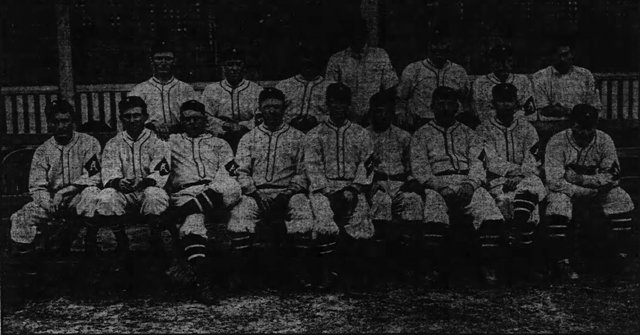
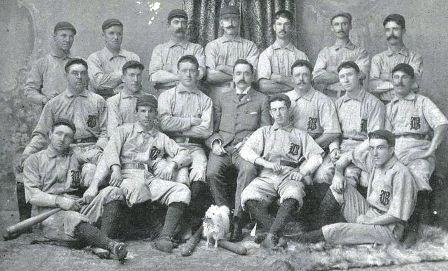
The 1910 Atlanta Crackers:  Standing, from Left to right: Arista DeHaven, Charlie Seitz, Paul Sentell, Brown Rogers, Hyder Barr, Roy Moran, and Ed Hohnhorst,  Seated from left: Scott Walker, Hank Griffin, Syd Smith, Otto Jordan, Bick Bayless, Erskine Mayer, Harry Matthews, Harold Johns and Tom Fisher.

The 1910 Atlanta Crackers: Standing, from Left to right: Arista DeHaven, Charlie Seitz, Paul Sentell, Brown Rogers, Hyder Barr, Roy Moran, and Ed Hohnhorst, Seated from left: Scott Walker, Hank Griffin, Syd Smith, Dutch Jordan, Dick Bayless, Erskine Mayer, Harry Matthews, Harold Johns and Tom Fisher.

It wasn’t enough for the team to simply deny the charges; in an unprecedented move they went right to the fans to assure them they were trying to win and happy to be members of the Crackers.

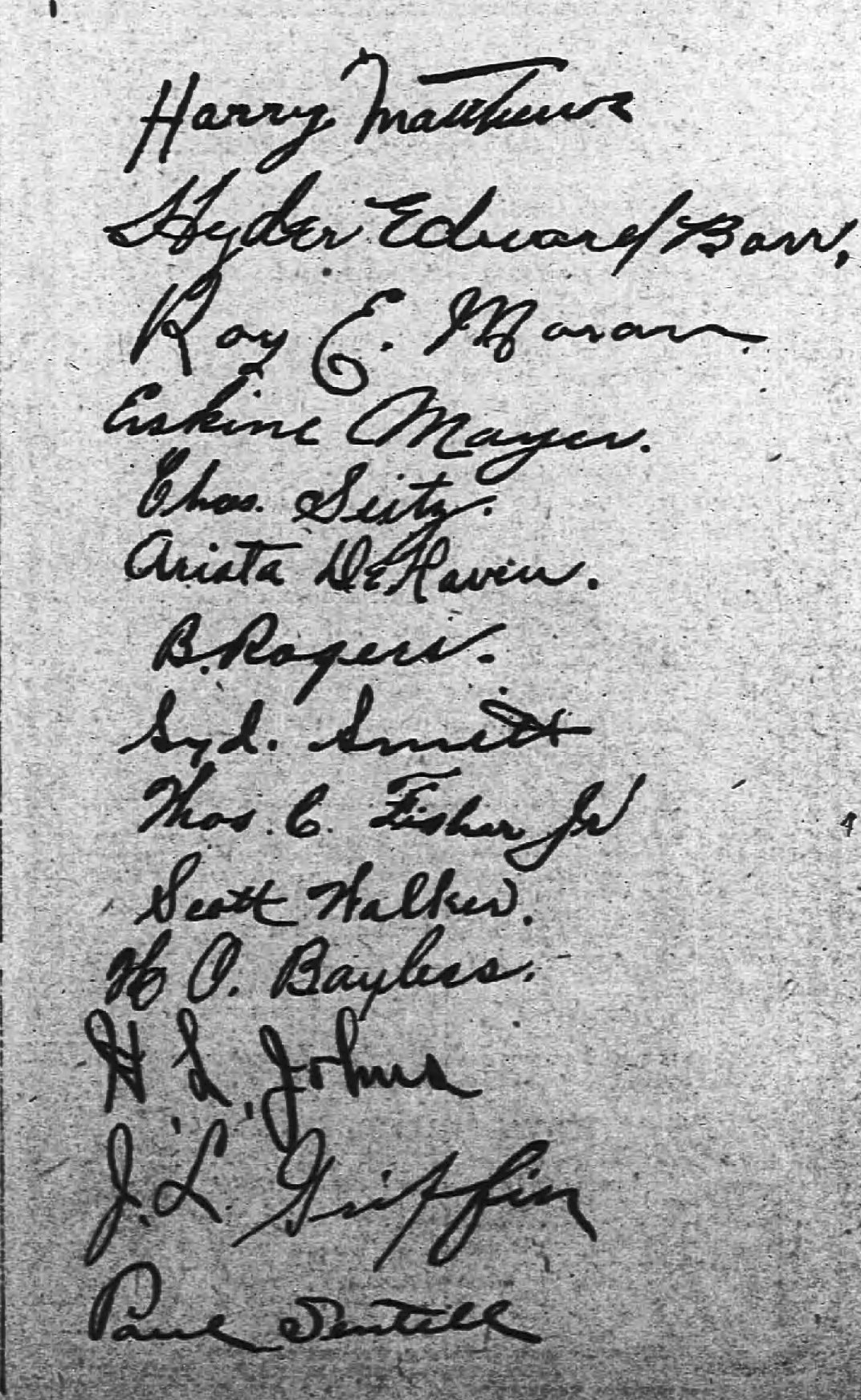
On May 1, The Atlanta Constitution ran a letter “gotten up without solicitation by the boys and the autographs of each and every man is attached hereto:”

A Card to the Faithful Fans of Atlanta:

We the undersigned players of the 1910 ballclub, appreciating to the full the kind of loyal support always accorded us by the good citizens of Atlanta, desire hereby to register an emphatic protest against a statement recently made in a Birmingham paper to the effect that there was dissention among us, and that this dissention, so it was alleged, was the cause of our defeats on the last road trip.

Without stopping to discuss the real reasons which gave us more defeats than victories, we wish to state that it gives us much satisfaction to put our friends on notice that there is not one word of truth in this malicious slander, and further, that we know of no reason why there should be any dissention in our club…It should be further interesting to state, as we do, that the very best of feeling prevails among us all, and there is not one of us who is not doing his very utmost to land another pennant for Atlanta.  We simply ask our friends to continue to put their faith in us, and in return, we desire to give them the assurance that, whether we win another pennant, or not, we are firmly determined to play the best and sincerest ball of our careers—at least so far as honest and persevering effort can aid in bringing about so happy a result.  We confidently hope to amply show both friend and foe, long before the summer of 1910 has passed into baseball history, just how basely we have been misrepresented by this idle and empty charge.

The signatures of the 1910 atlanta Crackers that appeared with their open letter to the fans.

The signatures of the 1910 Atlanta Crackers that appeared with their open letter to the fans.

After the slow start, and their pledge to “play the best and sincerest ball” of their careers,  Atlanta played well the remainder of the season, finishing with a 75-63 record, but the New Orleans Pelicans, behind “Shoeless Joe’ Jackson’s league leading .354 average, and the pitching of 41-year-old Ted Breitenstein (19-9, 1.53 ERA), and 31-year-old Otto Hess (25-9), went wire-to-wire, winning the pennant with a record of 87-53.

Atlanta would not win another pennant until 1913.

Lost Advertisements–Edelweiss Beer–“Slide, you rummy, Slide”

9 Aug

Edelweiss


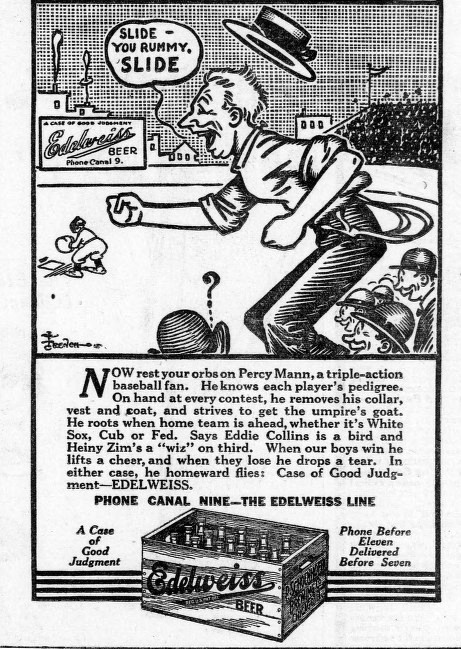
A 1915 advertisement for Edelweiss Beer which appeared in Chicago newspapers.

“Now rest your orbs on Percy Mann, a triple-action baseball fan.  He knows each player’s pedigree.  On hand at every contest, he removes his collar, vest and coat, and strives to get the umpire’s goat.  He roots when home team is ahead, whether it’s White Sox, Cubs, or Fed.  Says Eddie Collins is a bird and Heiny Zim‘s a ‘wiz’ on third.  When our boys win he lifts a cheer, and when they lose he drops a tear.  In either case, he homeward flies:  Case of Good Judgment–Edelweiss”

Things I Learned on the Way to Looking up Other Things #5

8 Aug

Johnny Evers “Ardent Worshipper of Hoodoo Lore”

Edward Lyell Fox was a war correspondent in World War I; after the war he was accused of taking money to write stories favorable to the German government.  Before that he wrote extensively about baseball for several American magazines.

In 1910, writing for “The Columbian Magazine”, Fox interviewed Johnny Evers of the Chicago Cubs about the “almost unbelievable efforts made by ballplayers to offset what they firmly believe to be ‘hoodoos.’”

Evers was one of the most superstitious players in the game, “an ardent worshipper of voodoo lore,” according to Fox, and Evers said the Cubs “are more superstitious than any team in the big leagues,” and that manager Frank Chance “is one of the most ardent respecters of diamond ‘hoodoos.’”

It’s not certain that Evers’ claim that “most players firmly believe in,” the superstitious he listed for Fox, but it’s clear he believed them:

 “If any inning is favorable to a player, he will try to lay his glove down on the same spot where he had placed it the inning before.

“While going to different parks in cars, the sight of a funeral cortege is always regarded as an ill omen.”

Evers also said the sight of a handicapped person was also an “ill omen…unless you toss him a coin.”

On the other hand Evers said a wagon load of empty barrels was a sign of good luck.

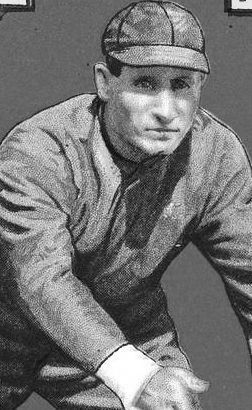
Johnny Evers,

Johnny Evers,


“Too much of a Good Thing”

Even in baseball’s infancy that were critics that said the popularity of the game was “too much of a good thing.”

In September of 1865 The Philadelphia Inquirer editorialized:

 “Let us take, for instance, the base ball (sic) pastime, which is now assuming the proportions of a violent and widespread mania.”

The culprit, according to the editorial, was the athletic club teams that were growing in popularity and  no longer “satisfied with a game or two a week.”

 “(S)ome of these associations devote, three, four or five days at a time to their games; that they are not satisfied with playing on their own grounds for their own benefit and amusement, but that they thirst for popular applause, and are rapidly transforming their members into professional athletes…They issue their challenges, and hotly contend for mastery with clubs belonging to other cities.”

 The Inquirer did predict one aspect of baseball’s new popularity:

 “It can be easily seen that this spirit must soon lead on to gambling. So far the only prize of the base ball and cricket matches has been a ball or some implement of the game, but private wagers have undoubtedly been laid upon the playing of certain clubs, and money has changed hands upon results.”

The Enquirer was also concerned that the game defied “common sense” because “during the heats of summer violent bodily exercise should be avoided; but upon this subject common sense and the base ball mania seem to be sadly at variance.”

The editorial concluded that “the young men,” make sure “they do not depreciate themselves to the level of prize fighters or jockeys, who expend their vim on horse races and matches made for money.”

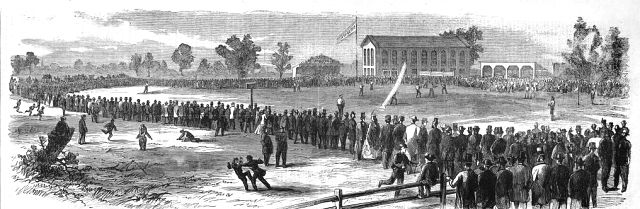
Athletic of Philadelphia versus Atlantic of Brooklyn, in Philadelphia October 30, 1865--"a violent and widespread mania."

Athletic of Philadelphia versus Atlantic of Brooklyn, in Philadelphia October 30, 1865–“a violent and widespread mania.”


Odds, 1896

Early in 1896 The New York Sun reported on “an early development of interest.”  A local bookmaker had issued odds on the 1896 National League race:

“He lays odds of 3 to 1 against Baltimore finishing first; 7 to 2 against Cleveland and Boston;  4 to 1 Philadelphia and New York; 7 to 1 Chicago; 8 to 1 Brooklyn and Pittsburgh; 15 to 1 Cincinnati; 40 to 1 Louisville; 100 to 1 Washington, while (Christian Friedrich “Chris”) von der Ahe’s outfit (St. Louis) is the extreme outsider on the list.  Any lover of the German band can wager any amount and “write his own ticket.”

The final standings:

1. Baltimore Orioles

2. Cleveland Spiders

3. Cincinnati Reds

4. Boston Beaneaters

5. Chicago Colts

6. Pittsburgh Pirates

7. New York Giants

8. Philadelphia Phillies

9. Washington Senators

10. Brooklyn Bridegrooms

11. St. Louis Browns

12.  Louisville Colonels

1896 Orioles, 3 to 1 favorites, won the National League Championship.

1896 Orioles, 3 to 1 favorites, won the National League Championship.

“The Disappearing Oakland Infielder”

7 Aug

James Ernest “Jimmy” Frick began his career with the Iola Gasbags in the Missouri Valley League in 1904, hitting .331 in 106 games.  While Frick began the 1905 season with the Oklahoma City Mets in the Western Association, a “C” level league, press reports said he could have played at a higher level and The Sporting Life said St. Louis Cardinals, Hall of Famer pitcher Charles “Kid” Nichols “cannot understand why Jimmy Frick of Oklahoma City persists in hiding out it the bushes when he can make good in fast company.”

Frick was hitting above .300 in July when he was sold to the Seattle Siwashes in the Pacific Coast League; he hit .252 in 18 games until August 18 when The Associated Press said Frick “disappeared mysteriously.”

Four days later The Seattle Star said Frick who “was very popular” with local fans had jumped the Siwashes and rejoined Oklahoma City having been promised “$1000 and a chance to manage the team next year.”

Whether the reported deal was actually promised to Frick is unknown.  While he returned to Oklahoma City he never joined the Mets and finished the season with the Wichita Jobbers.

At the end of the 1905 season multiple teams laid claim to him.  The Associated Press said:

“The case of J. Frick who was claimed by Indianapolis, Wichita, Seattle and Oklahoma City was referred to Secretary (John) Farrell (of the National Association).”

In February of 1906 Frick was awarded to Wichita then immediately traded to the Toronto Maple Leafs in the Eastern League.  He spent the next five and a half years in the Eastern League with Toronto, the Baltimore Orioles and the Newark Indians.

On July 16, 1910, while with Baltimore, Frick was hit in the head with a pitch.  In August The Sporting Life said he had not yet returned to the lineup:

 “(Frick) is in a bad way in this city, as the result of being hit on the head by a pitched ball during the last home series of the Birds. Although the accident happened at least three weeks ago, Frick’s head is still in bad condition, his face is swollen and dizziness seizes him on the slightest provocation. It is doubtful if Frick will play again this season.”

He did return at the tail end of the season, but only appeared in a few games.  In 1911 he was sold to Newark, and after hitting just .200 in 28 games he was sold to the Troy Trojans in the New York State League.

Jimmy Frick

Jimmy Frick

Before the 1912 season, Harry Wolverton, third baseman and manager of the Oakland Oaks in the Pacific Coast League, was named manager of the New York Highlanders in the American League.  Oakland hired Bayard “Bud” Sharpe to manage the team; one of his first moves was to purchase Frick from Troy to fill the void Wolverton left at third.

By March 7 The Associated Press said Sharpe was “somewhat exercised about infielder Frick.”  The new third baseman had arrived in Oakland by train several days earlier, but had not arrived at the Oaks training camp in Livermore, California and had not been heard from him.  Sharpe showed up the following day, but it was reported he had spent several days in an Oakland hospital—it was not reported why he was hospitalized.

Frick began the season as the Oaks starting third baseman, but after hurting his foot in April, August “Gus” Hetling filled in and Frick never returned to the regular lineup.

On September 17, with Oakland in a battle for the pennant with the Vernon Tigers, the team was in Los Angeles when Frick, according to The Associated Press left his room at the Hotel Rosslyn and “dropped from sight.”

The Los Angeles Examiner said the Oakland team and the Los Angeles Police Department had looked for Frick for more than a week and found no sign of the infielder.  The Associated Press said “all of Frick’s haunts have been searched,” and that the disappearance “may hurt Oakland in their fight for the pennant, as he is considered the best utility infielder on the team.”

Herb McFarlin, Secretary of the Oaks, said:

“Frick has always been a steady player, not inclined to drink or run around.  He always has been absolutely dependable.”

On October 4 The Associated Press said “the disappearing Oakland infielder” had been found by his wife:

“He had been ill in a Los Angeles Hospital, assuming an alias so that he would not be bothered.”

As with his spring disappearance there was no mention as to why Frick was in the hospital.

On October 5 he was with the Oaks in Portland for a game with the Beavers, he did not play, but was “out on the coaching line rooting for his team.”

Frick was with the team on October 27 when they took both games of a double-header in Los Angeles; Vernon won both games of a doubleheader from Portland, and Oakland took the pennant with a winning percentage of .591 to Vernon’s .587.

Frick saw little action in the final weeks of the season, his replacement Hetling hit .297 and was awarded a Chalmers Automobile as the league’s most valuable player.

Gus Hetling, Frick's replacement at third

Gus Hetling, Frick’s replacement at third

Frick and his wife went to Portland at the end of the season, and in late November planned to leave for Oklahoma City where they owned a farm.  On November 20 Mrs. Frick went to pick up tickets for the trip, when she returned home, she found Jimmy Frick dead.  He committed suicide by drinking carbolic acid. (Baseball Reference incorrectly lists his date of death as November 18),

The Portland Oregonian said Frick had been “ill and despondent,” and said he was suffering from “brain fever.”  (Brain fever is an antiquated and vague term used for inflammation of the brain).

None of the stories about Frick’s suicide and “brain fever” mentioned the severe injury he had received when he was hit in the head in 1910, so  it’s impossible to determine whether it contributed to the erratic behavior that year, hospital stays, or death of the disappearing Oakland infielder.”

“Another Phil Pitcher was Sacrificed on the altar of a Futile Attack”

6 Aug

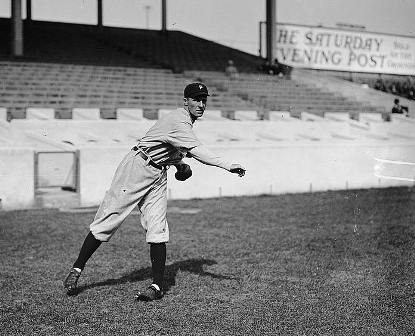
When George Chalmers returned from Cuba with the Philadelphia Phillies in November of 1911 he wasn’t the same pitcher.

After pitching the first game of the series against Almendares and the great Cuban pitcher Jose Mendez, Chalmers saw little action in the final eight games.

While training in Hot Springs, Arkansas in the spring of 1912 it became clear that Chalmers’ shoulder was in bad shape.  The Philadelphia Inquirer said he was sent from Hot Springs to Youngstown, Ohio to “visit ‘Bonesetter’ Reese.” (John D. Reese was a Welsh-born “practitioner of alternative medicine.” The  “self trained”  Reese was, according to The Pittsburgh Press, visited by many of baseball’s biggest stars, including Frank Chance, Ty Cobb, Honus Wagner, and John McGraw.  At the same time he was condemned by Ohio physicians who said there was no evidence of Reese “curing a single case where there was actual fracture or displacement of bone.”)

The famous “Bonesetter” was unable to do anything for Chalmers.  The Wilkes-Barre Times-Leader said in April:

“It is reported on good authority that Chalmers, one of the Phillies star pitchers, will be unable to deliver the goods this season owing to the condition of his pitching arm.”

As a result of the injury Chalmers only appeared in 12 games in 1912, with a 3-4 record, and didn’t pitch at all from July 5 until September 4.   At the end of the season Phillies owner Horace Fogel, who would soon find himself chased out of the game, used Chalmers’ injury to suggest a change in how pitchers were paid.  According to The Philadelphia Bulletin:Ho

“Horace wants to employ pitchers on the percentage basis, paying them so much per game—no game, no pay.

“The Phillies President conceived the idea after he had figured that it had cost him an average of $800 per game for the few games pitched by George Chalmers during the present season.”

Phillies team photo from George Chalmers personal collection--appears to be the 1912 team.

Team photo from George Chalmers’ personal collection

The $800 per game figure was clearly wrong—Chalmers would have not earned anywhere near $9600 for the 1912 season (Christy Mathewson made between $8000 and $9000), Chalmers and “Pete” Alexander both probably made less than $3000.  It is doubtful Fogel’s plan would have gone anywhere had he remained president of the Phillies.

The following season was no better; with no improvement to the injured shoulder, Chalmers appeared in 26 games, 15 as a starter, and was 3-10 with 4.81 ERA.  It got so bad that after a loss near the end of the season The Wilkes-Barre Times-Leader said:

“Our old friend ‘Dut’ Chalmers got another trimming yesterday.  It has gotten to be such a regular thing for Chalmers to be beaten that he doesn’t mind it anymore.”

Two of the Phillies best pitchers in 1913, Tom Seaton (27-12), and Addison “Ad” Brennan (14-12) jumped to the Federal League, making Chalmers and his injured shoulder even more critical to the Phillies hopes for 1914.

In March The Philadelphia Inquirer said Chalmers had spent the winter in Hot Springs rehabilitating his shoulder and appeared “to be in splendid shape,” when he reported to spring training in Wilmington, North Carolina, and “(Charles “Red”) Dooin is thanking his lucky stars that Chalmers is in camp.”

The season turned out to be Chalmers’ worst.  He pitched in three games, losing all three with an ERA of 5.50, and he Phillies released him on June 22.  The Inquirer said his shoulder had never healed and attributed the injury to “rheumatism and a misplaced muscle.”

George "Dut" Chalmers

George “Dut” Chalmers

The Pittsburgh Press said:

“The frailty of baseball life and the quickness with which a career in the big show may be ruined are shown again in the case of George Chalmers…Chalmers may recover and come back some time, but it is doubtful, and his going marks the untimely end of a career that promised to be one of the most brilliant in baseball pitching history.”

According to The Inquirer, he was not yet ready for the end:

“Chalmers…had mighty little money, about $400 in all, and his best friends advised him to stick the little old four hundred into some good business and forget baseball…Good doctors had told George that his arm was gone.  Other pitchers, real friends of the Phillies star, had told him the same thing…Then he heard of a specialist in New York who had done a great job on another pitcher’s arm which had seemed to be gone (no articles mentioned the name of the specialist or the other pitcher).”

With his arm seemingly better, Chalmers was invited to spring training with John McGraw’s New York Giants in Marlin, Texas.  The New York Mail said “he looked good at Marlin,” but the Giants let him go before the season began.  On April 20 he was signed again by the Phillies, and sent out to pitch the next day.  The Inquirer said:

 “George Chalmers, once a Philly discard and lately spurned by the Giants, with whom he trained during the spring trip to the Southland, was the hero of today’s festive occasion for Philadelphia.  Chalmers had been without a big league contract and he was signed by (manager Pat) Moran only yesterday.  But he gave him a quick trial by shunting him at the Giants, and he showed his gratitude to the Quaker boss by pitching the best game of his career.”

Chalmers gave up only two hits and beat the Giants 6-1.

As the Phillies fifth starter in 1915 he was 8-9 with a 2.48 ERA, appearing in 26 games.  Jack Kofoed, a sportswriter for The Philadelphia Record said in “Baseball Magazine”that Chalmers’ record did not reflect how well he pitched:

“Throughout the season Chalmers twirled splendid ball, but played in tougher luck than any man on the Philly staff.  Had fate been as kind to him as to Al Demaree (14-11 3.05 ERA) , for instance, he would have won twice the number of games he did.  But the Phillies played more weird ball behind him than in back of any man on the staff.”

The Phillies won the National League pennant, and met the Boston Red Sox in the World Series.  With Philadelphia down two games to one, Chalmers was Moran’s choice to pitch game four in Boston.

Facing Ernie Shore, who won 19 games for the Red Sox, Chalmers pitched well, but lost 2-1 (the same score of Philadelphia’s losses Geo 2 and 3); The Inquirer said:

“Another Phil pitcher was sacrificed on the altar of a futile attack…through the futile efforts of his companions to obtain for him even the slender margin that was all he required.”

The Red Sox beat the Phillies four games to one.

In November of 1915 several Pennsylvania papers said Chalmers had used his “World Series coin as a matrimonial nest egg.”

The following season was his last.  The shoulder injury returned and the Phillies only used Chalmers in 12 games, he was 1-4 with a 3.19 ERA.  He did not appear in a game after August 7, and was released at the end of the season.  After an unsuccessful attempt to catch on with the Kansas City Blues in the American Association in 1917 Chalmers career was over before his 29th birthday.

In the waning days of his career, The Wilkes-Barre Times-Leader said:

“’Dut,’ as George is called by his playmates is a fine, upstanding, intelligent young fellow, with all the sturdy Scotch virtues as well as a Scotch burr in his speech, and whether or not he lasts in baseball he is very likely to be successful in life.”

Chalmers retired to New York and died in the Bronx in 1960.

Special thanks to Karen Weiss, George Chalmers’ great niece, for generously providing copies of photos from Mr. Chalmers’ scrapbook.

George Chalmers

5 Aug

George “Dut” Chalmers is one of only seven big league players born in Scotland.  He came to New York City as a young child and, according to The Philadelphia Inquirer “his baseball education was begun” with the Bradhurst Field Club which played their games at 145th and Lenox Avenue.  He also played on amateur teams in Hoboken, New Jersey and Red Hook, Brooklyn.

After attending Manhattan College, Chalmers began his professional career in 1909 with the Scranton Miners in the New York State League, managed by Gus ZeimerThe Sporting Life said:

“In George Chalmers, the giant young Manhattan College grad, Zeimer has landed what looks to be the prize-package pitcher of the league.   His work has been sensational.”

There are no complete statistics for 1909, but the following season the 22-year-old Chalmers was 25-6 for Scranton; finishing second in victories to 23-year-old Syracuse Stars pitcher Grover Cleveland “Pete” Alexander who was 29-11.

The Wilkes-Barre Times-Leader said Chalmers:

“Looks like one of the very best in the minor leagues, having a major league head and everything in the pitching line, including fine control and a spitball.”

At the end of the 1910 season the Philadelphia Phillies acquired both of the New York League’s star pitchers; Chalmers was purchased, for either $3000 or $4000, depending on the source, and Alexander was obtained through the Rule 5 Draft.

Both rookies made the club after spring training in Birmingham, Alabama.  Six years later The Philadelphia Evening Public Ledger said of Chalmers’ first days with the 1911 Phillies:

“Chalmers came with an elaborate trousseau, together with lots of pinch neckwear and considerable toggery that aroused the brunette population of Birmingham to deep, empurpled envy. “

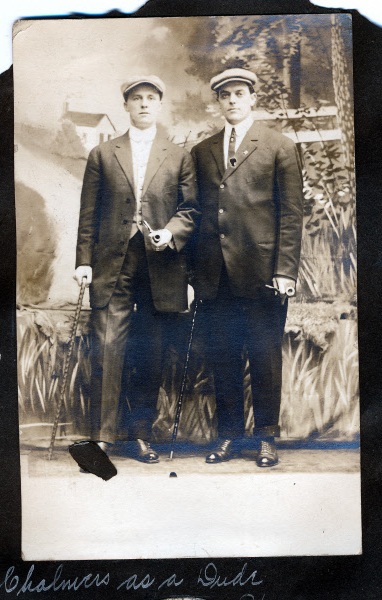
chalmersasadude

George Chalmers, left, with teammate Alonzo Earl “Crossfire” Moore Displaying the style “that aroused the brunette population of Birmingham to deep, empurpled envy. “
Caption reads “Chalmers as a Dude.”  Photo from Chalmers’ personal scrapbook.

In addition to his fashion sense, Chalmers also impressed the Phillies with his pitching ability.

While Alexander got off to a great start, Chalmers started slow, but after back-to-back victories in July, Phillies manager and catcher Charles “Red” Dooin told The Philadelphia Times:

“That youngster is a great twirler.  You know they told me up in the New York League that Chalmers was a better pitcher than Alexander.

“Of course this is impossible because I think that ‘Alex’ is the greatest pitcher that ever drew breath, but I am going to say there’s not a club in either league which could beat the ball Chalmers has pitched for the last two weeks.

“I think I have another Alexander in Chalmers and if he don’t make good prediction I will say that he lacks the nerve and nothing else.  Chalmers has more stuff than Matty (Christy Mathewson) had.  He needs the experience and knowledge of batsmen, but aside from that he is the best young twirler I have ever seen excepting Alex.”

A syndicated story from The American Press Association said Chalmers had given up other sports for baseball:

“George Chalmers, one of the pitching sensations of the Philadelphia National League team, is a motorcycle rider as well as a box artist.  Before he joined the Phillies Chalmers occasionally picked up a little spare change acting as a pacemaker for Elmer Collins, the bicycle rider.  Chalmers has paced Collins several times in the latter’s races against Bobby Walthour.  Chalmers, however, doesn’t intend riding any more.  He fears a spill that might injure his arm and affect his pitching.

“Chalmers at one time had an ambition to become an automobile race driver.  He gave up this notion when he got his chance to join Philadelphia.  The big right-hand pitcher is not sorry that he sidetracked that ambition, for his pitching now is yielding him a healthy income.”

While he was overshadowed by Alexander, who was 28-13 with a 2.57 ERA, Chalmers had a respectable rookie season posting a 13-10 record with a 3.11 ERA.

In September it was announced that the Phillies would travel to Cuba for a 12-game series with the Almendares and Havana teams in November.  As the October 31 departure date drew near it became clear that, for a variety of reasons, many of the Phillies would not be making the trip.  Most notably Alexander, locked in a contract dispute, and Dooin would remain at home.

Besides Chalmers, the players who made the trip were:

Wallace “Toots” Shultz P

Eddie Stack P

Bill Killefer C

Fred Luderus 1B

Otto Knabe 2B

Hans Lobert 3B/MGR

Jimmy Walsh SS

Sherry Magee OF

Mike Mitchell OF (Borrowed from Cincinnati Reds)

Dick Cotter OF

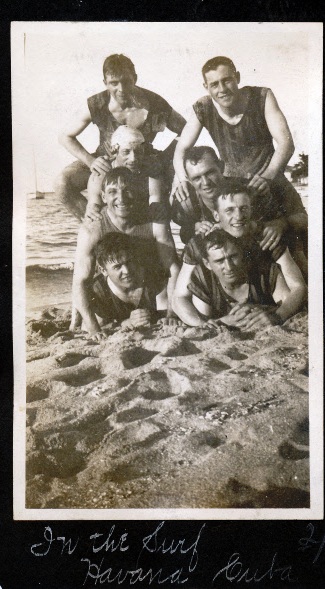
Chalmers and his Phillies teammates on the beach in Havana, Cuba

Chalmers and his Phillies teammates.  Caption reads “In the surf Havana Cuba”
Photo from Chalmers’ personal scrapbook.

The first game of the series, reduced from 12 to nine games because of the Phillies’ limited roster, took place on November 5.  Chalmers faced Almendares and Cuban legend Jose Mendez; the Phillies lost 3-1.  It is likely Chalmers hurt his arm during the series; he did not start another game, and Schultz picked up the slack, pitching six games, he was credited with the victory in the five games the Phillies won.

Upon returning to Key West the last week of November, Chalmers was briefly detained by authorities. The Philadelphia Times said the ship’s manifest listed Chalmers as American, but:

“On arrival in the states when he had to sign a long paper of identification, he told the officials that he was Scotch and never naturalized…Chalmers was reprimanded and the ship company was fined for carelessness”

Heading into the 1912 season The Philadelphia Times, and the second year pitcher, had high hopes:

“Chalmers is young and has every confidence in himself.  He is big and strong and is a perfect running mate for Alexander the Great.”

But the George Chalmers who returned from Cuba would never be the same pitcher.

More tomorrow.

Special thanks to Karen Weiss, George Chalmers’ great niece, for generously providing copies of photos from Mr. Chalmers’ scrapbook.

Thanks to Mark Fimoff co-chair SABR Pictorial History Committee for identifying Earl Moore in the first picture and correcting my incorrect, original caption placing Chalmers on the right–the information has been corrected in the caption.  October 18, 2013

Lost Advertisements–Old Underoof Whiskey, Cubs and White Sox

2 Aug

OO62010


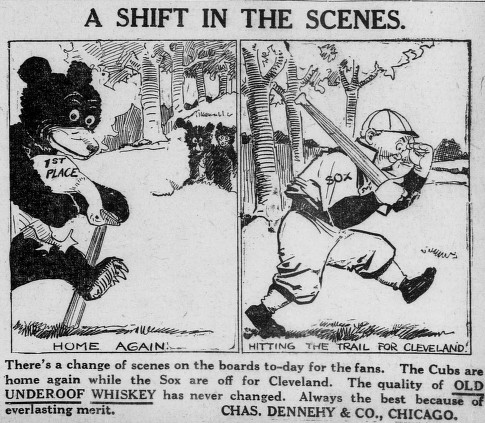
Two more 1910 advertisements for Old Underoof Whiskey featuring the Chicago Cubs and White Sox; these appeared in The Chicago Daily News and The Chicago Examiner.

The one above “A Shift in the Scenes” is from June 20, 1910.  The Cubs were returning home after a 10-4 road trip which put them 4 ½ games ahead of the second place New York Giants, while the struggling, seventh place White Sox were heading to Cleveland for a six game series.

The one below “It’s a Rocky Road to Pennantville” appeared just 10 days later.  The Cubs, who had won four straight games after the first ad appeared, just lost five of seven to the Pittsburgh Pirates, St. Louis Cardinals and Cincinnati Reds, cutting their lead over the Giants to a game and a half.

The White Sox would continue to struggle; they finished the season 68-85.  The Cubs would run away with the pennant, beating the Giants by 13 games.

OO63010

“Branding us as if we were a Band of Convicts”

1 Aug

When the directors of the Pacific Coast League (PCL) met in Los Angeles in January of 1912, The Los Angeles Examiner said the league would be introducing a new innovation:

“President (Allan) Baum said each player will be given a uniform bearing upon the left arm a number he will wear throughout the season.  On all score cards sold at games every man of each team will be named in consecutive order.”

The plan wasn’t immediately embraced.  The Portland Oregonian said several players on the Portland Beavers were against the idea, pitcher Frederick “Spec” Harkness said:

“Of course, I don’t like this branding us as if we were a band of convicts…Hap Hogan (Wallace “Happy Hogan” Bray, manager of the Vernon Tigers) must have been the man who got this freaky legislation past the magnates at Los Angeles for the numbers go nicely with Vernon’s convict suits.”

Frederick "Spec" Harkness

Frederick “Spec” Harkness

The idea was actually the inspiration of Oakland Oaks president Edward Walters.

Major League players and executives also objected to the idea, Tigers president Frank Navin was quoted in The Detroit Times:

“It is a 10-1 bet that the players would rather suffer salary cuts all along the line than be labeled like a bunch of horses.”

Despite early objections, PCL players eventually accepted the inevitable, even Harkness who caused a stir among superstitious teammates when he requested number thirteen.

Roscoe Fawcett, sportswriter of The Portland Oregonian said:

“(Harkness) has put superstition to rout by sending in a request for number 13 under the new Pacific Coast League system of placarding players.”

By March the numbering idea gained some acceptance, and the desire for number 13 had caught on; there was a competition for the number among the Portland Beavers.  The Oregonian said Harkness “now finds his claim disputed by Benny Henderson, Walter Doan and others.”

In the end Harkness (who was born on December 13) received the number.  Given the rampant superstitions of early 20th Century players, most teams simply didn’t issue number 13 to any player.  The only other player in the PCL reported to have worn the number was Oakland pitcher Harry Ables.

Harry Ables

Harry Ables

The PCL’s experiment in uniform numbers was largely unsuccessful.  The Oregonian said the armbands were too small and “cannot be read from 90 feet away.”

By the end of the season, Vernon manager Hogan and Portland manager Walter “Judge” McCredie both of whom enthusiastically supported the numbers, were of the opinion that “the present trial has been a fizzle.”

The biggest criticism of the experiment was the failure of the system to achieve its chief goal, “numbering the men did not help out the sale of scorecards.”

Numbers were eliminated before the 1913 season and the PCL did not use uniform numbers again until the early 1930s.