Tag Archives: Babe Ruth

“Probably the ‘Boniest’ Bonehead Play Ever”

22 Jun

While some of the details changed in subsequent tellings, this story stayed substantially the same from when it was first presented in a column by sports writer William A. in 1913, until the final published version in 1957 in The New Orleans Times-Picayune.  One version called it, “Probably the ‘boniest’ bonehead play ever”

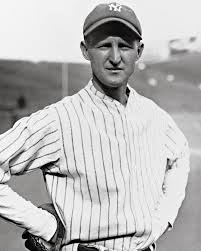
The story was told by and told about lefty Evan “Rube” Evans.  Born on April 28, 1890, in Sebring, Ohio, Evans was a career minor league pitcher who, when the story first appeared, seemed to be headed to the big leagues. 
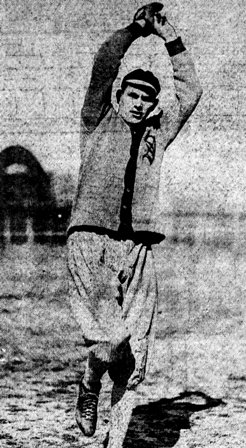
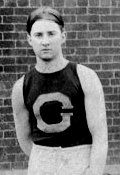
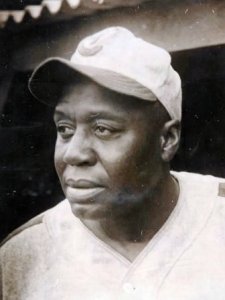
Rube Evans

Rube Evans

The tall–he was reported by various sources as anywhere from 6′ 2″ to 6′ 4″–began his professional career with the Dallas Giants in the Texas League in 1910; he was 15-12 for the pennant winners, but The Dallas Morning News said he didn’t “take baseball seriously” until the following year, when he was 18-16 for the Giants:

“Before that, it seemed, the big, husky flinger looked at playing baseball something in the light of a joke.  Last season, though he came back into the game with a different viewpoint. He seemed to realize that ball playing was a man-sized business.”

After his 1911 performance, Evans’ contract was purchased by the New York Giants, and he joined the team for spring training in Marlin, Texas in 1912.  The Morning News said if he maintained his new found focus “and works as hard as he knows how to work he ought to stick.”

Evans quickly impressed the Giants with a pitch “takes a most freakish break,” according to The Washington Times:

“Rube Evans, the Giants left-handed recruit pitcher from Dallas, surprised bot Manager (John) McGraw and Coach Robby (Wilbert Robinson) by showing them a curve that is entirely new to the big league…The ball is delivered in exactly the same manner as the spitball, but he does not moisten it.”

The paper did not elaborate on how Evans’ “dry spitter” was different from versions reported on during previous seasons–including the one thrown by Christy Mathewson of the Giants–but according to The New York World, “McGraw says he will try and teach it to Rube Marquard.”

Despite his “dry spitter,” Evans failed to make the team and was returned to Dallas where he posted a 22-12 record for the Giants.

In 1913, he joined the New Orleans Pelicans in the Southern Association but appeared to be headed to the Cleveland Naps before he threw a pitch in the regular season for the Pelicans.  In March, Evans shut down the Detroit Tigers 3 to 1 on five hits and followed that up with a four-hitter (and 3 to 1 victory) against the Naps.

The Cleveland Press said, “(Naps Manager Joe) Birmingham plans to cut down his squad considerably.  It is said recruits (Hugh) Peddy, (Pete) Shields and (Ward) McDowell will be left here in trade for one good pitcher, probably Southpaw Rube Evans.”

With Evans apparently on the verge of joining the Naps, the story of his “bonehead” play was told by Phelon, then repeated widely:

“(Evans) has one curious habit—a trait which has aroused much wonder on the part of every manager under whom the southpaw has been toiling.  When given an order by his manager or captain, Mr. Evans always stops, cocks his ears, and demands a repetition of the directions.  Naturally he is first taken for a simp, or bonehead, but when further acquaintance with him shows that he is a gentleman of intelligence and high mentality, the field leaders are muchly puzzled.

“’I always want my orders repeated,’ quoth Mr. Evans, ‘so that I will never again make such an error.”

(The 1913 version of the story, which quotes Evans,  places the incident in McKeesport, Pennsylvania, some later versions say it happened in 1913 with the Pelicans, still others say it was in Portland, Oregon; however, the original publication predates Evans’ time on the West Coast which did not begin until May of 1914).

Evans said he had pitched into the ninth inning when the opposing team put a runner on third with one out, when his manager told him if the other team attempted a squeeze play to “bean him.”  Evans said:

“’I knew no more what a squeeze play was than the man in the moon, but my orders rang in my ears as I started winding up.  Just as a swung up my arm, the fellow on third tore for the plate…I took careful aim at the oncoming runner, and pickled him with a fine shot to the back of the cranium.  Three seconds later the crowd was coming towards me with roars of fury, and I got over the back fence just in time.

“’Well how was I to know that I should have hit the batter and not the runner?  Ever since I have insisted on duplicate orders, so that I would know just what to do.’”

His acquisition by Cleveland never materialized and he had a disappointing 12-15 record in 1913, in a season split between New Orleans and the Birmingham Barons.

It is also in question whether Phelon’s characterization of Evans as a “gentleman of intelligence and high mentality,” was entirely accurate given his inability to stick with clubs who were impressed with physical abilities.  After his second chance to pitch in the majors didn’t materialize, the remainder his of career was marked by long stretches of mediocrity, charges of bad behavior and comparisons to another left-handed “Rube.”

In August of 1913, he was suspended for the remainder of the season by the Birmingham Barons for, according to The Birmingham Post-Herald, “Failure to keep in condition.”  The Sporting Life’s Chandler Richter called him “Erratic,” The Oakland Tribune said he was”Eccentric,” a wire service retelling of the “beanball” story from 1915 said he “earned a nationwide reputation as a ‘squirrel,” another called him “the real eccentric,” when compared to Rube Waddell.
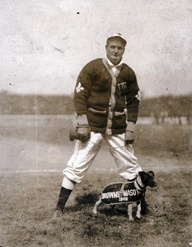
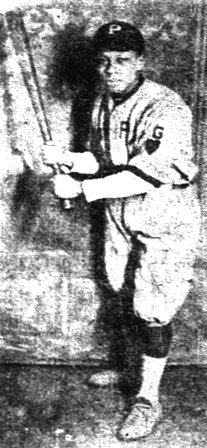
The other left-handed Rube

The other left-handed Rube

His two-year tenure with the Portland Beavers in the Pacific Coast League (PCL) began when he wore out his welcome in New Orleans in May of 1914 and was sold to the Beavers.  It was particularly rocky.  The Spokane Daily Chronicle said Evans and Beavers manager Walter “Judge” McCredie “got along like a pair of strange bulldogs.” He was suspended at least once, again for the euphemistic “failure to be in proper condition,” and gave up a game-winning home run to Jack Ness of the Oakland Oaks when he accidently threw a pitch over the plate while attempting to intentionally walk Ness.  At the close of the 1915 season, Portland let him go for what The Portland Oregonian called “His inability to take care of himself.” Of his 9-22 record the paper said:

“Rube ran into gobs of adversity.”

After leaving Portland, Evans played parts of three seasons for the Salt Lake City Bees in the PCL–in 1917 he was 21-9, but when McCredie was named manager of the Bees in 1918, Evans time with the team was nearly over.  Before the season, The Oregonian said, “Evans did not take kindly to the idea of having to take orders” from his former manager and was threatening to jump the club.  He finally did jump in June after appearing in 14 games and posting a 3-8 record.

Evans went to Portland and finished the 1918 season in the semi-pro Shipyards League, The Oregon Daily Journal said upon his arrival:

“Rube Evans was through at Salt Lake and McCredie was probably saved the trouble of wearying his hand by writing out Rube’s release, when Rube left.”

In 1919, he played for the Rupert franchise in the semi-pro Southern Idaho League; while successful, his reliance on the emery ball for his success didn’t make him friends.  The Twin Falls Times said:

“When Rube Evans lugged the emery ball into the S.I.L. he failed to do anything beneficial to the league.  Rube will win a few more games for the Rupert club, but he has lowered the standard of sport in the league.”

Evans had one more season in professional baseball, posting a 10-7 record with the Regina Senators in the Western Canada League in 1920.  In an August 15 doubleheader against the Edmonton Eskimos Evans was ejected for arguing with the umpire while facing the second batter of the first game; he came back to lead the Senators to 5 to 3 victory in the second game, giving up two runs in 7 2/3 innings, and hitting a three-run home run in the sixth.
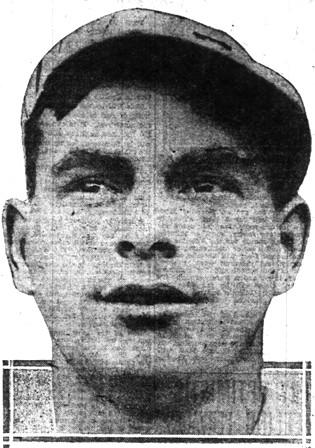
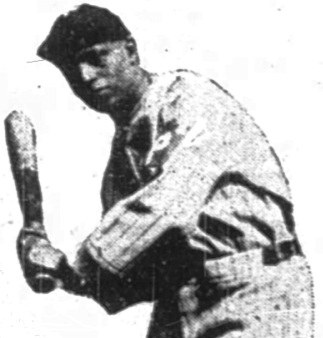
Rube Evans

Rube Evans

After the 1920 season, he returned to Ohio and spent the next decade playing semi-pro baseball there and in Western Pennsylvania.  His last headlines came in 1924 when he pitched six innings for the Sharon (PA) Elks team in an exhibition game against the New York Yankees.  The Elks lost 10-8, Babe Ruth went 2-4 with a double for the Yankees.

Evans’ playing days ended in Akron, Ohio.  He pitched for and managed the Goodyear Tire and Rubber Company team, and stayed on with the company as a rubber worker.  He died on January 30, 1950.

A clue to some of Evans’  erratic behavior is contained in his death certificate.  The pitcher spent the last three and a half years of his life in Ohio’s Cambridge State Hospital; his cause of death was listed as “General Paresis,’ brought on by syphilis.

A shorter version of this post appeared on June 3, 2013
“I mentioned Satchel and Josh and Cool Papa, I told Him he was Missing the boat”

18 May

After Heywood Broun’s remarks at the 1933 Baseball Writers Association dinner about integrating the game, The Pittsburgh Courier initiated a campaign to push the issue.  Despite some support inside baseball and from well-known newspapermen, the effort fell flat by opening day.

That summer, after the first East-West Game—won by the West All-Stars 11 to 7—at Comiskey Park, Henry L. Farrell of The Chicago Daily News suggested several “(M)ajor league club owners who are now on their knees might have their prayers answered,” by signing some the Negro League stars.

In the fall, The Chicago Defender briefly picked up the mantle from The Courier.  The paper asked their readers:

“How would you like to see the great baseball players of the Race performing in the major leagues? Wouldn’t you like to see Willie Foster, Satchel Paige and (Sam) Streeter pitch to Babe Ruth?”

If so:

“Sit down and write K.M. Landis commissioner of baseball, 333 N. Michigan Ave., Chicago.”

The following week, the paper reported that Landis’ office had refused to comment.  When baseball’s winter meetings commenced in Chicago in December, The Defender promised readers that the letters they had sent:

“(A)re not being passed on lightly as many suggested would be the case.  On the contrary, the club owners are downright concerned and from the inside word leaked out that some action would be taken.”

The optimism was tempered later that week when their reporter was barred from covering a meeting where he was told “vital points were discussed.”  The Defender reporter was told no newspapermen would be admitted, but:

“That sinister moves were being made against your author’s admission became a certainty when a well-known writer from one of the downtown papers came along, gave the high sign and was admitted.”

When 1933 came to a close, integration was no closer to being a reality than it was 11 months earlier as Broun stood to deliver his remarks to the baseball writers.

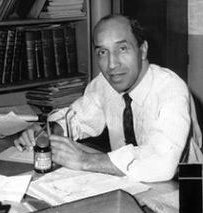
Four years later, Sam Lacy from The Baltimore Afro-American met with Washington Senators owner Clark Griffith in an attempt to revive the subject:

“I mentioned Satchel and Josh and Cool Papa, I told him he was missing the boat.”

Sam Lacy

Sam Lacy

Griffith, he said, told him the timing was wrong, and that Southern-born players would not accept integration.

The next major effort came in 1939.

Political support had generally been limited to socialist and communist organizations—the Young Communist League spent the summer of ’39 gathering signatures to present to Commissioner Landis.  But, in July of that year, the Illinois House of Representatives adopted a resolution which read in part:

“Resolved, by the House of Representatives of the Sixty-first General Assembly.  That the owners of all professional baseball teams in the United States, both in the major and minor leagues be strongly urged to give baseball players of the colored race the same opportunity of becoming players on their respective teams as is accorded to such players of the white race.”

Another push came from Pittsburgh as well.

Wendell Smith, who was playing baseball at West Virginia State College when Broun made his speech in 1933, was now a reporter for The Courier. In July, he promised readers:

“The most exclusive, startling and revealing expose, of the attitude of the major league players and managers themselves, ever written.”

Wendell Smith

Wendell Smith

Over the course of several weeks Smith asked 40 players and eight managers as they passed through Pittsburgh, “Are Negro ballplayers good enough to ‘crash’ the majors?”

The Courier’s Chester Washington said in a column to introduce the series of articles:

“One of the major reasons why Mr. Smith’s discovery is so revolutionary is that the club owners, in trying to pass the buck, have blamed the ban on the players themselves.  They claimed that the injection of colored stars into the clubs would bring about friction and dissention… (Smith) practically disproves this contention.

“Fearlessly buttonholing the managers and outstanding players of all the National League clubs, Mr. Smith received scores of testimonials which should be a revelation to the owners.”

A sampling of the statements collected by Smith:

Ernie Lombardi, Cincinnati Reds:  “(Satchel) Paige is as good as (Dizzy) Dean.”

Johnny Vander Meer, Cincinnati Reds:  “I wouldn’t object.”

James “Doc” Prothro, Philadelphia Phillies: “If given permission I would jump at the opportunity to sign up a good Negro ballplayer.”

Leo Durocher, Brooklyn Dodgers:  “(Satchel) Paige, (Bill “Cy”) Perkins, (Mule) Suttles and (Josh) Gibson are good enough to be in the majors right now…I certainly would use a Negro ballplayer if the bosses said it was all right.”

Gabby Hartnett, Chicago Cubs:  “I am sure that if we were given permission to use them, there would be a mad scramble between managers to sign them.”

Gabby Hartnett

Gabby Hartnett

Dizzy Dean, Chicago Cubs: “If some of the colored players I’ve played against were given a chance to play in the majors they’d be stars as soon as they joined up.”

Pepper Martin, St. Louis Cardinals: “Some of the big league players would object, but on the whole I think they would be accepted.”

Pie Traynor, Pittsburgh Pirates: “believe me when I say I have seen countless numbers of Negro ball players who could have made the grade in the majors.  Only their color kept them out.  If given permission, I would certainly use a Negro player who had the ability.”

Honus Wagner, Pittsburgh Pirates:  “Yes, down through the years I have seen any number of Negro players who should have been in big league baseball.”

Over the next five years, Smith would interview more than 150 additional major leaguers, who would echo the sentiments of his original 40, keeping the pressure on professional baseball to desegregate.

“Babe Ruth has a Locker full of Charms”

13 May

Eddie Collins had spent 25 years in the major leagues as a player, coach and manager by 1930 when he spoke to a writer for “Every Week Magazine” about superstitions.

Eddie Collins

Eddie Collins

The article noted:

“Collins, by the way, has been credited with being one of the most superstitious players in the national game.  His habit of sticking a piece of chewing gum on the button of his cap has almost become a tradition.  If the pitcher had two strikes on him, Eddie would jerk off the cap, yank the gum from the bottom, stick it in his mouth and chew violently.”

But, Collins, a graduate of Columbia University, didn’t consider himself superstitious and told the magazine:

 “The average man playing professional baseball today is too well-educated actually to believe you can make home runs by picking up hairpins or adopting any of the other numerous superstitions which have come to be so much part of the game. “

As for the obvious superstitions he and many other players, educated or not, subscribed to, Collins said they were merely “eccentricities,” and that “Having them gives confidence.”

That said:

“The late George Stallings was one of the most sensible men baseball has produced.  He was the personification of common sense and one of the last persons in the world you would credit with being superstitious.  Nevertheless, a single scrap of paper tossed on the ground in front of the dugout meant all sorts of bad things to George. It upset him completely and his managerial skill seemed to fade.”

George Stallings

George Stallings

Joe Sewell of the Cleveland Indians was another “college man,” someone who “generally loses any belief in omens.”  But, Sewell “after his last crack at the bat during practice” insisted on running towards third and touching the bag before anyone else did.  One day in Cleveland, the too educated to be superstitious Sewell started towards third, only to see Collins, also too educated to believe in superstitions, had:

“(D)ashed out of the Athletics’ dugout and touched the sack ahead of Joe and Joe didn’t get a hit during the afternoon.”

Joe Sewell

Joe Sewell

Next was Urban Shocker, who insisted no one touched his glove during a game.  Despite being “too wise a man to believe” such a thing, Collins told how during a game against the Athletics, “Eddie Rommel spotted the glove and knowing Shocker’s eccentric regard for it, walked over and picked it up, examined it and then tossed it back on the turf.”  The “too wise” Shocker:

“(S)aw red.  He became visibly unsettled.  He blew up the next inning.”

As for the game’s biggest star:

Babe Ruth has a locker full of charms, fetishes and tokens; fastened to the door is a wooden horseshoe with a four-leaf clover carved on it, and on top stands a totem pole and other curious objects guaranteed by enthusiastic donors to bring luck.”

Babe Ruth

Babe Ruth

Collins said the previous season when the Athletics were on their way to Chicago for game 3 of the World Series with the Cubs:

“(T)here was a fan on the train with us  who had a great fondness for canned pineapple.  He insisted the players eat some the morning of the game predicting we’d win if we did.  Well, we did, and we won.”

Collins said he, and the rest of the Athletics, too smart for superstition:

“Had pineapple every morning the rest of the series.”

“The Game is Stricter and Better now”

8 May

Honus Wagner was an exception.  Unlike most of his contemporaries, he didn’t spend his later years complaining that the game was just not the same and that current players would not be able to compete with the stars of his era.

Financially strapped as a result of the Depression, Wagner was offered a job by the Pittsburgh Pirates to join Manager George Gibson’s staff.   While in California with the team for spring training he spoke to Russell Newland of The Associated Press.   Wagner said:

“We’ve got more good players than we ever had.  That’s because there are more strong leagues.  The game is stricter and better now.  You can’t bully the umpire any more.  The boys used to be a rough and ready lot.  Now the umpire is a real authority and it’s all for the best.”

Wagner

Pirates Coach Honus Wagner

Wagner also felt that pitchers had to work harder than they did when he played:

“Our pitchers had the advantage of a dead ball and used the spitter, the shine ball and the emery ball.  They worked the old bean ball overtime.  All that’s out now.  Nowadays a pitcher has to throw a lot more balls.  He has to work the corners because that lively ball sure sails when the boys get one in the groove.  Actually he pitches a couple of games in nine innings, compared to the chuckers of my day.”

Wagner had no complaints about the comparatively large money stars like Babe Ruth were paid either:

“That $50,000 they’re offering the Babe reads like a lot of money to me, but if he can get them to raise it, I say ‘more power to him.’”

Wagner was also optimistic about baseball’s future:

“’Baseball is O.K.,’ he said as he crossed the most famous pair of bow legs in the history of the pastimes.  ‘They’ll be playing it a long time from now.”

“If Baseball is really the National Game let the Club Owners go out and prove it”

4 May

Haywood Broun, columnist for The New York World-Telegram, shook up the annual Baseball Writers Association dinner in February of 1933.  The Pittsburgh Courier said Broun “struck out boldly in advocacy of admitting Negroes to the charmed circle of big leagues.”

Heywood Campbell Broun

Heywood Broun

Broun said (and later wrote in The World-Telegram):

“I can see no reason why Negroes should not come into the National and American Leagues.

“Why in the name of fair play and gate receipts should professional baseball be so exclusive?”

[…]

“The introduction of a few star Negro ball players would do a great deal to revivify interest in the big leagues.  It would attract a number of colored rooters. And it would be a fair and square thing.  If baseball is really the national game let the club owners go out and prove it.”

Jimmy Powers of The New York Daily News said he polled the dinner guests after Broun’s remarks:

“I made an informal tour around the tables asking club owners and players their reactions to Broun’s little talk.  I was amazed at the sentiment in favor of the idea.”

Powers claimed that Yankees owner Jacob Rupert, St. Louis Cardinals General Manager Branch Rickey, and Babe Ruth were all in support of Broun’s statement.   John McGraw the dinner’s guest of honor—he had resigned as manager of the New Giants the previous summer due to his failing health—was, according to Powers, “The only prominent man present vetoing” the idea.

John McGraw

John McGraw vetoed the idea


Salem Tutt Whitney, a prominent star of the black vaudeville circuit, commented on McGraw in the pages of The Chicago Defender:

“John McGraw and his Giants have been the idols of the Colored baseball fans.  Whenever and wherever there had been talk about the color line in major league baseball, the Colored fans were a unit that declared that if John McGraw could have his way there would be no color line.  ‘Didn’t he play (Charlie) Grant at second base on the Giants!’  ‘Look how long he employed a Colored trainer (Ed Mackall)!’”

[…]

 “It is my opinion that if the Colored baseball fans of Harlem are not convinced that Mr. McGraw has nothing more to do with the Giants, there will be a lack of personal color in bleachers and stands at the Giants’ stadium this summer.”

Salem Tutt Whitney

Salem Tutt Whitney

Not content to simply report on Broun’s pitch for integration, Powers made his own:

“I would like to make a case for the colored baseball player.  In football, Duke Slater, Fritz Pollard and Paul Robeson and stars of similar complexion played with and against the cream of Nordic colleges.  Eddie Tolan, Ralph Metcalfe and Phil Edwards have conducted themselves in a gentlemanly—not to mention championship—fashion.  Boxing has known Joe Gans, Sam Langford, Joe Walcott and Tiger Flowers.  There are only three popular sports in which the dark-skinned athletes are snubbed—tennis, golf and baseball.”

The New York Age approved:

“Here’s hoping all the other big white sportswriters have the courage of Jimmy Powers.”

Chester Washington, a sports writer at The Pittsburgh Courier announced that the paper was launching “A symposium of opinion, coming from outstanding figures in baseball circles,” designed to demonstrate a broad coalition of support for integration.

The Courier reported “The first of these statements,” in response to Washington’s outreach the following week—and it was a rather incredible one from John Heydler, president of the National League, who said:

“Beyond the fundamental requirement that a major league player must have unique ability and good character and habits, I do not recall one instance where baseball has allowed either race, creed or color enter into the selection of its players.”

Gerald Nugent “aggressive young owner of the Phillies,” was next to respond to The Courier:

“Nugent calls attention to the fact that no ‘color line’ is drawn on the dollars which are spent by colored and white fans for admissions in the various big-league parks…He further declares that the average colored semi-pro league player is better than his white brother in the same category.”

Support continued to come.  Chicago White Sox President J. Louis Comiskey:

“You can bet your last dime that I’ll never refuse to hire a great athlete simply because he isn’t the same color of some other player on my team if the alleged bar is lifted.”

While Commissioner Kennesaw Mountain Landis did not respond to The Courier, his right-hand man, Leslie O’Connor said “(T)here isn’t any rule which keeps colored players out.”  But, like Heydler, he made the incredible claim that “the subject of Negro ball players had never been brought up,” among the Major League Advisory Council.

Based on the initial responses, William Goldwyn Nunn, The Courier’s managing editor, expressed great, if premature, optimism:

“And the color will be black!

“As sure as the Ides of March are approaching, there’s going to be some added color in the Major Leagues.  AND, THAT COLOR WILL BE BLACK!”

Meanwhile Jimmy Powers quoted Lou Gehrig and Herb Pennock of the Yankees and Frankie Frisch of the Cardinals in The Daily News, all said they were “open-minded,” about the possibility integration.

pennock

Pennock “Open-minded”


Two more prominent sportswriters came out in support:  Dan Parker of The New York Daily Mirror, and Gordon Mackay, who had been sports editor of three Philadelphia papers—The Enquirer, The Press and The Public Ledger.

And then, as abruptly as it began, the movement died.

Despite the brief groundswell of support, by the time the major league season opened Alvin J. Moses, another writer for The Courier admonished the papers readers:

“Aren’t you somewhat ashamed of yourselves that you haven’t seen fit to spare the time to flood (the paper) with letters that cry out against these NEGROPHOBES who for more than half a century have kept Negro ballplayers out of league competition?

“The cry of ‘Play Ball, Play Ball, Play Ball?’ is heard today in hundreds of parks the county over, and baseball statisticians have figured to show more than 40,000,000 fans walk past the turnstiles.  But what does that cry mean to you, and you, and you? Well, I’ll tell you—absolutely nothing.”


Things I Learned on the Way to Looking up other Things #14

29 Apr

Wishful Thinking in Boston–1921

Arthur Duffey was a former track athlete—he finished fourth in 100 yard dash in the 1900 Olympics—turned sports columnist for The Boston Post.

Arthur Duffey

Arthur Duffey

Like many in Boston, he hoped Babe Ruth would be unable again put up the type of numbers he did in 1920—54 home runs, 135 RBI, .376 average– after being sold by the Red Sox to the New York Yankees.

Ruth

Ruth

Duffey had received word in March of 1921 that his hopes would be realized:

“According to all reports from Hot Springs way where Babe Ruth is putting in his preliminary canters for the coming American League race, Babe evidently believes in that old slogan about ‘Living to eat instead of eating to live,’ for the Bambino is pounds overweight and not a few predict that he is going to have his troubles in getting down to anything like his baseball scale of last season…(Ruth) has no doubt been living the life of Reilly since he has proven himself the ‘King of Swat.’ But, is he going to eat himself out of another chance to beat that home run record?”

Ruth managed to “eat himself” into a season that included new career highs for games (152), at-bats (540), runs (177), home runs (59), RBI (168), and batting average (.378).  The Yankees won the American League pennant and the Red Sox finished their second straight fifth-place, Ruth-less season.

Wishful Thinking about honesty, 1901

George Erskine Stackhouse, sports editor of The New York Tribune, assured readers of “Leslie’s Weekly Illustrated” magazine, that there was no corruption in baseball:

“Baseball is honest.  Some peculiar things happen in baseball at times, but I have watched the game very closely for a great many years and believe that it is at least as close to perfect honesty as any professional sport in the world.”

George Erskine Stackhouse

George Erskine Stackhouse

Stackhouse also refused to believe that gamblers had any role in the game:

“Baseball has no side-show features, such as betting and the like, and soon as the average ‘fan’ thought the games dishonest he would lose all interest in the sport.”

But, Stackhouse assured his readers he was not naïve, but everyone involved in baseball had learned their lesson from the scandals of the 19th Century:

“I do not mean to say that there are not players and club owners who would not be tricky if they dared.  They simply don’t dare.

“The lesson dealt out to the early evil-doers who were charged with selling games in the interest of certain gamblers, has had a splendid effect.  The sentence hangs over those men yet, and the disgrace will remain with their children and their children’s children.  I believe that there have been hundreds of fake horse races, prize fights, wrestling matches, and professional running races to one really crooked baseball game.”

Stackhouse died in 1903 at the age of 42, content in the knowledge that baseball remained “close to perfect honesty.”

Fred Downer

30 Mar

In August of 1953, “Jet Magazine” said people were talking about:

 “That affectionate hug baseball immortal Ty Cobb gave Chicago news dealer Fred Downer.”

By then, Frederick Douglas Downer was largely forgotten.

Before playing as a professional, he was, according to The Pittsburgh Courier, the “star” of the Morehouse College baseball team in Atlanta.

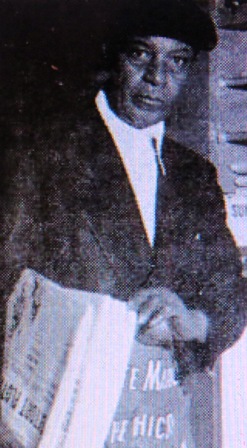
Fred Downer

Fred Downer

His first professional experience was with the Atlanta Cubs in 1919—the team was colloquially called the Atlanta Black Crackers for years, and newspapers referred to them by both names until 1922 when the “Cubs” name was permanently dropped.  Years later, Downer told The Chicago Defender he also played with the Knoxville Giants during this period.

In 1921, Downer and Gerard Williams, his teammate at Morehouse and with the Atlanta Cubs, went north to join the Pittsburgh Keystones.   Downer is listed by several sources as the club’s manager, but in the 1970s he told The Defender said he “played under the management of (William) Dizzy Dismukes.”  Dismukes was also the Keystones’ manager the following year when the team entered the Negro National League.

Downer appears to have played independent and semi-pro ball during 1922.

While not listed on any extant rosters, Downer spent some time with the Cleveland Tate Stars in 1923—in an interview given in 1972 Elander “Vic” Harris, who debuted with the Tate Stars as an 18-year-old that season, said Downer, who he had gotten to know in Pittsburgh was with the club. Harris told The Van Nuys (CA) News he tried out as a first baseman but was installed in the outfield, leading to Downer being let go.

Downer returned to Pittsburgh and assumed management of the Keystones in 1924. After a single season in the Negro National League, the Keystones had dropped out, and the team continued operations as a semi-pro club.

Downer, and another Georgian who also played with the 1923 Cleveland Tate Stars, Mathis Williams, managed and played for the semi-pro version in 1924 and ’25.  The Keystones barely treaded water financially.

Mathis Williams

Mathis Williams

In June of 1925 The Pittsburgh Courier said:

“Of the colored clubs in action, none but the Homestead Grays are making any money…Fred Downer and his Pittsburgh Keystones are practically a thing of the past.”

Within a month the team disbanded and Downer was through as a player.

The following year, he and his wife Marian Foster Downer, a reporter for The Pittsburgh Courier—and later The Chicago Defender— relocated to Chicago.  She continued to write for The Courier’s society page while Fred began covering baseball and boxing for the paper and acted as The Courier’s Midwest circulation manager.

In addition to covering most major Midwest-based events–including the annual Negro League East-West All-Star Game and several championship fights—Downer started the Atlas News and Photo Service which distributed content to Black newspapers.


Marian Foster Downer also wrote about sports for The Defender.  Her article on the 1935 East-West All-Star Game—won by the West 11-8 on George “Mule” Suttles’ three-run home run after Webster McDonald walked Josh Gibson to face him—was headlined:

Mule Suttles

Mule Suttles

Our Girl Scribe Sees Mule’s Hit

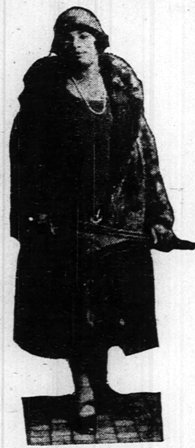
Marian Foster Downer--The Defender's "Girl Scribe"

Marian Foster Downer–The Defender’s “Girl Scribe”

In 1945, Fred Downer proposed a new path for Negro League baseball, writing in a Chicago-based magazine called “New Vistas:”

“If the white majors won’t hire good colored players, then the Negroes should build their own parks and hire the best players regardless of race.  This will build up competition, and competition will break down many barriers.”

Downer was covering the World Series at Wrigley Field in 1932 and was on-hand for Babe Ruth’s “called shot.”  The Courier’s Sports Editor Wendell Smith said Downer was “One of Babe’s most staunch and loyal supporters,” and was determined to find the ball.

 “His decision to find the ball Ruth hit resulted in a search that has been a detailed and intensive as any by a ‘G-man.’  Fred scoured every baseball haunt in the Chicago area.”

According to Smith, Downer expanded his search throughout the Midwest, with no luck.

Downer later told The Chicago Defender he found the ball and bought it from a former Chicagoan who had moved to Michigan.  He called the ball “one of his prized possessions.”

The actual provenance of the ball and its current whereabouts are unknown.

Twenty-one years after he witnessed Ruth’s “called shot,” Downer—by then he had left  The Courier and owned three newsstands on Chicago’s South Side– was again at Wrigley Field where he had an encounter that raised questions in the Black press about a long-held opinion of another baseball legend.

Ty Cobb stopped in Chicago on his way back to his California home from Cooperstown, to attend a game between the Cubs and the Brooklyn Dodgers.

Downer was born in Cobb’s hometown of Royston, Georgia in 1896.  The Defender said of the relationship between the two:

“(Downer) got his start in baseball chasing fly balls for Ty Cobb as a kid.”

The California Eagle said:

“Downer was raised around the Cobb’s household in Royston, Georgia.”

Wendell Smith, then with The Chicago Herald-American, said of Cobb’s day at Wrigley:

“(T)here were two things said about (Cobb) that were, apparently, the gospel truth:

  • He could hit any living pitcher.

  • He would hit any living Negro.”

Smith said the second “truth” was “merely a matter of hearsay.”

And, he said:

“(H)e gives no indication today of intolerance.”

In addition to his embrace of Downer, Cobb was asked which players on the field most impressed him:

“’Why that catcher there, he said, pointing to Roy Campanella.  ‘He’s the best ball player I’ve seen in many a year…That fella’s a great catcher,’ he volunteered.  ‘The very best in the game.  He reminds me a little of Roger Bresnahan.  If he can stick around for five or six more years they’ll have to put him alongside the game’s all-time catchers.’”

Downer continued to operate his newsstands well into his 70s.  At the corner of 53rd Street and Lake Park Avenue, The Defender said, he would:

“(S)ell morning newspapers (and) answer hundreds of questions pertaining to his long career.”

Fred Downer

Fred Downer

Frederick Douglas Downer died in Chicago on March 10, 1986.

“The Next Babe Ruth”

18 Mar

After he hit 11 home runs in 1918, and for the next two decades, stories about the discovery of “The Next Babe Ruth” became commonplace in newspapers across the country.

One of the first was Joe Doyle, “The Babe Ruth of Great Lakes,” signed by the St. Louis Cardinals in November of 1918.  Doyle was the star of the team representing Camp Dewey at Great Lakes Navel Training Station where, The St. Louis Globe-Democrat said he made a name for himself, hitting “a dozen home runs and nine triples…(and) flogging a home run over the Camp Dewey Drill Hall, a smash that might be compared to a lift over the left fences of any major league park.”

Doyle began his professional career the following spring with the Houston Buffaloes in the Texas League and played his entire career in Texas.  “The Babe Ruth of Great Lakes” hit just eight home runs over five minor league seasons.

Ben Paschal had the distinction of being declared “The Next Babe Ruth” twice.  When the Boston Red Sox purchased Paschal from the South Atlantic League’s Charlotte Hornets in July of 1920, Manager Ed Barrow told The Boston Herald he had acquired “A second Babe Ruth.”

Paschal joined the Red Sox after Charlotte’s season ended in September.  He had 10 hit in 28 at-bats, but no extra base hits, and was returned to Charlotte after the season.

After four more excellent seasons in the South Atlantic League and Southern Association (he hit .335 with 68 home runs from 1921-1924) he was  purchased by the New York Yankees for $20,000 in August of 1924.

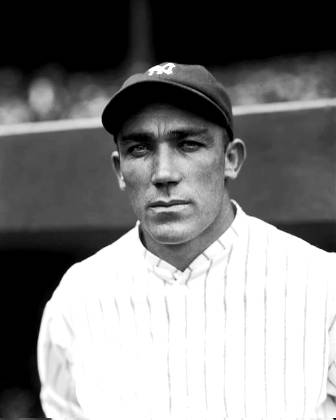
Ben Paschal

Ben Paschal

Paschal was again dubbed the “Second Babe Ruth” by newspapers.  His second stint as the second Ruth was longer and more successful than his first.  From 1924-1929 he hit .309 in with 24 home runs in 750 at-bats as an outfielder playing behind Ruth and Bob Meusel (Meusel was himself dubbed “Another Babe Ruth” by Manager Miller Huggins when he joined the Yankees in 1920).  On Opening Day in 1927 the Second Babe Ruth pinch-hit for Ruth (who was 0-3 and struck out twice) in the sixth inning; Paschal singled, and the Yankees went on to an 8 to 3 victory over the Philadelphia Athletics.

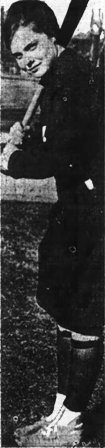
Then there was Dorothy Hodgens.  In 1921, Hodgens was a 20-year-old student at Wilson College in Chambersburg, Pennsylvania.  Hodgens briefly became a celebrity and was called the “feminine Babe Ruth” by many newspapers after The Associated Press (AP) reported that while growing up in Philadelphia Napoleon Lajoie said she was “the only girl he ever knew who could play ball.”

After her picture appeared in papers across the country, Hodgens, who played several sports at the school, was interviewed by The Harrisburg Evening News as she was “ready to enter a basketball game:”

“Yes, I’m terribly fond of baseball, and I’ve been playing it ever since I’ve been a bit of a youngster.”

She said Lajoie was a neighbor in Philadelphia when she was a child:

“Lajoie used to come out and pitch ball with the boys and girls in the neighborhood.  He told me I was the only girl he ever knew who could pitch and gave me a box of league balls that I have treasured ever since.”

Dorothy Hodgens "The Feminine Babe Ruth."

Dorothy Hodgens “The Feminine Babe Ruth.”

While she said her real ambition was to become an actress, Hodgens said, “I never expect to give up baseball entirely though, and I certainly think that every girl should learn to play the game.”

The “Feminine Babe Ruth” disappeared from the public eye shortly afterward.

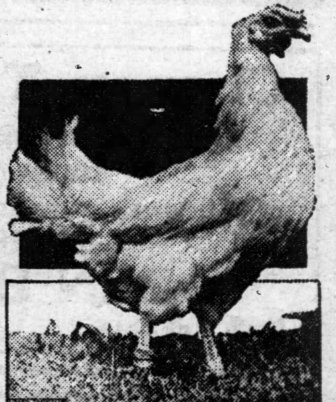
And finally, there was “Another Babe Ruth” who had a brief moment in the limelight in the fall of 1920.  This one was a three-and-a-half pound white Leghorn Chicken who was named “Babe Ruth,” and had just established a new record.

"Babe Ruth"

“Babe Ruth”

The AP said:

“(T)he home run king has a rival…She bats 326 eggs, and this beats the record of 314 (for a single year).  By experienced poultrymen, her record of 326 perfect eggs is considered the most remarkable in the history of the poultry industry.”

There was no report of how she performed the following season.

“The Longest Three-bagger on Record”

11 Feb

Babe Ruth was the reason American League Umpire Billy Evans called for a rule change after the 1918 season.

Billy Evans

Billy Evans

Ruth tied Philadelphia Athletics outfielder Clarence “Tillie” Walker for the league lead with 11 home runs, but Ruth was not given credit for what would have been number 12 on July 8.

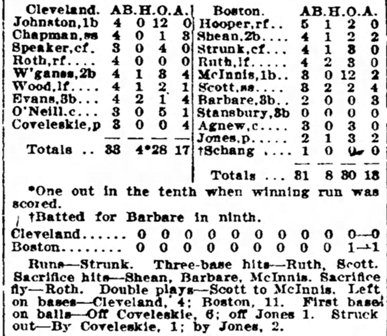
Ruth’s Red Sox were in a scoreless tie with the Cleveland Indians in the tenth innings of the first game of a doubleheader.  Stan Coveleski gave up a single to Amos Strunk with one out, and Ruth came to the plate.

The Boston Post said:

“Coveleski will probably hear the crash of Ruth’s bat for many a day.  The ball sped like a bullet far into the right field bleachers almost to the top.”

The Boston Globe said:

“It is getting so now that Ruth is the man of the hour every day.  His mighty crash into the right field bleachers in the 10th inning drove Strunk home.”

Ruth’s blast landed more than half way up into the right field bleachers, and The Boston Herald said a ball had never been hit further at Fenway Park, but noted, because Strunk had crossed the plate with the winning run “The best the scorers could give Ruth was a triple;” or, as The Post called it “The longest three-bagger on record.”

The box score

The box score

That winter, in his nationally syndicated column, Evans called Ruth’s “triple:”

“(O)ne of the longest drives I have ever seen.

“If there was a real, genuine, sure-enough home run, that wallop was the last word.  It was the longest drive Ruth made for the season, yet in the records he is credited with only a three-base hit.”

Ruth hit

Ruth hit “The longest three-bagger on record.”

To Evans, the solution was simple:

“I believe a more just scoring would have had the final result 2 to 0 in favor of Boston.  I believe a rule should be made which said that when a ball was knocked over the fence, or into the bleachers in an extra-inning game, all runners on the bases, as well as the batsman, should be entitles to score.”

For any present day fan, Evans’ suggestion sounds like common sense.  But, in 1918 it was criticized in many quarters.  One of the biggest critics of the potential rule change was William Blythe Hanna of The New York Herald.  Hanna said the rule change would go against everything the game stood for:

“Nothing could smack more of sophism than such advocacy.  Ball games end when the winning run crosses the plate, and any juggling with the rules to give a man a home run under the circumstances noted would be making the game subordinate to individual feats, which, of course, would be contrary to all the well-founded tenets of sport, discipline and organization.  It is surprising that a man of Evans’ intelligence could take so specious, so fallacious a view.”

Evans suggested his proposed rule change again in a column the following year, and sportswriter Fred Lieb of The New York Sun—a non-voting member of the rules committee—introduced the proposal.  The final roadblock was committee member and National League umpire Hank O‘Day, who according to Lieb insisted “I’m telling you, it is illegal.  You can’t score runs after the game is over!”

Despite O’Day’s objection the rule change was officially enacted by the Rules Committee on February 9, 1920 in Chicago.  Hanna had his final word on the rule the following day in The Herald:

 “This is a radical departure, and it is by no means a sure thing that is was based on sound reasoning.”

“Boys of ’76”

5 Jan

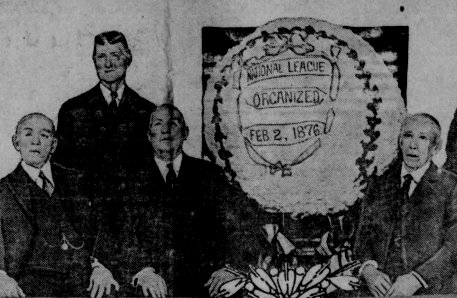
On February, 2, 1925, The National League magnates “paused in (their) schedule deliberations” to honor the league’s past, and kick-off the diamond Jubilee celebration.

Thomas Stevens Rice, of The Brooklyn Eagle said:

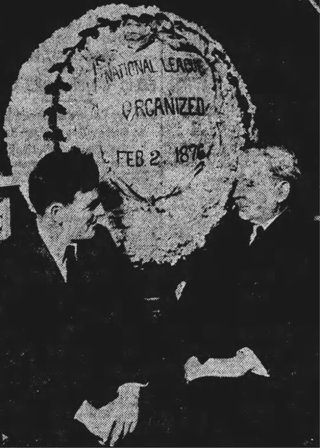
“In the very same rooms in which it was organized on Feb. 2, 1876, the National League of Professional Baseball Clubs met again yesterday.  These rooms are in what is now called the Broadway Central Hotel, then called the Grand Central Hotel.”

The Associated Press said:

“In the same room in which Morgan G. Bulkeley, of Hartford, Conn., was elected the first president of the National League, the baseball men, paid tribute to the character and courage of those pioneers a half century ago.”

Dozens of dignitaries were on hand, including, John McGraw, Christy Mathewson, John Montgomery Ward, and Governor John Tener

But, the stars that day were six of the surviving players who appeared during the league’s inaugural season:

George Washington Bradley, 72, who won 45 games for the St. Louis Brown Stockings; John “Jack” Manning, 71, who hit .264 and won 18 games as an outfielder and pitcher for the Boston Red Stockings; Alonzo “Lon” Knight, 71, an outfielder and pitcher for the Philadelphia Athletics in 1876 and hit .250 and won 10 games, and three members of the Hartford Dark Blues, Tommy Bond, 68, a 31-game winner; Tom York, 74, who played leftfield and hit .259, and John “Jack” Burdock, 72, an infielder who hit. 259. Also present was the only surviving umpire from the 1876 season–Calvin J. Stambaugh.

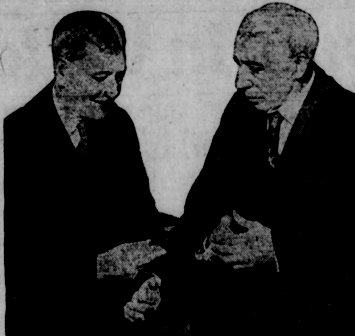
Calvin Stambaugh, right, the last surviving umpire from 1876 and Frank Wilson, a national League umpire from 1923 until his death in 1928.

Calvin Stambaugh, right, the last surviving umpire from 1876 and Frank Wilson, a national League umpire from 1923 until his death in 1928.

Other surviving 1876 players, including George Wright and and Al Reach cited “advancing age” for their inability to attend.

feb21925pix

Seated from left: York, Bradley, and Manning. Standing: Bond.

 Bozeman Bulger of The New York World said, in relating a conversation between too of the attendees, the event was notable for another reason as well:

“(S)everal of us younger men, moving over closer, discovered a contradiction of a tradition long cherished, that old-timers never could admit any improvement in the game or in the quality of the players.

“‘Have you seen this young fellow, Babe Ruth?’ Bradley asked of Manning.

“‘Yes, indeed,’ admitted Mr. Manning, ‘and don’t let anybody tell you that we ever had a man who could hit a ball as hard as that boy.  I doubt if there will ever be another one.'”

Bulger said the “Boys of ’76” also talked about how they “fought crookedness when a salary of $1,800 a year was considered big pay for a star.”  Bradley, who after baseball became a Philadelphia police officer, said:

“‘Oh, we had crooked fellows following us around back in ’76.  They pretended to make heroes out of us and would hang around the hotels.’

“‘One day Mr. (Chicago White Stockings President, William) Hulbert, a very learned man, advised me to keep away from these men.  He explained how they could ruin a boy and lead others into temptation . I was often approached, but thanks to that wise counsel, I kept myself straight, and I thank God for it today.  It’s worth a lot to me to look you younger men in the eye and feel that in turning the game over to you, we gave you something that was honorable.  It’s up to the players to keep it honorable.”

Tom York summed up his feelings about the game in 1876:

“‘Say, do you remember how proud we used to be after winning a game, when we walked home still wearing our uniform and carrying a bat–and the kids following us?  Ball players–all except Babe Ruth–miss that nowadays.”


bondmanning

Bond and Manning talk pitching at the Golden Jubilee kickoff event in 1925.