Hank O’Day, pitcher and Hall of Fame umpire, said Amos Rusie was the greatest pitcher ever:
“Amos is the greatest pitcher the country ever saw. Why, Rusie had more speed in his curve ball than any pitcher I ever saw before, or have ever since seen, has in his straight fast ones. Rusie was a wonder—that’s all there is to it. I was behind the plate one day when one of Rusie’s fast incurves hit Hughey Jennings…the ball hit Jennings squarely in the temple, and he fell as though shot by a ball from a Winchester rifle. I caught him in my arms as he toppled backwards—and he was out of his head for three days.” (Contemporary reports of the incident said Jennings actually finished the game, but later lost consciousness for four days)
O’Day was also on the field when Rusie blew out his arm in 1898; Rusie threw to first to pick-off Chicago Orphans outfielder Bill Lange and “his arm cracked like a pistol’s shot.” In 1940 Lange told his version of the story to The Portland Oregonian:
“Amos Rusie, I don’t know of any better one and I never played against any other one as good. He had great control, as well as everything else a pitcher should have. But my base stealing got him. He worried over it. I guess he lost sleep over it. Anyway, one day he showed up on the field and said he had developed a new way to catch me off of first without turning his body. I was anxious to see what he had, and he caught me off of first. But—and it was a mighty large but—in doing so Rusie threw his arm out. And never could pitch in his old form again.”
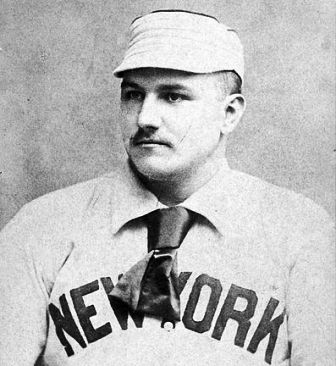
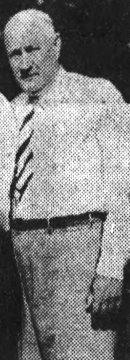
Amos Rusie
Rusie, with a dead arm, became a benchmark, an oddity, and a cautionary tale.
He posted a 246-173 record before the injury; after sitting out all of 1899 and 1900 he was traded to the Cincinnati Reds for Christy Mathewson, appeared in three games, was 0-1 with an 8.59 ERA, and his career was over.
In the decade between 1898 and 1908 The Sporting Life christened “the next Rusie,” or “another Rusie” no less than 20 times; scores more were given the same title by newspapers across the country. Most like Cecil Ferguson (career 29-46), Davey Dunkle (17-30), Cowboy Jones (25-34), and Whitey Guese (1-4) were busts. The three best were Orval Overall (108-71), who was called the “next Rusie” more than anyone else; Ed Reulbach (182-106), and Hall of Famer Ed Walsh (195-126).
During that same decade there were regular, small items in newspapers about Rusie’s post National League life. Shortly after his release from the Reds in June of 1901 papers reported that Rusie, “who commanded a salary of many thousands of dollars, is now working as day laborer at $1.50 a day.” The pitcher told a reporter “This shows I am not afraid to work, but it’s an awful comedown in salary.”
The Dallas Morning News pulled no punches in their assessment of his plight:
“The dismal afterclap to the brilliant career of a once-famous ballplayer whose name was a household word in balldom…reckless wastefulness in financial matters and a total disregard for physical care brought Rusie to his present deplorable condition when he should have been in his prime, for the big fellow is barely 30 now.”
In 1903 it was reported that Rusie had joined the Vincennes (IN) Alices in the Kitty League. While no statistics survive, he appears to have stayed with the team for most of the summer. The Detroit Free Press said he was “playing for a salary of $75 per month.”
After the 1903 season he went to work in a lumber yard, and the regular reports on his activities as a “low-wage laborer” appeared regularly in newspapers. The items became such a regular feature that The Associated Press, in a short story about the Philadelphia Athletics’ eccentric and troubled Rube Waddell in 1904 said:
“Rube has run the gamut of foolishness. He is in his prime but a few more years of such lack of sense as he displayed last season will send him to the wood pile or coal heap and he will, like Amos Rusie, be occupying two inches in the has-been columns every spring.”
There were multiple reports that Rusie was coming back as a pitcher for the 1906 season. The rumors started in September of 1905 when Rusie attended an exhibition game in Vincennes between the Alices and the Chicago Cubs. The Philadelphia Inquirer said of the news:
“If you don’t know the tremendous importance of this announcement you are no baseball fan.”
Not everyone agreed that Rusie returning to baseball would be a good thing. A report from The News Special Service, which appeared in many Midwest papers said:
“His habits were none of the best, and he rapidly deteriorated in efficiency as an athlete. He refused to pitch one whole season because he had been fined by the New York (Giants) management for being intoxicated and abusing his wife. A great deal of foolish sympathy was wasted about that time on Rusie, but he was entitled to nothing except what he received, and some who knew the circumstances thought stricter disciplinary methods would not have been amiss.”
Rusie didn’t sign a contract that spring; and two other rumors that John McGraw had sent him a letter inviting him to spring training with the Giants and that he would return to the Kitty League didn’t materialize either.
But Rusie did make the news again in June. A man named Gabe Watson was collecting mussels in the Wabash River when his boat when his boat overturned. The Evansville Courier said Rusie pulled the drowning man from the river.
The nearly annual reports of “Rusie’s return” ended after 1906, but Rusie’s many career, and life changes continued as newspaper copy for the next twenty years.
When pearls were discovered in the Wabash River’s mussels, Rusie became a pearl diver. Two years later he was in Weiser, Idaho, serving a 10-day sentence for public drunkenness. In 1910 he was in Olney, Illinois working in a glass factory. The following year he moved to Seattle, Washington. For the next decade served as an umpire for a couple of Northwestern League games, worked as a ticket taker and groundskeeper at Yesler Way Park and Dugdale Field, home of the Seattle Giants, and also worked as a steam fitter. Rusie went to jail at least once while in Seattle, and remained a big enough name that when he was injured by a falling pipe in 1913, it made newspapers throughout the country.
In 1921 Rusie became another in the long line of former players hired by the New York Giants at the behest of John McGraw. According to newspaper reports McGraw offered the former pitcher a “job for life” as a “deputy superintendent” at the Polo Grounds. Interest in Rusie’s career was renewed, and the pitcher was regularly interviewed for the next couple of years, reminiscing about his career and about how he’d like to have had the opportunity to pitch to Babe Ruth.
Unlike most of the former players who McGraw found work for at the Polo Grounds, Rusie did not stay for the rest of his life; he returned to Auburn, Washington in 1929 and bought a farm, where he remained for the rest of his life. He was badly injured in a car accident in July of 1934—The Seattle Daily Times said Rusie’s vehicle overturned and he sustained a concussion and broken ribs.
While he received less attention after being incapacitated after the car accident, Rusie was still mentioned frequently in the press until his death in 1942; contrary to oft-repeated fiction that he died in obscurity. And his obituary appeared in hundreds of papers across the country in December of 1942. It wasn’t until the post WWII area that Rusie stopped being a household name, which led to his final comeback in the 1970s; Rusie was inducted into the Hall of Fame 34 years after his death.
Tags: Amos Rusie, Bill Lange, Cecil Ferguson, Chicago Cubs, Chicago Orphans, Christy Mathewson, Cincinnati Reds, Cowboy Jones, Davy Dunkle, Ed Reulbach, Ed Walsh, Hall of Fame, Hank O'Day, Hughie Jennings, Kitty League, National League, New York Giants, Northwestern League, Orval Overall, Philadelphia Athletics, Rube Waddell, Seattle Giants, Vincennes Alices, Whitey Guese

 Baseball History Daily