Tag Archives: Cap Anson

“Pitcher Geiss No Good”

3 Jun

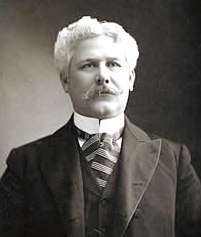
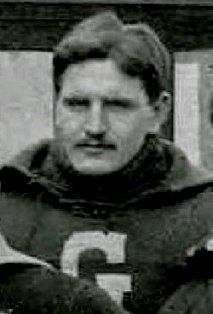
Emil August Geiss pitched one game in 1887 for Cap Anson’s Chicago White Stockings; it was his only Major League game as a pitcher (he later played two games in the infield).

The Chicago Tribune reported that Geiss was signed by the White Stockings “at a salary of $250 month.”  Geiss had been blacklisted the previous season for failing to report to the St. Paul Freezers in the Northwestern League after signing with that club.  The paper said, “It cost $200 to get him reinstated (The Sporting Life said it was $600).”

Geiss’ performance on May 18 was less than memorable.  He gave up 11 runs, eight earned, and 17 hits in an 11-4 loss to the Washington Senators.

The Chicago Tribune headline the following day summed up Geiss’ performance:

Pitcher Geiss No Good

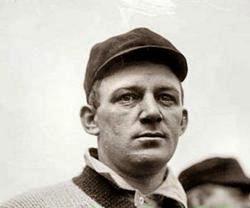
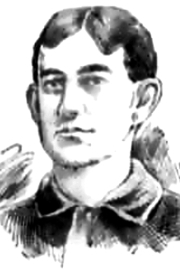
Emil Geiss

The headline in The Chicago Inter Ocean was no kinder:

Geiss Is No Good.  A New Pitcher Tried by the Chicagos at Washington with Disastrous Results

The paper said Anson, who sat out, “watched the game from the players’ bench, a look of disgust deepening on his face every inning widened, and fairly turned his back on the unfortunate Whites.”

Geiss briefly redeemed himself when filling in for Anson on June 15 against the Indianapolis Hoosiers. The Tribune said:

“Geiss played first base in first-class style. He accepted eleven chances with no errors.At the bat he struck out twice and made one hit.”

Their opinion changed one week later when he played in place of Fred Pfeffer at second and  made three errors on seven total chances and was 0 for 5 at the plate.

The Tribune said:

“If Geiss is capable of no better work that he did yesterday he should not be allowed to again don the uniform of the Chicago nine.  A man who plays as he did is a positive menace to the success of the club.”

At the end of June, Geiss was released and finished the season in the Chicago City League.

An additional note about Geiss, and it’s a confusing note:

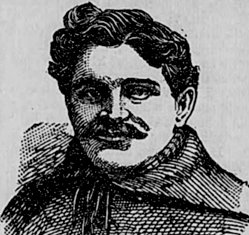
The remainder of his career is a bit vague and complicated.  His brother was William Geiss, who had two brief major league stints and a long minor league career during which he sometimes played under the name of Emil Geis (one “s”), further complicated because Emil Geiss’ Cook County, Illinois death certificate lists him as “Emil Geis.”

Emil pitched for the London Tecumsehs in the International League in 1888 and ’89.  He was the subject of a dispute between London and New Orleans in the Southern League over his rights—an arbitrator ruled that Emil was the property of London; at the same time William was with New Orleans, so we know it was Emil with London.

After a seven-year absence from professional ball, Baseball Reference has Emil hitting .402 in 41 games split between Bloomington in the Western Interstate League and Ottumwa in the Eastern Iowa League in 1895.

It seems likely, and contemporary reports indicate that it was actually William, playing under the name Emil Geiss (sometimes Geis) who put up those numbers in 1895–this conclusion is also supported by the fact that Emil, who had joined the Chicago Police Department in 1891 was still a member a force in 1895.

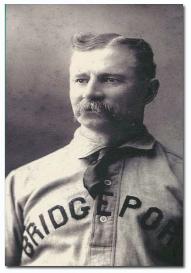
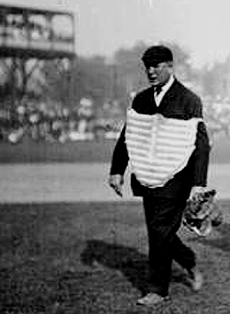
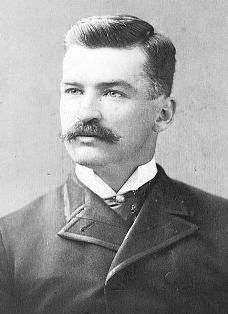
William Geiss

William Geiss

Both brothers died in Chicago, Emil on October 4, 1911, and William on September 18, 1924.  Both are buried at Saint Boniface Cemetery in Chicago.


Diet Tips from Tim Murnane

6 Apr

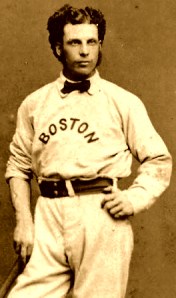
Tim Murnane, who began his career as a first baseman for Middletown Mansfields in the National Association in 1872 and later was a member of the Boston Red Stockings in the National League’s inaugural season in 1876, would go on to become one of the most influential baseball writers in the country.

Tim Murnane

Tim Murnane

Writing in The Boston Globe in 1906, he said he had discovered the one thing that caused the greatest harm to a baseball player.

“Over-feeding kills off more ballplayers than accidents or hard work on the ball-field.”

Murnane suggested two solutions.  First, he recommended that, “The Fletcher system should be taken up by the veteran ballplayers without delay.”

The “Fletcher System” or “Fletcherizing” was a then very popular diet technique put forth by a “self-taught nutritionist” named Horace Fletcher.  Fletcher claimed, in several books published during the first decade of the 20th Century that the key to weight loss was to chew food so completely that it was virtually liquefied before swallowing.  Called “The Great Masticator,” Fletcher counted Thomas Edison, Henry James, Franz Kafka, John D. Rockefeller, J.C. Penny—and apparently Tim Murnane—among his adherents.  His theories had fallen out of favor, replaced by diets based on calorie intake, by the time of his death in 1919.

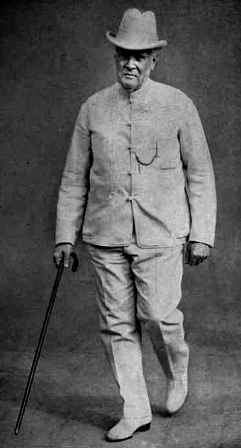
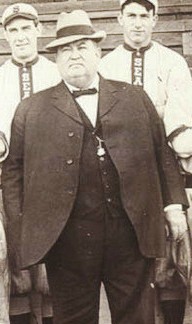
Horace Fletcher "The Great Masticator"

Horace Fletcher, “The Great Masticator.”

Secondly, Murnane said, “(T)he rules of eating should be laid down by the management of every club.”

He said Harry Wright, who had been Murnane’s manager in Boston, “(W)as about the first baseball man to keep a close watch over his players during meal time,” and insisted they eat lightly before games.

“’Just a plate of soup.  That’s plenty,’ would be Mr. Wright’s cry as the players filed into the dining room for lunch.  The greatest athletic performances on the field have been accomplished on practically empty stomachs.”

[…]

“I have known at least half a dozen good ballplayers being passed up in Boston on account of paying no heed to the manager’s advice about overloading their stomachs.  Frank Selee was just as much of a stickler in this line as was Harry Wright, and both were remarkably successful baseball managers.  The manager who does not pay especial attention to this end of the players’ life must lose out, for his team will be unable to keep up a fast clip very long after the boys commence to take on flesh as the result of overfeeding and drinking.”

Murnane had other diet tips for readers:

“A ballplayer cannot drink too much good milk.  The greatest drinker of milk I ever knew was James O’Rourke, and Jim, after thirty-three years on the ball-field, is just as lively a 10-year-old today.  O’Rourke never used tobacco in any form, nor ever indulged in malt liquors, but what a milk drinker he has been all his life and what credit to the national game, from every angle you view the old sport!’

Jim O'Rourke

Jim O’Rourke, “The greatest drinker of milk.’

Murnane blamed the disappointing performance of the Boston Americans in 1905 (Fourth place, 78-74, 16 games out of first) on the dietary habits of the team:

“To be honest, I think the Boston Americans last season practically ignored condition from first to last.  I never witnessed on one ball team so many men out of form by being overweight…This club would have won at least one dozen more games had they taken good care of their stomachs, and no one knows this better than Captain (Manager Jimmy) Collins himself, who has said it will be a much different season with the Boston club next season.”

The next season, 1906, was much different, but not in the way Collins had hoped.  The team was 35-79 when Collins was replaced as manager by Charles “Chick” Stahl, and finished in last place with a 49-105 record.

Murnane concluded:

“Baseball was never intended for a fat man’s game, and Captain Anson was the only heavyweight who ever piloted a pennant winner, although my old friend Charley Comiskey was growing a bit stout when his boys carried off the prize five years ago.”


“Silly Assertions by a Brace of Newspaper Nincompoops”

1 Apr

Adrian Constantine “Cap” Anson’s Chicago White Stockings cruised to the National League championship in 1880. The team was never out of first place and won the pennant by 15 games over the Providence Grays.

The 1880 National League Champions

The 1880 National League Champions

Two influential newspapers, The Cincinnati Enquirer and The Washington Capital spent the offseason downplaying the White Stockings’ victory and questioning the team’s integrity.

The Enquirer’s OP Caylor had a long-time feud with White Stockings—and National League President William Hulbert–which heated up further at the close of the 1880 season when the Cincinnati Reds were banished from the National League. Cincinnati management routinely leased the team’s Bank Street Grounds out for Sunday games—games where beer was sold as well. Hulbert pushed through a ban on both practices for the 1881 season, then, as was his original intent, forced the Reds out of the league.

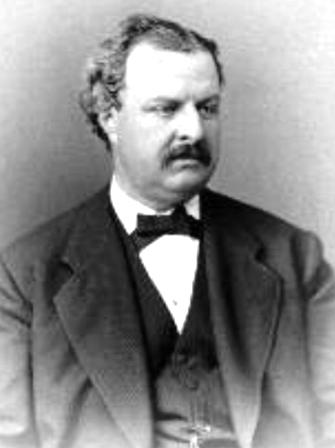
William Hulbert

William Hulbert

Caylor attributed the White Stockings’ success to favorable schedules approved by Hulbert’s “well-trained minions,” and he declared:

“The League, as owned and operated by Hulbert, is rotten and corrupt.”

The Capital, an independent, crusading weekly, took it further. Not content to limit the accusations to off-field corruption, the paper claimed it was common knowledge Chicago had thrown games late in the season.

Over their last fourteen games, the White Stockings were 9-4 with a tie. The Capital said:

“Everybody knows that when the Chicagos had the championship well in hand last season they gave games away to attract gate money…(Hulbert) does not seem to know that the public knows that every time his league goes into secret session it is to concoct some means of swindling the public or the players, or both.”

The Chicago Tribune would not let the insults stand. Their defense was no surprise, in 1875 the paper’s baseball writer, Lewis Meacham had been Hulbert’s conduit for selling the public on the formation of the National League as a successor to the National Association–a league free of drunkenness, gambling and corruption. While Meacham had died in 1878, the paper remained Hulbert’s staunch ally. The Tribune said:

Silly Assertions by a Brace of Newspaper Nincompoops

“Everybody knows that this assertion is a silly falsehood, without a shadow of basis in fact or reasonable probability. So far from losing games to attract gate-money, the Chicago club finds that nothing pays so well as to win all games and lose none. If such a thing were not possible, the club that should go through the greater part of a season without once suffering defeat would attract more patronage and make money than any club ever organized.

“Reason and fairness are, however, wasted upon two such hopeless imbeciles as the fellows who butcher base-ball in the columns of The Washington Capital and The Cincinnati Enquirer.”

The Tribune said jealousy over the lack of a National League club in each city was the only explanation:

The Capital man has been standing on his head ever since the League was impelled by geographical reason to refuse the Washington club’s application for admission; and The Enquirer man has been similarly inverted both as to body and brain ever since the Cincinnati Club was kicked out of the League on account of its refusal to abolish Sunday games and beer jerking on the club grounds in Cincinnati.”

like most 19th-Century allegations of malfeasance on and off the field, the allegations were quickly forgotten.

The White Stockings cruised to another championship in 1881 with a 56-28 record, finishing nine games ahead of second place Providence. It was Hulbert’s final season. He died three weeks before opening day in 1882.

The Tribune, Hulbert’s greatest ally to the end, said upon his death:

“His great force of character, strong will, marked executive ability, unerring judgment of men and measures, and strict integrity and fairness were of incalculable value to the league, and he was rightly considered to be the brains and backbone of that organization. In him, the game of base-ball had the most useful friend and protector it has ever had; and in his death the popular pastime suffers a loss the importance of which cannot easily be exaggerated.”

“The Chicago players began to Kick Vigorously”

26 Jan

The Chicago White Stockings arrived in Detroit on the evening of June 18, 1886 with a mission.  The Detroit Wolverines had won their first 18 home games, and threatened the record of 21 set by Chicago eight seasons earlier.

The Chicago Tribune said on the morning of the game a delegation of nearly 200 Chicago fans, led by team President Albert Spalding, arrived by train.  The Chicago Tribune said:

“Out of the car doors piled the delegation from the windy city, each man bearing a new broom with a placard strapped across the straw end announcing the arrival of the ‘Record Breakers.’”

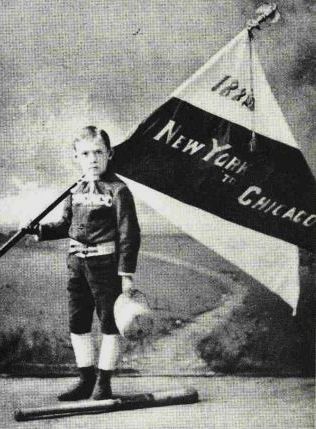
The Chicago players, along with team mascot Willie Hahn, met the group at the train:

“(T)he Chicago players and their mascot marched down the platform and placed themselves at the head of the double column of visiting Chicagoans that had formed at the depot, and then with their brooms elevated, the delegation marched out of the depot…The odd looking procession, extending nearly two squares, attracted a vast amount of attention.”

The delegation marched to the team’s hotel, the Russell House, until it was time to leave for Detroit’s Recreation Park at 3 PM.

With Hahn, and the players again in the lead, the delegation marched to the ballpark.

The Chicago Inter Ocean described the team’s arrival:

“The Chicagos were escorted to the ground by a band, and entered the field behind little Willie Hahn, who carried an immense broom on which were the words ‘Our Mascot.’”

Willie Hahn

Willie Hahn

Not to be outdone, the Wolverines had quickly recruited their own mascot for the game.  The Inter Ocean said:

“The Detroits entered the grounds behind a little fellow almost the same size of Willie Hahn, and were received with cheer after cheer.”

The Wolverines mascot was “young Charlie Gallagher,” a local boy “said to have been born with teeth, and is guaranteed to posses all the magic charms of a genuine mascot.”

Charles “Lady” Baldwin pitched for Detroit, and Jim McCormick for Chicago.  Both pitchers gave up four runs through five innings.  Then, said The Tribune:

“Not a run to either side did the sixth, seventh, or eighth innings yield.  The Whites did not once get further than second in these three innings.  (Sam) Crane and (Charlie) Bennett for the home team alone reached third.

“Now (in the eighth inning) came the misfortune to which many a Detroiter attributes the defeat of their team.  Bennett had caught his usually brilliant game without an error…(Fred) Pfeffer was at bat and struck one of those wicked fouls that have so often proved terrors to catchers.  The ball caught the crack catcher upon the tip of the middle finger of his right hand, and almost tore it from the joint.  Bennett bore the pain like a man, tried to brace up and go on, but he soon saw the folly of such an undertaking and withdrew.”

Shortstop Jack Rowe moved behind the plate to replace Bennett, and the following inning, with a runner on second and no out,  a foul off the bat of George Gore struck Rowe’s finger ”jerking the member out of joint, besides splitting it badly.”

Detroit then tried to stall in order to have the game called on account of darkness

(Charlie) Ganzel, the Detroits’ remaining catcher, was then sent for.  A long delay followed.  The delay was so long that the Chicago players began to kick vigorously.  ‘The man will not put on his uniform,’ said (Cap) Anson to (Umpire John) Gaffney.”

Ganzel finally took the field “after twenty-five minutes’ delay.”  Gore singled, moving McCormick to third, then Ganzel allowed a passed ball, and Chicago won 5 to 4.

“The scene that followed can scarcely be described, and the delight of the Chicago delegation bordered upon wildness, and was in strong contrast to the blue faces of the great crowd of Detroiters that filed out of the grounds.  Brooms were waved with increased enthusiasm by the Chicago contingent on the road back to the hotel.”

Detroit won the two remaining games in the series and increased their lead over the second place White Stockings to three and a half games.  They stayed in first place until August 26—Chicago took over the league lead and never relinquished it, winning the National League pennant by two and half games.

Hahn remained the White Stockings mascot until 1888. Charlie Gallagher was never heard from again.

“People who saw the Sport are still Laughing”

17 Dec

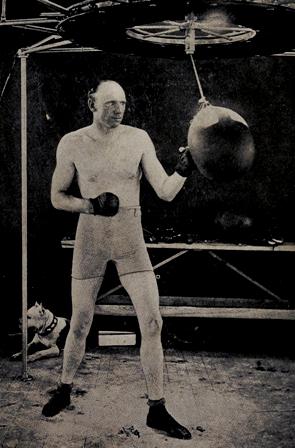
High expectations came with George W. “Big Mike” Mahoney to his hometown Boston Beaneaters in 1897.

A baseball, track and football star at Georgetown University—he played football until the University disbanded the team after his backfield mate George “Shorty” Bahen—a foot shorter than Mahoney– died from injuries sustained during the team’s Thanksgiving Day game against Columbia in 1894.

George "Big Mike" Mahoney

George “Big Mike” Mahoney

In 1895, he gained notice for his pitching after striking out 13 batters in a game with Yale.

The following year, The Philadelphia Times said:

“He has won enviable renown as a pitcher, where his remarkable strength, speed and ability to curve have made him a very formidable player.  He has also played football, where his remarkable physique, weight and strength have stood him in good stead.  One would imagine that his weight—236 pounds—would prevent his running with any remarkable speed, but it is so distributed—he being probably the largest athlete in the college world, measuring six feet five—that it is little of an encumbrance to him.”

In the spring of 1897, it was rumored that Mahoney would not return to Georgetown and instead sign with Boston.  The Philadelphia Inquirer said:

“(I)t is understood that he will play professionally with the Boston league team.  Mahoney is considered a wonderful pitcher, as well as being a fine catcher and first baseman.”

Shortly after signing with the Beaneaters, The Washington Evening Times said Mahoney had been offered the opportunity to take up yet another sport:

“(Mahoney) has a chance to shine pugilistically.  En route to Pittsburgh Sunday the Bostons had Bob Fitzsimmons for a traveling companion.  Fitz was smitten with Mahoney’s size, and offered to take him in charge and coach him into a high-class heavyweight.”

Bob Fitzsimmons-wanted to train Mahoney for the ring.

Bob Fitzsimmons-wanted to train Mahoney for the ring.

Mahoney turned down the offer.

On May 18 Boston was in Chicago; trailing the Colts 9 to 5 in the eighth inning, Mahoney made his big league debut on the mound for the Beaneaters.

The Colts and The Chicago Daily News were not kind to the rookie:

“Mr. Mahoney, the largest man seen in the League for many moons, made his debut in professional ball at the west Side Grounds yesterday.  He now wishes he had tarried at his Georgetown school.  The reception given Mr. Mahoney was one of the warmest ever seen around these districts since the year 1, and the people who saw the sport are still laughing.

“Mr. Mahoney is 6 feet 5 or more, and one of the finest looking men imaginable.  Small girls, who admire big men, could be heard squeaking, ‘Isn’t he cute?’ all of the stand.  He has been loafing around the park during the present series, doing nothing but taking life easy, and the multitude were really getting inquisitive as to who he was and what right he had to live.

“He went into the fray at a rather inauspicious time.  The Colts had just demolished (Ted) Lewis and had biffed fat (Jack) Stivetts in the solar plexus.  When Mr. Mahoney’s giant frame loomed up there was a shout of laughter, then a pause of dread lest the monster should prove strong and speedy in proportion to his fearful size.

“He threw a ball:  (Bill) Dahlen hit it.  He threw another: (Bill) Lange hit it.  He threw one more: (Walter) Thornton hit it.  And the picnic might have gone on had not the long man climbed eleven feet higher and pulled down a bounding ball (Mahoney had jumped high to rob Colts catcher Tim Donahue of a hit up the middle)”

Mahoney faced seven batters, allowed two runs, three hits, walked one and struck out one.

Mahoney

Mahoney

The Daily News ended the ridicule by allowing that Mahoney might, someday, be a good pitcher:

“The fate of Mr. Mahoney is no new experience for a young pitcher.  Many a man who has afterward been a star has been a horrible fizzle on his first appearance, while many a man who has panned out no good on earth has made a glorious debut.  Thornton was a conspicuous success on his initial day, and has been nothing in the way of box work since.  (Clark) Griffith did not do very well the first tie he pitched for (Cap) Anson, and he is the best of all nowadays.  Mr. Mahoney, if given a fair show, may yet become a (Amos) Rusie.”

Mahoney never received “a fair show.”  He never pitched in another major league game.  He caught one game for Boston, and went 1 for 2 with an RBI, but was released in July of 1897.  Mahoney appeared in two games for the St. Louis Browns the following season—he was 1 for 7 and committed one error.  For his four-game big league career he hit .111 and posted an 18.00 ERA.

After one more season playing for several East Coast minor league teams, Mahoney returned to Boston where he became a police officer; he died there in 1940.

“He’s a Loafer and a Drinker”

3 Dec

Bill Lange and Elmer Foster were likely the two favorite subjects of sportswriter Hugh Fullerton, who continued to write about both long after their careers were over. Another favorite subject was Bill Dahlen, who spent eight of his 21 big league seasons in Chicago, and received numerous mentions in Fullerton’s columns.

Bill Dahlen

Bill Dahlen

Fullerton claimed during the 1890s he worked for an editor who was “a wild baseball crank.” The editor had an assignment for Fullerton after watching Bill Dahlen play a particularly bad game for the Chicago Colts one day:

“(He) summoned me and said, sharply: ‘Go after that fellow, Dahlen, and drive him out of town. He’s a loafer and a drinker.’”

Fullerton said, “there wasn’t a chance to argue,” and he let his friend Dahlen know he would “pan the life out of him and drive him off the team, explaining the circumstances.” Dahlen, he said, “wished me success.”

Fullerton said after writing critically about Dahlen for two weeks, the two were together on a train as the Colts headed to the East Coast:

“Dahlen and I slipped away from (Cap) Anson’s ever watchful eye and sought the buffet car and liquid refreshment. While we were thus engaged the editor entered the car, addressed me, inquired whether the team was on the train and was introduced to Dahlen. I left them at 11 o’clock, the editor ordering more beer and talking baseball with Dahlen. The following morning the editor stopped at my berth.

“’I was much mistaken in that young man, Dahlen,’ he remarked. ‘He is a smart, intelligent and interesting young man. I believe these stories about his drinking have been exaggerated. I fear we have been misled by the talk of cranks. I wish you would write a story suggesting him as the logical successor of Captain Anson as manager of the team.’”

On several occasions Fullerton told another story about Dahlen, this one involving a run-in with umpire Hank O’Day; there were always slight variations in the dialogue:

“Billy Bull Head Dahlen perhaps has been driven to the the bench oftener than any player in the country. Dahlen is a nagger. He keeps right after an umpire from the time he gets displeased with a decision until the game ends, and then starts over again the next day.”

Hank O'Day

Hank O’Day

Fullerton said Dahlen approached O’Day before a game in New York:

“Say, Hank, if I run at you in the first inning and call you a blank, blank, blank and step on your toes with my spikes and push my glove into your face, what’ll you do?’

“‘Do?’ said Henry, getting roiled up. ‘Do? I’ll chase you off the lot faster than you can run.’

“‘All right,’ said Dahlen, calmly, ‘no hard feelings. I just want to get put out quick, so i can get to Harlem in time to get a bet down on the fourth race.’

“‘You can’t get put out of this game in a thousand years, not if you spike me in the face.’

“Nor could he, although he did everything he could think of O’Day made him play out the string, and the horse he wanted to bet on won the race at heavy odds.”

“This kind of Argument is the Veriest kind of Twaddle”

1 Dec

After just one season in the National League—a 24-36 record and a fifth place finish in 1878–the Indianapolis Blues disbanded.  Four members of the Blues joined the Chicago White Stockings—Silver Flint, Joe Quest, Ned Williamson, and Orator Shafer.
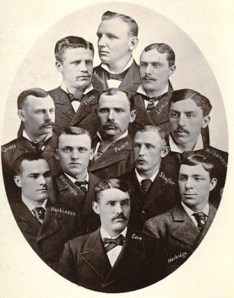
The 1879 White Stockings

The 1879 White Stockings

The White Stockings had been a disappointment in 1878, finishing in fourth place with a 30-30 record under Manager Bob Ferguson.  President A.G. Spalding, who had named Ferguson as his successor when he retired from the field, announced that first baseman “Cap” Anson would replace Ferguson for 1879.

The changes gave the Chicago press high hopes for 1879.

But, The Cincinnati Enquirer did not agree.  The paper said while the Chicago club was “greatly strengthened where it was very weak,” they would still finish no better than fourth place unless they were “properly managed.”  Boston Red Stockings Manager “Harry Wright could take this team and run it up to second place at least.”

In January The Enquirer implied that in addition to questionable management, Chicago’s new players were going to be a detriment:

“A prominent baseball official of Boston, in a private letter written recently, sententiously remarks: ‘Look out for the Indianapolis element in the Chicago Club next year.’  There’s a text for everybody’s thoughts.”

The Chicago Tribune quickly fired back with an article under the headline:

“Harmony” vs. Energy

 “There has been a great deal said at one time and another concerning ‘harmony’ in nines, and those who had the most to say on the subject contended that it was an essential point to be carefully looked after in the formation of any club which hoped for success on the diamond field.  Now The Tribune does not wish to set itself up in opposition to the judgment of men who have made baseball and the management of those who play it a study and a business venture, but it does say that many of them have harped so long upon this matter of ‘harmony’ that it has become a kind of second nature, whereby their judgment has been sadly warped.  Of late a paragraph, started in Cincinnati, has been going the rounds, in which the general public is solemnly warned to ‘look out for the Indianapolis element in the Chicago Club’ during 1879.

“Now the President and Manager of the Chicago Club are probably about as astute and far-seeing as any in the business and in view of this fact and reflection on their judgment or sagacity is in bad taste, and the parties who make ill-advised criticisms on the course of any club in hiring men, are very apt to undergo the unpleasant experience of persons not brought up in New Zealand who indulge in the pastime of throwing boomerangs; their weapons may come back and inflict considerable damage on those who threw them.  Whether or not the White stocking nine of next season will be a ‘harmonious’ one, it is doubtful if anybody knows, and still more doubtful if anybody cares.

“At the risk of being howled at by several papers, the baseball columns which are presided over by young men whose practical ignorance of the game is exceeded only by their ability to construct tables which not even themselves can understand when printed.”

One of the “Young men” referred to was The Enquirer’s sports Editor Oliver Perry “O.P.” Caylor.
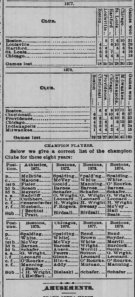
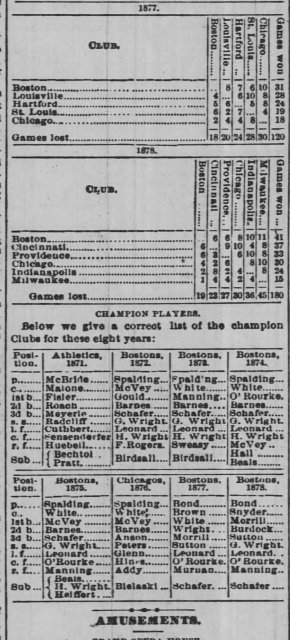
One of O.P. Caylor's tables "which not even themselves can understand when printed.”

One of O.P. Caylor’s tables “which not even themselves can understand when printed.”

The Tribune will say that the question of whether or not the Chicago nine of next season ‘harmonizes’ will probably make very little difference with its play.  Some of the men who enjoy the reputation of being first-class kickers and disorganizers are nevertheless very handy individuals to have around when a base hit or good field play in wanted.  Without intending either to arouse the wrath or flatter the vanity of the very amiable and stalwart young man, Anson, it may be said that his reputation as an experienced and prolonged kicker is one that any man might be proud of; but, in spite of those who preach that harmony is everything, he is acknowledged to be one of the best and most useful ball-players in the country.  (Cal) McVey, of the Cincinnatis, can also make quite a conspicuous kick, even when not specially called upon to do so; still he is a good ball-player.

Lip Pike is a disorganizer of the first water, but last season, when he used to hoist a ball out among the freight cars on the lake shore, people who were presumed to know a good player yelled themselves hoarse in his praise.  The list could be extended indefinitely, but such action is not necessary.  Those who organize nines on the basis of ‘harmony’ alone will never grow rich at the baseball business.  It is not possible to get together nine men who could travel around the country eating, sleeping, and playing ball together that would never get out of tune.  Nine angels could not do it, much less nine mortals, subject to the little idiosyncrasies that human nature is afflicted with. “

The Tribune likely assumed the “prominent baseball official of Boston,” was Manager Harry Wright, and next turned its attention to him, his brother, and his championship teams.

“Harry Wright has always been the prophet whom the ‘harmony’ men delighted to honor, and the success of the Cincinnati and Boston Clubs under his management has been laid entirely to the dove-like dispositions of the men engaged by him.  This kind of argument is the veriest kind of twaddle, and the history of the Boston Club proves the truth of this assertion.  George Wright and Tommy Beals went many a day without the interchange of a friendly word, and George and (Charlie) Gould did the same thing.  For one whole season Ross Barnes and Gould never exchanged a word, and glared at each other like opposing game chickens, but the Boston’s won the pennant that year (1872—National Association) all the same harmony or no harmony.

“Other instances of like character could be adduced were there any necessity therefore, but these, from the fountain head of ‘harmony,’ will suffice.  If a club wins the championship it will be because its men play ball, not because they are ‘goody-goody’ boys.  Your man who gets hot at something during a game, and then relieves his feelings by making a two or three base hit, is much more valuable than one who, although possessed of a Sunday-school temperament at all times, manifests a decided aversion to reaching first base., when the occupancy of that particular bag of sawdust would be of some value to the men who pay him high wages for playing ball.”
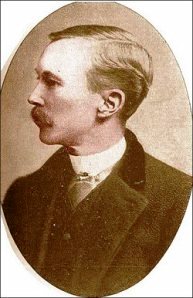
O.P. Caylor

O.P. Caylor

Caylor would not let the insult to him and to Harry and George Wright, go unchallenged:

The Chicago Tribune published some strange statements against the argument that in harmony there was always strength.  To prove that harmony was not always necessary to create strength in a baseball club, the writer made bold to say among other things that Tommy Beales [sic] when a member of the Boston Club, went many a day without the interchange of a friendly word with George Wright, and that the same feeling existed between George and Gould.  The writer knew from the first these statements were fiction, but in order to crush the fallacious argument our reporter left it to George Wright himself for an answer.  The letter is before us from which we quote, though we half suspect George would demur to its publication out of modesty if he knew it. “

Wright wrote to Caylor:

“(The Tribune) said Tommy Beales [sic] and I went many a day without the interchange of a friendly word, and that Gould and I did the same thing.  While they were with the Boston nine they were about my best friends.  Most of the time Beales [sic] boarded at my house, while Charley and I roomed together on trips.  I think the reporter was wrong in his argument against ‘Harmony’ as it was the great cause of the Boston Club’s success.  The credit for this mostly belonged to Captain Harry Wright.”
George Wright

George Wright

Although it appears Wright spelled the name of his good friend Tommy Beals incorrectly, he got the spelling right 12 months later when he named his son—tennis Hall of Fame member –Beals Wright after his former teammate.

The Tribune allowed Wright, and Caylor, the last word, and dropped the dialogue regarding “harmony.”

Despite Caylor’s prediction, the White Stockings, under Manager Cap Anson, led the National League from opening Day through August 15.  Anson became ill during July, and as his performance slipped, so did the team’s fortunes.

Suffering from what The Tribune called “an acute affection of the liver…that had sadly impaired his strength and capacity for play,” Anson left the club on August 26 with a 41-21 record, in second place, just a game and a half back.

With Silver Flint serving as manager, and without Anson’s bat—he led the team with a .317 average—the White Stockings were 5-12 in the last 17 games, and a fourth place finish.

Harry Wright’s Boston Red Stockings finished second; his team, winners of the previous two National League championships lost some of the “harmony” that made them winners when his brother George Wright and Jim O’Rourke signed with the Providence Grays.  George Wright, in his only season as a manager, led the Grays to the 1879 National League championship.

“Women have been the cause of Ruin of more Good Clubs than Anything Else”

17 Oct

In 1907 Hugh Fullerton wrote in The Chicago Herald about the outside influences that he felt did the most damage to a ballclub:

Hugh Fullerton

Hugh Fullerton

“There are dozens of things that happen to keep a team from landing a pennant about which the general public is entirely ignorant and which never can be explained clearly.

“For instance, one of the mysteries of baseball was the breaking up of the famous White Stockings team.

“Hundreds and thousands of people cursed the management of the Chicagos for selling off star players and wrecking the club—and few ever knew why it was.  The management felt worse over it than the fans possibly could feel—but it was inevitable.  A scandal in the club concerning two members and the wife of one of them started the trouble.  Threats to kill each other were made—and the disruption of the club became absolutely necessary.  The sale of (Mike “King”) Kelly (1887) and (John) Clarkson (1888) was the beginning –and after a time all parties to the scandal were let out—and Chicago was given a decade of losing clubs.”

Mike "King" Kelly

Mike “King” Kelly

He claimed the reason for the breakup of the White Stockings was a common one.

“Women have been the cause of ruin of more good clubs than anything else.  They need not necessarily be bad women.  There was one club in the old twelve-club National League which, for two years, was knocked out of all chances of winning merely because the wife of one of the players was an inveterate gossip.  She knew everything that went on in the club and retained it until she had half the players up in arms against each other.

“One of the best manager s in the country today frowns upon all women and his players, under his direction, forbid their wives to mention the subject of baseball to each other.  The result is that there is the best feeling in the club.  Almost every member of the team is married, their wives meet socially at all times—and baseball is tabooed by common consent.

“I know a catcher, one of the toughest, hardiest fellows in the business, who nearly was ruined as a catcher by the women of the club.  He was so strong and tough that you couldn’t have dented him with an ax, but one day he split his hand a little bit.  He thought nothing of it, and was ready to catch the next day when the women got to pitying him and telling him he ought to take good care of it.  When he left the grounds he had tied up the injured place with a rag—and was all right.  By the next morning he was ready to go to the hospital—and he did lay off for two weeks, all because the women made a martyr of him.”

But, according to Fullerton, there was something almost as bad for a baseball team as women:

“Horse racing, however, has ruined almost as many clubs as women have.  Once a team gets interested in horse racing, and so far as winning goes, it might as well disband.

“One of the greatest troubles in the present New York National League team is the devotion of some of the players to the racing game.  (John) McGraw himself has been so successful at it that baseball has become sort of a side issue.  Many of his players have followed his example, and the result is they think more of horse racing than of baseball.

“Racing did more to wreck (Ned) Hanlon’s championship Brooklyn team than any other thing.  The Washington Park grounds are so close to the Brighton and Sheepshead tracks that players could see two or three races before the game.  Eventually baseball was forgotten and the conversation in the clubhouse dwelt only on horse racing.

(Cap) Anson had a crowd of horse race fans for several years, and the result on the work of the team was something frightful.  They talked horse racing even on the field, and had the telegraph operators throwing out messages telling what horses had won.”

And, he said, gambling in general had been detrimental to the Giants during the years Andrew Freedman owned the club (1895-1902):

“There always was a crap game or a poker game in the clubhouse, and the stakes were so high that bitter feeling was endangered.”

While Fullerton, for the most part, avoided naming names, he did single out one former Chicago manager, who had died five years earlier, for presiding over teams that were “ruined” by gambling:

“The Chicago team the second year under Tom Burns (1899) was wrecked by the same sort of deal, the manager setting a bad example in that respect.  Burns also was charged by the Pittsburgh owners with ruining their club, when he was manager (1892), by permitting and encouraging gambling.”

Tom Burns

Tom Burns

“We didn’t have any High-Faluting Baseball Paraphernalia”

15 Oct

The Seattle Star said of Dan Dugdale:

“No man in the Northwest can rival the experiences in baseball that Daniel E. Dugdale has had in the national game.”

In his 1934 obituary, The United Press called Dugdale “the father of organized baseball in Seattle.”

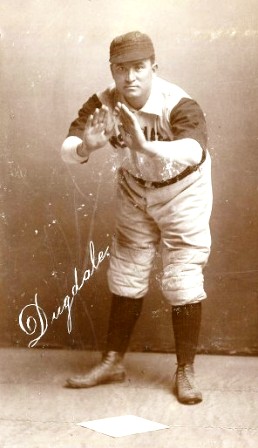
Dan Dugdale

Dan Dugdale

Primarily a catcher, Dugdale played professional ball for more than a decade; including two stints in the National League with the Kansas City Cowboys in 1886 and the Washington Senators in 1894.  He retired after the 1897 season and made what was intended to be a brief stop in Seattle on the way to Alaska for the Klondike Gold Rush.  He never made it to Alaska, and in Seattle, he organized most of the city’s early professional teams and built two ballparks.

Dan Dugdale 1894

Dan Dugdale 1894

Forty years after he began playing he shared his reminiscences about in the early 1880s in his hometown of Peoria, Illinois with Seattle reporter Leo Lassen:

“We didn’t have any high-faluting baseball paraphernalia for the deciding game of the Peoria, Illinois city championship in the summer of 1883.  I can remember that we used a piece of the curbstone for home plate.  Nobody except the catcher used glove, and he only had a fingerless glove of thin leather over both hands.

“Oh yes!  Of course my team, the Double Browns, won, or it wouldn’t start this story out right.  It was in that game that I got my start as a catcher.

“I had been playing shortstop, but the regular receiver split a finger and there wasn’t anyone else to catch, so I tried it.

“We stood back for the pitches except on the third strike, and except with men on bases, catching the ball on the first bounce when standing back.

Ted Kennedy, who later helped pitch one of Pop Anson’s Chicago teams into the championship, was hurling for our side that day, and baby but he could throw that ball with plenty of swift.

“’Don’t catch if you want to keep your health,’ Ted warned me before taking up my receiving duties…Kennedy was right.  The first time I stood up close to catch, the ball hit that curbstone plate and crashed into my mouth, knocking out teeth by the wholesale and putting me on queer street.

“But in those days no one considered quitting as long as it was possible to stand up and catch the ball.

“I finished the game and we won the championship, and I felt well repaid for it.

“That game started me on my baseball career as a catcher, after which I was to serve for 15 years as a receiver for clubs throughout the country.”

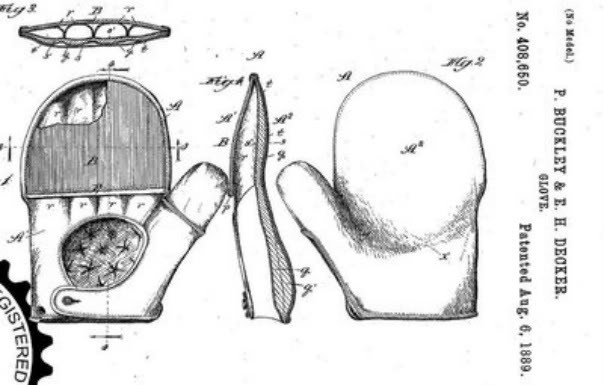
Kennedy wasn’t the only major leaguer Dugdale played with while in Peoria.  In 1885, he played with one of the claimants to the title of invention of the catcher’s mitt—Harry Decker—and Dugdale talked about some of the attempts his teammate made to protect his hands four years before Decker was awarded the patent for the Decker Safety Catcher’s Mitt:

“(Catchers) had no shin guards, masks or big gloves in those days, and a fellow had to be almost a martyr to go behind the plate with fellows like John Clarkson, Amos Rusie and those old stars doing the pitching.

“The big catcher’s pad now in use in baseball, is the same glove that Harry Decker, a teammate of mine on the Peoria team in 1885, invented.

“Harry had been troubled with split fingers and he kept tinkering around with leather trying to figure out how to protect his left hand, which does the big work for all catchers.

“He had a thin, fingerless glove to start with and one day he slipped a piece of raw beefsteak between the glove and his hand and that glove gave him his first idea.  He used this protection for almost a season, using a fresh piece of meat each day.

“Then he tried shot in the pocket of the glove and put a piece of leather on top of the shot, leaving it between the two pieces of leather.

“This gave him the idea of building the mitt up bigger and lacing fingers on the back of the glove.

“One day he hit upon the idea of stuffing the glove with rags in the mitt for protection, and finally got some good felt and used that.  It has been in use ever since.”

Decker Safety Catcher’s Mitt

Decker Safety Catcher’s Mitt

Dugdale remained the most prominent figure in Seattle baseball until he was hit by a truck and killed in 1934.

Accounts vary over how much Decker received from the sale of the mitt patent to A.G. Spalding.   He  is one of the enigmatic 19th Century players for whom there is no information on the date or location of his death.

After his career ended in 1891 he was convicted of numerous crimes—most involving forgery, but also including larceny and bigamy; several of his crimes involved other ballplayers.

Throughout his career Decker had a reputation as a womanizer; The Philadelphia Inquirer called him “The Don Juan of the Diamond,” but by 1890, perhaps exacerbated by his being hit in the head by a pitch, he went from lovable rogue to serial offender.  He racked up arrests and convictions in at least six states and an involuntary commitment to the Elgin State Hospital in Illinois over the next 25 years.

Victims of his crimes included Dugdale, and Al Reach, both of whose names appeared on forged checks in separate cases, and Jack Horner and Pat Pettee, teammates of Decker’s in 1891 during his brief stay with the New Haven Nutmegs in the Eastern Association.  Decker was convicted of stealing property worth $150 from Horner and $55 from Pettee after the two had allowed him to stay in the apartment they shared.

Decker’s trail goes cold after he was released from California’s San Quentin Prison in 1915.

Leo Lassen, the reporter Dugdale spoke to, went on to become the radio voice of the Seattle Rainiers of the Pacific Coast League from 1931 through the 1961 season.  Some surviving audio can be found here.

“Stories of his Badness are told all over the League”

8 Oct

After “Bad Bill” Eagan finished the 1898 season with the Syracuse Stars –he hit just .227, his lowest recorded minor league season average—then returned to his native Camden, NJ–Eagan started his amateur baseball career in Camden as a pitcher, his catcher was another Camden native, William “Kid” Gleason.

Bad Bill Eagan

Bad Bill Eagan

The Harrisburg Telegraph—Eagan had spent two seasons playing in the Pennsylvania city—told the story:

“Bill Eagan the once great second baseman of the Harrisburg Club, in a fair example of what rum will do when it gets the upper hand of a man.  Eagan would have been one of the leading players of the profession if he had left strong drink alone.  He was a sure fielder, hard batter and quick baserunner and ought to be in his prime as a player by this time, but he has drained too many mugs and now winds up in a police court at his home in Camden, NJ, on a charge of attempted murder.

“Eagan was intoxicated yesterday and displaying a 48-caliber revolver, placed it to his temple and remarked: ‘I am going to kill my wife and blow my brains out.’ He paid Barber Riceman fifty cents which he owed him, and also paid a nearby saloon keeper $1 for drinks that he had bought.  Then he returned to the barber shop, said good-bye to his friends, and exclaiming; “Now I am free from debt and am ready to do the job,’ he started for his home and put the threat into execution.

When he arrived home Eagan fired two shots at—and missed–his wife, and then attempted to shoot one of the responding police officers, but because of “a quick blow from (another police officer’s) club the murderous weapon was knocked from the crazed man’s hand.”

The Chicago Tribune said:

“William Eagan, or, as he is known in the baseball profession, ‘Bad Bill’ Eagan, is a player of national reputation.  He is an ignorant man, and stories of his badness are told all over the league.  He was considered one of the best ball players in the profession.”

The Tribune said about Eagan’s brief stay with Pittsburgh earlier in 1898:

“He failed to behave himself, and drunkenness was the charge which let him out as a Pirate.”

Eagan was held in the Camden jail from October of 1898 until March of 1899; it is unclear what he was formally charged with, and he was never tried.

In spite of his reputation, baseball wasn’t done with “Bad Bill” yet.  Shortly after his release from jail, Syracuse sold Eagan’s contract to the Western League’s Detroit Tigers.  His statistics for the season don’t survive, but Eagan seems to have gone back to his old habits.  After he sat out both games of a double-header with the Kansas City Blues in July, The Kansas City Journal said:

“’Bad Bill’ Eagan acquired a jag yesterday and succeeded in making a holy show of himself.  Such creatures and ‘Bad Bill’ should be out of the game.”

Eagan was also seriously injured the same month when, according to The Associated Press, during a game with the Columbus Buckeyes, while trying to stretch a double into a triple:

“Eagan threw himself, feet foremost toward the bag.  His spike caught in the base sack and his right leg was given a terrible wrench.  ‘Bad Bill’ screamed with pain and in an instant was surrounded by members of both teams… (He) had thrown out his kneecap.  (A doctor) pushed the cap back and then the injured player was carried to the bench.”

Whether the injury contributed or not is unknown, but by August The Sporting Life reported that he had again worn out his welcome:

“Bad Bill” Eagan has worn a Detroit uniform for the last time. Eagan has not behaved at all and (George) Stallings has got through for good and all with him.”

George Stallings

George Stallings

One more team was willing to take a chance on Eagan; he was signed for 1900 by the Youngstown Little Giants in the Interstate League.  After appearing in just 26 games The Sporting Life reported that:

“Eagan has been playing ball in Youngstown, OH, but he said he needed a rest.  He came to Detroit for that purpose Saturday morning, and he paid $5 in the police court this morning for the first installment. “Bad Bill” said he was so glad to get back and he met so many friends that he rather lost track of the proceedings. He had fallen Into a Rip Van Winkle sleep when the policeman picked him up. “Bad Bill” paid his fine and went out for the “rest.” Bill doesn’t think much of Youngstown, he says. “

The Youngstown Vindicator said Eagan was released by the Little Giants before he left for Detroit

In either case, he had finally run out of chances, and never played another professional game.

The Indianapolis News said, in late August of 1900, that Eagan was:

 “(P)icked up on the streets of Detroit) insane.  He was removed to the emergency hospital, where he became violent and it took a number of men to overpower him and take him to the station and confine him in a padded cell.  Drink caused Eagan’s downfall. Sober he was a hard working ambitious ball player; if a drink or two were given to him he became a dangerous maniac.”

He was released after several days, and the the many premature rumors of his death began at that point, while Eagan continued to tend bar in Detroit. In April of 1904 w he became ill and was sent to a tuberculosis sanitarium in Denver.  Ten months later “Bad Bill” was dead at age 35.

Despite having played just six games with Chicago in 1893 Eagan made such an William A. Phelon that more than 20 years later he wrote in “Baseball Magazine:”

 “Although the poor fellow had few chances given him in the big league, I always thought there never yet was a second baseman who mixed and mingled in the furtherance of infield plays like Bad Bill Eagan. Possibly I can best symbolize Eagan’s style of second-basing, for the present generation, by stating that he played second just about as (Fred) Tenney played first. (Eddie) Collins doesn’t go so far from second as Eagan did, nor does he carry out nearly so many plays—but it’s quite likely he could if he had to—if he didn’t have, through the past few years, the marvelous (Jack) Barry cutting in and taking his half of the proceedings.

Eagan, though, was almost uncanny at times. I saw him working with (Cap) Anson on first and (Bill) Dahlen at short. It might be taken for granted that Eagan would have to move round considerably on the side toward first, with the ponderous and fast-aging Anson on station one, but Dahlen was then in the flush of his youth and a moving streak at short—when he wanted to be. Yet I saw Eagan bewildering Dahlen as well as Anson by the phantom-like rapidity of his movements, and the way in which he suddenly appeared at the spot where the play should be kept going, arriving on the ground before Dahlen could even draw back his arm to throw.”