Tag Archives: Charles Comiskey

Comiskey’s “Sandusky Terror”

15 Sep

In February of 1899 The Chicago Inter Ocean said of Charles Comiskey, then owner of the Western League’s St. Paul Saints:

“It is also proper to state that C. Comiskey is, all things considered, the greatest story teller in this profession.”

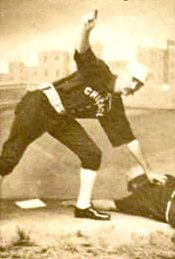
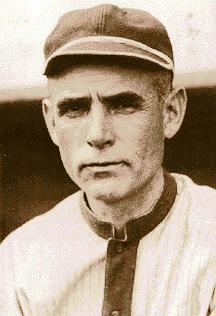
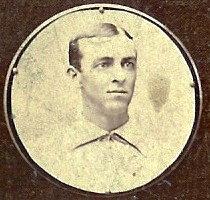
Charles Comiskey
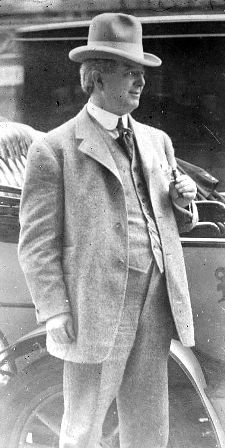
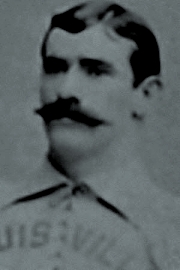
Charles Comiskey

The paper then related one of Comiskey’s favorite stories, told during that winter’s Western League meeting:

“’Speaking of ballplayers and their ways,’ he began, ‘did I ever tell you about my efforts to make a pitcher of the ‘Sandusky Terror?’  It happened while I was managing the old St. Louis Browns… It was in the early spring and I was in St. Louis waiting for my men to report for preliminary training.  (Browns owner Chris) von der Ahe had trouble in signing his star pitcher (Dave Foutz) that year, and when I looked over the list I found that I needed twirlers and needed them badly.  I told my troubles to Chris and he did his best to cheer me up.  He told me, among other things, that he had sent a railroad ticket to a young farmer who lived near Sandusky, and from all accounts was a wonder.  I didn’t enthuse, for I had had previous experience with these rustic phenomenons , but Chris said that a friend of his in Sandusky had bet him a case of champagne that the boy would prove a grand find.’

Chris von der Ahe

Chris von der Ahe

“’Next morning the boy from Sandusky showed up at the ballpark.  He was one of the biggest and strongest chaps I ever met in or out of baseball.  What is more, he had a pitching arm of tremendous powers, and after he passed the ball to me five minutes I saw that he had a world of speed and for a raw amateur, very fair control of the ball.’

“’Well, we started on a little training trip down South, and as a matter of course I took the boy with us.  His terrific speed and his willingness to learn made him popular with the members of the team, and they spent hours in catching him.  A week passed and I really began to think I had discovered the pitching star of the year.  Things went well until we struck Mobile..  When we drove up the hotel a fairly good looking woman of 30 or thereabouts walked up the bus and caught my Sandusky wonder by the arm.’

“’William,’ she said, ‘I want to have a serious talk with you.’

“’They strolled down the street arm in arm while the other players lounged around the hotel wondering what it all meant.  Half an hour later the couple returned.  The girl went into the parlor, but the young fellow called me to one side.’

“’Captain,’ he said, ‘I have gone and done it.’

“’Done what?’ I asked.’

“’Married Louisa,’ he answered.  ‘You see, she came all the way from Sandusky to teach school down in this part of the country, an’ she says she’s lonesome like an’ that playin’ ball for wages don’t suit her views.  Me an’ she kinder liked each other when she lived up in Sandusky an’ we’ve been writin’ letters to each other ever since she left home.  That’s how she knew I was with your club.  Captain, I guess that’s all, exceptin’ here’s the 60 cents I borrowed from you yesterday.  Louisa says I musn’t quit you owin’ a cent, and she gave me the money to hand to you.’

“’You don’t mean to say you’re going to quit the team,’ I gasped.  ‘Why, we will make a pitcher of you and pay you good wages while you are developing.’

“’That’s just it,’ he answered.  Louisa says I musn’t play for money.  Says her uncle, who is a preacher in the village, insists that it is wrong to do it.  Come in and ask Louis if I am not tellin’ you the truth.’

“’Well, I spent an even half hour in trying to induce that woman to change her mind, but she wouldn’t.  She said she had decided to make a lawyer out of her husband and that they would live on the money she earned teaching school until he was admitted to the bar.  Then she took her youthful husband away from the hotel and that was the last we ever laid eyes on the pair.  Later in the day I made a little investigation on my own account and found that the woman, who by the way, was at least ten years older than her new husband, had taken the boy straight to the parsonage and married him before he had been in the town twenty minutes.  I don’t know whatever became of the pair, but I believe to this very day that if the ‘Sandusky Terror,’ as the players nicknamed him, had gone back to St. Louis with the team he would have developed into another (Amos) Rusie.  I have never forgiven that pretty school teacher for making him jump our club, and, what’s more, I never will.’”

“Because Players are apt to be Foolish”

25 Jul

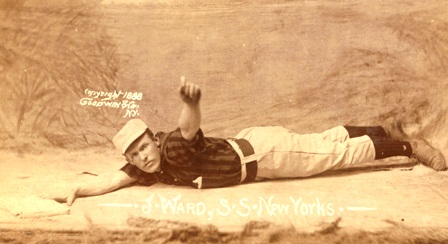
In 1887 John Montgomery Ward shared with The New York Sun his wisdom about what it takes for a ballplayer to get in shape.

“Gymnasium apparatus and gymnastic exercise are going out of favor among ball players for several reasons, and very few of them now attempt to keep in condition through the winter.  When you hear a player going into a gymnasium that usually means he goes in there, tries some feat and lames himself…It is not a good thing for a player to fool with the apparatus.  He does not want to develop big bunches of muscle.  What he needs is agility, suppleness, quickness of eye, hand and foot.  If he goes into a gymnasium he exercises muscles that he does not use in the field, and he either develops them at the expense of his useful muscles, so he puts too much strain upon them, thinking himself as strong in one part as another, and breaks a cord or otherwise injures himself.”

John Montgomery Ward

John Montgomery Ward

He said the gym contained “too many temptations in the apparatus for trials of strength…Because players are apt to be foolish about the use of apparatus managers now discourage gymnasium use as a rule.”

Ward said he, and others were injured in this way:

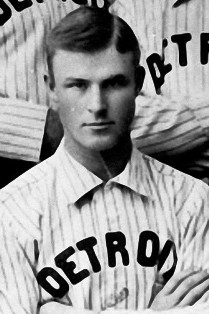
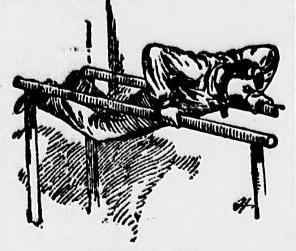
(Larry) Twitchell of the Detroits hurt his shoulder and could not pitch well afterward.  The parallel bars broke some small sinew in my shoulder and spoiled me for pitching, and I can feel the pain now when I raise my arm in a certain way. “

Larry Twitchell

Larry Twitchell was primarily an outfielder after 1887, appearing in just 23 games as a pitcher .

Ward then laid out his vision for how he would prepare a team for the season:

 “If I were training a nine, I would call the men together about two weeks before the opening of the season, and put them at work in a hand-ball court, watching them very closely.  Hand-ball is the best form of exercise they could have, excepting base ball, of course.  When you come right down to the point, no exercise is as good for a base ball player as base ball itself, but in this climate it is not practicable to put a nine at work on the diamond much before the opening of the regular season.  Hand ball comes next to the real thing, as it requires the same agility and quickness of eye, and it is much better than the gymnasium, because it is a game in itself and is full of amusement and excitement.  When the players get interested in a game of hand ball they forget that they are working, and before they know it they are perspiring, and their blood is circulating finely through all their muscles.  The throwing in this game is easy, and there is no danger of a player’s straining his arm or shoulder, as he might if he tried to make a long throw in the field after a long rest.   In catching the ball on the bound and returning it to the wall, activity is necessary, and the work is so quick that it keeps a player on a jump all through the game.  The constant striking of the ball with the palm of the hand accustoms the hand to the impact, and if it does not harden the palm it tends to deaden the nerves on the surface.

“In the handball court the pitcher and catcher and pitcher can pass the ball when not playing in the game, and so get the special practice that the battery needs.  Batting exercise should be kept up by the whole nine also.  The director of this training ought to understand the men thoroughly and adapt the exercise to their individual peculiarities.  The stout man needs to be worked hard and the thin man restrained.  A nervous man is inclined to go in too enthusiastically and do more than is good for him, while the stout, phlegmatic man is averse to exertion, and will not do enough unless he is urged.”

Ward said the parallel bars ruined him as a pitcher

Ward said the parallel bars ruined him as a pitcher

Ward said it was necessary to make players understand that each one should be treated differently when getting in condition for the season:

 “This makes the director’s position anything but pleasant.  The heavy men think that they are doing more than their share, and attribute the difference in work to partiality.  All expect to be treated alike, but that cannot be done, and it is difficult to make some players understand why the work should be varied.

“I would have the men begin to practice throwing about the 1st of March, insisting upon starting with light, easy work, and getting into it gradually.  They ought also to walk some and take short jogs out of doors.  A man may be in good gymnasium condition and still be unfit for hard outdoor work.  Indoor condition is different from outdoor condition.  Let a man work all winter in a gymnasium and then go outside and take a violent exercise, and he will surely stiffen up at first.  He must accustom himself to the open air and difference in temperature before trying to do too much outside.  Hand ball playing will put him in outdoor condition without laming him.  If he does not attend to this matter, but attempts to go right out of the gymnasium and play base ball, he will feel the effects very unpleasantly.  Last year the New York nine played a game the very next day after being called together, having had no preliminary outdoor training to harden the muscles and the next day the men were sore and lame all over.  It took them several weeks to get into condition.  They had to train in the field, and the result was the spring practice was greatly interfered with, and they did not begin the championship series in as good condition as they would have if they had received the proper amount of preliminary training.  A man just out of a gymnasium, with lots of spare flesh, feels strong and thinks he can do anything.  Before the public he will attempt to do more than his condition warrants.  He will try to throw a ball in from the field to home plate, and strain his shoulder or lame his arm so that he can’t throw worth a cent for the next week or two.  Or he will make a good hit and try to get in a home run, the result being lame legs or a strained knee that makes him almost useless for several games.  An injury to a good player at the first of the season may be thousands of dollars damage to the club, but some men do not seem to appreciate that fact.  When the St. Louis Browns were trained by Comiskey they came into the field in splendid condition, and took such a lead in the first part of the season that no club could catch up with them.  The Chicago Club was trained well last year, and won the championship.  This year the Chicago men are having five weeks of outdoor work at Arkansas Hot Springs under (Cap) Anson’s direction, and they will show up in fine form and be able to play well right from the start.

“Many ball players show up for the first game about 25 pounds overweight, and they have to work that off before they can handle themselves well.  It is not advisable to begin in what a trainer calls condition, because one soon feels tired; but neither is it well to have a great deal of extra flesh.  The exact condition to be recommended depends upon the temperament of the player, and must be decided by common-sense rules.  The subject of proper training has been too much neglected by base ball men, but it is beginning to receive attention, and eventually a system will be adopted and its observance enforced by discipline in the clubs.  Some players are sensible enough to see the importance of rational training and will take care of themselves and study up the best methods; but there are many foolish fellows who never think of anything in that line, don’t understand themselves well enough to work properly, and need to be directed and compelled to follow instructions.  The calling together of most of the clubs several weeks earlier this year than heretofore indicates that the managers are waking up to the importance of having their men fit for work at the start.”

He provided a glimpse of the type of manager he would be three years later when he le Brooklyn’s Ward’s Wonders to a second place finish in the Players League:

”Discipline ought to be more strict during the base ball season, and men should not be allowed to knock about and abuse their stomachs as many of them do.  While traveling about the country and getting frequent changes of food and water, it is difficult enough to keep the stomach right with the greatest care.  A nine has been disabled more than once by one man’s recklessness in eating.  A base ball player never ought to be seen in a barroom during the season.  He may go in to get a glass of beer, but he meets friends who insist upon treating, gets four or five drinks that do him no good and that he doesn’t want, and somebody goes about reporting that he was drunk.

“A thin player may get some benefit from a bottle of ale with his meal after the game, but he should not drink before the game; and the stout man should not drink at all, because he does not need anything of the kind.  Base ball players ought to keep regular hour also, go to bed early and get plenty of sleep, and be up by breakfast time.  This staying up until 2 in the morning and then sleeping until noon is all foolishness, and it ought to be prohibited.”

Ward’s views on training had a larger purpose, they were in keeping with his role as the leader of baseball’s first labor movement; in order for players to achieve the status the Brotherhood sought Ward knew they needed to take every aspect of the game seriously, including preparation:

“The sum and substance of the whole thing is that a base ball player must recognize the fact that base ball is a business, not simply a sport.  It is no longer just a summer snap, but a business in which capital is invested.  A base ball player is not a sporting man.  He is hired to do certain work, and do it as well as he possibly can.  The amount of his salary depends entirely on the way he does his work, and it is for his own interest to keep himself in the best condition and study how to get the best results.  If he does not know how to train himself, he should submit to the direction of somebody who understands the business.  Players are beginning to see this, but they need to see it more clearly yet.  They have been through the gymnasium experience and learned that performing feats of strength and turning on the rings is not good for them, and many of them have given up winter training on that account, but they have yet to learn that there is a proper system of exercising and training that is indispensable.  Those who do appreciate the importance of the matter are glad to see the growing interest and discussion, but the success of clubs that exercise systematically will o more than all the talking toward bringing about a general recognition of the benefits or training and the adoption of a perfect system of discipline.”

“There will be Cliques”

30 Jun

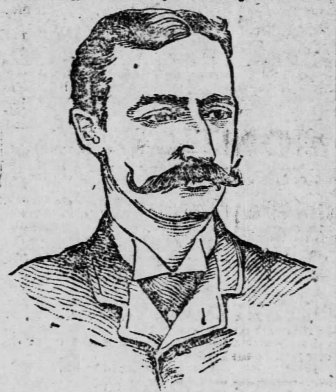
William Ingraham “W.I.” Harris was one of the most important baseball writers of the 19th Century, but like Charles Emmett Van Loan three decades later, he died young and is mostly forgotten today.

He was sports editor for The New York Press, which was billed as “The aggressive Republican newspaper of New York,” and The New York Star.  The Sporting Life said of Harris:

“He feels strongly in any given direction and talks earnestly. One cannot be long in his presence without being convinced of his unswerving honesty and sincerity.”

He was, along with Ren Mulford Jr. of The Cincinnati Times-Star, an outspoken critic of the Players League, and said he agreed with Mulford’s assessment that the appearance of the Brotherhood, and the resulting “baseball war” was “a campaign for the preservation of baseball law on one side and its destruction on the other.”

William Ingraham Harris

William Ingraham Harris

Harris was also considered the best prognosticators among contemporary baseball writers, and before the 1890 season began he said:

 “For the past two years I have had the satisfaction of naming the champions of both major associations before a championship game had been played…and last season (in the National league), with the exception of Pittsburgh and Cleveland, I located the exact position at the finish.”

He said he would not attempt to handicap the results of the three leagues in 1890:

“The writer who ventures to make predictions as to the results of the championship fight in any one of the many leagues at this stage of affairs takes an enormous risk on masticating a pretty tough crow later on.”

But, said Harris, he was “willing to take my chances on giving one tip,” before the beginning of the season.  The “tip” went against the conventional wisdom, in fact, it went against what the entire baseball world considered a certainty; the fate of the club The Chicago Tribune called “The greatest team ever organized.

“(I) shall not undertake to pick any winners this year until the season has been well started.  I propose, however, to nominate one team that will not win a pennant, and that is the Chicago Brotherhood team.  In making this assertion I am bucking against general sentiment, or rather general belief.  The consensus of opinion is the other way.  There is no doubt that on paper the Chicago Brotherhood team is in many respects one of the greatest aggregations of baseball stars ever got together, but there are some potent reasons against its success.“

Harris was critical of the team’s catchers and pitchers:

(Conrad “Dell”) Darling never was a first class catcher and never will be.  (Charles “Duke”) Farrell is a strong hitter, and at times a most brilliant catcher, but he is not a steady or remarkably heady catcher.  Boyle is a good one, but he isn’t in it with such good men as (William “Buck”) Ewing, (Jack) Clements, (Charlie) Bennett, (Charlie) Ganzel, (George “Doggie’) Miller, (Connie) Mack, (Michael “King”) Kelly, (John “Jocko”) Milligan, (Paul) Cook and (Cornelius “Con”) Daily.  On catchers the team is all right on quantity, but short in quality.

“As to pitchers, (Mark) Baldwin, in 1887 and 1889, was a star In 1888 he was not to be depended on.  Baldwin doesn’t take care of himself as he should in the winter time.  As a pitcher he ranks among those who may be great at any time, but who keep you guessing on the dates.

(Charles “Silver”) King, in condition, is a ‘tip topper.’  He was a failure in the League once before, and in the world’s Series against New York didn’t astonish people to any extent.”

He dismissed the other two pitchers, Frank Dwyer and Charlie Bartson as a “medium man” and “unknown quantity,” and said “Unless strengthened in the battery department, and probably not then, this team will not land first.”

He conceded that “The outfield and infield are well-nigh perfect.”  But, there was a bigger problem than the weak pitching and catching; Harris predicted tension between second baseman Fred Pfeffer, who had raised $20,000 for the creation of the Players League, recruited most of his Chicago White Stockings teammates to jump to the Brotherhood, and was one of the club’s directors, and team captain and first baseman Charles Comiskey:

“(T)he Comiskey-Pfeffer or the Pfeffer-Comiskey combination.  By the way, which is it?  The answer to this will have quite a bearing on the general result…There will be cliques.  Germany and Ireland will be at war in less than a month.  The public may not know, but the lack of harmony will be there and will have its effect.  Comiskey is a great baseball captain.  At least he was in the American Association.  His methods are well-known.  He was supreme at St. Louis.  Everything went.  The men had no respect for (owner Chris) von der Ahe.  They feared Comiskey.  At Chicago Comiskey will find some men who have just escaped from the rule of a greater captain than himself, perhaps a harder task master.  They have reveled all winter over the prospect of freedom from that restraint, proper and effective though it was.  They are stockholders—yes magnates—now.  Will they swallow Comiskey’s manners on the field and in the dressing room?  As Charlie Reed sings, ‘Well, I guess not.’ (Reed was a famous minstrel performer in the 1880s and 18890s)

“Comiskey must change his methods.  He will have to gag himself; he will have to, figuratively, kiss the baseball blarney stone; he will have to be cheerful, under protest; and, above all, if harmony be his objective point he will have to please Director Pfeffer.  He may not try to do these things; he probably won’t.  Comiskey will have his way.  He always has had it.  He can only rule by practically despotic methods.”

Fred Pfeffer

Fred Pfeffer

Harris correctly concluded that Brooklyn, New York, and probably Boston (the eventual champions) would finish ahead of Chicago.  At season’s end, The Chicago Times summed up how prescient Harris had been about the fourth place team in the Players League:

“The outside world cannot fully realize the bitter disappointment felt here over the poor showing made by Comiskey’s team during the season just closed.  Surely it was strongest aggregation of players ever collected in one club, but its lack of success was mainly from two causes—lack of discipline and the miserable condition of certain members of the club.

“There has been absolutely no discipline in the team, and some of the men paid as much attention to Comiskey’s orders as they would to a call from some church congregation.  An order to sacrifice was met with a smile of scorn, and the ball was hammered down to an infielder, who made an easy double play.”

Harris died the following summer on July 7, at age 33, of tuberculosis.  The Boston Globe, the first paper he worked for, said:

“Being of a most observing nature, a ready thinker and as it were, a lightening calculator, he managed to foretell many of the leading baseball events of the year weeks ahead…Mr. Harris was without exaggeration, one of the brightest of his class, a ready and graceful writer and a hard worker.”

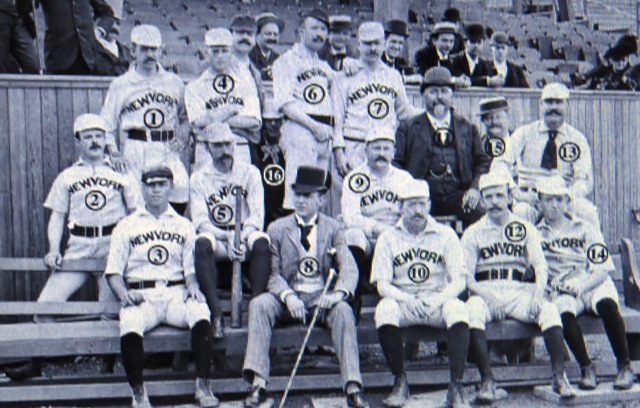
W.I. Harris (#5), as a member of the New York Reporters Baseball Club at the Polo Ground in 1889.

W.I. Harris (#5), as a member of the New York Reporters Baseball Club at the Polo Ground in 1889.

“King of the Bushes”

23 Apr

Edward Francis “Ned” Egan was called “The Connie Mack of the minors” and the “King of the Bushes” during his managerial career.

It is likely that most of the statistics listed under Egan’s name on Baseball Reference and other sources  are for another player or players with the same surname.  Egan’s grave, burial record, birth and death record confirm that he was born on January 13, 1878, in St. Paul, Minnesota–which would make him 10-years-old for the first playing records for the “Ned Egan” listing.  Contemporary references to Egan’s playing career are vague–most say he played semi-pro ball in Minnesota beginning in 1897, and some sources say he was with St. Paul Saints in the Western League in 1901; although his name does not appear on any roster for the team.

What is certain is that his managerial career began 1902 and that he won eight pennants in 16 seasons.

Ned Egan

Ned Egan

Egan won championships in 1902 and 1903 with the Winnipeg Maroons in the Northern League,  then won six more with the Burlington Pathfinders (1906 Iowa League of Professional Baseball Clubs, 1908 Central Association), the Ottumwa Speedboys-Packers (1911,12 and ’13 Central Association), and the Muscatine Muskies (1916 Central Association).  The Washington Post called him “The Central Association’s chronic pennant winner.”

Egan was credited with helping develop several major leaguers including Burleigh Grimes, Lee Magee, Cy Slapnicka, Hank Severeid, and Cliff Lee.

Egan finally got his chance in the high minors in January of 1918, but it happened as a result of a fluke.  Al Timme, owner of the Milwaukee Brewers of the American Association announced that Egan would be his new manager.  The Milwaukee Journal said:

 “A very peculiar circumstance brings ‘Ned’ Egan to the local club. When President Temme attended the meeting of the International League in New York some months ago the local prexy opened negotiations with Jack Egan, manager of the Providence club in 1917.  Jack Egan’s name was made public as the possible leader of the Brewers, but the press reports from the east said that ‘Ned’ Egan was being considered by Owner Temme [sic].

“The local baseball headquarters were immediately flooded with recommendations from major leaguers who unanimously stamped ‘Ned’ Egan as the logical man to lead the locals.  Subsequently, Temme [sic], who had not met the St. Paul man, realized that these endorsements of Ned Egan were worth taking stock of and finally he opened negotiations with him.”

Egan was signed to a “provisional contract for 1918, 1919 and 1920.”

Al Timme told reporters he had confidence in his new manager despite the mix-up, and despite the fact he had denied he had any interest in hiring him as recently as a week earlier:

“Ned Egan has devoted his entire life to baseball—is one of the best posted and able men in the game today.  No one has a wider or more favorable acquaintance, especially with major league club owners.  His development of players and many pennants prove conclusively Mr. Egan’s superior ability to build and handle a team.”

Egan returned home to Minnesota in late January, and while ice skating another skater ran into him, knocking him down.  Egan sustained what he thought was a minor back injury.

Ned Egan, 1918

Ned Egan, 1918

In February Egan contacted Timme and told the Brewer owner that the injury was more serious than originally thought; he had fractured two vertebrae and said that a doctor had recommended he resign.  The Journal said:

“Mr. Timme prompted Egan to reconsider.”

A month later after “his fighting spirit kept him on the job constantly,” Egan’s injury became so severe that he was no longer able to walk.  The Journal said:

“The St. Paul man is at present confined to the Sacred Heart sanatorium here, at the expense of the Milwaukee ball club.  He is a nervous wreck…Physicians cannot predict how long Egan will be incapacitated.”

The Brewers then hired Jack Egan, the manager Timme originally sought, to replace Ned Egan.

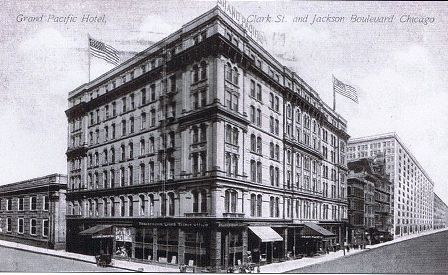
Egan was still in the sanatorium on May 4 when he was released for 3 days in order “to visit Chicago” and checked into the Grand Pacific Hotel.  On May 6 The Chicago Tribune said:

“Edward F. (Ned) Egan…was found dead with a revolver at his side in the Grand Pacific Hotel shortly after midnight this morning.  He had apparently been dead for hours.  Despondency, brought on by ill health, is believed to have led him to commit suicide.”

The Grand Pacific Hotel Chicago

The Grand Pacific Hotel Chicago

Timme told The Journal:

“So far as I have learned, his condition while at the sanatorium was improving.  I will have Mr. (Tom) Hickey (president of the American Association) obtain the facts from the police at Chicago.”

It was reported that Egan, who “owned considerable property in St. Paul,” was to be married in June.  His first wife had died in 1912, just more than a year after their marriage.  The day following his death, the Cook County Coroner confirmed the cause of death was suicide and said Egan was despondent over his injury.

The Milwaukee Sentinel published a eulogy for Egan written by long-time minor league umpire Oliver Otis “Ollie” Anderson:

“Umpires are supposed to have no feelings—to shed no tears, but they do bow their heads occasionally, and mine is bowed in thought, I have just read of the death of Ned Egan.

“As a baseball genius he was worthy of being compared to Comiskey, as a developer of players he was a Connie Mack, as a winner of pennants he was king of the bushers.  As a friend he was loyalty itself.

“What more can we say.”

Opening Day—1901

26 Mar

The Chicago White Sox opened the American League’s inaugural season as a major league on April 24, 1901, against the Cleveland Blues.  The three additional league games scheduled for the 24th were postponed on account of rain.

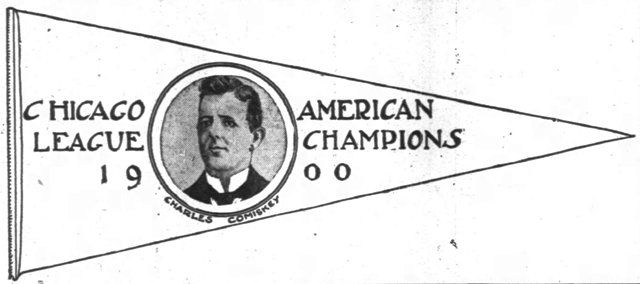
The Sox won the then-minor league American League championship the season before.

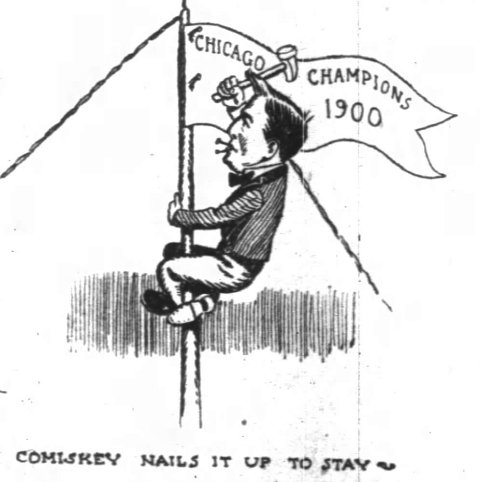
1900alchamps


Comiskey relinquished managerial duties in 1901 to Clark Griffith, the pitcher jumped from the cross-town National League Orphans for a reported $4,000; a $1,500 salary increase.

Clark Griffith

Clark Griffith

The opener at Thirty-Ninth and Wentworth included a parade, several bands, and speeches from many dignitaries—The Chicago Tribune said every member of Chicago’s City Council was on hand, but Mayor Carter Harrison, who had promised Comiskey he would appear to speak and throw out the first ball, “was kidnapped by William J. Bryan, who slipped into town unperceived. ‘Commy’s’ plans for having the Chief Executive start the opening game were shattered.”

The Tribune said American League President Ban Johnson also missed the game; he had traveled from league headquarters to attend the opener in Philadelphia “and it’s a 1,000 to 1 shot he was sorry when he found Comiskey was the only magnate who had squared himself with the weather man.”

Other than the absence of the mayor and the league president, the paper said the first game of the upstart league was a success:

 “Under the fairest skies the weather clerk could select from his varied stock of April goods; with a championship pennant floating high above them from the proudest pine of all Michigan forests; with 9,000 fans to cheer them from a pent-up enthusiasm that burst forth at every possible opportunity, the White Stockings open the American League baseball season on the South Side Grounds yesterday with a clean-cut victory over the aggregation from Cleveland.”

The Chicago Inter Ocean, which reported the attendance at 10,073 said:

“As a grand opening it was an unqualified success, something which Charles Comiskey can look back upon in after years with all the serene satisfaction of a baby who has just swallowed a tin Indian.  As a ball game it was a hideous nightmare, a cold and icy vision of the darksome night, a living horror, let loose to stalk adown a diamond field, hooting hoarsely…With pomp and ceremonial, with braying of bands and braying of fans, with an enormous audience gathered in the frapped stands, the American League season of 1901 was duly opened in Chicago, and the real champions, Comiskey’s White Stockings, began their campaign by giving the Clevelands all that was coming to them.  The afternoon was cold; the stands were Greenland, and the bleachers bore nets of icicles.  Yet 10,000 cranks and crankesses, keen devotees of the game.”

The Chicago Daily News said more than 14,000 fans were at the game:

“Promptly at 3:30 the two clubs lined up at the plate and, preceded by a “Rough Rider” band, marched to the flagpole at the south end of the field, where the championship banner was unfurled to the strains of ‘The Star Spangled Banner.’”

Cartoon of "pennant" being hoisted from The Chicago Tribune.

Cartoon of “pennant” being hoisted from The Chicago Tribune.

The Associated Press said the attendance was 8,000.

The Tribune said the crowd was enthusiastic despite the weather:

“There were cheers for everybody, from (William Ellsworth “Dummy’) Hoy, who couldn’t hear them, to (starting pitcher Roy) Patterson, the hero of many a hard-earned victory last year…there were flowers for (Dave) Brain, the youngest of the White Soxs [sic]…And at the end there was so much surplus exuberance that the bleacherites indulged in a merry cushion fight all through the concluding inning by way of celebration.”

Chicago scored two in the first and five in the second off Cleveland starter Bill Hoffer and cruised to an 8 to 2 victory behind Patterson.

The Inter Ocean said the most “ludicrous” play of the otherwise “uneventful” game took place in the sixth inning when Hoy attempted to steal third:

“(Catcher Bob) Wood threw wild, and (Bill) Bradley scooped up the ball way off from the cushion.  As Bradley, with no thought of the runner, turned to return the ball to the pitcher, Hoy, losing his balance as he ran, slid clear over third , out into the field and right into Bradley, his knee striking the ball clasped in Bradley’s hand.  It was possibly the first case on record of a man’s forcing a put-out on himself, and the crowd marveled greatly, perceiving that the science of the game had much advanced, and that there were new freckles every day.”

While the Chicago Orphans were losing their opening game in Cincinnati, The Tribune said the team’s president, James A. Hart, “was present and witnessed the game from a box at the south end of the grandstand.  He chatted with President Comiskey for some time and seemed to like the work of the players, but he did not voice his sentiments.”

Behind Griffith and his 24-7 record, the Sox won the league’s first pennant with an 83-53 record. Opening Day pitcher Roy Patterson was 20-15.  Cleveland finished seventh with a 54-82 record; Hoffer was 3-8 in 16 games when he was released in July, ending his major league career.

1901 Chicago White Sox

1901 Chicago White Sox

Comiskey and Hart were both members of their respective league’s “peace committee” at the January 1903 meeting in Cincinnati that led to the forging of the first National Agreement.


“The Game was not Exactly ‘On the Square’”

21 Mar

After the 1886 season, Jim Hart brought a team composed of members of his Louisville Colonels and other American Association players west.  The team played their way out towards California, winning twenty games against minor league, semi-pro and “picked nines.”

Jim Hart

Jim Hart

They finally lost their first game of the tour in San Francisco on December 26 to the Haverlys of the California League.  Dave Foutz, who had won 41 games for the champion St. Louis Browns pitched for Hart’s club.  Foutz allowed three runs on four hits in the first inning then shut out San Francisco on one hit the rest of the way, but Pete Meegan of the Haverlys held the American Association players to just two runs.

Pete Meegan

Pete Meegan

The San Francisco Morning Call said that Foutz who was “rather superstitious” and tried to “have a lemon in his possession whenever he steps on the diamond,” attributed the loss to the fact that the he had purchased a lemon “but was careless and did not put it in the pocket of his uniform.”

After the loss, Hart’s team defeated every California League team, including a Foutz one-hitter against the San Francisco Pioneers.

Dave Foutz

Dave Foutz

On January 23, with some of his players injured, Hart added three local players to his roster for a game with a “picked nine’ of local players in Alameda.  The game was tied 4 to 4 after seven innings, but Foutz gave up two in the seventh and four in the eighth and lost 10 to 4. The San Francisco Chronicle said:

“A large crowd was in attendance at the Alameda Baseball Grounds yesterday to witness the game between the Louisvilles and a picked nine of California players… the impression of many of the spectators was that the game was not exactly ‘on the square’…The cause of suspicion was as to the fairness of the game was caused by the appearance among the spectators of men well known at baseball games offering large odds against the Louisvilles.  At about the seventh inning these men were offering odds of twenty to one against a team that has hitherto been almost invincible.”

The Morning Call headline said simply:

“Hippodrome!”

There was no doubt, said the paper, that the game had been “pre-arranged” and “made up for the picked nine to win.”

In St. Louis there was more concern that Foutz had “broken down,” having given up fourteen hits rather than speculation that he might have thrown a game.  The Globe-Democrat said:

“Regarding the reported break down of Foutz in California… (Manager Charles) Comiskey received a letter from Foutz in which he denied that he had broken down, and said he was as good as ever.”

No one reported whether the pitcher had carried a lemon into the contest.

The evidence of a fix consisted of the activity of the gamblers, Foutz’ performance in the seventh nd eight innings, and an alleged conversation between Louisville’s second baseman Joseph “Reddy” Mack and Ed Morris the pitcher for the “picked nine.” Discussing how the result of the lightly attended game would improve attendance at the next game Louisville was scheduled to play in Alameda two days later.

reddymack

Reddy Mack

Jim Hart was indignant and wrote letters to West Coast papers denying that anyone on his team could have been involved:

“I wish to say that I have made the fullest and most searching investigation and can find no foundation for the charges.  Not one of my men wagered a dime.”

Hart blamed the loss on the “weakened condition” of his team and noted that three local players filled in with his squad for the game.  The players he “brought out here all enjoy national reputations, and they could not afford to hazard their good names for the small amount of gain there would be for them.”

In another letter, written to The Sporting Life, Hart attacked the credibility of the unnamed writer of the article in The Morning Call:

“(I)t was not much of a surprise to in the issue of a sensational morning journal last Monday the flaming headline ‘Hippodrome!’  The journal referred to, I understand, instructs its reporters and correspondents in the following language—‘Make your articles sensational even at the expense of the truth,’ and the young man who wrote the article under the above referred-to head line was evidently closely following instructions…What the young man who wrote the article don’t [sic] know about baseball would make a very large book.”

Hart went on to detail his additional complaints with “the young man” from The Morning Call, but as with his letters to West Coast newspapers, he never addressed the allegations regarding the abrupt changes in the odds offered on the game, and instead of asserting that “Not one of my men wagered a dime,” as he said in the earlier letters, the letter in The Sporting Life said:

“I have investigated the whole matter religiously, and if any of the boys were implicated in any way, they are too smart for me to find out.”

The California League conducted the only official” investigation into the allegations; that inquiry was limited to determining if any of their players were involved in any wrongdoing and according to The Chronicle, simply determined that no California League players “had anything to do with it or were cognizant of it,” and made no statement regarding whether there was evidence of a fixed game.

The Chronicle evidently didn’t think the case was closed and said:

“If Foutz, Mack or (Hubert) Hub Collins expect to come out here again, they must arise and explain to the entire satisfaction” of the league president.

The Louisville team wrapped up the tour in early February; Hart resigned his position and relinquished his interest in the team in order to take over the operation of the Milwaukee Cream Citys in the Northwestern League.  Mack and Collins returned to Louisville, Foutz headed to St. Louis and another 19th Century allegation of dishonest play disappeared into the ether.

The Color Line and the PCL

22 Jan

In the spring of 1913 Walter “Judge” McCredie brought Rube Foster’s Chicago American Giants to the West Coast to play five games against his Portland Beavers of the Pacific Coast League (PCL).  The American Giants won four of the games and also split a two-game series against Nick Williams’ Portland Colts of the Northwestern League.

Walter "Judge" McCredie

Walter “Judge” McCredie

When McCredie made arrangements with Foster for the American Giants to return west in 1914 it created a stir in the PCL.  Joe Murphy of The San Francisco Call wrote:

“Some of the magnates and officials of the Pacific Coast League are bitterly opposed to Manager Walter McCredie’s plan of playing a series of games with the Chicago Giants, an aggregation of colored ball players.  The Beavers played the colored tossers during their training trip last season and were badly beaten by them.”

Murphy said “no official action can be taken against McCredie to prevent his team engaging in games with the dusky tossers,” but said several prominent PCL figures “do not mince any words” regarding the games.

Dan Long, who had managed the San Francisco Seals from 1908 through 1912, was now a West Coast scout for the Chicago White Sox and booked the team’s 1914 spring games in California.  Long said he turned down a request for the Sox to play the American Giants:

“Colored players are barred in organized baseball, and I can see no reason why white players should even meet them in exhibition games, if they are barred by the baseball powers.  Baseball is a sport that must be elevated, and it is up to the managers and players to keep it free from criticism.

“I never arranged or played in any games with colored players, and I doubt Mr. (Charles) Comiskey, owner of the White Sox, would allow his team to play with the colored men.”

James Calvin “Cal” Ewing, the owner of the San Francisco Seals, who was one of the PCL’s founders and a former president of the league, was equally as outspoken:

“If I were a player working for McCredie, and he asked me to go out and play against these colored fellows, I would refuse to do it for him.

“There are two classes I bar from playing on my ball park—colored tossers and bloomer girls.  They will never use any park I control.”

Cal Ewing

Cal Ewing

Allan T. Baum, entering his third season as the PCL’s president said he was against the games, but was powerless to act because the games were played outside of the league’s regular season:

“I have no jurisdiction in the matter, but my sentiments are strongly against it.  I am sure that there is not another manager in the league who would consider playing with the Chicago Giants.”

Lester Aglar Walton, managing editor of the East Coast’s largest circulation black newspaper, The New York Age, responded to “the vicious article” from the West Coast:

“Joe Murphy, in an heroic effort to start needless agitation relative to the drawing of the color line in organized ball, does a journalistic stunt which, while humorous for the absurdities contained therein, is a curious document for the lamentable ignorance which this writer and other show on the subject.”

Walton said the color line was borne solely out of fear:

“The cowardly practice of using the color prejudice subterfuge as a cloak to hide the white man’s fear in open competition with the colored man in various avenues of endeavor will someday lose its effectiveness.  The truth of the matter is some white managers and players are not opposed to playing colored teams solely on account of color, for if their aversion was based purely on color the Indian would not be permitted to join organized baseball, nor would teams of the two major leagues journey every winter to Cuba to engage in games with native players, many of whom are as black as the ace of spades.”

“Manager Walter McCredie is the only game white man in the Pacific Coast League.  He is not afraid to permit his team to meet a strong colored nine and fight it out on the diamond.  There would not be a word of complaint today about the beavers and Giants playing a series of exhibition games had not the colored team given undisputed evidence of its supremacy last spring.”

Lester Aglar Watson

Lester Aglar Watson

McCredie claimed he wasn’t making a social statement.

He told The Portland Oregonian he needed to schedule the games in order to compete with teams like San Francisco in the regular season.  The Seals, he said, were preparing for the season by playing the White Sox, and taking in between $15,000 and $20,000 in the process:

“Yet they rave because I book the Beavers for four or five games against the Negroes, although they furnish the only stiff opposition available.

“It is to laugh.  Likewise the statement that playing against the Negroes hurts baseball.  It might, were we to consider them on an equal footing because of the strong race prejudice that exists here on the Coast. But the games are nothing more or less than training affairs.”

Despite the objections, Foster and his team arrived on the West Coast in March of 1914.

The rest of the story on Friday

“By-By, Baby Anson”

26 Dec

On August 20, 1888 Adrian Constantine “Cap” Anson and his Chicago White Stockings were set to begin a three-game series with the Pittsburgh Pirates.  Chicago was in second place, six and a half games behind the New York Giants.

Anson’s club had been in first place for most of the season, but  relinquished the lead to the Giants after dropping eight of nine games at the end of July.

After sweeping two games from the Giants in New York earlier that week, Anson said he had just improved his team by signing pitcher John Tener, who was playing for the East End Athletic Club in Pittsburgh, for a reported $2500 for the remainder of the season.   He also spoke to a reporter from The New York Times:

“Mr. Anson is inclined to think that New York will ‘take a tumble,’ and if it occurs soon the Giants’ chances of closing the season at the top of the pile are woefully thin.”

Another New York paper, The World, was determined to not let Anson forget his prediction.

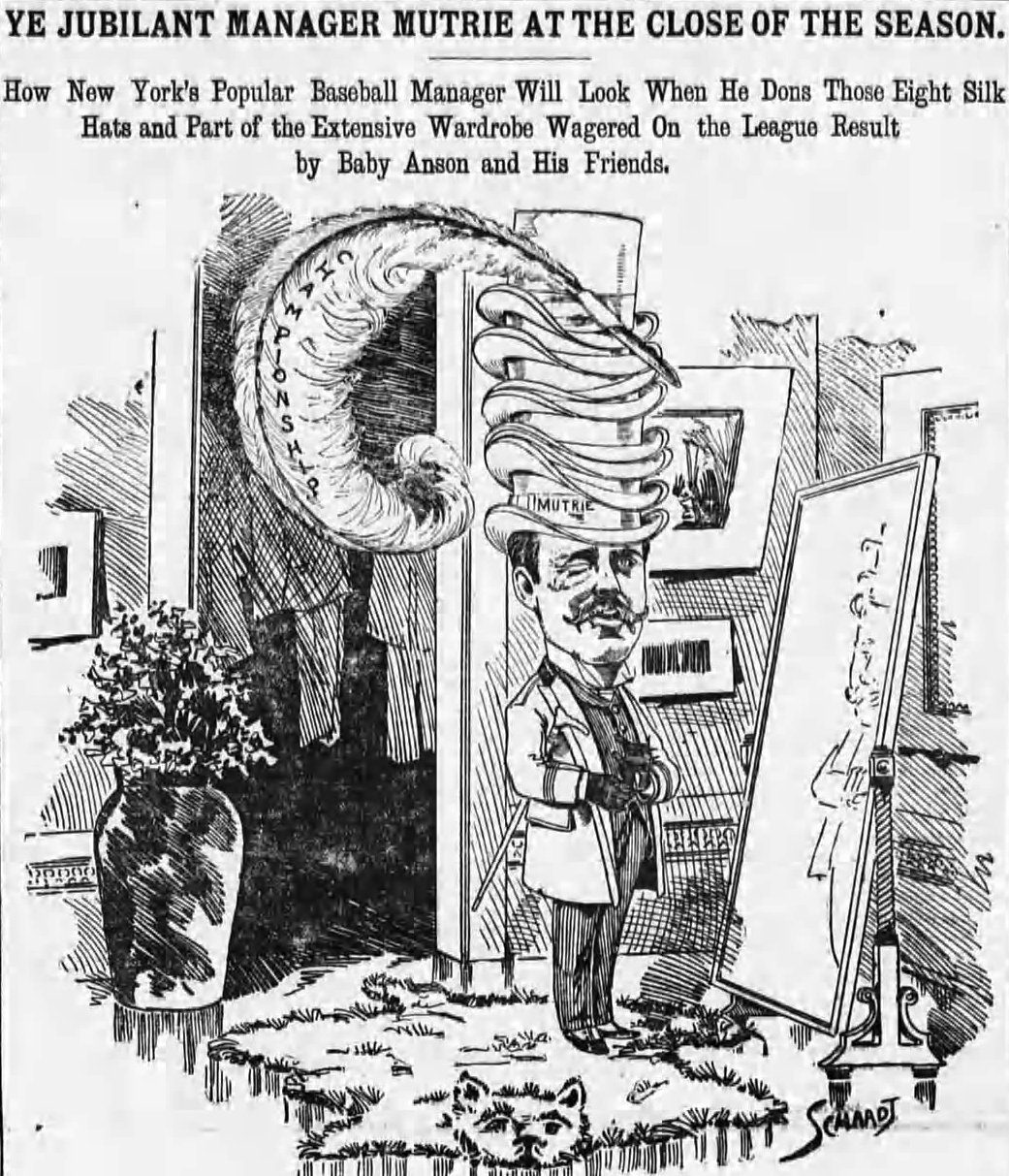
Three days after he made the comment, The World said Anson and Giants Manager Jim Mutrie had bet a $100 suit on the National League race, and:

“(Anson) has been busily engaged in predicting a tumble for the Giants. Jim says that tumble is not coming.”

Within a week the White Stockings had dropped to eight games behind the Giants.  The World said:

“Anson’s prophecies much resemble the boomerang.  He swore Mutrie’s men would take a tumble, and his own men are fast getting there themselves.”

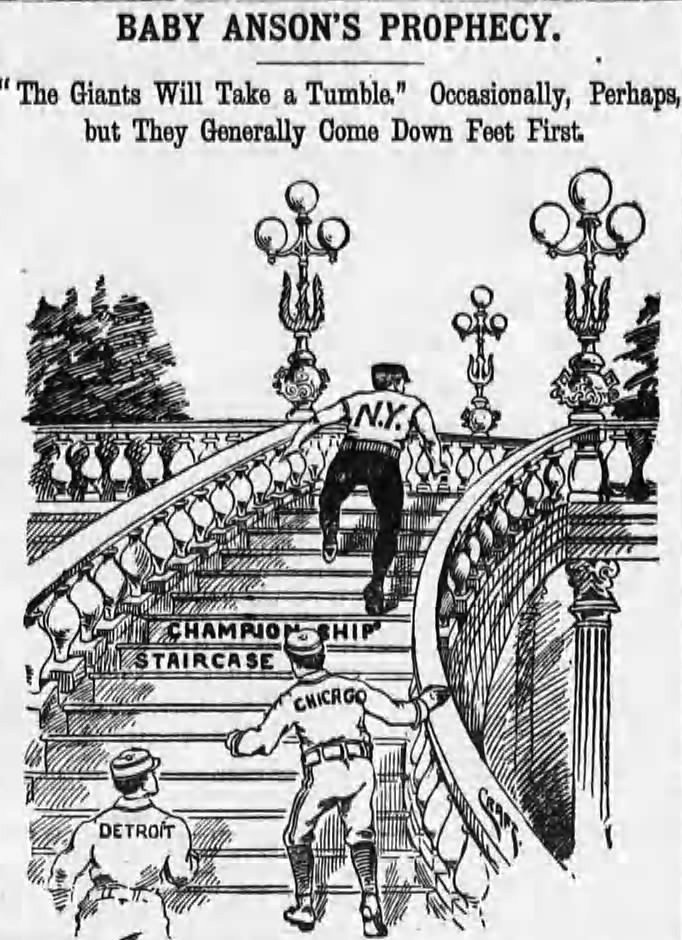
The paper also taunted Anson with a front-page cartoon:

 anson18880

The taunting continued.  After Chicago lost 14 to 0 to the Indianapolis Hoosiers on August 31:

“Did Brother Anson notice anything falling in Indianapolis yesterday?”

Another front-page cartoon on September 6:

anson18881

A week later, after the Colts took three straight from the Giants in Chicago, and cut the New York lead to five and a half games, The World attributed it to “Two new men for Anson’s team;” umpires Phil Powers and Charles Daniels.   The Giants managed win the fourth game of the series 7 to 3; the paper said Giant pitcher Tim Keefe was “too much for Anson and the umpires.”

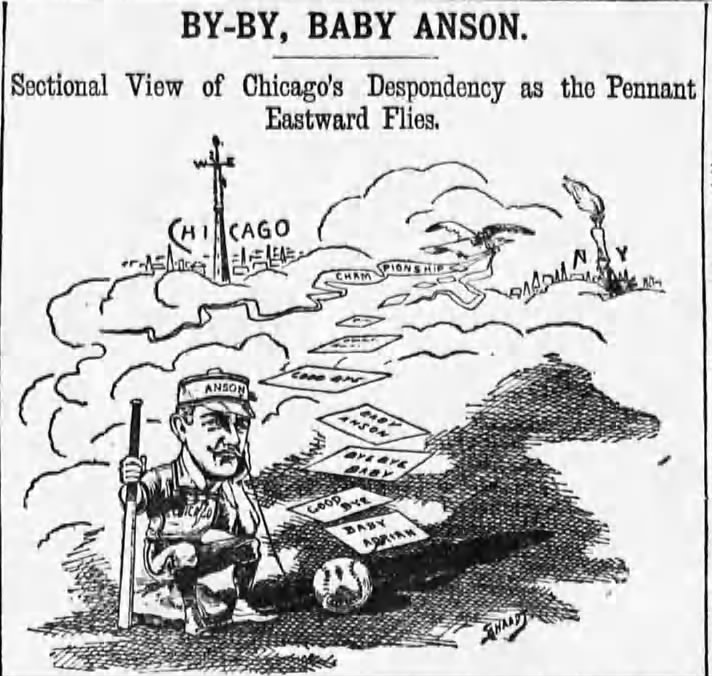
Chicago never got within six and a half games again.  On September 27 the Giants shut out the Washington Nationals, putting New York nine games ahead of the idle White Stockings.  The World declared the race over on the next day’s front page:

anson1888

All was finally forgiven on October 10.  The Giants had won the pennant, and Anson, on an off day before his club’s final two games of the season in Philadelphia, came to the Polo Grounds and met with Mutrie:

“(Anson) gave Mutrie a check for $100, in payment for the suit of clothes won by the latter.  The two then clasped hands over a similar bet for the next season—that is, each betting his club would beat the other out..  Anson then cordially congratulated his successful rival upon the winning of the pennant, and stated his belief that New York would surely win the World’s Championship.”

The Giants beat Charlie Comiskey’s American Association champion St. Louis Browns six games to four.

Anson’s White Stockings won five National League championships between 1880 and 1886, he managed Chicago for another decade after the 1888 season; he never won another pennant.

Tener, the pitcher signed by Chicago in August posted a 7-5 record with a 2.74 ERA.  He played one more season in Chicago and finished his career in 1890 with the Pittsburgh Burghers in the Player’s League.  Tener later became a member of the United States Congress (1909-1911) and Governor of Pennsylvania (1911-1915), and served as President of the National League.

Mutrie’s Giants repeated as champions in 1889 (and he presumably claimed another $100 suit from Anson), he managed the team through the 1891 season.

“The Great Baseball Question has been what will Capt. Comiskey do next Season”

3 Dec

In January of 1890 The St. Louis Globe-Democrat said what was on the minds of every baseball executive, writer, and fan:  “The great baseball question has been what will Capt. Comiskey do next Season”

For weeks there was speculation about whether Charles Comiskey, captain and manager of the St. Louis Browns, would remain in the American Association or join the Players’ National League of Professional Baseball Clubs (Players League), the league borne out of baseball’s first union the Brotherhood of Professional Base-Ball Players.

Charles Comiskey, against slang in baseball stories.

Charles Comiskey

On January 15, in a letter to The Sporting News, Comiskey announced his decision:

“During the past few weeks many interviews have appeared with me in different newspapers of the country relative to my having signed a contract with the St. Louis and Chicago Brotherhood clubs.  Up to this writing I am mind and fancy free.  But before Saturday night, January 18, I will have signed a contract to play at first base for the Chicago Brotherhood team.  I take this step for the reason that I am in sympathy with the Brotherhood.

“I believe its aims are for the best welfare and interest of the professional players.  I believe that if the players do not this time stand true to their colors and maintain their organization they will from this day forward be at the mercy of the corporations who have been running the game, who drafted the reserve rule and give birth to the obnoxious classification system.

“I have taken all the chances of success and failure into consideration, and I believe that if the players stand true to themselves they will score the grandest success ever achieved in the baseball world.

“But besides having the welfare of the players at heart I have other reasons for wanting to play in Chicago.  My parents and all my relatives reside there, and the all the property I own is located in the city.  I was raised there and have a natural liking for the place.  But, outside of all these reasons, my relations with the management of the St. Louis club have, during the past year been so unpleasant I do not care to renew them.  I have many friends in St. Louis, and for their sake I hate to leave here, but the other reasons out-balance this friendship, so I will cast my lines with the Chicago club.

“This is the first letter I have written on the subject which seems to have interested the baseball world throughout the whole of the present winter.

“Yours respectfully, Chas. Comiskey”

A week before the season began The Chicago Tribune said Comiskey’s new club “on paper, is the greatest team ever organized.”   Despite the hype, Comiskey’s Chicago Pirates finished in fourth place.  The Players League lasted only one season and dissolved in November of 1890.

Comiskey’s backing of the Brotherhood against “the corporations who have been running the game” would probably have come as a surprise to many of those who played for him when he owned the Chicago White Sox.  Arnold “Chick” Gandil, banned from baseball for his role in the 1919 Black Sox scandal said of Comiskey in a 1956 article in “Sports Illustrated:”

“ He was a sarcastic, belittling man who was the tightest owner in baseball. If a player objected to his miserly terms, Comiskey told him: “You can take it or leave it.” Under baseball’s slave laws, what could a fellow do but take it? I recall only one act of generosity on Comiskey’s part. After we won the World Series in 1917, he splurged with a case of champagne.”

Chick Gandil

Chick Gandil

“Evans, who, at the Least, is Incompetent”

2 Dec

William George “Billy” Evans was nicknamed “The Boy Umpire” when he was hired by the American League at the age of 22.  After 21 seasons  he became a front office executive, working for the Cleveland Indians, Boston Red Sox and Detroit Tigers; he was also president of the Southern Association, authored two baseball books and in 1973, 17 years after his death, was elected to the Baseball Hall of Fame.

Billy Evans

Billy Evans

But during his first season as an umpire, 1906, he was not held in high esteem in Chicago.

On September 10 the White Sox were in second place, a game behind the New York Highlanders.  The Sox trailed the Tigers 2 to 1 in the 9th inning.  Chicago shortstop George Davis laid down a bunt and was called out at first by Evans.  Every Chicago paper said Evans beat the throw by “at least a step.”

The call precipitated a near riot.  The Chicago Tribune said:

“Instantly a shower of bottles from the first base bleachers drove the umpire, coacher, and players away from the vicinity of the base.”

After the next two batters were retired:

“Evans walked off the field amid another volley of bottle from the third base stand.”

The Tribune and The Chicago Inter Ocean said Evans and fellow umpire Tommy Connolly were mobbed by fans as they attempted to leave the ballpark with a police escort.  Both papers said “one or two blows” from fans connected with the umpire during his retreat.

The Inter Ocean said, “Evans has been the most heartily reviled arbiter that ever worked in any league.”

The Tribune said two weeks earlier Evans cost the Sox a game in Philadelphia.  After Chicago scored two runs in the top of the sixth inning to take a 5 to 4 lead, Evans “let the Athletics take advantage of his inexperience,” and stopped the game on account of rain with two men out in the bottom of the inning.  The Inter Ocean said, “(Sox Manager Fielder) Jones and (second baseman Frank) Isbell nearly came to blows with the umpire and members of the Athletic team.”

After a half hour, the game was called and the score reverted back to the end of the 5th inning, giving Philadelphia a 4 to 3 victory.

The next day, September 11, the Sox played the St. Louis Browns at South Side Park.  Evans worked the game along with Jack Sheridan.  The newspapers said Sox owner Charles Comiskey had discontinued the sale of “bottled goods” at the park that day.

The Browns won 7 to 3, and the Chicago press put much of the blame for the loss on the rookie umpire.

The Tribune said:

President (Ban) Johnson’s persistence in sending Evans, who, at the least, is incompetent, is giving baseball a black eye in Chicago.  Half the crowd believes the charges that Evans is working under instructions from Johnson to beat Chicago.  These charges undoubtedly are founded on mere prejudice, yet, had Evans been under instructions and trying to beat Chicago, he could not have done better than he did yesterday.”

The Inter Ocean said the Browns “were aided and abetted by Umpire Evans, the boy wonder…Why Ban Johnson insists upon sending the joke to officiate at important games is more than any sane man can see.”

But the Evans’ most ardent critic was William A. Phelon, sports editor of The Chicago Journal:

“Umpire Evans is the worst that ever yet came down this or any other pike in the history of the modern universe…And Ban says he is the best in the game.  We are not selfish and we are willing to let some other city endure him.  We can get over the shock of his removal.  If he doesn’t move he may have a statue down on the lake front, a statue 200 feet high made of bottles.  Give us liberty, give us death, give us any old thing, but, by the snakes of old Ireland, give us an umpire!”

Phelon also said Evans “seems to be a gentlemanly individual, whose place in life is evidently a long ways from the profession of umpiring.”

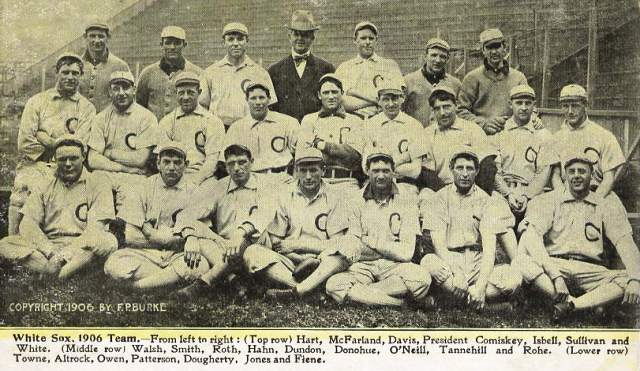
1906 White Sox

Despite the blame heaped on the young umpire in the press, the White Sox went 17-7 the rest of the season and won the pennant by three games.  They went on to beat the Chicago Cubs 4 games to 2 in the World Series.

Things got better for Evans as well.  He worked his first World Series in 1909—the youngest umpire to do so– and participated in five more from 1912 to 1923.  He was the third umpire to be elected to the Hall of Fame; Connolly and Bill Klem were the first two.