Tag Archives: Chicago Colts

“Go Back to Old Kentucky”

26 Sep

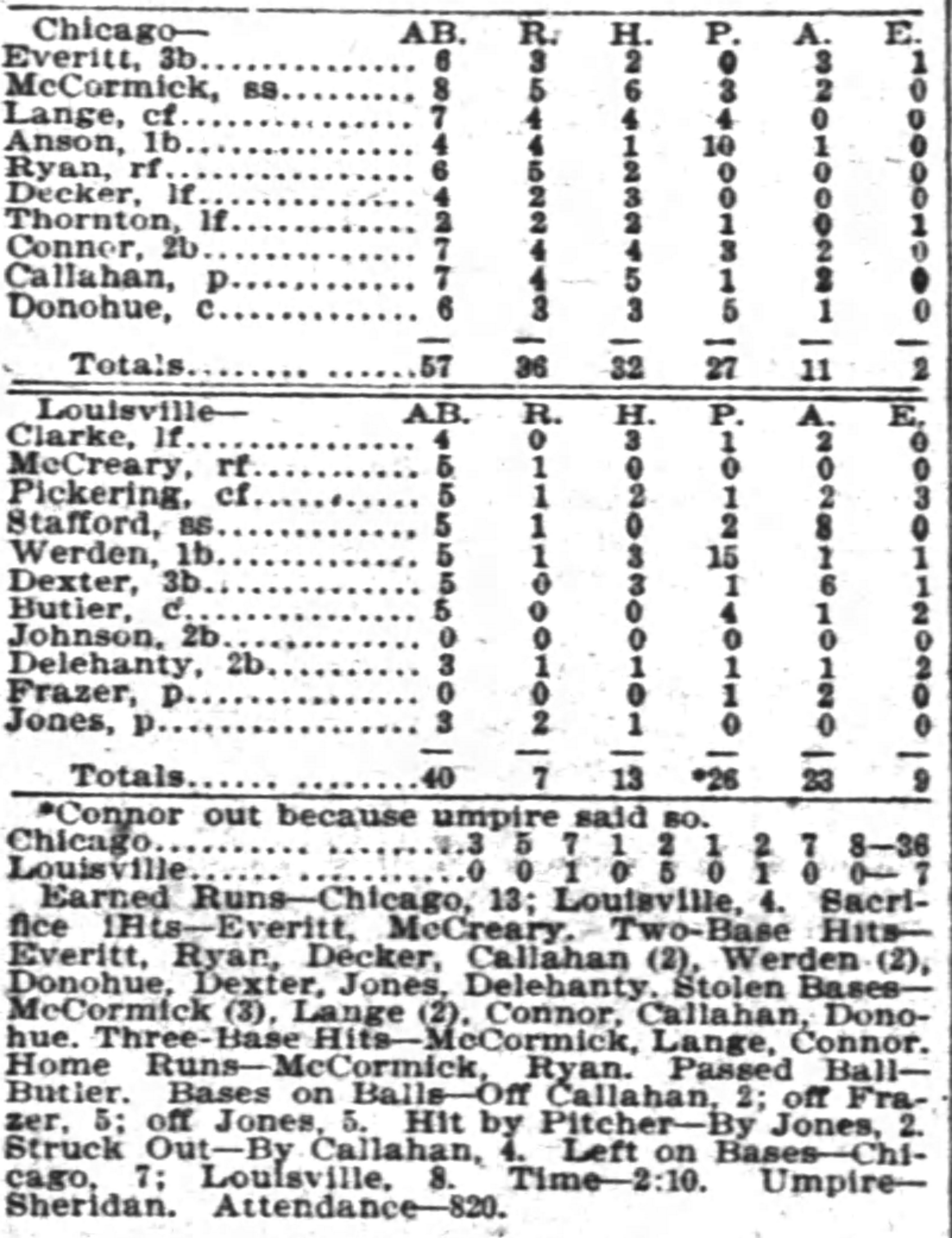
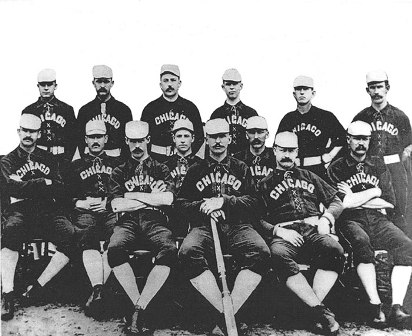
On June 29, 1897 “Cap” Anson’s Chicago Colts defeated Fred Clarke’s Louisville Colonels by scoring more runs than any team has ever scored in a single game.  The Chicago Tribune said:

“Game is a farce and everybody has a good time except the Colonels.”

The Chicago Inter Ocean said:

“Chicago exterminates Bourbons to the tune of 36 to 7.”

The Louisville Courier-Journal headline put it simply:

“Awful work.”

The Colts scored at least one run in each inning, collected 30 hits, and Louisville committed nine errors.

The Colonels finished in 11th place with a 52-78 record in 1897

The Colonels finished in 11th place with a 52-78 record in 1897

One Chicago fan memorialized the contest with a song, which The Courier-Journal shared with their readers.  The song, said the paper, was “a parody on the song ‘She Was Bred in Old Kentucky;”

Go Back to Old Kentucky

While talking one summer’s day,

With a friend not far away,

About a baseball game

That was coming off that day,

The Colonels and the Colts

Were going to take the holts

On the Diamond Field

And battle for the game.

A man, Fred Clarke, by name,

Young, but who had won great fame,

Had come out to play

With the Kentucky boys.

He had reason to be sad,

For Louisville was bad,

When a hobo in the crowd

Rose up and said:

Chorus

Go back to old Kentucky,

Here the meadow grass is green;

You’re a lot of dub ball-players,

You’re the worst I ever seen,

Go back to old Kentucky

And consider yourself lucky

You got off as light as you did.

Oh! His heeding of advice,

He would not listen to him twice,

And the grounds that day he did go;

There was Clarke and (Charlie) Dexter too,

The game began at half-past two,

And their places in the field they took;

Ritchie was at second base,

With the ball he tried to race.

The ball bounded

And caught him in the eye;

And Clarke fancied he could trace

A little swelling on his face.

As he sat down a lobster in the crowd cried:

(Repeat Chorus)

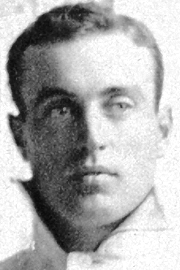
“Richie” was Ebenezer “Abbie” Johnson, who was occasionally called “Richie” in the press; Johnson was playing second base during the third inning when a ball hit by Anson—The Tribune called it “a viciously driven ball”– took a bad hop and “smashed Johnson in the eye, almost knocking it out.”

Abbie Johnson

Abbie Johnson

The game also included, in the fifth inning, an incident The Tribune called “probably the most ludicrous situation ever seen on a league diamond.”

The Colts led 16 to 1 at the beginning of the inning.  After loading the bases and scoring two runs, catcher Tim Donahue fouled out, and third baseman Bill Everitt grounded out; Jim Connor, the Colts second baseman appeared to score from third on the play, but, The Tribune said:

“When the players all came off the field the fact only two were out became known.  After much searching through his brain pan for and excuse (Umpire Jack) Sheridan took the tally away from Connor and called him out for ‘Cutting third base.’”

Perhaps the first, and only, time a player was called out for “cutting” the base he left from; Sheridan’s call also made for one of the most interesting notations included within a box score.

The Tribune box score included the note: “Connor called out.  No reason assigned.”  The Inter Ocean went with the more sarcastic:  “Connor out because umpire said so.”

The Tribune Box Sore


The Inter Ocean Box Score

The Inter Ocean Box Score


30 runs or more have only been scored by one team in a single game nine times—eight of them were before 1900—and Chicago is responsible for four; the other three games were in 1876, 1883 and 1883.

Tom Lynch’s Broom

24 Sep

In 1905 Chicago White Sox outfielder Jimmy “Nixey” Callahan talked about his first season in Chicago in 1897 in an article distributed by “Newspaper Enterprise Association” to several newspapers across the country:

“’Bill’ Lange, who is now a prosperous real estate dealer in Frisco, and former Umpire Tom Lynch, who is a theatrical magnate in New Britain, Conn., were sworn enemies of the diamond.  On the ball field Lynch insisted on being addressed as ‘Mr. Lynch’ and was probably the strictest disciplinarian that ever wore a mask.

“We were playing in Boston with the old Chicago club, under (Cap) Anson, and noticed that the broom used to brush the plate was always kept or thrown over to our side, due to some superstition of other on the part of the Boston players to have it on the visitors’ side.  Lange was leading off about the fifth inning and as he walked to the plate he picked the broom up and threw it over on the Boston side.  (Hugh) Duffy, who was then captain of the Boston nine, threw it back.  One of our players ran from the bench and hurled the broom over to the Boston side.  The large crowd began to see the humor of the situation and began cheering the players as the broom passed back and forth.  Lynch stopped the game and as a truce umpired the rest of the game with the broom in his possession.  The next day the broom was missing and Mr. Lynch carried a small whisk broom in his pocket.”

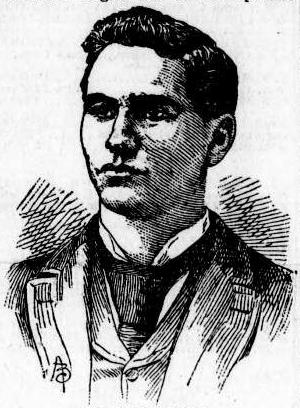
National League President Thomas Lynch

National League President Thomas Lynch

During the same series, Callahan said:

“Lange’s method of annoying Lynch was artistic.  When at bat or passing Lynch he would say” ‘Don’t you think Boston will win today Mr. Lynch? Or ‘Don’t you think Boston will win the pennant Mr. Lynch? Would you as a disinterested party like to see Boston win, Mr. Lynch?’  Never giving Lynch a chance to fine him by being vulgar or noisy, Lange would not stop walking when addressing him, ever.

“He would have Lynch furious, but as he kept within the bounds Lynch was forced to take his medicine.”

Five years later, after Lynch had been named president of the National League; Lange retold the broom story to a reporter and said:

“After the damage had been done I suggested that we compromise by allowing one half the handle to lie on one side of the plate and the other half on the other.”

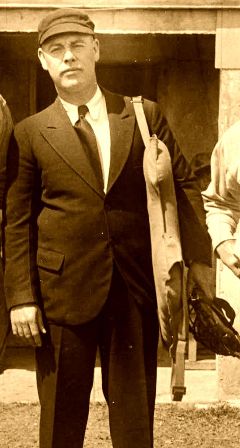
Years later, another National League umpire, George Barr, told a reporter for The Associated Press that the umpire’s whisk broom was “The most important thing, he possessed on the field:

“That little whisk-broom which most of the fans and players, too, believe is carried around to keep the plate free from dust is actually the symbol of authority the umpire has over the game.

“So when you are working behind the plate, stride up to the old pan and give her a vigorous dusting, even if the thing’s as clean as a whistle.  That’s to let the fans and players know you’re in charge of the game—that you’re the official representative of the league which, in fact, you are.”

George Barr

George Barr

“Dunnie’s” Narrow Escape

28 Jul

Samuel Morrison “Dunnie” Dungan returned home to Southern California in 1889 after graduating from Eastern Michigan University– the Michigan State Normal School– and joined the F.N. Hamilton’s a powerful San Diego-based semi-pro team that included 39-year-old Cal McVey, a member of Harry Wright’s Cincinnati and Boston Red Stockings teams from  1869 through 1875 (with a detour to Baltimore in 1873).

In the spring of 1890 the Oakland Colonels, champions of the California League in 1889 recruited Dungan to catch for them during a series of exhibition games in Los Angeles.  The Oakland squad did not impress Southern California critics.  The San Diego Union said:

“It is drawing it mild to say that it was the rottenest game that been played on the ground.  If it was not a fake, than the Oaklands cannot play ball.  Do they suppose up about San Francisco and Oakland that they can bring down to Southern California a lot of boys and show the Southerners how to play ball?”

Samuel Dungan

Samuel Dungan

The Union said the Hamiltons, as well as two other San Diego teams, the Schiller & Murthas and the Llewellyns “can beat the Oakland team out of sight.”

The paper said only one player stood out:

“Dungan, the San Diego catcher, who caught for the Oaklands both days, was about the only redeeming feature of that club…And he does not pretend to be a professional.”

As a result of his play during the exhibitions, Dungan was signed by the Colonels;  he still caught occasionally but was now primarily an outfielder.  Team owner Colonel Thomas P. Robinson was unable to restrain his enthusiasm when Dungan was signed, telling The Oakland Tribune:

“I believe Dungan is the greatest batter we’ve ever had here—better than (Lou) Hardie or (Vince) Dailey, the latter of whom I rank as the best of the old men.”

Fred Carroll, a California native who played with the Pittsburgh Burghers in the Players League in 1890, called Dungan “the only scientific batter on this coast.”

Statistics are incomplete for the 1890 California League season, but both The Tribune and The San Francisco Chronicle reported that Dungan was the league’s batting champion.  The Los Angeles Herald said he hit .332.  The Colonels finished third in the four-team league.  The Tribune said it was “probable that Dungan will go East.”

He was first rumored to be heading to be heading to the Washington Statesmen in the American Association but ended up signing with the Western Association’s Milwaukee Brewers.

It was Dungan’s departure from the West Coast in the spring of 1891 that led to the biggest headlines of his career.

The San Francisco Chronicle told the story:

“Sam Dungan, the ballplayer who was with Oakland last season and who led the California League in batting, is being pursued by an irate wife who says she will follow him to the end of the earth if necessary to again clasp him in her arms.  It seems that last year among the many conquests Dungan made in Oakland was Miss Mamie Bodgard.  She became wild over him, and at last was introduced to him.  After the season Dungan came south to his home in Santa Ana, but communication between himself and Miss Bodgard kept up.  She sent him many dainty perfumed notes.  Finally the marriage of the couple was announced and it created no great surprise.

“Now comes the thrilling part of this story.  Two hours after the marriage had taken place (in Los Angeles) Dungan left his bride and journeyed to Santa Ana, where he had an interview with his parents, who are well and favorably known and rank among the leading families.  Sam is a college graduate and was the idol of his parents.  Mrs. Dungan also journeyed to Santa Ana.  She did not go to the home of the Dungan’s, but went to the Richelieu Hotel.  She is a most pronounced brunette, rather petite, and is reported to have a temper.  The couple had parted, and the news of the separation soon became noised around.  Mrs. Dungan consulted a lawyer to have her ‘hubby’ restrained from leaving Santa Ana, but the heavy hitter eluded his young wife and started for Milwaukee, giving his bride the slip at Orange, she being on the same train with him that far.”

The jilted bride told a reporter for The Los Angeles Herald that she was “a grass widow,” but vowed to pursue Dungan to Milwaukee.  Mrs. Dungan’s trip to Milwaukee was unsuccessful.

A year later The Herald reported that a court in Santa Ana had awarded Mrs. Dungan $25 a month  “and she is very elated in consequence.”  She was said to have gone to Milwaukee twice the previous year and had taken to reading “Sammy’s love letters on the street corners,” of Santa Ana:

“Mrs. Dungan is an excellent dresser and is an exceptionally handsome woman.  She doubtless could be induced to kiss and make up, but the parents of her husband stand in the way of a reconciliation.  The Dungan’s are anxious to have Sam get a divorce, but he  can’t very well, and Mrs. Dungan says: ‘Never in a thousand years.'”

A divorce was finally granted in 1893.  Sam Dungan remarried in 1900.

Dungan went on to play parts of five seasons in the major leagues, mostly with the Chicago Colts and had a .301 career batting average.  He was an excellent minor league hitter, putting up several excellent seasons—including averages of .447, .424 and .372 in 1894, ’95, ’97 with the Detroit Creams and Detroit Tigers in the Western League. He also hit a league-leading .337 in 1900 for the Kansas City Blues in the inaugural season of the American League.

Dungan returned home to Santa Ana after retiring at the close of the 1905 season and participated in many old-timers games in Southern California.  The Santa Ana Register reported on his heroics during a 1924 fundraising game for former player Ed Householder who was dying of stomach cancer—Dungan joined Sam Crawford, Gavvy Cravath, Fred Snodgrass and other West Coast baseball legends for the game in Los Angeles:

“Yesterday, Dungan, now a prosperous Santa Ana resident and rancher, proved that years have not dimmed the remarkable eye nor time deprived the power from his arms and shoulders that enabled him, year after year, to outhit the other big league players of his day.

“Dungan rapped out a two-bagger with two men on the cushions in the tenth inning.  This blow broke up the game.  Previously Dungan had smashed out three other bingles.  Thus, Dungan of Santa Ana, the oldest man on the field in point of years, was the heaviest hitter just as he used to be years ago.”

Dungan died in Santa Ana in 1939.

“The Contest is going to be the Hottest in the History of Baseball”

6 Jun

Just weeks into the 1892 season, National League president Nick Young declared the newly expanded league, which absorbed four franchises from the defunct American Association and included the only scheduled split-season in major league history, an unqualified success.

Nick Young

Nick Young

The schedule, which called for the first half to end on July 15, and the second in later October, necessitated starting league play two weeks earlier than 1891 resulting in a large number of early season games being played in inclement weather.

Young spoke to a reporter named Max Ihmsen, who usually covered politics for The Pittsburgh Dispatch, about the state of game

“(T)here is no doubt of the overwhelming success of the new deal.  Considering the wretched weather that prevailed everywhere during April the showing, both financially and as to skill displayed, has been remarkable.  Everyone is making money, and I look for the most successful season ever known in the history of the game.  The reconciliation of the clashing interests, a reconciliation effected during the past winter, has been the salvation of the sport…This year there is every prospect of each club quitting a big winner.  Never before have such games, as are now being put up, been seen.”

Young said an April 19 doubleheader in Chicago, which brought in $4,000 accounted for the league’s highest single-day gate receipts of the season so far.

As for the pennant race Young said:

“The contest is going to be the hottest in the history of baseball.  Everybody is ‘out for blood,’ and at the close of the season I anticipate seeing a tie for every place up to fourth or fifth.  A difference of 10 or 15 games between the highest and lowest clubs will reflect no discredit on the lowest club…All the clubs are in good shape and I expect quite a number of absolutely errorless games will be recorded before the season closes.”

Young got nearly everything wrong.

At the close of the season, Ernest J. “Ernie” Lanigan said in The Philadelphia Record that only two teams (Cleveland and Pittsburgh) operated in the black.  He said their profits were less than $20,000 combined while “ten clubs have lost in the neighborhood of $150,000.”

O.P. Caylor said in The New York Herald the league’s financial state was a “disaster more astonishing than any which have preceded it and knocks the hot air out of President Nick Young’s prosperity balloon, which went sailing up so grandly.”

At a June meeting in New York team owners agreed to cut rosters from 15 to 13, and the salaries for the remaining thirteen players were cut (as much as 40 percent).  At the same time, they increased to 12 ½ percent the 10 percent of gate receipts each club was assessed to pay off the debt incurred to buy out the American association franchises that were not absorbed into the league.

Caylor said salaries would continue to fall and “This is the year when the owners of huge blocks of baseball stock are not classed with the Vanderbilts, Goulds, Astors, and Rockefellers.  Every one of the holders has been ‘touched’ heavily, more or less, by the financial disappointments of the year.”

The Baltimore Sun put it more succinctly:

“The season has been a failure financially.”

The Boston Beaneaters won the first half (52-22) over the Brooklyn Grooms (51-26), after the June roster and salary reductions, the Cleveland Spiders (fifth place with a 40-33 record in the first half) won the second half (53-23) over the Beaneaters (50-26).

Initially, Boston owner Arthur Soden said his team would not meet Cleveland in a post-season series as a result of charges in Boston that his team tanked the second half.  He told Caylor:

“You cannot make a large number of our patrons believe that the Boston club has not purposely lost the last championship for the sake of making money out of a series of finals.  That belief has hurt us to the extent of thousands of dollars during the last half of the season, and unless it be removed will hurt us equally as much next season.  The only way we can remove the wrong impression is by refusing to play.”

Caylor said at the October owners meeting “the rest of the league took up the case and literally forced the Boston club to play…Boston’s refusal to play would do more harm to the interests of the League at large than the Bostons could possibly suffer by the playing of the games.”

The nine-game championship series began with an 11-inning pitching duel between Boston’s Jack Stivetts and Cleveland’s Cy Young that ended in a 0-0 tie.  Boston swept the next five games.

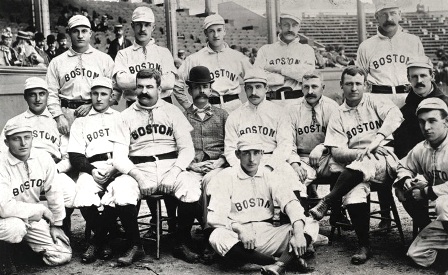
The Boston Beaneaters

The Boston Beaneaters

The split schedule and the resulting longer season were dropped for 1893.

Max Ihmsen, the reporter Nick Young spoke with, became city editor of The New York Journal, a William Randolph Hearst paper, in 1895.  Ihmsen went on to manage Hearst’s unsuccessful campaigns for mayor of New York City and governor of New York; he was also the Hearst-backed candidate for Sheriff  of New York County in 1907, a race he lost to the Tammany Hall-backed candidate.

Ihmsen later became the managing editor of another Hearst paper, The Los Angeles Examiner.  He died in 1921.

“Foster you are Released”

17 Mar

Elmer Ellsworth Foster’s career as a pitcher ended on August 26, 1884.  He had been out for three weeks with “an injury to the tendon in his right arm,” when he took the mound for the St. Paul Apostles in a Northwestern League game against the Milwaukee Brewers.  The 22-year-old was 17-19 with 1.18 ERA when he took the mound at St. Paul’s West Seventh Street Grounds.

The St. Paul Daily Globe said:

“When the popular favorite took his position in the box in the last half of the first inning the audience received him with an ovation of cheers, to which he responded by raising his cap.  A moment later he pitched the first ball, a sharp crack was heard distinctly all over the ground and the sphere went spinning ten feet to the right of the batter.  Foster turned pale, but stood in his position until the players in the vicinity reached him.”

He had “snapped the bone of the right arm just above the elbow,” and after Foster left the field a collection was taken up among the fans “A few minutes later it was announced that $172 had been collected.”

He made it to the major leagues two years later as an outfielder with the New York Metropolitans in the American Association, and played parts of five seasons in the American Association and National League.  A consistent .300 hitter in the minors, Foster hit just .187 in 386 big league at bats.

According to The Sporting Life, his manager with the New York Giants in 1888 and ‘89, Jim Mutrie considered him “one of the best fielders in the country, and the only reason New York ever let him go was because he didn’t show up well with the stick in fast company.”
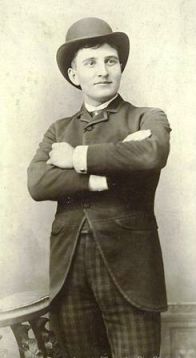
Elmer Foster

Elmer Foster

Sportswriter Hugh Fullerton said he excelled at other things as well:

“The rowdy of the rowdies was Elmer Foster.  Handsome, well bred, clean cut and with it all, well educated and something of an actor.  Foster was in baseball for the fun of it.”

From the time Fullerton joined The Chicago Tribune in 1897 until he left Chicago for New York in 1919 Bill Lange was probably the only 19th Century player he wrote about more often Foster.

Foster’s  best season was 1890 (.248 in 105 at bats and 5 home runs) with Cap Anson’s second place Chicago Colts after being acquired in late August.

Foster started the season with his hometown Minneapolis Millers in the Western Association (he hit .388 in his first twelve games), but fell out of favor with Manager Sam Morton after he and a teammate named Henry O’Day were arrested and fined in Milwaukee for public intoxication in May.
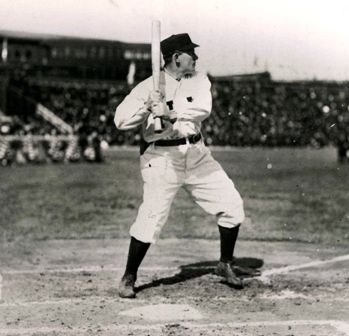
Foster was benched, but the team refused to release him, and by mid-July he was ready to take the Millers to court.  The St. Paul Daily Globe said:

“(Foster) threatens to bring suit against the management to compel its members to give him his release.  His claim will be that they are unjustly preventing him from earning a livelihood.  There is a possibility that the threat may be only a bluff, but should such a trial be put on, it will be of much interest in Western baseball circles, as it will be the first of its kind in this section.”

The Millers finally chose to release Foster rather than fight a lawsuit.  Foster was rumored to be headed to several different teams, but finally signed with the Colts on August 27.

After his strong September in 1890 Foster began the ’91 season as the Colts center fielder, but it didn’t last.

Fullerton said Foster sealed his fate with Anson during the opening series:

“We were going to Pittsburgh, and just before we arrived in town on the unearthly jump from Chicago to Pittsburgh, via Cleveland, Anson came along and sat facing us.

“’Foster,’ He said ‘The next time you take a drink, or anyone on the club takes a drink with you, I’ll release you.’

“’All right, Cap,’ said Foster, cheerfully.

“We arrived in Pittsburgh, and while Anson was registering the club at the desk Foster said: ‘Let’s go have a cocktail.’

“’Better be careful, Elmer, the old man is sore,’ I remarked.

“But we went.  The mixologist had just strained the cocktails into the glasses when Foster, looking into the mirror, spied Anson in the doorway.  He turned and, bowing low, said sweetly “Captain anson, will you join us for a drink?’

“’No,’ thundered Anson.  “Foster you are released.

“And now that I am released, Captain Anson,’ said Foster, ‘will you join us in a drink?”

Unlike many of Fullerton’s story, the basic facts (if not the part where he included himself in the story) are confirmed by contemporaneous accounts.  The Chicago Tribune said on April 26 after the Colts four-game series with the Pirates:

“Elmer Foster is not with the club and he has probably played his last game with it.  He and (Pat) Luby last night at Pittsburgh were drinking and Anson fined each $25 and ordered them to go to bed.  They paid no attention to the order and the fine was increased to $50.  This morning when the team was ready to go to Cincinnati Anson gave foster a ticket to Chicago and sent him home.”

Luby was not sent home and lost to the Reds 1 to 0 the following day.  He was fined several times for drinking during the 1891 season, and after a promising 20-9 rookie season in 1890 he slipped to 8-11, and followed it up with an 11-16 season in 1892 before Chicago let him go.

Foster was suspended without pay and finally released on May 11.  He was immediately signed by the Kansas City Blues.

Foster played well in Kansas City, hitting .300 in 70 games for the second place Blues, but was released in August.  The Kansas City Star said:

“One of the sensations of today is the unconditional release of Elmer Foster whose behavior on the present trip has been disgraceful”

The paper said Manager Jim Manning was forced to make the move, not just because of Foster’s drinking, but because he “has been largely instrumental in leading other members of the team astray.”

His replacement, Joseph Katz, acquired from the Grand Rapids Shamrocks in the Northwestern league hit just .225 in the final 25 games.

In December of 1891 The Minneapolis Times said:

“Elmer Foster, the ballplayer, yesterday secured $25,000 through the will of his dead mother, and today announced his permanent retirement from the diamond. “

With the exception of one game in 1895 (he went 1 for 2) with the Millers, Foster was true to his word and quit baseball at the age of 29.

Foster retired to Minneapolis where he operated a piano and organ store with his brother, did some acting and occasionally said he was considering running for the Minneapolis City Council or the Minnesota State Legislature, although there is no record of his ever officially filing to run for office.  He also worked as a scout for the Pittsburgh, and signed Ralph Capron out of the University of Minnesota for the Pirates.

After Fullerton moved to New York and stopped writing about Foster the “The rowdy of the rowdies” faded into comfortable obscurity in Minnesota.  He died in 1946 at age 84.

Some of Fullerton’s less reliable stories about Foster on Wednesday.

“The Cleverest bit of Quick Thinking I ever Witnessed”

26 Nov

Hugh Fullerton was one of baseball’s most influential writers; his career began in 1889 and he was active into the 1930s.  Widely credited as the first writer to directly quote players and managers, he is the source of hundreds of stories. Some, like the story the story of Bill Lange’s fence-crashing catch, are likely untrue.  Others may be apocryphal, or exaggerated.

Hugh Fullerton

Hugh Fullerton

This one is about Hall of Famer John Alexander “Bid” McPhee:

“The cleverest bit of quick thinking I ever witnessed was years ago in Cincinnati, and Bid McPhee, the ‘King,’ pulled it off.  How fast he thought only can be guessed.  It must have been instantaneous.  Bid was on first base with nobody out, when somebody drove a ball straight at ‘Wild’ Bill Everitt who was playing first for Chicago.  Bill dug up the ball, touched first, and made one of his copyrighted throws to second to catch Bid, having plenty of time for the double play.

Bid McPhee

Bid McPhee

“The ball disappeared.  (Bill) Dahlen, who was on second, never saw it.  He thought the ball had hit Bid.  The umpire, crouching to see the play at the base, lost the ball.  Bid hesitated at second, glanced around, saw the entire Chicago infield running around wildly and tore for third.  At third, after turning the base, he hesitated again, looked back, and then tore for home.  From his actions both at second and third any spectator would have sworn Bid was as ignorant of the whereabouts of the ball as were the Chicago players.

“The Chicago team was wild with excitement and the crowd was mystified.  No one knew where the ball was.  The only clue was a yell of amusement from the Cincinnati bench.

“The ball had disappeared utterly and the umpire threw out a new one.  After the game we learned what had become of the ball.  Everitt hit Bid with it.  The ball had struck him under the arm, and holding it tight against his body Bid carried it entirely around the bases and to the bench while acting as if he didn’t know where it was.”

“Clark Griffith nearly Ended the Life of William Phyle”

19 Nov

Bill Phyle was expelled from baseball after failing to back up his allegations that the 1903 Southern Association pennant race was fixed—four years earlier he had an even more eventful season.

Phyle started his career as a pitcher; he was 18-9 in 1897, and 21-21 in 1898 for the St. Paul Saints when he was traded to the Chicago Orphans for Frank Isbell.

Bill Phyle

Bill Phyle

He appeared in three September games, winning two with a 0.78 ERA, and was expected to contribute the following season.

In March of 1899 Phyle failed to report to Hudson Hot Springs, New Mexico to join manager Tom Burns and Orphans for spring training.

The Chicago Tribune said the pitcher had refused to sign his contract:

“It is asserted on good authority that pitcher Phyle has refused so far to sign a Chicago contract owing to the insertion of a temperance clause in the document…Phyle objects strenuously to the temperance contract which has been offered to him.  He has asserted positively within the last three weeks that he would never sign such an agreement.”

The Tribune said the contract clause wasn’t the only issue that might keep Phyle from playing in Chicago in 1899; the pitcher had, inadvertently, alienated Burns and team president James Hart the previous September:

“Phyle was unfortunate in his entry into the major league in incurring the displeasure of the Chicago president and manager.  There is a peculiar story connected with the affair.  Last year some members of the Chicago team believed that someone was carrying reports to Hart and Burns regarding the conversations of the players concerning their opinions of the heads of the club.  One night in Washington some of the men put up a job on the man they suspected in order to find out if their suspicions were correct.    In the presence of the man in question they made unflattering remarks regarding the president and manager of the club, and Phyle, being an innocent party to the plot, listened, approved some of the statements quoted as facts, and also took up the discussion.  It is asserted the conversation was carried to President Hart and Manager Burns.  At any rate, Phyle has been in disfavor since that time.”

The Tribune said Phyle was the only player who was given a contract that included a temperance clause.

With the situation at an impasse, Charlie Comiskey, Phyle’s manager in St. Paul, intervened.  The Chicago Inter Ocean said Comiskey, who called Phyle “one of the most promising youngsters” in baseball, sent a “tersely worded” telegram to the pitcher who “decided to sign the Chicago contract temperance clause and all.”

Phyle reported to Hudson Hot Springs ten pounds overweight on March 21.

Three days later he went duck hunting with teammates Clark Griffith, Bill Lange, Jack Taylor and Jimmy Callahan at A.G. Spalding’s New Mexico ranch.  The Inter Ocean said of the trip:

“A bullet from a Winchester rifle in the hands of Clark Griffith nearly ended the life of William Phyle, the promising young pitcher of the Chicago ball team.”

Clark Griffith

Clark Griffith

Phyle, unbeknownst to Griffith, remained in the group’s boat while Griffith fired on a flock of ducks flying near the boat:

“Griffith pulled the trigger and a ball tore its way through the stem of the boat…The ball carried in a direct line over the young pitcher’s head, and could not have missed him by more than six inches.”

Phyle was shaken, but unhurt, while “Griffith’s nerves received such a shock that he was weak and almost prostrated for some time after.”

Things didn’t get much better for Phyle after his near-death experience—tomorrow.

Hence his Careless, Indifferent air when he goes to the Plate to Bat.”

18 Nov

In 1911 Reds manager Clark Griffith told The Cincinnati Times-Star that pitchers no longer hit like they did when he played:

“Give me pitchers who can hit the ball instead of fanning out weakly, I wish there were a few more pitchers available like the top notchers of twenty years ago.  In those days a pitcher believed that he was hired to soak the ball as well as curve it, and he always did his best to get a hit.

(Tim) Keefe (career .187), (Mickey) Welch (.224), (Thomas “Toad”) Ramsey (.204), and (James “Pud”) Galvin  (.201) were among the old-time pitchers who could not bat, but they tried all the time, and if one of them got a hit he was as proud as a kid just breaking into the big league.”

Clark Griffith

Clark Griffith

The problem, said Griffith, was that “The pitcher seems to think that when he is delivering the goods in the box nothing more is required of him.  Hence his careless, indifferent air when he goes to the plate to bat.”

Griffith said Cap Anson, “wouldn’t hire a pitcher who couldn’t hit,” and said former Chicago pitchers Pat Luby (.235), Ad Gumbert (.274),  Walter Thornton (.312) and  George Van Haltren (.316, but was primarily an outfielder appearing in 93 games as a pitcher over a 17-year career), “were bear cats with the stick.”

Griffith said of his ability with the bat:

“The old guide-book will show that even your humble servant hit over .300 for Anson.”

Griffith hit .319 for Anson in 1895, and .233 for his career.

The 1911 Reds had only one starting pitcher who hit better than .214, (George Suggs. 256).  He was also the only starter with a winning record (15-13) for Griffith’s sixth place Reds.

George Suggs

George Suggs

Clark Griffith “Convinced me of the Knuckle Ball’s Effectiveness”

7 Nov

As with most 19th Century players, Bill Lange had had several criticisms of players who came later, particularly the “batsmen of the present time,” when he spoke to a reporter from The Chicago Inter Ocean in 1909;  but unlike many of his contemporaries he thought some aspects of the game were better.  He said players were better behaved and were in better condition; he also believed pitching had improved:

“We old timers were a long time in believing there was anything in the so-called spit ball.  But results have forced us to admit its existence and its power to deceive.  Now they are talking about the knuckle or finger nail ball.  For a long time I supposed that was a joke.  But just this morning I had a letter from Clark Griffith, telling about a discussion he had with (Cap) Anson during the schedule meeting at Chicago over the knuckle ball.  Griff ought to know what he is talking about, and he convinced me of the knuckle ball’s effectiveness but his argument with Anse must have been funny.

“You know Anse has to be shown on every proposition.  Griffith told him that (Ed) Summers of the Detroit team had the best command of the knuckle ball and that it came up to the plate in such a peculiar manner that it fooled not only the batsmen, but the catchers too.

“’That’s all rot,’ Anson said to Griffith, but Griff came back with the willingness to bet Anson $100 that Anse couldn’t catch three out of five knuckle balls as thrown by Summers.  Anson jumped at the chance and took the wager, and it will be decided sometime this year, if Summers, Anson and Griffith happen to be in the same city at the same time.

“I guess Griff will win the money, for he told me in his letter that he couldn’t catch half the balls Summers had thrown to him in practice.  I can hardly believe any pitcher has such a funny delivery as that.  Of course, if the knuckle ball worked all the time, there wouldn’t be any hitting at all.”

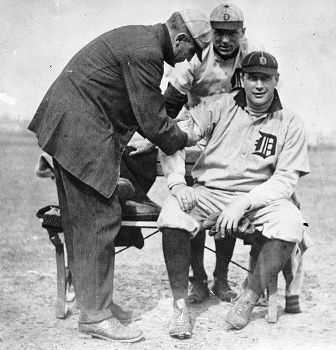
Al Summers has his arm worked on by Tiger trainer Harry Tuthill, first baseman Del Gainer looks on.

Al Summers has his arm worked on by Tiger trainer Harry Tuthill, first baseman Del Gainer looks on.

There’s no record that the wager was ever decided.

Clark Griffith

Clark Griffith

“In the ‘90s Nobody ever Thought Anything of telling the Manager to go Chase Himself”

6 Nov

Bill Lange played only seven seasons in the National League—all with Chicago–but his reputation lived on long after he walked away from the game in 1899 at 28 years-old.  Two of his biggest supporters, Connie Mack and Clark Griffith, remained influential until their deaths in the mid 1950s, and both helped to keep Lange’s legend alive until his death in 1950.

Long after his retirement to enter the insurance and real estate business in his native San Francisco, Lange remained extremely popular in Chicago;  he was frequently quoted by Chicago sportswriters (most often his friend Hugh Fullerton), and was even retained The Chicago Examiner’s  “World Series expert” in the early and mid teens.

Bill Lange

Bill Lange

In 1909, when the White Sox were training in San Francisco, Lange told a reporter for The Chicago Inter Ocean that “the batsmen of the present time had not advanced in any way” over the hitters of his day—and Lange felt they took too many pitches:

“I have noticed that the habit nowadays is to be altogether too scientific.  And that science is ruining the batters.  There used to be such things as .400 hitters in the big leagues and now the managers are spending fortunes in the hopes of finding a .250 hitter.  The reason they are so hard to find is because the batsmen don’t follow their natural inclinations to wallop the ball, but stall around at the plate in the artificial hope of drawing a pass instead of breaking a board in the back fence.

“No batter, who has any eye at all, ought ever to wait when he has three balls and one strike on him, unless the pitcher is uncommonly wild.  Think of the advantage of hitting when three balls have been called.  You are dead sure that the next one will be over the plate if the pitcher can get it there.  If he doesn’t, let it go and take your base.  But if you let a good one go then you are up against another proposition.

“Then the batsman is in a worse hole than the pitcher and his chances of making a safe hit are at least 4 to 1 against him, for a nervy pitcher will take a chance on a curve or a high one in the hope of making the batsman bite.  He wouldn’t dare do that very often when the count was only three and one.  The batsman who waits too long is just giving himself the worst of the deal.”

Unlike many players of his generation, Lange did note that some aspects of the game had improved since he played:

“We didn’t hustle like the players of the today do.  We would shirk morning practice all the time, so we could sleep late.  And take it from me, a lot of us needed the sleep, for most all of the boys belonged to the Ancient Order of Owls.

“The teams of today report at the grounds at 9:30 in the morning and work to beat the band for two hours. In the old days, after we had stalled the manager off as long as possible, we would finally show up for morning practice.  I don’t know all the systems the players on other teams had for dodging morning work, but with the old Chicago bunch we left it up to (Bill) Dahlen to break up the practice after about ten minutes of hustling.

“Dahlen could turn the trick might easily.  All he had to do was whiz four or five low throws at Anson’s shins.  ‘Pop’ used to bawl Dahlen out for a few minutes, but Bill would keep up the bum throwing until Anse would say ‘Enough.’  Nothing like that goes in the big or small leagues now.  It is a question of work and buckle down to business.  In the ‘90s nobody ever thought anything of telling the manager to go chase himself.  I haven’t heard of anybody doing anything like that in late years, and getting away with it.”

Bill Dahlen

Bill Dahlen

Lange on pitching, tomorrow.