Tag Archives: Chicago Colts

“He Used to Knock Down Infielders”

4 Nov

William Alexander “Bill” Lange is best known for a play that likely never happened.  The legend was that he had made a spectacular catch that culminated with the Chicago Colts’ outfielder crashing through the left-field fence in Washington in an 1897 game with the Senators.  It is most likely another in a long line of exaggerations and apocryphal stories from Lange’s friend, Chicago sportswriter Hugh Fullerton—a story that first appeared in that paper with no byline in 1903, but was repeated by Fullerton many times in later years.   A nice analysis of that story appears here.
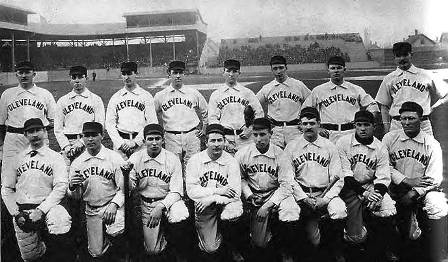
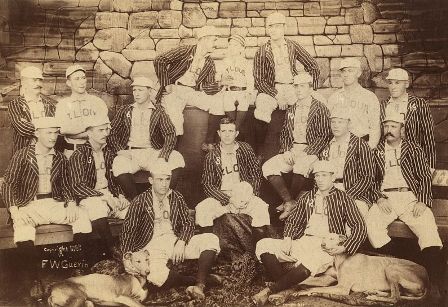
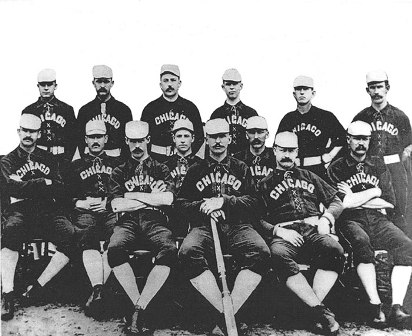
Bill Lang, seated fourth from left, with 1896 Chicago Colts

Bill Lang, seated fourth from left, with 1896 Chicago Colts

Lange played just seven seasons, retiring after the 1899 season at age 28 to join his father-in-law in the insurance and real estate business in San Francisco.

During the spring of 1900, The Chicago Daily News said “The wise ones in the baseball business” were certain he’d be back, including Chicago’s manager Tom Loftus and President James Hart, and Charlie Comiskey, “’When the season opens and the sun warms up he can’t stay away,’ remarks Comiskey, with a knowing wink.”

Despite the certainty that he would, Lange never returned.

Lange, who stole 400 career bases, was called “Little Eva” because of his gracefulness.  In 1909 Billy Sunday called him “the greatest outfielder in baseball history.”  Connie Mack called him the best base-runner he ever saw.  In fact,  Mack and Clark Griffith considered Lange so good that they petitioned the Hall of Fame in 1940 to change the “rules (which) restrict membership to players of the twentieth century” in order to allow for Lange’s induction.

Griffith said Lange was “the best outfielder that ever played behind me:”

“Lange here was rougher base-stealer than (Billy) Hamilton.  He used to knock down infielders.  Once I saw him hit a grounder to third base.  He should have been out, but he knocked down the first baseman.

“Then he knocked down the second and third baseman and scored.  Connie Mack was the catcher.  No he didn’t knock Connie down because he didn’t have to.”

Mack told the same story over the years.

Lange never made the Hall of Fame.  He died in 1950.
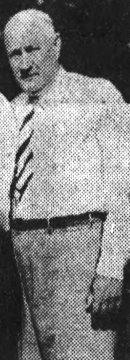
Bill Lange 1931

Bill Lange 1931

In his final years the story about the “catch” had become so ingrained in the legend of Bill Lange that other players told essentially the same story Fullerton did (the most widely disseminated versions appeared in “The American Magazine” in 1909 and in Johnny Evers‘ book “Touching Second,” coauthored by Fullerton), but inserted themselves into the story.  In 1946 Griffith told reporters:

“It happened right here in Washington, I was pitching for Chicago.  Bill missed the train from New York, and arrived in the fourth inning.  We were then with the Chicago Colts and Cap Anson fined Lange $100 before he put him in the game.

“I had a one-run lead when Al (“Kip”) Selbach of Washington hit a terrific drive.  Lange ran back hard, and when he crashed into the wooden fence his 210 pounds took him right through the planks.

“He caught the ball at the same time and held it.  All we could see were his feet sticking through the fence and Bill’s arm holding the ball.  When he came back to the bench, he handed the ball to Anson and said:

‘This ought to cancel that $100 fine.’ It did too.”

When Lange died Griffith said:

“I have seen all the other great outfielders—Speaker, Cobb, DiMaggio –in action and I consider Bill Lange the equal of, if not better than, all outfielders of all time.  There wasn’t anything he couldn’t do.”
“Who told you you were a Ladies’ man, Mr. Viau?’

3 Oct

Leon A. “Lee” Viau (pronounced vee-o) was the first player from Dartmouth College to make it to the major leagues.

Listed at only 5’ 4” and 160 pounds Viau was 83-77 in five big league seasons.  The Cleveland Leader said of his time pitching for the Spiders:

“(Viau) with comparatively little speed but with curves well mixed with gray matter, got out of lots of tight places where an ordinary twirler would have been knocked out of the box.”

In addition to having attended an Ivy League school, he was best known for his looks, and for being one of the best-dressed players in baseball.

The Philadelphia Inquirer called him “The Adonis of the diamond.”  When he played for the Patterson Silk Weavers in the Atlantic League The Patterson Weekly Press called him “the Beau Brummell of the club.”

Lee Viau

Lee Viau

A story, perhaps apocryphal, made the rounds in several newspapers during the first decade of the 20th Century about how “the grandstand was filled with ladies…when the handsome Viau was in the box.”

On this particular occasion, as recounted in The Kansas City Star, Viau was pitching for the Spiders against “Cap” Anson and his Chicago Colts in Cleveland:

“The score stood 4 to 2 in the last half of the ninth inning, and in Cleveland’s favor.  There was a Chicago man on second and one on third, while Anson was at the bat.

“He was madly anxious to bring in those runs, and he swung viciously at the first ball pitched. ‘Strike one!’ yelled umpire (Thomas) Lynch.

“Anson gritted his teeth and waited for the next one.  Lee sent up one of those slow, deceptive drop balls for which he was noted, and again Anson swung wildly.  ‘Strike two!’ cried Lynch.

“At this there was a veritable uproar among the female occupants of the grandstand.

“’Strike him out Lee! Oh, do strike him out!’ they shrieked in chorus.

“Hearing these cries, the grim old Anson, with a sneer on his face, sardonically inquired: ‘Who told you you were a ladies’ man, Mr. Viau?’

“Lee maintained a haughty silence, wound his arm slowly about his head and then, taking a wide swing, shot the ball up to the plate, and Anson took the third swipe at it and missed.

“’Now’ remarked Lee, as he advanced toward Anson, ‘I will answer your question.  The same person who told you you could bat.’”

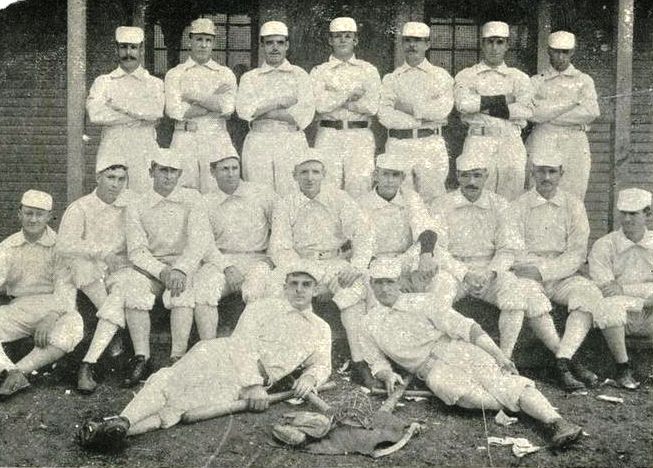
Lee Viau, front row third from right, with 1892 Cleveland Spiders

Lee Viau, front row third from right, with 1892 Cleveland Spiders

“Anson, the Baseballist, would like to see some Changes”

26 Sep

Some of baseball’s pioneer’s had ideas for rule changes that would have if adopted, dramatically changed the game.  In 1896 Adrian Constantine “Cap” Anson proposed two such changes.

Anson’s Colts had not finished better than fourth place in the National League in the previous five seasons, and the manager apparently thought two radical changes would improve his team’s chances and simplify the game.

"Cap" Anson

“Cap” Anson

The Chicago Record said:

“Anson, the baseballist, would like to see some changes in the present system of playing ball.”

Anson said he wanted to make a change to the 1893 rule that established the distance from the pitcher’s mound to home plate and replaced the pitcher’s box with the rubber:

“He is in favor of putting the pitcher’s slab in front of the pitcher, instead of having it behind him.  He wants this done in order to stop the interminable bickering that is going on in almost every game as to whether the pitcher was in position.  It is much easier to see whether the rule is conformed to when the slab is in front of the pitcher, and he dare not stop over it.”

Anson’s other rule change would have led to complete chaos, and would have made it an adventure to fill out a scorecard:

“Another radical change that Anson is in favor of allowing the captain to put players back into the game after they have been taken out…(Anson)  wants all restrictions removed, the manager being allowed to play his men just as he sees fit, taking them out and putting them back just when he wants to.”

The issue of introducing free substitution into baseball has occasionally been raised in the years since Anson advocated for it.

Montreal Canadians coach Dick Irvin suggested it to Kennesaw Mountain Landis as a solution to player shortages when the baseball commissioner attended an NHL game during World War II.   Lew Fonseca made a pitch for the rule in the 1950s, and Walter “Red” Barber, long-time Dodger and Yankee broadcaster suggested in the 1960’s that the rule would help keep baseball from being “as exciting as watching paint dry.”

In 1967, Eddie Stanky of the Chicago White Sox was given permission from the American League to experiment with a crude form of what would become the designated hitter rule six years later.  The convoluted rule, according to The Milwaukee Sentinel, said:

“(T)he Sox and their spring opponents will be allowed to call on a pinch hitter twice provided that he is designated before the game is not used twice in the same inning.”

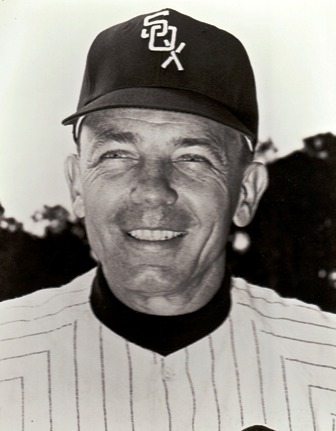
Eddie Stanky

Eddie Stanky


Things I Learned on the Way to Looking up Other Things #5

8 Aug

Johnny Evers “Ardent Worshipper of Hoodoo Lore”

Edward Lyell Fox was a war correspondent in World War I; after the war he was accused of taking money to write stories favorable to the German government.  Before that he wrote extensively about baseball for several American magazines.

In 1910, writing for “The Columbian Magazine”, Fox interviewed Johnny Evers of the Chicago Cubs about the “almost unbelievable efforts made by ballplayers to offset what they firmly believe to be ‘hoodoos.’”

Evers was one of the most superstitious players in the game, “an ardent worshipper of voodoo lore,” according to Fox, and Evers said the Cubs “are more superstitious than any team in the big leagues,” and that manager Frank Chance “is one of the most ardent respecters of diamond ‘hoodoos.’”

It’s not certain that Evers’ claim that “most players firmly believe in,” the superstitious he listed for Fox, but it’s clear he believed them:

 “If any inning is favorable to a player, he will try to lay his glove down on the same spot where he had placed it the inning before.

“While going to different parks in cars, the sight of a funeral cortege is always regarded as an ill omen.”

Evers also said the sight of a handicapped person was also an “ill omen…unless you toss him a coin.”

On the other hand Evers said a wagon load of empty barrels was a sign of good luck.

Johnny Evers,

Johnny Evers,


“Too much of a Good Thing”

Even in baseball’s infancy that were critics that said the popularity of the game was “too much of a good thing.”

In September of 1865 The Philadelphia Inquirer editorialized:

 “Let us take, for instance, the base ball (sic) pastime, which is now assuming the proportions of a violent and widespread mania.”

The culprit, according to the editorial, was the athletic club teams that were growing in popularity and  no longer “satisfied with a game or two a week.”

 “(S)ome of these associations devote, three, four or five days at a time to their games; that they are not satisfied with playing on their own grounds for their own benefit and amusement, but that they thirst for popular applause, and are rapidly transforming their members into professional athletes…They issue their challenges, and hotly contend for mastery with clubs belonging to other cities.”

 The Inquirer did predict one aspect of baseball’s new popularity:

 “It can be easily seen that this spirit must soon lead on to gambling. So far the only prize of the base ball and cricket matches has been a ball or some implement of the game, but private wagers have undoubtedly been laid upon the playing of certain clubs, and money has changed hands upon results.”

The Enquirer was also concerned that the game defied “common sense” because “during the heats of summer violent bodily exercise should be avoided; but upon this subject common sense and the base ball mania seem to be sadly at variance.”

The editorial concluded that “the young men,” make sure “they do not depreciate themselves to the level of prize fighters or jockeys, who expend their vim on horse races and matches made for money.”

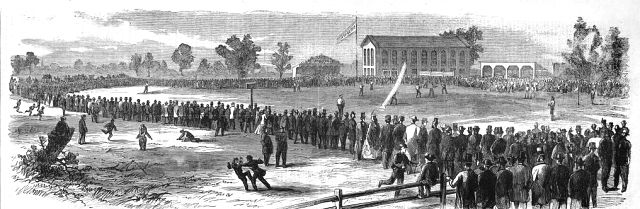
Athletic of Philadelphia versus Atlantic of Brooklyn, in Philadelphia October 30, 1865--"a violent and widespread mania."

Athletic of Philadelphia versus Atlantic of Brooklyn, in Philadelphia October 30, 1865–“a violent and widespread mania.”


Odds, 1896

Early in 1896 The New York Sun reported on “an early development of interest.”  A local bookmaker had issued odds on the 1896 National League race:

“He lays odds of 3 to 1 against Baltimore finishing first; 7 to 2 against Cleveland and Boston;  4 to 1 Philadelphia and New York; 7 to 1 Chicago; 8 to 1 Brooklyn and Pittsburgh; 15 to 1 Cincinnati; 40 to 1 Louisville; 100 to 1 Washington, while (Christian Friedrich “Chris”) von der Ahe’s outfit (St. Louis) is the extreme outsider on the list.  Any lover of the German band can wager any amount and “write his own ticket.”

The final standings:

1. Baltimore Orioles

2. Cleveland Spiders

3. Cincinnati Reds

4. Boston Beaneaters

5. Chicago Colts

6. Pittsburgh Pirates

7. New York Giants

8. Philadelphia Phillies

9. Washington Senators

10. Brooklyn Bridegrooms

11. St. Louis Browns

12.  Louisville Colonels

1896 Orioles, 3 to 1 favorites, won the National League Championship.

1896 Orioles, 3 to 1 favorites, won the National League Championship.

“The Sudden Reappearance of ‘Silver’ King”

27 Jun

Oliver Perry “O.P.” Caylor wrote in June of 1896 in The New York Herald:

“One of the baseball surprises of the season is the apparently successful reappearance of ‘Silver’ King upon the National League diamond.  Without any warning the Washington club sent him in against the Pittsburgh team, and he not only won his game, but held the latter down to six hits, Of course all this caused a great deal of gossip wherever baseball is a subject of interest.”

When Charles Frederick “Silver” King (born Koenig), took the mound for the Washington Senators and beat the Pittsburgh Pirates 8 to 1 in the second game of a May 30 doubleheader, it was his first appearance in professional baseball in nearly three years.

King had been one of baseball’s best pitchers of the 1880s, with a 142-70 record from 1887-1890 while playing for Charlie Comiskey, first with the St. Louis Browns in the American Association and then following Comiskey to the  Chicago Pirates in the Players League.

Comiskey (8) and pitcher Silver King (14) with the 1888 St. Louis Browns, King would follow Comiskey to the Chicago Pirates in the Players League in 1890

Comiskey, seated center(8) and Silver King standing second from right (14) with the 1888 St. Louis Browns, King would follow Comiskey to the Chicago Pirates in the Players League in 1890

Caylor said that during Flint’s heyday:

“His most successful delivery was what is known as ‘the cross fire,’ first used effectively, I believe, by (Charles “Old Hoss”) Radbourne and at present the prominent stock in trade of (Wilfred “Kid”) Carsey of the Philadelphias (Phillies).  It consists of standing on the extreme end of the pitcher’s plate, stepping away still farther from the direct line towards the batsman and sending the ball across the home base at an angle, which, although small, is very bothersome to the man with the bat.”

Silver King

Silver King

Caylor said King was “put out of the business” in 1893 when “the pitcher’s box was set back five feet,” (to the current 60’ 6”).  While King’s record slipped during the last two seasons the distance was 55 feet to a combined 36-53 while pitching for the Pirates and New York Giants, he had respectable ERAs of 3.11 and 3.29.  After the rule change King went 8-10 with a 6.08 ERA pitching for the Giants and Comiskey’s Cincinnati Reds in 1893, and then disappeared.

Caylor thought there was “a great deal of significance to King’s return to the diamond,” and predicted a trend:

“It means managers, having exhausted the new crop and finding nothing before them worth a trial, are forced to look behind and try to rekindle some of the half burned out embers. Washington not only took up King, but they gave (Les) German a trial after the New York club let him go.  (Cap) Anson (Chicago Colts) went back to (Fred) Pfeffer after finding (Algernon “Algie”) McBride, (Josh) Reilly and (George) Flynn wanting and was even forced to put himself into his nine to fill out the weak spots.”

Caylor said it was “astonishing  to look over the list of new material which was brought into the National League last spring and notice how small a part of it has been able to keep ‘in the swim.’  Every day one hears that some younger player has been released or that another has been loaned or farmed to a minor league club.”

Caylor’s prediction of success for the “trend,” and the players named was a mixed bag.  Anson, who had never really gone away, hit .331 in 108 games, for the Colts, but Pfeffer hit just .244 in 94 games. German fared the worst, he was 2-20 in 1896 and 3-5 the following season before being released in August.

King managed to post a 16-16 record for the Senators in 1896 and ’97 but never found his early career form.  After the 1897 season, he returned to St. Louis where he died in 1938.

Caylor would become ill the following season, and died in October of 1897.

“The Speed of Rusie”

30 May

Hall of Famer Amos Rusie “The Hoosier Thunderbolt,” was famous for his fastball; it’s been estimated that he threw in the high 90s.  In only nine full seasons he led National League pitchers in strikeouts five times.

Amos Rusie

Amos Rusie

Sports writer William A. Phelon contended that Rusie was the fastest pitcher he had seen, and in 1913 he told a story by James Tilford Jones who played for the Louisville Colonels in 1897, and was still a fairly well-known minor league player.

The likely apocryphal story (Jones only had one at bat as a pinch hitter that season, and did not strike out)  appeared in The Cincinnati Times Star, and according to Phelon, Jones said:

“ Don’t tell me that Walter Johnson, or any other pitcher of the present time, is faster than Rusie, or even that any man has the speed that Rusie used to throw…That man was unique and individual –there was never one like him before his time, and none since.  I don’t think there ever will be.

“My first experience with Rusie happened a long, long time ago, when he was in full swing and I was playing with Louisville, then a member of the big circuit.  I was warming the bench that particular afternoon, and wasn’t specially noticing the work of the other side, when our manager (Fred Clarke) beckoned me.  ‘Joensey’ said he, ‘you go up and bat for the pitcher.  Two on, two down—we just gotta have this game.  Go up there and lay the bat against the leather.’

“’All right sir’ I assented.  I’ll pickle one outside the lot if he puts it over.’  And up I strode, with a fat bat in my hands.  I saw a very large, red-faced man standing out there on the pitching line and I saw him raise his right arm.  I was wondering why on earth he didn’t throw it, when heard something go POW, just like that, behind me.  I looked around.  It was the thud of the ball ramming into the big mitt, and the umpire said, ‘One strike.’

“I watched the big man keenly, and again he raised his arm while I set myself to annihilate the ball.  An instant later I saw a ball going by me, and swung at it.  It was the ball being returned by the catcher, and I thought it was coming up instead of going away.

“By this time I was furious, also desperately determined.  So I set myself almost upon the plate, with the bat jutting out, and watched the big man very closely.  Then something crashed into my bat, ripped it from my hands, and drove it round against the back of my neck—and I knew no more.

“Two or three days later, the situation was exactly the same—Rusie pitching, our pitcher up, and dire need of a pinch hitter.  Again the manager beckoned me. ‘Go up and hit him, Jonesey’ growled he.

“I marched up to the plate, but went up empty-handed— didn’t even pick up my bat—and calmly stood there in the batter’s box, with nothing but my bare hands.  ‘Hey you,’ yelled the manager, ‘where’s your bat.’

“’Don’t need it,’ I shouted back.  ‘I can’t see them anyway, and it is a whole lot safer with nothing in my hands than be up here with a chunk of timber that he might drive clear through my head!’

“Oh, yes, yes.  Rusie had some speed when he wanted to use it, and I never remember seeing him any time when he wasn’t inclined to use it, either.”

Jones only appeared in two games during the 1897 season; in his first game he pitched 6 2/3 innings in relief in a 36-7 loss to the Chicago Colts, giving up 22 runs, 14 earned—the Colts’ 36 runs are still the Major League record.

Jimmy Jones

Jimmy Jones

Jones became a full-time outfielder in 1900 and returned to the National league with the New York Giants in 1901; he appeared in 88 games for the 1901-02 Giants, hitting .209 and .237.

He returned to the minor leagues and continued playing until 1914, and finished his career managing the Maysville (KY) Burley Cubs in the Ohio State League in 1916.  He served as Laurel County Clerk for twenty years, and died in London, Kentucky in 1953.

Rusie retired with a 245-174 record, striking out 1,934 and walking 1.704.  He died in 1942 and was elected to the Hall of Fame by the Veterans Committee in 1977.

Profiles of Members of Spalding’s World Tour, “The Stonewall Infield”

23 Apr

While with the players who took part in the world tour between the 1888 and ’89 seasons, Si Goodfriend observed:

 “My experience in traveling with baseball clubs, the circumstances of which necessarily brings about a close association, has impressed me with the fact that most of them are, as a rule, men of far more intelligence and better manners than they are generally given credit for.”

Among those players were all four members of the Chicago White Stockings “Stonewall Infield:” Adrian Constantine “Cap” Anson, Nathaniel Frederick “Fred” Pfeffer, Edward Nagle “Ned” Williamson, and Thomas Everett “Tom” Burns.

Goodfriend said of Anson:

“Decidedly the most unique and interesting figure of all is that of Captain Anson.  He shows the same peculiarities of temperament off as on the ball field.  He takes advantage of every point he sees and, and holds it…He may not admire a fellow baseball player personally, but this will not induce him to detract from his skill or standing as a player.

“’Old Anse’ has genuine sporting blood in him, and will bet on anything that turns up…There isn’t anything (aboard)the ship he won’t bet on if he has a fair chance of winning.  Anson’s nature is not nearly as harsh as some people imagine.  The rippling water in the moonlight or the graceful soaring of a bird will draw out the greatest sentiments from him.”

Like John Tener, Anson would enter politics, but was less successful.  After being elected Chicago’s city clerk in 1905, he was defeated in the Democratic primary for Cook County (IL) Sheriff in 1907

"Cap" Anson

“Cap” Anson

Of Pfeffer he observed:

“(He) is handsome and has no striking mental characteristics.  He has a long, flowing, brown mustache and soft brown eyes, both of which would readily come under the head of a womanly ‘lovely.’  To show the nature of the man I need only mention a little incident that is causing him much worry at the present time.  His only relative is his mother who lives in Louisville.  Before leaving on the trip he promised to write to her regularly and while on the ocean he promised to cable home from every point possible.  He did not know there was no cable from Honolulu, and now he is worrying himself that his old mother will be anxious about him until he can cable from Auckland.  It will seem an age to him until that city is reached.”

Pfeffer, along with “Monte” Ward was a leader in baseball’s nascent labor movement, Pfeffer was frequently at odds with Anson, and led the exodus of most of the White Stockings’ starters to the Players League.  Despite that, in 1918 Anson called Pfeffer the game’s all-time greatest second baseman after sportswriter Grantland Rice said Eddie Collins of the White Sox was the best ever.

Fred Pfeffer

Fred Pfeffer

Williamson, he said, was “unassuming” and:

“(A) big tender-hearted fellow, whom everybody likes.  He writes in an exceedingly clever and interesting style, and can ‘fake’ a good story like a veteran journalist.”

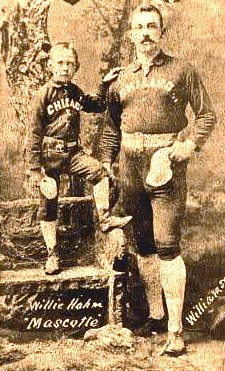
Ned Williamson with White stockings mascot

Ned Williamson with White stockings mascot

Williamson wrote his own dispatches from the tour which became popular features in Chicago papers.  He injured his knee on the tour and A.G. Spalding refused to help him with medical expenses; the 36-year-old Williamson jumped to the Players League in 1890, but his health began to deteriorate that year while playing for the Chicago Pirates.  He died of tuberculosis in 1894.

Goodfriend on third baseman Burns:

“(He) is a bright, intelligent man, who spends most of his time in reading; works of a standard heavy and weighty character being favorites.  He has the reputation of being a great dresser, and is said to have as many trunks with him as a New York belle would carry to Saratoga.”

Tom Burns

Tom Burns

Nearly a decade after the tour, Burns would be the man who replaced Anson as manager of the Chicago National League ballclub.  Burns took the reins of the “Orphans” in 1898, ending Anson’s 19-year run as manager.

Burns was named manager of the Jersey City Skeeters in the Eastern League in 1902, but died just weeks before the beginning of the season.

“An Umpire Nearly Lynched”

11 Mar

The above headline appeared on an Associated Press story in August of 1890.  Former Major Leaguer Jimmy Manning, then managing the Kansas City Blues in the Western Association had interceded to quell a riot at the end of a game with the Denver Grizzlies in Kansas City:

“Two questionable decisions by umpire Jovin (Sic) in the ninth inning, when Kansas City was about to tie the score, angered the crowd to such an extent that they swarmed into field, hooting and jeering the umpire.  Two young boys got hold of a rope, and in fun proposed to lynch him.  This added to the excitement, and it looked for a time as if the umpire would be mobbed.  Jimmy Manning climbed up to the top of the fence and addressed the mob.  He said the umpire had decided rightly and advised that no violence be attempted.  This quieted the mob to a degree.  In the meantime the players of both clubs formed a hollow square around the umpire and conducted him to the clubhouse.”

Jimmy Manning

Jimmy Manning

“Jovin” was actually Fred Jevne, a 26-year-old minor league veteran who had become an umpire just a month earlier.  After joining the Spokane franchise in the Pacific Northwest League in April, Jevne was suspended in May for punching an umpire.

In July The Spokane Falls Daily Chronicle said Jevne and teammate Tom Turner “quit the nine because they were excessively fined and ill-treated.”  According to the paper the two players showed up at the July, 1 game “in an intoxicated condition and acted like ruffians in the grand stand.” Turner was eventually reinstated and finished the season in Spokane, Jevne did not.

Since 1885 Jevne had played for a variety of teams in several leagues, including the Southern, International, and California.  When he was signed by Spokane to play center field and serve as captain, The Daily Chronicle said:

“Jevne is rather short.  He is a good batsman and a good player generally.  The San Francisco papers, when he played there, alternately praised him and berated him, but all agree that he was a good player.”

Jevne made one more attempt at playing, joining the Evansville Hoosiers in the Northwestern League in 1891.  He then returned to the Western Association as an umpire.

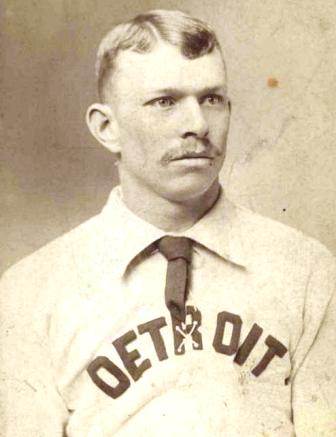
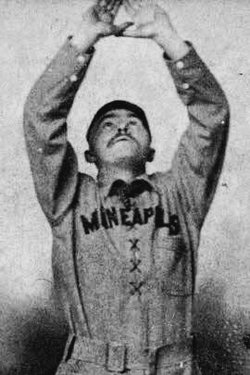
Fred Jevne

Fred Jevne with the Minneapolis Millers, 1889

In December of 1894 Jevne was named to the National League umpiring staff, where his work received mixed reviews.  In June The Baltimore Sun called him “As good an umpire as there is in the business.” In August, after a he worked a game between the Boston Beaneaters and Chicago Colts, The Boston Globe said “Umpire Jevne did poor work, both sides suffering from his yellow decisions.”  The Pittsburgh Press called Jevne’s performance in a September game between the Pittsburgh Pirates and Philadelphia Athletics “By far the worst exhibition of umpiring given this season.”

Jevne was not offered a position in the National League for 1896, and went to work in the Southern Association, where he seems to have a continued his fighting ways.  In July, The Birmingham Age-Herald said Jevne had missed the previous day’s game between the Montgomery Senators and Columbus River Snipes:

“Jevne, the regular umpire, arrived in town last night, but this morning loaded himself up with the spirit of hilarity, got into a fight with a citizen and when the hour for playing arrived was in the hands of the police, and failing to make bond was unavoidably absent from the field.”

Despite his troubles, or because of them, Jevne was asked to join the Interstate League at the end of the 1896 season because, according to The Sporting Life, umpires were losing control of games:

 “(Interstate League President Charles) Powers to-night wired for Fred Jevne the ex-National League umpire, who is so handy with his fists, to report for duty.”

Jevne was not popular with players or the press down south, and said his time in the Southern Association was difficult:

“It was no snap umpiring down South.  Fines didn’t go—were never paid—and so I used to remove men from the game.  Sometimes I would have to take out about half of a team before they would behave, and then the papers would roast me good and plenty the next morning…I had a scrap with a player named (Al) Gifford (Atlanta Crackers shortstop), and punched him in a car going from the grounds.  The local paper came out the next morning and urged the chartering of a special car for the umpire. So that he could be alone in his dignity, and another paragraph hinted that a cigar sign or dummy could be put in the special car for the umpire to punch”

Jevne appears to have returned to the Southern Association for parts of the 1897 and ’98 seasons.  He spent at least part of 1899 and 1900 in his hometown, Chicago, where he worked as an umpire in some college games.  In 1901 Jevne became a Western League umpire and that year met with a violent and mysterious end.

Initial newspaper reports said Jevne had fallen from a third story window in Denver’s Hotel Victor on August 2; he lingered for two days before dying. His body was returned to Chicago and he was buried at Graceland Cemetery.

However, several months after his death, Jevne’s brother Lloyd, a well-known three cushion billiard champion, told The Associated Press he was certain he had been murdered, and that before dying Jevne had said he was pushed:

“I saw Fred’s body after it was shipped back to Chicago, where the burial took place, and the most prominent feature of his injuries was the bruise on his nose.  Doctors I saw believe that he was struck across the face with some blunt object… When he was about to die it is not probable he would have told a falsehood.  He would not have said at that time that he had been pushed out the window.”

Lloyd Jevne

Lloyd Jevne

Whether Fred Jevne fell or was pushed from that hotel window has never been positively determined.

Chief and Cy

19 Dec

Charles “Chief” Zimmer caught Denton True “Cy” Young’s first Major League game; an 8-1 victory for the Cleveland Spiders over Cap Anson’s Chicago Colts.

Years later, Davis Hawley, a Cleveland banker and hotel magnate who also owned a minority share of the Spiders and served as the team’s secretary, related a story about Young’s debut:

“The night of Young’s first National League game, he complained to me that although he had let Anson’s team down with a few hits, he had not had his usual speed.”

Hawley who had watched him pitch in the Tri-State League asked why he felt that way.

“Well, down in Canton the catchers could not hold me I was so fast, but this man Zimmer didn’t have any trouble at all, so I guess I didn’t have much speed.”

Zimmer would go on to catch 247 of Young’s starts through 1898, including 19 shutouts; second in both categories to Lou Criger, who played with Young in Cleveland, St. Louis and Boston.

Zimmer would catch Young a few more times after 1898.

In 1921 the 54-year-old Young pitched two shutout innings, with the 60-year-old Zimmer catching, in a game between Cleveland Major League legends and amateur stars staged as part of Cleveland’s 135th anniversary celebration.  In addition to Young and Zimmer, Nap Lajoie, Earl Moore, Bill Bradley, Charlie Hickman, Nig Cuppy and Elmer Flick were among the participants.

Earl Moore, Cy Young, Bill Bradley, Charlie Hickman, Nap Lajoie and Chief Zimmer at the 1923 game.

Earl Moore, Cy Young, Bill Bradley, Charlie Hickman, Nap Lajoie and Chief Zimmer at the 1923 game.

The game was such a success that for the next four years it became an annual event at League Park (called Dunn Field during the 1920s); Young pitched the first two innings of each game with Zimmer catching. The event benefited the Cleveland Amateur Baseball Association medical fund.

Young always shared credit for his success with his catchers.  In the 1945 book “My Greatest Day in Baseball As told to John P. Carmichael and Other Noted Sportswriters,” he said:

“Every great pitcher usually has a great catcher, like Mathewson had Roger Bresnahan and Miner Brown had Johnny Kling. Well, in my time I had two. First, there was Chief Zimmer, when I was with Cleveland in the National League, and then there was Lou Criger, who caught me at Boston and handled my perfect game.”

A little more “Chief” tomorrow.

What Goes Around…

12 Dec

Harry “Bird Eye” Truby’s best days were behind him by 1905.  He broke in with Rockford in the Central Interstate League in 1888, had spent part of 1896 and ’96 in the National League with the Chicago Colts and Pittsburgh Pirates, and for the next decade was a solid minor league player.  But his skills had eroded and by 1902 he was playing in lesser quality leagues.

Truby started the season in the D-level Cotton States League with the Jackson Blind Tigers, by June he was either released or sold (depending on the source) to the Meridian Ribboners in the same league—he was acquired by the Niles Crowites in the Ohio-Pennsylvania League on September 1—within days his career was over.  The Youngstown Vindicator said:

“Harry Truby won’t have a chance to slug any more umpires for a while (sic) unless he makes a special appointment with them.”

In a Labor day game against the Akron Buckeyes Truby punched an umpire named List after he called a Niles player out for not tagging up on a fly ball; The Vindicator said of the resulting melee which involved at least two other players and some fans:

“It was a disgraceful scene, indeed.”

League president  Charles Hazen Morton suspended Truby indefinitely; the suspension effectively ended his career.

Harry Truby, 1898

Harry Truby, 1898

The following season Truby became an umpire, quickly worked his way back to the Big Leagues,  and was named to the  National League staff at the beginning of the 1909 season; however, he was let go or resigned in July (again, sources disagree).  In August Truby became an umpire in the Tri-State League.

Within days of joining the Tri-State,  Truby umpired a game between the Williamsport Millionaires and Trenton Tigers in Williamsport, PA.  Williamsport argued a number of calls and Truby had already ejected three of their players: Bert Conn, George Therre, Tom O’Hara, when in the seventh inning he ejected a fourth, outfielder Rip Cannell. The Pittsburgh Press said:

“(T)he crowd, enraged by (Truby’s) poor work and apparently uncalled for action against the local team swarmed  upon the diamond.  He was knocked down…and struck on the nose by a stone.  The police quickly ended the disturbance, but after the game the crowd was in waiting and ran the umpire into a shed from which he was rescued by two officers in an automobile.  The crowd tried to pursue the automobile but it pulled ahead and at 7 o’clock he reached his hotel.”

Truby worked as an umpire in the Tri-State and Ohio State Leagues through the 1913 season, and seems to have avoided any additional attacks by angry mobs.

He died in 1953 in Ironton, Ohio.