Tag Archives: Cincinnati Red Stockings

“If Jones Refrains from any more ‘Baby’ Whining”

17 Sep

In June of 1877 the struggling– financially and on the field–Cincinnati Reds disbanded. The defending champion Chicago White Stockings, mired in fifth place in the six-team league, signed Reds second baseman Jimmy Hallinan and outfielder Charley Jones.

Both players had signed with Chicago believing there was no chance that the Cincinnati franchise would be saved. Some stories claim Lewis E. Meacham of The Chicago Tribune, who worked with White Stockings President William Hulbert to organized the National League, got Hallinan drunk and convinced him to sign. There were also non-specific, unsubstantiated rumors of “coercion” being used to secure Jones.

Within days, enough money was raised by the Reds new president J.M. Wayne Neff to continue operation of the club, and Jones made it clear he wasn’t happy to be in Chicago; the Chicago press was not particularly happy with Jones either.
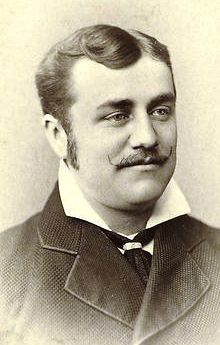
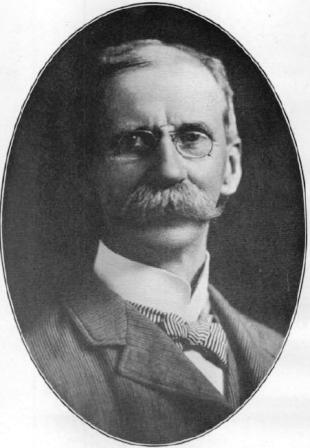
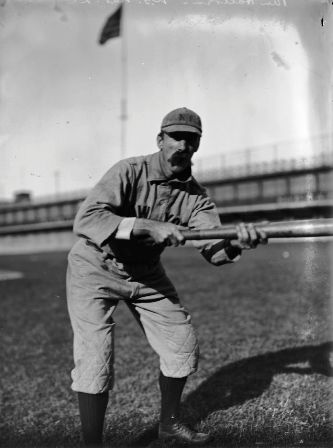
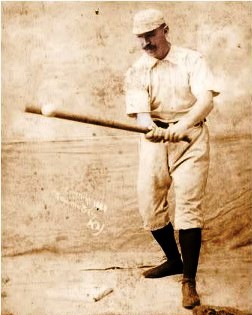
Charley Jones

Charley Jones

When the White Stockings new outfielder failed to join the team before two straight losses in Hartford to the Dark Blues, The Chicago Inter Ocean said:

“(I)f Jones refrains from any more ‘baby’ whining, and shows up like a man and a reputable ball-player there should be no reason why the nine should not win.”

Jones officially became a member of the White Stockings on June 26; an 11-0 win over the St. Louis Brown Stockings; Jones had a single in four at bats. Two days later they beat St. Louis again 6 to 2, Jones was 2 for 4 with two RBIs.

During those three days the Reds were petitioning the National League to return Jones to Cincinnati (they made no effort to reacquire Hallinan), Hulbert refused and the league refused to force the issue. A prominent Cincinnati attorney, Edgar M. Johnson sent a letter to the White Stockings requesting that Jones be released, the letter read in part:

“We, as you probably know, have succeeded in reorganizing the base-ball club here. The task has been a hard one, and even now we find that it will be almost impossible for us to get along without Jones…I ask you, as a favor that our club will always appreciate, that you will honorably release Jones and permit him to rejoin us.”

On June 30 Charley Jones’ two-game career with Chicago came to an end.

The Cincinnati Enquirer announced that an agreement had been reached, Hulbert had agreed to release Jones and, “recognized the fact that (Jones’ contract) had been obtained in an unfair manner.”

The Chicago Tribune saw the situation differently; Hulbert made a, “graceful concession to the evident feeling in Cincinnati,” and by releasing Jones carried out “the idea of doing what he could for the new (Reds) club.”

Chicago papers were quick to point out to their readers that the release of Jones, and the signing of former Philadelphia Athletics outfielder Dave Eggler to take his place, would not hurt the White Stockings:

The Inter Ocean:

“Eggler is generally considered a fine ballplayer, and there are many who think a much better fielder, runner and batter than Jones. Last year his record in all of these important points was far in advance of Jones’.’’

The Tribune:

“There can be no doubt that Eggler will fully fill Jones’ place and the club will certainly lose nothing by the change.”

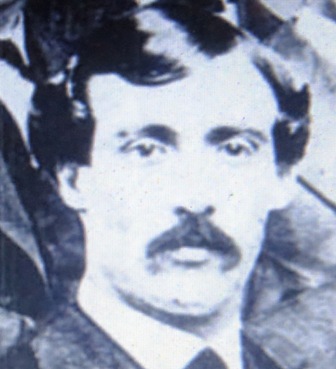
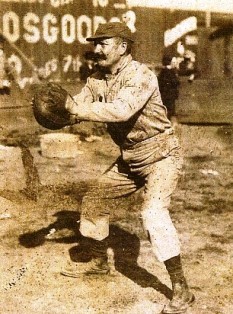
Dave Eggler
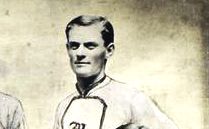
Dave Eggler

Eggler hit .265 in 33 games in Chicago. Jones hit .313 for the Reds.

The White Stockings finished in fifth place with a 26-33 record, the Reds were sixth with a 15-42 record.

Speaking of Charley Jones

Jones (born Benjamin Wesley Rippay) was once, for a short period in the 1880s, baseball’s all-time home run leader. He hit 56 in a 12-year career from 1875 to 1888. He missed 1881-82 after being blacklisted from the National League because of a dispute over money owed to him by Boston Red Stockings owner Arthur Soden, despite his claim being upheld in court.

He returned to major league baseball with the Cincinnati Red Stockings in the American Association in 1883.

Colorful was a word often used in regard to Jones; and probably his most colorful mention in the press came between the 1885 and ’86 seasons. The Cincinnati Star-Times reported on some unrest in the Jones household:

“Charles W. Jones, the well-known base ball player, was accosted by his wife Monday night, while he was making himself agreeable to another woman. Mrs. Jones threw cayenne pepper in her spouse’s eyes causing such intense suffering that he had to be taken to the hospital.”

While there was no report of any lasting effects, Jones’ batting average did drop 52 points; from .322 in 1885 to .270 in 1886.

“Chicago has been Successful in her Efforts to Wrest the Base Ball Supremacy from Cincinnati”

26 Aug

In 1916 Jimmy Wood recounted his greatest triumph, his Chicago White Stockings’ two victories over the Cincinnati Red Stockings.

“When we went to Cincinnati for that first game even our most loyal rooters were pessimistic.  It was not that they lacked confidence in our ability, but because they feared we would be ‘jobbed’ by some Cincinnati umpire, or menaced so by the rowdy crowds that we wouldn’t play our real game because of fear of violence if we should win.”

Most of the doubts in Chicago had disappeared.  Even The Chicago Tribune, which pronounced the team a failure before Wood and Tom Foley had completed putting it together and remained critical through their early struggles, allowed that the game was “liable to be a close one.”

The White Stockings would benefit from the injury to Red Stockings shortstop George Wright; and contrary to Wood’s recollection, they also benefitted from the selection of the umpire.

Wood’s 1916 account told a far-fetched story of the selection of the game’s umpire:

“Just before the game we made an announcement to the stands that we wanted some spectators to umpire the game for us—and that Cincinnati and Chicago residents were barred.  From out of the stands, after a long delay, stepped a salesman, named Milligan, from Philadelphia.  He convinced us quickly that he was thoroughly conversant with the game, and he was named an umpire.”

William Milligan might have been a salesman, but he was also a former member of the West Philadelphia Club amateur baseball team with whom Chicago outfielder Ned Cuthbert played briefly in 1867.  The Cincinnati press also discovered that he had traveled to Cincinnati with the White Stockings and stayed with them at the Gibson House Hotel.

The Cincinnati Gazette said of Milligan:

“The umpire was doubtless a very nice sort of man, but he knew precious little of base ball.  His decisions were given in a weak and faltering voice and after much hesitation, and we hardly think Captain Harry Wright could have made a worse selection.”

Wood cast the umpire in a much different light:

“Milligan was of an heroic mold.  He umpired that game fairly and squarely as he saw it.  He played no favorites.”

The Gazette also noted George Wright’s absence as “a serious drawback upon the nine, and they do not now play with the vim and energy usual to them when the King is present at short field.”  Despite that, the paper did give some credit to Wood’s club:

“The Chicago nine could not have been in better condition for a grand trial of skill with the famous Cincinnatis than they were yesterday.”

George Wright, Red Stockings shortstop missed the first game

George Wright, Red Stockings shortstop missed the first game

The White Stockings won the game 10-6 leaving; The Gazette said the “The base ball public of Cincinnati will feel deeply humiliated,” by the loss.

The New York Times said as a result of the victory Chicago was experiencing “the warmest expressions of delight, the more so, as no one anticipated it.”

The Chicago Tribune’s headline and sub headline were less subdued:

WHITE ABOVE THE RED

 The Redoubtable Red Stockings Defeated by Chicago’s $18,000 Nine. When the Garden City Sets Out to Do a Thing, She Does it. It Took Money      to Accomplish the Business, but it is Done.

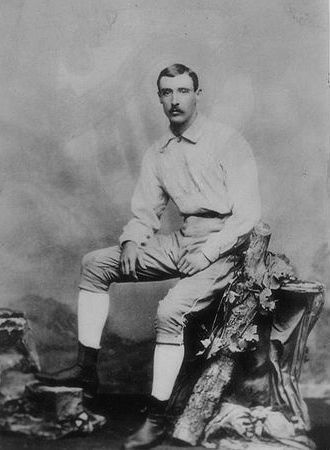
Jimmy Wood

Jimmy Wood

Wood said in his questionable 1916 account that after the victory his team barely escaped the fans:

“Immediately after the game was over the crowd swarmed upon the field, intent upon wreaking vengeance upon us.  I had anticipated this move and instructed my players for a quick get-away.  When the last out was made we dashed for the exits and jumped into our carriages.  As we ran across the field many of us were struck with stones and bottles.”

After the White Stockings made their escape—allegedly with umpire Milligan joining them for the return trip—back to Chicago where Wood said “we were given a greeting unlike any ever accorded ball players before.”

The following month the rematch was played at Chicago’s Dexter Park.

Wood claimed in 1916:

“Before the game began, 27,000 admissions at $1 each had been sold, with another 25,000 in a wild scramble for tickets…The paid admission for the game was 27,000; the ‘free admissions’ went well beyond 25,000, making a 52,000 crowd within the park when the call ‘play ball’ sounded.”

According to every contemporary report of the game the attendance was around 15,000 (The Chicago Tribune said it was 18,000), still an incredible crowd for 1870, but far less than Wood’s memory.  The Cincinnati Commercial also observed that “Not more than 500 ladies were present.”

For this game the mutually agreed upon umpire was Brooklyn Atlantics catcher Bob (the other“Death to Flying Things”) Ferguson.

Umpire Bob Ferguson

Umpire Bob Ferguson

In recounting the game in 1916, once again Wood’s recollections were far from accurate, but reporter and “baseball historian” Frank G. Menke did nothing to verify Wood’s memories:

“Things broke badly for us in the early innings.  An error or two on the part of my boys, mixed with several long hits by the Red Stockings, gave them a lead of five runs.  Later on they increased it and when the seventh inning was ended the score stood 11 to 2 in favor of the Cincinnati club.”

Actually, Chicago scored one run in the first inning, Cincinnati tied it in the third, the red Stockings scored four in the sixth and the White Stockings added one in the seventh; making the score 5 to 2 at the end of seven.  The White Stockings scored 14 runs in the last two innings and won 16 to 13.

The Chicago Republican said:

“From first to last the game was one of the finest ever seen in the country…Up to the end of the fifth inning not a point was lost on either side, and even then the increase in the scores was rather the effect of an increase in the strength of the batting than the result of errors.”

The Chicago Tribune said:

“It has been done again; this time in a manner which leaves no doubt as to whether Chicago has been successful in her efforts to wrest the base ball supremacy from Cincinnati.”

Of course the newspapers in the two towns viewed the performance of the umpire differently.

Chicago’s take, from The Republican:

“Of the umpire, Mr. Ferguson, too much cannot be said in praise…he presented one of the best specimens of an umpire ever seen.  It is sufficient, perhaps, to say, that neither side questioned one of his decisions.”

And Cincinnati’s from The Gazette:

“The umpire was against us, the weather was against us, the crowd was against us, the heavens were against us, the ground was against us, the pestilential air of the Chicago River was against us, the Chicago nine were against us, and last, but not least, the score was against us.”

However, The Cincinnati Commercial did praise Ferguson, saying he “umpired the game superbly.”

Wood and Tom Foley had achieved their goal in organizing the White Stockings; they had defeated Harry Wright’s Red Stockings.  They were named “champions” of the National Association of Base Ball Players that year (in a disputed decision—and a story for another day).

After his baseball career ended in 1875 Wood went into various business ventures in Chicago.  In 1891 he bought a tavern on Dearborn Street with another famous Chicago ballplayer, New Williamson—the two remained partners in the business until Williamson’s death in 1894.  Wood eventually settled in New Orleans, he died while on a trip to San Francisco in 1927.

Foley, remained well-known in Chicago for his connection with baseball, but became even better known for his role in popularizing billiards.  The Associated Press called him “the father of base ball and billiards in the west,” in his 1926 obituary, and said Foley was:

“Promoter of the first amateur billiard tournament in the country, Foley made a significant contribution to the game when he was a prominent member of the committee which in 1882 formulated the balk line form of play.  He was himself an expert cueist and held the Illinois championship for two years.”

Tom Foley "King of base ball and billiards in the west"

Tom Foley “King of base ball and billiards in the west”

More more bit of billiard trivia about Foley.  In 1897 The New York Times reported that he had opened the first “Billiard parlor for women,: when he created a “ladies annex” to his new pool hall in Chicago:

“Foley has a friend who likes billiards and also likes his wife, but refuses to buy a billiard table for his better half.  He told Foley about it the other day, and Foley after a little thought determined to test the scheme which he now announces.”

“Eighteen Thousand Dollars Squandered by Chicago”

22 Aug

Almost 50 years after he helped to organize the Chicago White Stockings Jimmy Wood told the story of the team’s founding to Hearst Newspapers sports writer Frank G. Menke in a series of articles.

Wood said he read an ad in a New York newspaper in late 1869, seeking to “form a team to represent Chicago and to defeat the Cincinnati Red Stockings.”  Wood said:

“Chicago wasn’t such a wonderfully large city then and it was doing everything possible to boom the town.  And it was jealous of Cincinnati because of the great publicity Cincinnati had gained through the medium of its 1869 ball team which had won 56 out of its 57 games.”

Wood, along with Tom Foley, who had placed the ad, (not to be confused with Thomas James “Tom” Foley, who played outfield for the White Stockings in 1871) set out together to build a team.

Wood called it the most difficult task of his life, attempting to sign players for “a team that had as its ultimate purpose the beating of the Reds in a three-game series.”

The press was ready to call the entire operation a failure in January—a point never referred to in Wood and Menke’s “historical” account.  The Chicago Tribune declared:

“We are not to have a first-class base ball club.  That is the long and short of it.  The thing has fizzled.”

The Tribune cited Wood and Foley’s “bungling inefficiency” as the reason Chicago should not expect much from the undertaking.

The 1870 article was at odds with wood’s nearly 50-year-old recollection that the problem of securing players was because of fear of taking on the Red Stockings:

“Scores of desirable players throughout the country applied for engagement, but delay after delay ensued…in short, everything was done precisely as it should not have been done, and the result is a total failure.  A base-ball club may, and probably will, be selected and announced within the next few weeks; but it will not be a nine capable of worsting all other clubs.”

Even Wood acknowledged that he might not have handled the process of securing players particularly well; he gave more than $1200 out of his pocket to players only to find out “some of those players had squandered their first advance money in drinking or gambling, they came for more, threatening to jump their contracts if we didn’t ‘come through.’”

Despite the slow the start, and doubts about whether or not it would be possible to put together a competitive team, Wood and Foley completed the roster that spring when they signed Bill Craver and William “Cherokee” Fisher away from the Troy Haymakers—although Fisher never played for the team.

Even The Tribune was on board; lauding Chicago’s newly formed “$18,000 team.”   The $18,000 White Stockings roster in addition to Wood and Craver, consisted of Ned Cuthbert, Charlie Hodes, Michael (Bub) McAtee, Levi Meyerle, Ed PinkhamFred Treacey, Marshall King, and William “Clipper” Flynn—a number of Chicago amateurs also filled in with the team throughout the 1870 season.

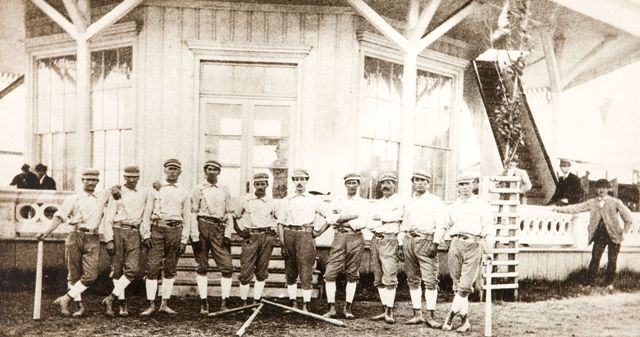
The 1870 White Stockings: Ned Cuthbert, Fred Treacey, Charlie Hodes, Bill Craver, Charlie Hodes, Levi Meyerle,Bob McAtee, , Marshall King, and William “Clipper” Flynn

The 1870 White Stockings: Ned Cuthbert, Fred Treacey, Charlie Hodes, Levi Meyerle, Ed Pinkham, Jimmy Wood, Bub McAtee, Bill Craver, Marshall King, and William “Clipper” Flynn

In May, the White Stockings arrived in New Orleans for a training trip.  Many books and articles credit Wood with being “the father” of spring training as a result of this trip; most cite Al Spink of The Sporting News as the source.  Most fail to mention that the Red Stockings trained in New Orleans at the same time that season, and even Wood didn’t take credit for being first.  Wood said in 1916 that his was “the second Southern trip ever undertaken by a ball club.”  The Atlantics of Brooklyn had made a similar trip in 1868, which included stops in New Orleans, Mobile, and Savannah.

Wood said the team won all of their games against New Orleans opponents—the Lone Stars, Pelicans, Robert E. Lee’s, and Southerns—“by overwhelming scores.”  He also claimed they defeated “the Memphis team, champions of Tennessee 157-1—and Foley was very angry because we had permitted the southerners to score their lone tally!”

The team played what Wood called their “first real game,” against Al Spalding and the Forest Citys in Rockford, Illinois and despite the Rockford fans backing “their team heavily in the betting…we swamped them.”

According to Wood, he and Foley shut the team down due to injuries “along about June 4th when I found that my ailing quartet was not convalescing very rapidly, I canceled all our remaining June and July games and stayed in Chicago.”

His 1916 recollection seems to be faulty here as well, as records indicate that the White Stockings played several games in June and July against amateur and professional clubs, including the season’s biggest disappointment for the team.

On July 6 the overconfident White Stockings lost 13-4 to the New York Mutuals, who had recently lost several games.  The New York Herald headline taunted:

Eighteen Thousand Dollars Squandered by Chicago

“With ‘hearts as light as the wind blows’ and feeling as happy as ‘big sunflowers’ the White Stockings crossed over to Williamsburg yesterday, there to teach the Mutuals of New York what a six months residence in Chicago could do in the art of base ball playing.  Never did a more confident party enter a ball field than the ‘nine’ created by Chicago…On the other hand, the Mutuals crossed over alarmed somewhat at the confidence of their opponents, and reflecting over their many defeats of late, denied not a syllable uttered.  They were quiet, reticent, in fact, and dressed for the fray as one might roll himself in a shroud preparatory to decapitation.  Underneath all of this, however, there was a determined will.”

On July 26, the Mutuals would beat Chicago again, this time on their home field, at the Dexter Park Racetrack at 47th and Halsted.  The Herald again taunted Chicago, calling the 9 to 0 victory “The Worst Whipping on Record.”

Despite the records indicating a fairly complete schedule during June and July, Wood, speaking in 1916 said “About August 4 we resumed our schedule and played out the season, winning all of our games from the resumption in August until the end.  And then came the grand climax of the year—the task for which we had been preparing ourselves; the battle with the Cincinnati Red Stockings.”

Wood’s memory was again at odds with the facts.  The White Stockings lost, at least, one August game at home, a 14 to 7 defeat at the hands of Spalding’s Forest Citys.

The story of Wood’s “grand climax of the year;” the Red Stockings series, coming up on Monday.

No Such Thing as “Off the Record”–Even in 1875

19 Aug

James Leon “Jimmy” Wood was a baseball pioneer.  The second baseman began his playing career as a 17-year-old in Brooklyn with the Eckfords in 1860.  After spending a decade as one of the best-known players on the East Coast Wood went to Chicago where he became the first manager of the newly formed White Stockings.

Wood is sometimes credited with being the man who invented spring training (a claim first advanced by Al Spink of The Sporting News) because in 1870 he took the Chicago team to New Orleans for a series of games with local teams, the Robert E. Lee’s, the Lone Stars, the Pelicans and the Southerns—most of those sources fail to mention that Harry Wright’s Red Stockings were in New Orleans at the same time.  (Wood’s reminiscences about the early days of the White Stockings coming up later this week).

Jimmy Wood, 1871

Jimmy Wood, 1871

Wood also managed the team the following season, when the White Stockings became one of the charter members of the National Association.  They finished second in 1871  but disbanded as a result of the great Chicago Fire in October.

Wood next played for and managed two teams that wouldn’t survive the year; the Troy Haymakers went bankrupt in July and the Brooklyn Eckfords who folded at the conclusion of a 3-26 1872 season.

After leading the Philadelphia Whites to a second place finish in 1873, Wood returned to Chicago and the newly re-formed White Stockings.

Wood was slated to play second and serve as captain, but would never play a game for the White Stockings or any other team.  After falling at his home during the spring of 1873, he developed an abscess on his leg, which kept him out of the lineup as the infection got worse.

In July The Chicago Tribune said:

“The well-known base ball player and former captain of the Chicago nine Jas. Wood, has had his leg amputated.  He has been unable to play this summer, owing to a disease of the bones, and has been under medical care for some months.  He was a most conscientious player, and has the esteem of all with whom he was connected.”

On August 20 The Chicago Inter-Ocean said Wood was named “manager of the club for the remainder of the present season and for the season of 1875.”  While he “officially” served as manager for the last 23 games of the season, both The Inter-Ocean and The Tribune said Wood was “unable to assume active duties,” and would be led on the field by team president William Hulbert (called “Hurlburt” by The Inter-Ocean).

By the spring of 1875, Wood had returned full-time to the management of the White Stockings, with plans to take the team for “two weeks of practice,” in April.

The Chicago manager had an off the record conversation with a reporter for The St. Louis Democrat in which he unfavorably compared the newly formed St. Louis Brown Stockings to his own team.  The paper printed the manager’s comments verbatim; even including his assertion that the comments were “private:”

“Now, said he, let us compare the players individually.  ‘For catcher there is (Tom) Miller and Higham; the former is inexperienced, poor runner, fair batter, and the only catcher you have, while Dick Higham is one of the surest and heaviest batters in the country, has experience and is a first-class base-runner.  (George) Bradley and (George) Zettlein—Zett is a poor batter and runner, to be sure, but on a pitch you ought to know as much as I can tell you.  I do not know anything about Bradley, but, if (Jim) Devlin pitches, I think we have the best of it, as he was second on our batting list last season.  First base, (Herman) Dehlman and (John) Glenn,  the former may play the base the best, but in batting, base running and general playing, Glenn can discount him.  Second base, (John) Peters and (Joe) Battin.  Well, I won’t compare notes with them, as anyone ought to know that Peters is head and shoulders above Battin in every respect.  (Davy) Force and (Dickey) Pearce, shortstop.  There is no better player in the country than Force, he being one of the very best batters.  Pearce has been one of the best, but, I think his race is run.  This is private, remember(Frank) Fleet and Warren White, third base.  Why just think of it; there is as much difference in them as in Battin and Peters.  White is first-class at the bat, and led the score on the Baltimore team last season, and is a fine base-runner in the bargain, while Fleet is not as good, by a jug full.  (Ned) Cuthbert and (Paul) Hines, left field.  The latter took balls away out in Cuthey’s field last season (Hines had played left field, with Cuthbert in center for the White Stockings the previous season).  Hines stands better at the bat—Cuthey is a fast baserunner.  (Lip) Pike and (Oscar) Bielaski center field.  Pike is the hardest batter, but no surer than Bielaski, while both are about the same in the field, they being the fastest runners in the country.  (Jack “Death to Flying Things”) Chapman and (Winfield Scott) Hastings right field.  The former won’t begin to show up with Hastings, as he is one if the finest batters and catchers in the business.

“’Take us all in all we are much stronger at the bat.  While St. Louis has but Pike and Cuthbert for base runners, we have but one poor base-runner in Zett; all the others are first class.  We have change pitchers and catchers—St. Louis has not.  If we don’t beat St. Louis eight out of ten games, we deserve to be thrown into the lake.’”

Dickey Pearce, "his race is run," according to Wood

Dickey Pearce, “his race is run,” according to Wood

A few of the players Wood referred to in early March ended up playing different positions, or like Davy Force, of whom Wood said “There is no better player in the country,” didn’t play for the White Stockings at all.

Regardless, he underestimated the ability of most of the St. Louis’ roster, while wildly inflating his club’s prospects; Wood’s team would underperform all season, finishing 30-37 in sixth place, behind the fourth place (39-29) Brown Stockings.

Wood wildly overestimated the quality of his team and presided over a season of dysfunction and scandal.  More on the 1875 White Stockings tomorrow.

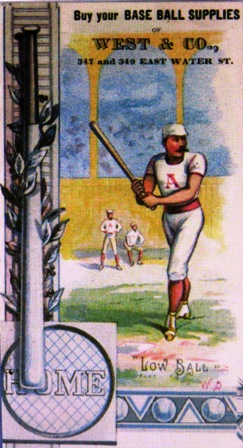
Lost Advertisements—1870s “Buy your Base Ball Supplies”

1 May

west&co

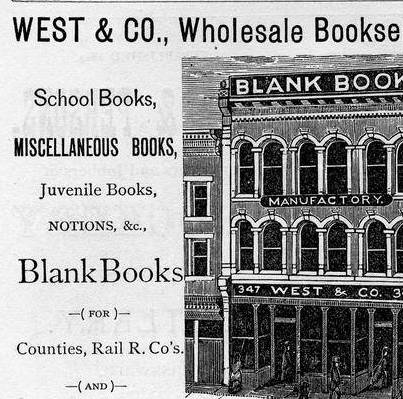
This advertisement from around 1870 was for West & Co., a book and stationery business founded by Henry Harris West in 1857.  West was instrumental in forming the first post-Civil War team in Milwaukee.  The Milwaukee Cream Citys were organized in October of 1865, with West serving as the team’s first president.

The Cream Citys were a dominant amateur team in 1866 and ’67, playing in Wisconsin and Illinois—although they lost

By the time this ad appeared the Cream Citys had declined in stature.  They joined the National Association of Base Ball Players (NABBP) in 1868, and while remaining an amateur team, were  badly beaten by quasi-professional teams, losing 67-13 to Brooklyn Atlantics and 43-16 to the Unions of Morrisania (South Bronx).

When openly professional clubs were admitted to the NABBP in 1869, things got even worse for the Cream Citys, they were beaten 85-7 and 84-17 by the Cincinnati Red Stockings in two July games.

Milwaukee would have its first fully professional team in 1877 when the West End club joined the League Alliance.

West died in 1893; the company would eventually be renamed H.H. West & Co. The  East Water Street headquarters was destroyed by fire the following year.

H. H. West & Co., 1870s

H. H. West & Co., 1870s

“California Wonder”

30 Apr

Two West Coast ballplayers dubbed “California Wonder” by the press made their Major League debuts less than a week apart in 1887.  One went on to be one of the best leadoff hitters of his era; the other remains almost completely unknown.

George Van Haltren was a 21-year-old left-handed pitcher, outfielder and first baseman who had played two seasons with the Oakland franchise in the California and California State Leagues.

James McMullin, birth date unknown, had pitched for Mike Finn’s San Francisco Pioneers in 1886.

Mike Finn, manager, San Francisco Pioneers

Mike Finn, manager, San Francisco Pioneers

Van Haltren’s rights were acquired by the Pittsburgh Alleghenys, but because of his mother’s illness he said he would instead play for the San Francisco Haverlys.  The Chicago White Stockings traded for Van Haltren in April, but he still refused.  The Sporting Life said “the California Wonder will not come east,” quoted him saying:

“No, I will not play with Chicago this season; but if my left arm holds out and my parents are blessed with good health I will be open to Eastern engagements next season.”

The White Stockings threatened to have him blacklisted for not reporting but Van Haltren dug his heels in; only changing his mind after his mother passed away in May.

The Chicago Inter Ocean announced that he had arrived in town on June 25 and would be making his debut for the White Stockings on the two days later:

“(Van Haltren) at one time retired the Pioneer Club of San Francisco with a hit, and struck out seventeen men.  If he can continue this record here the Chicagos will come out of the race this season with another set of figures to put on the big flag at the park.”

Van Haltren’s debut was not good.  He walked 16 Boston Beaneaters and lost 17 to 11.  He finished the season 11-7, and would spend one more season as a full-time pitcher; going 13-13 in 1888 (he was 15-10, splitting time between the mound and outfield with the Brooklyn Ward’s Wonders in the Players league in 1890).  Van Haltren would distinguish himself as one of the game’s best leadoff men, hitting better than .300 every year from 1889-1901, except for 1892 when he hit .293.

Van Haltren ended his career in 1903 with 2544 hits.

George Van Haltren

George Van Haltren

McMullin’s debut was no better than Van Haltren’s.

He began the 1887 season with the Pioneers, but was acquired in June by the new York Mutuals of the American Association.

When McMullin joined the club The Sporting Life said:

“The Mets have got their new California pitcher and like him well in practice.  He has plenty of speed.”

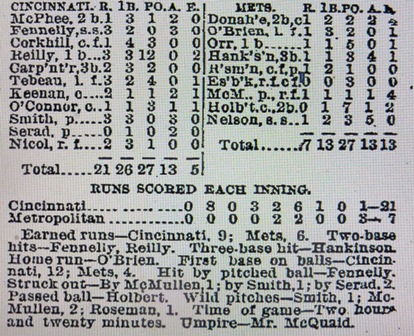
McMullin made his debut on July 2 against the Cincinnati Red Stockings.  The New York Times said of his performance, under the headline, “A ‘Wonder’ Exploded.  The Mets’ California Pitcher A Failure:”

“The debut of McMullen, the ‘California Wonder,’ was made (in Cincinnati) today in the presence of nearly 7,000 people, who went into hysterics from laughing at the awful exhibition given by the Wonder and his support.  He was utterly unable to get the ball over the plate and was miserably supported in the field.  After the third inning he retired to right field and there made a couple of errors.”

He gave up eight runs, made four errors and had two wild pitches in a 21-7 drubbing.

The box score from McMullin's debut.

The box score from McMullin’s debut.

McMullin only made two more appearances for the Metropolitans, and while he was credited with wins in both games his performance was no better; in his eight-day, three-game career he pitched 21 innings, gave up  25 runs (18 earned),  25 hits, walked 19, and struck out 2.  He made a total of five errors, and had one hit in 12 at bats.  The Mets released him on July 10.

And with that McMullin disappeared—there is no record of him having pitched anywhere after he left New York, there’s no record of whether he  threw and batted left-handed or right-handed, no pictures survive, and no record of when or where he died.  Another enigmatic figure of professional baseball’s early years.

“The ‘Original’ up-behind-the-bat Man”

17 Apr

Douglas L. Allison was largely forgotten by 1907.

He caught for Harry Wright’s Cincinnati Red Stockings from 1868-1870, joined the newly formed National Association as a member of Nick Young’s Washington Olympics in 1871, and was an inaugural member of the Hartford Dark Blues during the National League’s first season in 1876; in total he played for parts of 10 seasons in the American Association, National League, and National Association.

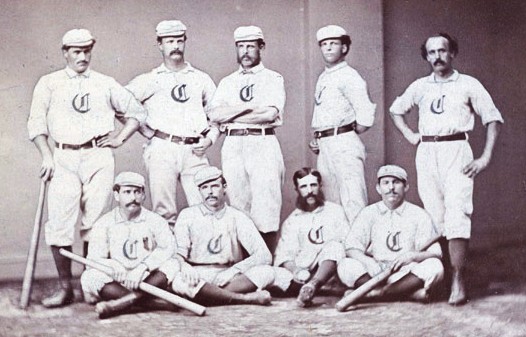
Doug Allison, standing third from left, with the 1869 Cincinnati Red Stockings

Doug Allison, standing middle, with the 1869 Cincinnati Red Stockings

It was the death of a contemporary that brought him back into the public eye.

On April 21, 1907, Nathan Woodhull “Nat” Hicks died in Hoboken, NJ.  Hicks had also been a catcher, having played for the New York Mutuals, Philadelphia Whites and Cincinnati Reds in the National Association and National League from 1872-1877.

Hicks’ obituary, including the one in The New York Times, gave him credit for being the first catcher to stand directly behind the batter:

“To catch behind the bat without the elaborate protection of mask, protector, great glove, and shin guards, as Nat Hicks was the first to do, required a grit and endurance that few of the high-priced artists of the diamond today would care to emulate.  Hicks created a sensation by catching behind the bat with his naked hands and body unprotected.”

Doug Allison couldn’t let that stand, and he contacted a reporter from The Associated Press to set the record straight:

“Nat Hicks was a great catcher for the short period that he stood in the limelight of public opinion, but the press of the country is away off in giving him credit as the ‘original’ up-behind-the-bat man.”

While coming forward to claim the distinction, Allison insisted it wasn’t important to him:

“Not that I wish to claim any such record, for after all it does not carry any great weight or glory, but just the same I think figures will prove that I was among the first, if not the first, of any of the backstops  to attempt that trick that was the mystery of the game.”

Allison said that while catching for a team in the Manayunk neighborhood of Philadelphia he developed a “theory,” and “began to believe it possible to get close up to the bat,” in order to prevent runners from stealing:

“I put my theory in action, and that was way back in 1866…My success in this style of play was remarkable, and naturally the talk of the place, until our game began to draw crowds simply because ‘Allison was behind the bat.’  This is not egotism, but the fact, and my method soon had lots of imitators.”

Allison said the following season while playing with the “Gearys, the leading amateur team of Philadelphia,” he was discovered by “that greatest of all baseball generals—Harry Wright.” And while with the Red Stockings he “continued up under the bat with plenty of success.”

As for “my friend Nat Hicks,” Allison said:

“(He) did not break into the game until 1870 and could not have started that play for which so many newspapers have been giving him credit, and while disliking to cloud their stories, it seems right to correct the popular impression of this important epoch in the history of baseball.”

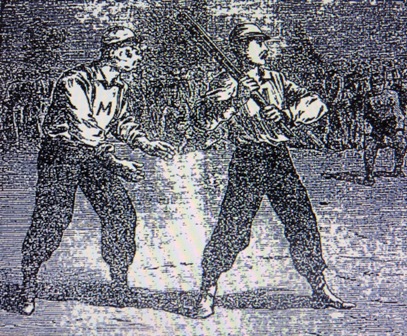
A print from the 1870s depicting "Nat" Hicks "behind the bat" with the New York Mutuals.

A print from the 1870s depicting “Nat” Hicks “behind the bat” with the New York Mutuals.

Having set the record straight, Allison returned to his job in the dead letter office of the United States Post Office in Washington D.C.  He died in 1916 at age 70.

“Leather-Fisted Phil”

12 Apr

“Leather –Fisted Phil” is what Phillip J. Powers was called in his 1914 Associated Press obituary which said:

“(Powers) was famous for his ability to stop the swiftest throws of the league’s star pitchers.”

He most likely earned the nickname in 1877 when, like many other catchers of the era, he began using a small, leather pad on his hand while with the London Tecumsehs of the International Association.

After the London team disbanded in August of 1878 Powers joined the Chicago White Stockings.  According to The Chicago Inter Ocean:

“He is a tall young fellow…He is described as a good catcher, but liable to get hurt, fair at the bat, and a genial man on the grounds.”

Powers would spend parts of seven seasons and 155 games in the National League and American Association with the Boston Red Stockings, Cleveland Blues, Cincinnati Red Stockings and Baltimore Orioles, hitting .180.  In between his engagements as a player Powers was an umpire.

It was as an umpire that he made a name for himself, but it probably wasn’t what he had in mind.  Few umpires, even in an era when members of the “profession” were poorly trained and underpaid, were the target of as much criticism as Powers.

In 1881 he began the season as a National League umpire.  By July he had become a target in several cities,

The Detroit News said:

“Phil Powers has acquired reputation enough in the last two weeks to last him a lifetime.  The erroneous umpiring he did here, people were inclined to regard as errors of judgment, but to say the least his ‘mistakes’ have become so numerous that his utter unfitness for the position he holds is unquestioned.”

The Cleveland Plain Dealer took the criticism even further:

“Powers is said to have been offered $150 to play ball (for the Detroit Wolverines) for one month, but refused it.  As an umpire he cannot, if square, earn more than $15 or $20 a week and expenses; and must take the chance at that of being chosen an umpire.  He preferred to be an umpire.  Several of his decisions on Saturday were grossly unfair, and, what is worse, they bore heavily on Cleveland.  They were so one-sided that many of the spectators believed he deliberately purposed to give the game to Troy.”

Despite the ill feelings in Cleveland, Powers joined the Blues in August and caught five games for the team after Michael “Doc” Kennedy was injured and John Clapp was “called away by an illness in his family.”   He finished the season with the New York Metropolitans in the Eastern Championship Association.

Powers again became a full-time player from 1882-1885, and was part of the Red Stockings American Association championship team in 1882.  He was released by Cincinnati in July of 1885, signed with the Baltimore Orioles and was again released the following month.

1882reds

1882 Cincinnati Red Stockings, Phil Powers standing 2nd from left

Powers was signed by the St. Louis Browns in the spring of 1886, but released before the beginning of the season, and was added to the National League umpiring staff in August.  He again worked as an umpire through the 1887 season, left to return to London, Ontario to manage the Tecumsehs in the International Association, but again returned to the National League as an umpire in August of 1888.   He came back just in time to find himself in the middle of a controversy involving two Hall of Famers.

New York Giants catcher/captain William “Buck” Ewing was hit on the wrist by a ball during a game with the White Stockings in Chicago.  In 1888 the opposing team’s captain had to agree that an injury was serious to necessitate a substitution; Chicago’s “Cap” Anson said he did not agree to a substitution when backup catcher “Big Bill” Brown entered the game in the 6th inning.  Anson appealed to the umpire, and according to The Chicago Inter Ocean, “(Powers) said that Captain Ewing was not so badly hurt that he could not play.”

After a heated argument, during which The Inter Ocean said Ewing acted “in a childish and fatuous manner,” Powers declared the game “forfeited to Chicago by a score of 9 to 0.”

Buck Ewing acted “in a childish and fatuous manner”

Buck Ewing acted “in a childish and fatuous manner”

Powers had been involved in a similar situation in 1886, refusing to allow Philadelphia Quakers catcher “Deacon” McGuire to leave a game after an injury.  The Chicago Tribune said Quakers captain Arthur Irwin “told McGuire to catch ‘away back’ (from the plate).” The Tribune said Irwin’s actions created a “scene” and “pandemonium reigned,” until Anson agreed to allow Philadelphia to replace McGuire.  White Stockings President A.G. Spalding “preferred charges against umpire Powers” for losing control of the game.

The substitution rule was changed in 1891, putting an end to controversies regarding the replacement of injured players.

But controversies involving Powers continued.  More on Monday.

“The Money in Baseball” 1884

14 Mar

In 1884, under the headline “The Money in Baseball,” The Boston Globe expressed their antipathy about the “enormous salaries which the ‘kings of the profession’ demand.”

The Globe observed that “The best pitchers get as much money for working a few hours each day during seven months as many college professors receive for the entire year’s service.”

George Wright, Hall of Famer, and brother and teammate of Harry Wright with the 1869 Cincinnati Red Stockings, told the paper

“The money paid the entire team would put a poor team on the field today.  My brother Harry was the most expensive man on the team, and he got $2000 for being captain and playing center field.  I was in my regular position at short and drew $1800.”

Wright said several players on the Red Stockings were paid less than $1000.

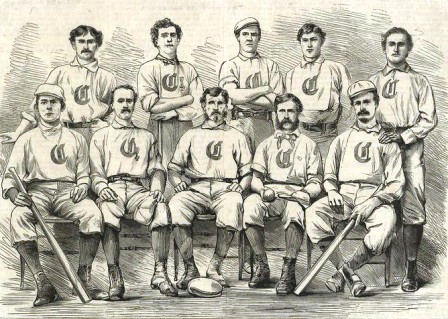
1869 Red Stockings, Harry Wright, standing third from left, George Wright standing to the right of him.

1869 Red Stockings, Harry Wright, standing third from left, George Wright standing to the right of him.

By comparison The Globe said:

“The salary list of the Boston League club amounts to $25,000 in round numbers…It is impossible to estimate how much has been paid in salaries to ballplayers throughout the country.  The eight League clubs will certainly average as much as Boston’s total…In the Union Association are eight more clubs…there is not much doubt that the eight clubs pay at least $125,000 in salaries.  The American Association has twelve clubs…the salary list of these three largest baseball associations in the country aggregate between $500,000 and $600,000.”

John Bradley

18 Jan

Two members of the 1888 Dallas Hams were shot and killed in Texas.

One, George Kittle, I wrote about in September.

John Bradley was the other one.

Charles M. “John” “Brad” Bradley (wrongly listed with the middle initial “H” on Baseball Reference) left Oil City, Pennsylvania where he was born in June of 1864, to go west and play baseball.  An article in The Louisville Courier Journal said he was born to wealth and left Pennsylvania because of his father’s disapproval of baseball:

“(Bradley) was surrounded with every luxury.  He acquired a collegiate education and all the ornamental accomplishments of modern times.  He was possessed of a charming tenor voice; was a brilliant pianist and an expert linguist.  He was passionately fond of the national game…An early disagreement with his father, the result of his penchant for baseball, led to an estrangement, and, troubles never coming singly, he was rejected by a young lady of Oil City, PA, to whom he was devoted.”

After playing in Corning, New York in 1885 Bradley went to Kansas.  Various sources place him with the Topeka Capitals in the Western League and/or a team in Abilene in 1886 though neither can be verified.  Bradley then played with the Emporia Reds in the Western League in 1887.

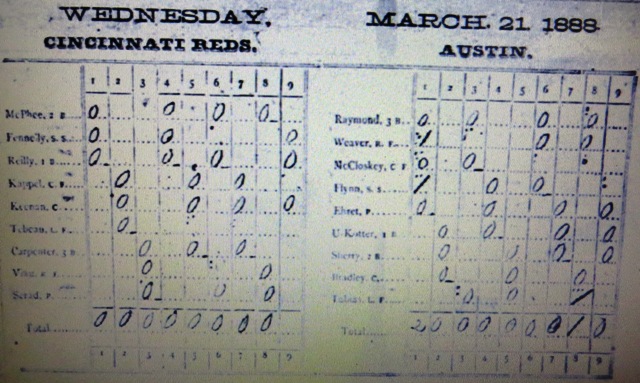
He signed with the Austin Senators in the newly formed Texas League in 1888.  In March, Bradley caught for Austin in two exhibition games with the Cincinnati Red Stockings of the American Association—the Statesmen lost the first game 2-0, but won the second 3-0.

Box score of 1888 Austin -Cincinnati game won by Austin 3-0.

Box score of 1888 Austin-Cincinnati game won by Austin 3-0.

Bradley was Austin’s starting catcher until the dissolution of the Texas League in July.  When the reformed Texas Southern League commenced play later that month, Bradley was with Dallas where he shared catching duties with Kittle.

Bradley hit .158 as Dallas coasted to a championship.

The 1888 off season was an eventful one.

Bradley was offered a contract for 1889 with the St. Joseph Clay Eaters in the Western Association.

He also started seeing Dolly Love, “A woman of bad repute,” as The Dallas Morning News said; problem was Love was also involved with a livery driver named Tom Angus.

At the same time Bradley got in trouble with the law in December of 1888.  The Austin Weekly Statesman said:

“(Bradley) shot a man named Billups in a (Dallas) bar room, because Billups attacked him with an empty beer keg because he refused to pay for drinks.”

Bradley was charged with “assault with intent to kill” and was scheduled to appear in front of a Dallas Judge at the end of January.  He was also arrested twice in early January for altercations with Love at the brothel she operated.

Throughout the chaos Angus and Bradley were trading threats over Dolly Love.

The rivalry came to a head on January 16.  Shortly after 10:30 a.m., Bradley and a friend exited Swope & Mangold’s Saloon at the corner of Main and Austin to return to his room at the Grand Windsor Hotel across the street.  The Austin Weekly Statesman said Bradley was:

“Shot down like a dog by Tom Angus, a hack driver, who followed him and fired in his back.”

The Headline in The Dallas Morning News said:

“The Killing of Charles Bradley the Baseball Catcher, all about a Fallen Woman.”

Bradley was shot through the back and began to run as Angus fired two additional shots; after running about 120 feet, Bradley fell dead in the street.  Angus was immediately arrested and ordered held for trial.

A letter from five representatives of the Texas/Texas Southern League and addressed “To the Baseball Profession of the Union” was published in newspapers around the country soliciting funds “In order that able counsel may be obtained to conduct the prosecution,” the letter concluded:

“John Bradley played with Austin and Dallas in 1888, and had recently signed with St. Joe for the season of 1889. He was a gentleman, an excellent ballplayer and altogether an honor to our profession.  To ball players this case suggests not only a duty but a privilege, and we trust that a suitable response will be made.  Yours fraternally,

J. J. McCloskey, manager Austin team, I888.

Charles Levis, manager Dallas team 1888

Doug Crothers, manager Dallas team, 1889.

Kid Peeples, short stop Dallas team 1888.

Billy Joyce, third base Ft. Worth and New Orleans, 1888.”

It is unknown how much money was raised.

Dolly Love left Dallas for Fort Worth to escape the publicity.  Tom Angus spent more than a year in jail awaiting trial during which time he got married.  Dick Johnson, a friend of Angus’, who was at the scene of the shooting, was charged as an accessory, but was acquitted in a separate trial.

When the trial began in April of 1890 The Dallas Weekly Times-Herald headline called it:

“The Most Sensational Case that Has Been up for Years.”

Several witnesses, including a Dallas police officer testified that Bradley had also made threats against Angus in the weeks leading up to the killing, and that he often carried a gun.  Although Bradley wasn’t carrying a gun on the morning he was shot, and was shot in the back, the defense claimed that Angus had acted in self-defense.  Angus was found guilty, but sentenced to only five years in prison.

The sentence was upheld on appeal, the decision said:

“The accused should congratulate himself upon the mildness of the sentence.”

Angus was released from prison in the spring of 1895; in December he was arrested for shooting a man over a dispute about a horse.

Bradley was buried in Dallas.