Tag Archives: Clark Griffith

“People who saw the Sport are still Laughing”

17 Dec

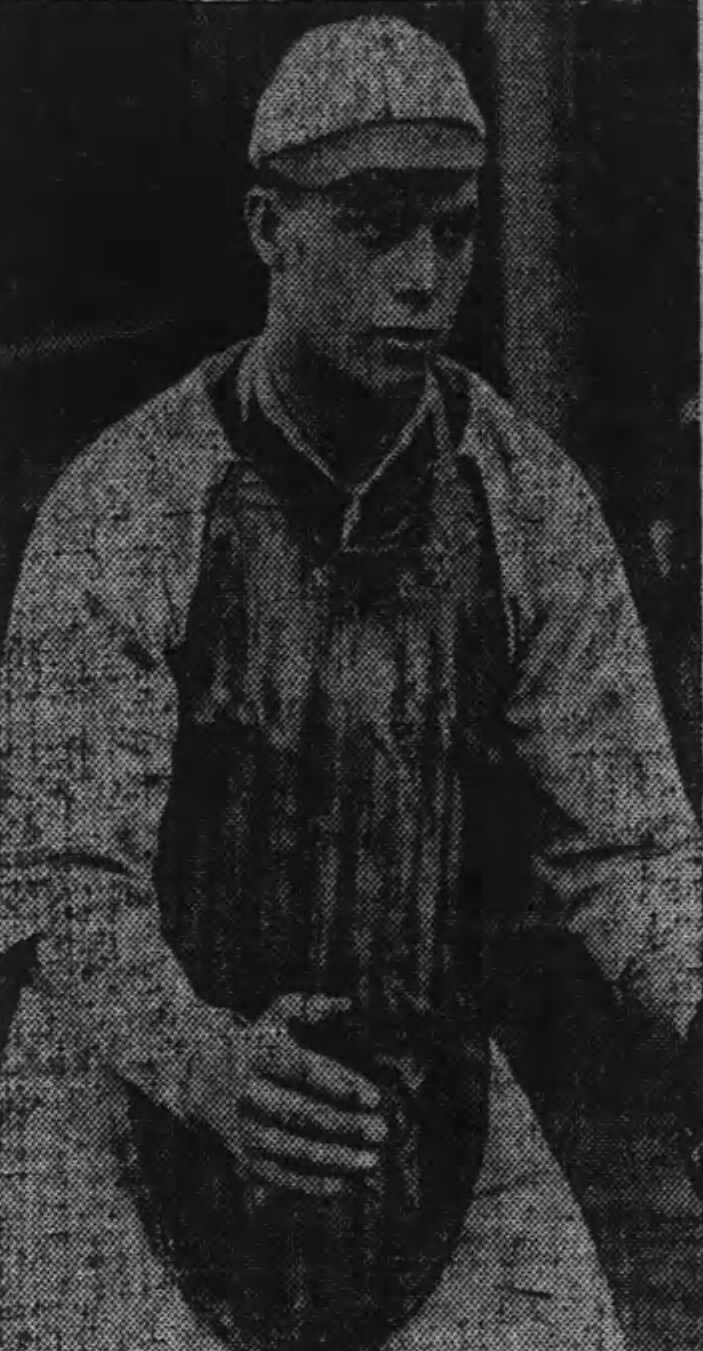
High expectations came with George W. “Big Mike” Mahoney to his hometown Boston Beaneaters in 1897.

A baseball, track and football star at Georgetown University—he played football until the University disbanded the team after his backfield mate George “Shorty” Bahen—a foot shorter than Mahoney– died from injuries sustained during the team’s Thanksgiving Day game against Columbia in 1894.
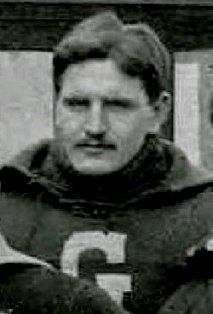
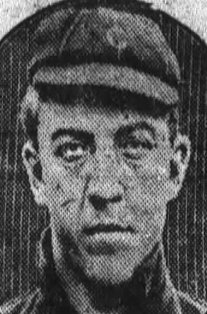
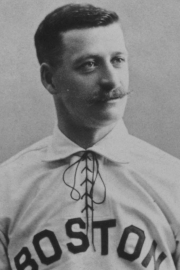
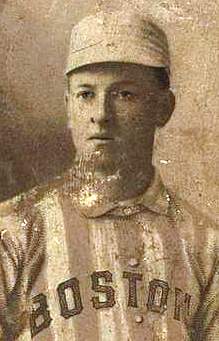
George "Big Mike" Mahoney

George “Big Mike” Mahoney

In 1895, he gained notice for his pitching after striking out 13 batters in a game with Yale.

The following year, The Philadelphia Times said:

“He has won enviable renown as a pitcher, where his remarkable strength, speed and ability to curve have made him a very formidable player.  He has also played football, where his remarkable physique, weight and strength have stood him in good stead.  One would imagine that his weight—236 pounds—would prevent his running with any remarkable speed, but it is so distributed—he being probably the largest athlete in the college world, measuring six feet five—that it is little of an encumbrance to him.”

In the spring of 1897, it was rumored that Mahoney would not return to Georgetown and instead sign with Boston.  The Philadelphia Inquirer said:

“(I)t is understood that he will play professionally with the Boston league team.  Mahoney is considered a wonderful pitcher, as well as being a fine catcher and first baseman.”

Shortly after signing with the Beaneaters, The Washington Evening Times said Mahoney had been offered the opportunity to take up yet another sport:

“(Mahoney) has a chance to shine pugilistically.  En route to Pittsburgh Sunday the Bostons had Bob Fitzsimmons for a traveling companion.  Fitz was smitten with Mahoney’s size, and offered to take him in charge and coach him into a high-class heavyweight.”

Bob Fitzsimmons-wanted to train Mahoney for the ring.
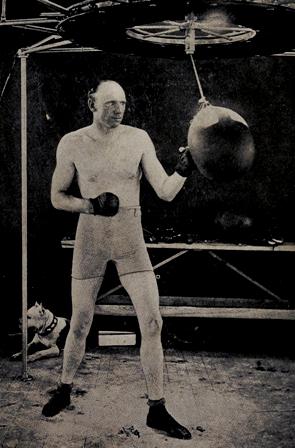
Bob Fitzsimmons-wanted to train Mahoney for the ring.

Mahoney turned down the offer.

On May 18 Boston was in Chicago; trailing the Colts 9 to 5 in the eighth inning, Mahoney made his big league debut on the mound for the Beaneaters.

The Colts and The Chicago Daily News were not kind to the rookie:

“Mr. Mahoney, the largest man seen in the League for many moons, made his debut in professional ball at the west Side Grounds yesterday.  He now wishes he had tarried at his Georgetown school.  The reception given Mr. Mahoney was one of the warmest ever seen around these districts since the year 1, and the people who saw the sport are still laughing.

“Mr. Mahoney is 6 feet 5 or more, and one of the finest looking men imaginable.  Small girls, who admire big men, could be heard squeaking, ‘Isn’t he cute?’ all of the stand.  He has been loafing around the park during the present series, doing nothing but taking life easy, and the multitude were really getting inquisitive as to who he was and what right he had to live.

“He went into the fray at a rather inauspicious time.  The Colts had just demolished (Ted) Lewis and had biffed fat (Jack) Stivetts in the solar plexus.  When Mr. Mahoney’s giant frame loomed up there was a shout of laughter, then a pause of dread lest the monster should prove strong and speedy in proportion to his fearful size.

“He threw a ball:  (Bill) Dahlen hit it.  He threw another: (Bill) Lange hit it.  He threw one more: (Walter) Thornton hit it.  And the picnic might have gone on had not the long man climbed eleven feet higher and pulled down a bounding ball (Mahoney had jumped high to rob Colts catcher Tim Donahue of a hit up the middle)”

Mahoney faced seven batters, allowed two runs, three hits, walked one and struck out one.
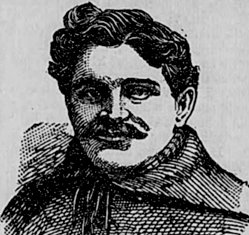
Mahoney

Mahoney

The Daily News ended the ridicule by allowing that Mahoney might, someday, be a good pitcher:

“The fate of Mr. Mahoney is no new experience for a young pitcher.  Many a man who has afterward been a star has been a horrible fizzle on his first appearance, while many a man who has panned out no good on earth has made a glorious debut.  Thornton was a conspicuous success on his initial day, and has been nothing in the way of box work since.  (Clark) Griffith did not do very well the first tie he pitched for (Cap) Anson, and he is the best of all nowadays.  Mr. Mahoney, if given a fair show, may yet become a (Amos) Rusie.”

Mahoney never received “a fair show.”  He never pitched in another major league game.  He caught one game for Boston, and went 1 for 2 with an RBI, but was released in July of 1897.  Mahoney appeared in two games for the St. Louis Browns the following season—he was 1 for 7 and committed one error.  For his four-game big league career he hit .111 and posted an 18.00 ERA.

After one more season playing for several East Coast minor league teams, Mahoney returned to Boston where he became a police officer; he died there in 1940.

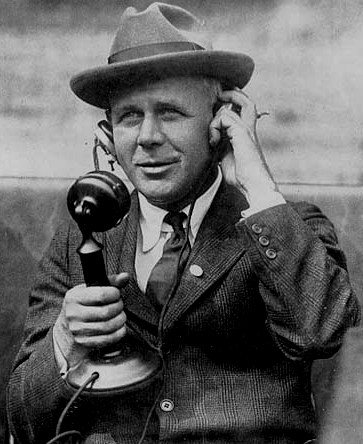
“Dummies Don’t Make Good”

15 Dec

Clark Griffith, while managing the New York Highlanders, provided The Washington Post with his insights on pitching—as well as sleeping and eating.  Griffith, “essentially a great a thinker,” shared “numerous cogent truths” with the paper:

“When I was working regularly, I prepared myself for games under a perfect system.  The day after I had been in the box I made it a point not to do any pitching whatever.  I would go to the outfield and develop my wind by chasing the ball out there.  The next day I would assume pitching practice until limbered up; then stop and do no more until I went in the box the next day.

“I was always careful what I ate, especially at lunch on the day I was going to pitch, as are most of the pitchers of the present day.  They can’t be good pitchers unless they are.  I always keep an eye on the man I am going to send in the box, though a majority of the pitchers know enough to pick out the right kind of diet.  As they have the most work to do in a game, and more depends on them than on any one man, they have to take better care of their stomachs than the others.

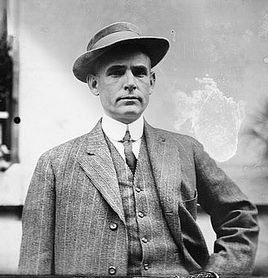
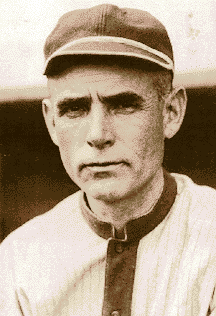
Clark Griffith

Clark Griffith

“I always found it a good plan to take a nap after lunch on the day I was going to pitch.  That brings a man’s faculties all back.  I don’t mean lie there until you get dopey, just a light sleep.  A heavy sleep knocks a man out.  The average ballplayer is a late riser.  He gets up anywhere from 9 to 10 as a rule, and as he eats a heavy breakfast, his luncheon ought to be a light meal and over by not later than 12:30.  He has to go light on pastry.  On the road, in particular, he has to be careful or he will have indigestion. When on the road he eats a number of hurried meals, and then his stomach needs watching more than any other time.  What with hurried meals and the wear and tear of traveling, a team on the road is playing on its spirit.

“”The successful pitcher has to be a thinker and always trying to get something out of the batter.  Dummies don’t make good, because they are up against a smart bunch of hitters who are always sizing a pitcher up.  The pitcher must be thinking constantly, and for that reason the slow pitcher is not the dull-witted pitcher.  When you see a man who is a slow worker in the box you can bet that he is trying to place every ball and is figuring out where every ball should go and why.

“The easiest games to pitch are the shutout games.  You wouldn’t think that a pitcher had had an easy time when he had kept the other side from scoring, but as a matter of fact those are the very kind of games that are the softest for him.  Take a game where the score is 4 to 0 or 5 to 0, and the winning pitcher has been taking it easy the last part of the game.  The chances are the other side was going out in one, two, three order.  In any event, few of them were on the bases, and this gave the pitcher something to work on—that is, a chance to ease up and not be on the watch all the time.  The 5 to 4 and 8 to 7 games are the hardest on a pitcher.  They mean that men are on the bases a good deal  and that the pitcher is always working hard to keep them from scoring.

“I have been called a hard loser in baseball, and I guess that’s so.  Nobody can amuse me after I have pitched a losing game, my appetite is completely gone, and I would not go to the best show on earth if I had a private box.”

“The Annual Spring Typhoon has Blown up Again”

10 Nov

In 1906, despite being, on paper, the best team in the American League, the Cleveland Naps finished in third place, five games behind the Chicago White Sox.  The club had three twenty game winners—Addie Joss, Bob Rhoads, and Otto Hess—and four regulars who  hit better than .300—Napoleon Lajoie, William “Bunk” Congalton, Elmer Flick and Claude Rossman,

As the 1907 season approached, Grantland Rice, of The Cleveland News said the team was now a victim of the success of individual players:

“The annual spring typhoon has blown up again—only a bit worse than ever.  In nearly every big league camp well-known athletes are breaking into loud roars over the pay question, and there promises to be quite a batch of trouble before the storm is cleared away.  In this respect Cleveland heads the list, although Napland owners have one of the highest salary lists in the game.  Up to date Joss, Rhoads, (Terry) Turner and Congalton have balked, while neither Flick nor Hess have returned a signed contract.”

Grantland Rice

Grantland Rice

Rice said the club’s negotiations with Joss and Rhoads were at an impasse, and “just how it will end is a matter of uncertainty.”  The news of the team’s trouble signing their stars led Rice to a discussion of “just how much a major leaguer is supposed to receive for his work each season.”

“When a youngster breaks in he is never given less, or at least rarely so, than he received in his minor league berth.  His pay is boosted the greater part of the time, so the average debutante’s pay roll ranges closely around $1,800 providing he is recognized as a first class man.

“If he delivers the goods his first year out he can figure on about $2,000 or $2,200 for his next season, and then if he becomes established as a regular, his income should be somewhere in the immediate vicinity of $2,500.

“From this point upward it all depends on their rankings as stars.  You hear considerable about $5,000 contracts and better, but as a matter of cold, clammy fact, but few athletes draw over $3,000 or $3,500 at best.

“In the epoch of war salaries $3,500 or $4,000 was a fairly common figure—but no more.

“A high grade slabman along the order of Joss, Rhoads (Nick) Altrock, etc…will rake in about $3,000 now.  In his weekly letter in a Toledo paper (The News-Bee), Joss stated that he was offered $3,000 for his season’s work, but that he demanded more—just how much he didn’t say.

“George Stone drew $3,000 or there abouts last season and now that he has fought his way to the premiership in the School of Slugs he demands $5,000, at which figure Mr. (Jimmy) McAleer balks strenuously.  (Johnny) Kling also asks for $5,000, which sum Charley Murphy says he will not receive.

“From this list we jump to the drawing cards of the game such as Lajoie, (Honus) Wagner, (Wee Willie) Keeler, (Christy) Mathewson, etc…

“Lajoie’s figures range somewhere above $8,000 and something shy of the $9,000 mark.

“Wagner is supposed to draw $5,000 for his work.

“If reports sent out from New York are true, Keeler’s yearly ante is close to $6,000, while Mathewson draws in about the same.

Hal Chase won’t miss $3,500 very far.

“But the high-priced teams are not pennant winners by a jug full.

(Charles) Comiskey and (Connie) Mack hew closer to the line than any others in Ban Johnson’s circle, and yet these two have won more pennants than all the rest put together.  In fact, they’ve gotten away with all but the two which Boston nailed.

“Mack had one of the cheapest, if not the cheapest team in the American League through 1905, the last year he copped the pennant.  Comiskey’s world champions of 1906 were far below Cleveland, New York or even Boston, from the salary standpoint.

“It looks funny to figure the cellar champions of a league paid more than the holders of the world’s title, but if all the figures were given out, the White Sox payroll would loom up under Boston’s to a certainty.

“The full salary cost of running a big league club varies from $40,000 to $50,000, or maybe $55,000 a year.

“A set of figures somewhere between $45,000 and $50,000 would probably hit at the higher average.

“There was a time when Boston’s payroll was close to $70,000 and (Clark) Griffith’s was only a notch below—but this golden era for the ballplayer has passed.”

According to The Washington Post, Joss had earned $3,2000 in 1906 ($2,700 and a $500 bonus), the biography, “Addie Joss:  King of Pitchers,” said he was paid $4,000 in 1907—Joss, who was 21-9 with a 1.72 ERA in 1906, followed that up with a league leading 27 wins (against 11 loses, with a 1.83 ERA) in 1907.

Addie Joss

Addie Joss

Fellow twenty game winners Rhoads and Hess both saw their production slip (15-14, 6-6), and only two regulars—Flick .302 and Lajoie .301—hit better than .300, and the team’s batting average slipped 28 points from the previous seasons.

The Naps finished fourth in 1907.

“It is Feared that the Cares of his Office are making an old man out of Tim”

18 Aug

Timothy Carroll “Tim” Hurst had an eventful season in 1906.

He had been an umpire since 1891—with the exception of one awful season managing the St. Louis Browns to a 39-111 last place finish in 1898.  In 1904 Hurst retired from the National League, but months later joined the umpire staff of the Central League, and took a job in the American League in 1905.

Tim Hurst

Tim Hurst

The Kansas City Journal described the 5’ 5” umpire who was also a boxing referee::

“Hurst is a pudgy little fellow, below medium height, with sandy hair, twinkling blue eyes and a ruddy complexion.”

He was often called “pugnacious” for his on field, and off, altercations, and once told a reporter for The New York Herald how he dealt with argumentative catchers:

“Never put a catcher out of the game.  If the man back of the bat is sassy and objects to your calling of balls and strikes, keep close behind him while doing your work and kick him every time he reaches out a catch a ball.  After about the third kick he’ll shut up.”

The incident that earned him the most attention in 1906 happened during a May 7 game in New York between the Highlanders and the Washington Nationals.   The New York Times said during the fifth inning:

(Frank) LaPorte was declared out at first base on a close decision.  Manager (Clark) Griffith rushed over to the base line, and, throwing his cap in the air, protested against the decision.  He wildly gesticulated, and Hurst ordered him away.  Griffith, instead of following Hurst’s instructions, stepped up to the latter, protesting all the time.  In his excitement he stepped upon Hurst’s foot.”

Hurst “drew back” to punch Griffith but was held back by players from both teams.

“Hurst then took hold of the lapel of Griffith’s coat and started to lead the player-manager to the bench.  The latter angrily resented this action and pushed Hurst’s hand away.  Lave Cross and the Washingtons tried to pacify Griffith, and succeeded in getting him to the players’ bench.”

Hurst followed Griffith to the New York bench and again attempted to punch the manager, while Griffith “rushed at the umpire.”

Clark Griffith

Clark Griffith

According to The Associated Press Griffith claimed “’Hurst didn’t hit me.’ Then pointing to his swollen mouth he added, ‘I had this swollen lip before the game.’”

Hurst and Griffith were both suspended for five games.

The following year Henry Pierrepoint Edwards of The Cleveland Plain Dealer said Hurst had given him an explanation to “clear up the mystery” of why he reacted so violently:

“Now, it isn’t customary for Tim to wear baseball shoes on the diamond.  Usually Tim appears for the fray clad in the same suit he would wear at a pink tea.  His real uniform is just a cap.

“On the afternoon in question Tim purchased a new pair of patent leather shoes.  The shoes glistened in the sun like a diamond and gave Tim great pleasure.  Griffith forgot all about the shoes and in his rage over losing a close decision spiked and spoiled the new kicks.  Great was Tim’s rage.  Even greater was the clash.  That’s all.”

Two months after the incident with Griffith, Hurst made what might have been the worst call of his career.

On July 7 in Washington, he was working the game between the Nationals and the Detroit Tigers.  The score was tied 3 to 3 in the seventh inning, the Tigers had the bases loaded with two out and Sam “Wahoo” Crawford at the plate, facing Nationals pitcher Frank KitsonThe Washington Post said:

“’Wahoo’ lifted one a thousand miles directly over the pan.  Kitson came tearing in,  (Catcher Howard) Wakefield hesitated.  Manager (Jake) Stahl stood still at first base.  The pellet whirled in the air and finally dropped just inside the line and bounded back to the stands.  (Charley) O’Leary and (John) Eubank romped home.  Crawford went to second, carrying the funniest two-base hit on record.  Kitson and Wakefield stood admiring each other until Hurst again yelled ‘Fair ball!’ when the boy catcher went after the bulb.”

Sam Crawford

Sam Crawford

While the Nationals argued the call, and Hurst refused to reverse his decision, The Post said “The spectators were forced to listen to the dillydallying for fully fifteen minutes, then many of them got up and left the belligerents wrangling over the decision.”

Kitson threw a wild pitch to the next batter, Matty McIntyre scoring Herman “Germany” Schaefer and Crawford.  The Tigers went on to win 9 to 3.  Jake Stahl filed a protest with American league President Ban Johnson.

The Washington Evening Star said:

“The only excuse that Umpire Hurst can have is that the play was an unusual one.  Lave Cross admitting that he never saw its like in his experience on the diamond.  Hurst was palpably rattled, and the Tigers when taking their places on the field chaffed the locals with the remark that ‘Tim certainly handed us one that time.’”

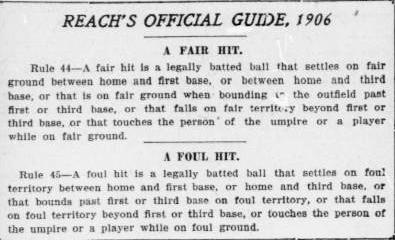
The Washington Times said it was “one of the most remarkable plays ever seen on a diamond,“ and printed for their readers rule number’s 44 and 45 from the 1906 “Reach Guide” Reach describing “A Fair Hit,” and “A Foul Hit.”

The Washington Times used "The Reach Guide" to illustrate how Hurst blew the call.

The Washington Times used “The Reach Guide” to illustrate how Hurst blew the call.

The Times said:

“(T)here seemed no possible way of calling it fair, but Hurst was obdurate, and the only explanation he would give was that the ball ‘was hit too high.”  What the heighth of the hit had to do with the fact that it eventually bounded foul is still another mystery.”

Hurst’s story evolved over the next several days.  The Post said his original explanation regarding the ball’s height was “to the effect that the ball was it so high it ‘settled’ inside, constituting the hit a fair one. “  This was quickly replaced by Hurst’s claim that the ball had touched Wakefield, the Washington catcher, before bounding into foul territory.

The Times’ baseball reporter Thomas Stevens Rice said of Hurst’s new story:

“This explanation is all right if it presents the facts in the case.  In the press box there was not a single man who thought the ball was touched by Wakefield or anybody else.”

The Post conceded that the protest would be rejected, saying “It is almost certain that Ban Johnson will sustain his scrappy umpire, no matter what interpretation he puts on the rules,” but the paper did not let up on Hurst.

The following week when Sam Crawford brought his average up to .300, The Post said:

“Hurst last week decided that Crawford’s high rap which hit inside the base line and bounded back to the stands was fair…am would have faced the pitcher 271 times and got away with 81 hits which would have made his average .299, as it was Sam got and extra hit which brought the total to .303.  He owes Tim a hat.”

Hurst was still young, just forty-one in 1906, but The Sporting Life said something had changed during that year, and by the end of the season that the umpire lacked the “Aggressiveness and enthusiasm” he had previously exhibited:

“It is feared that the cares of his office are making an old man out of Tim, who once was noted for having the finest brand of keen-cutting, kill-at-a-thousand-yards sarcasm of any umpire in captivity.  Sit Timothy is very tame, and the players, even the bush leaguers who have just broken in, can tell him what they think of him and his calling.”

Hurst’s old “aggressiveness” came out in 1909.  He was suspended in May for a fight with Norman “Kid” Elberfeld of the Highlanders, then on August 3 during a game between the Athletics and White Sox.  The Brooklyn Eagle said:

“At Philadelphia Tim Hurst came in for considerable trouble.  Hurst called Eddie Collins out at second and the Columbia youngster put up a kick.

“Whether it was with malice aforethought or quite an accident, it is a fact that the umpire distributed a mouthful of moistened union-made tobacco in the direction of the youthful Eddie, who immediately called Tim’s attention to the board of health ordinance which prohibited expectorating in public places.”

After the game Hurst had to be escorted from the field by Philadelphia police.  Ban Johnson suspended Hurst, beginning two weeks of rumor and speculation about the umpire’s fate.  Finally, on August 18 it was announced that Hurst had been let go by the American League.

Hurst, in poor health since 1912, died in 1915.  Hugh Fullerton of The Chicago Examiner said of his passing at age 49:

“The saddest part of it is that ‘Timothy’ did not die in the blue uniform, and that during the last few years of his life he was practically blacklisted in baseball for refusing to answer or deny charges made against him for his actions during a clash with Eddie Collins…President Johnson declared that if Hurst even had replied to his telegrams of inquiry he would have kept him—but Tim, knowing he had done wrong, refused, and went out of the game.”

“First thing I know they had the Cushions Populous”

15 Aug

Nearly two decades after he claimed it happened, Clark Griffith told a reporter from The Sporting News a story about getting the final out, and humiliating a friend in the process:

Clark Griffith

Clark Griffith

“It has been my luck to see a large number of peeved and angry people in this old game of baseball, particularly gentlemen against whom I have been lucky enough to do some successful pitching.

“I still think, however, that the maddest man I ever did behold was that grand old Monolith of the Boston team—Mr. Thomas Tucker.  The Occasion on which I beheld the fury of this famous warrior is still green in my memory, and can never forsake me.

“Old Tommy Tucker was pretty nearly on his last legs so far as big league baseball was concerned, and hits to him were more precious than rubies and diamonds when we bumped together one summer afternoon.  It was a big game, a most important game, and I really had to win it.  I love Tom Tucker very much, but I loved my salary more.

Tommy Tucker

Tommy Tucker

“The battle was a hot one, running along on pretty even terms till near the close, when we managed to get a couple on the bases when good old Uncle (Cap) Anson did the rest with one of those murderous  hits that they don’t make now, the old man not being there to soak them.  That Boston bunch was never whipped till the last man was counted out, and they went after me strong in the last death rally.  First thing I know they had the cushions populous, two down and old Tom Tucker standing grimly at the plate.  I worked him into biting at two wide ones, then fed him two more which he refused to reach after.  It was coming down to cases and no mistake.

“Just at this juncture I happened to remember a trick of indoor baseball—the enormous upshot which is put on an indoor ball by swinging it underhand, with the knuckles uppermost and the ball rolling off the palm.  It causes a huge upshot ball, but it is not practicable for outdoor ball because, at the greater pitching distance, the ball would lose all its speed before it reached the platter.

“I decided to throw the ball just once, as a desperate experiment, and I threw it.  The globule sauntered along, way low, below Tom’s knee line, and he stood scoffing at it.  Then, just as the ball came parallel with him it leaped up and whirled over the plate, while the umpire yelled ‘strike three.’

“Old Tom Tucker laid down his bat and started toward me, with evidence of much excitement on his face, but I was already on my way, and was going fast.  That night he came to the hotel looking for me, and publicly announced that he intended to slay me on sight, but I was not in, and he never got his hands upon me.”

The pitch used to strike out Tucker was not the only one Griffith said originated with him.  In addition to his claim to have invented the screw ball, in 1899 The Chicago Daily News said Griffith claimed to have perfected a new type of curve which “is said to be an amplification of his celebrated slow ball, with which he has in times past puzzled so many batsman.”

The “celebrated slow ball” was taught to Griffith by Charles “Old Hoss” Radbourne—as a result The Chicago Tribune’s Hugh Fullerton said Griffith held “practically a monopoly on the slow ball and (used) it with wonderful effect.”

Griffith said he developed this new curve when shooting pool:

“You simply English the ball with your hand instead of the cue that is the only difference.  In other words, before the ball leaves my hand it is set to spinning in a direction towards my body.  All the time it is going through the air towards the batter it has this rotary motion.”

The Daily News described the pitch:

“It is believed that the air in the case of a curve of this kind acts like the cushion of a billiard table and accentuates the tendency to return, which underlies the forward motion of the baseball.  Be that as it may, the result is astonishing.  A ball that starts out with great velocity from Griffith’s hand in this experiment, as it gets to the batter suddenly slows up to a speed not more than one-half as great as that at which it was launched.  The effect on the batter, who is expecting a swift ball, can readily be imagined.  He strikes at the leather globe before it reaches him, and the chance that he hits it is reduced to a minimum.”

Big Six versus The Hoosier Thunderbolt

6 Aug

Christy Mathewson had only pitched five full seasons when Sam Crane of The New York Journal said in January of 1906 “there is a great diversity of opinion” regarding whether Mathewson or Amos Rusie was the better pitcher.

Crane said “Old-time lovers of the game” said Rusie, “The Hoosier Thunderbolt”, whose career ended in 1901 after being traded to Cincinnati for “Big Six” Mathewson,  was the best ever, “and refuse to acknowledge that the young college man who won the world’s championship so easily last fall…is his superior.”   While, “the younger generation of enthusiasts say there was never but one Mathewson and point to his wonderful record to prove their point.”

Amos Rusie

Amos Rusie

Crane said two famous New York baseball figures—and future Hall of Famers– disagreed on the point:

George Davis, the crack shortstop of the Chicago White Sox, and one of the best players who ever wore ‘New York’ across his shirt front, met Clark Griffith, manager of the Yankees (Crane was one of the earliest to call the then “Highlanders” the “Yankees”), yesterday at the headquarters of the New York American club, and argued over the much mooted questions of pitching superiority between the two crack box artists.  Both Davis and Griffith agreed that Mathewson and Rusie were two of the best, but differed as to which was entitles to the premier position.”

Davis thought Mathewson was better.

“Both have excelled all other Boxmen.  I have never batted against Matty in a game, but I have met his curves in practice and I want to say that he has just as good control of the ball as Rusie.  Matty’s most effective ball is a straight drop, but his speed is a great factor as well as a wonderfully controlled slow ball.  He uses his forearm and elbow and winds up in such a manner that a batsman is sure to be puzzled.  Rusie, on the other hand, depended on an out drop, which he controlled with remarkable skill, in addition to his fast ball; but he had very little preliminary motion and used his shoulder almost exclusively.  Rusie probably had the better physique, but in head work and vitality Mathewson outclasses the big Hoosier.”

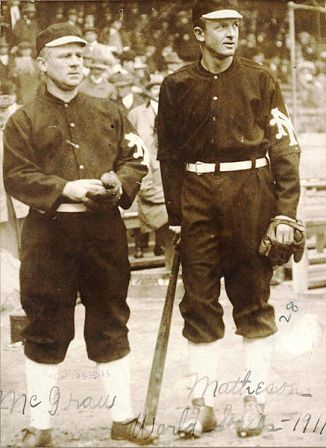
Christy Mathewson with John McGraw

Christy Mathewson with John McGraw

Griffith disagreed:

“Rusie in his prime was the best twirler that ever stepped into the box.  His curves, speed and control were the best assortment I ever looked at, and no pitcher has ever approached him in class since he made his departure from baseball.”

Crane cast the deciding vote, declaring:

“Rusie never had a peep in with Mathewson as a box artist.  Rusie relied mostly on brute strength until his arm began to show symptoms of crystallizing, then he accumulated a good slow ball; but for head work, pure good judgment, with a delivery or series of deliveries to back up his well-balanced brain, Mathewson is superior to any pitcher who ever wore shoe plates.”

Crane’s analysis was prescient.

Rusie’s greatness is undisputed—his speed was primary reason for moving the pitching distance from 50‘ to 60’ 6”—but his best days were behind him before he turned 24-years-old.  His season-long holdout in 1896 and the arm injury that effectively ended his career at 27 after the 1898 season (except for three games he pitched for the Cincinnati Reds in 1901) make him one of baseball’s great “what ifs?”  He still finished his career 246-174, and was elected to the Hall of Fame in 1977.

Mathewson won twenty games for nine straight seasons after Crane declared him “superior to any pitcher.   He finished 373-188 and was part of the Hall of Fame’s first induction class.

Kid Nichols

25 Jun

Add Hall of Famer Charles “Kid” Nichols to the list of those who were convinced that players from an earlier era were of better quality than those “of today,” even if the earlier era was less than a decade before.

Kid Nichols

Kid Nichols

While pitching for the Kansas City Blue Stockings in the Western League in 1903, the 33-year-old pitcher told a group which included a reporter for The Associated Press:

“I am not so sure that the ball players of today are much superior to those of ten years ago in general utility.  It seems to me there was more life and spirit in the games of a decade ago than in those of the present regime.  They weren’t so mercenary in those days and there was much more sportsmanlike spirit.  Nowadays the paramount question with the average player is salary.  He doesn’t care so much about the record of the team he plays with makes as opportunities offered him to make himself individually famous and thus increase the value of his services.  In many clubs teamwork is lacking on account of the intense desire of some of the men to make an impressive showing by individual work.  In the old days one didn’t hear so much of the individual as the playing of the team as a whole an in my opinion baseball would stand on much firmer foundation if the same spirit prevailed nowadays.”

Among the best:

“Take old (Tommy) McCarthy for instance.  As an outfielder none of them had him beaten, and in my opinion there is not an outfielder his equal now.  It was McCarthy who originated the trap ball which he worked so effectively.

“He was absolutely the headiest man in the outfield I ever saw.  You have seen outfielders throw men out at first on line drives, but you haven’t seen it done often.  I’ve seen McCarthy spoil many a legitimate one-base hit by that same play.  Another favorite play of his was this:  A man would be on first and second.  The man at bat would drive to left.  McCarthy would snap it up on a short bound and flip it to second as quick as a flash in time to catch the man who had run off first.  In turn the second baseman would throw the ball to third in time to head off the man who had started from second.  Thus a really legitimate one-base hit was turned into a double play.

“But, speaking of outfielders, Willie Keeler was about as good as any of them for all around ability.  He was like lightning on his feet and was no slouch at hitting.  He certainly did things to me one day in Baltimore.  He faced me four times and this is what he did:  Made four hits to four different parts of the field off of four different kinds of curves.  Keeler was the hardest man to fool I ever pitched to.”

Nichols said Herman “Germany” Long, his teammate for 12 years was:

“(O)ne of the greatest shortstops in the business.  He played with Boston while I was a Beaneater, and of course I had good opportunities to watch him work.  He could cover a world of territory and was a sure and accurate fielder.  You hear many people say that Hughie Jennings in his palmy days was the best infielder ever developed.  In my opinion Long could cover a foot more territory than Jennings.

“When it comes to catchers my preference is, and always has been, Charlie Bennett, whose legs were cut off in a railroad accident at Wellsville, Kansas.  Charlie was always consistent and knew what his brain was given to him for.  He was also an accurate, quick thrower…Martin Bergen was another good catcher.  He was the one who went crazy, you know, and murdered his wife and children.  Bergen always was ‘a little bit off of the top,’ but when he took a notion to do his best, his playing was beyond criticism.  Ed McFarland and (Billy) Sullivan are two right good men, and then there was reliable old Jim McGuire and Charles Zimmer, both of whom were cracker jack.”

bergen

Martin “Marty” Bergen–” always was ‘a little bit off of the top,’

Nichols said as a pitcher “I can hardly be considered a competent judge” of fellow “slabsters,” but continued:

“Personally, I admire the old war-horse, Cy Young, more than any of the others.  He is certainly a remarkable man.  Of the left-handers there a few better than (Frank “Noodles”) Hahn, of Cincinnati; (Christy) Mathewson and (Joe) McGinnity are undoubtedly valuable men.  Clark Griffith is, I think, the headiest pitcher that ever stepped on a rubber.  Among the other great ones are Jack Taylor, Joe Corbett, (Bill) Bernhard, of Cleveland and our own Jake Weimer.

Nichols was largely forgotten as one of baseball’s great pitchers by the time the Baseball Hall of Fame’s inaugural class was selected in 1936.  In the late 1940s, a push for his inclusion was led by sportswriter Grantland Rice.  Rice frequently mentioned the pitcher in his columns and in the summer of 1948 quoted two Hall of Famers regarding Nichols’ prowess:

“A few decades ago I asked Christy Mathewson to name the best pitcher he ever faced.  ‘That’s easy,’ Matty answered.  ‘His name is Charles Kid Nichols of Boston.  Nichols isn’t a good pitcher.  He is a great one.’

“I recalled this talk when the mail brought a letter from Ty Cobb at Menlo Park, California.

“‘I think everyone has overlooked one of the greatest pitchers of all time,’ Cobb Writes.  ‘His name is Kid Nichols.  Here are just a few of his records from 1890 to 1906:

“1.  Won three consecutive games on three consecutive days, all pitched in different cities.

“2.  Won 20 or more games for 10 consecutive years.  He won 360 and lost 202. (Nichols’ record was 361-208)

“3.  Won 28 or more games for eight consecutive seasons.  (Nichols won more than 28 games seven times, and not consecutively).”

Despite the inaccuracies in the letter, Cobb and Rice continued to campaign for Nichols and the push to honor him worked.  He was elected to the Hall of Fame in 1949.

Nichols, right, with Pie Traynor, left, and Branch Rickey at the Hall of Fame in 1949. Traynor was elected in 1948, but his plaque was not presented until 1949

Nichols, right, with Pie Traynor, left, and Branch Rickey at the Hall of Fame in 1949. Traynor was elected in 1948, but his plaque was not presented until 1949

Lost Pictures–Walter Johnson Steamrolls the American League

20 Jun

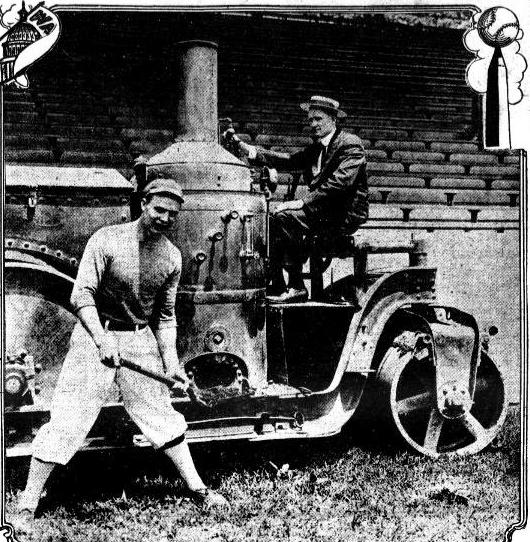
walterjohnsonsteam

A 1912 publicity photo featuring Walter Johnson at the wheel of a steamroller, and Senators catcher Eddie Ainsmith with the shovel at Griffith Stadium in Washington.  The photo was taken on June 17; the Senators had just returned from Cleveland having won 16 straight games–all on the road.  During the streak, the Senators had gone from 17-21 in sixth place, to 33-21, just one and a half games behind the Boston Red Sox.

The Washington Times said “It was considered an omen of continued triumph” that the steamroller was “found on the grounds.”

The Senators won the following day and continued playing well the rest of the way, finishing 91-61, their first winning season in the team’s 12-year history.  But, it was not good enough to catch the Red Sox who finished 14 games in front.

Johnson had his first of two 30-win seasons, finishing 33-12 with a league-leading 1.39 ERA.

Ainsworth played in the major leagues for 15 years, the first nine with the Senators.  The Washington Post said before the season opener in 1915:

“For the seventh consecutive year Walter Johnson will work in the opening clash for the home folks, and in nearly as many seasons will Eddie Ainsworth be his battery mate.  This pair always work together and no pitcher and catcher in either league are better acquainted when it comes to baseball.”

Eddie Ainsmith

Eddie Ainsmith

Several weeks after Ainsmith was traded to Boston (then to Detroit on the same day) in January of 1919, Louis Dougher a writer for The Washington Times said:

“When Eddie Ainsmith was traded to Detroit via Boston, Clark Griffith shattered on of the crack batteries…it was Johnson and (Charles “Gabby”) Street.  Then when Gabby slowed up and gave way to a successor, it rapidly became Johnson and Ainsmith.”

Age, more than the departure of Ainsmith slowed Johnson down, but he still won 140 games and posted three 20-win seasons after his personal catcher was traded.

Spring Training, 1900

16 Jun

There was never a dull moment during the Chicago Orphans 1900 training trip to Selma, Alabama.  New manager Tom Loftus arrived with twenty-three players from West Baden, Indiana on March 23—two more players, Jimmy Ryan and Bill Everitt would be joining the team in a few days.  The Chicago Tribune said, “Loftus is pleased with the grounds and the players are agreeably surprised at the town and hotel.”

Tom Loftus

Tom Loftus

The team was greeted in Selma with a parade and presented keys to the city; the stay in Alabama went downhill from there.

Rain in Selma disrupted the team’s practice schedule and the day Jimmy Ryan arrived it was revealed that there was a conflict between the leftfielder and his manager.

The Chicago Inter Ocean said Ryan, who claimed playing left field in Chicago’s West Side Grounds the previous season had damaged his eyes, announced he would not play the “sun field” for the team in 1900.

“(Ryan) intimated there was nothing in his contract which calls upon him to play in the sun field and that he will not do it unless he is given more money.”

Ryan told the paper:

“Let some of the young fellows put on smoked glasses and try the sun field for a while.  I am a right fielder and am tired of getting the hard end of the deal.  If they want me to play in the sun field it is up to Loftus for it is worth more money.”

Loftus responded:

“I don’t understand any such talk as this.  Ryan will play where he will make the most money for the club…I am running this club just now, and the men will play where I put them.”

The dispute went on for several days and included an offer to Ryan to join Selma’s local team if he chose to quit.

Ryan wasn’t the only disgruntled player.  Clark Griffith, who won 22 games for the team in 1899 told The Tribune:

“It is only a question of time when we all have to quit, and the sooner a man quits the better off he will be, for it is a cinch he won’t have a cent, no matter how long he stays in this business.”

Clark Griffith

Clark Griffith

A few days later The Tribune said it appeared Griffith and utility man Charlie Dexter had quit

“Clark Griffith and Charles Dexter have announced they are no longer members of the Chicago ball team.  This morning the two men, one of whom Chicago ball cranks have relied on to bring the pennant westward, announced they will start with a week for Cape Nome to mine gold.

“Griffith has been wild all spring to go to Alaska.  Some friend offered Griffith and (Jimmy “Nixey”) Callahan $20 a day as common laborers if they would go to Cape Nome.  This morning Griffith and Dexter were talking and Griffith declared he would go in a minute if he could get someone to go with him.  Dexter accepted the chance, declared he would go, and within a few minutes the pair had deposited their diamond rings with Tim Donahue as a forfeit, each agreeing to forfeit the rings in case they failed to start for Cape Nome inside a week.  Both men are in earnest”

Loftus didn’t take Griffith’s plan seriously, but the threat highlighted the growing dissatisfaction of his star pitcher, which would be reflected in his performance during the 1900 season.  There was no report of whether Griffith and Dexter forfeited their diamond rings when they failed to leave for Alaska.

The final incident of the Orphans’ Selma trip resulted in one of the most unusual reasons for a game to be delayed.

Griffith was on the mound during the early innings of an intersquad game, Tim Donahue was at the plate when according to The Inter Ocean:

“(A) Southern Gentleman opened up with a .44.”

The Chicago Tribune said:

“Just as the game was starting a young native, inspired by a desire to show the players his ambidexterity with revolvers, crossed the bridge (over the Alabama River) firing volleys.  As he approached the park he began he began firing at will, and for ten minutes gave a wild South exhibition of cannonading inside the park.”

Once inside the park, the man fired first in the direction of the players, and then, after reloading, “at the feet” of several local children watching the game.

He then “turned his attention to the ball players.”  The Inter Ocean said:

“He began shooting across the diamond, and every man on the field made a slide on the ground toward the shelter of the grand stand in a manner which would have been a guarantee of the championship, if repeated in regular league games.”

The paper said Tim Donahue, “who was never known to slide a base, went fifteen feet on his ribs” under the stands.  While Jimmy Ryan “made a dash” for left field “which broke the sprinting record.  He was last seen crawling under a dog hole in an extreme corner of the grounds.”

The gunman was taken into custody by Selma police, and The Tribune said the playing was “nervous and erratic,” after the shooting incident, but incredibly the game continued and was completed.

Griffiths “Scrubs” defeated Donahue’s “Regulars” 13 to 12.

The Box Score

The Box Score

Things didn’t get any better for the team after they opened the 1900 season; the Orphans limped to a 65-75 sixth place finish under Loftus.  Ryan, who still often played the “sun field”, hit .277, his first sub .300 season since 1893.  Griffith, who won 20 games the previous six seasons, won just 14.  Charlie Dexter had his worst season, hitting just. 200 in 40 games and Donahue hit just .236 in his final season in Chicago.

Opening Day—1901

26 Mar

The Chicago White Sox opened the American League’s inaugural season as a major league on April 24, 1901, against the Cleveland Blues.  The three additional league games scheduled for the 24th were postponed on account of rain.

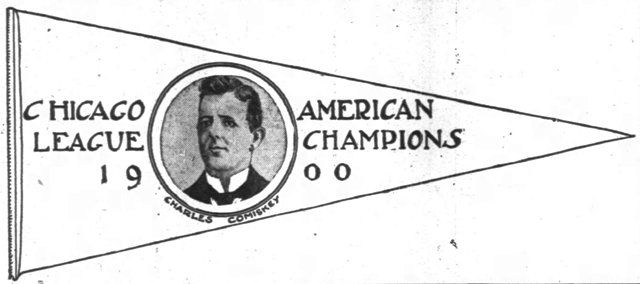
The Sox won the then-minor league American League championship the season before.

1900alchamps


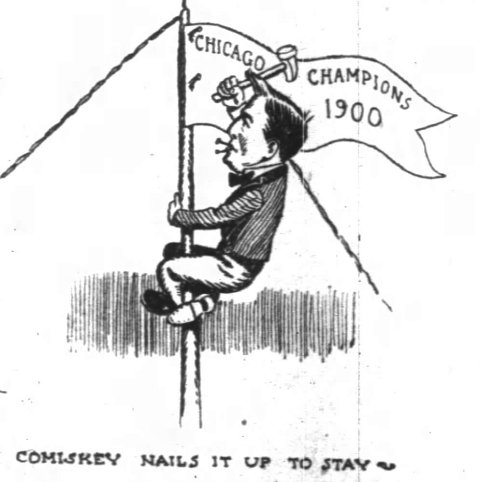
Comiskey relinquished managerial duties in 1901 to Clark Griffith, the pitcher jumped from the cross-town National League Orphans for a reported $4,000; a $1,500 salary increase.

Clark Griffith

Clark Griffith

The opener at Thirty-Ninth and Wentworth included a parade, several bands, and speeches from many dignitaries—The Chicago Tribune said every member of Chicago’s City Council was on hand, but Mayor Carter Harrison, who had promised Comiskey he would appear to speak and throw out the first ball, “was kidnapped by William J. Bryan, who slipped into town unperceived. ‘Commy’s’ plans for having the Chief Executive start the opening game were shattered.”

The Tribune said American League President Ban Johnson also missed the game; he had traveled from league headquarters to attend the opener in Philadelphia “and it’s a 1,000 to 1 shot he was sorry when he found Comiskey was the only magnate who had squared himself with the weather man.”

Other than the absence of the mayor and the league president, the paper said the first game of the upstart league was a success:

 “Under the fairest skies the weather clerk could select from his varied stock of April goods; with a championship pennant floating high above them from the proudest pine of all Michigan forests; with 9,000 fans to cheer them from a pent-up enthusiasm that burst forth at every possible opportunity, the White Stockings open the American League baseball season on the South Side Grounds yesterday with a clean-cut victory over the aggregation from Cleveland.”

The Chicago Inter Ocean, which reported the attendance at 10,073 said:

“As a grand opening it was an unqualified success, something which Charles Comiskey can look back upon in after years with all the serene satisfaction of a baby who has just swallowed a tin Indian.  As a ball game it was a hideous nightmare, a cold and icy vision of the darksome night, a living horror, let loose to stalk adown a diamond field, hooting hoarsely…With pomp and ceremonial, with braying of bands and braying of fans, with an enormous audience gathered in the frapped stands, the American League season of 1901 was duly opened in Chicago, and the real champions, Comiskey’s White Stockings, began their campaign by giving the Clevelands all that was coming to them.  The afternoon was cold; the stands were Greenland, and the bleachers bore nets of icicles.  Yet 10,000 cranks and crankesses, keen devotees of the game.”

The Chicago Daily News said more than 14,000 fans were at the game:

“Promptly at 3:30 the two clubs lined up at the plate and, preceded by a “Rough Rider” band, marched to the flagpole at the south end of the field, where the championship banner was unfurled to the strains of ‘The Star Spangled Banner.’”

Cartoon of "pennant" being hoisted from The Chicago Tribune.

Cartoon of “pennant” being hoisted from The Chicago Tribune.

The Associated Press said the attendance was 8,000.

The Tribune said the crowd was enthusiastic despite the weather:

“There were cheers for everybody, from (William Ellsworth “Dummy’) Hoy, who couldn’t hear them, to (starting pitcher Roy) Patterson, the hero of many a hard-earned victory last year…there were flowers for (Dave) Brain, the youngest of the White Soxs [sic]…And at the end there was so much surplus exuberance that the bleacherites indulged in a merry cushion fight all through the concluding inning by way of celebration.”

Chicago scored two in the first and five in the second off Cleveland starter Bill Hoffer and cruised to an 8 to 2 victory behind Patterson.

The Inter Ocean said the most “ludicrous” play of the otherwise “uneventful” game took place in the sixth inning when Hoy attempted to steal third:

“(Catcher Bob) Wood threw wild, and (Bill) Bradley scooped up the ball way off from the cushion.  As Bradley, with no thought of the runner, turned to return the ball to the pitcher, Hoy, losing his balance as he ran, slid clear over third , out into the field and right into Bradley, his knee striking the ball clasped in Bradley’s hand.  It was possibly the first case on record of a man’s forcing a put-out on himself, and the crowd marveled greatly, perceiving that the science of the game had much advanced, and that there were new freckles every day.”

While the Chicago Orphans were losing their opening game in Cincinnati, The Tribune said the team’s president, James A. Hart, “was present and witnessed the game from a box at the south end of the grandstand.  He chatted with President Comiskey for some time and seemed to like the work of the players, but he did not voice his sentiments.”

Behind Griffith and his 24-7 record, the Sox won the league’s first pennant with an 83-53 record. Opening Day pitcher Roy Patterson was 20-15.  Cleveland finished seventh with a 54-82 record; Hoffer was 3-8 in 16 games when he was released in July, ending his major league career.

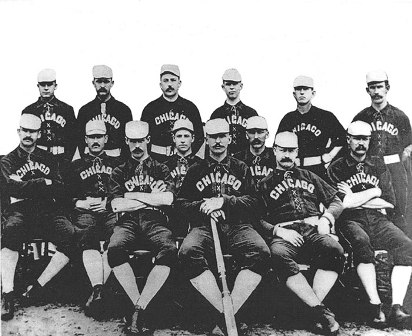
1901 Chicago White Sox

1901 Chicago White Sox

Comiskey and Hart were both members of their respective league’s “peace committee” at the January 1903 meeting in Cincinnati that led to the forging of the first National Agreement.