Tag Archives: Connie Mack

Connie Mack vs Herman W. Souse

6 Nov

In his autobiography “My 66 Years in the Big leagues,Connie Mack said, “My first great disappointment came in 1912.”

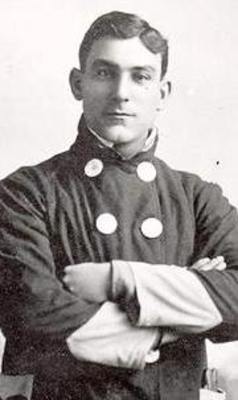
Connie Mack

                          Connie Mack

After two straight World Series victories, Mack’s Athletics stumbled to a disappointing third-place finish.  With his team 15 ½ games out of first on September 6, Mack suspended pitcher Charles “Chief” Bender and Reuben “Rube” Oldring for, as The Philadelphia Inquirer  put it:

 “(T)heir failure to live up to the training requirements, as demanded by Mack and all common sense baseball managers.”

Chief Bender

                                Chief Bender

The Inquirer said “Mack refused to discuss this matter further,” but just days later in Detroit he gave what The New York World called “a sermon” on the reason for the suspensions:

“Booze and baseball don’t mix; never did, and never will. A pitcher who thinks he can fan Herman W. Souse is simply pitching to the greatest home run hitter he ever faced.

“Once in awhile you hear of some marvel who can stay out all night, drink all the breweries dry, wreck a few taxi cabs and otherwise enjoy himself, and then step in the box and pitch a wonderful game of ball.  Players who haven’t any more sense point to Rube Waddell, Bugs Raymond and that brand and say: ‘Ah, those were the good old days.  None of these high-priced managers and their red tape then.  And what wonderful players we produced in those days.’

“Well, look at Waddell—one of the most remarkable pitchers nature ever produced.  But Waddell, with all his talent, couldn’t stay in the major leagues.  Why?  Because he stood there and pitched himself to Old Man Barleycorn, and finally every one he threw was slammed over the fence.  And that’s the way all go.  Is it so wonderful, after all?

“No, sir, the day of the stewed ballplayer has gone and it won’t come back.  If the members of my team want to drink, all right.  But they can’t drink and play ball at the same time.  That’s settled.  They can do whatever they prefer, but they can’t do both.

“There are no exceptions to my rule, either.  Any manager will tell you the same.  A short life and a merry one—that’s it.  And the merrier it is the shorter it will be in the big leagues.”

In December of 1912, The Philadelphia Record said Bender had written a letter to Mack asking his manager “to please forgive him.”

According to The Inquirer, he was forgiven and set to return to the Athletics in 1913:

“This winter Bender has spent nearly all the daylight hours automobiling and hunting in the South.  He looks stronger than ever.”

The “stronger,” sober Bender appeared in 48 games, 21 as a starter, and posted a 21-10 record with a 2.21 ERA, and helped lead the Athletics to their third championship in four seasons.

In “My 66 Years in the Big leagues” Mack said of him:

“Let me say here that I consider Chief Bender the greatest one-game pitcher, the greatest money pitcher baseball ever has known.”
Collins’ “Ten Commandments”

5 Oct

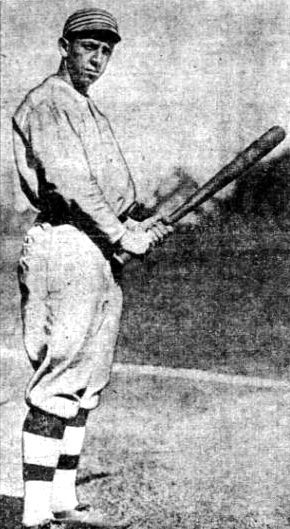
The Philadelphia Inquirer said in February of 1916, Eddie Collins of the Chicago White Sox, had broken “into the ‘Gospel League,’ after  the second baseman gave a temperance speech in front of “500 persons” at the Epworth Methodist Church in Palmyra, New Jersey church.

collins2

Eddie Collins

Despite Collins telling his audience he wasn’t  “contemplating a pulpit career,” the paper said they “(A)pplauded like World Series fans when he handed ‘booze’ some wallops that would have done credit to Billy Sunday.”

Collins’ talk focused on the evils of alcohol:

“I come to bring a message to your young people, from a baseball player’s viewpoint, of the necessity of clean living and I will be glad if anything I say will help any of you fight the battle of life…Temperate living in necessary for success in any field of action.”

He also praised his former manager from the pulpit:

“Life is a whole lot like playing baseball under Connie Mack’s orders.  Mack is the greatest baseball general the world has ever known and any man who has ever played on the old Athletics honors respects and loves the boss.”

Sunday said he approved of Collins taking to pulpit and providing a “boost” for baseball:

“The way to make the great game respectable is for every player to be respectable himself.”

The Inquirer told readers the following day that the Columbia University graduate had little in common with the evangelist who often mangled the language:

“The statement that Eddie Collins is emulating Billy Sunday is entirely erroneous…Eddie had a perfect record at the bat and fielded cleanly with the King’s English.”

Billy Sunday, evangelist

Billy Sunday, evangelist

Within a week, The Philadelphia Press said:

“Eddie Collins’ dip into evangelism has had a home-run effect among church people throughout the country, and he now is swamped with invitations to address church congregations, bible classes, and Sunday school meeting.

“The requests have swept in upon him at his home in Lansdowne (Pennsylvania) in such a deluge that he said today he had reached the point where he would have to give up base ball if he were to meet all the engagements asked.”

Collins told a reporter:

“I am gratified to learn that my little talk of last Sunday and my rules of life amounted to something but I don’t rank as an evangelist and can’t follow that calling.”

Instead of leaving the diamond for the pulpit, Collins printed and had distributed to churches, several thousand copies of part of the talk, what he called “The Ten Rules of Life.”

Some reporters, including William Peet of The Washington Herald, referred to the list as “Collins’ Ten Commandments:”

First: Safeguard your honor

Second: Don’t overeat

Third: Be a good loser

Fourth: Smile

Fifth: Keep good hours

Sixth: Have courage to do right

Seventh: Don’t think you know it all

Eighth: Be prompt

Ninth: Don’t drink alcoholic drinks

Tenth: Think clean thoughts.

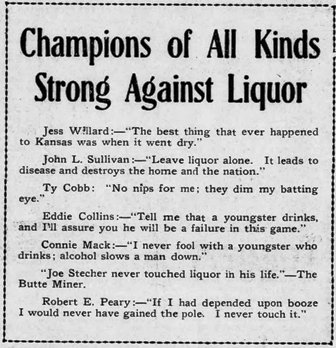
Collins’ statements about alcohol were used by various temperance organizations seeking prohibition.  Ads like the one below with quotes from Collins, Ty Cobb, and Connie Mack, and Admiral Robert Peary, as well as boxers Jess Willard, John L. Sullivan, and Joe Stecher appeared in newspapers and handbills distributed throughout the country.

temperance

“He was the Greatest Receiving Catcher”

23 Sep

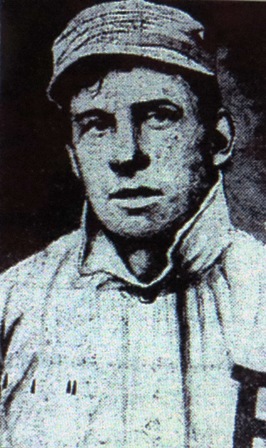
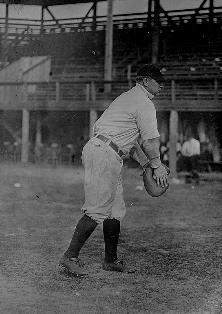
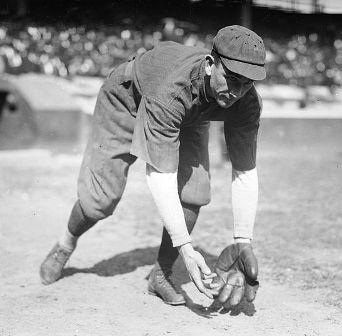
Freeman Ossee “Schreck” Schrecongost’s was most famous for being Rube Waddell’s catcher with the Philadelphia Athletics.

Ossee Schrecongost

                Ossee Schrecongost

Years later, Connie Mack told Harry Grayson of the Newspaper Enterprise Association that Schrecongost was “the fizz powder in the pinwheel that was Waddell.”  He also told the reporter that Waddell’s catcher “was the wilder of the two in many respects.”

Schrecongost lived at least as hard as Waddell and caused his manager as many headaches, but more than 30 years after his final game, Mack said he did “more with gloved hand than any other catcher who has come along.”

Allan Gould, the long-time sports editor for The Associated Press said of the catcher:

“Schreck had the eccentric habit of doing as much of his backstopping as possible with his gloved hand only. This worried Mack, who considered it careless workmanship until Schreck convinced his manager he could do a better job one-handed than with two.”

His teammates felt the same.

Three years after Schrecongost’s final major league game, Harry Davis told Gordon Mackay of The Philadelphia Times:

Walter Johnson is some grand pitcher with a barrel of speed.  But I’ll tell you one old boy who would sit on a chair and catch the big fellow.  That’s old Schreck.  He’d catch Walter with that big glove on his fin, and then after he had eaten up the old smoke to the limit he’d yell to the big chap to put something on the ball.

“I’ve seen Rube Waddell cross Ossee six or seven times, and Schreck wouldn’t pay the least bit of attention to it.  Suddenly Schreck would go out to the box and tell the Rube with a bunch of billingsgate trimmings that would make your hair curl that he stop crossing him.

Rube Waddell

                                 Rube Waddell

“There never was a backstop like old Ossee.  He could catch all the speed merchants in our league with one hand, and then only use the other one to throw with.  He was the greatest receiving catcher, receiving alone, I mean, who ever tripped down the pike.  He was a wonder, that old boy.”

Davis wasn’t Schreck’s only teammate who claimed he was a “wonder,” Tully “Topsy” Hartsell told The Philadelphia Press he saw the catcher perform “the greatest stunt” he had ever seen in 1904:

 “Schreck had a bad finger, and the other catcher (Michael) Doc Powers, was also laid up.  The third catcher, who was Pete Noonan, was doing all the backstopping.  He got hurt one day and Schreck had to go in in the first inning.  He couldn’t let the ball strike his wounded and uncovered hand, and Topsy says he caught the whole game only using his gloved hand.

“’Not only did he (only) use the glove to catch them,’ said Topsy, “’ but there wasn’t a stolen base or passed ball by him.  That’s the greatest catching feat I ever saw.”

Forever tied to Waddell, who died at age 37 on April 1, 1914, Schrecongost died just three months later, on July 9, at age 39.

The Associated Press said in his obituary:

“Grief over the death of the brilliant but eccentric Waddell…probably had much to do with hastening the end of the former great catcher.  Schreck told friends at the time that he ‘did not care to live now.  The Rube is gone and I am all in.  I might as well join him.’”

Lost Advertisements–“The World’s Best Pitchers Recommend…”

8 Jul

adreach

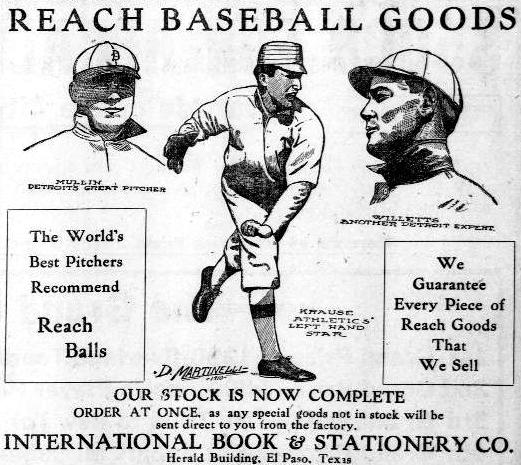
A 1910 advertisement for Reach Baseball Goods  “The World’s Best Pitchers Recommend Reach Balls”–from International Book & Stationary Co. in El Paso, Texas.  The ad features “Detroit’s Great Pitcher,” George Mullin, “Another Detroit Expert,” Ed Willett (Misspelled Willetts in the ad), and “Athletics’ Left Hand Star,” Harry Krause.

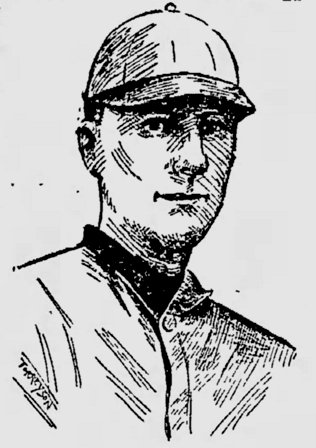
In 1909, the 20-year-old Krause, who had been 1-1 in four appearances with the Athletics in 1908, became the talk of baseball when he opened the season with 10 straight victories–including six shutouts.  A San Francisco native who played under Hal Chase and was a teammate of Hall of Famer Harry Hooper at St. Mary’s College, Krause was asked by The Oakland Tribune what led to success:

“That’s easy.  A capable manager in Connie Mack, one of the best pitching tutors in the world in Ed Plank, fairly good control on my part and lots of luck.”

The Tribune‘s scouting report on Krause:

“He has a good curve, but many pitchers in the league have a better one.  He has speed, but any number of American League twirlers have more smoke than he.  However, there are very few twirlers, whether right or left-handers, who can equal him in control of the ball.

“He doesn’t appear to have much to the opposing batters when they first face him, but when the game is over they wonder how it came to pass that he let them down with three or four hits and no runs.”

Harry Krause

Harry Krause

On July 18 his luck ran out, Krause dropped his first game of the season, an 11-inning, 5 to 4 loss to the St. Louis Browns.

He went just 8-7 (with one shutout) the rest of the season, but led the league with a 1.39 ERA.

He appeared in only 55 more games over three seasons, winning 17 and losing 20, before a sore arm ended his major league career at age 23.

He finished the 1912 season in the American Association with the Toledo Mud Hens, then returned to California and pitched for 15 seasons in the Pacific Coast League (with a one-season detour to the western League), where he won 230 games.

“He is a $900 Man”

6 Jul

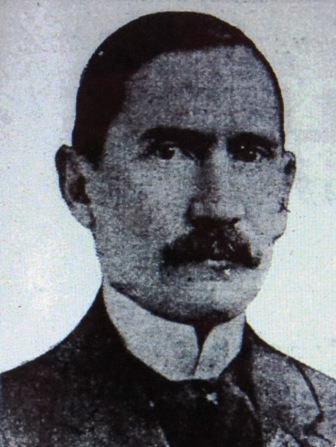
Frank Leonardo Hough had a major conflict of interest. While sports editor for The Philadelphia Inquirer, he also held a 12.5% interest in the Philadelphia Athletics from the club’s inaugural season until 1912—he also served as the team secretary for several seasons while working at the paper. Another Philadelphia sports writer, Sam Jones of The Associated Press also held a 12.5% interest in the team.

Frank L. Hough

Frank L. Hough

Perhaps it was Hough’s close association with an American League team that made him one of the most vocal advocates for the rights of current and former National League players while the leagues battled for stars.

In 1902, he told his readers the story of how William “Bill” Duggleby, who jumped from the Phillies to the Athletics after the 1901 season, was treated—Hough said he was, “Human Chattel”–while a member of the Phillies:

“These are the facts:

“William Duggleby, pitcher played with the Auburn Club, of the New York State League, during the season of 1897. In the fall of that year, he was drafted by the Philadelphia Ball Club.”

According to Hough, Duggleby was offered $900 for the season, a $25 raise from his salary in Auburn.

Hough pitched just nine games for the Phillies in 1898 and, “was farmed or rented,” to minor league clubs for the remainder of 1898 and in 1899 and 1900.

“Thus it will be seen that although he was under the absolute control of the Philadelphia Club from 1897, he played only a few games in the season of 1898 with that organization. He had no control over his own services. He could not even say where he would play, or where he would not play. That matter was determined by the treasurer of the Philadelphia Ball Club.”

William Duggleby

William Duggleby

Hough noted that while Duggleby, “developed considerable skill,” and had three good seasons in the Eastern League (12-11, 22-16, 17-10) drawing considerable interest from a “half dozen” major league teams, he only received $900 from the Phillies each season:

“The clubs that rented Duggleby did not know him in the financial end of the transaction at all.

“Had Duggleby the right to sign wherever he could have made the best bargain he would have undoubtedly received at least $1800 a season for his services—just twice as much as received under the White Slave system of the National League.”

Hough said Duggleby likely only had six to 10 years total earning power and “lost three years in which he should have received a salary somewhere commensurate to his ability.”

That, however, said Hough, was not the worst of it. In 1900, Duggleby was with the Toronto Canucks, who paid the Phillies, “$225 per month for his services,” while Duggleby was paid just $150 a month.

“No convict from a Texas or Georgia penitentiary was ever rented or leased to break stone on a quarry or repair roadways in colder blood than was Duggleby to the Toronto Club.

“If Duggleby was not a white slave in a free country, what in the name of all that is fair was he?…Of course, Duggleby did not have to wear ball and chain—that might have interfered with his playing ability. But he had no more control over his actions than would the most hardened criminal consigned to the quarries.”

Just days after Hough made the case for Duggleby’s victimhood—and after he appeared in just two games for the Athletics— the pitcher returned to the Phillies. Said to have been paid $3250 by the Athletics, Duggleby accepted a $2400 contract with the Phillies. He told Sporting Life:

“There was no great reason for my going with the American League in the first place, but after I had given my word to go with Connie Mack’s team I did not feel like breaking it. Then came the decision in the (Napoleon) Lajoie case, and a notice from Manager (Bill) Shettsline to report to him or meet with the same fate as Lajoie. I went to see Shetts at once and asked him if the club really intended to proceed against all players that were under reserve. He assured me that they would. Well, under the circumstances I saw nothing for me to do but go back to the National.”

Hough’s tone changed considerably after Duggleby left the Athletics; in addition to his paper referring to the pitcher in a headline as a “Vertebraeless Youth,” he said:

“Without awaiting the outcome of the efforts to be made today to secure an appeal (in the Lajoie case)… (Duggleby) runs to cover like a frightened hound…Evidently the treasurer of the Philadelphia Ball Club sized up Duggleby right in the first place. He is a $900 man.”

Duggleby, who posted a 20-12 record for the Phillies in 1901, only had one winning season after (18-17 in 1905). He pitched in the major leagues until 1907.

Duggleby had one other distinction: During his initial trial with the Phillies in 1898, he hit a grand slam in his first major league at-bat on April 21–for 70 years he remained the only player to hit a grand slam in his first game until Bobby Bonds hit one during his debut (his third at-bat) on June 25, 1968; Jeremy Hermida equaled the feat in his first major league at-bat in 2005.

Hough remained a stockholder and officer with the Athletics while simultaneously reporting on baseball for The Inquirer, until he sold his interest to Connie Mack in 1912. He was the paper’s sports editor until his death the following year. (While Hough’s middle name was said to be Leonardo throughout his life, his Pennsylvania death certificate lists it as Lewis)

Tragic Exits 3

23 Mar

Eddie Meade

Edward “Eddie” Meade appeared headed to the big leagues.  After beginning the 1926 season with the Kinston Eagles in the Virginia League, the 24-year-old left-hander was acquired at midseason by the St. Paul Saints of the American Association and posted a 12-7 record with a 3.40 ERA in 22 games.

Meade began the 1927 season with a 6-0 shutout of the Louisville Colonels on April 17.  The same week he recorded his first victory, The Associated Press said he was about to become a member of the defending American League champions:

“The Yankees talked of possible reinforcements in the shape of Eddie Meade, of St. Paul, called the best young pitcher in the American Association.”

Eddie Meade

Eddie Meade

During the same week, Meade became ill; although the nature of the illness was never disclosed.  Eight days later he started a game with the Columbus Senators but was pulled after giving up six runs in the fifth inning of 9 to 8 loss.  Five days later he pitched in relief against Louisville, but The Minneapolis Journal said he lasted less than an inning due to his “impaired physical condition.”

When the Saints left Minnesota for a series in Kansas City on May 16, Meade stayed behind.  The following evening Meade checked into St. Paul’s Boardman Hotel and shot himself to death.

The day after his suicide, The Journal said, “it was learned today that Meade was slated to go to the New York Yankees in the fall.”

St. Paul Manager Nick Allen told The Associated Press:

“He was one of the hardest working youngsters we ever had on the club and the outlook for his future was bright, as he had only two years in baseball.  The only motive he could have had for such action would be mental depression.  He was not married.  The nature of his illness was no cause for alarm, but he apparently believed it otherwise.”

Tommy Coates

Thomas A. “Tommy” Coates was born in Omro, Wisconsin on February 18, 1886 (Baseball Reference lists his middle initial as “O” but birth and death records  list it as “A”).

After starring, along with his older brother Hiram, on Omro High School’s undefeated baseball team in 1901—The Omro Herald called the team “possibly the best in the state”—Coates played industrial league and semi-pro ball in Central and Northern Wisconsin.

After playing in Rhinelander, Wisconsin in 1908, The Oshkosh Northwestern said:

“Coates had lots of confidence in himself, and during the winter months the Omro boy came to the city one day and sought out “Pink” Hawley. Hawley agreed to give him a trial.”

Emerson Pink Hawley, a Wisconsin native who pitched in the major leagues for a decade, was the manager of the Oshkosh Indians in the Wisconsin-Illinois League.

Tommy Coates

Tommy Coates

 “Coates came to this city from his home at Omro (for his tryout).  He donned baseball togs and he ‘made good’ from the start.”

Coates, who The Northwestern said  was “tall (and) built something like the great Ty Cobb,” became the Indians starting left fielder one week into the season and went on to lead  the team with a .299 batting average (he hit .002 better than his 19-year-old teammate Heinie Groh).

In September, The Sporting News reported that with just one season of professional experience, Coates “Looks good to Connie Mack,” and was drafted by the Philadelphia Athletics. He was the only member of the Indians drafted by a big league club in 1909.

At season’s end in September, Coates, with an invitation to train with Mack’s club in the spring, spent most of his time hunting.

On October 11 Coates was in a row-boat with a friend, hunting in a marsh near Omro.  The friend told The Omro Herald:

“Tom saw a mud hen rise up on the right hand side.  He turned about quickly and took hold of his gun which was at his left side and pulled it toward him…I turned about as soon as I heard the shot, and to my horror saw Tom lunge forward.”

Coates accidentally discharged his gun, shooting himself in the left eye.

Twelve days after the Oshkosh Indians received a $300 check from Connie Mack—his draft price—Coates was dead.

The Northwestern said:

“He was quiet and unassuming. After making a sensational play in the field or batting out the hit that won the game…the Oshkosh fans could not induce Coates to doff his hat.  He would return to the bench with face covered with blushes.”

[…]

“His more ardent admirers were confident he would make good in the American League, and one of their first thoughts upon hearing of the unfortunate accident, was the promising career he had before him.”

“Why not bring one of the Big League Teams to Phoenix for Spring Training?”

18 Feb

Grover Cleveland Land was a visionary.

In 1921 The Arizona Republican asked the question the former catcher had put to several major league clubs:

“Why not bring one of the big league teams to Phoenix for spring training?”

Land, a Kentucky native who spent the last 40 years of his life as a Phoenix resident,  was encouraged by a report that Connie Mack had announced that his Philadelphia Athletics would no longer train in Lake Charles, Louisiana;  according to The Associated Press Mack said “certain things happened at the Louisiana resort last March that handicapped” the team.

Grover Land

Grover Land

Land, the former catcher for the Cleveland Naps and the Brooklyn Tip-Tops, said:

“I have played ball in every section of the country, and I have yet to find a climate more suited for baseball training than I find right here in Phoenix…Major league managers have been sending their players to Texas and other southern states for many years and I can safely state that there is not one manager entirely satisfied with the present training camp sites.  Fully one-third of the training period is hampered by rain and storms and by the time the training season is ended the players are just beginning to round into shape.”

He said he understood that “local boosters” had made some effort to bring teams to Arizona in the past—the Chicago White Sox, Cubs, and Pittsburgh Pirates had played spring exhibition games in the state several times since 1909—but Land said he would “make an effort to induce one of my manager friends to come down here…I am certain that if one of the managers could be induced to come here for a few weeks Phoenix would have no difficulty getting on the sport pages.”

He said the local chamber of commerce was getting behind the push, and that he had “already written to one of the major league managers and I have been corresponding with several sports writers in the east,’ to make the case for Phoenix.

“If the local fans get behind the move and convince Connie Mack that they want his team here next spring I have every confidence that the Philadelphia Athletics will do their 1922 training in Phoenix.”

Land was a bit overconfident in regard to Philadelphia; Mack chose to take the Athletics to Eagle Pass, Texas in the spring of 1922.

No team would train in Arizona until 1929—the Detroit Tigers came to the state for one season—but chose California the following year.

The Detroit Tigers in Arizona, 1929

The Detroit Tigers in Arizona, 1929

But Land, who died in 1958, lived long enough to see his adopted home become the spring training location for four clubs.

“Signals had a lot to do with our Winning the Championship”

16 Jan

George Stallings had been accused of being a sign stealer.  And, when he finally won his first and only championship with the miracle Boston Braves in 1914—the team was 35-43 and in eighth place on July 18—his shortstop, Walter “Rabbit” Maranville claimed sign stealing was a part of the team’s success.

Rabbit Maranville

Rabbit Maranville

The Boston Post quoted Maranville speaking to a group from Boston College during the winter after the team’s World Series victory:

“Signals had a lot to do with our winning the championship.  We had signals of our own, of course, and so far as I know they never were solved consistently.  We were able to get the meaning of the signals of the other team in nearly every other city of the league.  In St. Louis we knew almost every move that the other fellow was going to make, and that helped a lot.  Their signals were very easy.  Other teams had harder signals, but we managed to get most of them, while the other side was doing the guessing.”

Whether or not sign stealing played a part, the Braves were 9-1 (with one game ending in a tie) in their last 11 games against the St. Louis Cardinals and their “very easy” signals.

While Stallings never confirmed Maranville’s claim, he did tell The Boston Globe that winter that took great pains to ensure that their signs weren’t stolen in the World Series:

George Stallings

George Stallings

“Although we had a set of signals that I don’t think any ballclub in the world could have gotten on to we heard rumors that the (Philadelphia) Athletics had been tipped off to them.  We framed up an entire new set, and a coacher or base runner could have looked square into the catcher’s glove and never had gotten these.  (Connie) Mack’s men failed to get a sign of ours in the series so far as I know.”

“Take a Chance, any time, and Fight all the Time”

19 Dec

John W. McConaughy was just 19 when he became the sports editor of The St. Louis Post-Dispatch in 1903.  Over the next 30 years he worked as the Washington Correspondent for The New York Evening Journal, was the production manager for William Randolph Hearst’s film company, Cosmopolitan Productions, and was a member of the Creel Committee, created by President Woodrow Wilson to influence public opinion at home and abroad during World War I.  He also published several books on crime, politics and sports, including: “From Cain to Capone,” “Who rules America?: A Century of Invisible Government,” and “Big Jim Jeffries: His Twelve Greatest Battles.”

But, he continued to write about baseball long after he left St. Louis, including a profile of New York Giants Manager John McGraw on the eve of the 1913 World Series for The Evening Journal:

“The most distinctive and aggressive personality in baseball—this is John J. McGraw, the wonderful leader of the Giants.  He has been at one and the same time the most abused and most admired man in the national game.

John McGraw

John McGraw

“He has been called a rowdy and a Napoleon in equal parts.  He has been mixed up in more rows than any big league manager; but he has also been mixed up in more pennants… (Connie)Mack is his only rival for the title of greatest manager in the game and no two men in the world were ever more widely apart in character and methods than these two.  The old fox of Philadelphia has been dealt with elsewhere.  His system is carefully constructive work, leaving nothing to chance.

“McGraw’s motto is:

“’Take a chance, any time, and fight all the time.’

“He believes especially in fighting, but he is of the mind of Polonius in not advocating fighting as an end.  It is always a means with McGraw.  There is method in his mixing.  He has been represented as running amuck through baseball for the love of a rough-house.  Nothing is further from the truth.  When McGraw has a row on the ball field he figures that he is going to win something material at some time as a result.

“For instance, you never hear of any of the Giants being suspended or fined for battling with the umpires these days.  Why?  Because McGraw discovered that the magnates meant business in their manifestos against bully-ragging the arbiters and the chief of the Giants decided that a star on the field was worth six on the bench, recovering from the effects of ea sing their mind to an umpire.

“’I’ll do all the kicking from now on,’ he told his warriors.  ‘If any man is benched by an umpire I’ll fine him myself.  Let ‘em put me out of the game.  I’m not out there playing.’”

McConaughy said the two things McGraw looked for when evaluating players was “speed and brains,” but only the first one was non-negotiable:

“’It is possible to get good baseball out of a bonehead,’ he said once, ‘if you never expect him to think. Whenever there is any thinking to be done do it for him, and land on him with both feet if he tries to do any himself.

“By following this system he has actually made popular heroes out of notoriously slow-witted athletes.  He is out there on the coaching line thinking for them.”

McGraw, he said, was the “quickest and most daring thinker” in the game:

“It is characteristic of his aggressive mind that he is the only baseball leader who has no use for the sacrifice hit.  There is no doubt that he has lost many ball games by not using it, but there is also no doubt that he has won many a game by discarding it.  He follows offensive tactics of the dashing kind.  He is all for the hit-and-run and the double steal.  He believes in hitters and always has at least one a better than average hitting club, and his argument is that there is no sense in getting .300 hitters and ordering them to chuck away a one-in-three chance for a clean hit to advance a man a base at the cost of an out.”

McConaughy said McGraw was the ultimate player’s manager:

“He is the boss-he gives the orders and takes the blame.  He never breaks into print with anything like criticism of any man on his team no matter how much to blame any man may be for any disaster.

“He demands strict obedience and whole-hearted loyalty from his men, and he stands by them against all comers all the time and under all circumstances.  It doesn’t make any difference if every fan and sporting writer on the circuit has turned down his thumbs on a ballplayer.  This is usually a good reason, in McGraw’s system for moving him up a few places in the batting order and making him a regular player in a prominent position.

“There is scarcely a manager in the country who would have clung to (Fred) Merkle under the terrific panning that unfortunate man was let in for by his historic play at second base.  McGraw’s answer to the storm of abuse was to make him regular first baseman of the club, a place he has filled with credit.”

While McGraw did always defend Merkle for “his historic play, “he did not make him the “regular first baseman,” during “the storm of abuse” immediately following “Merkle’s Boner” in September of 1908, but  rather after the release of Fred Tenney following the 1909 season.

McConaughy summed up McGraw:

“His men are always looking for a chance to swear by him, and the fans around the circuit are equally keen for a chance to swear at him.”

Connie Mack, who McConaughy said was McGraw’s “only rival” for the title of baseball’s best manager, guided his Philadelphia Athletics to a four games to one victory over McGraw’s Giants in the 1913 world Series.

McGraw and Mack two years earlier at the 1911 World Series.

McGraw and Mack two years earlier at the 1911 World Series.

“Is Napoleon Lajoie a Hoodoo?”

14 Nov

Napoleon Lajoie had his share of superstitions and sought to avoid “Hoodoo,” like most players of his era.  But, as Lajoie was winding down his long career, hitting un-Lajoie like .246 for a horrible Philadelphia Athletics team (36-117) in 1916, The Philadelphia Bulletin presented a case that Lajoie himself was the problem:

“Is Napoleon Lajoie a hoodoo?

Napoleon Lajoie

Napoleon Lajoie

“Several baseball managers and ‘Larry’ himself would like to know the answer.  And here is why:

“Lajoie, for many years recognized as the king of second basemen and dubbed ‘King Larry,’ now has visions of the waning of his baseball star of fame, and he has never played on a pennant-winning team…For years he hit well over the .300 mark—once over .400—was one of the most dangerous men to pitch to in a pinch, and fielded his position around second base in a finished, manner—so finished in fact, that he won the distinction of being the classiest second-sacker in baseball.  Every move of the big Frenchman was grace personified.

“Notwithstanding the fact that he was a star of the first magnitude, ranking with Hans Wagner of Pittsburgh—and they are the two real stars of baseball of former years—he never was able to help his team to the pennant.  So, when Lajoie was sold to Connie Mack dopesters and Larry himself thought he eventually would get into a World Series.  But alas!

“Larry joined the Athletics in the spring of 1915, and while his admirers were expecting him to get back his batting eye, which had apparently been dimmed while he was in Cleveland, Connie Mack decided to tear down his wonderful machine.  (Eddie) Collins, (Ed) Plank, (Charles “Chief”) Bender, (Jack) Coombs, and (Jack) Barry were sold (or released), while (Frank) Baker played bush league ball because Connie would not meet his salary demands, and the famous $100,000 infield of the Athletics was wrecked and the run making machine of the world champions was put out of commission.  And the hopes of Larry and his enthusiastic followers went glimmering.  He is on a tail-end team, just like he was at Cleveland.

“And worst of all from Lajoie’s point of view, the Cleveland team has been holding down first place in the American League for many weeks and is a contender for the pennant.

“The question, ‘Is Napoleon Lajoie a hoodoo?’ Again presents itself.”

While Cleveland was in first place as late as July 12, the Lajoie-hoodoo-free Indians still faltered and finished seventh in 1916.

After Philadelphia’s disastrous season—they finished 54 and a half games back—Lajoie accepted the position of player-manager with the Toronto Maple Leafs in the International League.  The 42-year-old second baseman hit a league-leading .380 and led the Maple Leafs to the championship in 1917—the first, and only of his career.