Tag Archives: Detroit Tigers

“Bill Abstein Denies he is a Bonehead”

20 Feb

Pittsburgh Pirate owner Barney Dreyfuss and manager Fred Clarke felt all they needed to win a World Series was a first baseman.  Since winning the National League Pennant with Kitty Bransfield in 1903, only one Pirate first baseman hit better than .260 (Del Howard .292 in 1905).

In 1908 the Pirates finished second with four different first basemen, Harry Swacina, Alan Storke, Jim Kane and Warren Gill; none played more than 50 games, none hit better than .258 and they combined for 29 errors.

The man who took over in 1909, and was with the Pirates for their World Series victory, might have preferred to have never been given the job.

Bill Abstein had played eight games at second base and in the outfield for the Pirates in 1906, before returning to minors.

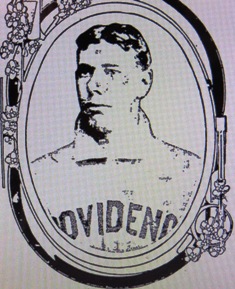
-Abstein had put up respectable, but by no means spectacular, numbers with the Shreveport Pirates in the Southern Association and Providence Grays in the Eastern League from 1906 to 1908—but as early as August of 1908 The Pittsburgh Press said he was the answer to the Pirates problem at first base:

“Fred Clarke is very eager to secure Bill Abstein from Providence.  Bill is rated the best first baseman in the Eastern League, and he would no doubt strengthen the Pirates where they are weak.”

When Abstein joined the Pirates before the 1909 season The Press said:

“The acquisition of bill Abstein has rounded our infield nicely.  He’s the best first baseman we have had in years and he certainly fits in nicely.”

???????????????????????????????

Abstein, Providence 1908

In a letter sent to Dreyfuss with his contract, Abstein told the Pirate owner:

“Fred Clarke will not have to worry about a first baseman after he sees this big German hustling around the bag.”

In keeping with his career performance, Abstein had a respectable season for the pirates.  He hit .260 and drove in 70 runs.  His 27 errors were only a slight improvement over 1908’s first baseman by committee.

The Pirates won 110 games and won the National League Pennant by six and half games over the Chicago Cubs and met the Detroit Tigers in the World Series.  The series would be the beginning of the end of Abstein’s Major League career.
09pirates

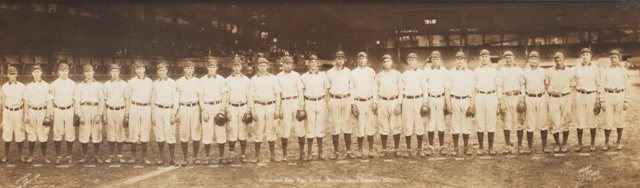
1909 World Champion Pittsburgh Pirates, Abstein 11th from left.

Abstein struggled at the plate (6 for 29 with nine strikeouts) and in the field (5 errors total, 2 each in games 3 and 4).  The Pirates won the series in seven games, but despite the victory, Abstein quickly became the subject of ridicule in Pittsburgh.

An Associated Press article after the series said:

“During the games with Detroit Abstein appeared to forget all that he knew about base ball.  He ran the bases foolishly, made a number of costly errors, failed to hit and disobeyed orders.  In fact, his playing was worse than that of any other man on either team.  The other Pirates, seeing that Abstein was the ‘goat’ for the combination, kept up the cry against him…Before the series was ended many of the Pirates shunned Abstein and it was reported he would be traded.”

The Pittsburgh Press was less generous:

“Bill Abstein denies he is a bonehead and says baseball is largely a case of ‘if-you-can-get-away-with-it,’ well it’s a cinch that Bill couldn’t in the National League.”

The Pirates were unable to trade Abstein and finally put him on waivers.  He was claimed by his hometown St. Louis Browns.

Even though the Pirates had actually won the Worlds Series and even though Abstein was gone, that didn’t mean the Pirates, and The Pittsburgh Press, wouldn’t continue to pile on.

Barney Dreyfuss told The Associated Press shortly after Abstein was claimed by St. Louis:

“We have discarded the weakest offensive player we had—Abstein—and hope to improve the team by doing so.”

Dreyfuss also claimed:

“Fred (Clarke) told me as early as last June that we should get someone else for Abstein’s place in 1910, as Bill mixed up the team’s plays too frequently.”

The Pittsburgh Leader said:

“(Abstein) had deplorable batting weaknesses which the opposing pitchers were certain to fathom in time.”

The Pittsburgh Press was even less generous:

“Bill Abstein is reported to be making a hit with the Browns by his work in the spring practice.  Just wait about three months friends, before declaring Bonehead Bill a wonder.”

When the Pirates sold pitcher Vic Willis the St. Louis Cardinals in February of 1910, newspapers reported that Willis and Abstein had “engaged in a bitter fight,” during the series.

Abstein quickly wore out his welcome in his own hometown of St. Louis.  Abstein made 11 errors in 23 games at first base and hit .149; he was released on June 2, 1910.  It appears Abstein was no more popular with Browns Manager Jack O’Connor than he was in Pittsburgh.  O’Connor was quoted in The St. Louis Times in May:

“How did Abstein get away with it last year?  How could he make plays like he has been making for me and get away with it all year for Pittsburgh?  I never dreamed that some of the plays made by him were even possible.”

His Major League career over, Abstein returned to the minor leagues for seven seasons.  He had one above average year with the Los Angeles Angels in the Pacific Coast League in 1914; in 202 games he hit .308, with 234 hits and 40 doubles.

Abstein moved on, Pittsburgh apparently did not.  For years, Pittsburgh newspapers took every opportunity to take a shot at the first baseman.  In 1915 The Pittsburgh Press, in an article about the revolving door the Pirates still had at first base–in the five post-Abstein seasons, the Pirates had four different starting first baseman–(emphasis theirs):

“No one will ever forget the way Bill did NOT play the bag in the Worlds Series.  In fact, Bill did NOT play the bag all the time he was stationed there.”

Pittsburgh finally seemed to move on by the time they won their next world Championship in 1925.  Abstein died in St. Louis in 1940.
Ty Cobb, Joe Jackson, Harry Hooper and Quackery

15 Feb

Baseball history is full of stories of products that have been routinely used in the belief they give players an edge.  Some, like steroids and amphetamines have obvious benefits; others like Power Balance bracelets provide none.

In 1916 advertisements began to appear in newspapers and magazines across the country for a new miracle drug from DAE Health Laboratories in Detroit: Nuxated Iron.

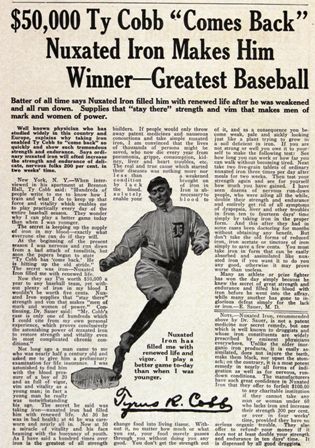
An ad featuring Ty Cobb said “Greatest Baseball Batter of all time says Nuxated Iron filled him with renewed life after he was weakened and all run down.”

Cobb said in the advertisement:

“At the beginning of the present season I was nervous and run down from a bad attack of tonsillitis, but soon the papers began to state ‘Ty Cobb has come back, he is hitting up the old stride.’ The secret was iron—Nuxated Iron filled me with renewed life.

“Now they say I’m worth $50,000 a year to any baseball team.”

cobbnux

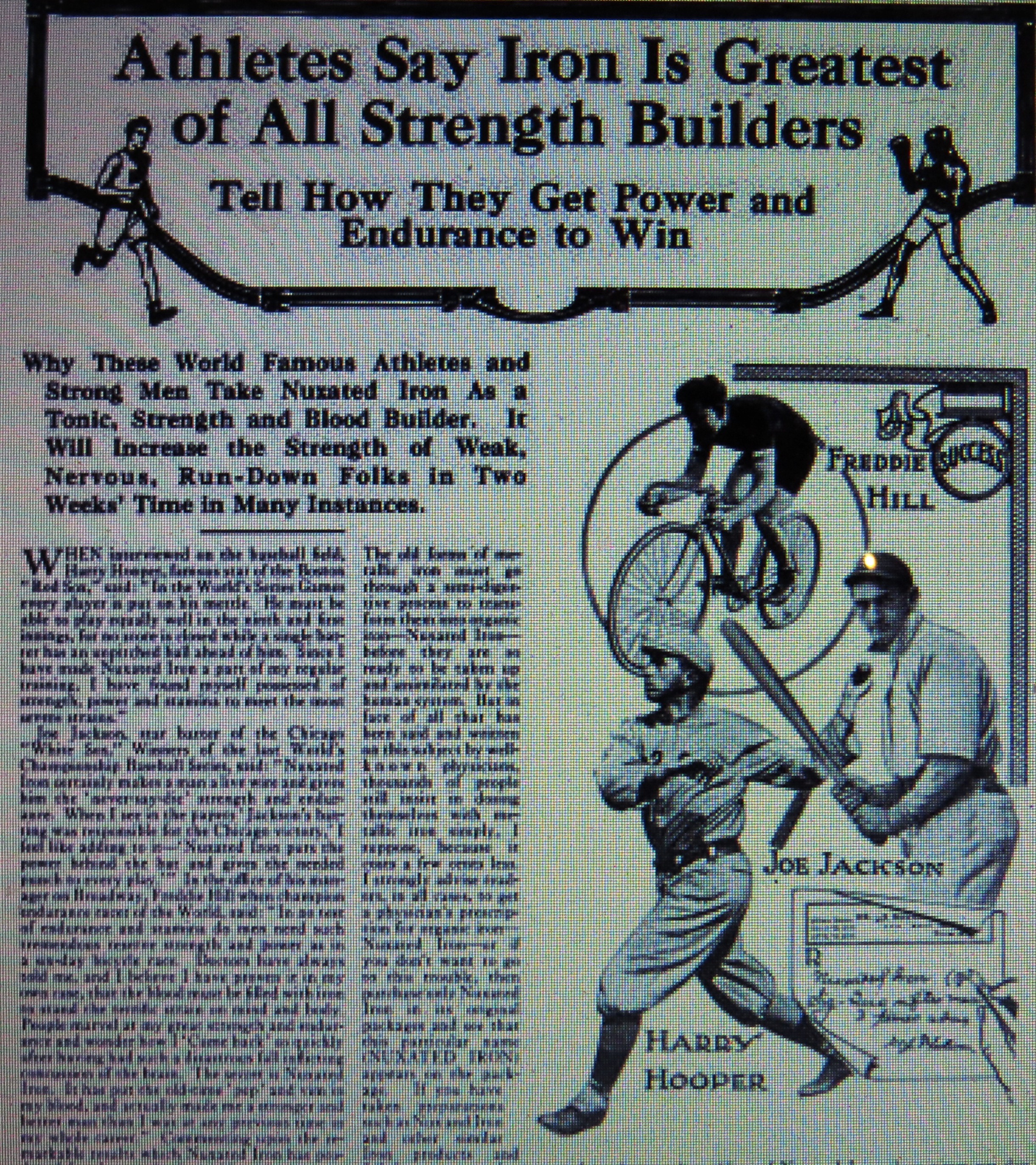
Other ads for Nuxated Iron began to appear, featuring boxer Jess Willard, cyclist Freddie Hill and baseball stars Harry Hooper and Joe Jackson.  Hooper said:

“Since I have made Nuxated Iron a part of my regular training, I have found myself possessed of strength, power and stamina to meet the most severe strains.”

Jackson said:

Nuxated Iron certainly makes a man a live wire and gives him the ‘never-say-die strength and endurance.”

The illiterate Jackson added: “When I see in the papers ‘Jackson’s batting was responsible for the Chicago victory,” I feel like adding to it—‘Nuxated Iron puts the power behind the bat and gives the needed punch to every play.’”

???????????????????????????????

The Journal of the American Medical Association took notice of the Nuxated Iron ad campaign and in October of 1916 had this to say about the “miracle drug:”

“Newspapers whose advertising ethics are still in the formative stage have, for some months past, been singing—at so much a song—the praised of “Nuxated Iron.”  The public has been that this nostrum is what makes Ty Cobb, “the greatest baseball batter of all time,” a “winner” and is what helped Jess Willard “to whip Frank Moran” besides being the “untold secret” of Willard’s “great triumph over jack Johnson.”

All that DAE would say about the ingredients were:

“Formula—The valuable blood, nerve force and tissue building properties of this preparation are due to organic iron in the form of ferrum peptonate in combination with nux vomica (strychnine) phosphoglycerate and other valuable ingredients.

But alas, The AMA Journal was not impressed with the claims made by Nuxated Iron’s endorsements:

“The Journal felt that it owed it to the public to find out just how much iron and nux vomica there were in ‘Nuxated Iron.’  Packages of the nostrum…were subjected to analysis.”

What the analysis found was that the formula that made Ty Cobb a “winner,” offered no health benefits:

“There is only one-twenty-fifth of a grain of iron in each ‘Nuxated Iron’ tablet, while the amount of nux vomica…is practically negligible…In a dollar bottle of ‘Nuxated Iron’ the purchaser gets, according to our analysis, less than 2 ½ grams of iron; in 100 Blaud’s Pills, which can be purchased at any drug store for from 50 to 75 cents, there are 48 grains of iron.”

To sum up their analysis The Journal called the claims made by Nuxated Iron “the sheerest advertising buncombe.”

Contemporary sources said Cobb earned as much as $1000 for his endorsement of Nuxated Iron; there is no record of what Hooper or Jackson were paid, but all three disappeared as paid spokesmen for the product by early 1917.

Nuxated Iron stayed on the market, and stayed in the crosshairs of the AMA until at least 1921.  But by then, the company no longer used baseball players to sing their players.

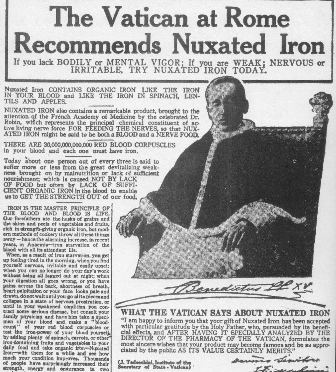
The 1921 ad campaign for Nuxated Iron sought a higher authority to promote the product’s benefits, and featured a picture of Pope Benedict XV under the headline:

“The Vatican at Rome Recommends Nuxated Iron.”

pope

“Greatest Baseball Game Ever Contested”

13 Feb

The Philadelphia Record headline called it the “Greatest Baseball Game Ever Contested, “ the September 1, 1906 game at Boston’s Huntington Avenue Grounds between the Philadelphia Athletics and the Boston Americans:

“What will go down in history as the most remarkable ball game ever played in a major league lasted 4 hours and 47 minutes to-day, and the champion Athletics beat the Bostons 4 to 1 in 24 innings.  It was a heart-breaking struggle all through, and to the astonishment of 18,000 people who saw the contest, the pitchers hung on until the last gun was fired.”

Rookie Jack Coombs pitched for Philadelphia, Joe Harris was on the mound for Boston.

Philadelphia scored a run in the third inning; Boston tied the game in the sixth:

“After that plenty of opportunities were offered, but owing to fast fielding and good pitching neither side could cross the plate.

“In the twenty-fourth, when darkness was fast covering the field, (Topsy) Hartsell led off with a single.  (Bris) Lord struck out, but Hartsell stole second…Shreck (Ossee Schrecongost) sent him home with a single over second.”

The Athletics added two more Runs as “The immense crowd filled out around the field.”

Coombs closed the Americans out in the twenty-fourth and “was cheered to an echo, some of the fans wanting to carry him on their shoulders from the field.”

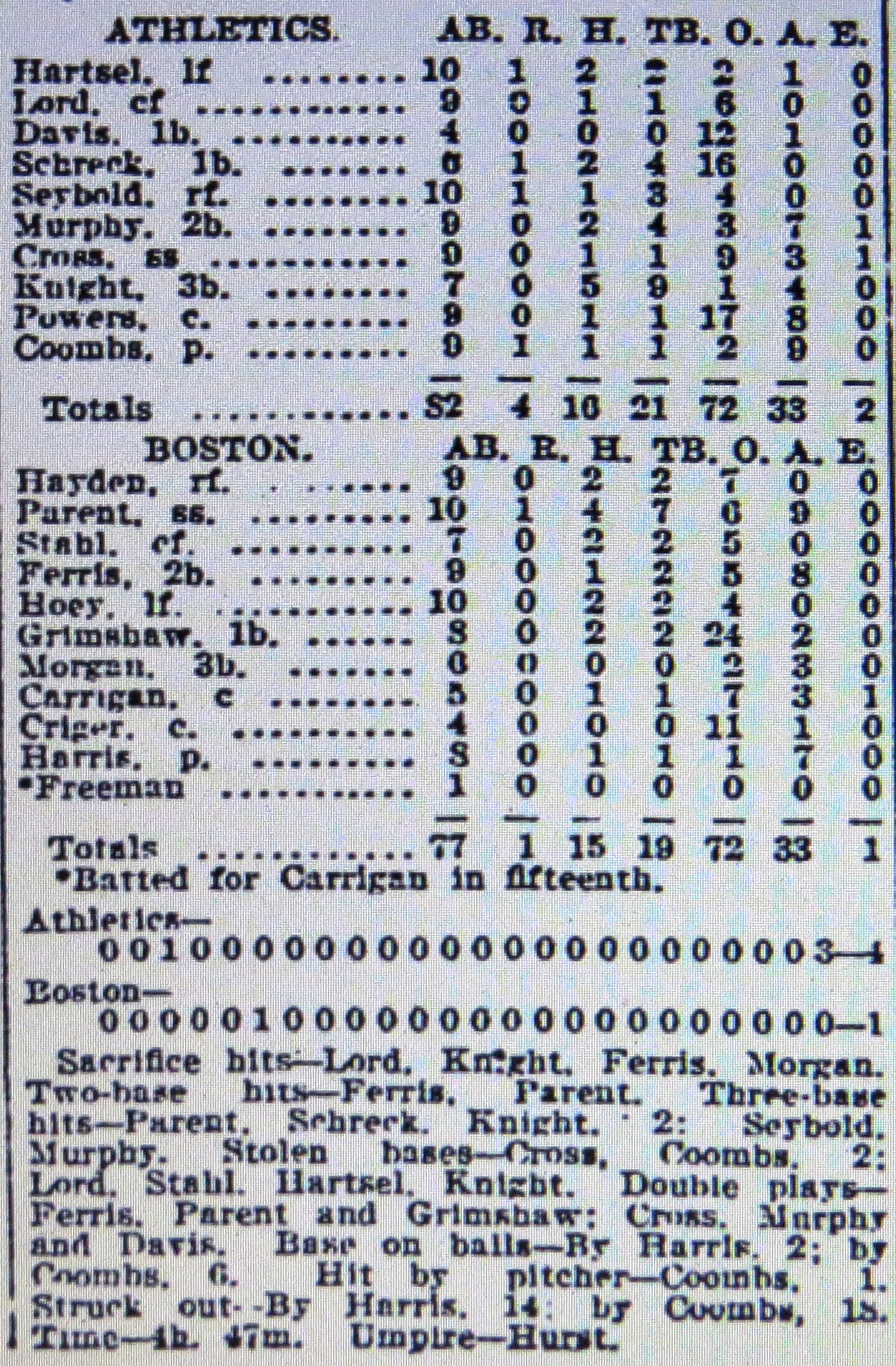
The box score:

???????????????????????????????

“It was well that the game was concluded as it was, for it was too dark to go another inning, and the crowd began to murmur that the light was too dim when the last round began.  But the players themselves interposed no objection, for they were all deeply anxious to fight it out.”

Jack Coombs, 1906

Jack Coombs, 1906

Coombs would go on to a long career, highlighted by a 31-9 record, and three more wins over the Chicago Cubs in the World Series for the champion Athletics in 1910; overall he was 5-0 in World Series play.  He also pitched for the Brooklyn Robins and Detroit Tigers.

Harris is one of the ultimate hard-luck pitchers in the history of baseball.  He ended the 1906 season with a 2-21 record (the Americans were shut out 8 times when he pitched).  His Major League career was over after he went 0-7 in 1907; Harris ended his career with a 3-30 record.

A Thousand Words–Satchel Paige, Chicago White Sox

6 Feb

???????????????????????????????

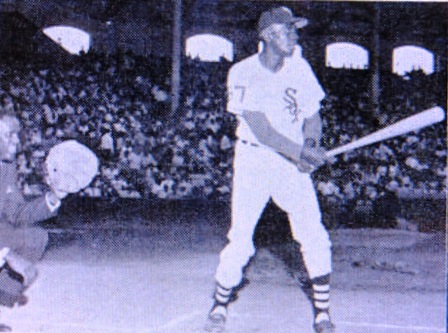
What if?  Satchel Paige in a White Sox uniform.  From 1938-1947 the Sox never finished better than 3rd, add Satchel Paige to those teams, which already had some good pitching including Ted Lyons, Eddie LopatThornton Lee, Monty Stratton and Orval Grove, and Sox fans might have had something to cheer about.  But of course, by the time Paige had a chance to play in the Major Leagues he was at least 42-years-old.  Paige would have helped at the box office as well.  For example, on July 18, 1942 the Sox drew slightly better than 24,000 for a doubleheader with the Detroit Tigers, across town at Wrigley Field a nearly identical amount came out to watch Paige pitch the first five innings for the Memphis Red Sox against the New York Cuban Stars.

Instead, all White Sox fans have is this rare photo taken in 1965 when Paige appeared with the Indianapolis Clowns at Comiskey Park (Chicago Cubs outfielder George Altman is the catcher in the picture).

——-

in 1935, Gene Coughlin, a sports writer for The Los Angeles Evening Post-Record wrote a column that went largely ignored, calling on organized baseball to break the color barrier which “not only makes (baseball) look ridiculous but is at the same time passing up increased business.”  Coughlin predicted that if a Pacific Coast League team were to sign Paige, it “would be good for an extra 10.000 in attendance every time he goes to the mound.  And he became good despite the inane prejudice that drives the colored baseball player to the sandlots and keeps him there.”

Coughlin’s column concluded:

“When you come right down to it, that baseball doesn’t give a darn whether it is pitched or caught by a white hand or a black one.  It is a symbol of game, a sport, and not a symbol of class distinction or color.”

Twelve years later organized baseball finally agreed.

Moriarty and Cobb

5 Feb

While the Detroit Tigers captain “jinx” almost cost George Moriarty his captaincy in 1912, he was also nearly traded to the Cleveland Naps in December of 1911.  The reason given for the Tiger’s desire to trade Moriarty was an alleged fight with Tigers star Ty Cobb.

Whether the fight actually took place is questionable, and an oft-told story about Cobb and Moriarty that grew out of the fight rumor is almost certainly untrue.

George Moriarty

George Moriarty

In December of 1911, The Associated Press reported the “Real reason for proposed trading of Moriarty.” The wire service said:

 “A battle royal between George Moriarty and Tyrus Cobb one day late in the season of 1911, is the reason why Detroit now wishes to dispose of the star third sacker.  Moriarty and Cobb started their argument upon the field at Detroit, and followed it up with an angry controversy at the club office.  Finally Cobb grabbed a bat and threatened to hit the big third baseman.  The latter armed himself in a similar manner, and they started to beat each other up.”

Ty Cobb

Ty Cobb

The story said the fight was broken up by teammates, and “Cobb then issued his ultimatum which was that he would not play with the Tigers if Moriarty was on the team, unless Moriarty apologized to him.”

Within days, both players and Tigers management denied that there had been any fight.  Cobb said:

“There has been a lot of talk that Moriarty and I almost had a fight in the clubhouse last season.  George and I are the best of friends.  We roomed together in the spring and were on the friendliest terms throughout the season.  The story that I put it up to (Tigers owner Frank) Navin to sell or trade George is a fabrication.  In the first place I had no grounds for such action, and in the second place I wouldn’t take such a step if I did have.  I wouldn’t put the Detroit club in a compromising position.”

While the story of a fight was told and retold over the next twenty years, Cobb and Moriarty always denied it happened.

The story that is still included in nearly every mention of Moriarty is that as he and Cobb were preparing to fight, Moriarty said “A fellow like you needs a bat to even things up when fighting an Irishman.”

The quote first appeared in a 1932 column by New York World-Telegram sportswriter Joe Williams when, as an American League umpire, Moriarty’s reputation as a fighter was renewed.  The Associated Press said after a double-header sweep by the Cleveland Indians, Chicago White Sox catcher

Charlie Berry followed the umpire into the runway of the clubhouse, accusing him of ‘missing’ a third strike on Earl Averill just before the Indian broke up the second game with a ninth-inning triple.

“Berry challenged Moriarty to a fight…Milt Gaston, Chicago pitcher, advanced himself.  The umpire felled Gaston…Then Berry, Frank Grube and Lew Fonseca rushed Moriarty, beating him until he was rescued by the Indians.”

In response to mentions of a fight with Cobb in the reports of the 1932 fight, Moriarty renewed his denial of a fight with Cobb, a denial he had also made in 1927 when he replaced Cobb as Detroit manager:

“Say anything else you like about me, but don’t spread the report that Ty and I fought.  We were roommates, and while we may have disagreed we never came to blows.”

Cobb and Moriarity relished their reputations as fighters, the fact that both continued to deny they fought long after it mattered would indicate that they often retold story is more wishful thinking than fact.

One more bit of trivia about Moriarity:  His grandson Michael Moriarty starred as Henry Wiggen in one of the greatest baseball movies, “Bang the Drum Slowly” with Robert De Niro.

Moriarty and De Niro in "Bang the Drum Slowly"

Moriarty and De Niro in “Bang the Drum Slowly”

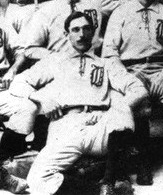
“Victim of Hoodoo”

4 Feb

In a game filled with stories of superstition, jinxes, “hoodoo,” and general irrationality, the Detroit Tigers seem to be the subject of an out-sized number of such stories during major league baseball’s first four decades.

Tigers’ pitcher George Mullin, whose story I told in October, was one of the most superstitious players in the history of the game, and he was not alone in Detroit.

This story begins in 1904, but took off in 1911, first in the Detroit newspapers and then across the country.  The Headline in The Duluth News-Times said:

“Moriarity (sic) is Victim of Hoodoo that follows Detroit Captains.”

“Moriarity” was George Moriarty, who had been named captain of the Tigers for 1911.  The story said Moriarty was the victim of a “Jinx” that dated back to 1904 when Bobby “Link” Lowe was acquired by the Tigers and named captain:

“His sterling playing qualities and the friendship that all the players had for him, together with his knowledge of baseball brought him the appointment of captain.  Bob got into a slump and Bob did not get out of it.”

Bobby "Link" Lowe

Bobby “Link” Lowe

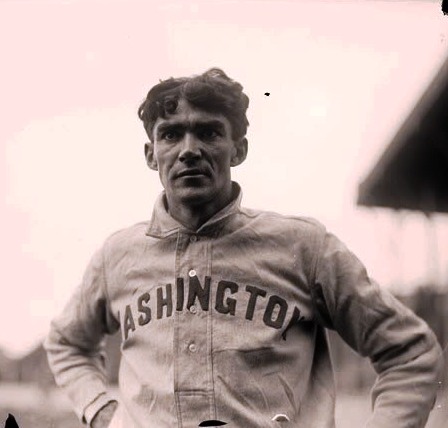
In 1905, the Tigers named Bill Coughlin captain, the story continued:

“Coughlin, whom everybody liked and who could play ball as well as the majority of them and think faster than most of them… (His) playing started down grade.  Bill bit his fingernails tore out his black wavy hair in bunches, lost sleep and worried several pounds off…Bill never got back to form.”

Bill Coughlin

Bill Coughlin

After Coughlin was replaced at third base by Moriarty in 1909, Detroit manager Hughie Jennings named William Herman “Germany” Schaefer captain for the 1909 season.  The story said of him:

“Herman with his ever penetrating optimism, humor and baseball wisdom …appeared to be the right man in the right place as captain…but Herman’s playing ability decreased to such an extent that Detroit gladly grasped at the chance to trade Schaefer.”

Germany Schaefer

Germany Schaefer

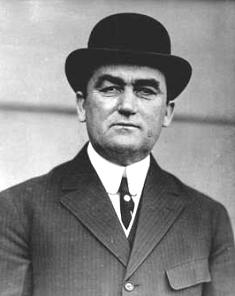
Hughie Jennings was enough of a believer in the jinx, even before it became grist for the newspapers, that after trading Schaefer in August of 1909, he chose not to name a captain for the remainder of the season, or for 1910.  Jennings decided to again name a captain in 1911:

“On the Southern training trip Jennings came to realize the necessity of a field leader… (Moriarty) was cool-headed and had the qualities of a leader…the choice seemed like a good one…But soon after the opening of the season it became apparent that Moriarty caught the hoodoo…The duties of the position have weighted in Moriarty until his playing ability has fallen away below par.”

After the 1911 season, Jennings took the situation seriously enough to again consider eliminating the position of captain.  The Detroit Free Press said, “In all probability the Tigers will have to struggle along without a captain next season,” citing Moriarty’s “Frightfully bad year,” after being named captain.

George Moriarty

George Moriarty

In the end, Moriarty was again captain of the Tigers in 1912 and served in that capacity through 1915.

Like most “jinxes,” there really was no jinx, none of the players performed significantly worse than their career averages except for Lowe—but he was 38-years-old when he was acquired by Detroit in 1904 and had missed most of 1903 with a badly injured knee.

Coughlin had shown great promise with the Washington Senators, hitting .275 and .301 in 1901 and 1902, but by the time he was named Tiger captain in 1905 he had back-to-back seasons of .245 and .255, right around his career .252 average.

Schaefer was a .257 career hitter, and his numbers during his half-season as captain were similar to his career numbers.

Moriarty hit .243 during his season with the captain “hoodoo;” his career average was .251, and most of his 1911 numbers were similar to his performance throughout his career.

More on Moriarty tomorrow.

Kauff and Perritt

29 Jan

Benny Kauff and Pol Perritt were two of the reasons why the New York giants won the National League Pennant in 1917.  Kauff led the team with a .308 average and Perritt was 17-7 with a 1.88 ERA.  Both came to the Giants by way of the Federal League, and with the help of “Sinister Dick” Kinsella, John McGraw’s right-hand man.

"Sinister Dick" Kinsella

“Sinister Dick” Kinsella

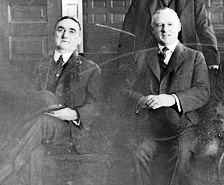
Kinsella was the former baseball magnate of Springfield, Illinois who went east to serve as McGraw’s chief scout.  He was a key player in the incident that led to Giants’ catcher Larry McLean’s banishment from organized baseball.

After the 1914 season, McGraw set his sights on the Indianapolis Hoosiers’ Kauff, who was being called the “Ty Cobb of the Federal League.”  Kauff led the league with a .370 average, 120 runs, 211 hits and 75 stolen bases.

When the debt-ridden Hoosiers were transferred to Newark for the 1915 season Kauff’s contract was sold to the Brooklyn Tip-Tops, and he joined the team in Browns Wells, Mississippi.

At the same time, Perritt coming off a 16-13 season was prepared to jump the St. Louis Cardinals and join the Pittsburgh Rebels in the Federal League.

Pol Perritt and Benny Kauff, 1917

Pol Perritt and Benny Kauff, 1917

Sportswriter Frank G. Menke of Hearst’s International News Service picks up the story:

“Dick Kinsella, scout for the Giants, according to the story we get, hustled to Browns Wells and got a job on a plantation…Kinsella didn’t dare to put up at the same hotel because he was known by Manager Lee Magee, Business Manager Dick Carroll and others of the Brookfeds.”

Kinsella, according to Menke, was pretending to be a farm hand and also observing Kauff’s workouts and reporting back to McGraw who, along with Jack Hendricks of the Indianapolis Indians in the American Association (who held Kauff’s rights) was sending coded telegrams to Kauff signed “Father.”  Kauff received telegrams saying, “Mother wishes to see her boy,” and “All is forgiven.”

According to Menke, the telegrams were intended to inform Kauff that McGraw wanted him with the Giants and:

“The “everything forgiven” telegram was to tip Kauff off that if he jumped the National Commission probably would let him play.”

While Kauff was in Mississippi, Pol Perritt was in the process of  jumping to the Federal League.

According to Menke, Kinsella left Mississippi in the middle of the operation to secure Kauff in order to talk to Perritt.  What Kinsella said to Perritt is unknown, but Perritt’s meeting with Pittsburgh manager Rebel Oakes pretty much put an end to any chance of joining the Federal League.  The Associated Press said:

“Pitcher ‘Pol’ Perritt who jumped to the Pittsburgh Federal recently had a fist fight with Manager ‘Rebel’ Oakes…Those who saw the fight say that the pitcher delivered one blow that knocked Oakes over a chair…Friends and acquaintances interceded and hushed up the whole affair before police arrived on the scene.”

The story said Perritt was meeting with Cardinals’ management to “flop back to organized ball,” within weeks the Cardinals sold Perritt’s contract to the Giants, The AP said:

“Carefully guarded by “Sinister Dick” Kinsella…Perritt was delivered to John J. McGraw this noon…Kinsella brought his man in from Shreveport without struggle, and states that he did not even sight a Federal submarine during the entire journey.”

An alternate version of the story, published in The New York Times said it was McGraw who met with Perritt rather than Kinsella and highlighted the manager’s journey to meet the pitcher:

“McGraw had to travel forty miles on one railroad, nine miles on another, and then drive nine miles through the mud to get to Perritt’s home in Louisiana.”

Perritt was in the fold.  After a 12-18 season in 1915, he would win 18, 17 and 18 from 1916-18.

Kauff would be a bit more complicated.

While Kinsella was gone from Mississippi securing Perritt, Kauff signed a $6000 contract with Brooklyn, which he immediately regretted and contacted McGraw.

kinsellamcgraw

Dick Kinsella and John McGraw, 1920

According to Menke, Kauff:

“Related the difficulty he had with Robert B. Ward, president of the Brookfeds, over the contract.  The Giants people thought that owing to Kauff’s trouble—or alleged trouble—over the Brookfed contract that he was not legally under contract.”

Menke said the Giants signed Kauff for $7000 a year for three years with a $7000 bonus.

National League President John Tener voided the contract and Kauff was forced to return to the Tip Tops; he again led the league with a .342 average.

McGraw finally got his second man at the close of the 1915 season.  After the Federal League folded and Kauff was reinstated to organized baseball he signed a two-year contract for $6500 a season and a $5000 bonus with the Giants.

New York had finished in eighth place in 1915. They improved to fourth in 1916 and won the pennant by 10 games in 1917. McGraw’s Giants lost the to the Chicago White Sox four games to two in the World Series.  Perritt appeared in three games in relief, and Kauff hit a disappointing .160, despite two home runs in the Giants’ game four victory.

After the 1917 World Series Perritt and Kauff faded fast.

Perritt was 18-13 in 1918, but would only win four more games over the following three seasons with the Giants and Detroit Tigers; he was out of professional baseball before his 30th birthday.

Kauff’s demise is better known; his professional career came to an end at age thirty, the result of allegations of his involvement with gamblers, in general, and 1919 World series fixer Arthur Rothstein in particular.  Kauff, who owned an automobile accessory business with his half-brother and Giant teammate Jesse Barnes, was charged with stealing and reselling an automobile.  Although he was acquitted at trial, Kenesaw Mountain Landis banned Kauff for life.  Kauff’s oft-told story is told best in two excellent books by David Pietrusza:  Rothstein: The Life, Times, and Murder of the Criminal Genius Who Fixed the 1919 World Series and Judge and Jury: The Life and Times of Judge Kenesaw Mountain Landis.

Perritt died in Shreveport, Louisiana in 1947; Kauff died in Columbus, Ohio in 1961.

Fighting Jimmy Burke

2 Jan

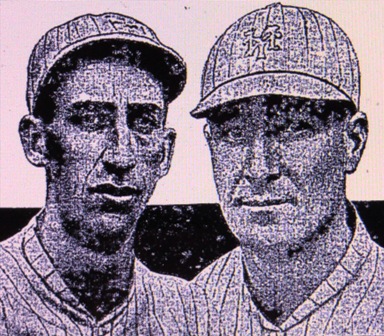
James Timothy Burke had a stormy tenure with the Saint Louis Cardinals from 1903-1905, including a disastrous 35-56 record as player-manager in 1905, replacing Kid Nichols (who remained on the pitching staff)—Burke resigned in August, and the Cardinals were in such disarray that owner Stan Robison eventually took over the team for the remainder of the season.

Burke had been with five teams from 1898 through 1902 before being traded to the Cardinals.

Jimmy Burke

Jimmy Burke

During his time with the Cardinals Burke had various fights and feuds, it was said he was the ringleader in a group of players trying to undermine manager Patsy Donovan in 1903; he had a long-standing feud with shortstop Dave Brain and the two seldom spoke, and he feuded with Robison throughout his short tenure as manager.  After his resignation he said:

“When I took charge of the team it was with the understanding that I was to be manager or nothing.  I have suffered as Donovan and Nichols with too much interference.”

Burke also had trouble with a Saint Louis sportswriter named Joe Finnegan.  Their contentious relationship came to a head at the Victoria Hotel in Chicago in September of 1904 after Finnegan had written an article in which he called Burke “a cow’s foot,” (apparently those were fighting words circa 1904).

The Pittsburgh Press provided the colorful blow-by-blow of the fight:

“First round–Burke hit Finnegan in the lobby, and followed the blow with a left hook on the back of the neck, breaking the scribe’s collar.  Burke pressed the advantage and struck Finnegan near the cigar stand.  Finnegan blocked cleverly, uppercut with the left and caught Burke in the snout.  Finnegan crossed his right and landed on Jimmy’s potato-trap.  Burke jolted Finnegan in the rotunda and followed with a short swing near the Turkish parlor.  Finnegan shot the right to the ear, and the left to the lamp.  They clinched.  Terrific short-arm fighting, completely wrecking Finnegan’s collar and cuff.  Johnny Farrell separated the men. Time.

“Second round—The house detective threw both fighters out in the alley.  Time.  Decision to Finnegan.”

Burke’s Major League career ended after the 1905 season.  New Cardinal manager John McCloskey said he wanted to retain Burke as his third baseman, but Robison, against his manager’s wishes (and continuing the pattern which led papers to call Cardinals managers “figureheads”) waived Burke.

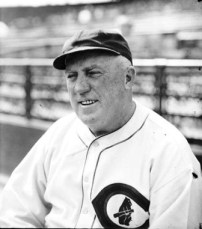
Burke became a successful minor league manager and returned to the Major Leagues as a coach with the Detroit Tigers in 1914.  He also served as a coach with the St. Louis Browns and managed the team for three seasons.

Jimmy Burke, Cubs coach

Jimmy Burke, Cubs coach

Burke served as Joe McCarty’s right hand from 1926-1930 with the Chicago Cubs and followed him to the New York Yankees where they continued together until a stroke necessitated Burke’s retirement after the 1933 season.  McCarthy had played for Burke with the Indianapolis Indians in the American Association in 1911.

Burke died in St. Louis in 1942.

“The Man who Ate Himself out of the American League”

20 Nov

Frank Frederick Schneiberg was born in Milwaukee in 1882 (Baseball Reference lists his year of birth as 1880, but all available documents say 1882).

He began playing baseball for amateur teams in the Milwaukee city league, and after playing for the Pabst Brewery team in 1903 signed with the Springfield Hustlers in the Three-I League.  No records survive, but according to The Milwaukee Journal Schneiberg “won 19 out of 21 starts.”  He played with the Freeport Pretzels in the Wisconsin State League in 1905 and according to the Journal “won 12 straight.”

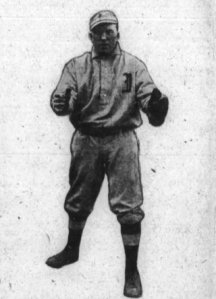
Frank Schneiberg

He won 22 games the following season with the La Crosse Pinks, which earned him a shot with the Detroit Tigers.

It didn’t go well.

Schneiberg was released to the Milwaukee Brewers before the beginning of the season.

The Associated Press said:

“He has the earmarks of a great pitcher…speed, curves, control and a pretty good collection of baseball brains…but Schneiberg was lazy…He wasn’t eager to pitch.”

The story quoted Tigers manager Hugh Jennings:

“He knows how (to pitch) but he won’t exert himself, I don’t want anybody who will not hustle.”

The Toledo News-Bee blamed his release on something else:

“He is known all over the country as the man who ate himself out of the American League.”

It is unknown whether either or both versions of his time with the Tigers is accurate, in either case, Detroit did try to claim that Schneiberg was still their property later that season when he was pitching well for the Brewers.  The claim was denied and he remained in Milwaukee.

Schneiberg pitched for the Brewers for three seasons compiling a 40-48 record.

While a fan favorite in Milwaukee, Schneiberg appears not to have been popular in at least one other American Association city.  The Toledo News-Bee accused him of being a head hunter in 1908:

“Schneiberg has the reputation of threatening to ‘bean’ batters.”

The following season The News-Bee claimed the Brewers were trying to trade the pitcher and said the team was:

“(V)ery anxious to trade the German, who does not work with any spirit, but the player is not highly regarded around the circuit.”

Regardless of the opinion in Toledo, The Brooklyn Superbas thought highly enough of Schneiberg to draft him from the Brewers at the end of the 1909 season.

He appeared in his only Major League game. On June 8, 1910, with Brooklyn trailing the Cincinnati Reds 4-0, Schneiberg relieved Nap Rucker in the top of seventh inning.  He walked four, gave up five hits and allowed 7 runs (Baseball Reference shows Schneiberg giving up eight runs, with seven earned—the box score from the game shows 7 total).

Schneiberg was lifted for a pinch-hitter in the bottom of the seventh.  Within days, he was traded to the Des Moines Boosters in the Western League.

He retired after the 1910 season, but in February of 1913 signed with the Memphis Chickasaws of the Southern Association.  He appeared in two games and was released, and in June signed with the Springfield Watchmakers in the Three-I League.  It’s unclear whether he appeared in any games with Springfield.

Frank Schneiberg 1932

Schneiberg retired to Milwaukee after the 1913 season, he became an asbestos worker and an official in the Asbestos Workers Union.  He passed away in Milwaukee in 1948.

Stallings Stealing Signs

17 Oct

George Stallings had turned the New York Highlanders around.

Hired by owner Frank Farrell after New York’s disastrous 51-103 season in 1908, Stallings guided the Highlanders to 74-77 record in 1909.

George Stallings

American League President Ban Johnson said he knew why Stallings’ team had improved.

During a series with the Highlanders in the summer of 1909 Washington Senators Manager Joe Cantillon thought he noticed something unusual past the center field wall in Hilltop Park.  He passed his suspicions on to Detroit Tigers Manager Hughie Jennings.

Tiger Manager Hughie Jennings

The Highlanders hit Detroit pitcher Ed Summers hard during the first game of Detroit’s next series in New York.  Jennings sent pitcher Bill Donovan out to center field to investigate, but according to The Sporting Life:

“Bill returned without having shown any ability as a Sherlock Holmes.”

Jennings then assigned trainer Harry Tuthill to the job.  Tuthill noticed that the letter “H” in a hat advertisement on the center field fence was moving, scaled the fence and made a discovery.

Initially the Tigers did nothing, Jennings had more on his mind; Detroit was headed to the World’s Series and despite New York’s improvement they were a fifth place team.

But rumors spread and the story was picked up by The Sporting Life, getting the attention of  the American League president.

Johnson sent a telegram to Tuthill threatening to bar him from the league if he did not provide the his office with a full report of what he knew.  Tuthill said that after he noticed the letter in the sign moving he went to the center field wall and upon climbing to the other side discovered a small area behind the sign where a man sat with a pair of field glasses.  According to Tuthill “The man ran out as I came in, I think I know who it is but can’t be positive.”

In other reports Tuthill said he was sure who the man was but would not reveal his identity—it was later alleged to be former Major League pitcher Gene McCann.

Trainer (and detective)  Harry Tuthill with Tigers first baseman Del Gainer

Jennings was convinced the Highlanders were stealing signs all year as did The Sporting Life:

“It has been a noticeable fact all season that the Highlanders always hit like fury at home and were punk batters on the road.”

The Highlanders scored 338 runs in 76 homes games; 251 in 75 road games.

The Sporting Life also speculated that Stallings, who had a poor relationship with the American League president, might be expelled from the league as a result of the allegations:

“President Johnson has conclusive evidence…and it is all but natural to suppose that the man in charge of the team which benefited by the system employed knew of its existence, and it is on this theory that Stallings’ resignation will be asked.”

Despite the speculation there was no rule at the time which prohibited stealing signs in the manner the Highlanders were accused

At the winter meetings that December the American League Board of Directors exonerated Stallings, but in their ruling vowed that any team official found stealing signs in the future would be “Barred from baseball for all time.”

Stallings was at the helm of the Highlanders for most of the 1910 season, and became embroiled in another sign stealing controversy in late July when “Big Ed” Walsh and several members of the Chicago White Sox accused the Highlanders of stealing signals in the same manner.

The Chicago Tribune said:

“There is not a player on the Sox club who isn’t confident the catcher’s signs are being tipped off.”

Stallings again denied the charges and said the White Sox pitching staff was tipping their pitches:

“What are you going to do when practically every Chicago pitcher insists on giving his own signals from the box and the signals get familiar, they are repeated so often?”

Stallings was again cleared of wrongdoing, but in spite of a guiding the Highlanders to a 78-59 record through September 19, he was replaced as manager after losing a struggle for control of the team with first baseman Hal Chase, who was named as his replacement.

Stallings went on to manage the World’s Series winning Boston Braves in 1914.