Tag Archives: Hall of Fame

“Either they think that Everybody is Gullible, or else they are Weak Mentally themselves”

19 Nov

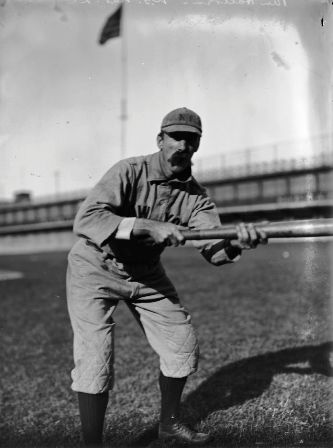
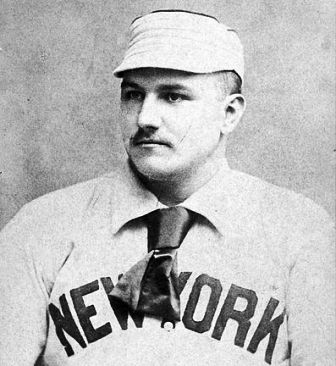
Until a broken ankle in 1902 slowed him, George Van Haltren was one of baseball’s best leadoff hitters; a .316 hitter with 2544 hits during his 17 seasons.   After a disappointing 1903–.257 in  84 games—his major league career was over, and he went home to the West Coast where he spent six seasons in the Pacific Coast League (PCL).

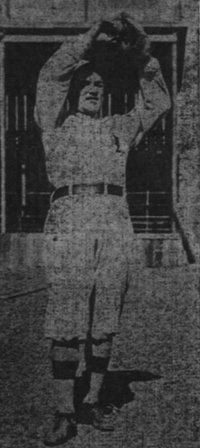
George Van Haltren

George Van Haltren

A member of the Seattle Siwashes during his first year in the PCL, Van Haltren was asked by The Oakland Tribune—the paper called him “an ultra-scientific batsman,” to share his expertise:

“Every ball player occasionally meets other players who call themselves ‘place hitters.’  The assertions of the majority of these players are such that either they think that everybody is gullible, or else they are weak mentally themselves.  They tell you they ‘can put the ball where they please,’ and that ‘it is easy when you know how.’

“Never take any stock in such twaddle.  These place-hitters would be just the men to have around when the ‘fans’ are calling on the home team to ‘hit ‘em where the fielders ain’t!’  But when it comes to delivering the goods, I have noticed, they are generally short.

“As a matter of fact, the batter often tries to hit to a certain field, and sometimes he is successful, but no man can give a guarantee when he goes up that the ball he hits will take any special direction.  If place-hitting could be carried out to the fine point that some players say they have it, they would be able to hit safely every time they came up.

“To the young player I would say: Don’t get in the habit of planting your feet on the ground and not moving them until you have swung at the ball.  Get a stride and advance a little toward the ball as you hit.  Do not step too far and accustom your eyes and hands to the change such a step makes.  Learn to hit squarely every ball that passes over any part of the plate between the knee and shoulder, and devote the most practice to what you are weakest on.

“Learn to think and act quickly and to keep your head at all times.  In a contest do not always do the same thing under the same circumstances.  Give your opponents a surprise whenever you possibly can.”

By the time he arrived on the West Coast, Van Haltren was no longer able to give his opponents “a surprise” as often as he could before the ankle injury; he hit .270 for Seattle in 1904, he played five seasons with the Oakland Oaks, hitting .255 before retiring in 1909.

Van Haltren died in 1945 without ever drawing serious Hall of Fame consideration.  A good argument for his enshrinement can be found here.

“The Dream of an Ardent Baseball Fan and Admirer brought to Realization”

8 Sep

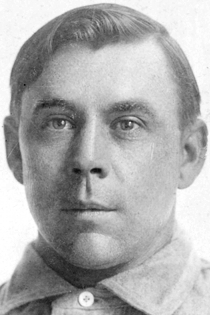
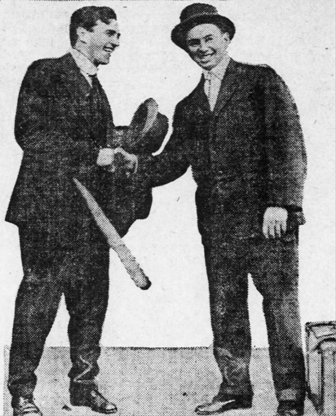
The Associated Press (AP) reported the same day that Hall of Famer Joe McGinnity was released by the New York Giants that he, along with a partner had purchased an Eastern League franchise, the Newark Indians, for $50,000—more than $1.3 million in current dollars.

Joe McGinnity

Joe McGinnity

The following month, The AP told how McGinnity and his co-owner, Chicago businessman Henry Clay Smith, came to be partners:

“There is an interesting story connected with the deal whereby Joe McGinnity and H.C. Smith of Chicago purchased the Newark club of the Eastern League, which reveals the identity of Mr. Smith and portrays the rise of a penniless man to a millionaire, who remained true to his first love in the baseball world.

“H.C. Smith is now a leading member of a Chicago manufacturing company, was station agent for the Chicago & Alton Railroad at Auburn, a little town south of Springfield, IL., working on a modest salary, with nothing better in view, 12 years ago…it was in those days that he learned to admire McGinnity as a ballplayer.

“That was the time when McGinnity earned the sobriquet of ‘Iron Man.’ He would work six days a week, pitching for country teams all over central Illinois, and on Sunday he would go to Springfield and play with the Springfield team.”

One of McGinnity’s teammates on that semi-pro team in Springfield was Dick Kinsella, who would become a minor league magnate and confidant of John McGraw:

“(Kinsella) remembers the connection between H.C. Smith and Joe McGinnity in the olden days.

“Smith was one of Joe’s staunchest and most consistent admirers, and from the time he first knew him until the present day, his admiration has not abated.  In 1895 Smith left Auburn and went to Chicago, where he became engaged in the brokerage business, at which he prospered.  Later he became connected with his present company, gradually working his way to the top, until he was a man of wealth.

“Learning that the New York Giants were going to release McGinnity, Smith at once arranged with Joe to get hold of some team, for which Smith would furnish the money.  The result was the purchase of the Newark club, the dream of an ardent baseball fan and admirer brought to realization, and a home assured the famous Joe McGinnity, all through the regard, which a station agent in a country town felt for a ballplayer whom he considered the best he had ever known.”

McGinnity

McGinnity

The 38-year-old McGinnity started 46 games and posted a 29-16 record with a 1.66 ERA for the 2nd place Indians during his first season as co-owner and team president.

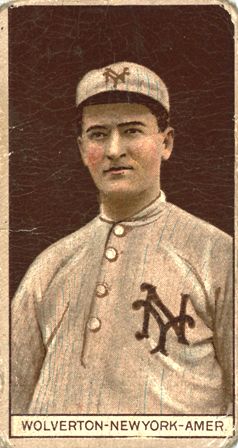
Harry Wolverton, who had been hired as manager by the previous ownership was retained by McGinnity and Smith.

Harry Wolverton

Harry Wolverton


There are several versions of the story of how McGinnity came to replace Wolverton as manager late in the season—some say Wolverton was let go for trying to remove McGinnity from a game, others say Wolverton took another position.  The real story, based on contemporaneous accounts in The Newark Evening News, was simply that Wolverton was injured before the team’s final road trip, and McGinnity took over.  In the winter of 1909 Wolverton purchased his release and McGinnity became the team’s full-time manager.

McGinnity and Smith owned the Newark Tigers through the 1912 season.  McGinnity managed the team to a second place finish in 1910 and a seventh place finish in 1911.  The team joined the International League in 1912 and finished third.

McGinnity won 87 games and lost 64 in 151 starts during his four seasons in Newark.

He and Smith sold their shares in the club after the 1913 season.

“It’s Strange how these Stars of Balldom have such Beliefs”

27 Aug

Throughout his career as an American League umpire, Billy Evans, who had covered baseball for The Youngstown Vindicator continued to write syndicated newspaper articles.  He was fascinated by the superstitions that controlled the actions of so many players.

Billy Evans

Billy Evans

He followed a 1907 article about the subject, with more stories the following year:

“Of all professions, that of baseball player is the most superstitious…Of course, there are many superstitions in common, yet most of the players have pet ideas of their own on which they place much reliance.  The data of origin of many of the superstitions is a deep, dark mystery.”

Evans said:

“There is certainly nothing out of the ordinary to be seen in a load of hay, yet most players welcome the sight of one during the playing season.  In the dictionary of baseball a load of hay signifies two hits that afternoon for the discoverer, and history tells us there is nothing dearer to a player’s heart than base hits…While its supposed strange magic often fails, still the players retain faith in it.  On the other hand, the sight of a load of empty barrels is always dreaded, for some it means a shutout, to others merely defeat.”

Of one popular superstition of the time, Evans said there was “no greater believer in shaking up the bats when a rally is on” than Cleveland Naps pitcher Charles “Heinie” Berger:

“Ordinarily a team keeps its bats lined up in front of the bench in a fairly tidy manner.  According to Heinie’s code that is all well and good when everything is moving along smoothly, but when a rally appears to be in the air, the proper way to encourage it, according to Berger, is to scatter the bats in every direction.”

Heinie Berger

Heinie Berger

Evans told the story of the Naps’ August 21, 1908, game, although some of the details regarding the scoring wrong, he got most of the facts correct:

“One day last summer during an important game at Philadelphia, the Athletics got away with a seven-run lead in the first two innings.  When they added another in the third, it certainly looked as if things were all off so far as Cleveland was concerned.  Until the seventh inning the Naps bench was not unlike a funeral.  Two runs in the seventh stirred up a little hope, and caused Heinie to heave a few big sticks in different directions.  His actions caused Umpire Jack Sheridan (Sheridan and Evans both worked the game, Sheridan was behind the plate) was to offer a mild rebuke and incidentally warn Heinie that he wanted nothing but silence during the rest of the afternoon.”

Cleveland scored two runs the following inning, and had the tying run on base:

“Heinie proceeded to scatter the two dozen or more bats in all directions.  That was too much for the veteran Sheridan, and after he had made Berger replace all the bats back in a straight line, he tied a can on the Teuton and chased him from the lot.

“Berger viewed the remainder of the game from the bleachers, failing to carry out completely the edict of the umpire.  When the Naps scored the two men on the sacks and tied up the game he was happy.  Heinie was confident that the bat superstition had aided in the victory that he was sure would result, now that the score was tied.  When the Athletics scored a run in the eighth that proved to be the winner his confidence in the theory was not shaken in the least. He blamed the defeat on Sheridan, claiming that as soon as the umpire ejected him from the game the spell was broken.”

Evans also wrote about his favorite superstitious player, “Wild Bill” Donovan, pitcher for the Detroit Tigers.  Evans had previously mentioned Donovan’s fear of throwing a shutout during his first start of each season, and his actions in one game in particular, but now gave a more detailed account:

“It all seems rather foolish, yet I have worked back of Donovan on two such occasions and have every reason to believe that Bill makes it possible for his opponents to score.  In one of the games Detroit had the affair clinched 8 to 0 in the eighth.  With one down and a man on second Charley Hickman stepped to the plate.  A straight fast one is the most delicious kind of dessert for Charley, although he likes almost any old thing in the shape of curves and slants.

“There is no more strategic pitcher in the league than Donovan, yet he started off the reel to hand them up to Hick’s liking.  After fouling off three, Hick met a fast one on the nose and was blowing hard at third by the time the ball was relayed back to the infield.  He scored a moment later, but Detroit too the game easily, 8 to 2.  Bill had escaped the much despised shutout.  By the way that year was the most successful of Donovan’s career, and, of course, merely served to strengthen his belief.”

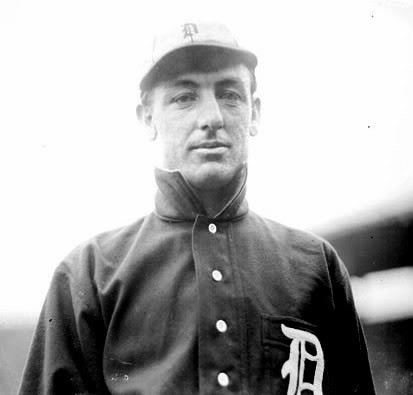
Bill Donovan

Bill Donovan

Again, Evans got nearly all the details correct—except the final score was 9 to 2.  The May 24, 1907, game was Donovan’s first start of his best season in baseball (25-4, 2.19 ERA for the American League Pennant winners), and he did lose a shutout to Washington in the eighth inning on a Hickman triple.

Evans said a superstition often attributed to Cy Young, was not a superstition at all:

“The veteran Cy Young, the grand old man of them all, is one of the few players who doesn’t take much stock in omens of good or bad luck.  Cy, however, has one big hobby.  He always prefers to pitch on dark days…The dark day idea is no superstition with Cy.  No one except the batters perhaps realizes how hard it is to hit his fast ball when the light is dim.  It is really a pleasure for him to work out of turn on such days, for he knows what a big handicap he has over his opponents.”

Evans said another Hall of Fame pitcher had a bizarre habit, that while perhaps not a superstition, bears mentioning:

Jack Chesbro, the famous spitter, is always of the opinion that someone is slipping a doctored ball over on him, and quite often asks for a new one when the cover doesn’t taste just right.”

The umpire concluded:

“It’s strange how these stars of balldom have such beliefs and stick to them, but they do.  The ball player lives in a world of his own, more than any other profession with the possible exception of the actors.”

Big Six versus The Hoosier Thunderbolt

6 Aug

Christy Mathewson had only pitched five full seasons when Sam Crane of The New York Journal said in January of 1906 “there is a great diversity of opinion” regarding whether Mathewson or Amos Rusie was the better pitcher.

Crane said “Old-time lovers of the game” said Rusie, “The Hoosier Thunderbolt”, whose career ended in 1901 after being traded to Cincinnati for “Big Six” Mathewson,  was the best ever, “and refuse to acknowledge that the young college man who won the world’s championship so easily last fall…is his superior.”   While, “the younger generation of enthusiasts say there was never but one Mathewson and point to his wonderful record to prove their point.”

Amos Rusie

Amos Rusie

Crane said two famous New York baseball figures—and future Hall of Famers– disagreed on the point:

George Davis, the crack shortstop of the Chicago White Sox, and one of the best players who ever wore ‘New York’ across his shirt front, met Clark Griffith, manager of the Yankees (Crane was one of the earliest to call the then “Highlanders” the “Yankees”), yesterday at the headquarters of the New York American club, and argued over the much mooted questions of pitching superiority between the two crack box artists.  Both Davis and Griffith agreed that Mathewson and Rusie were two of the best, but differed as to which was entitles to the premier position.”

Davis thought Mathewson was better.

“Both have excelled all other Boxmen.  I have never batted against Matty in a game, but I have met his curves in practice and I want to say that he has just as good control of the ball as Rusie.  Matty’s most effective ball is a straight drop, but his speed is a great factor as well as a wonderfully controlled slow ball.  He uses his forearm and elbow and winds up in such a manner that a batsman is sure to be puzzled.  Rusie, on the other hand, depended on an out drop, which he controlled with remarkable skill, in addition to his fast ball; but he had very little preliminary motion and used his shoulder almost exclusively.  Rusie probably had the better physique, but in head work and vitality Mathewson outclasses the big Hoosier.”

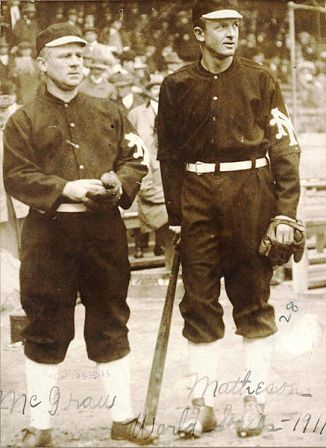
Christy Mathewson with John McGraw

Christy Mathewson with John McGraw

Griffith disagreed:

“Rusie in his prime was the best twirler that ever stepped into the box.  His curves, speed and control were the best assortment I ever looked at, and no pitcher has ever approached him in class since he made his departure from baseball.”

Crane cast the deciding vote, declaring:

“Rusie never had a peep in with Mathewson as a box artist.  Rusie relied mostly on brute strength until his arm began to show symptoms of crystallizing, then he accumulated a good slow ball; but for head work, pure good judgment, with a delivery or series of deliveries to back up his well-balanced brain, Mathewson is superior to any pitcher who ever wore shoe plates.”

Crane’s analysis was prescient.

Rusie’s greatness is undisputed—his speed was primary reason for moving the pitching distance from 50‘ to 60’ 6”—but his best days were behind him before he turned 24-years-old.  His season-long holdout in 1896 and the arm injury that effectively ended his career at 27 after the 1898 season (except for three games he pitched for the Cincinnati Reds in 1901) make him one of baseball’s great “what ifs?”  He still finished his career 246-174, and was elected to the Hall of Fame in 1977.

Mathewson won twenty games for nine straight seasons after Crane declared him “superior to any pitcher.   He finished 373-188 and was part of the Hall of Fame’s first induction class.

Kid Nichols

25 Jun

Add Hall of Famer Charles “Kid” Nichols to the list of those who were convinced that players from an earlier era were of better quality than those “of today,” even if the earlier era was less than a decade before.

Kid Nichols

Kid Nichols

While pitching for the Kansas City Blue Stockings in the Western League in 1903, the 33-year-old pitcher told a group which included a reporter for The Associated Press:

“I am not so sure that the ball players of today are much superior to those of ten years ago in general utility.  It seems to me there was more life and spirit in the games of a decade ago than in those of the present regime.  They weren’t so mercenary in those days and there was much more sportsmanlike spirit.  Nowadays the paramount question with the average player is salary.  He doesn’t care so much about the record of the team he plays with makes as opportunities offered him to make himself individually famous and thus increase the value of his services.  In many clubs teamwork is lacking on account of the intense desire of some of the men to make an impressive showing by individual work.  In the old days one didn’t hear so much of the individual as the playing of the team as a whole an in my opinion baseball would stand on much firmer foundation if the same spirit prevailed nowadays.”

Among the best:

“Take old (Tommy) McCarthy for instance.  As an outfielder none of them had him beaten, and in my opinion there is not an outfielder his equal now.  It was McCarthy who originated the trap ball which he worked so effectively.

“He was absolutely the headiest man in the outfield I ever saw.  You have seen outfielders throw men out at first on line drives, but you haven’t seen it done often.  I’ve seen McCarthy spoil many a legitimate one-base hit by that same play.  Another favorite play of his was this:  A man would be on first and second.  The man at bat would drive to left.  McCarthy would snap it up on a short bound and flip it to second as quick as a flash in time to catch the man who had run off first.  In turn the second baseman would throw the ball to third in time to head off the man who had started from second.  Thus a really legitimate one-base hit was turned into a double play.

“But, speaking of outfielders, Willie Keeler was about as good as any of them for all around ability.  He was like lightning on his feet and was no slouch at hitting.  He certainly did things to me one day in Baltimore.  He faced me four times and this is what he did:  Made four hits to four different parts of the field off of four different kinds of curves.  Keeler was the hardest man to fool I ever pitched to.”

Nichols said Herman “Germany” Long, his teammate for 12 years was:

“(O)ne of the greatest shortstops in the business.  He played with Boston while I was a Beaneater, and of course I had good opportunities to watch him work.  He could cover a world of territory and was a sure and accurate fielder.  You hear many people say that Hughie Jennings in his palmy days was the best infielder ever developed.  In my opinion Long could cover a foot more territory than Jennings.

“When it comes to catchers my preference is, and always has been, Charlie Bennett, whose legs were cut off in a railroad accident at Wellsville, Kansas.  Charlie was always consistent and knew what his brain was given to him for.  He was also an accurate, quick thrower…Martin Bergen was another good catcher.  He was the one who went crazy, you know, and murdered his wife and children.  Bergen always was ‘a little bit off of the top,’ but when he took a notion to do his best, his playing was beyond criticism.  Ed McFarland and (Billy) Sullivan are two right good men, and then there was reliable old Jim McGuire and Charles Zimmer, both of whom were cracker jack.”

bergen

Martin “Marty” Bergen–” always was ‘a little bit off of the top,’

Nichols said as a pitcher “I can hardly be considered a competent judge” of fellow “slabsters,” but continued:

“Personally, I admire the old war-horse, Cy Young, more than any of the others.  He is certainly a remarkable man.  Of the left-handers there a few better than (Frank “Noodles”) Hahn, of Cincinnati; (Christy) Mathewson and (Joe) McGinnity are undoubtedly valuable men.  Clark Griffith is, I think, the headiest pitcher that ever stepped on a rubber.  Among the other great ones are Jack Taylor, Joe Corbett, (Bill) Bernhard, of Cleveland and our own Jake Weimer.

Nichols was largely forgotten as one of baseball’s great pitchers by the time the Baseball Hall of Fame’s inaugural class was selected in 1936.  In the late 1940s, a push for his inclusion was led by sportswriter Grantland Rice.  Rice frequently mentioned the pitcher in his columns and in the summer of 1948 quoted two Hall of Famers regarding Nichols’ prowess:

“A few decades ago I asked Christy Mathewson to name the best pitcher he ever faced.  ‘That’s easy,’ Matty answered.  ‘His name is Charles Kid Nichols of Boston.  Nichols isn’t a good pitcher.  He is a great one.’

“I recalled this talk when the mail brought a letter from Ty Cobb at Menlo Park, California.

“‘I think everyone has overlooked one of the greatest pitchers of all time,’ Cobb Writes.  ‘His name is Kid Nichols.  Here are just a few of his records from 1890 to 1906:

“1.  Won three consecutive games on three consecutive days, all pitched in different cities.

“2.  Won 20 or more games for 10 consecutive years.  He won 360 and lost 202. (Nichols’ record was 361-208)

“3.  Won 28 or more games for eight consecutive seasons.  (Nichols won more than 28 games seven times, and not consecutively).”

Despite the inaccuracies in the letter, Cobb and Rice continued to campaign for Nichols and the push to honor him worked.  He was elected to the Hall of Fame in 1949.

Nichols, right, with Pie Traynor, left, and Branch Rickey at the Hall of Fame in 1949. Traynor was elected in 1948, but his plaque was not presented until 1949

Nichols, right, with Pie Traynor, left, and Branch Rickey at the Hall of Fame in 1949. Traynor was elected in 1948, but his plaque was not presented until 1949

Lost Pictures–Walter Johnson Steamrolls the American League

20 Jun

walterjohnsonsteam

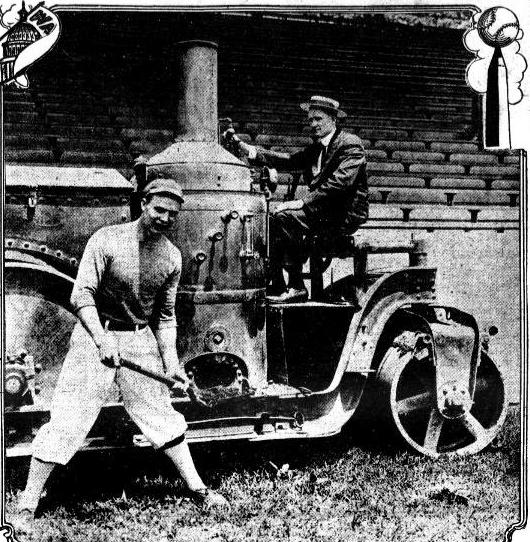
A 1912 publicity photo featuring Walter Johnson at the wheel of a steamroller, and Senators catcher Eddie Ainsmith with the shovel at Griffith Stadium in Washington.  The photo was taken on June 17; the Senators had just returned from Cleveland having won 16 straight games–all on the road.  During the streak, the Senators had gone from 17-21 in sixth place, to 33-21, just one and a half games behind the Boston Red Sox.

The Washington Times said “It was considered an omen of continued triumph” that the steamroller was “found on the grounds.”

The Senators won the following day and continued playing well the rest of the way, finishing 91-61, their first winning season in the team’s 12-year history.  But, it was not good enough to catch the Red Sox who finished 14 games in front.

Johnson had his first of two 30-win seasons, finishing 33-12 with a league-leading 1.39 ERA.

Ainsworth played in the major leagues for 15 years, the first nine with the Senators.  The Washington Post said before the season opener in 1915:

“For the seventh consecutive year Walter Johnson will work in the opening clash for the home folks, and in nearly as many seasons will Eddie Ainsworth be his battery mate.  This pair always work together and no pitcher and catcher in either league are better acquainted when it comes to baseball.”

Eddie Ainsmith

Eddie Ainsmith

Several weeks after Ainsmith was traded to Boston (then to Detroit on the same day) in January of 1919, Louis Dougher a writer for The Washington Times said:

“When Eddie Ainsmith was traded to Detroit via Boston, Clark Griffith shattered on of the crack batteries…it was Johnson and (Charles “Gabby”) Street.  Then when Gabby slowed up and gave way to a successor, it rapidly became Johnson and Ainsmith.”

Age, more than the departure of Ainsmith slowed Johnson down, but he still won 140 games and posted three 20-win seasons after his personal catcher was traded.

Things I Learned on the Way to Looking up other Things #9

18 Jun

The Business of Bats–1896

The Louisville Courier-Journal said in the spring of 1896 that their city “is now conceded to be the bat market of the world.”

That year, J. F. Hillerich & Son, a company that “was in practical obscurity three years ago,” had already “received orders to manufacture 75,000 bats this season.”

(Many sources, including the Louisville Slugger Museum, say the name change from Hillerich Job Turning to Hillerich and Son took place in 1897, but the names “& Son” and “& Son’s” were used in advertisements as early as 1895)

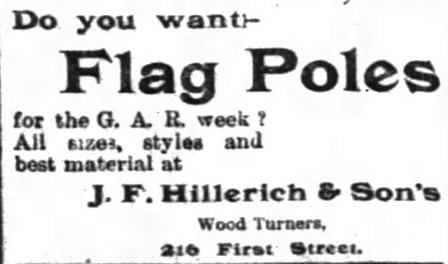
An advertisement for flag poles which appeared in Louisville papers on the eve of the 29th Encampment of the Grand Army of the Republic in September of 1895 shows the company name as J.F. Hillerich & Son's.

An advertisement for flag poles which appeared in Louisville papers on the eve of the 29th Encampment of the Grand Army of the Republic in September of 1895 shows the company name as J.F. Hillerich & Son’s.

“(Hillerich) is known to every ball player of any note in the United States.  A Courier-Journal reporter yesterday afternoon found orders from (Ed) Delehanty of the Philadelphias; (Hugh) Duffy of the Bostons, (Jesse) Burkett of the Clevelands and many other noted batsmen in the little factory at 216 First Street. Eight years ago (James Frederick) Jim Hillerich did not have money enough to buy a wagon load of ash, from which bats are made.  This season his business amounts to more than $50,000 which is done in ball bats alone.

“When a team arrives in the city the first thing the members do is to have a race for this bat factory to select some new ‘sticks.’”

The paper said the company’s output in 1895 had been twice that of 1894 and “The business this year amounts to four times as much as it did last year.”

The ash for Hillerich’s bats was grown in Indiana and Kentucky “and is felled and split by fifty men.  All the bats are hand-turned”

Washington’s Brief Craps Scandal–1891

In June of of 1891 The Washington Herald reported trouble in the ranks of the American Association’s ninth place Washington Statesmen.

The team was playing for their second manager (there would be a total of four that year), the first, Sam Trott had been let go after just 11 games.  The Herald said when Charles “Pop” Snyder was installed in place of Trott “the directors thought they had at last secured a pilot who would successfully carry them through the breakers.”

The team lost 16 of their first 19 games under Snyder and the paper said “steps are being taken to secure a new man to fill Snyder’s place.”

Chief among Snyder’s failing was:

“(W)hen a discovery was made at the grounds by some interested parties.  It was in the morning, and the men should have been practicing in order to better their playing, but instead were found, it is said, engaged in the seductive pursuit of playing ‘crap.'”

The only player the paper named was catcher James “Deacon” McGuire who, at one point during the game was ahead $56.  The Herald quoted an unnamed team official:

“‘We pay them good salaries, from $250 to $350 per month, and they ought to give us good ball.’ observed one director, after exhausting himself in giving expression to some very emphatic language regarding the crap incident.”

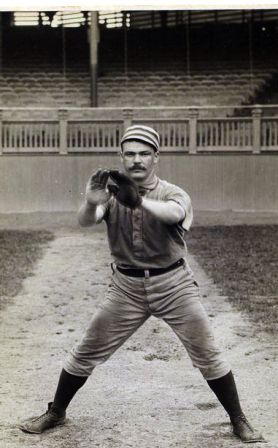
Deacon McGuire

Deacon McGuire

One week later the paper said:

The Herald cheerfully publishes this denial:  Manager Snyder makes a plain statement of the case, to the effect that one morning, the day of the extreme heat, while the men were in the shade, umpire (John) Kerins pulled out the ivories and the men in the spirit of fun went at the game.  It did not last ten minutes and it was the only time it occurred during the season.”

Snyder was replaced as manager a month later by Dan Shannon who fared no better (15-34); he was replaced by Tobias “Sandy” Griffin in October.

 The Reason for Baseball’s “Mania”–1869

The Milwaukee Semi-Weekly Wisconsin editorialized on the growing popularity of baseball in July of 1869:

“A few years ago the game of baseball which every male in the land, perhaps, had played from his youth up, was dignified by being elevated into a ‘national game,’ and set off with printed rules and regulations.  Forthwith the sport became the rage of young and middle-aged, and clubs were formed all over the land.  It was suddenly found that the game was just the thing to develop muscle and invigorate the frames of school boys and men of business, clerks and mechanics, sedentary men and farmers.”

The Associated Press gives with the utmost minuteness the score of every match game–no matter though it may have taken place in the obscurest village of the far east.  Across and up and down the continent these reports go side by side with the most important matters of state, of commerce, of international policy, often times taking up more space than news of the greatest moment.”

The paper asked “What has given this sudden impetus to the ‘national game?’ Is it the result of an increased desire for physical culture?  Is it because men feel more than ever the importance of exercise?  Not at all…There is another reason for the mania.”

That reason was gambling:

“We have nothing to say against baseball or any other sport when carried on simply as a recreation; we approve of them and think they ought to be encouraged; but the trouble is they degenerate into a machine for betting , and thus they become the means of corrupting the morals of the youth.  Americans seem to be rapidly acquiring an appetite for betting…This passion for outside  betting is increasing, and this is the reason why these match games are telegraphed over the country with such minuteness…Men bet on an election or a  baseball match who would not go into a gambling saloon for any consideration.”

The conclusion of the editorial was a foreshadowing of the role of gambling during baseball’s next five decades”

“It may be a comparatively small evil to make or lose five dollars upon some kind of match game, but this is only the beginning of an evil which too frequently grows into a magnitude which cannot always be computed.”


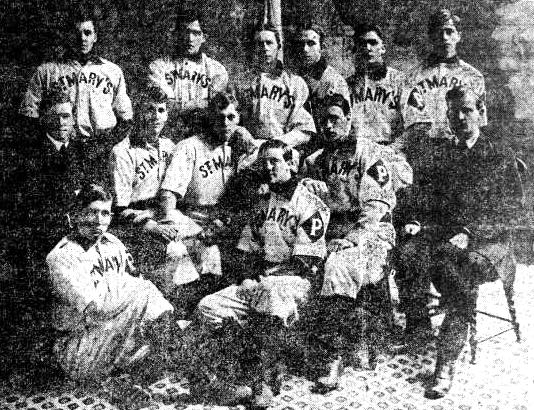
Lost Team Photos–Harry Hooper’s 1907 St. Mary’s College Team

13 Jun

1907stmarypix

Harry Hooper, Hall of Fame outfielder for the Boston Red Sox and Chicago White Sox (standing, far right), with the 1907 St. Mary’s College team.  The team, often called the best  pre-World War I college ballclub, also included pitcher Harry Krause (center, second from left), and catchers Charlie Enwright (center, second from right), and Ed Burns center, middle)–The San Francisco Chronicle referred to the 5′ 10′ Krause and the 5′ 6″ burns as “the midget battery.”

Coach Hal Chase is in the middle row, far left.

After the team’s final game The San Francisco Call said:

“The Phoenix baseball team of St. Mary’s, satisfied that it has conquered the world, has closed its schedule for the season.”

How good were they?

“Perhaps no California team has ever had a more brilliant career than has the 1907 phoenix.  Pitted 27 times against only first class teams, professional and amateurs, it has escaped from the fray without once having to bow to a foe.  Moreover, but 39 runs have been scored against the Phoenix all season, while the Phoenix players have scored 137.  No team made more than four runs on them, and this occurred but three times.  They have had eight shutouts, eight one run games, seven two run victories (and) one three run contest.”


Hooper, left, with Red Sox teammate George "Duffy" Lewis after the 1915 World Series

Hooper, left, with Red Sox teammate George “Duffy” Lewis after the 1915 World Series–the two were also teammates at St. Mary’s in 1906.

Jack Grim

2 Jun

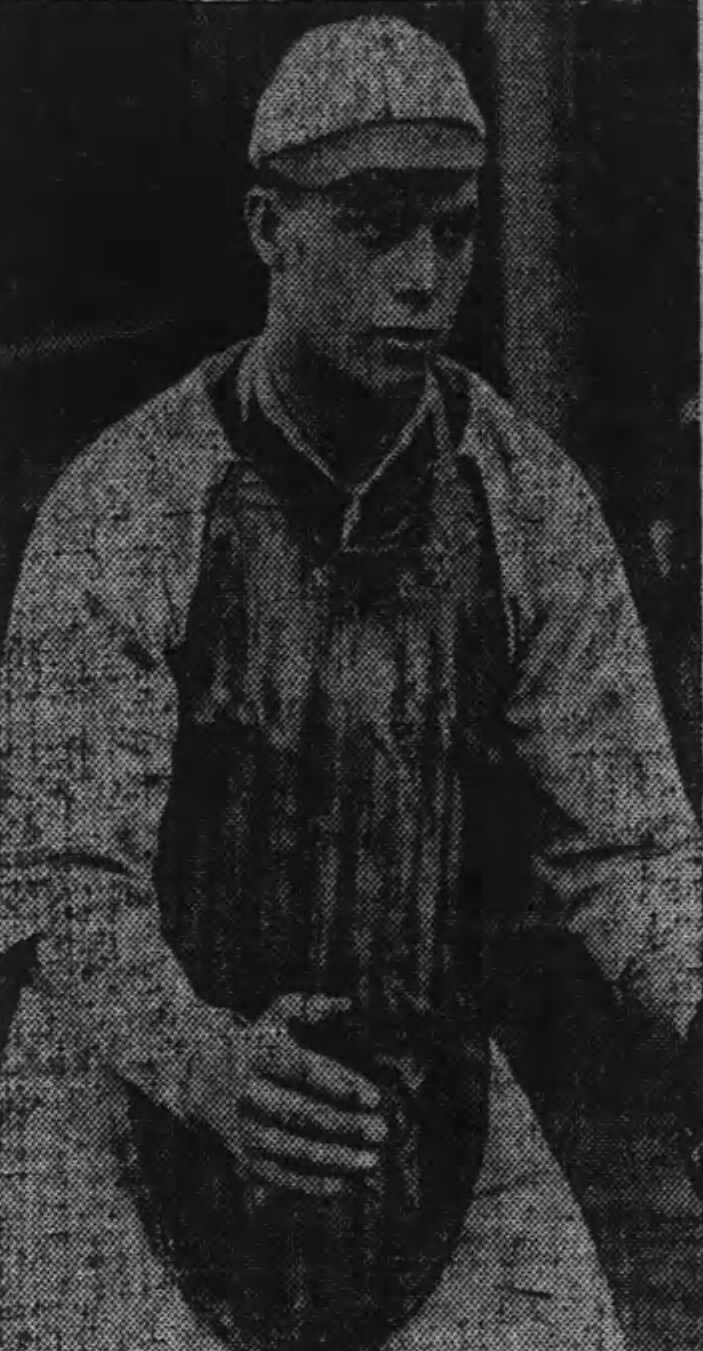
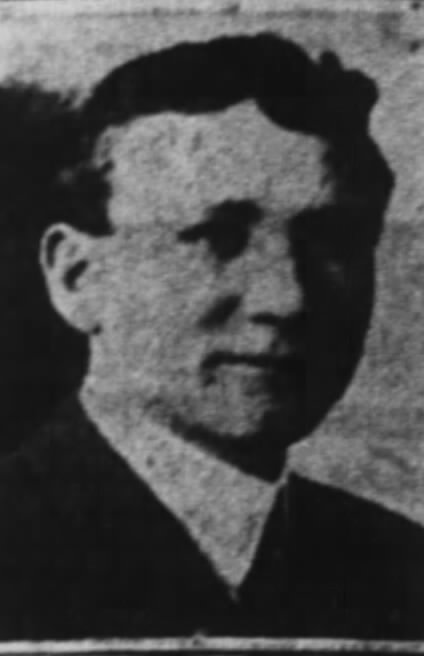
John J. “Jack” Grim never amounted to much as a player.  Statistics are nearly nonexistent for his playing career, and those that do survive are unimpressive; primarily a catcher, he played for all, or parts of nine seasons from 1894 until 1902.  The Cincinnati native made his mark, now all but forgotten, as a manager and executive.
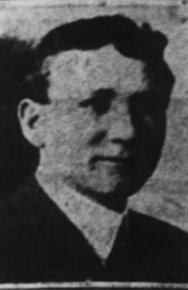
John J. "Jack" Grim

John J. “Jack” Grim

Often confused with former major league catcher John Helm “Jack” Grim—for example, most sources list John H. Grim as the manager of the 1904 Columbia Skyscrapers in the South Atlantic League, it was John J. Grim who managed that team, and during that season might have made his greatest contribution to the game.

Grim’s first managerial appointment was with the Anaconda Serpents in the Montana State League in 1900.  He guided the team to a second-place finish in the first half, and the club was in first place in the second half race on August 11, when Grim abruptly resigned.  The Anaconda Standard said Grim sent a letter to the team directors in which he charged “there is a feeling in certain quarters, against me.” He said:

“I cannot do myself justice while laboring under these conditions.”

Arthur “Dad” Clarkson, brother of Hall of Famer John Clarkson, replaced Grim; the team finished the second half of the season in second place under Clarkson.  Grim became an umpire in the league for the remainder of the season.

In 1901 Grim went to the West Coast with William H. Lucas, a former minor league pitcher who had been president of the Montana State League, to join Dan Dugdale to reestablish  the Pacific Northwest League; Lucas served as league president and Grim managed the Portland Webfoots to the championship, winning the pennant by 16 games.

The league expanded from four to six teams for 1902, and Grim was hired to manage the Spokane franchise, which had finished in last place (41-67) under three different managers in 1901.  The Sporting News said:

“(Spokane’s) stockholders have given (Grim) full power to act in signing players.”

The Sporting Life said Spokane fans were “feeling confident that (Grim) will this year sustain his reputation for always piloting winners.”  Despite the free reign, and high hopes, Spokane struggled, finishing in last place with a 46-75 record.

The following season, as a result of the West Coast baseball war—the California League expanded to the Pacific Northwest, becoming the Pacific Coast League—the Pacific Northwest League expanded into California and became the Pacific National League.  Grim managed the Portland Green Gages.

On July 1 the Portland franchised was, according to, The Oregon Journal “transferred bag and baggage to Salt Lake City.” In Salt Lake City Grim quickly wore out his welcome.

After it was reported in late July that Grim might be let go, six players, including the team’s star shortstop Charles “She” Donahue, went on strike.  They missed two games, but returned after the team’s president said: “he has no intention of letting Grim out.”  The harmony didn’t last and just weeks later Grim was released and fined $100 for what The Salt Lake Herald called “starting a mutiny within the ranks of the club.”

The trouble in Salt Lake wasn’t over.  Near the end of the season, Donahue’s contract was sold to the St. Louis Cardinals.  The sale was reportedly engineered by Grim after he was let go as manager.

The Herald said:

“What kind of a con game is Jack Grim trying to work on the Salt Lake ball club?  What right had Jack Grim, who was fired…got to sell Donahue to the St. Louis club?  How many more of the Salt Lake’s players is Grim trying to dispose of in the same way?  What did Grim do with the money he received from (Cardinals President Benjamin) Muckenfuss of the St. Louis team?”

Grim told The Cincinnati Enquirer he entered into negotiations with the Cardinals over Donahue on September 14. But The Herald noted:

“At that time Grim’s sole business in Salt Lake was to hang around with the ballplayers and try his best to create discord among them.  He had been fired long before.”

The National Commission ruled the sale/signing legal.  Garry Herrmann, chairman of the commission, said that in the contract he signed with Portland for 1903 “Donahue had a specified agreement that he was not (placed on the reserve list)” despite the fact that the Salt Lake team claimed he had already signed a contract for the following season.  As a result, there was nothing stopping Grim from delivering Donahue to the Cardinals, and the money he received—the amount was never reported—was his.

Grim was again involved in a new league in 1904, when he and fellow Cincinnati native Ed Ashenbach, helped form the first incarnation of the South Atlantic League—Grim managed the Columbia Sky Scrapers and Ashenbach managed the Charleston Sea Gulls in the six-team circuit.  Grim only lasted until mid-July as manager and finished the year as an umpire in the league.

It was that season that that he claimed he made his great contribution to the game.  According to Grim, he was the first person to alert the Detroit Tigers about a 17-year-old outfielder for the Augusta Tourists named Tyrus Raymond Cobb.

While Cobb was not sold to the Tigers until August of 1905, some credence for the claim was provided by Cobb himself in 1910, when an article appearing under his name—likely ghostwritten by Roger Tidden of The New York World—said Grim had tried to purchase his contract when he was struggling at Augusta, shortly after “I left home to show up the league.”

In 1905 Grim was one of the principal organizers of the Virginia-North Carolina League and managed the Greensboro Farmers—Grim lasted less than half a season and by August The Sporting Life said he was scouting for the Cincinnati Reds.

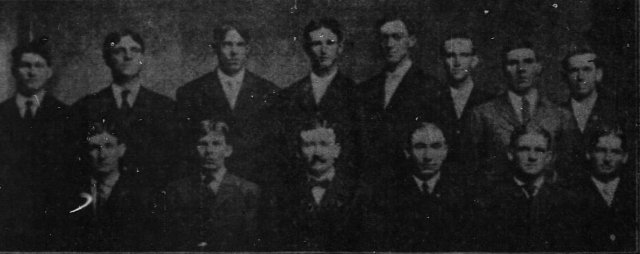
Grim finally found some stability in 1906.  He again helped found a league and owned and managed a club.  Grim’s Lynchburg Shoemakers won the Virginia League pennant in 1906—the team was led by pitcher Walter Moser (24-8), who would make the jump from the C-league Shoemakers to the Philadelphia Phillies in August.   But after a fifth-place finish and 1907, and a slow start the next season, Grim sold the team in July of 1908.
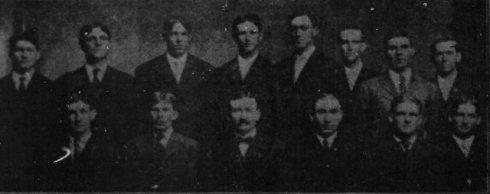
1906 Lynchburg Shoemakers, Virginia League champions. Grim is third from left on the bottom row.

1906 Lynchburg Shoemakers, Virginia League champions. Grim is third from left on the bottom row.

Just after selling the team, Grim’s wife reported him missing.  She told police in Louisville, Kentucky that she hadn’t heard from him for three weeks and thought he might be in Louisville after visiting family in Cincinnati.  Al Orth, the New York Highlanders pitcher, said he saw Grim in New York and told The Associated Press “He did not look like a man who was missing from anywhere.”
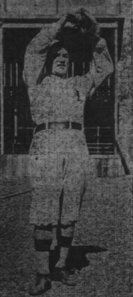
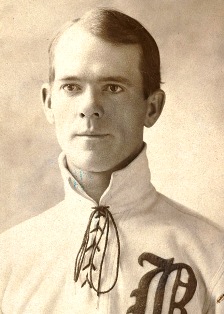
Al Orth

Al Orth


Grim eventually returned to Virginia and his disappearance was never explained.  Orth, who was from Lynchburg, returned there later that summer purchased an interest in the team and managed the club until early 1909 when he returned to the Highlanders.

For the next four years Grim bounced back and forth from team ownership (he managed, and owned part of two more Virginia League franchises (Portsmouth in 1910 and Newport News in 1912) and real estate speculating on the West Coast and in Virginia.

At the beginning of the 1912 season a small item in The Richmond Times-Dispatch hinted that there was trouble ahead:

“Jack Grim has a combination of troubles.  One is of the financial variety—well the other is nobody’s business.”

The financial troubles came to a head in August.  The Times-Dispatch said:

 “Because Manager J.J. Grim would not pay their salaries, all of the players of the Newport News baseball club except (Frank) ‘Deacon’ Morrissey, struck just before the scheduled double header between Newport News and Petersburg.”

After the game was awarded to Petersburg by forfeit, Grim’s co-owners removed him—outfielder William “Buck” Hooker was named manager for the remainder of the season.

At the end of the 1912 season, Grim found himself in an odd predicament.  The Cincinnati Enquirer said:

“Though minus a franchise, Jack Grim, formerly of Cincinnati, has a ball team under reservation, for he owns title to the players of the Newport News club…It develops that in the adjustment of the club’s affairs in August, Grim who was manager and part owner, got out without losing title to the players, though he lost the franchise.”

As a result, when the Cleveland Naps drafted third baseman Ray Bates from Newport News after the 1912 season, the draft price went to Grim.

It was the last good thing to happen to him; from there, Grim’s life spun out of control.

In October, he attended the World Series in New York (his wife later said he attempted to kill her during that trip).

In November of 1912 the Virginia League turned down his attempt to secure a franchise for 1913; next his effort to start a new league with teams in Virginia and the Carolinas fell through.

In addition to being unable to secure a franchise and running out of money—an effort to secure the New York-New Jersey League franchise in Kingston, New York also fell through–Grim’s wife had him arrested  during the first week of March 1913, and told a Lynchburg judge he had repeatedly “threatened Mrs. Grim with bodily harm.”  Grim was held in jail, but according to The Times-Dispatch “is doing everything possible to effect a reconciliation with his wife.”

Grim was released on bond after a week, but quickly rearrested, and by March 23 The Times Dispatch said:

“That a commission of lunacy will be summoned early this week to investigate the Sanity of john J. Grim, the well-known minor league baseball magnate , seems now to be a foregone conclusion…Since his incarceration Grim’s condition has grown so bad that there is no doubt in the minds of the jail attaches that he is insane…Grim has not had his clothes off in a week, and he spends his time in his cell singing, shouting, talking and pacing up and down, begging to be liberated.”

The “commission of lunacy” found Grim insane based on the testimony of Grim’s wife and a doctor named Albert Priddy, and ordered him sent to Virginia’s Southwestern State Hospital in Marion.  It was in front of the commission that Mrs. Grim related the story of the “attempt to murder her with a razor in New York City.”
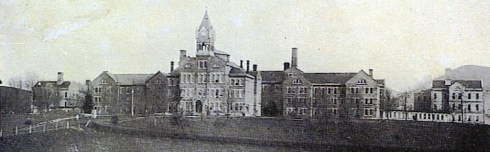
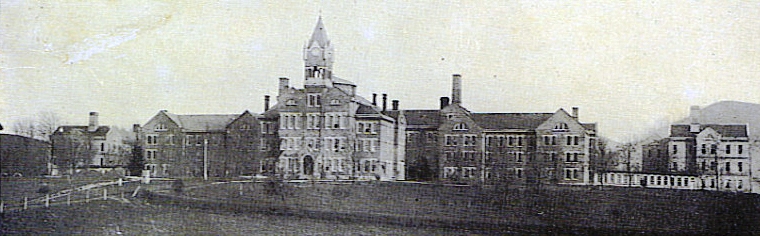
Southwest State Hospital, Marion, Virginia

Southwest State Hospital, Marion, Virginia

Contradictory reports about Grim’s condition came out during the next year.  The Associated Press said in August Grim was “A raving maniac…not far from death.”  A December story in The Cincinnati Enquirer said “he is improving rapidly and probably will be discharged at an early date…Grim expects to return to Cincinnati.”

Almost a year later, he was still in the hospital, and The Enquirer reported that “Grim is improving in health and expects to visit his Cincinnati friends soon.”

That item was the last newspaper reference to Grim; he was never released and died in the state hospital.

The doctor who testified that Grim was insane, Albert Sidney Priddy, was superintendent of the Virginia State Colony for Epileptics and Feebleminded in Madison Heights, Virginia.  The doctor, and that institution became infamous in the case of Buck v. Bell (the case was Buck v. Priddy until Priddy’s death in 1925; Bell was his successor at the State Colony).  The Supreme Court’s decision in the case–upholding the Virginia’s compulsory sterilization law– resulted in the forced sterilization of more than United States citizens in Virginia and states that enacted similar laws.

“I was Large and McCarthy was Quick Tempered”

16 May

In 1912, Pennsylvania Governor and former major league pitcher John Tener, told William Phelon of The Cincinnati Times-Star about how a minor league team made a payroll during his playing days.

John Tener

John Tener

 “Such a thing as one day’s pay wouldn’t exactly break or worry me, that is wouldn’t worry me know, and it has been some years since I have had occasion to fret about losing one day’s wages.  Yet believe me there was once a time when I was robbed of one day’s salary, and that one day’s salary seemed to John K. Tener, as big as the First National Bank to the average young clerk at the present time.  And—just to show what strange things happen in this world—the man who took away John K. Tener’s poor little one day’s pay was in the after years Justice (William Henry) Moody, of the (United States) supreme court bench—that’s how life really happens in this republic of ours, and, I’m sure, the one day’s pay he saved on me looked as big to him right then as half a million did a few years subsequently.

“It was long, long ago when the world was very young, and I was a pitcher for the Haverhill team (1885) Tommy McCarthy, who afterwards grew so renowned as one of the headiest players of the champion Bostons, was one of the Haverhill outfielders, and Justice Moody was one of the chief officials of the Haverhill club.  The season was drawing to a close, the Haverhill team was losing money, and it seemed doubtful whether the exchequer could be so replenished that everybody would get what was coming to him at the final settlement.

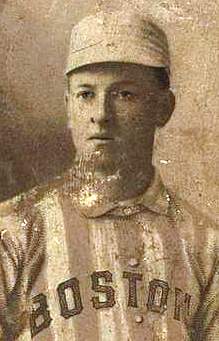
Tommy McCarthy

Tommy McCarthy

“The days ran along and finally but one more day remained.  That night the stockholders of the club held a meeting, inspected the books, and did some great figuring as to ways and means.  Towards 11 o’clock, they found that they would lack only a few dollars of enough to settle up—but where were they going to find those few dollars?  That was the question, and they were debating on passing the hat when a great thought struck Mr. Moody.  ‘Gentlemen,’ he said, ‘I have it!  Upstairs, in the hotel, our two highest salaried players, Tener and McCarthy, are now asleep.  If we could save one day out of their wages we would have just enough to see us through.  Let’s release them and save tomorrow’s salaries.

“The stockholders carried the suggestion by acclamation, and releases were duly carried out.  Then a glance at the clock showed it was 11:30.  In half an hour or more it would be too late—a new day would begin, and we would have to have our full day’s pay.  Mr. Moody was deputed to bring us the news—which was considered a ticklish task, as I was large and McCarthy was quick tempered.  Somewhat bashfully, he came upstairs, woke us up, and gracefully handed us our releases.  Then he fled before Tom and I could get our heads clear and realize the situation.

“And, believe me, in those days I was so short of money that it just about broke my heart to lose that one day’s pay.  But I had to lose it, just the same, and Mr. Moody was the winner.  Did I ever get it back?  Not the money I didn’t—but I have often made Justice Moody buy enough good wine to pay for that several times over.”

Tener served in the United States House of Representatives, was Governor of Pennsylvania and President of the National League, but his short career as a player remained important to him.  A story made the rounds in many newspapers (although at least a decade after he left office) that when signing a bill into law while governor, a legislator said:

“Governor Tener, I think that’s one of the best things you ever did.”

Tener was said to have replied:

“You’ve got it all wrong–I once shut out the Giants.”

On his 81st birthday, July 25, 1944, The Associated Press asked about the “move to get Tener’s name added to the roll of immortals in Baseball’s Hall of Fame.”  Tener, and another former National League President, John Heydler had been an early and ardent supporter of the establishment of the Hall of Fame.

“(Tener) laughs that off.  ‘I don’t belong there.'”