Tag Archives: Honus Wagner

Lost Advertisements–Hans Wagner Says!!!

11 Oct

hans


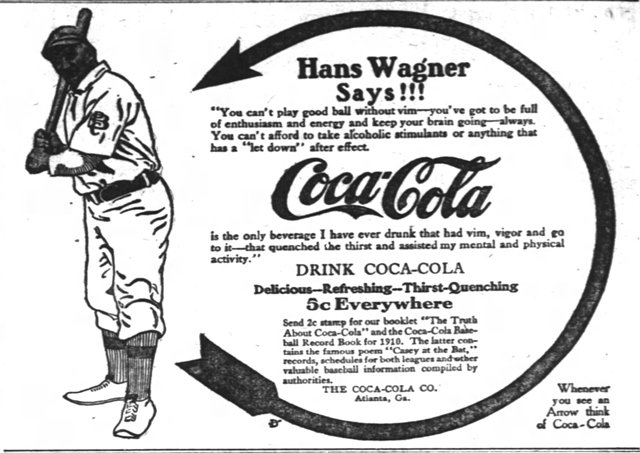
A 1910 advertisement for Coca-Cola featuring Honus Wagner (a 1908 Wagner Coke ad was featured in an earlier post).

You can’t play good ball without vim–you’ve got to be full of enthusiasm and energy and keep your brain going–always.

You can’t afford to take alcoholic  stimulants or anything that has a “let-down” after effect.

Coca-cola

is the only beverage I have ever drunk that had vim, vigor and go to it–that quenched the thirst and assisted my mental and physical activity.

Page Fence Giants

30 Sep

The Page Fence Giants would become one of the great early teams in black baseball; some sources say they played 156 games, winning 118 their first year.  But things did not go well in their first game.

Organized by John “Bud” Fowler and Grant “Home Run” Johnson, the team represented the Adrian, Michigan-based Page Woven Wire Fence Company; at the time the nation’s largest fence company;  Augustus “Gus” Parsons served as the team’s business manager and scheduled their games (he’s often misidentified as the team’s manager).

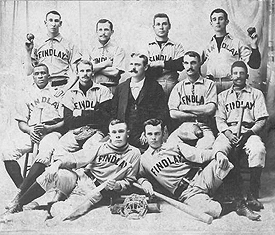
Grant "Home Run" Johnson, left center row and John "Bud" Fowler, right center row, with the independent Findley (OH) Sluggers in 1894.

Grant “Home Run” Johnson, left center row and John “Bud” Fowler, right center row, with the independent Findley (OH) Sluggers in 1894.

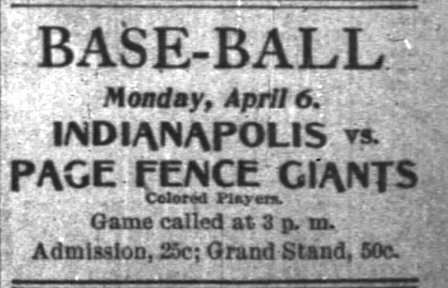
Their first game was scheduled for April 10 against the Western League’s Indianapolis Hoosiers.

The Indianapolis News said of the Giants:

“Besides playing ball they perform feats of tumbling, and there is a quartet among them that sings between innings.”

The team also would arrive in towns riding bicycles in parade formation (the Giants’ other sponsor was the Monarch Bicycle Company).

While they often played for mostly white crowds The News said the stands “were very nearly peopled” with black fans; they did not get the show they had hoped for:

“In the first inning the Indianapolis team had fourteen men to bat and scored eight runs.  It seemed evident that one more inning of slaughter like the first would precipitate a race riot, and President (and manager William “Bill”) Watkins diplomatically let up.  The ease with which Indianapolis did everything it wanted to, and the “rough deal” the colored team received at the hands of umpire Andrews conspired to make the score look like the original report of the Armenian massacre…The one-sided score, which misrepresents both teams as far as figures are concerned.”

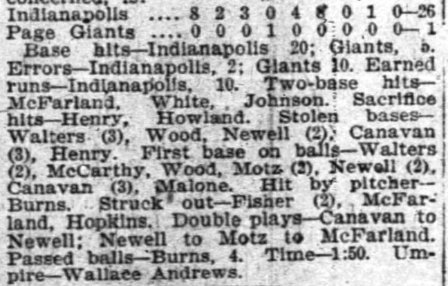
Page Fence lost 26-1.

The Box Score

The Box Score

They also lost two games against the Cincinnati Reds, then lost Fowler and pitcher George Wilson to the Adrian Reformers in the Michigan State League (where they were teammates of Honus Wagner).

The Giants returned to Indianapolis in 1896, losing 16-3 to the Hoosiers

The Giants returned to Indianapolis in 1896, losing 16-3 to the Hoosiers

Despite their first game, the Giants continued drawing crowds and winning games until they disbanded in 1898—with most of the players joining the newly formed Chicago Columbia Giants.

“Another Phil Pitcher was Sacrificed on the altar of a Futile Attack”

6 Aug

When George Chalmers returned from Cuba with the Philadelphia Phillies in November of 1911 he wasn’t the same pitcher.

After pitching the first game of the series against Almendares and the great Cuban pitcher Jose Mendez, Chalmers saw little action in the final eight games.

While training in Hot Springs, Arkansas in the spring of 1912 it became clear that Chalmers’ shoulder was in bad shape.  The Philadelphia Inquirer said he was sent from Hot Springs to Youngstown, Ohio to “visit ‘Bonesetter’ Reese.” (John D. Reese was a Welsh-born “practitioner of alternative medicine.” The  “self trained”  Reese was, according to The Pittsburgh Press, visited by many of baseball’s biggest stars, including Frank Chance, Ty Cobb, Honus Wagner, and John McGraw.  At the same time he was condemned by Ohio physicians who said there was no evidence of Reese “curing a single case where there was actual fracture or displacement of bone.”)

The famous “Bonesetter” was unable to do anything for Chalmers.  The Wilkes-Barre Times-Leader said in April:

“It is reported on good authority that Chalmers, one of the Phillies star pitchers, will be unable to deliver the goods this season owing to the condition of his pitching arm.”

As a result of the injury Chalmers only appeared in 12 games in 1912, with a 3-4 record, and didn’t pitch at all from July 5 until September 4.   At the end of the season Phillies owner Horace Fogel, who would soon find himself chased out of the game, used Chalmers’ injury to suggest a change in how pitchers were paid.  According to The Philadelphia Bulletin:Ho

“Horace wants to employ pitchers on the percentage basis, paying them so much per game—no game, no pay.

“The Phillies President conceived the idea after he had figured that it had cost him an average of $800 per game for the few games pitched by George Chalmers during the present season.”
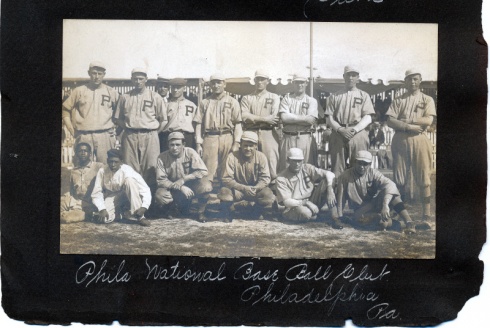
Phillies team photo from George Chalmers personal collection--appears to be the 1912 team.

Team photo from George Chalmers’ personal collection

The $800 per game figure was clearly wrong—Chalmers would have not earned anywhere near $9600 for the 1912 season (Christy Mathewson made between $8000 and $9000), Chalmers and “Pete” Alexander both probably made less than $3000.  It is doubtful Fogel’s plan would have gone anywhere had he remained president of the Phillies.

The following season was no better; with no improvement to the injured shoulder, Chalmers appeared in 26 games, 15 as a starter, and was 3-10 with 4.81 ERA.  It got so bad that after a loss near the end of the season The Wilkes-Barre Times-Leader said:

“Our old friend ‘Dut’ Chalmers got another trimming yesterday.  It has gotten to be such a regular thing for Chalmers to be beaten that he doesn’t mind it anymore.”

Two of the Phillies best pitchers in 1913, Tom Seaton (27-12), and Addison “Ad” Brennan (14-12) jumped to the Federal League, making Chalmers and his injured shoulder even more critical to the Phillies hopes for 1914.

In March The Philadelphia Inquirer said Chalmers had spent the winter in Hot Springs rehabilitating his shoulder and appeared “to be in splendid shape,” when he reported to spring training in Wilmington, North Carolina, and “(Charles “Red”) Dooin is thanking his lucky stars that Chalmers is in camp.”

The season turned out to be Chalmers’ worst.  He pitched in three games, losing all three with an ERA of 5.50, and he Phillies released him on June 22.  The Inquirer said his shoulder had never healed and attributed the injury to “rheumatism and a misplaced muscle.”

George "Dut" Chalmers

George “Dut” Chalmers

The Pittsburgh Press said:

“The frailty of baseball life and the quickness with which a career in the big show may be ruined are shown again in the case of George Chalmers…Chalmers may recover and come back some time, but it is doubtful, and his going marks the untimely end of a career that promised to be one of the most brilliant in baseball pitching history.”

According to The Inquirer, he was not yet ready for the end:

“Chalmers…had mighty little money, about $400 in all, and his best friends advised him to stick the little old four hundred into some good business and forget baseball…Good doctors had told George that his arm was gone.  Other pitchers, real friends of the Phillies star, had told him the same thing…Then he heard of a specialist in New York who had done a great job on another pitcher’s arm which had seemed to be gone (no articles mentioned the name of the specialist or the other pitcher).”

With his arm seemingly better, Chalmers was invited to spring training with John McGraw’s New York Giants in Marlin, Texas.  The New York Mail said “he looked good at Marlin,” but the Giants let him go before the season began.  On April 20 he was signed again by the Phillies, and sent out to pitch the next day.  The Inquirer said:

 “George Chalmers, once a Philly discard and lately spurned by the Giants, with whom he trained during the spring trip to the Southland, was the hero of today’s festive occasion for Philadelphia.  Chalmers had been without a big league contract and he was signed by (manager Pat) Moran only yesterday.  But he gave him a quick trial by shunting him at the Giants, and he showed his gratitude to the Quaker boss by pitching the best game of his career.”

Chalmers gave up only two hits and beat the Giants 6-1.

As the Phillies fifth starter in 1915 he was 8-9 with a 2.48 ERA, appearing in 26 games.  Jack Kofoed, a sportswriter for The Philadelphia Record said in “Baseball Magazine”that Chalmers’ record did not reflect how well he pitched:

“Throughout the season Chalmers twirled splendid ball, but played in tougher luck than any man on the Philly staff.  Had fate been as kind to him as to Al Demaree (14-11 3.05 ERA) , for instance, he would have won twice the number of games he did.  But the Phillies played more weird ball behind him than in back of any man on the staff.”

The Phillies won the National League pennant, and met the Boston Red Sox in the World Series.  With Philadelphia down two games to one, Chalmers was Moran’s choice to pitch game four in Boston.

Facing Ernie Shore, who won 19 games for the Red Sox, Chalmers pitched well, but lost 2-1 (the same score of Philadelphia’s losses Geo 2 and 3); The Inquirer said:

“Another Phil pitcher was sacrificed on the altar of a futile attack…through the futile efforts of his companions to obtain for him even the slender margin that was all he required.”

The Red Sox beat the Phillies four games to one.

In November of 1915 several Pennsylvania papers said Chalmers had used his “World Series coin as a matrimonial nest egg.”

The following season was his last.  The shoulder injury returned and the Phillies only used Chalmers in 12 games, he was 1-4 with a 3.19 ERA.  He did not appear in a game after August 7, and was released at the end of the season.  After an unsuccessful attempt to catch on with the Kansas City Blues in the American Association in 1917 Chalmers career was over before his 29th birthday.

In the waning days of his career, The Wilkes-Barre Times-Leader said:

“’Dut,’ as George is called by his playmates is a fine, upstanding, intelligent young fellow, with all the sturdy Scotch virtues as well as a Scotch burr in his speech, and whether or not he lasts in baseball he is very likely to be successful in life.”

Chalmers retired to New York and died in the Bronx in 1960.

Special thanks to Karen Weiss, George Chalmers’ great niece, for generously providing copies of photos from Mr. Chalmers’ scrapbook.

Hap Myers

29 Jul

When the 6’ 3” 175 pound Ralph Edward “Hap” Myers was let go by the Boston Braves after the 1913 season a reporter told Braves shortstop Rabbit Maranville he was sorry to see Myers go.  Maranville joked:

“Well, you might be, but I’m not.  Do you know that guy is so thin that every time I picked up a grounder I had to shade my eyes with my gloved hand to locate him before throwing the ball.”

Myers began his professional career after graduating from University of California, Berkeley in 1909, where he also played baseball.  The San Francisco native hit a combined .311 playing for the Sacramento Sacts in the Pacific Coast League, and the San Jose Prune Pickers and Santa Cruz Sand Crabs in the California League.

Myers went east in 1910 after being purchased by the Boston Red Sox, but became ill, with scarlet fever, and as a result appeared in only six games in Boston before being  sent first to the Toronto Maple leafs in the Eastern league, then the Louisville Colonels in the American Association.

Despite hitting just .240 with Louisville, Myers was selected by the St. Louis Browns in the Rule 5 draft.  The Red Sox claimed Myers still belonged to them and his contract was awarded to Boston, where he began the season, was sold to the St. Louis Browns, who quickly released him despite hitting .297 in 11 games, then back to the Red Sox where he hit .368 in twelve games before being sent to the Jersey City Skeeters in the Eastern League.

It was never clear why, in spite of hitting .333 in 81 at bats in 1910-1911, Myers couldn’t stick in the American League.

In 1912 he returned to the West Coast to play for the Spokane Indians in the Northwestern League where he led the league in hits, and runs, hit .328, and led all of professional baseball with 116 stolen bases.  The Portland Oregonian said:

“Myers base stealing smashes any previous performance in Northwestern League history.  You have to go back 20 years in official guide books to find any record to compare…and that includes every league in organized baseball.”

Spokane owner Joe Cohn went overboard in his praise of Myers in The Spokane Spokesman-Review:

“Best ballplayer in the Northwestern League by a long shot.  He is the greatest ballplayer I ever saw.  Boy I tell you this Myers is a wonder.  Ty Cobb, Hans Wagner, Tris Speaker and all of them have nothing on Myers…I think Myers has it on Cobb, Wagner, Lajoie, Jackson and the whole bunch.”

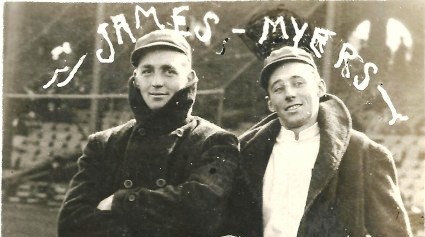
Myers, and Portland catcher Rex DeVogt were purchased by the Braves from Portland, Devogt would only last for three games, and six hitless at-bats in April of 1913.  Myers would become the Braves starting first baseman.  Another Pacific Coast League player, pitcher “Seattle Bill” James also joined the Braves.

hap3

“Seattle Bill” James and “Hap” Myers

Myers got off to a slow start; he was hitting just .224 in early July, but was leading the National League in steals.  An article in The Tacoma Times said:

“When Hap Myers, recruit first baseman of the Boston Braves is in full stride stealing bases, he covers nine feet…the average stride of a sprinter is six feet. “

The article said the average player took 13 steps, roughly seven feet per step, between bases but Myers took only ten steps:

“Myers is something of a baseball curiosity, and his work is watched with interest by the fans.  If the time comes that the big fellow climbs into the .300 class as a batter, he is apt to become a veritable terror of the paths.”

He was also said to use “a bat of unusual length,” but the size was never mentioned.

After the slow start, Myers hit well in the second half of the season, ending with a .273 average and 57 stolen bases (second to Max Carey of the Pittsburgh Pirates who stole 61).  Despite his strong finish, Myers was replaced at first base for 22 games in August and September by Butch Schmidt, who was purchased from the Rochester Hustlers in the International League.

"Hap" Myers

“Hap” Myers

At the end of the season Myers was sold to the Hustlers, the deal was, in effect, a trade for Schmidt.  The Boston press simply said Myers did not get along with manager George Stallings; Myers told a reporter in San Francisco that there was another reason; baseball’s labor unrest:

  “I was assigned by the fraternity to get as many Braves as possible into the fraternity, and succeeded in enrolling nearly the entire team.  The powers that be evidently didn’t relish my actions for soon my every move began to bring calldowns and I was not surprised to read in the newspapers a little later that I had been sent to Rochester.”

Myers jumped Rochester to join the Federal League; his signing was reported months before he actually signed.  The Associated Press said in March of 1914:

“Although it has been generally understood that Hap Myers, last season’s first baseman of the Boston National has been under a Federal League contract for some time, the elongated first sacker did not put his name to a contract until yesterday afternoon.  Myers originally expected to play with Larry Schlafly on the Buffalo Federals, but was transferred to Brooklyn, and seemed altogether pleased with the move.”

Myers got off to a strong start, and The Sporting Life said:

“Brooklyn fans cannot understand why Hap was passed out of the National League. They have had a chance already to give his successor at first base on the Boston team (Butch Schmidt) the once over, and the general opinion is that- Hap Myers “lays all over.”

His success in Brooklyn didn’t last; in 92 games Myers hit just .220.

Hap’s story continued tomorrow.

“Is the Best the Game has Known”

23 Jul

Joining the Boston Braves for the 1914 season provided second baseman Johnny Evers with the opportunity to appear in one more World Series, and gave him the chance to take a very public swipe at one of his most famous former teammates, shortstop Joe Tinker.

In December of 1912 the Chicago Cubs traded Tinker to the Cincinnati Reds, and depending on which version of the story was to believed, Tinker and Evers had not spoken a word to one another for either five or six years.

Johnny Evers

Johnny Evers

Tinker said the two stopped talking in 1908 after Evers jumped in a horse-drawn cab leaving Tinker and other teammates behind before an exhibition game in Indiana leading to an on-field fight between the two later that day; Evers said a year earlier Tinker initiated the bad blood between the two by throwing a ball so hard to the second baseman on a force play that it injured his finger.

Evers said years later:

“I yelled to him, you so-and-so. He laughed. That’s the last word we had for-well, I just don’t know how long.”

The 1914 Braves got off to a horrible 4-18 start, and were still in eighth place on July 18, but surged to second place by August 10, winning 18 of 21 games.  By September 2 the Braves had first place to themselves, and ended up running away with the pennant, beating the second place New York Giants by 10 ½ games, and sweeping Connie Mack’s Philadelphia Athletics in the World Series.

Evers, named Boston’s captain by manager George Stallings, led National League second basemen in fielding; hit .279 for the season, and .438 in the World Series.  Evers received baseball’s last “Chalmers Award,” a forerunner of the Most Valuable Player Award, which was presented from 1911-1914.  The award was sponsored by the Chalmers Motor Car Company and was presented to Evers along with a new car.

The runner-up for the Chalmers Award was Evers’ teammate, shortstop Walter James Vincent “Rabbit” Maranville.  Maranville, Evers and first baseman Charles “Butch” Schmidt were an excellent double-play combination throughout the season; Evers participated in a career-high 73 twin killings, more than he’s ever turned in a season with Tinker and Frank Chance.

Years later Maranville said of Evers:

“It was just Death Valley, whoever hit a ball down our way.  Evers with his brains taught me more baseball than I ever dreamed about.  He was psychic.  He could sense where a player was going to hit if the pitcher threw the ball where he was supposed to.”

Two days after the Braves won the World Series; Evers took the opportunity to take a swipe at his former teammate Tinker.  Evers told William Peet, sportswriter for The Boston Post that:

“(Maranville’s) the best shortstop the game has ever known.

“Better than Joe Tinker; your old side partner?

“Yes, he’s better than Tinker.”

Joe Tinker

Joe Tinker

Peet sad:

“Evers has been given credit for making Maranville the great player he has shown himself to be this season, but Johnny declares this s untrue, stating that Maranville learned the game and all its fine points unaided.”

Peet said Evers’ claim that Maranville “is a greater shortstop than Tinker is about the highest praise anyone can shower on the peppery little chap who was such a prominent factor n the Braves’ victory.”

Rabbit Maranville

Rabbit Maranville

Evers and Peet failed to mention where Honus Wagner would be ranked if Maranville was, in fact, “the best shortstop the game has ever known.”

No response from Tinker was recorded.

Evers and Tinker would not speak again for another decade.  In 1924, the two finally spoke when they were summoned to California by Chance, their former teammate and manager, who was dying.

Tinker, Evers and Chance

Tinker, Evers and Chance

Tinker, Evers and Chance were inducted into the Hall of Fame together in 1946 by the veterans committee; Maranville was elected by the Baseball Writers Association of America in 1954.

“The Worst Bone Play Ever Made in Baseball”

16 May

The Pacific Coast League pioneer and all-star self-promoter Mique Fisher spent his later years as a near-constant source of material for west Coast sports writers.

In 1937 William Lair Hill Gregory, who wrote for The Portland Oregonian for nearly 60 years wrote about a play in 1904 that Fisher called “the worst bone play ever made in baseball;” it involved pitcher James Marcellin St. Vrain, and happened when Fisher was managing the Tacoma Tigers to a pennant; winning both halves of the 1904 Pacific Coast League season:

“On the Tigers was a southpaw pitcher named Jimmy St. Vrain.  In a close game one day, St. Vrain singled and with two outs was on second.  The batter lashed a line drive out of the shortstop’s reach, but right over St. Vrain’s head.

“’What did that left-hander do when he should have been scoring the winning run,’ complains Mique, ‘but reach up and catch the ball! Of course he was out…hit by a batted ball.’”

Jim St. Vrain

Jim St. Vrain

St. Vrain is also known for another boneheaded play alleged to have happened during his brief, 12-game career as a pitcher for the Chicago Orphans.  The story was first told The Detroit Free Press in 1906 by Tigers outfielder Davy Jones, who had been St. Vrain’s teammate in Chicago; Jones later told the same story to Lawrence Ritter in the great baseball book “The Glory of Their Times.”  The version in the book—aided by another 50-years of telling the story, and more colorful—is included below.

 “He was a left-handed pitcher and a right-handed batter. But an absolutely terrible hitter — never even got a loud foul off anybody.

“Well, one day we were playing the Pittsburgh Pirates and Jimmy was pitching for us. The first two times he went up to bat that day he looked simply awful. So when he came back after striking out the second time Frank Selee, our manager, said, “Jimmy, you’re a left-handed pitcher, why don’t you turn around and bat from the left side, too? Why not try it?”

“Actually, Frank was half-kidding, but Jimmy took him seriously. So the next time he went up he batted left-handed. Turned around and stood on the opposite side of the plate from where he was used to, you know.  And darned if he didn’t actually hit the ball. He tapped a slow roller down to Honus Wagner at shortstop and took off as fast as he could go … but instead of running to first base, he headed for third!

“Oh, my God! What bedlam!  Everybody yelling and screaming at poor Jimmy as he raced to third base, head down, spikes flying, determined to get there ahead of the throw. Later on, Honus told us that as a matter of fact, he almost did throw the ball to third.

“‘I’m standing there with the ball in my hand,” Honus said, looking at this guy running from home to third, and for an instant there I swear I didn’t know where to throw the damn ball. And when I finally did throw to first, I wasn’t at all sure it was the right thing to do!'”

Davy Jones

Davy Jones

Crazy Schmit Stories

13 May

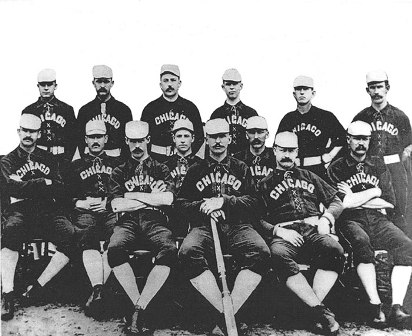
Fred “Crazy” Schmit was widely considered to be the first pitcher to keep a “book” on hitters, it was mostly attributed to his poor memory, and the pitcher kept an actual book in his pocket listing the weakness of each hitter.  The earliest reference to Schmit’s book was in The Sporting Life in 1894, but the story was repeated in newspapers for the next thirty years, usually as a story told by John McGraw or Hughie Jennings.

The article said Schmit kept:

“(A)n account of the weakness at bat of his opponents, setting them down in a small book, which he always carried with him on the diamond…One day when he had the Chicagos as opponents (it was the season that Captain Anson led the League in batting), Anson came to the bat. “Crazy” Schmit looked at the big first baseman, then went down into his pocket, and, taking out his book, read “Anson, base on balls.”

Over the years the story changed—the batter was sometimes Elmer Flick, Nap Lajoie, Ty Cobb, Honus Wagner, Tris Speaker, and as Jennings said in 1926, “Every good hitter since Anson’s day, but Anson is the player whose weakness was reported to be a base on balls.”

"Cap" Anson

“Cap” Anson

Jennings also claimed that during the 1890s as part of a prank by teammates aboard a ferry, Schmit’s suitcase, with his book inside, fell overboard, and said:

“Schmit was a losing pitcher from that time on.  He won a few games but lost a great many more…The bottom of Hudson River held his ‘pitching arm.’”

Pitcher turned sports cartoonist Al Demaree said Schmit “used to warm up with an old water-soaked ball that weighed several pounds—at a distance of 75 feet, and not the regulation 60 feet from his catcher.”

Al Demaree's Schmit cartoon--as with most references to the pitcher, his name is spelled incorrectly

Al Demaree’s Schmit cartoon–as with most references to the pitcher, his name is spelled incorrectly

After his final game with the Baltimore Orioles in 1901, Schmit continued to play with semi-professional and quasi-professional teams for more than a decade.  His antics continued to make the papers.

In 1906 Schmit joined Jim “Nixey” Callahan’s Logan Squares in the Chicago City League.  The Sporting News’ Revere Rodgers told a story (complete with Schmit speaking in a comic German accent) about the team going to Joliet, Illinois for a game:

“(The Logan Squares) knew the umpire was a ‘homer’—a man who couldn’t see a close decision without giving his team the best of it.  He stopped before the grandstand, hat in hand, and announced (the batteries)…’Crazy’ Schmit was right behind him and when (the umpire) finished Schmit took off his cap and making a sweeping bow said: ‘Laties and schentlmen, der umpire for der game today vill be Mister Miller of Joliet and he vill as usual slightly favor der home glub mit his decision.”

According to The Chicago Tribune’s Hugh Fullerton Schmit was deeply disappointed at the end of the 1906 season when Callahan did not allow him to pitch in the Logan Squares victories against the World Champion White Sox, and National League Champion Cubs.

Schmit continued to play in the Midwest and also did some scouting for John McGraw’s New York Giants.  A story that appeared in The Duluth News-Tribune said Schmit pitched a few games for the Fond du Lac in the Wisconsin-Illinois League (Schmit’s name does not appear on any Fond du Lac roster in either of the two years the other player mentioned in the story was with the team (1909, 1911)so the story may be apocryphal):

“Along about the seventh inning, with Rockford leading by 6 to 4 the first man up got on.  Schmit pitched out three times in an attempt to get the runner going down to second base, but the runner made no attempt to purloin the sack.  With the count three and nothing on the batter he grooved the next one, only to have the batter lean on it and drive it over the left field fence for a homerun.

“After the runners had circled the bases the umpire threw up another ball.  Schmit took it, shook his head and walked over to Bobby Lynch, who was playing third base…and said to him ‘Say, Bobby, no wonder I can’t beat these fellows.  I won’t pitch against them any longer.  I quit right now.  They don’t know how to play baseball and yet they are leading in this league.  The runner that was on first base just let me waste three balls and yet he does not attempt to steal; then when I put one over for the batter who has three balls and no strikes, he hits it.  Tell me, how can a man of my intelligence and baseball knowledge pitch a game of baseball against such boneheads and unscientific playing of the game?”

“Crazy” Smith died in Chicago in 1940.

Lost Advertisements—Old Underoof Whiskey, 1909 World Series and 1910 A.L. Race

11 Apr

oldunder1909ws

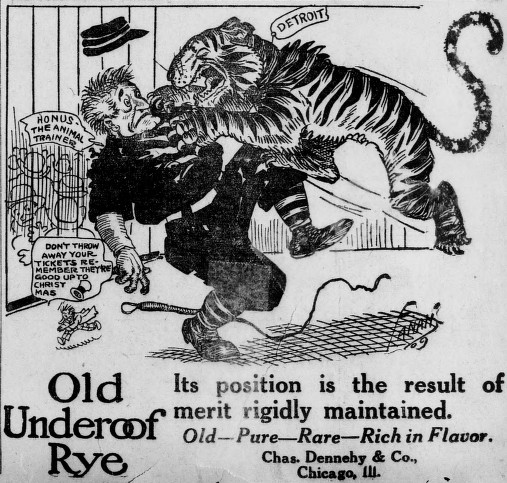
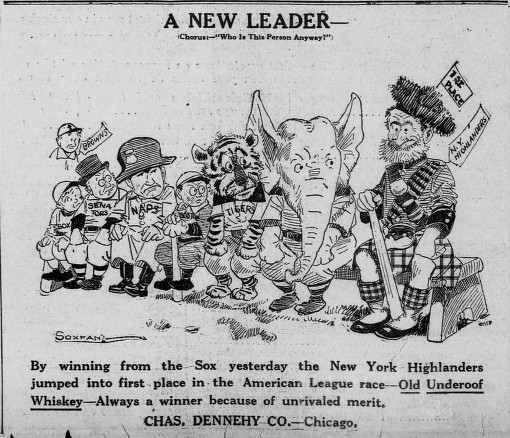
During the first decade of the 20th Century cartoon ads from Chas. Dennehy & Co., distributor of Underoof Bourbon and Rye Whiskey appeared regularly in Chicago newspapers.  Most focused on the Cubs and White Sox, the two featured today do not.

The ad above appeared after game 4 of the 1909 World Series when the Detroit Tigers evened the series with the Pittsburgh Pirates at two games apiece on George Mullin’s a five hitter;  Pirate star Honus Wagner, who would hit .333 for the series was held hitless by Mullin.  The Pirates would go on to win the series in seven games.

The one below was published on June 6, 1910 when the New York Highlanders, after winning two of three in a series with the White Sox, moved into first place.  The Philadelphia Athletics quickly overtook New York and would win the American League Pennant by 14 1/2 games.


oldunder1910Highlanders

Lost Advertisements–“I Shave with Gillette”

2 Apr

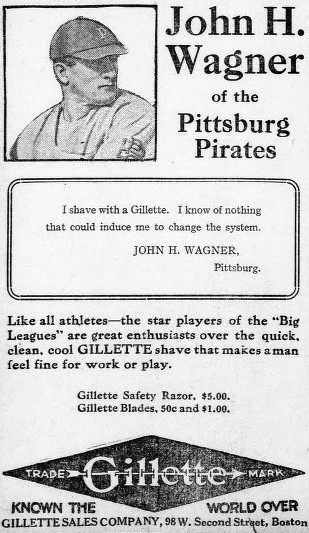
wagnergilletteA 1908 advertisement for Gillette–featuring John H. Wagner (Honus Wagner’s actual full name was John Peter Wagner).

“I Shave with a Gillette.  I know of nothing that could induce me to change the system.” John H. Wagner, Pittsburgh.

“Like all athletes–the star players of the “Big Leagues” are great enthusiasts over the quick, clean, cool, GILLETTE shave that makes a man feel fine for work or play.”

“A Heart-Breaking Play, Engineered by Wagner”

29 Mar

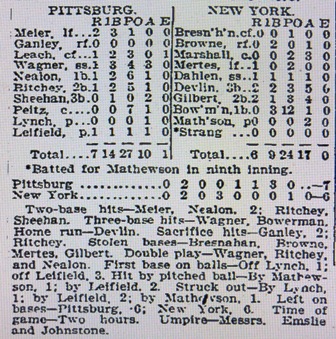
The defending World Series Champion New York Giants had gotten off to a fast start in 1906; on May 15 they were 19-7, the Chicago Cubs were 21-9, when they arrived in Pittsburgh for a four game series.

The Giants were shut out by the Pirates in the first two games.  In the third game of the series Christy Mathewson blew a three-run lead and the Giants trailed 7-5 heading into the top of the eighth inning..

Outfielder Sam Mertes walked, moved to second on Bill Dahlen’s single and scored on a two-out single by second baseman Billy Gilbert.  The Giants were behind 7-6 with runners on first and second; manager John McGraw was about to send Sammy Strang to pinch hit for Mathewson, when, according to The New York Times:

“A heart-breaking play, engineered by (Honus) Wagner in the last second of the eighth inning, beat the Champion New Yorks…It was a hard game to lose, and might not have been lost had Dahlen not fallen a victim to the wiles of Wagner.  The big Dutchman was guilty of the trick of hiding the ball, and when Bill stepped off second base, thinking (pitcher Albert “Lefty”) Leifield had the ball, Wagner, who had concealed it, touched Dahlen, which made the third out.”

Bill Dahlen

Bill Dahlen

The Pirates held on to win 7-6; The Times said of Dahlen:

“The New York shortstop felt so bad that he fairly wept.  McGraw, too, was angry, and it was said tonight he fined Dahlen heavily for his bit of carelessness.”

The Giants were unable to keep pace with the Cubs who finished 20 games ahead of New York for National League Pennant.

The Box Score

The Box Score