Tag Archives: John McGraw

“Out of the Game”

2 Nov

ripley

A September 1920 cartoon in The New York Globe, “Cleaning Up” by Robert Ripley–later famous for “Ripley’s Believe it or Not” which he began drawing two years earlier–calling on organized baseball to banish  Hal Chase, Heinie Zimmerman, and six members of the Chicago White Sox: Swede Risberg, Joe Jackson, Eddie Cicotte, Buck Weaver. Happy Felsh [sic, Felsch] and Lefty Williams–Ripley left out Chick Gandil and Fred McMullin.

Ripley continued to draw baseball cartoons as “Believe it or Not” gained popularity, including the one below from 1921 winter meetings featuring Kenesaw Mountain Landis, Ban Johnson, Kid Gleason, Hooks Wiltse, Charles Ebbets, John McGraw, and Wilbert Robinson.  After The Globe folded in 1923, Ripley moved to The New York Evening News.

ripley2


“There’s one thing you mustn’t do when you get to New York”

26 Oct

“Sinister Dick” Kinsella is primarily known as John McGraw’s equally pugnacious right-hand man and scout.  He was at McGraw’s side for one of the manager’s most famous brawls; a battle with Giants catcher Larry McLean in the lobby of the Buckingham Hotel in St. Louis, he also boasted an impressive list of “finds” including Carl Hubbell, Chief Meyers, Hack Wilson and Larry Doyle.

"Sinister Dick" Kinsella

              “Sinister Dick” Kinsella

Kinsella credited a career minor league player and manager for his discovery of Doyle, who he sold to the New York Giants in July of 1907.  After Doyle hit .310 in 1911, a syndicated Newspaper Enterprise Association told the story of how he acquired Doyle after the 1906 season from the Mattoon Canaries of the Kitty League, having never seen him play:

“Mattoon was in need of a pitcher and appealed to President Dick Kinsella of the Springfield Three-Eye League team for aid…Kinsella saw a chance to make a bargain when Mattoon hoisted the distress sign and struck one.  ‘I’ll let you have a pitcher for the pick of your team at the end of the season,’ Kinsella told the Mattoon people.  His offer was accepted and pitcher (John) Jokerst was sent  to the Kitty League team by Springfield.

“Doyle didn’t do well with Mattoon (.225 in 91 games) that season.  Kinsella had not even considered him in deciding what player to pick.  He had almost made up his mind to take a veteran pitcher.”

Fate intervened when Kinsella mentioned the Mattoon deal to Frank Belt, manager of the Kitty League’s Jacksonville Jacks.  Belt asked Kinsella if he had ever seen Doyle:

“’No,’ answered Kinsella.

‘”Well, don’t pick anyone until you do, and then pick him.  He’s the coming ballplayer of that club.  He hasn’t looked good in the box scores, but he’s ‘there’ any way you take him.  He’ll bring you more money inside of a year than you ever got for a player.”

Larry Doyle

                  Larry Doyle

Sight unseen, Kinsella took Belt’s advice.  Doyle played third base and hit .290 in 66 games for Kinsella’s Springfield Senators.  He became the subject of a bidding war with the Giants winning out over the Detroit Tigers and Washington Senators for his services on July 16.

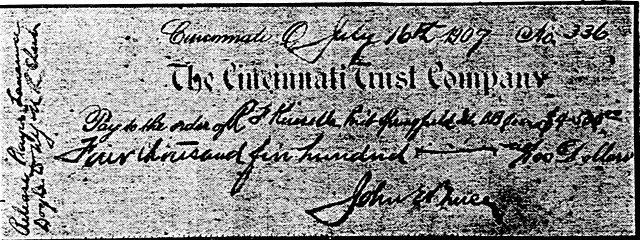
Kinsella was paid a then-record $4500 for Doyle—a record eclipsed the following year when Kinsella sold Rube Marquard to the Giants for $11,000.

The $4500 check to Kinsella for the sale of Doyle

                              The $4500 check to Kinsella for the sale of Doyle

According to The Springfield Journal Kinsella sent Doyle off to New York with just one piece of advice:

“There’s one thing you mustn’t do when you get to New York.  You must quit sliding to bases on your head.  If you don’t, they will think you’re from the brush.”

Doyle was moved to second base, hit .290 over a 14-year big league career, and presumably took Kinsella’s advice about sliding head first.

“Here was the King of all the Tramps I’d ever seen”

7 Oct

In 1947, Grantland Rice of The New York Herald-Tribune told a story about how he came to know one of the most colorful pitchers of the first decade of the 20th Century:

“Baseball, above all other games, has known more than its share in the way of masterpieces of eccentricity.  Many of these I happen to know.”

Grantland Rice

Grantland Rice

Rice went on to list some of his favorites—Rube Waddell, Crazy Schmit, Dizzy Dean—“Also, Flint Rhem, Babe Herman, Bobo Newsom, Germany Schaefer, Shoeless Joe Jackson, Arlie Latham—nits, wits, and half-wits—but all great ballplayers.”  But, said Rice, “one of the leaders in this colorful field” had been all but forgotten:

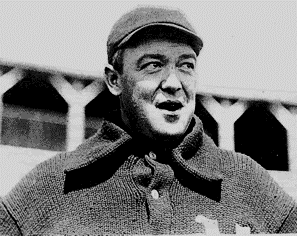
“His name was (Arthur) Bugs Raymond, the pitcher John McGraw always insisted had the finest pitching motion he ever saw, including Walter Johnson.”

[…]

“I remember Bugs because I happened to have a small part in his pitching career.  I was working in Atlanta (for The Journal) when I happened to read a story that came out of Shreveport (Louisiana), about a young pitcher named Raymond who had made and won the following bet:

“That he could eat a whole turkey, drink two bottles of scotch—and win a doubleheader.  He did it.  I didn’t believe it at the time, but I believed it later.  I recommended to either (Atlanta Crackers owner) Abner Powell or (manager) Billy Smith (44 years is a long time) that Raymond looked like a good buy.  Good copy is always scarce.  Raymond sounded like good copy.”

Bugs Raymond

Bugs Raymond

Rice’s story about the bet is likely apocryphal, there is no mention of it in contemporary newspapers in Shreveport, or in Jackson, Mississippi where Raymond played in the Cotton States League before coming to Atlanta–he also names the wrong manager–Smith came to Atlanta the following season.  While Raymond probably didn’t make the bet Rice claimed, he did, on at least one occasion win both ends of a doubleheader, and he was wildly popular in Mississippi.  After he was sold to Atlanta in July of 1905, The Jackson News said:

“The regret over Raymond’s departure was not one-sided.  The big fellow was all broken up over the transaction.”

The paper said that although Raymond would make $200 a month in Atlanta and have a chance to return to the major leagues, leaving Jackson was difficult for him:

“During his engagement with the Jackson team he has made a host of friends and was undoubtedly the most popular player who ever donned a home uniform.  The plain fact is Raymond almost owned the town.  Nothing was too good for him and he always made a hatful of money on the big games, a shower of silver and greenbacks being the inevitable result of a victory in a doubleheader.”

Rice’s story about Raymond also took another real event and embellished it–either by design or through the fog of forty years.

After finishing the 1905 season with a 10-6 record for the Crackers, Raymond was picked by new Manager Billy Smith to start for Atlanta in an exhibition against the Boston Americans on March 26, 1906.

In Rice’s colorful version, he gave the incorrect date for the exhibition and wrongly claimed that he met Raymond face-to-face for the first time on the morning of the game:

“By some odd chance, before starting a mile-and-a-half walk to the ballpark, I happened to be taking a drink at some wayside bar in preparation for the trip.  A heavy hand fell on my shoulder and, as I looked around, there was an unkempt-looking fellow, around 200 pounds who wore no necktie and hadn’t shaved in at least two days.  Here was the king of all the tramps I’d ever seen.

“’How about buying me a drink, fellow?’ was his opening remark.  I bought him a drink.  Then I had to buy him another drink.

“’How do we get out to this ballpark?’ he asked.

“’We walk,’ I said, ‘if you are going with me.’ Then a sudden morbid thought hit me.  ‘Isn’t your name Raymond?’ I asked.

“’Yes,” he said ‘Bugs Raymond.’

“I figured then what my recommendation to the Atlanta team was worth.  Something less than two cents.

“’Do you happen to know,’ I suggested, ‘that you are pitching today against the Boston Americans?’

“’I never heard of ‘em,’ Bugs said.  ‘Where’s Boston?’

“On the walk to the ballpark that afternoon Bugs spent most of the trek throwing rocks at pigeons, telegraph poles and any target in sight.  People I had known in Atlanta gave me an odd look after taking a brief glance at my unshaven, rough and rowdy looking companion.”

Once at the ballpark, Rice said:

“Raymond started the game by insulting Jimmy Collins…and every star of the Boston team.  He would walk from the pitcher’s box up towards the plate and let them know, in forcible and smoking language, what he thought they were.”

In Rice’s version, the cocky, seemingly drunk Raymond shuts Boston out 3-0 on three hits.  He got those details wrong as well, and Raymond’s performance was just as incredible without the embellishments.

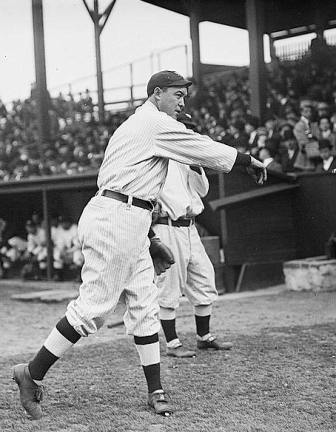
Bugs Raymond

Bugs Raymond

The Atlanta Constitution said on the day after the game:

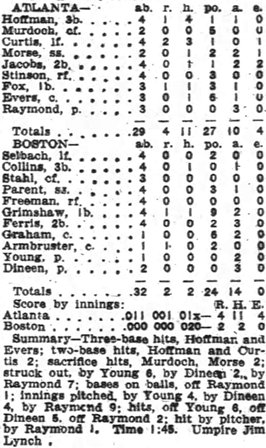
“No better than bush leaguers looked the Boston Americans…yesterday afternoon at Piedmont Park, when ‘Bugs’ Raymond came near to scoring a no-hit game against the bean-eating crew, who escaped a shut-out through two errors made by (Morris “Mike”) Jacobs in the eighth inning.

“Score—Atlanta 4, Boston 2.

“’Bugs’ was there with the goods.  Boston hitter after hitter stepped up to the plate, pounded the pan, looked fierce for awhile, and then went the easy out route.

“’Bugs’ was in his glory.  It was in the eighth inning before a single hit or run was scored off his delivery

Both Boston hits were ground balls Atlanta shortstop Frank “Whitey” Morse beaten out by  Collins and Myron ”Moose” Grimshaw:

“As inning after inning went by, the Boston sporting writers along with the team began to think of the possibility of defeat, and, about the seventh inning, when it looked strangely like a shutout game, they pulled out their books of excuses and began to look for the proper one to use in Tuesday morning’s newspapers.

“The one finally agreed upon at a conference of all four writers read like this:

“’The eyes of the Boston players were dimmed by the flying moisture from the spit-ball delivery of one ‘Bugs’ Raymond, who let himself out at full steam, while our pitchers were waiting for the opening of the coming season.  It does a major league club good to be beaten every now and then, anyway.”

The Box Score

                 The Box Score

Given Raymond’s alcoholism, there might be some truth Rice’s embellishments although there is no evidence for most of his version.

The performance against Boston was quickly forgotten as Raymond just as quickly wore out his welcome with Manager Billy Smith.  On May 6 he was suspended indefinitely because, as The Constitution put it “(Raymond) looks with delight in wine when it is red.”  On May 31, Atlanta sold Raymond to the Savannah Indians in the South Atlantic leagues. An 18-8 mark there, followed by a 35-11 season with the Charleston Sea Gulls in the same league in 1907, earned Raymond his return to the big leagues with the St. Louis Cardinals.

By 1912, the pitcher, about whom Rice claimed John McGraw said “Even half sober Raymond would have been one of the greatest,” was dead.

Lost Advertisements–Larry McLean for Sweet Caporal

25 Sep

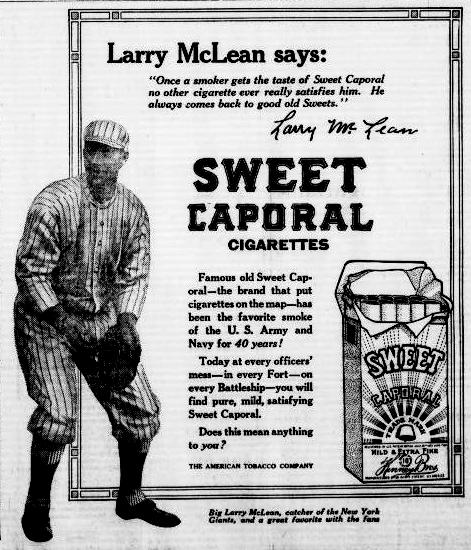
mclean

A 1914 Sweet Caporal Cigarette advertisement featuring New York Giants catcher Larry McLean “a great favorite of the fans:”

“Once a smoker gets the taste of Sweet Caporal no other cigarette ever really satisfies him.  He always comes back to good old Sweets.”

McLean wore out his welcome in New York and ended his major league career the following season when he fought with Manager John McGraw, and McGraw’s right-hand man, “Sinister Dick” Kinsella in the lobby of the Buckingham Hotel in St. Louis.

It was hardly the first controversy for McLean, who battled–albeit not physically–with every manager he played for during his 13-year-career.  Sam Crane, the sports writer and former infielder, summed up McLean well in a 1910 article for “Pearson’s Magazine:”

“Larry McLean, of the Cincinnati Reds, as a mere mechanical catcher is hard to beat.  He has a splendid arm and can throw like a streak.  Larry is too, perhaps, the best batting catcher in either league, but his erratic habits make it impossible to place any confidence in him.”

Larry McLean

                                  Larry McLean

A year earlier, in May, McLean had deserted the Reds during an East Coast trip and was “suspended indefinitely” by Manager Clark Griffith, who told The Cincinnati Enquirer:

“When you have a man who is liable to run out at the first call of the wild, you are in an uncertain position all the time. I am perfectly free to say that I might not take McLean back on the team at all, and certainly not until he shows me that he means business.”

McLean was back in the lineup within days, and as he did throughout his career, pledged to a reporter from The Cincinnati Times-Star that he would “(C)onduct himself properly from now on.”

It was a pledge McLean made and broke several times throughout his career which ended at age 33.  He would be dead six years later, the result of a fight in a Boston bar.


Grantland Rice’s “All-Time All-Star Round up”

10 Aug

In December of 1917, thirty-eight-year-old sportswriter Grantland Rice of The New York Tribune enlisted in the army–he spent fourteen months in Europe.  Before he left he laid out the case, over two weeks, for an all-time all-star team in the pages of the paper:

“As we expect to be held to a restricted output very shortly, due to the exigencies and demands of the artillery game, this seemed to be a fairly fitting period to unfold the results.”

Grantland Rice

Grantland Rice

Rice said the selections were “not solely from our own limited observation, extending over a period of some eighteen or twenty years,” but included input from players, managers and sportswriters, including  “such veterans” as Frank Bancroft and Clark Griffith, and baseball writers Joe Vila of The New York Sun, Bill Hanna of The New York Herald and Sam Crane, the former major league infielder turned sportswriter of The New York Journal.

Rice said only one of the nine selections “(S)eems to rest in doubt.  The others were almost unanimously backed.”

The selections:

Pitcher:  Christy Mathewson

A. G. Spalding, John (Montgomery) Ward, Larry Corcoran, Charley Radbourn, John Clarkson, (Thomas) Toad Ramsey, Tim Keefe, Bill Hoffer, Amos Rusie, (Mordecai) Miner Brown, Addie Joss, Ed Walsh–the array is almost endless.

“In the matter of physical stamina, Cy Young has outclassed the field.  Cy won more games than almost any others ever pitched.

“(But) For all the pitching mixtures and ingredients, stamina, steadiness, brilliancy, brains, control, speed, curves, coolness, courage, is generally agreed that no man has ever yet surpassed Christy Mathewson…there has never been another who had more brains or as fine control.”


[…]

“It might be argued that Radbourn or (Walter) Johnson or (Grover Cleveland) Alexander was a greater pitcher than Mathewson.

But we’ll string with Matty against the field.”

Radbourn was the second choice.  Bancroft said:

“Radbourn was more like Mathewson than any pitcher I ever saw.  I mean by that, that like Matty, he depended largely upon brains and courage and control, like Matty he had fine speed and the rest of it.  Radbourn was a great pitcher, the best of the old school beyond any doubt.”

Catcher:  William “Buck” Ewing

“Here we come to a long array—Frank (Silver) Flint, Charley Bennett, (Charles “Chief”) Zimmer, (James “Deacon”) McGuire, (Wilbert) Robinson, (Marty) Bergen(Johnny) Kling, (Roger) Bresnahan and various others.

“But the bulk of the votes went to Buck Ewing.”

Buck Ewing

Buck Ewing

[…]

“Wherein did Ewing excel?

“He was a great mechanical catcher.  He had a wonderful arm and no man was surer of the bat…he had a keen brain, uncanny judgment, and those who worked with him say that he had no rival at diagnosing the  weakness of opposing batsman, or at handling his pitchers with rare skill.”

Kling was the second choice:

“Kling was fairly close…a fine thrower, hard hitter, and brilliant strategist…But as brilliant as Kling was over a span of years, we found no one who placed him over the immortal Buck.”

1B Fred Tenney

First Base was the one position with “the greatest difference of opinion,” among Rice and the others:

“From Charlie Comiskey to George Sisler is a long gap—and in that gap it seems that no one man has ever risen to undisputed heights… There are logical arguments to be offered that Hal Chase or Frank Chance should displace Fred Tenney at first.

But in the way of batting and fielding records Tenney wins….Of the present array, George Sisler is the one who has the best chance of replacing Tenney.”

2B Eddie Collins

 “There was no great argument about second base.

“The vote was almost unanimous.

“From the days of Ross Barnes, a great hitter and a good second baseman on through 1917, the game has known many stars.  But for all-around ability the game has known but one Eddie Collins.”

Rice said the competition was between Collins, Napoleon Lajoie and Johnny Evers:

“Of these Lajoie was the greatest hitter and most graceful workman.

“Of these Evers was the greatest fighter and the more eternally mentally alert.

“But for batting and base running, fielding skill, speed and the entire combination, Collins was voted on top.”

 SS Honus Wagner

“Here, with possibly one exception, is the easiest pick of the lot.  The game has been replete with star shortstops with George Wright in 1875 to (Walter “Rabbit”) Maranville, (George “Buck”) Weaver…There were (Jack) Glasscock and (John Montgomery) Ward, (Hardy) Richards0n, (Hugh) Jennings, (Herman)Long, (Joe) Tinker and (Jack) Barry.

“But there has been only one Hans Wagner.”

Honus Wagner

Honus Wagner

Jennings and Long were rated second and third,  “But, with the entire list  considered there is no question but that Wagner stands at the top.”

3B Jimmy Collins

Rice said:

“From the days of (Ned) Williamson(Jerry) Denny, and (Ezra) Sutton, over thirty years ago, great third basemen have only appeared at widely separated intervals.

“There have been fewer great third basemen in baseball than at any other position, for there have been periods when five or six years would pass without an undoubted star.”

The final decision came down to “John McGraw vs. Jimmy Collins.”  McGraw was “a great hitter, a fine bunter and a star base runner,” while “Collins was a marvel and a marvel over a long stretch…he was good enough to carve out a .330 or a .340 clip (and) when it came to infield play at third he certainly had no superior…So taking his combined fielding and batting ability against that of McGraw and Collins wins the place.  McGraw was a trifle his superior on the attack. But as a fielder there was no great comparison, Collins leading by a number of strides.”


OF Ty Cobb

“The supply here is overwhelming…Yet the remarkable part is that when we offered our selection to a jury of old players, managers and veteran scribes there was hardly a dissenting vote.”

[…]

“Number one answers itself.  A man who can lead the league nine years in succession at bat.

“A man who can lead his league at bat in ten out of eleven seasons.

“A man who can run up the record for base hits and runs scored in a year—also runs driven in.

“Well, the name Ty Cobb answers the rest of it.”

OF Tris Speaker

 “The man who gives Cobb the hardest battle is Tris Speaker.  Veteran observers like Clark Griffith all say that Speaker is the greatest defensive outfielder baseball has ever exploited…Speaker can cover more ground before a ball is pitched than any man.  And if he guesses incorrectly, which he seldom does, he can go a mile to retrieve his error in judgment…And to this impressive defensive strength must be added the fact he is a powerful hitter, not only a normal .350 man, but one who can tear the hide off the ball for extra bases.”

Tris Speaker "hardest hit"

Tris Speaker 

OF “Wee Willie” Keeler

Mike Kelly and Joe KelleyJimmy Sheckard and Fred Clarke—the slugging (Ed) Delehanty—the rare Bill LangeBilly Hamilton.

“The remaining list is a great one, but how can Wee Willie Keeler be put aside?

“Ask Joe Kelley, or John McGraw, or others who played with Keeler and who remember his work.

“Keeler was one of the most scientific batsmen that ever chopped a timely single over third or first…And Keeler was also a great defensive outfielder, a fine ground coverer—a great thrower—a star in every department of play.

“Mike Kelly was a marvel, more of an all-around sensation, but those who watched the work of both figure Keeler on top.”

Rice said of the nine selections:

“The above is the verdict arrived at after discussions with managers, players and writers who have seen a big section of the long parade, and who are therefore able to compare the stars of today with the best men of forgotten years.

“Out of the thousands of fine players who have made up the roll call of the game since 1870 it would seem impossible to pick nine men and award them the olive wreath.  In several instances the margin among three or four is slight.

“But as far a s deductions, observations, records and opinions go, the cast named isn’t very far away from an all-time all-star round up, picked for ability, stamina, brains, aggressiveness and team value.

“If it doesn’t stick, just what name from above could you drop?”

“Three of the Greatest Pitchers the Game ever has Produced”

15 Jul

In 1915, Frank G. Menke, who wrote for the Heart Newspaper’s International News Service told readers:

“The color line drawn so tightly around major league baseball has barred from major league fields three of the greatest pitchers the game ever has produced.”

The three were John Donaldson, Frank Wickware, and Jose Mendez.

In May, Donaldson, who pitched for the All Nations, had thrown 30 consecutive no-hit innings against Kansas City based semi-pro clubs.

Sketchy contemporary accounts with some transposed numbers in newspaper articles seem to have led to confusion about Donaldson’s feat in later years: some sources claim the streak was over two games—a regulation contest and a 21-inning game , but it appears from the earliest reports in The Kansas City Times and The Indianapolis Freeman that he pitched a nine-inning and 12-inning no-hitter against the Schmelzers, a powerful semi-pro club sponsored by the Schmelzer Arms Sporting Goods Company in Kansas City and another no-hitter against a team called the KCK (Kansas City, Kansas) All-Stars.  (Later in the summer of 1915, Schmelzers became the sponsor of the All Nations after the club lost their original sponsor, Hopkins Brothers Sporting Goods).

John Donaldson

John Donaldson

Menke quoted New York Giants Manager John McGraw’s assessment of the All Nations’ star after having watched him pitch in Cuba:

“If Donaldson were a white man, or if the unwritten law of baseball didn’t bar Negroes from the major leagues, I would give $50,000 for him—and think I was getting a bargain.”

Menke said of Wickware of the Chicago American Giants:

“(He) is another Negro pitcher who would rank with the Walter Johnsons, Joe Woods and Grover Alexanders if he were a white man…Wickware has marvelous speed, a weird set of curves and wonderful control.  And he has a trick that has made him feared among batters.  He throws what seems like a ‘bean ball,’ but his control is so perfect that he never yet has hit a batter in the head.  But when the batters see the ball, propelled with mighty force, come for their heads, they jump away, and the ball, taking its proper and well-timed curve, arches over the plate for a strike.”

Frank Wickware

Frank Wickware

The final pitcher on Menke’s list was Mendez,  another member of the All Nations:

“He’s known as “The Black Matty” and his work has been almost as brilliant as that of “The Big Six” of the Giants.  Mendez is only of medium height (5′ 9”), but he has terrific power in his arm.

“The Cuban Negro has a canny brain and he always has used it.  He has mixed his fastball with his slow one, has an assortment of beautiful curves and perfect control…Like Mathewson, he never pitches air-tight ball unless he has to.  He conserves his strength.  But when he needs to pitch hitless ball he does it.  When he needs to strike out a man he usually succeeds.”

Jose Mendez

Jose Mendez

Incredibly, a story about three pitchers who deserved notice by the major leagues written by an influential white sportswriter received barely a notice in the black press.

The Indianapolis Freeman ran the story with no further comment, and no mention of who wrote the original story, simply attributing it to The Indiana Daily Times which had run Menke’s piece.

The Chicago Defender and The Pittsburgh Courier ignored the story entirely.  The New York Age didn’t mention Menke’s story, but the same week did make a pitch for black players—not with the positive portrayal of three great pitchers as Menke had done, but by highlighting the bad behavior of some major leaguers.

Lester Aglar Walton, who wrote about baseball and theater for The Age and later became the United States Ambassador to Liberia, said:

“(I)f baseball magnates are not color prejudiced can it be that they have misgivings as to how Negro players would conduct themselves on and off the field if permitted to play in the big leagues?  However, if this is their chief cause of concern and the stumbling block in the way of crack Negro players, big league managers should be reminded of the Ty Cobbs, Larry McLeans and others who have distinguished themselves by acts of ruffianism on and off the diamond.”

Lester Aglar Watson

Lester Aglar Watson

Walton related the story of McLean’s recent fight with Giants Manager John McGraw and coach “Sinister” Dick Kinsella in the Buckingham Hotel in St. Louis.

“(H)ad McLean been a colored player the incident in St. Louis would have brought about the disbarment of all Negroes from hotels in St. Louis—had a policy of accommodating Negroes existed.”

Larry McLean

Larry McLean

Walton also noted that when white teams met black teams on the field after the regular season, “The mixing of the races does not provoke racial conflicts and the best of feelings exist” among the players.

Then, he asked the men who owned major league clubs:

“The question is therefore put up to big league magnates that if the Indian with his dark skin and the Cuban are permitted to play in the big leagues, and if there is not the least possibility of the record for ruffianism established by the Ty Cobbs and Larry McLeans being eclipsed, why not give the Negro player a chance?”

As would be the case for three more decades, there was no reply.

“It smacks of Old-fashioned Common Sense”

26 Jun

For more than a century, major league baseball has looked for ways to increase hitting.  Or, as Bozeman Bulger of The New York World put it in 1917

“Overhauling the rules of baseball to make it harder for the pitcher and more of a joy ride for the boys who wield the ash has always been a favorite winter pastime.”

Burger said former pitcher and current National League President John Tener was “(C)onvinced that the public wants more hitting.”

John Tener

John Tener

Tener and others shared their ideas for rule changes with Bulger on the eve of the meeting of the rules committee.

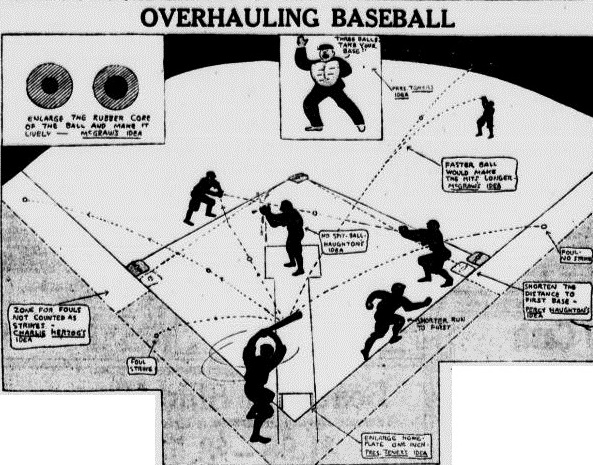
“Tener proposes making the home plate larger and at the same time allowing a batter to take his base on three balls instead of four.”

[…]

“Then comes Charlie (Buck) Herzog (of the New York Giants) with a suggestion, perhaps the most interesting of all.  It is the outpost of a real imagination that is comprehensive. Before announcing his plan, Herzog calls attention to the injustice of calling strikes on very hard hit line drives that fall foul by inches.  To all intents and purposes, those are real scientific hits, and the fact that luck causes them to fall foul should not act upon the batter as a penalty.  In other words, he is being severely punished for really doing scientific work. Herzog suggests, therefore, that a zone be described along those two foul lines between third and the fence and between first and the ground limits.  This zone should be at least ten feet in width, and any ball hit therein is not to be called a foul.  At the same time, it is not to be called a safe hit.  In other words, the batter loses his hit by bad luck, but it relieves him of an unjust penalty.”

Buck Herzog

Buck Herzog

Incredibly, Bulger completely endorsed Herzog’s proposed rules change and claimed, “Every ballplayer in America” would agree, because “It smacks of old-fashioned common sense.”

Another rule change was proposed by Percy Duncan Haughton.  Haughton, a long-time college football coach (Cornell and Harvard), and Harvard baseball coach in 1915 (he also played both sports at Harvard) had become a part-owner of the Boston Braves in 1916.  Bulger said:

“Mr. Haughton’s scheme has not been taken very seriously by those who were studying these problems while he was still a football player, but there is a real satisfaction in finding a new magnate so much interested in the sport.  The President of the Braves proposes that the distance from third to home and from home to first be lessened by several inches.  It might help the batter a little, but an extreme change like that would be pecking at the one fundamental of the game that has stood all tests.”

The most practical suggestion came from Giants Manager John McGraw, who proposed that no rules be changed, but advocated a more lively ball.

Bulger, however, was sure some rules would change:

“(T)he powers that be appear to be intent upon really turning out a new model.”

The New York World's rendering of the proposed changes.

The New York World’s rendering of the proposed changes.

When the meetings at the Waldorf Astoria in New York ended two weeks later, Jack Veiock of the Hearst Newspapers International News Service said:

“(I)t was confidently expected that the members of the rules committee would get together and make a few alterations in the baseball code as it stands today.

“But the rules committee did nothing of the kind  The wise old heads who are in control of baseball are satisfied with the rules.”


“Probably the ‘Boniest’ Bonehead Play Ever”

22 Jun

While some of the details changed in subsequent tellings, this story stayed substantially the same from when it was first presented in a column by sports writer William A. in 1913, until the final published version in 1957 in The New Orleans Times-Picayune.  One version called it, “Probably the ‘boniest’ bonehead play ever”

The story was told by and told about lefty Evan “Rube” Evans.  Born on April 28, 1890, in Sebring, Ohio, Evans was a career minor league pitcher who, when the story first appeared, seemed to be headed to the big leagues. 
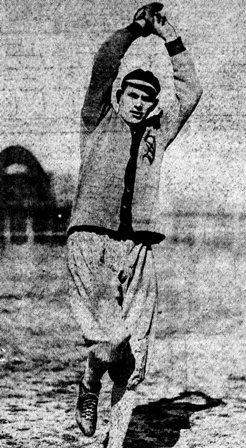
Rube Evans

Rube Evans

The tall–he was reported by various sources as anywhere from 6′ 2″ to 6′ 4″–began his professional career with the Dallas Giants in the Texas League in 1910; he was 15-12 for the pennant winners, but The Dallas Morning News said he didn’t “take baseball seriously” until the following year, when he was 18-16 for the Giants:

“Before that, it seemed, the big, husky flinger looked at playing baseball something in the light of a joke.  Last season, though he came back into the game with a different viewpoint. He seemed to realize that ball playing was a man-sized business.”

After his 1911 performance, Evans’ contract was purchased by the New York Giants, and he joined the team for spring training in Marlin, Texas in 1912.  The Morning News said if he maintained his new found focus “and works as hard as he knows how to work he ought to stick.”

Evans quickly impressed the Giants with a pitch “takes a most freakish break,” according to The Washington Times:

“Rube Evans, the Giants left-handed recruit pitcher from Dallas, surprised bot Manager (John) McGraw and Coach Robby (Wilbert Robinson) by showing them a curve that is entirely new to the big league…The ball is delivered in exactly the same manner as the spitball, but he does not moisten it.”

The paper did not elaborate on how Evans’ “dry spitter” was different from versions reported on during previous seasons–including the one thrown by Christy Mathewson of the Giants–but according to The New York World, “McGraw says he will try and teach it to Rube Marquard.”

Despite his “dry spitter,” Evans failed to make the team and was returned to Dallas where he posted a 22-12 record for the Giants.

In 1913, he joined the New Orleans Pelicans in the Southern Association but appeared to be headed to the Cleveland Naps before he threw a pitch in the regular season for the Pelicans.  In March, Evans shut down the Detroit Tigers 3 to 1 on five hits and followed that up with a four-hitter (and 3 to 1 victory) against the Naps.

The Cleveland Press said, “(Naps Manager Joe) Birmingham plans to cut down his squad considerably.  It is said recruits (Hugh) Peddy, (Pete) Shields and (Ward) McDowell will be left here in trade for one good pitcher, probably Southpaw Rube Evans.”

With Evans apparently on the verge of joining the Naps, the story of his “bonehead” play was told by Phelon, then repeated widely:

“(Evans) has one curious habit—a trait which has aroused much wonder on the part of every manager under whom the southpaw has been toiling.  When given an order by his manager or captain, Mr. Evans always stops, cocks his ears, and demands a repetition of the directions.  Naturally he is first taken for a simp, or bonehead, but when further acquaintance with him shows that he is a gentleman of intelligence and high mentality, the field leaders are muchly puzzled.

“’I always want my orders repeated,’ quoth Mr. Evans, ‘so that I will never again make such an error.”

(The 1913 version of the story, which quotes Evans,  places the incident in McKeesport, Pennsylvania, some later versions say it happened in 1913 with the Pelicans, still others say it was in Portland, Oregon; however, the original publication predates Evans’ time on the West Coast which did not begin until May of 1914).

Evans said he had pitched into the ninth inning when the opposing team put a runner on third with one out, when his manager told him if the other team attempted a squeeze play to “bean him.”  Evans said:

“’I knew no more what a squeeze play was than the man in the moon, but my orders rang in my ears as I started winding up.  Just as a swung up my arm, the fellow on third tore for the plate…I took careful aim at the oncoming runner, and pickled him with a fine shot to the back of the cranium.  Three seconds later the crowd was coming towards me with roars of fury, and I got over the back fence just in time.

“’Well how was I to know that I should have hit the batter and not the runner?  Ever since I have insisted on duplicate orders, so that I would know just what to do.’”

His acquisition by Cleveland never materialized and he had a disappointing 12-15 record in 1913, in a season split between New Orleans and the Birmingham Barons.

It is also in question whether Phelon’s characterization of Evans as a “gentleman of intelligence and high mentality,” was entirely accurate given his inability to stick with clubs who were impressed with physical abilities.  After his second chance to pitch in the majors didn’t materialize, the remainder his of career was marked by long stretches of mediocrity, charges of bad behavior and comparisons to another left-handed “Rube.”

In August of 1913, he was suspended for the remainder of the season by the Birmingham Barons for, according to The Birmingham Post-Herald, “Failure to keep in condition.”  The Sporting Life’s Chandler Richter called him “Erratic,” The Oakland Tribune said he was”Eccentric,” a wire service retelling of the “beanball” story from 1915 said he “earned a nationwide reputation as a ‘squirrel,” another called him “the real eccentric,” when compared to Rube Waddell.
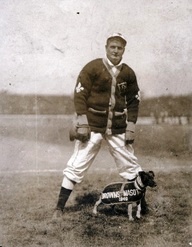
The other left-handed Rube

The other left-handed Rube

His two-year tenure with the Portland Beavers in the Pacific Coast League (PCL) began when he wore out his welcome in New Orleans in May of 1914 and was sold to the Beavers.  It was particularly rocky.  The Spokane Daily Chronicle said Evans and Beavers manager Walter “Judge” McCredie “got along like a pair of strange bulldogs.” He was suspended at least once, again for the euphemistic “failure to be in proper condition,” and gave up a game-winning home run to Jack Ness of the Oakland Oaks when he accidently threw a pitch over the plate while attempting to intentionally walk Ness.  At the close of the 1915 season, Portland let him go for what The Portland Oregonian called “His inability to take care of himself.” Of his 9-22 record the paper said:

“Rube ran into gobs of adversity.”

After leaving Portland, Evans played parts of three seasons for the Salt Lake City Bees in the PCL–in 1917 he was 21-9, but when McCredie was named manager of the Bees in 1918, Evans time with the team was nearly over.  Before the season, The Oregonian said, “Evans did not take kindly to the idea of having to take orders” from his former manager and was threatening to jump the club.  He finally did jump in June after appearing in 14 games and posting a 3-8 record.

Evans went to Portland and finished the 1918 season in the semi-pro Shipyards League, The Oregon Daily Journal said upon his arrival:

“Rube Evans was through at Salt Lake and McCredie was probably saved the trouble of wearying his hand by writing out Rube’s release, when Rube left.”

In 1919, he played for the Rupert franchise in the semi-pro Southern Idaho League; while successful, his reliance on the emery ball for his success didn’t make him friends.  The Twin Falls Times said:

“When Rube Evans lugged the emery ball into the S.I.L. he failed to do anything beneficial to the league.  Rube will win a few more games for the Rupert club, but he has lowered the standard of sport in the league.”

Evans had one more season in professional baseball, posting a 10-7 record with the Regina Senators in the Western Canada League in 1920.  In an August 15 doubleheader against the Edmonton Eskimos Evans was ejected for arguing with the umpire while facing the second batter of the first game; he came back to lead the Senators to 5 to 3 victory in the second game, giving up two runs in 7 2/3 innings, and hitting a three-run home run in the sixth.
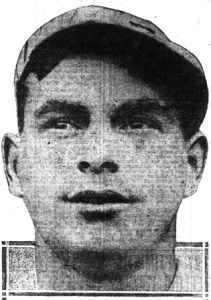
Rube Evans

Rube Evans

After the 1920 season, he returned to Ohio and spent the next decade playing semi-pro baseball there and in Western Pennsylvania.  His last headlines came in 1924 when he pitched six innings for the Sharon (PA) Elks team in an exhibition game against the New York Yankees.  The Elks lost 10-8, Babe Ruth went 2-4 with a double for the Yankees.

Evans’ playing days ended in Akron, Ohio.  He pitched for and managed the Goodyear Tire and Rubber Company team, and stayed on with the company as a rubber worker.  He died on January 30, 1950.

A clue to some of Evans’  erratic behavior is contained in his death certificate.  The pitcher spent the last three and a half years of his life in Ohio’s Cambridge State Hospital; his cause of death was listed as “General Paresis,’ brought on by syphilis.

A shorter version of this post appeared on June 3, 2013

“If Baseball is really the National Game let the Club Owners go out and prove it”

4 May

Haywood Broun, columnist for The New York World-Telegram, shook up the annual Baseball Writers Association dinner in February of 1933.  The Pittsburgh Courier said Broun “struck out boldly in advocacy of admitting Negroes to the charmed circle of big leagues.”

Heywood Campbell Broun

Heywood Broun

Broun said (and later wrote in The World-Telegram):

“I can see no reason why Negroes should not come into the National and American Leagues.

“Why in the name of fair play and gate receipts should professional baseball be so exclusive?”

[…]

“The introduction of a few star Negro ball players would do a great deal to revivify interest in the big leagues.  It would attract a number of colored rooters. And it would be a fair and square thing.  If baseball is really the national game let the club owners go out and prove it.”

Jimmy Powers of The New York Daily News said he polled the dinner guests after Broun’s remarks:

“I made an informal tour around the tables asking club owners and players their reactions to Broun’s little talk.  I was amazed at the sentiment in favor of the idea.”

Powers claimed that Yankees owner Jacob Rupert, St. Louis Cardinals General Manager Branch Rickey, and Babe Ruth were all in support of Broun’s statement.   John McGraw the dinner’s guest of honor—he had resigned as manager of the New Giants the previous summer due to his failing health—was, according to Powers, “The only prominent man present vetoing” the idea.

John McGraw

John McGraw vetoed the idea


Salem Tutt Whitney, a prominent star of the black vaudeville circuit, commented on McGraw in the pages of The Chicago Defender:

“John McGraw and his Giants have been the idols of the Colored baseball fans.  Whenever and wherever there had been talk about the color line in major league baseball, the Colored fans were a unit that declared that if John McGraw could have his way there would be no color line.  ‘Didn’t he play (Charlie) Grant at second base on the Giants!’  ‘Look how long he employed a Colored trainer (Ed Mackall)!’”

[…]

 “It is my opinion that if the Colored baseball fans of Harlem are not convinced that Mr. McGraw has nothing more to do with the Giants, there will be a lack of personal color in bleachers and stands at the Giants’ stadium this summer.”

Salem Tutt Whitney

Salem Tutt Whitney

Not content to simply report on Broun’s pitch for integration, Powers made his own:

“I would like to make a case for the colored baseball player.  In football, Duke Slater, Fritz Pollard and Paul Robeson and stars of similar complexion played with and against the cream of Nordic colleges.  Eddie Tolan, Ralph Metcalfe and Phil Edwards have conducted themselves in a gentlemanly—not to mention championship—fashion.  Boxing has known Joe Gans, Sam Langford, Joe Walcott and Tiger Flowers.  There are only three popular sports in which the dark-skinned athletes are snubbed—tennis, golf and baseball.”

The New York Age approved:

“Here’s hoping all the other big white sportswriters have the courage of Jimmy Powers.”

Chester Washington, a sports writer at The Pittsburgh Courier announced that the paper was launching “A symposium of opinion, coming from outstanding figures in baseball circles,” designed to demonstrate a broad coalition of support for integration.

The Courier reported “The first of these statements,” in response to Washington’s outreach the following week—and it was a rather incredible one from John Heydler, president of the National League, who said:

“Beyond the fundamental requirement that a major league player must have unique ability and good character and habits, I do not recall one instance where baseball has allowed either race, creed or color enter into the selection of its players.”

Gerald Nugent “aggressive young owner of the Phillies,” was next to respond to The Courier:

“Nugent calls attention to the fact that no ‘color line’ is drawn on the dollars which are spent by colored and white fans for admissions in the various big-league parks…He further declares that the average colored semi-pro league player is better than his white brother in the same category.”

Support continued to come.  Chicago White Sox President J. Louis Comiskey:

“You can bet your last dime that I’ll never refuse to hire a great athlete simply because he isn’t the same color of some other player on my team if the alleged bar is lifted.”

While Commissioner Kennesaw Mountain Landis did not respond to The Courier, his right-hand man, Leslie O’Connor said “(T)here isn’t any rule which keeps colored players out.”  But, like Heydler, he made the incredible claim that “the subject of Negro ball players had never been brought up,” among the Major League Advisory Council.

Based on the initial responses, William Goldwyn Nunn, The Courier’s managing editor, expressed great, if premature, optimism:

“And the color will be black!

“As sure as the Ides of March are approaching, there’s going to be some added color in the Major Leagues.  AND, THAT COLOR WILL BE BLACK!”

Meanwhile Jimmy Powers quoted Lou Gehrig and Herb Pennock of the Yankees and Frankie Frisch of the Cardinals in The Daily News, all said they were “open-minded,” about the possibility integration.

pennock

Pennock “Open-minded”


Two more prominent sportswriters came out in support:  Dan Parker of The New York Daily Mirror, and Gordon Mackay, who had been sports editor of three Philadelphia papers—The Enquirer, The Press and The Public Ledger.

And then, as abruptly as it began, the movement died.

Despite the brief groundswell of support, by the time the major league season opened Alvin J. Moses, another writer for The Courier admonished the papers readers:

“Aren’t you somewhat ashamed of yourselves that you haven’t seen fit to spare the time to flood (the paper) with letters that cry out against these NEGROPHOBES who for more than half a century have kept Negro ballplayers out of league competition?

“The cry of ‘Play Ball, Play Ball, Play Ball?’ is heard today in hundreds of parks the county over, and baseball statisticians have figured to show more than 40,000,000 fans walk past the turnstiles.  But what does that cry mean to you, and you, and you? Well, I’ll tell you—absolutely nothing.”


Lost Advertisements–Larry Doyle for Coca-Cola

20 Mar

larrydoylecoke

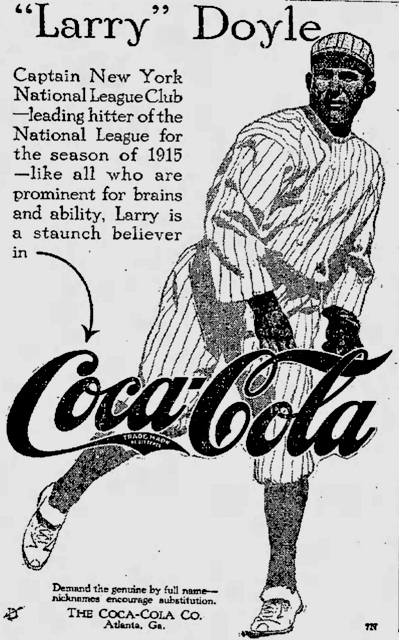
A 1916 advertisement for Coca-Cola featuring New York giants Captain Larry Doyle.

Four years earlier, when Doyle led the Giants to a National League championship–hitting .330 and winning the Chalmers Award as the league’s most valuable player–he told a reporter from The New York Evening Journal that his success was driven by a snub from White Sox Manager Jimmy “Nixey” Callahan:

“When he was playing in a western minor league city (the Three-I League with the Springfield Senators) the (New York) Highlanders heard of him and asked Callahan, then playing independent ball (in Chicago’s City League), to look him over.  Callahan watched Doyle perform in several games and then wired the Highlanders:

“‘He isn’t fast enough.  Can’t field and isn’t a first-class hitter.’

“So Doyle was passed up and Callahan sent in a bill for $200 to cover his expenses and time.  Then (John) McGraw walked up…and paid $4,000 (actually $4,500) for Doyle, who couldn’t be purchased now for three times that amount.  All of which goes to show that some of the best judges of ball players make serious mistakes.”