For almost 30 years Richard “King Tut” King was the clown prince of Negro League baseball and one of its biggest drawing cards. King, born in 1905 in Philadelphia spent his youth playing in sandlot and semi-pro leagues.
He is listed as having made seven plate appearances for the Atlantic City Bacharach Giants in 1931—the rest of his nearly 30-year career was spent primarily as an entertainer.
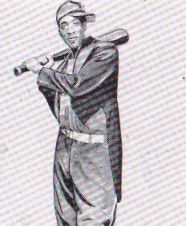
Richard “King Tut” King
King joined Charlie Henry’s Louisville-based Zulu Cannibal Giants in 1934. The Cannibals wore grass skirts, red wigs and face paint. Players were identified by “native” names, as with this lineup printed in The Meriden (CT) Daily Journal in advance of the team’s 1935 appearance:
“The Cannibals will lineup as follows: Wahoo, right field, Limpopo, first base, Rufigi, center field, Tanna, left field; Taklooie, third base; Bissagoss, shortstop, Kangkol, second base, Nyass, Catcher; Kalahare, Pembra, Moke, Impo and Tankafu pitchers.”
Sometime during the 1935 season after the Cannibals had played a game with the Miami Giants, King, tired of irregular paydays with the cash-strapped Cannibals, stayed in Miami and joined the Giants.
The following season the Giants became the Ethiopian Clowns—later the Cincinnati Clowns and finally the Indianapolis Clowns– and King spent the next 22 years with the team.
He became most famous for his pantomime “shadow ball” routine with Spec Bebop, a ball juggling act with “Goose” Tatum, and playing with an over-sized first baseman’s mitt.
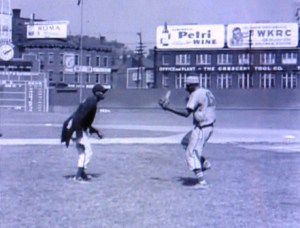
Richard “King Tut” King, left and Goose Tatum at Crosley Field, Cincinnati 1946, performing the ball juggling routine
For the most part, he did not participate in games. As a result, it’s unclear exactly what his skill level was.
In 1948, Hall of Fame sportswriter Sam Lacy wrote in The Baltimore Afro-American said King:
“ Hasn’t hit a ball since they found his namesake’s tomb.”
Bob Motley, who was a Negro League umpire from 1947-1958, said in his biography:
“King Tut was actually a heck of a ballplayer and could put some serious wood on the ball. I don’t particularly think he was major-league caliber, but he was good.”
At 45-years-old, King was pressed into duty as the regular first baseman on the Clowns’ 1949 barnstorming tour, The Associated Press said:
“Heretofore little has been known about his hitting prowess, since during the regular season the Clowns have used him only as a fun maker…at Atchison the other night, he slammed out three hits in five trips to the plate, including a long home run over the left field wall to slug the Clowns to a 9-6 victory over the mighty Kansas City Monarchs.”
While tremendously popular with fans across the country, and the top-billed member of the team in promotional materials throughout his career, the Black Press was not always in agreement about King’s act.
Near the end of his career, The Baltimore Afro-American said:
“Tut is a natural clown and a natural ballplayer…one of baseball’s most popular players among the fans as well as with his teammates.”
On the other hand, when King entertained the crowd at the 1947 East-West All-Star Game at Comiskey Park, he included two of his regular routines. Frank “Fay” Young of The Chicago Defender, often called “The dean of Black sportswriters,” was not amused:
“(T)here are thousands who did not approve of King Tut’s crap shooting stunt or his shimmy in the grass skirt. He could have left that part of his act at home. The East vs. West classic is a high-class sport event. Let’s keep it that way.”
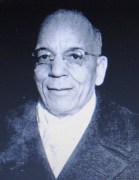
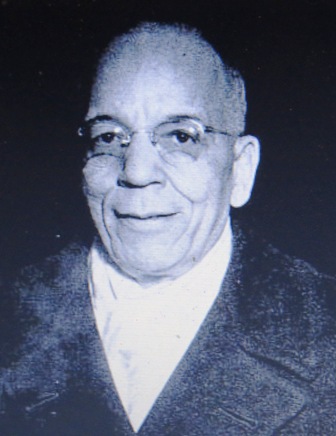
Frank “Fay” Young, The Chicago Defender
King remained a huge drawing card throughout the 1950s; he spent each off-season appearing regularly with New York Broadway Clowns and New York Colored Clowns basketball teams, and occasionally with the Harlem Globetrotters. He and Spec Bebop were part of the Jackie Robinson’s All-Star’s barnstorming tour in 1953.

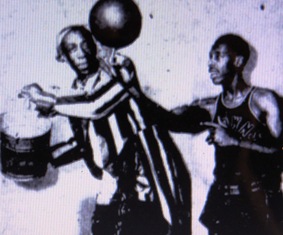
King with Curtis “Junior” Johnson in a 1952 New York Broadway Clowns promotional photo
On August 29, 1958, King was honored for what The Afro-American called “A million miles and a billion laughs,” at Connie Mack Stadium in Philadelphia. Jackie Robinson sent a congratulatory telegram and many Negro League legends were on hand, including Bill Yancey, Toussaint Allen, Mahlon Duckett, Bill Cash, Chaney White. Buddy Burbage, and Hank Miller.
King’s career came to an abrupt end before the 1959 season. Jet Magazine reported:
“(King) suffered a memory lapse en route to spring training at St. Petersburg, Fl, was picked up by police and returned by air to Philadelphia where he was hospitalized.”
King was committed to the Pennsylvania State Hospital at Byberry; he died there in 1966.
0.000000
0.000000
Tags: Bacharach Giants, Bill Cash, Bill Yancey, Bob Motley, Buddy Burbage, Chaney White, Cincinnati Clowns, Connie Mack Stadium, Ethiopian Clowns, Goose Tatum, Hank Miller, Harlem Globetrotters, Indianapolis Clowns, Jackie Robinson, Kansas City Monarchs, Mahlon Duckett, Miami Giants, Negro Leagues, Richard "King Tut" King, Spec Bebop, Toussaint Allen, Zulu Cannibal Giants






 Baseball History Daily