Tag Archives: Lost Advertisements

Lost Advertisements–“Over There, Over Here”

27 May

spaldingwwi

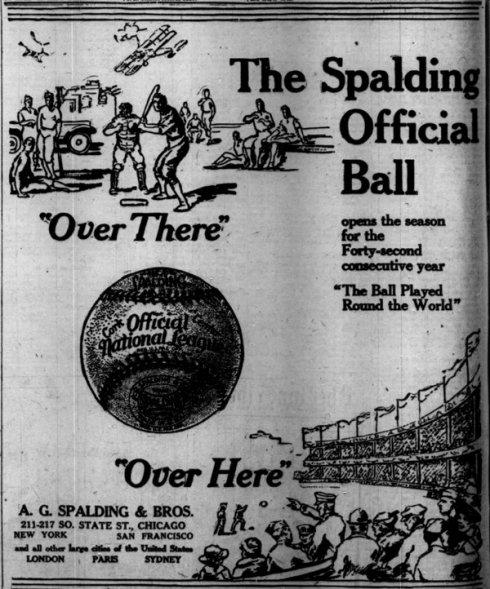
An advertisement for A. G. Spalding & Bros. that appeared during the opening weeks of the 1919 season; the first post-World War I:

“Over There” “Over Here”

“The Spalding Official Ball opens the forty-second consecutive year season for the forty-second consecutive year.”

“The Ball Played Round the World.”

Spalding Official National League Ball, circa 1919

Spalding Official National League Ball, circa 1919

Hundreds of Spalding balls went to troops “Over there” during the war through Washington Senators Manager Clark Griffith‘s “Ball and Bat Fund.”  The fund raised money throughout the country–including a donation from President Woodrow Wilson–and used it to purchase baseball equipment for servicemen.  In his final report for the fund, published in 1919, Griffith said Spalding and other “sporting goods houses” were “very patriotic, selling me goods for cost or even less.”

Clark Griffith presents a box of baseballs to US Army officers, 1917

Clark Griffith presents a box of baseballs to US Army officers, 1917

The 1919 “Spalding Guide,” said more than $102,000 was raised by the fund and:

“Wonderful good was done…even though the Huns did sink the Kansan (the Kansan was a merchant vessel sunk near Belle Ile, off the Brittany Coast of France)  with its load of equipment for the soldiers of the American Expeditionary Force.  The moment the news reached the United states, other equipment was provided as quickly as possible and dispatched on its way to France.”


Lost Advertisements–Ty Cobb ‘The American Boy”

29 Apr

cobbamericanboy1921

A 1921 advertisement for “The American Boy.”  “The Biggest, Brightest, Best Magazine for boys in all the world.”

The magazine was published from 1899-1941, and at one point had a circulation of nearly 300,000.

The May issue, on sale for .25 at newsstands, featured Ty Cobb:

How Ty Cobb put new thrills in baseball!

“The, bulliest, most inspiring story of the year; the kind that will set your blood tingling and boost your enthusiasm!  Complete with splendid action photographs of Cobb.”

[…]

“Read Cobb’s experiences: how he has blazed a path to greater baseball; how his new standard is being felt in every department of the game.

“Read about the batters Cobb had t beat; how he used his brains at the plate and conquered his fear of southpaws; how he used his brains in base running;  the story of his greatest play; his lightning thinking and running;  how he fooled the fielders;  his nine ways to side; ‘picking up a fly,’ one of Cobb’s great tricks.

“Every line will delight you!”

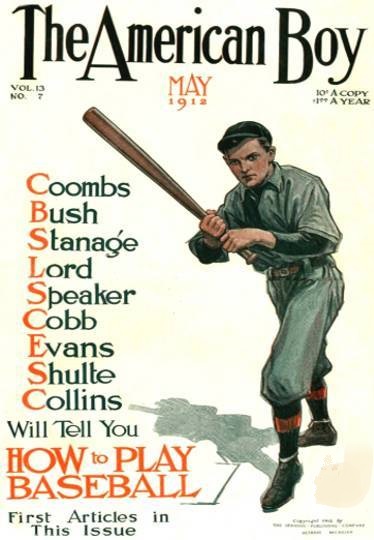
It appears that no copies of the May 1921 edition are still available.  Below is anther example of a baseball cover from “The American Boy” in 1912:

amboy1912

Lost Advertisements–“Walter Johnson says…”

22 Apr

goldsmithbb

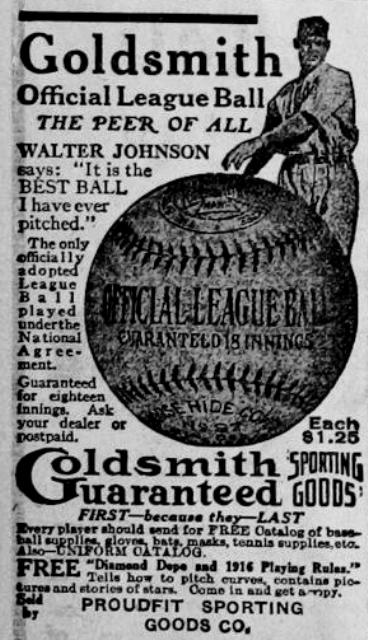
A 1916 advertisement for the Goldsmith Official League Ball:

The Peer of All

“Walter Johnson says: ‘It is the best Ball I have ever pitched.’

“The only officially adopted League Ball played under the NAtional Agreement.

“Guaranteed for eighteen innings.”

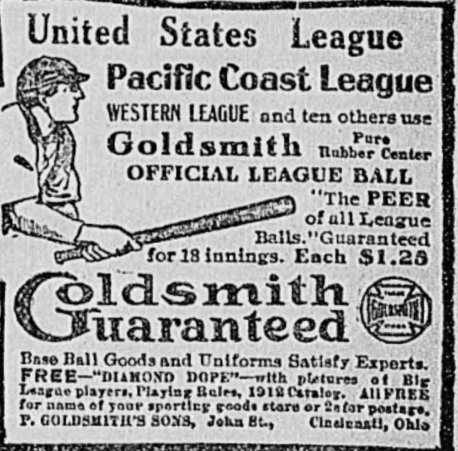
The 18-inning guarantee and mentions of the leagues which had adopted the ball for use were a staple of Goldsmith’s advertising, like the one below from 1912, announcing that the ball would be used in the United States, Pacific Coast, and Western Leagues:

goldsmith1912

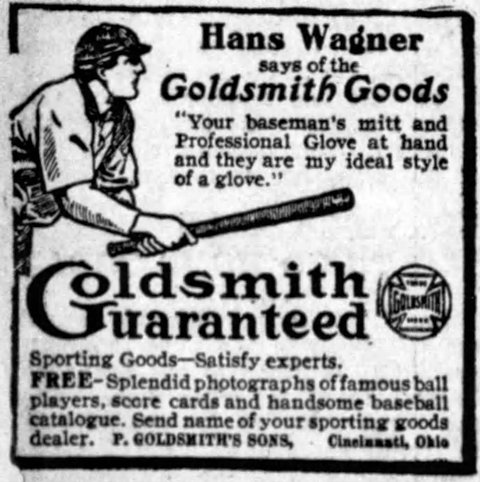
The 1912 ad used the same image–that of Honus Wagner–that appeared in the company’s 1911 sporting goods ad, which quoted Wagner: “Your baseman’s mitt and Professional Glove at hand and they are my ideal style of a glove.”

goldsmithwagner

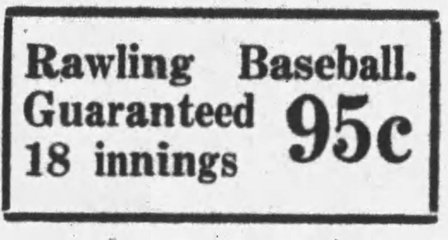
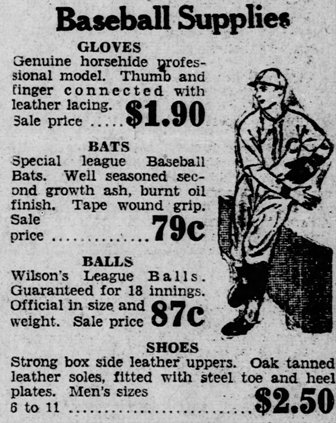
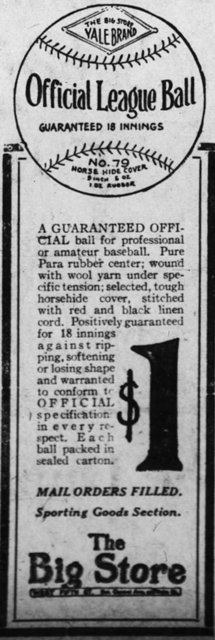
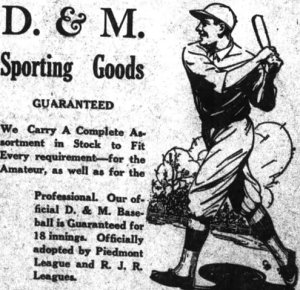
By the 1920s, the 18-inning guarantee became generic throughout the sporting goods world

rawlings wilson yaleball

dm

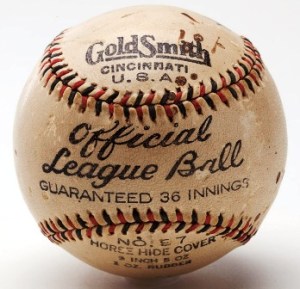
Not to be outdone, the Goldsmith ball of the 1930s was “Guaranteed for 36 Innings:”

goldsmith30s

Lost Advertisements–“A Pennant Winning Nine!!

8 Apr

1910reds

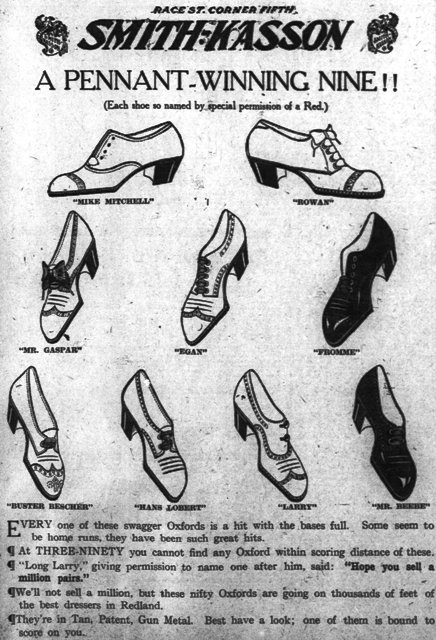
A 1910 advertisement for Smith-Kasson Shoes in Cincinnati.

“Each shoe so named by special permission of a Red”

The shoe lineup included the “Mike Mitchell,” the “Rowan,” for pitcher Jack Rowan, the “Mr. Gaspar,” “Mr. Beebe,” and “Fromme” for pitchers Harry Gaspar and Art Fromme.  The “Egan,” for 2nd baseman Dick Egan, outfielder Bob Bescher was immortalized with the “Buster Bescher,” the “Hans Lobert” for third baseman Hans Lobert, and simply “Larry” for catcher Larry McLean.

"Buster Bescher"

“Buster Bescher”

“Every one of these swagger Oxfords is a hit with the bases full.  Some seem to be home runs they have been such great hits.

“At Three-Ninety, you cannot find any Oxford within scoring distance of these.

“Long Larry (McLean), giving permission to name one after him said, ‘Hope you sell a million pairs.’

Long Larry

Long Larry

“We’ll not sell a million, but these nifty Oxfords are going on thousands of feet of the best dressers in Redland.

“They’re in Tan, Patent, (and)  Gun Metal.  Best have a look, one of them is bound to score on you.”

It’s unknown how well the line of shoes fared;  their namesakes, stylish Oxfords and all, limped to a 75-79, fifth place finish.

Lost Advertisements–“Play Ball!”

4 Apr

openingday19191

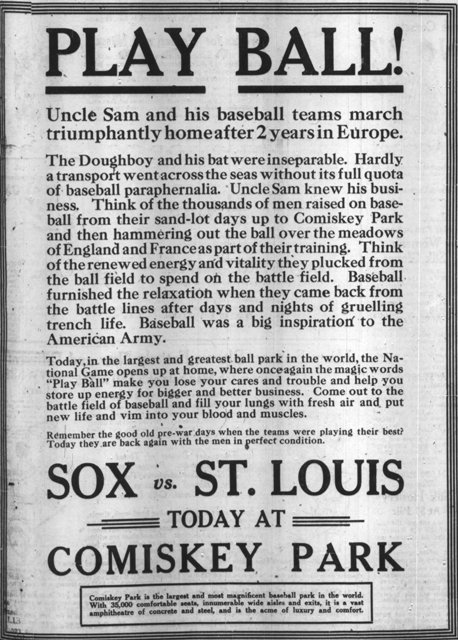
Opening Day at Comiskey Park, 1919, the first opener after the end of World War I:

The ad above appeared in Chicago Newspapers on May 1, 1919, and appealed to the patriotism of fans:

“Uncle Sam and his baseball teams march triumphantly home after 2 years in Europe.

“The Doughboy and his bat were inseparable.  Hardly a transport went across the seas without its full quota of baseball paraphernalia.  Uncle Sam knew his business.  Think of the thousands of men raised on baseball from their sandlot days up to Comiskey Park and then hammering out the ball over the meadows of England and France as part of their training.  Think of the renewed energy and vitality they plucked from the ball field to spend on the battlefield.  Baseball furnished the relaxation when they came back from the battle lines after days and nights of gruelling trench life.  Baseball was a big inspiration to the American Army.

“Today, in the largest and greatest ballpark in the world, the National Game opens up at home, where once again the magic words ‘Play Ball’ make you lose your cares and troubles and help you store up energy for bigger and better business.  Come out to the battlefield of baseball and fill your lungs with fresh air and put new life and vim into your blood and muscles.

“Remember the good old pre-war days when the teams were playing their best.  Today they are back again with the men in perfect condition.”

As for the “greatest ballpark in the world,” the ad said:

“Comiskey Park is the largest and most magnificent baseball park in the world.  With 35,000 comfortable seats, innumerable wide aisles and exits, it is a vast amphitheatre of concrete and steel, and is the acme of luxury and comfort.”

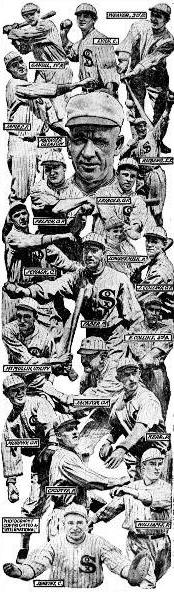
Patriotic fervor and “men in perfect condition” were no match for the weather, or perhaps as a metaphor for what was to come, dark clouds brought rain and postponed the game between the White Sox and the St. Louis Browns.

The 1919 White Sox

The 1919 White Sox


“You can’t Rattle Him”

1 Apr

luderuscoke

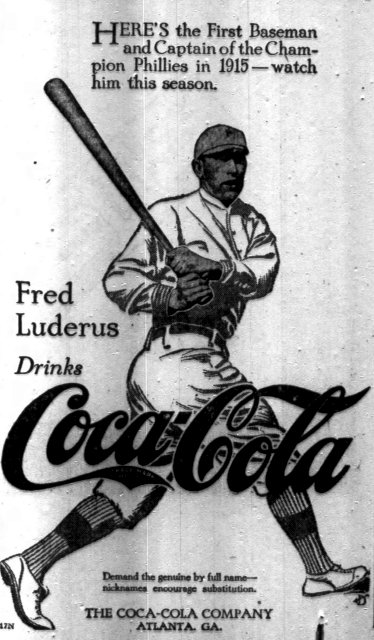
A 1916 advertisement for Coca-Cola featuring Fred Luderus:

“Here’s the First Baseman and Captain of the Champion Phillies in 1915–watch him this season.

“Fred Luderus drinks Coca-Cola.”

Christy Mathewson told Harold Dekalb “Speed” Johnson of The Chicago Record Herald a story about an attempt by Giants Manager John McGraw to rattle Luderus at the plate:

“‘I hear you can kid Luderus along,’ said the Little Napoleon to (catcher John) Chief Meyers.’

“‘Josh him a little when he comes to bat.’

“‘Ludie lumbered to the pan in the second round toting a heavy bludgeon and an innocent smile.  Meyers was ‘set’ for him.  He fixed his fingers in a fake signal and then addressed Ludie.’

“‘Look down into my glove,’ invited the noble redman.  ‘The best hitters steal the signs, you know.’

“‘Luderus didn’t answer.  The pitcher wound up and buzzed one over the outside corner.  Fred’s mace swung around with a crash and he meandered nonchalantly around the circuit for a homer.’

“‘I don’t need to steal the signs to hit that pitcher,’ he told Meyers as he crossed the plate.  ‘Besides, they pulled that gag on me in the bushes long ago.’

“‘I don’t want you to talk to that fellow anymore,’ ordered McGraw when the Chief finally got back to the bench.  ‘You can’t rattle him.”

Luderus

Luderus

Incidentally, in a case of plagiarism or great minds thinking alike, the lede of Johnson’s story read:

“He’s no Chase on the defense, nor a  Daubert in batting, nor a Merkle on the basepaths, but he’s the most underrated star in baseball today.”

Nearly a year earlier, John “J.C.” Kofoed of The Philadelphia Record wrote in “Baseball Magazine:”

“He is not a McInnes on the defense, nor a Daubert in batting, nor a Merkle on the basepaths…He is the most under-rated man in baseball today.”


Lost Advertisements–John McGraw for Coca-Cola

18 Mar

mcgrawcoke

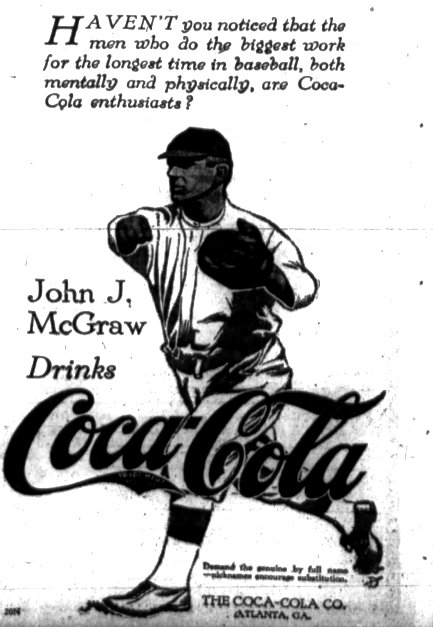
“Haven’t you noticed that the men who do the biggest work for the longest time in baseball, both mentally and physically, are Coca-Cola enthusiasts?

John J. McGraw drinks Coca-Cola.”

After winning three straight pennants with the Giants from 1911-1913, McGraw was confident his team was heading for a fourth straight National League championship after his club took over first place on May 30.  In September, the surging Boston Braves–who were in eighth place when New York took over first– split a doubleheader with the Giants to remain tied for first place (The Braves were tied with the Giants for one day on August 25 and were in sole possession of first for one day earlier in the month).

That day, under the headline “Prophecies and sich!” Ralph Davis of The Pittsburgh Press presented a series of quotes he attributed to McGraw which nicely summed up the season’s pennant race:

“John McGraw said on June 1: ‘The big disappointment of the year has been the Boston Nationals.  I thought (George) Stallings would get his team into the first division at the start and keep it there.’

George Stallings

George Stallings

“John McGraw said on July 1: ‘Those poor old Bostonians are still at the bottom of the pile, where they seem to be anchored.  The team is surely the surprise of the season.’

“John McGraw said on Aug 1: ‘The Boston Braves have made a great showing during the past two weeks, and are now in fourth place.  They will probably slump again, but should not drop back into last place.’

“John McGraw said on Aug. 15: ‘Boston is now in second place, but we are not worried about that.  Their present spurt is merely a flash, and they will soon be headed the other way.’

“John McGraw said on Sept. 1: ‘As I predicted, the Braves did not stay with us.  They have dropped back to second place and have probably shot their bolt.  They will decline from this out.  Mark my words.’

“John McGraw said on Sept. 7: “Those Braves blankety blank, blank, etc…, ad infinitum!’

McGraw

McGraw

“Which being interpreted means Boston once more tied with the Giants for the lead, and shows no sign of breaking badly, as the eminent Mr. McGraw predicted.”

Davis’ prophecy that the Braves showed “no sign of breaking badly” was correct.  Boston beat the Giants 8 to 3 the following day, recapturing sole possession of first place.  They never looked back.  The Braves went 25-6  (with three ties) the rest of the season and cruised to the pennant, beating McGraw’s Giants by 10 1/2 games.

Lost Advertisements–Heinie Groh for Sweet Caporal

4 Mar

grohsweetcaporal

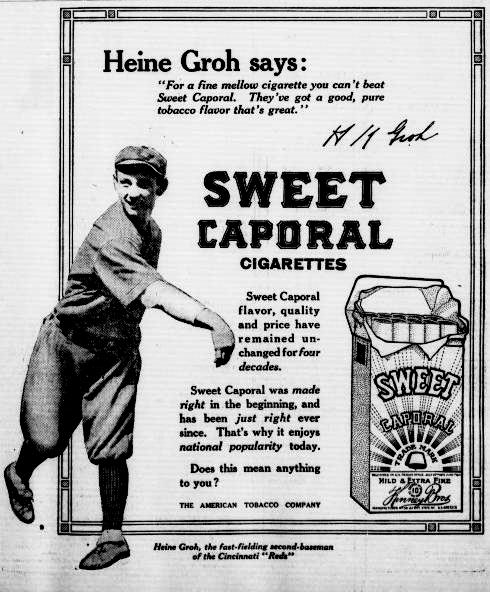
A 1914 Sweet Caporal advertisement featuring Heine [sic] Groh–the company didn’t spend a great deal of time checking the spelling of the names of their endorsers.

“For a fine, mellow cigarette you can’t beat Sweet Caporal.  They’ve got a good, pure tobacco flavor that’s great.”

The salary dispute that culminated with Groh’s trade from the Cincinnati Reds to the New York Giants after the 1921 season had been ongoing since at least 1917 and earned him the title “last of the holdout kings” from The Washington Herald.

His 1920 holdout was, according to Groh, inspired by his wife Marguerite, who also spoke to the press on her husband’s behalf as the dispute ground on into March.

The Cincinnati Times-Star said while speaking at a “local banquet,” Groh told the audience:

“We were sitting in a vaudeville show not long ago and were listening to the thunderous applause being accorded a couple of high salaried dancers.

“My wife touched my arm.  ‘Do you see how they are being praised now?’ she asked. ‘But what will happen to them in a few years when their legs start to go bad?  They’ll get asked to leave won’t they? That’s why they’re so high-priced now.  Let that be a lesson to you.’

“So right then and there Mrs. Groh made me promise that I would not sign a Reds contract until I got my figures…When my wife says sign, I’ll sign and not a minute before.”

Groh

Groh

Marguerite Groh was more direct when she spoke to the paper:

“I don’t care if all the other players sign, and if Heinie can’t do anything better next summer than work in the garden I think he should continue holding out for what he wants.

“We both believe Heinie has been underpaid for several seasons.  This is the year in which we can afford to be independent, and I am urging Heinie to continue his fight to get what he believes he is entitled to.

“It is not a question of how much Heinie can make in some other business. We both know the Reds are willing to pay him more than he will make if he does not sign at the club’s terms.

“But we will be perfectly able to get through the year without any baseball income if the Reds don’t meet Heinie’s terms, and they’ll have to do it if he is to play for them.”

After the Reds left for Miami, Florida without Groh on March 5, The Associated Press said:

“Heinie Groh, or rather Mrs. Heinie Groh, is still among the holdouts in baseball.  There is lurking suspicion that Heinie would like to end the controversy and join his teammates in the South, but Mrs. Groh absolutely refuses to let him go unless (Reds owner August) Garry Herrmann offers her little Heinie more money.”

Four days later Groh agreed to terms, The Cincinnati Enquirer said the Reds “Would not state the amount” of the contract, but said Groh had asked for $12,500 and the team had originally offered $10,000.

During Groh’s long holdout the following year, Mrs. Groh’s opinion was never reported.


Los Advertisements–Hans Wagner, Lewis 66

26 Feb

wagner66

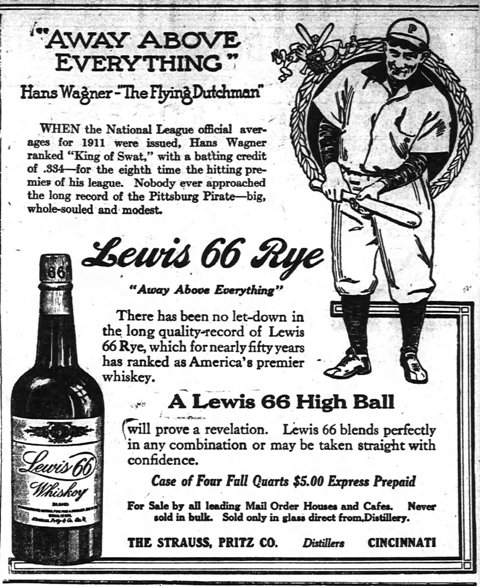
A 1912 advertisement for Lewis 66 Rye, featuring Honus Wagner:

“Hans Wagner–‘The Flying Dutchman’

“When the National League official averages for 1911 were issues, Hans Wagner ranked ‘King of Swat,’ with a batting credit of .334–for the eighth time the hitting premier of his league.  Nobody ever approached the long record of the Pittsburgh Pirate–big, whole-souled and modest.”

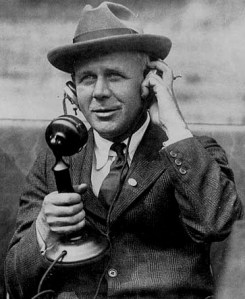
Five years later, as Wagner’s career was drawing to a close, Grantland Rice of The New York Tribune said:

Grantland Rice

Grantland Rice

“Wagner stands to date, for team worth, as the most valuable ball player that ever lived.

“A great infielder is of more value than a great outfielder, so in this respect Wagner has even ranged beyond Ty Cobb.

“Hughey Jennings was a star–a great hitter, a brilliant infielder and a brainy workman.

“But even Hughey has to make way before Wagner a man who for twenty years could average .340 [sic 21 years, .328] at bat and cover all the ground in sight between third base and the right field bleachers.

“Wagner is the game’s main marvel…He was as marvelous in the field as at the bat.  Floundering, awkward looking, bow-legged, with his vast hands dangling at his side, no one would ever have taken him for any action snapshot of grace.

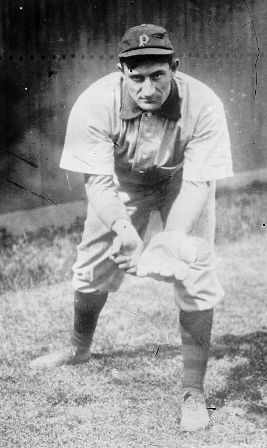
Honus Wagner

Honus Wagner

“But when it came to killing base hits back of third and back of second, mopping up his side of the field with a deadly certainty, he had no equal.

“If Wagner had been a .240 hitter he would have been one of the most valuable man of all time through his great defensive value alone.”

Lost Advertisements–Grover Cleveland Alexander, Sweet Caporal

19 Feb

alexandercaporal

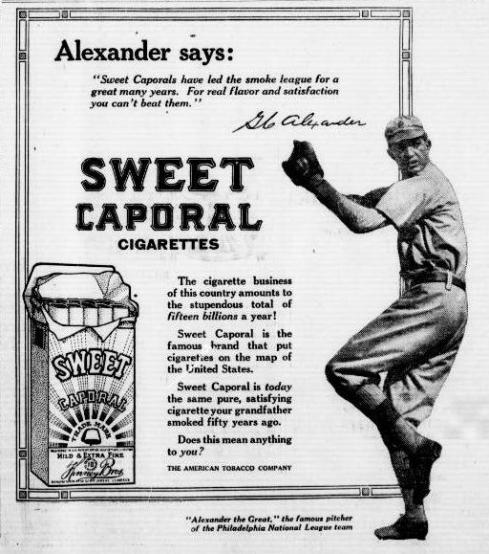
A Sweet Caporal advertisement featuring Grover Cleveland Alexander:

  “Sweet Caporals have led the smoke league for a great many years.  For real flavor and satisfaction you can’t beat them.”

Shortly before the 1915 season, Damon Runyon, writing in The New York American compared Alexander and Walter Johnson:
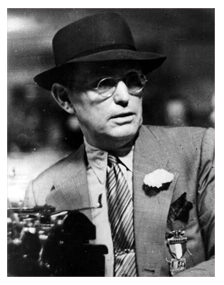
Damon Runyon

Damon Runyon

“Whenever we see Grover Cleveland Alexander pitching at top form, we conclude that he is the greatest right-handed pitcher in the land, and we cling to that conclusion until Walter Perry Johnson comes along with a line of his best pelting.  Then we decide that Walter is the greatest, and we hold that decision to the day that ‘Alex’ reappears.

“In short, our mind–probably none to stable at best–does a heap of vacillating between these Western wonders, and we are certain of only just one thing with respect to their ability–which is that it’s either Grover or Walter who is the greatest righthander…You may think that (Christy) Mathewson, or (Dick) Rudolph, or Bill James or Willie (Bill) Doak is greatest, and we have no doubt that you can produce just as many arguments in support of your belief…but it is our opinion that Johnson and Alexander today stand head and shoulders above all the rest.”

Runyon said that neither, however, were better than Mathewson when Matty was at his best:

“They are both great pitchers, but there have probably been many just as great–and there has been only one Mathewson.”

Runyon also claimed that players who faced both Alexander and Johnson agreed that one was the better pitcher:

“Ball players who have hit against both men–or rather who haven’t hit against them, for there is never much hitting against Walter or Grover–say that the Nebraskan is the better of the two.  They say he has as much ‘stuff’and knows how to use it better than Johnson.”
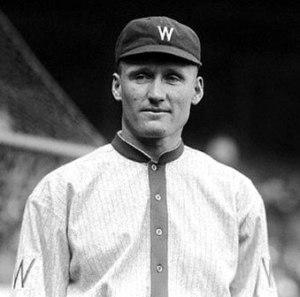
Morris' ride, Walter Johnson
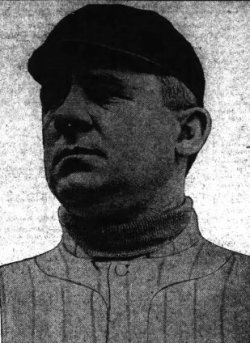
Walter Johnson
Most important to Runyon, he said, was that he preferred watching Alexander pitch:

“As a matter of personal choice, however, we would rather watch Alexander work than Johnson:  To us, it seems that he has more natural grace in the box…than the big Washington propeller.  There are mighty few pitchers who come under the head of things of beauty when they are working, but ‘Alex’ is one of them.”

As for a forecast for the coming season, Runyon said:

“Some fans are dreaming this year of seeing Alexander and Johnson as opponents in the first game of the 1915 world’s series, but they are mostly Philadelphia and Washington fans who are having those dreams, and we doubt if the dreams will come true.”

Both pitchers were dominant that season.

Johnson was 27-13 with a 1.55 ERA for a team, true to Runyon’s prediction, could only dream of a pennant–finishing fourth.

Alexander, however, was 31-10 with 1.22 ERA and did pitch the first game of the World Series for the pennant-winning Philadelphia Phillies–he won the opener 3 to 1, beating Ernie Shore and the  Red Sox, but Boston came back and won four straight, including Dutch Leonard‘s 2 to 1 victory over Alexander in Game 3.