Tag Archives: Lost Advertisements

Lost Advertisements: Bill Killifer [sic] for Sweet Caporal Cigarettes

5 Jun

killifersweetcaporal

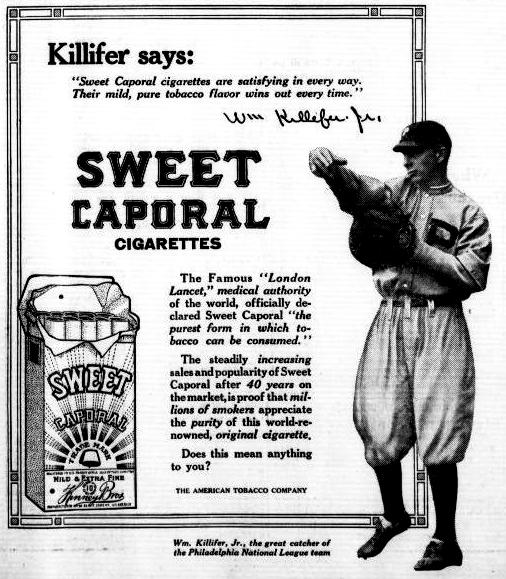
A 1914 advertisement for Sweet Caporal Cigarettes.  While spelling Killefer‘s name wrong, the ad calls him “(T)he great catcher of the Philadelphia National League Team.”

Killefer says:

“Sweet Caporal cigarettes are satisfying in every way.  Their mild, pure tobacco flavor wins out every time.”

In 1918, Killefer was traded to the Chicago Cubs, along with Grover Cleveland Alexander.  After the Cubs won the National League pennant, The Chicago Daily News reported that Killefer would be getting a bonus beyond his World Series share:

“A bet of a ten-cent cigar against $1000, made as the result of a joke while the Cubs were training at Pasadena, California, last spring has been won by Bill Killefer, it was revealed today.  The loser, William Wrigley, one of the club’s stockholders, wagered the $1000 that the team would not win the National League pennant.  Killefer, who accepted it in jest, had forgotten about the bet until he was reminded of it by Wrigley.”


Lost Advertisements–Bull Durham’s Fan for a Fan

29 May

1913fan

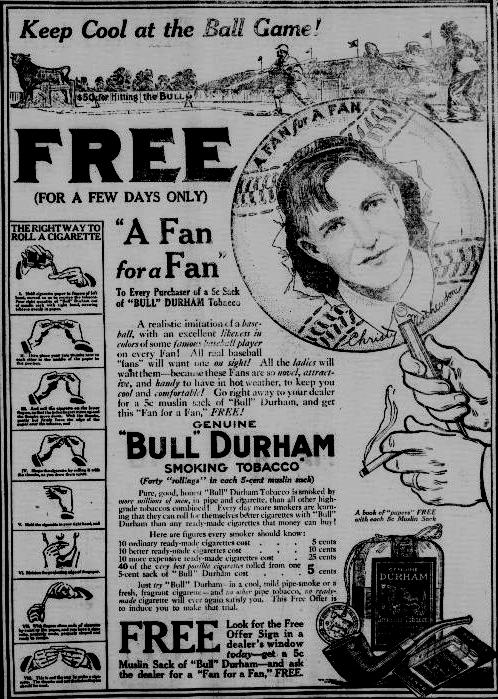
A 1913 advertisement for the “A Fan for A Fan” offer from Bull Durham Tobacco:

Keep Cool at the Ballgame

 Free (for a few days only)

A Fan for a Fan

 To Every Purchaser of a 5 cent sack of “Bull” Durham Tobacco

A realistic imitation of a baseball, with an excellent likeness in colors of some famous baseball player in every fan!  All real baseball “fans” will want this on site!  All the ladies will want them–because these fans are so novel, attractive, and handy to have in hot weather to keep you cool and comfortable!  Go right away to your dealer for a 5 cent muslin sack of “Bull” Durham, and get this “Fam for a Fan,” Free!

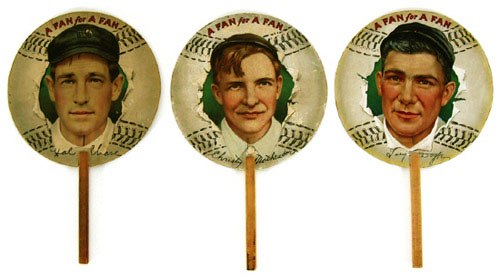
In addition to the Christy Mathewson fan featured in the ad,  Ty Cobb, Hal Chase, Frank Baker, and Larry Doyle were also available; the fans themselves included a facsimile signature of the player and no mention of Bull Durham.  Apparently they are rare enough that auctions date them only to “Circa 1910,” and make no mention of them being distributed by the tobacco company.

fan

Chase, Mathewson and Doyle fans from a 2005 auction; the three sold for $3,480.


Lost Advertisements–Pat Moran for Sloan’s Liniment

22 May

patmoran

An advertisement that appeared late in the 1919 season featuring Cincinnati Reds Manager Pat Moran:

“‘When my players get sore, I don’t rub them the wrong way;  I use Sloan’s Liniment–it penetrates.’

“Moran knows how to keep his men fit for the pennant scramble–keeps Sloan’s handy for emergency.  ‘Glass arm,’ ‘Charley horse,’ stiffness, soreness, bruises, rheumatic aches, are quickly and comfortably relieved.  Penetrates without rubbing, keeping the boys ready for the winning game.”

The 1919 World Series was the fourth for Moran.  He played in two with the Chicago Cubs (1906 and ’07) and managed two, (the other was with the Philadelphia Phillies in 1915).

Moran replaced Charles “Red” Dooin as Phillies manager after the team finished in sixth place in 1914.  Under Moran, the team won 10 of their first 11 games and won the National League with a 90-62 record.

In September, Frank Menke of The International New Service said:

“Moran deserves ranking among the greatest managers the game has ever known.  It is the wonderful leadership of the red-faced, gray-haired Irishman that has put the misfit Phillies where they are today.”

Moran

Moran

Menke said Moran was saddled with a team consisting primarily of “castoffs,’ and “one wonderful pitcher (Grover Cleveland Alexander).”

Moran followed up the 1915 pennant with two second-place finishes, with teams Grantland Rice of The New York Tribune said the manager had little to work with beyond pitcher Alexander:

“(T)hose astounding Phillies, piloted by a leader who has never received anywhere near his due recognition for extraordinary ability to lead a ball club.  need it be said that we refer to Pat Moran?  It needn’t.”

As was his habit, Rice memorialized Moran’s abilities with a poem:

Pat Moran’s no Miracle Man

Nor anything like that;

Nobody ever stands and cheers

The while he tips his hat.


Pat doesn’t draw the headline space

Nor yet the picture frames;

Pat Moran’s no Miracle Man–

Buthe’shellatwinninggames”

During his nine-year managerial career in Philadelphia and Cincinnati, Moran compiled a 748-586 record, which included a total of four second-place finishes to go with his two pennants.

During spring training of what would have been his sixth season with the Reds, Moran, who had a history of excessive drinking, became ill in Orlando, Florida.

His former Cubs teammate Johnny Evers came to his bedside.  According to The Associated Press, he said:

“‘Hello John, take me out of here.’ He then lost consciousness.”

He died later that day.  The official cause was Bright’s Disease.

Lost Advertisements–Famous Ball Players–Farmers & Merchants

24 Apr

farmersandmerchantsad

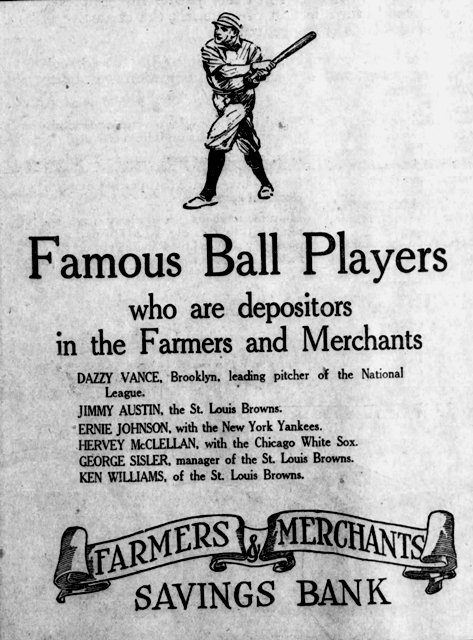
An October 1925 advertisement for California’s Farmers & Merchants Bank:

Famous Ball Players who are depositors in the Farmers and Merchants

Dazzy Vance, Brooklyn, Leading pitcher of the National League

Jimmy Austin, the St. Louis Browns

Ernie Johnson, with the New York Yankees

Hervey McClellan, with the Chicago White Sox

George Sisler, manager of the St. Louis Browns

Ken Williams, of the St. Louis Browns

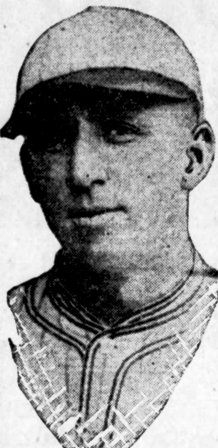
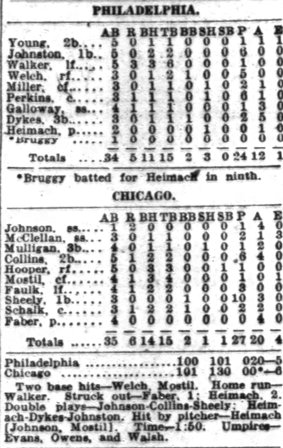
One of Farmer’s  Merchants depositors, Hervey McClellan, had an unusual distinction on June 14, 1922, while filling in at shortstop after his Chicago White Sox teammate, and fellow bank customer, Ernie Johnson was hit by a pitch and left a game against the Philadelphia Athletics.   The Sox, behind Urban “Red” Faber, took 6 to 3 lead into the eighth inning.

Hervey McClennan

Hervey McClellan

Then, according to The Chicago Tribune‘s Irving Vaughan, McClellan was responsible for “Possibly the most unusual feature of the afternoon,” when:

 “(He) started his high diving by muffing (Cy) Perkins‘ roller.  (Chick) Galloway then grounded to (first baseman Earl) Sheely who heaved to second, but McClellan neglected to cover.  This put runners on the two far corners and both counted when McClellan threw to the grandstand on (Jimmy) Dykes‘ grass cutter…What McClellan did was notch three errors on three consecutive batters…two runs scoring on the blunders and providing a close score.”

The Box Score

The Box Score

McClellan, who played six seasons with the White Sox, died a month after this advertisement appeared.  He had been ill for more than a year, suffering from  complications from two gall stone surgeries.

1911 Washington Senators Season Ticket Contest

22 Apr

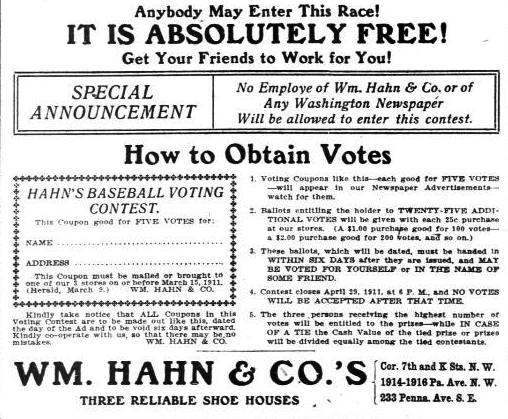
hahnscontest1


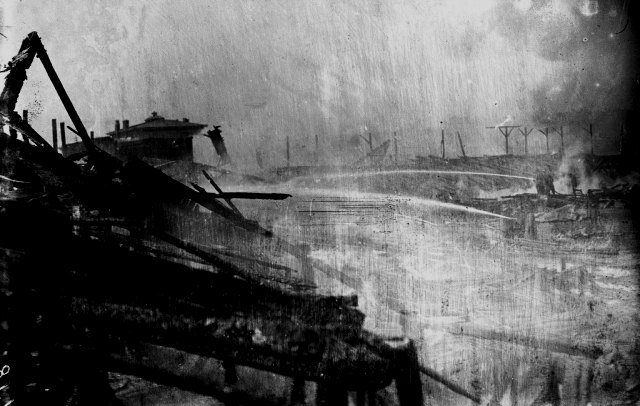
On March 17, 1911, a fire destroyed Washington D.C.’s Boundary Field, almost immediately construction began on a new ballpark on the site–what would become Griffith Stadium.
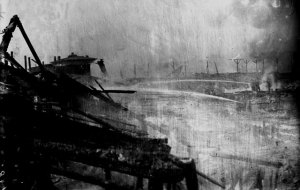
The Boundary Field fire.

The Boundary Field fire.

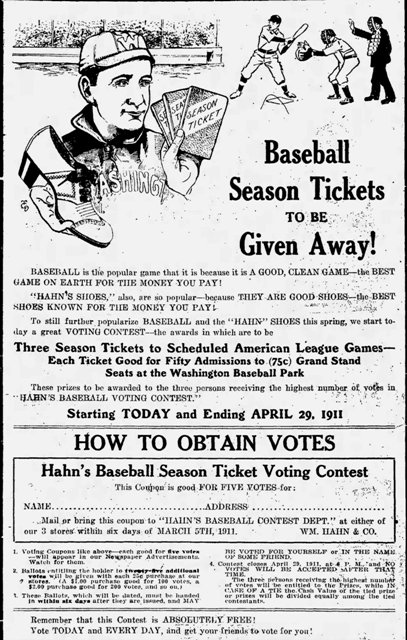
The Hahn Shoe Company took out advertisements in all of Washington’s daily newspapers announcing a promotion for the new ballpark:

Baseball Season Tickets To Be Given Away!

“Baseball is the popular game that it is because it is A GOOD, CLEAN GAME–the BEST GAME ON EARTH FOR THE MONEY YOU PAY!

“‘HAHN’S SHOES,’ also are so popular–because THEY ARE GOOD SHOES–the BEST SHOES KNOWN FOR THE MONEY YOU PAY!

“To still further popularize BASEBALL and the ‘HAHN’ SHOES this spring, we start today a great VOTING CONTEST–the awards in which are to be

“Three Season Tickets to Scheduled American League Games–Each Ticket Good for Fifty Admissions to (.75) Grand Stand Seats at the Washington Baseball Park.”

The contest called for fans to collect votes on their behalf–the three highest vote totals by April 29 would receive the tickets to 50 home games from May 4 through the end of the season.

The contest became very popular, and by April 9 The Washington Times said that a million votes had been cast,
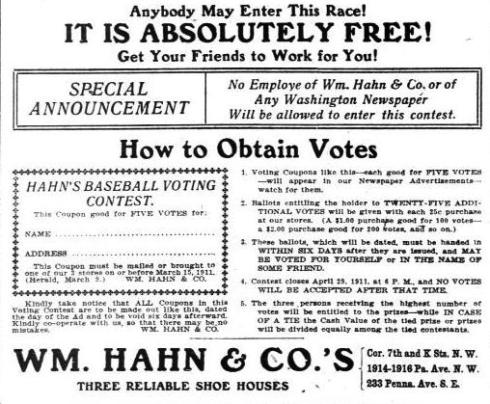
hahnscontestformBallots were printed regularly in the newspapers and additional votes could be received for submitting bonus coupons and purchasing items in Hahn stores.

Leader boards were displayed in the windows of each Hahn store, and The Washington Herald said “So close to the present leaders are many of the other contestants that constant changes are likely.”

When the contest came to an end, The Times claimed “a total of 7,000,000 votes was [sic] cast by friends of the contestants.”

Hahn’s announced the winners in large ads in all of Washington’s newspapers:
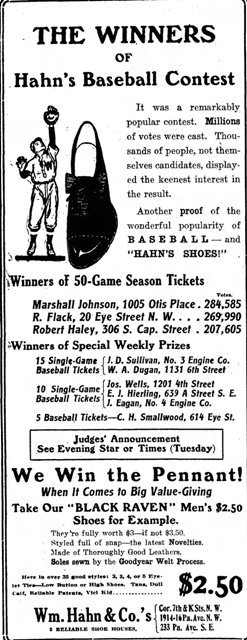
hahnscontestwinners

The winning contestants each received more than 200,000 votes each.  Hahn’s said:

“That baseball and Hahn’s Reliable Shoes are both at the zenith of their popularity here in Washington was manifested by the phenomenal success of our Baseball Voting Contest, in which millions of votes were cast.”

Despite the claim that baseball was “at the zenith” of its popularity in the nation’s capital, or perhaps because construction of the new ballpark wasn’t completely finished until July 24, attendance dropped by nearly 10,000 from 1910 to 1911.

The Senators were no better either.  They followed their 66-85 record in 1910, with a slightly worse 64-90 mark in 1911.


Lost Advertisements–“Spark plug of Huggins’ Machine”

17 Apr

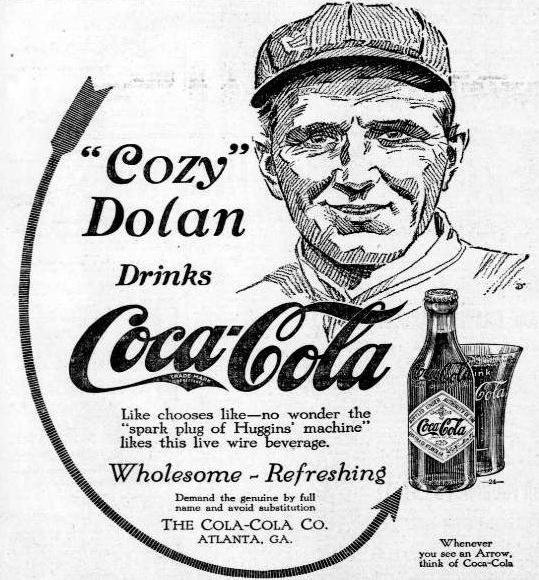
cozydolanA 1915 Coca-Cola ad featuring Albert “Cozy” Dolan of the St. Louis Cardinals.

“Like chooses like–no wonder the ‘spark plug of (Manager Miller) Huggins‘ machine’  likes this live wire beverage.”

Dolan, a 32-year-old utility infielder and outfielder who had never appeared in more than 100 games in a season before 1914, was an unlikely spokesman, given that most Coca-Cola ads of the period featured the game’s biggest stars.

He stole 42 bases for the Cardinals in 1914, but he hit just .240. In 1915, he hit .280 and stole 17 bases in 111 games.

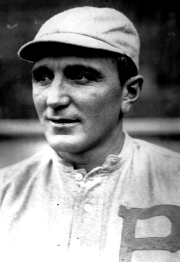
While hardly great numbers, Dolan’s time in St. Louis was a huge success when compared with his disastrous 35-game tenure with the Pittsburgh Pirates.

Dolan was traded to the Pirates by the Philadelphia Phillies for third baseman Bobby Byrne and pitcher Howie Camnitz in August of 1913 and became the team’s starting third baseman but hit .203, had a fielding percentage of .937 and became the target of angry fans.

Cozy Dolan

Cozy Dolan

Richard Guy of The Pittsburgh Post-Gazette described his time with the Pirates:

“He looked bad and he was object of revile by those who criticize, and he failed.”

Joe Kelly of The Pittsburgh Chronicle said:

“No player ever was ridden harder by players and fans than was the former International League speed boy when he performed at Forbes Field.  Perhaps few who held down a berth regularly ever deserved more criticism, for his performances were on the awful order.  But it’s a hard job to make good when hoots and howls follow every poor play, and the few successful ones are greeted with ironical applause.  Dolan got off wrong at Forbes Field and he seemed to be sensitive, too sensitive, to the crowd’s attitude.  There comes to mind a scene last summer when the Pirates were leaving their club house.  They came out in twos and threes, laughing and joking, but among the first was Dolan, all alone.  His face was strained and drawn and worried.  He had failed that day, and he knew it…The fans poured their criticism on his head, and he sat tight and took it without a whimper.  There is something in a guy like that, or the major league managers wouldn’t keep him sticking around.”

Dolan stopped “sticking around” after 1915.  Huggins released his “spark plug” at the end of the season.  He returned to the minor leagues, playing three seasons in the American Association, then became a coach for the New York Giants in 1922.

In 1924, received a lifetime ban from Commissioner Kenesaw Mountain Landis for his role in an attempt to fix a game.


Lost Advertisements–Larry Doyle for Coca-Cola

20 Mar

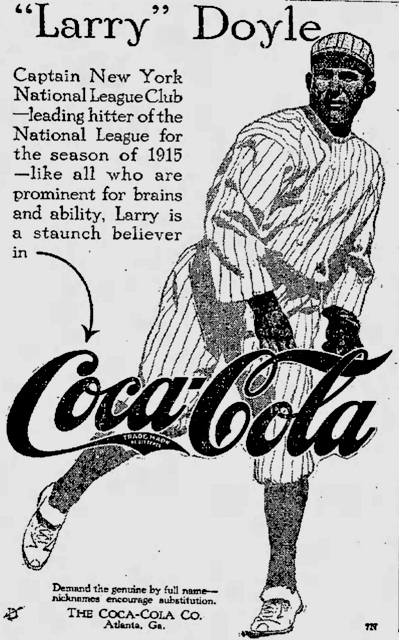
larrydoylecoke

A 1916 advertisement for Coca-Cola featuring New York giants Captain Larry Doyle.

Four years earlier, when Doyle led the Giants to a National League championship–hitting .330 and winning the Chalmers Award as the league’s most valuable player–he told a reporter from The New York Evening Journal that his success was driven by a snub from White Sox Manager Jimmy “Nixey” Callahan:

“When he was playing in a western minor league city (the Three-I League with the Springfield Senators) the (New York) Highlanders heard of him and asked Callahan, then playing independent ball (in Chicago’s City League), to look him over.  Callahan watched Doyle perform in several games and then wired the Highlanders:

“‘He isn’t fast enough.  Can’t field and isn’t a first-class hitter.’

“So Doyle was passed up and Callahan sent in a bill for $200 to cover his expenses and time.  Then (John) McGraw walked up…and paid $4,000 (actually $4,500) for Doyle, who couldn’t be purchased now for three times that amount.  All of which goes to show that some of the best judges of ball players make serious mistakes.”


Lost Advertisements–“The Clever Konetchy Drinks Coca-Cola”

13 Mar

konetchy

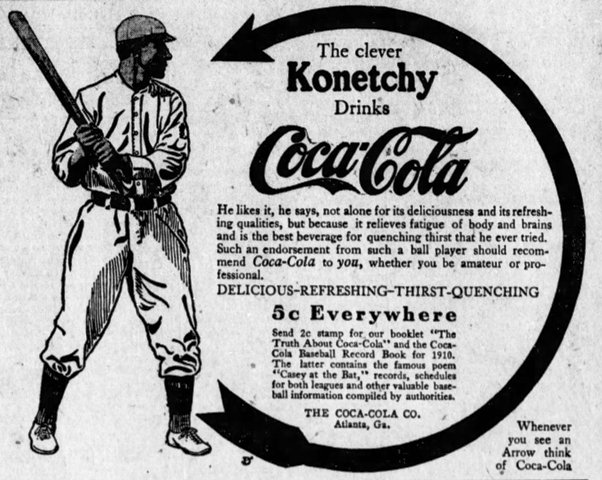
A 1910 advertisement for Coca-Cola featuring St. Louis Cardinals first baseman Ed Konetchy:

“He likes it, he says, not alone for its deliciousness and its refreshing qualities, but because it relieves fatigue of body and brains and it is the best beverage for quenching thirst he’s ever tried.

“Such an endorsement from such a ballplayer should recommend Coca-cola to you, whether you be amateur or professional.”

Two years later, Konetchy shared his theories on batting and batting slumps, with The St. Louis Globe-Democrat:

“The ordinary person cannot for the life of him reason out why a ballplayer should be able to hit one part of the season and suddenly take a slump and act like a novice at the bat.  To one familiar with the playing of the game of baseball, the reason for this was a well-known fact.

“Good hitting, considering of course a natural player, generally depends upon the physical and mental condition of the man.  When he is in good shape, his eye is clear and his brain works quickly;  when he is out of condition his mind is dull and he loses his eye for the ball.”

[…]

“The other day as were leaving the field of St. Louis, I heard a fan, referring to one of our players, remark: ‘They ought to bench that fellow, he can’t hit anything.’  As a matter of fact, the man to whom he referred was one of the best stickers of our team and had merely been up against a little hard luck.  For three or four days, I have watched this player and almost every time he came to bat he had met the ball squarely but could not seem to place it into fair territory.  This is a fact that is not taken into consideration by a great many baseball lovers.  They judge a man’s ability to hit by reading the scores in the next day’s papers, not at all stopping to think that a man who has no hits credited to him may have done far more towards winning the game than the player who annexed two or three safeties.”

Lost Advertisements–The Missouri Store

30 Jan

1914ad

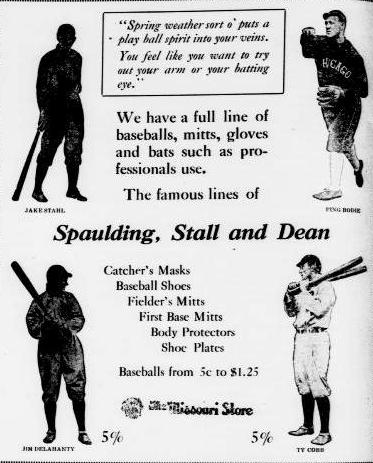
A 1914 advertisement for The Missouri Store at the University of Missouri in Columbia.  The ad features Jake Stahl, Frank “Ping” Bodie, Jim Delahanty and Ty Cobb.

“Spring weather sort o’ puts a play ball spirit into your veins.  You feel like you want to try out your arm or your batting eye.”

The store carried a full line of items “such as professionals use” from Spalding and Stall & Dean–catcher’s masks; baseball shoes, fielder’s mitts; first base mitts; body protectors, and shoe plates–with “Baseballs from 5 cents to $1.25.”


Lost Advertisements–Beer “The Proper Drink for Athletes in Training”

23 Jan

cobbbecker's

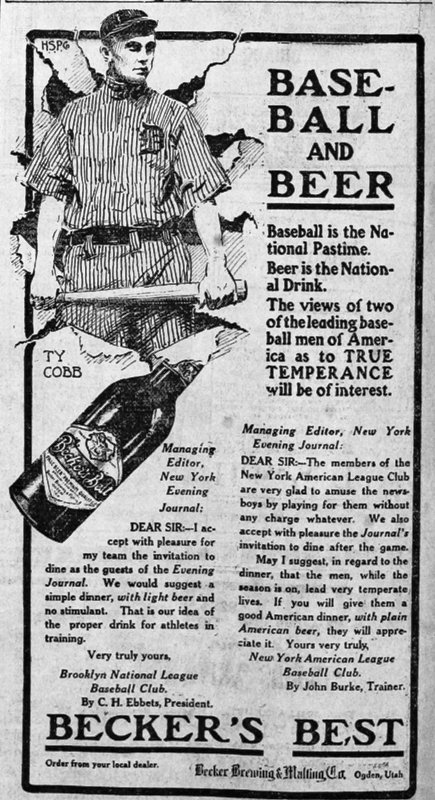
A 1918 advertisement for Becker’s Best Beer from Utah’s Becker Brewing & Malting Company, featuring Ty Cobb,  the ad said:

“Baseball is the National Pastime.  Beer is the National Drink”

It also included testimonials from “two of the leading baseball men of America as to True Temperance.”

As a result of the World War I “Food and Fuel Control Act,” malt beverages were mandated to contain less than 2.75% alcohol; brewers were trying to highlight the non intoxicating aspects of their current products as a wartime ban on the brewing of all beer was on the horizon (eventually that ban was adjusted to allow brewing of “non-alcoholic malt beverages).

The featured letters were from Brooklyn Robins President Charles Ebbets and New York Yankees Trainer John Burke to The New York Evening Journal regarding the paper’s invitation to a dinner honoring the ball clubs. Ebbet’s wrote:

“I accept with pleasure for my team the invitation to dine…We would suggest a simple dinner, with light beer and no stimulant.  That is out idea of the proper drink for athlete in training.”

Burke wrote:

“May I suggest in regard to the dinner , that men, while the season is on, lead very temperate lives.  If you will give them a good American dinner, with plain American Beer, they will appreciate it.”

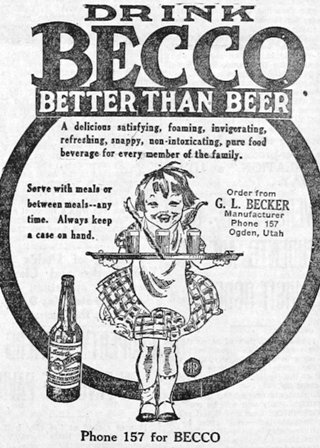
Becker Brewing & Malting, according to a  1919 issue of “Brewers Journal,” was among the company’s making “laudable efforts…to meet the adverse conditions which have been imposed under the veil of ‘war time’ prohibition” by bottling soft drinks and manufacturing “Becco, a cereal beverage.”

Ty Cobb no longer appeared in the ads.

becco