Tag Archives: Lost Pictures

Lost Pictures–Pete Childs

9 Mar

A good detective story.

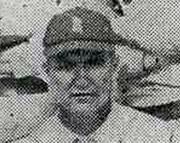
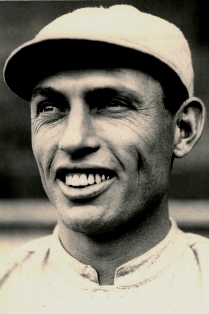
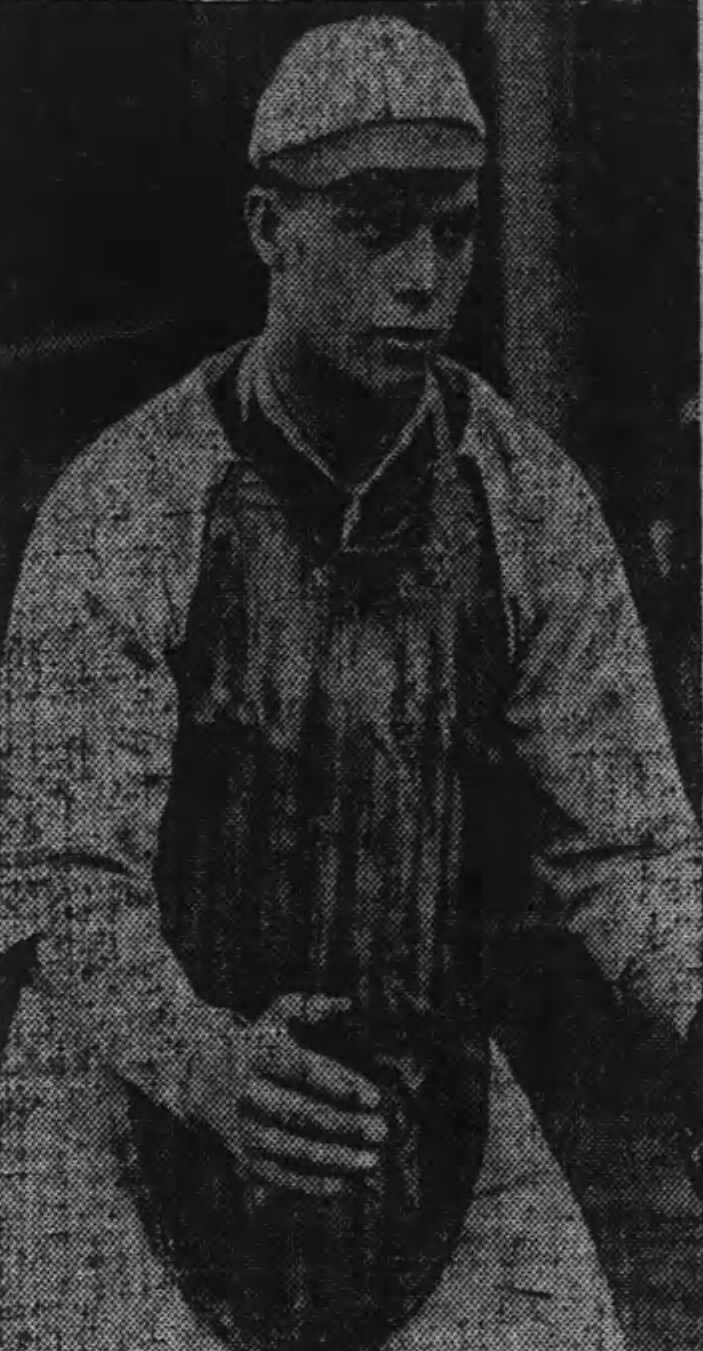
In February, I told the story of Peter Pierre Childs’ one-pitch triple play while he was the manager and occasional relief pitcher for the Portsmouth Cobblers in the Ohio State League in 1910.  While I was able to locate a picture of Childs with Portsmouth, I could not find a high-quality image of him in a major league uniform.  The only one I was aware of was a grainy photo included with Childs’ one-sentence biography in Wikipedia.

After I posted the story, I received an email from Mark Fimoff, co-chair SABR Pictorial History Committee. Mark is one of the foremost baseball photograph researchers and has helped me identify players in photographs in the past.

He has recently discovered two photographs of Childs that have been misidentified for more than 100 years.

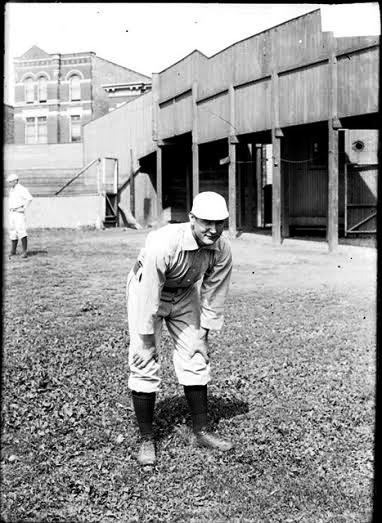
petechilds petechildschidailynews2

The pictures are part of the collection from The Chicago Daily News.  The paper, and subsequently, the Library of Congress and the Chicago History Museum misidentified Childs (and also got the year wrong) until Mark discovered the error.

The listings for the pictures say:

“Baseball player Delhanty [sic] standing on a baseball field.”

And

“Baseball player Delhanty [sic] bending forward with hands on his knees standing on a baseball field.”

“Delhanty” is Jim Delahanty, who played with Childs on the 1901 Chicago Orphans.

jimdelahanty

Delahanty

pchilds

Pete Childs

Pete Childs

The listings for the photos also say they were taken in 1906.  Mark said, based on the uniform and the centerfield clubhouse visible in the photos—the wood structure pictured was replaced with a brick structure in 1905—the photos could not be from 1906.  Neither Childs nor Delahanty played with Chicago in any season other than 1901–so the photo was taken sometime between mid-July and October of 1901.

—–

 Childs was acquired by the Orphans in July after he was released by the St. Louis Cardinals.  He replaced Cupid Childs (no relation), who had been released by Chicago a week earlier, at second base.

Pete Childs was an upgrade in the field but hit just .229, 29 points lower than his predecessor, Cupid Childs.

The Chicago Inter Ocean said:

“Pete Childs is the best thing, in a fielding sense, Chicago has had since the days of (Fred) Pfeffer.  It is a mystery how a man who moves so fast after a grounder can move so slow in going down to first.  It is probable that Motionless Peter stands on his heels when batting, and that he thus heaves a mound of earth under his hoofs, blocking his passage, when he scoots, and materially jarring his batting average.”

Pete Childs was released by Chicago at the end of the 1901 season.

Lost Pictures–The Princeton Pitching Gun

6 Mar

princetonpitchinggun


The illustration above–from The Chicago Times-Herald in the summer of 1897–depicts the Princeton University team’s first use of The Pitching Gun–the invention of Mathematics Professor Charles Howard “Bull” Hinton, a member of the Princeton faculty.

The Times-Herald said of the gun:

“A test was recently made at Princeton in three games played on the college ball field, and the machine is said to have given satisfaction, although there was some delay caused by the necessity of loading the canon.”

The paper said there were no problems “regulating the speed of the ball, nor in causing it to curve or drop as if thrown by a human being.”

The illustration is inaccurate, the device was not fired like a gun, but rather, according to The New York Sun, it was “discharged by the batsman, who, when ready for the ball to be delivered, steps upon an electrical intercepting plate, connected by wires which trigger the cannon.”


The success of the new invention, which Hinton had been testing for more than a year, was likely overstated as well.

A trial of the gun in Newark, during an exhibition game between the Newark Field Club and the Orange Y.M.C.A., did not go as well.

The New York World said:

“Prof. Hinton and his so-called pitching gun were on exhibition at Newark yesterday…Fifty-seven persons were on hand to see the performance.”

The paper said it took Hinton more than an hour and a half to set up the gun, which used gunpowder to discharge the ball.  The players on both teams feared stepping up to the plate against the gun.

The World concluded:

“(Hinton) is thoroughly in earnest about the practicability of a pitching gun, although his experiences by this time should have convinced him that his invention, even if perfected, will never be of the slightest use to the world.”

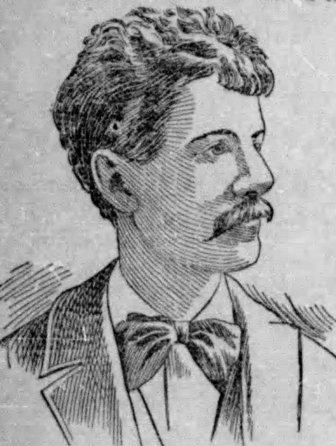
Charles H. Hinton

Charles H. Hinton

Hinton moved from Princeton to the University of Minnesota in 1898 and continued trying to perfect his invention, but The Philadelphia Press declared it “impracticable for regular use.”

Hinton finally abandoned his quest to create the first viable pitching machine when he went to work at the United States Navel Observatory in 1900.

Lost Pictures: Dode Paskert Plays Ice Baseball

20 Feb

dode

Ice Baseball made its first appearance in the winter of 1866 when the Athletic Baseball Club of Philadelphia played a game on ice against a “picked nine’ comprised of other local baseball teams.  Games were played occasionally over the next 50 years, but the game never caught on.

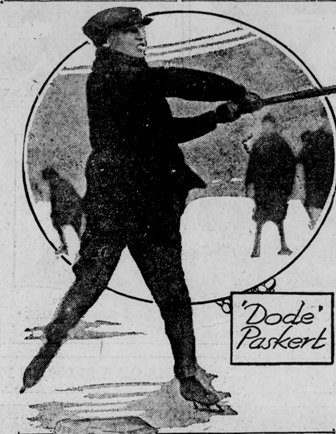
That changed briefly the winter following the 1919 season when the game, along with Ice Boxing, became a sensation in Cleveland.  The Cleveland Press said the biggest star among the “many ice baseball clubs” was Chicago Cubs centerfielder, and Cleveland native,  George “Dode” Paskert “an expert skater (who) says the exercise he is getting is going to put him about a month ahead” of his teammates.

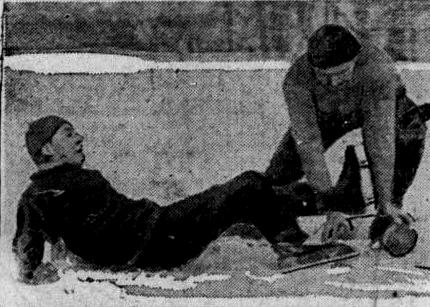
Unidentified Ice Baseball players in 1920 photo.

Unidentified Ice Baseball players in 1920 photo.

The paper said Cleveland Indians players Bill Wambsganss and Jack Graney played, and that Ray Chapman, the Indians second baseman,  and William “Pickles” Dillhoefer, catcher for St. Louis Cardinals would be joining teams.

Indians Manager Tris Speaker umpired at least one game.

Like every other short-term Ice Baseball craze, the game quickly faded in Cleveland.

Dode Paskert

Dode Paskert

As for Paskert, after a horrible 1919 season–.196 in 88 games–the 38-year-old seems to have benefitted from his “extra exercise.”  He hit .279 in 139 games in his final full season in the major leagues.


Lost Pictures–Sidney Smith’s Baseball Cartoons

26 Dec


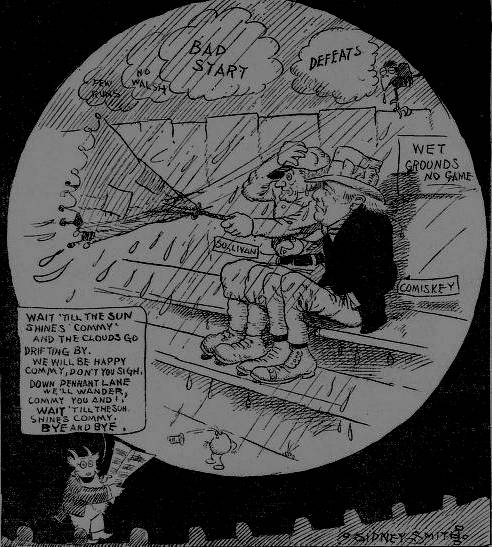
sidneysmithapril221909

By the time of his 1935 death in a car accident, Robert Sidney Smith—known professionally as Sidney Smith—was one of America’s most popular cartoonists; The New York Times said his death “will be felt by literally millions of Americans.”  His comic strip, “The Gumps,” was syndicated by The Chicago Tribune, and ran in hundreds of newspapers; it also spawned dozens of animated film shorts, nearly fifty-two-reel comedy film, a radio program and merchandise.

But, before Smith joined The Tribune, he had started in Chicago drawing baseball cartoons for The Chicago Examiner.

The cartoons featured a talking (sometimes singing) goat named Buck Nix.

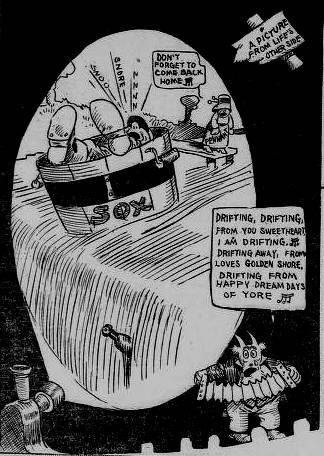
These two examples chronicled the  fortunes of the 1909 Chicago White Sox.

The first, above, appeared just seven games into the season.  Chicago had high hopes for the Sox, 86-64, the previous season, but the club limped to a 3-4 start.

As the cartoon notes, in addition to bad weather and weak hitting causing a poor start for President Charles Comiskey and Manager Billy Sullivan, Sox ace “Big Ed” Walsh was not yet with the team.  Walsh, a forty game winner the previous season held out for $7,500 and did not sign until April 28.  Still hopeful, “Buck Nix” says “Wait ’til the sun shines Commy.”

The second, below, appeared on June 26.  The Sox were 24-28, in fifth place, and as Buck Nix sings were “Drifting away from loves golden shore.”  Walsh only started 28 games, the Sox hit just .221 as a team and were never in the race.  They finished 20 games out in fourth place.sidneysmithjune261909

Lost Pictures–Walter Johnson Steamrolls the American League

20 Jun

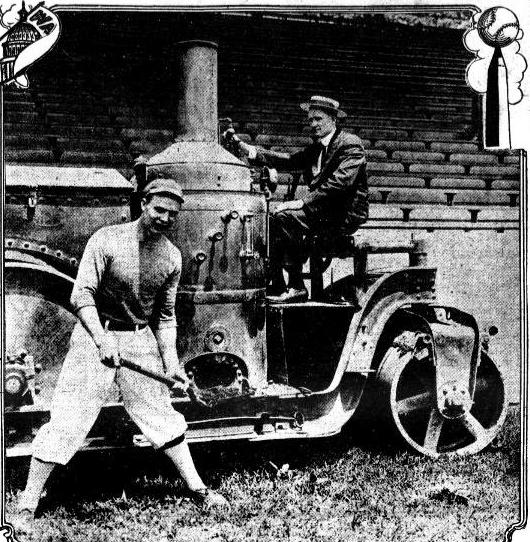
walterjohnsonsteam

A 1912 publicity photo featuring Walter Johnson at the wheel of a steamroller, and Senators catcher Eddie Ainsmith with the shovel at Griffith Stadium in Washington.  The photo was taken on June 17; the Senators had just returned from Cleveland having won 16 straight games–all on the road.  During the streak, the Senators had gone from 17-21 in sixth place, to 33-21, just one and a half games behind the Boston Red Sox.

The Washington Times said “It was considered an omen of continued triumph” that the steamroller was “found on the grounds.”

The Senators won the following day and continued playing well the rest of the way, finishing 91-61, their first winning season in the team’s 12-year history.  But, it was not good enough to catch the Red Sox who finished 14 games in front.

Johnson had his first of two 30-win seasons, finishing 33-12 with a league-leading 1.39 ERA.

Ainsworth played in the major leagues for 15 years, the first nine with the Senators.  The Washington Post said before the season opener in 1915:

“For the seventh consecutive year Walter Johnson will work in the opening clash for the home folks, and in nearly as many seasons will Eddie Ainsworth be his battery mate.  This pair always work together and no pitcher and catcher in either league are better acquainted when it comes to baseball.”

Eddie Ainsmith

Eddie Ainsmith

Several weeks after Ainsmith was traded to Boston (then to Detroit on the same day) in January of 1919, Louis Dougher a writer for The Washington Times said:

“When Eddie Ainsmith was traded to Detroit via Boston, Clark Griffith shattered on of the crack batteries…it was Johnson and (Charles “Gabby”) Street.  Then when Gabby slowed up and gave way to a successor, it rapidly became Johnson and Ainsmith.”

Age, more than the departure of Ainsmith slowed Johnson down, but he still won 140 games and posted three 20-win seasons after his personal catcher was traded.

Lost Pictures–1916 Champions of Chicago’s City League

8 Nov
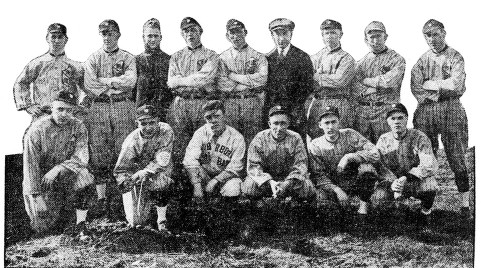
1916bankers

The 1916 Fort Dearborn National Bank team

According to The Chicago Examiner, in 1916 there were “more than 2000 amateur teams in Chicago, representing an army of from 18,000 to 25,000 young Americans who believe in clean living and wholesome athletic diversion.”  The team from the Fort Dearborn National Bank was the best.

On August 6 the Fort Dearborn’s beat out The First National Bank of Chicago team for the Bankers League Championship in August.  They next won Chicago’s month-long City League Championship elimination series, beating The Illinois Toll Company 10-1 in the championship game on September 2.

The team traveled to Des Moines, Iowa where they were defeated two games to one by the Des Moines Gas Company team and eliminated from the National Baseball Federation tournament, which was eventually won by the “Norwoods,” a powerful semi-pro team from Norwood, Ohio, who also won the tournament in 1917.

Lost Pictures–Hatton Ogle

17 Oct

hattonoglepix

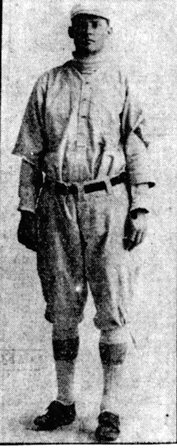
Hatton Geter Ogle (Texas papers often misspelled his last name “Ogles”) pitched in the Texas League from 1909 to 1916.  He was most likely born in 1885 (Baseball Reference lists his birth date as 1883, but North Carolina and Texas records disagree).

The six-foot, 185 pound Ogle began his professional career with the Wilson Tobacconists in the Eastern Carolina League;  complete records are not available, but in July The Raleigh Times said he “has pitched and won 11 games, having a clean slate.”

The Dallas Morning News said former pitcher Cy Mulkey watched him play in Wilson and signed him to a 1909 contract for the Dallas Giants;  Mulkey compared him to Texas League star Harry Ables.

Ogle moved to Texas after the 1908 season and took a job teaching school near Dallas, in Coppell; his off-season job earned him the nickname “professor’ in Texas papers–he continued teaching in the off-season through at least 1915.

He was just 7-14 with Dallas in 1909 and joined the Waco Navigators in 1910.  After an 11-22 season in 1910, Ogle had a three-year run as one of the best pitchers in the Texas League.

From 1911 until 1913 he was 21-11, 17-14, and 19-12.

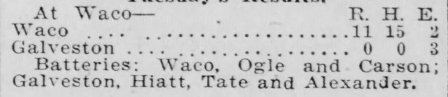
In 1912 he pitched in two exhibition games against the Chicago White Sox, on March 17 and March 30, allowing just two runs and six hits in nine innings.  He also had his first no-hitter that season, an 11-0 victory over the Galveston Pirates.

The Waco-News Tribune said:

“(Ogle’s) principal asset was his head, but when the occasion made it necessary ‘the professor’ shows his usual assortment of curves and speed.”

He continued pitching in the Texas League with Waco, the Houston Buffaloes, the Austin Senators and San Antonio Bronchos, through the 1916 season; he added a second no-hitter for Waco in 1914, defeating Austin 6-0 on April 26.

After an 8-17 season in 1916 his career was over.  He returned to the classroom until 1918 when he contracted tuberculosis and moved to El Paso, Texas, where he died five years later, on May 27, 1923.

The Waco News-Tribune–seven years after his career ended, and four years after Waco’s Texas League franchise had folded–simply said in Ogle’s small obituary:

“(He) was one of the popular tossers of the old Waco Navigators.”

Ogle's 1912 no-hitter

Ogle’s 1912 no-hitter

Ogle's 1914 no-hitter

Ogle’s 1914 no-hitter