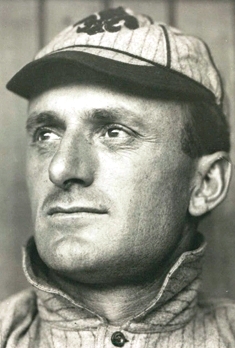
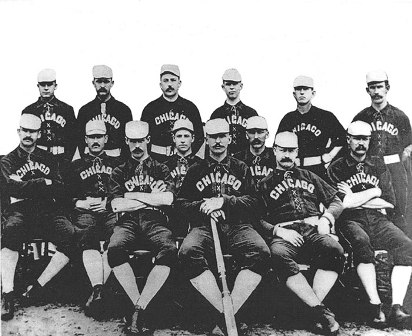
Tag Archives: National League

11,297,424

12 Sep

The Chicago Tribune baseball writer Hugh Fullerton was fond of saying:

“Once upon a time there was a baseball bug down in Cincinnati who figured out there were 11,297,424 possible plays in baseball.  This, of course, was counting only straight and combination plays and taking no account of the different kinds of fly hits and grounders, which all are different.  He proved it conclusively and the next day the team made one that wasn’t on the list.

“Every play, every throw, every hit is different.  That is why baseball is the national game, and there are freaks in the game that make even the case hardened regular sit up and yelp with surprise and joy.”

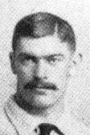
Hugh Fullerton

Hugh Fullerton

Fullerton made a career of telling stories about those plays; some might have even been true.

A few more of them:

“Philadelphia lost a hard luck game to Cleveland in the old twelve club league.  The score was close, Philadelphia had two men on base, and Ed Delehanty was at bat.

“He cracked a long drive across the left field fence—a sure home run.  The ball was going over the fence high in the air, when suddenly it changed its course, dropped straight down, hit the top of the fence and bounded back into the lot.

Ed Delahanty

Ed Delahanty

“The crowd, which had given up in despair, was astonished.  The Cleveland left fielder got the ball and, by a quick throw, cut down the runner at the plate and Delehanty was held at second.  The next men went out and Philadelphia was beaten.

“Investigation after the game proved that the ball had struck a telephone wire reading to a factory just outside the grounds.”

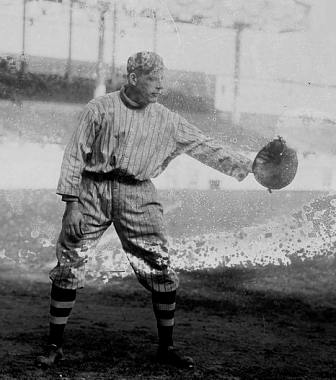
Tom Corcoran had one of the oddest baseball experiences in the history of the National League at the old Eastern Park grounds in Brooklyn years ago, in a game against Boston.  The game was played on the morning of Labor Day, and there had been a hard rain the night before.  In the early part of the game Corcoran, going after a ground ball, felt his foot slip and his ankle turn, and, half falling, he stopped the ball and then fell.  He turned to pick up the ball to throw out his man, and saw no ball—although there was a hole six inches across, into which his foot had plunged.  The runner, reaching first, stopped and saw Corcoran with his arm plunged to the elbow in the ground, and after hesitating a moment, he ran on down to second.

Tom Corcoran

Tom Corcoran

“Corcoran, meantime, had been thinking.  His fingers were clutched around the ball, and yet he waited, pretending to be groping for the ball.  The runner started on, and as he passed, Corcoran dragged the ball out and touched him out.”

“One of the funniest plays I ever witnessed was pulled off on the old Baltimore grounds along in 1896, and it was good-natured, happy Wilbert Robinson who made the blunder that resulted in the defeat of the Orioles when they might have won the game.

Wilbert robinson

Wilbert Robinson

“The struggle was between Chicago and Baltimore and it went into extra innings.  In the eleventh, with a Chicagoan on second Doctor Jimmy McJames made a wild pitch, the ball shooting crooked and bounding around back of the visitors bench with Robby in close pursuit.  The ball rolled back of the water cask and disappeared.  Robby made one frantic grab back of the cask, and then, straightening up, hurled a sponge full of water at McJames, who was covering the plate.  The Doctor grabbed it, and as the water flew all over him he tagged Jimmy Ryan…In spite of the fact that the play beat Baltimore, the crowd yelled with delight over it, and Robby, who had made the sponge throw as a joke when he found he could not get the ball in time, appeared as much pleased as if he had won the game.”


Matty and the Federal League

3 Sep

Despite the controversy during 1913 over ghost-written articles appearing under the bylines of major league players, Christy Mathewson continued to  “write” articles that were distributed to newspapers by the “Wheeler Syndicate.”  The Wheeler Syndicate was the creation of John Neville Wheeler, a reporter for The New York Herald, and widely known to be the writer of Mathewson’s articles.

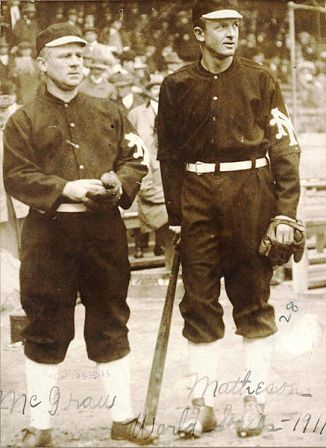
Christy Mathewson with John McGraw

Christy Mathewson with John McGraw

Shortly before the beginning of the 1914 season, Mathewson “wrote’ a story about the outlaw Federal League, and the attempt the nascent league’s president made to secure his services:

“Until I had definitely signed with the Giants again, I made no comment on the Federal League or the offer of that organization to me.  In fact, there was nothing definite in the way of an offer until I received a telegram from President (James A.) Gilmore a few hours after putting my signature to a National league contract…The proposition came out of a clear sky and was unexpected.  I have learned since that the Federals believed I was signed up all winter and that it was not until a New York newspaperman happened to mention the fact to Gilmore.”

James A. Gilmore

James A. Gilmore

A New York reporter (likely Wheeler) told Mathewson how Gilmore came to find out he wasn’t yet signed:

“’We were sitting around the Waldorf late one night, fanning and discussing the Federal League, when one of the boys said to Gilmore: “’Why don’t you make Matty an offer and get some publicity out of it anyway?

“’He’s signed isn’t he?’ asked Mr. Gilmore.

“’No more than I am.  His contract expired last season, and he has not signed the new one yet.’

“’Gilmore at once left the party and sent a telegram to you.  Then he announced his action to us newspaper men, and the story appeared in the papers the next day.’”

At the time of the offer, Mathewson was asked by a reporter from The Los Angeles Examiner whether he would consider joining the Federal League, and said, “he would consider the offer.”  He now claimed, “all the time I knew I would not desert the New York club which had practically made me in baseball.”

Mathewson also took the opportunity to deny another rumor; that he was in California working on behalf of National and American League franchises to help them protect their players from the Federal League said:

“I saw several reports in the newspapers during the winter and early spring months that I was the agent of organized baseball on the Coast and that I had been busy counterbalancing the bids of the Federal League agents for the players spending the winter there.  As a matter of fact, I kept clear of both baseball on the diamond and the politics of baseball last winter because I did not care to have it on my mind.   Was having too much fun playing golf, and it is not in my province as merely a player to try to influence others to take certain steps which some day they might regret and then blame me for their mistakes”

Mathewson used his former teammate, catcher Art Wilson, as an example of how he had not given any players advice about accepting Federal League offers—Wilson had jumped from the Giants to the Chicago Feds during the winter:

“(Wilson) received a big offer to go with the Federals with the promise of a large piece of advance money.  Wilson has been pining for the chance to work regularly with a big league club for two or three years now and was weary of sitting on the bench, absorbing information in this position about how it is done in the majors.  As I said in a previous article, Wilson even asked (Manager John) McGraw to transfer him to a minor league team this season so that he could have an opportunity to work daily.  Now, if the Federal League turns out to be a big success, and if I had advised Wilson to refuse its offer and stick with the Giants, he might have said to me some day:

“’Well, I took your advice and am still sitting on the bench.  If I had gone with the Feds, I might have been a star now.’”

Art Wilson

Art Wilson

The move did result in additional playing time for Wilson.  From the time he joined the Giants in 1908 until he jumped to the Feds, he had appeared in just 231 games over six seasons.  In 1914 and ’15 he appeared in 233 Federal League games, hitting .291 and .305.

Mathewson, who had been paid $9,000 by the Giants in 1913, would not reveal how much he was paid by the Giants for 1914: “It is at the request of the New York club that I do not state the terms.”  He did, however, say exactly what he was offered by Gilmore to jump.  He said after not responding to the initial telegram from the Federal League president—a telegram that did not mention terms–he received a second:

“’Newspaper reports state you do not take Federal League offer seriously.  Get acquainted with the Federal League officials and be convinced we are not four flushing.  I will give you $65,000 for three years service as manager of a Federal League club–$15,000 advance money.  If satisfactory, meet me at the Waldorf Thursday, at my expense.  Wire answer Chicago.’”

Mathewson said he “was torn with regret” for refusing the offer that would have more than doubled his salary.

“It would be like leaving home if I were to pass up the Giants now.  I don’t think I would feel right in any other uniform.”

Mathewson said “the Federals have been spending money very liberally,” but placed the credit for the success the league had in inducing players to jump with Joe Tinker.  Tinker had jumped the Cincinnati Reds to join the Chicago Feds as player-manager.  Mathewson said:

“At first there was little confidence in the backers of the new organization until Joe Tinker jumped…The ball players had faith in Tinker because he is rated as one of the shrewdest in the business.  If the Federal League lives and goes through, Joe should get credit for it, because he is the man who has collected practically all the players for it.”

Joe Tinker

Joe Tinker

Both 33-years-old Mathewson (24-13 3.00 ERA) and Tinker (hit .256 in 126 games and led the Chi-Feds to a second place finish) had their last productive seasons in 1914.

Mathewson continued to “write” articles for the Wheeler Syndicate until 1916 when Wheeler sold the operation to the McClure newspapers.  Almost immediately after the sale, Wheeler formed the Bell Syndicate, and occasional articles under Mathewson’s byline were distributed by Bell through 1919.

“Lord, if you ever Helped a Mortal Man, help me get that Ball”

29 Aug

Outfielder turned evangelist Billy Sunday spent a month during 1902 traveling through the small towns of East Central Indiana, preaching in the small towns that rose as a result of the natural gas boom.

Billy Sunday

Billy Sunday, ballplayer

A reporter for The Philadelphia Press spent time with Sunday during the tour, and the paper ran a story that the evangelist told at every stop—about how “prayer saved a game of baseball.”

Sunday said it happened during 1886—Sunday at various times said he was “saved” in 1886 or 1887– when he was playing for the Chicago White Stockings.  The first place White Stockings were playing the second place Detroit Wolverines in a September series:

“The last half of the ninth inning was being played,” says the ex-ball player.  “Two men were out, and Detroit, with Charley Bennett at bat, had one man on second and another on third.  He had two strikes on him and three balls called, when he fell on a ball with terrific force.  It started for the clubhouse.  Benches had been placed in the field for spectators, and as I saw the ball sailing through my section of the air I realized I was going over the crowd, and I called: ‘Get out of the way!’  The crowd opened, and as I ran and leaped those benches I said one of the swiftest prayers that was ever offered.

“It was, ‘Lord, if you ever helped a mortal man, help me get that ball.’  I went over the benches as though wings were carrying me up.  I threw out my hand while in the air, and the ball struck and stuck.  The game was ours.  Though the deduction is hardly orthodox, I am sure the Lord helped me catch that ball, and it was my first great lesson in prayer.  Al Johnson, brother of the present mayor of Cleveland, ran up to me and handed me a ten-dollar bill.  ‘Buy a new hat Bill,’ said he.  ‘That catch won me $1,500.”

The White Stockings went on to win the National League championship over Detroit by two and half games.

Sunday’s stories earned him thousands of followers, and scores of critics—among the religious and non-religious.

Billy Sunday, evangelist

Billy Sunday, evangelist

A 1915 article—during the height of Sunday’s popularity– in “The Congregationalist and Christian World,” the magazine of the National Association of Congregational Christian Churches said:

“He has grave faults.  He is intolerant; his language is often violent, impatient and unkind.  He is a fighter of the types that asks and gives no quarter.  I saw him do and say things that seemed to me ridiculous and I disapprove of many things I reason to believe he has said and done.  I could make out a pretty strong case against him on the facts I have at my command.  But after we have said all that, we have before us a preacher whom I believe to be honest and earnest…He says ‘If I talked the same and acted the same as the other fellows do I wouldn’t get more people to listen to me than they get.’  With the crowd before him he wins their confidence, makes them his friends and delivers the message that is in his heart.  He talks plain, blunt language, tinged with the vernacular of the sporting crowd and that all who follow our great national game are accustomed to use.”

“Sweeney was Drunk, but I didn’t Know it”

22 Aug

In 1884 Frank Bancroft’s Providence Grays won the National League pennant and defeated the American Association’s New York Metropolitans in the World Series—the first post-season exhibition to be called the World Series.  Late in 1896 he told a reporter for The Boston Post his version of the story of the turning point in that season:

Frank Bancroft

Frank Bancroft


“We were leading the championship race (the Grays were in 2nd place at the time of the game in question).  Both (Charles) Sweeney and (Charles “Old Hoss”) Radbourne were pitching in grand style.  In those days you couldn’t take a player out of the game and put another one in his place unless he was sick.  I wanted to save my pitchers all I could.  One day we were playing the Bostons (Bancroft was incorrect; the game was against the Philadelphia Quakers on July 22).  I had (Joseph) Cyclone Miller in right field and Sweeney in the box.  I told Joe Start, who was captain of the team that if we got far enough ahead in the game to take Sweeney out of the box and bring in Miller.  I did this to save Sweeney’s arm.  In the sixth inning we had a lead of 7 to 2 (the score was 6 to 2).  I told Start to make the change.  He asked Sweeney to go out in the field.  Sweeney was drunk, but I didn’t know it.  Start’s request made Sweeney mad.  He didn’t take it in the way it was meant.  He walked off the field.  I went after him, but couldn’t get him to come back.

“He called me a vile name.  The president of the club (J. Edward “Ned” Allen) went to him and asked him what he meant, and he called him everything vile on the calendar.  Sweeney was very drunk.  We had to finish the game with eight men, and the Bostons [sic] beat us out (Providence lost 10 to 6).  The directors of the club had a meeting that night, expelled Sweeney and came within an ace of breaking up.  In fact, they did vote to disband.”

Charlie Sweeney

Charlie Sweeney

With Sweeney gone, the team was left without their two top pitchers.  Bancroft had suspended Radbourn earlier in the month, and he was still sitting out at the time—Radbourne was unhappy sharing the pitching duties and was rumored to be heading to the St. Louis Maroons in the Union Association–The Providence Evening Press in describing Sweeney’s July 22 outburst said he had “caught Radbourn’s complaint.”

Picking up the story in The Post, Bancroft said:

“They said there was no use of going on with one pitcher.  I said to President Allen: ‘If you will give me authority to tell Radbourne that you will not reserve him at the end of the season, I can get him to pitch all the rest of the games this year.’  ‘All right,’ said Allen, ‘you have that authority.’  I found old Rad at his boarding house.  I told him about the proposition.  ‘It’s a go,’ said Rad.  ‘I’ll get rid of reservation if I lose my arm.  I’ll pitch all the other championship games this season.”

Radbourn did not pitch “all the other” games that season but did pitch 75—with 73 complete games, 678 2/3 innings.  Bancroft said of his pitcher:

“It was the greatest feat of endurance I ever witnessed.  Rad was in awful shape before it was all over…Why, (his arm) hurt him so bad when he would get up in the morning that he couldn’t get it up high enough to fasten his collar button.  He had to comb his hair with his left hand.  It used to make me shudder to look at him, but he was gritty.  He would go out in the afternoon before the game, and instead of loosening up by easy pitching, as pitchers do nowadays, he would go in the field and throw the ball just as far as he could.  He would throw for ten or fifteen minutes, until he got wound up, and then he would go in to pitch a winning game.”

"Old Hoss" Radbourn

“Old Hoss” Radbourn

Bancroft said the pitcher “could split the plate any time he wanted to,” and that during “morning practice, to show what he could do, Radbourn would set a pop bottle on the home plate and knock it down three out of four times.”

The release of Sweeney had an immediate positive effect on the Grays.  On the day of the incident, The Evening Press said: “The pennant is no doubt out of the reach of Providence this year.”

The following day, after Radbourn pitched the team to an 11 to 5 over the New York Gothams, the paper’s outlook brightened:

“The summary expulsion of Sweeney for crookedness seemed to have a salutary effect, on Wednesday, for the purging of the club of such a bad egg resulted in a better class of patrons on the grand stand than for many weeks.  The attendance throughout was better than the management had looked for after the airing of Sweeney’s revolt, about 700 being present. “(There were just 450 in the stands the day before for “Sweeney’s revolt”)

Sweeney had not yet left for St. Louis and the paper took the opportunity to take one final shot at the pitcher:

“Sweeney is still about town, and wherever he goes the women whom he escorted to the ball game on Tuesday are seen with him.  The conduct of this fellow is shameful, and he will regret it when he fully wakes up to its enormity.”

The twenty-one-year-old Sweeney pitched the Maroons to the Union Association championship with a 24-7 record and 1.83 ERA.  Whether his arm couldn’t handle the strain, or as a result of his off-field habits, he would only win 16 more games (losing 30), and was out of the major leagues at age 24.

He returned to his home in California and played for teams in the California, Central California Leagues, after his retirement he worked for a short time as a police officer and later worked in saloons around San Francisco.

By the time Bancroft shared his reminiscences of 1884 with The Post, Sweeney was incarcerated in California, and Radbourne was dying in Illinois.

In July of 1894, Sweeney shot a man named Cornelius McManus during an altercation in a bar.  The San Francisco Chronicle said when he was informed the following day that the victim was dead “he broke down and wept bitterly.”  Sweeney was convicted of manslaughter four months later and sentenced to eight years.

The Chronicle said he was released after serving “a little over three years of his sentence,” after which “his health broke down.”  Sweeney died of Tuberculosis in 1902—most sources say he died on April 4—The Call and The Chronicle both said he died on April 3.

Radbourn pitched 1311 innings in 1883 and ’84, and started and won all three games in the 1884 World Series.  Bancroft said that after the Grays won the championship:

“President Allen kept his word, and gave him his release; but Rad didn’t take it.  The club offered him just twice as much salary for the next year.”

Radbourn pitched seven more seasons and finished his career with a 309-194 record.  After being accidentally shot in a hunting accident, and suffering from a variety of ailments, he died in February of 1897.

Bancroft remained in baseball until January of 1921 when he retired a business manager of the Cincinnati Reds. He died two months later at age 74.

“It is Feared that the Cares of his Office are making an old man out of Tim”

18 Aug

Timothy Carroll “Tim” Hurst had an eventful season in 1906.

He had been an umpire since 1891—with the exception of one awful season managing the St. Louis Browns to a 39-111 last place finish in 1898.  In 1904 Hurst retired from the National League, but months later joined the umpire staff of the Central League, and took a job in the American League in 1905.
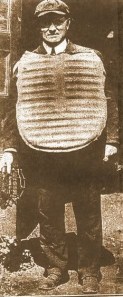
Tim Hurst

Tim Hurst

The Kansas City Journal described the 5’ 5” umpire who was also a boxing referee::

“Hurst is a pudgy little fellow, below medium height, with sandy hair, twinkling blue eyes and a ruddy complexion.”

He was often called “pugnacious” for his on field, and off, altercations, and once told a reporter for The New York Herald how he dealt with argumentative catchers:

“Never put a catcher out of the game.  If the man back of the bat is sassy and objects to your calling of balls and strikes, keep close behind him while doing your work and kick him every time he reaches out a catch a ball.  After about the third kick he’ll shut up.”

The incident that earned him the most attention in 1906 happened during a May 7 game in New York between the Highlanders and the Washington Nationals.   The New York Times said during the fifth inning:

(Frank) LaPorte was declared out at first base on a close decision.  Manager (Clark) Griffith rushed over to the base line, and, throwing his cap in the air, protested against the decision.  He wildly gesticulated, and Hurst ordered him away.  Griffith, instead of following Hurst’s instructions, stepped up to the latter, protesting all the time.  In his excitement he stepped upon Hurst’s foot.”

Hurst “drew back” to punch Griffith but was held back by players from both teams.

“Hurst then took hold of the lapel of Griffith’s coat and started to lead the player-manager to the bench.  The latter angrily resented this action and pushed Hurst’s hand away.  Lave Cross and the Washingtons tried to pacify Griffith, and succeeded in getting him to the players’ bench.”

Hurst followed Griffith to the New York bench and again attempted to punch the manager, while Griffith “rushed at the umpire.”
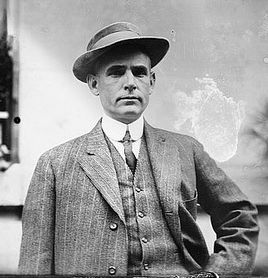
Clark Griffith

Clark Griffith

According to The Associated Press Griffith claimed “’Hurst didn’t hit me.’ Then pointing to his swollen mouth he added, ‘I had this swollen lip before the game.’”

Hurst and Griffith were both suspended for five games.

The following year Henry Pierrepoint Edwards of The Cleveland Plain Dealer said Hurst had given him an explanation to “clear up the mystery” of why he reacted so violently:

“Now, it isn’t customary for Tim to wear baseball shoes on the diamond.  Usually Tim appears for the fray clad in the same suit he would wear at a pink tea.  His real uniform is just a cap.

“On the afternoon in question Tim purchased a new pair of patent leather shoes.  The shoes glistened in the sun like a diamond and gave Tim great pleasure.  Griffith forgot all about the shoes and in his rage over losing a close decision spiked and spoiled the new kicks.  Great was Tim’s rage.  Even greater was the clash.  That’s all.”

Two months after the incident with Griffith, Hurst made what might have been the worst call of his career.

On July 7 in Washington, he was working the game between the Nationals and the Detroit Tigers.  The score was tied 3 to 3 in the seventh inning, the Tigers had the bases loaded with two out and Sam “Wahoo” Crawford at the plate, facing Nationals pitcher Frank KitsonThe Washington Post said:

“’Wahoo’ lifted one a thousand miles directly over the pan.  Kitson came tearing in,  (Catcher Howard) Wakefield hesitated.  Manager (Jake) Stahl stood still at first base.  The pellet whirled in the air and finally dropped just inside the line and bounded back to the stands.  (Charley) O’Leary and (John) Eubank romped home.  Crawford went to second, carrying the funniest two-base hit on record.  Kitson and Wakefield stood admiring each other until Hurst again yelled ‘Fair ball!’ when the boy catcher went after the bulb.”
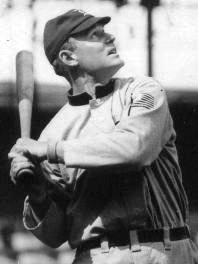
Sam Crawford

Sam Crawford

While the Nationals argued the call, and Hurst refused to reverse his decision, The Post said “The spectators were forced to listen to the dillydallying for fully fifteen minutes, then many of them got up and left the belligerents wrangling over the decision.”

Kitson threw a wild pitch to the next batter, Matty McIntyre scoring Herman “Germany” Schaefer and Crawford.  The Tigers went on to win 9 to 3.  Jake Stahl filed a protest with American league President Ban Johnson.

The Washington Evening Star said:

“The only excuse that Umpire Hurst can have is that the play was an unusual one.  Lave Cross admitting that he never saw its like in his experience on the diamond.  Hurst was palpably rattled, and the Tigers when taking their places on the field chaffed the locals with the remark that ‘Tim certainly handed us one that time.’”

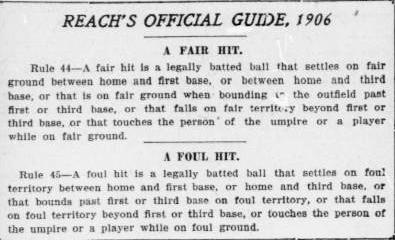
The Washington Times said it was “one of the most remarkable plays ever seen on a diamond,“ and printed for their readers rule number’s 44 and 45 from the 1906 “Reach Guide” Reach describing “A Fair Hit,” and “A Foul Hit.”
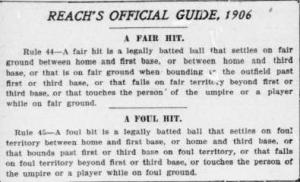
The Washington Times used "The Reach Guide" to illustrate how Hurst blew the call.

The Washington Times used “The Reach Guide” to illustrate how Hurst blew the call.

The Times said:

“(T)here seemed no possible way of calling it fair, but Hurst was obdurate, and the only explanation he would give was that the ball ‘was hit too high.”  What the heighth of the hit had to do with the fact that it eventually bounded foul is still another mystery.”

Hurst’s story evolved over the next several days.  The Post said his original explanation regarding the ball’s height was “to the effect that the ball was it so high it ‘settled’ inside, constituting the hit a fair one. “  This was quickly replaced by Hurst’s claim that the ball had touched Wakefield, the Washington catcher, before bounding into foul territory.

The Times’ baseball reporter Thomas Stevens Rice said of Hurst’s new story:

“This explanation is all right if it presents the facts in the case.  In the press box there was not a single man who thought the ball was touched by Wakefield or anybody else.”

The Post conceded that the protest would be rejected, saying “It is almost certain that Ban Johnson will sustain his scrappy umpire, no matter what interpretation he puts on the rules,” but the paper did not let up on Hurst.

The following week when Sam Crawford brought his average up to .300, The Post said:

“Hurst last week decided that Crawford’s high rap which hit inside the base line and bounded back to the stands was fair…am would have faced the pitcher 271 times and got away with 81 hits which would have made his average .299, as it was Sam got and extra hit which brought the total to .303.  He owes Tim a hat.”

Hurst was still young, just forty-one in 1906, but The Sporting Life said something had changed during that year, and by the end of the season that the umpire lacked the “Aggressiveness and enthusiasm” he had previously exhibited:

“It is feared that the cares of his office are making an old man out of Tim, who once was noted for having the finest brand of keen-cutting, kill-at-a-thousand-yards sarcasm of any umpire in captivity.  Sit Timothy is very tame, and the players, even the bush leaguers who have just broken in, can tell him what they think of him and his calling.”

Hurst’s old “aggressiveness” came out in 1909.  He was suspended in May for a fight with Norman “Kid” Elberfeld of the Highlanders, then on August 3 during a game between the Athletics and White Sox.  The Brooklyn Eagle said:

“At Philadelphia Tim Hurst came in for considerable trouble.  Hurst called Eddie Collins out at second and the Columbia youngster put up a kick.

“Whether it was with malice aforethought or quite an accident, it is a fact that the umpire distributed a mouthful of moistened union-made tobacco in the direction of the youthful Eddie, who immediately called Tim’s attention to the board of health ordinance which prohibited expectorating in public places.”

After the game Hurst had to be escorted from the field by Philadelphia police.  Ban Johnson suspended Hurst, beginning two weeks of rumor and speculation about the umpire’s fate.  Finally, on August 18 it was announced that Hurst had been let go by the American League.

Hurst, in poor health since 1912, died in 1915.  Hugh Fullerton of The Chicago Examiner said of his passing at age 49:

“The saddest part of it is that ‘Timothy’ did not die in the blue uniform, and that during the last few years of his life he was practically blacklisted in baseball for refusing to answer or deny charges made against him for his actions during a clash with Eddie Collins…President Johnson declared that if Hurst even had replied to his telegrams of inquiry he would have kept him—but Tim, knowing he had done wrong, refused, and went out of the game.”

“There are many Degrees of ‘Fan'”

1 Aug

It seemed that James Aristotle “Jim” Hart, president of the Chicago Orphans had a full plate in 1901.  His team got off to a 1-6 start and never recovered, finishing a disappointing 58-81, while the cross-town White Sox took over first place on July 10 and never looked back, winning the American League’s inaugural pennant.

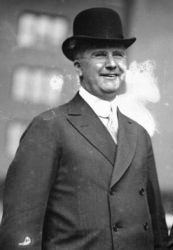
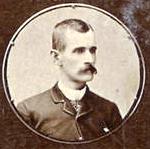
Jim Hart

Jim Hart

Additionally, Hart was meeting frequently with American League President Bancroft “Ban” Johnson in an attempt to avert all-out war between the two leagues.  Rumors about the trouble ahead were so numerous that The Chicago Inter Ocean said one day during August:

“Ban Johnson went fishing yesterday, and Jim Hart busied himself making out checks for his players.  As a plain matter of fact, there wasn’t enough baseball excitement in town to scare a rabbit, but the fakebirds sang just the same.  By night, the National League had flopped over to the American and the American had joined the National; all the players on each side had been stolen, and there were forty-six more baseball wars in view.”

Despite his fading team, the looming battle, and the fact that the White Sox would out draw his club by nearly 150,000 over the course of the season, he still found time to make it clear what constituted “a genuine fan.”  Hart wrote an article for The Chicago Record-Herald:

“The genuine fan is a proper adjunct of the game of baseball and should be encouraged, for from him must come the enthusiasm which provides capital necessary  to operate the game, the encouragement which causes youths to become proficient players and the constant dropping of con for admission tickets to witness games which permits the sport to continue.

“There are many degrees of ‘fans,’ some agreeable and some disagreeable to an extent which is intolerable.  The ‘fan’ proper is perfectly harmless; he annoys nobody and loves the game for the amusement and benefit he derives from it.  He keeps the records of players of his favorite team and players of other teams.  He feels as if he had encountered personal loss when his team losses and is correspondingly jubilant when the team wins.  He does not roar or rant at the players, but feels grieved that any player on his pet team should ever make an error.

“The next degree of ‘fan’ is the one who becomes wildly demonstrative; he can ‘see things’ only one way, and that is the way he wants them to be; the umpire’s decisions are invariably wrong when they do not happen to be the way he wants them; the errors made by the players of his favorite team are made purposely and could just as well been avoided.  Consequently he at once joins the chorus of ‘take him out’ etc…

“The disagreeable ‘fan’ is strictly speaking not a ‘fan’ at all, but is a person who wishes notoriety and the ‘laugh’ which his sallies cause, for be it known that almost any remark made by a person among the spectators  causes more or less of a laugh.  This class of ‘fan’ does not always employ profane of vulgar language, but his remarks are usually coarse and are personal, directed usually to some spectator, or to a player or to the umpire, and, as stated above while the language is not always of a character that is vile, it encourages the next lower degree of ‘fan’ to use expressions which cannot be tolerated on any properly conducted baseball park.

“An honest management is under great strain during a game of baseball whenever the attendance runs up into the thousands, for it feels that every person there, especially the women, are under the protection of the management, and, when one reflects upon the enormous force for good or evil that is contained in an enclosure of less than a half dozen acres when from 15,000 to 20,000 persons are congregated to witness what may prove a wildly exciting contest upon which the championship of the world may depend, he will not by any act or word jeopardize the welfare and happiness of the people assembled.

“The mobs that attack umpires are not ‘fans.’  They are cowards and rowdies and the person who from the crowd insults a player is bound by the rules of his league and club to resent no insult of any description while in uniform;  consequently to hurl an insulting remark at a player or umpire while he is on the playing field is at par with striking a man who is bound hand and foot and tied to a post.”

Hart’s Orphans improved to 68-69 and finished fifth in 1902, but were again outplayed (74-60, fourth place) and out drawn by the Sox–Hart made no comment about the relative quality of either team’s fans.

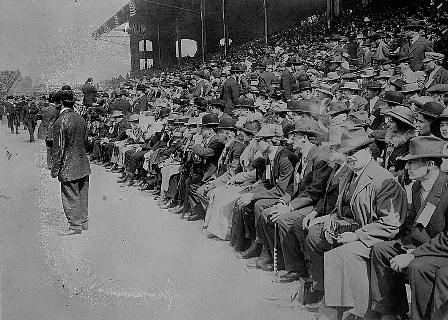
Fans at White Sox game circa 1910

Fans at White Sox game circa 1910

“It may well be Doubted whether Beals should be Permitted to play Second Base again”

23 Jul

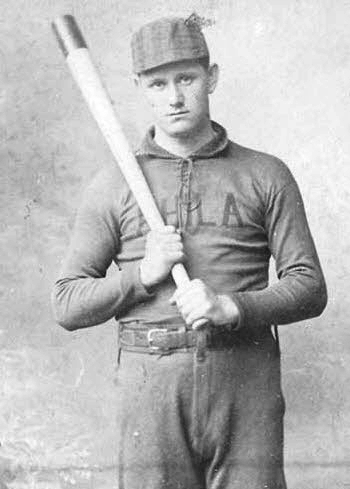
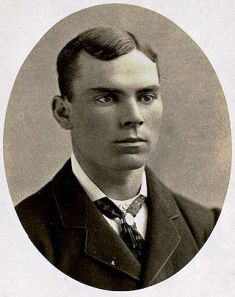
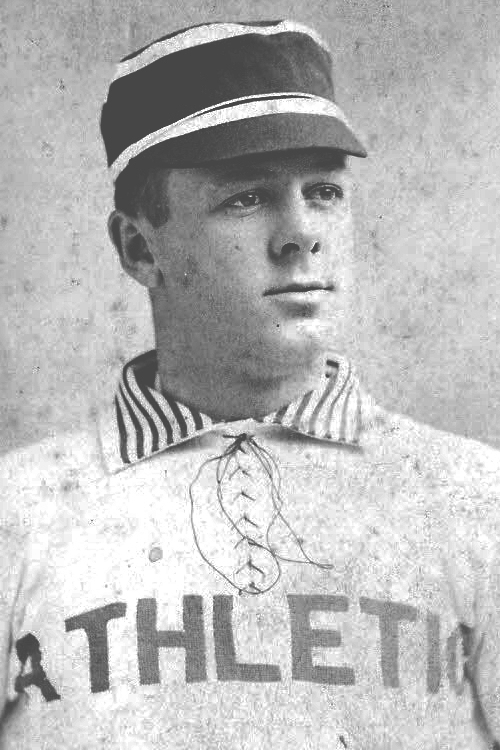
Thomas Lamb “Tommy” Beals had a complicated relationship with Harry and George Wright.

George named his son, the Hall of Fame tennis player, Beals Wright after his friend and former teammate.  But, The Chicago Tribune said when the two played together, “George Wright and Tommy Beals went many a day without a friendly word,” a charge Wright denied.

After signing a contract to play second base for Harry Wright’s Red Stockings for 1876—the first season of the National League—Beals decided instead to jump the contact and go to Colorado where he worked as a miner.

Tommy Beals

Tommy Beals

He eventually left Colorado and went to the West Coast where he played a handful of games in 1879 for the San Francisco Mutuals and Oakland Pioneers in the California League.  In the spring of 1880 he signed a contract with the Chicago White Stockings.

Harry Wright protested the signing of his former player, or as The Tribune said:

“Some parties in Boston have been making a wholly unnecessary fuss over the engagement of Beals by the Chicago Club, claiming that after engaging to play with the Bostons in 1876 he refused to report for duty.”

The Tribune noted that the contract was actually signed before the league was officially founded on February 2, 1876, but:

“The Boston people argue that, although the League was not in existence at the time Beals retired from baseball, it was agreed, upon its formation, that that all contracts existing between clubs and players should be recognized.”

The newspapers in Wright’s former hometown of Cincinnati weighed in.  The Commercial Gazette encouraged the Boston protest and said Wright should make it “a test case (and) prevent the Chicago Club from playing him during the coming season.”  The Cincinnati Enquirer took the opportunity to accuse Wright of protesting activities he was himself regularly guilty of engaging in:

“The disposition shown by the Boston Club management to create an unpleasantness in the matter of the engagement of Tommy Beals by the Chicago Club, upon the ground that Beals was under some sort of engagement with Boston four or five years ago, has had the effect of recalling some reminiscences calculated to show that the pharisaical kickers of the Hub are in no position to give us the ‘holier than thou’ racket.  In the first place Boston has slept upon its rights, if it ever had any, in the Beals case so long that the matter is outlawed long since, and ought never be raked up at this late day, especially in view of the fact that Chicago acted in good faith and without any suspicion of a cloud upon its title to the services of Beals.

“In the next place Boston had better be repenting for some of its own sins before assuming the role of exhorter towards other folks.  That club has now under contract three players whose engagements will not bear the closest kind of scrutiny.  In 1877 the Boston Club, in the middle of the season, committed an act of piracy on the Lowell Club of which it ought to be ashamed, by jerking (John) Morrill and (Lew) Brown out of the Lowell nine in regular highwayman fashion, both these players being then under contract for the entire season in Lowell…we (also) find that (Jack) Burdock was under contract to Chicago in 1875 and never showed up.  He might have been expelled by Chicago, but was not, and continues an honored and valued member of the Boston outfit.  In 1876, again Thomas Bond was suspended from play and pay by the Hartford Club, of which he was then a member, and in spite of this cloud upon his name and fame, was engaged the following year by Boston, and has been there ever since.”

Morrill, Burdock and Bond were all still members of the Red Stockings, comprising three-fourths of the team’s infield.

The Enquirer also criticized Boston because the team acted to “choke off” an attempt by Hartford Manager Bob Ferguson to bring the allegations which led to Bond’s suspension to light during a league meeting—Bond, during a season-long feud with Ferguson had accused his manager, among other things, of “selling” games.  Bond was suspended by Ferguson on August 21 of 1876 despite posting a 31-13 record for the second place Dark Blues—Bond’s replacement as Hartford’s primary pitcher was Candy Cummings.

Tommy Bond

Tommy Bond

The Enquirer took a final shot at Wright noting that when the league instituted the new rule for 1879 which barred non-playing managers from the bench “Boston squealed because Harry Wright couldn’t enjoy privileges  denied to everybody else, and this year they are playing baby about Beals on grounds equally absurd.”

The Tribune laid out Chicago’s long list of grievances for “plenty of ‘queer’ work in which Boston has been engaged.”  In addition to the incidents mentioned by The Enquirer, The Tribune said in 1877 after Albert Spalding had secured infielder Ezra Sutton for Chicago, “Sutton was worked upon by Boston and went there to play.”

So, according to Boston’s critics the club’s entire 1880 infield had come to the team via questionable circumstances.

The Boston Herald responded:

“It is not to be expected that the Chicago Club will recognize the position of the Boston Club in this matter, and release Beals.  That organization has on more than one occasion, shown its utter contempt for League rules, or in fact, for anything that interferes with its own particular self, and, to expect justice in this case, is not to be thought of.  In the meanwhile, the Boston Club will probably not take any official action in the premises, but let the Chicago Club enjoy all the honor (?) there is in playing such a man.”

After the weeks of allegations, posturing and name-calling in the press, the season began on May 1; Boston never lodged a formal complaint about the signing of Beals.

Chicago cruised to the National League title, spending only one day (after the season’s second game) out of first place.  Beals, rusty from his layoff made little impact for the champions, hitting just .152 in 13 games at second base and in the outfield.  By August, with the fight to defend his signing long forgotten, The Tribune said after a rare Beals start in a 7 to 4 loss to the Worcester Ruby Legs:

“Beals played as though he had never seen a ball-field before…It may well be doubted whether Beals should be permitted to play second base again…any amateur who could be picked at random would be likely to do better both in fielding and batting.  Worcester would have made two or three less runs yesterday if second base had been left vacant altogether, as what time Beals didn’t muff grounders he threw wild and advanced men to bases they would not otherwise have reached.”

Beals was 0 for 3 with three errors that afternoon—for the season he committed 4 errors in thirteen total chances at second for a fielding percentage of .692.

Let go by Chicago at the end of the season, Beals’ professional baseball career was over and he returned to the west.  In 1894 he was elected to one two-year term in the Nevada State Legislature as a Republican representing a district that included the town of Virginia City.  By 1900 he was back in Northern, California, where little is known about his activities.  He died in Colma, California in 1915

Frank Bancroft

14 Jul

When Frank Carter Bancroft died in 1921 at age 74, “Spalding’s Official Baseball Guide” said:

“His executive ability and Knowledge of Base Ball, combined with the fact that he was for sport first and the show element of Base Ball secondarily, rendered him one of the most competent of men to handle the affairs of a professional team.”

Frank Bancroft

Frank Bancroft

While working in the front office of the Reds in 1892, Bancroft talked with Harry Weldon, sports editor of The Cincinnati Enquirer about some of the players who got their start with his teams.  He also didn’t seem to mind taking a swipe at a couple former players:

“Probably no man now before the public except Harry Wright or Adrian C. Anson have had a longer or more varied experience with the intricacies of the great National Game than Frank C. Bancroft.  He never wore the spangles, like a great many other managers, but he has been connected with the game in a managerial capacity since the early seventies.  ‘Bannie’ is one of the wittiest men in the profession and he has a fund of anecdotes about players and plays that are well worth hearing.  Many of the great baseball stars now before the public made their debut under Mr. Bancroft’s management.  Many of them who are now drawing $4,000 or $5,000 a season worked under Bannie for about one-tenth that amount and were glad to get it.  Bancroft was one of the leading lights in the original New England League, which graduated a great many of the stars of today.

“At the present time Mr. Bancroft is business manager of the Cincinnati Reds.  He has nothing whatever to do with the players. All of that part of the club’s affairs being under the supervision of Captain (Charlie) Comiskey.  All Bannie has to do is look after the gate, railroad rates and dates.  The other evening the veteran manager was in The Enquirer office and grew reminiscent.  His recital of the details of the debut of some of the stars is worth reproducing.

Harry Stovey, one of the greatest ballplayers today, began his professional career under Manager Bancroft.  He began his career in the pitcher’s box and graduated out of the ranks of a Philadelphia amateur team called the Defiance in 1877 (the Philadelphia Defiance were a professional team, part of the league Alliance).  Manager Bancroft heard of him, and in 1878 engaged him as a change pitcher for the New Bedfords.  G. Washington ‘Grin’ Bradley was the regular pitcher of the team, and as he was an every-day pitcher Stovey was never allowed an opportunity of displaying his pitching abilities on the New Bedford team.  He had to be content with warming the bench until fate was kind and he had a chance.

Stovey

Harry Stovey

“‘Stovey played his first game with our team at Baltimore,’ said Mr. Bancroft.  ‘we were making an exhibition tour when John Piggot, the first baseman, was taken ill, and as we only carried ten men, Stovey was called on to make an attempt to play first base.  His maiden effort was a brilliant one—so brilliant that it lost Piggott his job and made Stovey a fixture on first.  He had at least twenty putouts, no errors and several cracking hits to his credit that day.  He played the season with us, and his fame spread so that he was signed by the Worcester (Ruby Legs) League team and afterward with the Athletics Stovey’s salary the first season in New Bedford for $50 a month.  Now he is paid nearly that much a game.’

George Gore, the crack center-fieder of the New Yorks is another player who came into prominence with the New Bedfords that year.  Gore’s home was in Maine, at a little town called Saccarappa…Gore was about as green a specimen as ever stepped into the business.  He played a few games with the Fall Rivers, and then the New Bedfords got him.  He was a big, awkward country boy then, but he could run like a deer and hit the ball like a trip hammer.  Gore signed with the New Bedfords under Manager Bancroft for $50 a month, but he did not stay with them long.  His terrific batting attracted the attention of the whole baseball world, and soon the more prominent clubs were after him.  While the Chicagos were in Boston the late lamented (William) Hulbert, President of the National League, who was with them, ran up to New Bedford to have a talk with Gore.  Luck was with big George.  He had his eye with him, and made three home runs in the game.  That feat settled his fate.  Before Hulbert left New Bedford he had Gore’s name to a contract to play in Chicago in 1879 at $150 a month.  His career since that time is well known.  Today he is yet a great hitter, and reached first base as frequently as any player in the business, by either hits, errors or bases on balls.  His ability to reach first causes him to be selected to head the battery list of the New Yorks.

Arthur Irwin is another player whom Manager Bancroft put in the business. ‘He made a grand impression in his opening game with me,” said Manager Bancroft.  ‘I was then manager of the Worcester League team, and we were on the hog train for a while, owing to Charlie Bennett’s glass arm and Buck (William “Farmer”) Weaver’s faint heart.  Matters were so bad that a crisis was at hand.  A meeting of the stockholders of the club was called, and it was voted to place the team in my hands for one month, and if no improvement was shown at the end of that time I was to be given the chase.  It was a dying chance for me, and you could gamble that I had my eyes and ears open for a savior of some kind.  Arthur Irwin was then playing with an amateur team called the Aetnas, of South Boston, and I engaged him to play short with the Worcester.  (J. Lee) Richmond, the once famous left-handed pitcher, who played here with the Reds in 1886, was then with the Brown University team and he was telegraphed to come for a trial.  We played the Chicagos that day, and we shut them out, only one man getting first base.  Irwin made a great hit at short, and Richmond was a wizard.  Irwin was a fifty-dollar-a-month man, and that was the start of his professional career.  Richmond is now a physician at Geneva, Ohio.’”

The game Bancroft referred to was an exhibition between Worcester (a member of the National Association) and the National League’s Chicago White Stockings played on June 2 in Worcester. Richmond walked the first batter, Abner Dalrymple, and then retired the next twenty-one before the game was called after seven innings.  The Chicago Tribune said Richmond struck out 8.  Worcester tagged Frank Hankinson for 12 hits and 11 runs (Chicago also committed 11 errors).  Bancroft was correct that Richmond became a physician, but by 1892, he was no longer practicing and was working as a teacher in Toledo, Ohio.

J. Lee Richmond

J. Lee Richmond

“Big Roger Connor of last season’s New Yorks, but now of Philadelphia, received his professional introduction under Manager Bancroft.  ‘It sounds queer to say that such a cracking hitter as Roger Connor was ever released for poor batting, but such was the case’ said Manager Bancroft

“’I had him with the New Bedfords in 1878, but he was hitting so poorly that I released him.  He afterward signed with the New Havens the same season, but the disbanded.  Roger left New Haven and went to Waterbury, his home, where he joined an amateur team in that city called the Monitors.  Up to that time he had batted right-handed, but he decided to turn around and try it left-handed.  The change saved his life.  He blossomed out as a great slugger, and his reputation has been growing ever since.

“Connor, like Stovey, began his professional career at $50 a month, and has since climbed to the top rung of high salaried players.  Many young players of today should look upon these as examples for honest and temperate habits have enabled them to remain at the head of the profession, while the path is strewn with a multitude of others who might have been where they are if they had not thought this world was a continuous round of gaiety and fun and discovered their mistake when it was too late.”


“No Exhibition was ever Received in this City with more Enthusiasm”

2 Jul

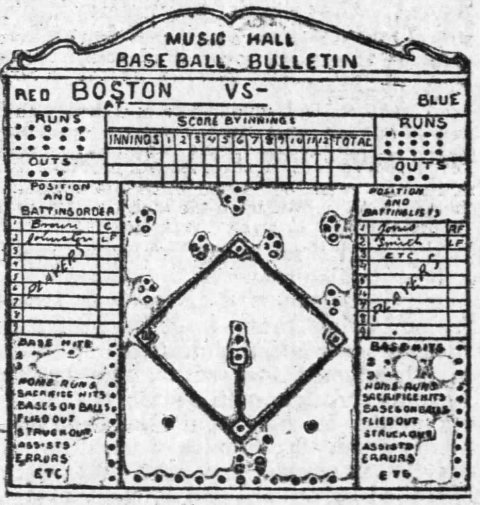
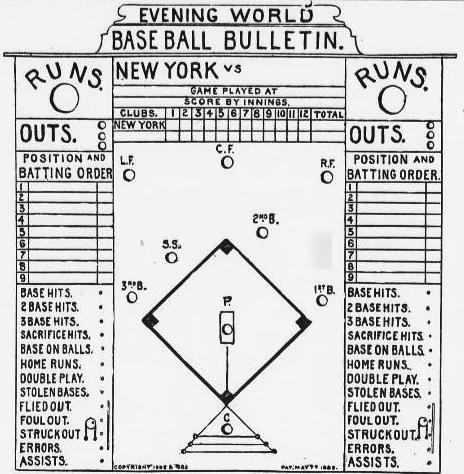
The New York World unveiled a newly updated attraction for baseball fans on August 6, 1889; the “Baseball Bulletin,” a version of which had also been introduced at the Boston Music Hall earlier that summer.

The Boston Music Hall "Bulletin Board."

The Boston Music Hall “Bulletin Board.”

The Associated Press said some fans thought the board was “an advantage over the actual game, in that it not only reproduces the plays graphically and simultaneously, but it keeps at the same time a simple and conspicuous record of the contest.”

The New York World's "Bulletin Board."

The New York World’s “Bulletin Board.”

The Boston Herald said their board measured “fifteen feet square.”  New York’s board was an improved version of one that had been used the previous October for the Giants six game to four World Series victory over the American Association’s St. Louis Browns.

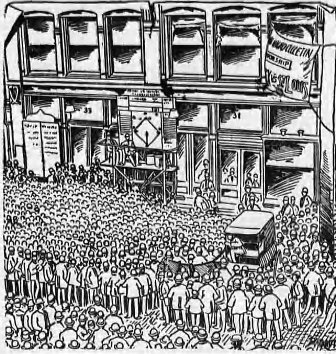
The crowd on Park Row for the 1888 World Series

The crowd on Park Row for the 1888 World Series

The board was the creation of  reporter Edward Van Zile of The World; Van Zile received a patent for the invention, although it was another member of the paper’s staff, Publisher Joseph Pulitzer’s secretary Edwin A Grozier, who turned it into a profitable enterprise. After purchasing the original rights from Van Zile, Grozier improved the design and received his own patent.

The World said the new version was a bigger sensation than the one introduced the previous October:

“’Perfection’ is the word which expressed the verdict of the baseball public who had the good fortune to witness the game between the New York Giants and Baby Anson’s team on The  World’s Baseball Bulletin Board yesterday afternoon…it is safe to say that no exhibition was ever received in this city with more enthusiasm than was the baseball bulletin.

“And the crowd too!  What a vast number!  There must have been fully 10,000 people in the audience, and the way they cheered when the Giants made a run was a sound that would have made Baby Anson sick.”

The presentation of the game took place on New York’s “Newspaper Row” (Park Row), with a crowd on the east side of the street

“(E)xtending from above The World Building to far below it (and) on the west side of the street the crowd was much larger.  There was a long line of people from Mail Street almost down to the other end of the big Federal Building.

“No point from which the game could be witnessed was left vacant.  The boys climbed up and lodged themselves in among the pillars of the Post Office…Even the lamp post was monopolized by the urchins, and when our boys made a good play they generally led the cheering.”

The “expert board operator placed the Chicago men in the field,” for the first inning, and leadoff hitter George Gore at the plate:

“When (Gore) slid down to first base the crowd were just ready to cheer, but they saw him put out and they reserved their applause for another occasion.

“They did not have long to wait, however, for (Mike) Tiernan and (Buck) Ewing  each succeeded in gaining bases, and then big Roger Connor was placed over home plate

“The crowd held its breath in anticipation of what was to come.  Their enthusiasm was drawn up to a high pitch, and was just waiting for a chance to break its bonds.  And they got it!  The little red disk representing Connor slid up to first and Tiernan slid across home plate.  Then there was a volley of cheers.  It broke forth clear and strong, and the sound could be heard blocks away.

“Up on the tops of the tall buildings in the neighborhood the cheers of the crowd could be heard resounding forth as a victorious army returning from battle.

“And it was all the same through the game. A great many people were attracted to the spot by the cries of the crowd, and when they saw the baseball bulletin they all united in declaring it to be the greatest thing they had ever seen.”

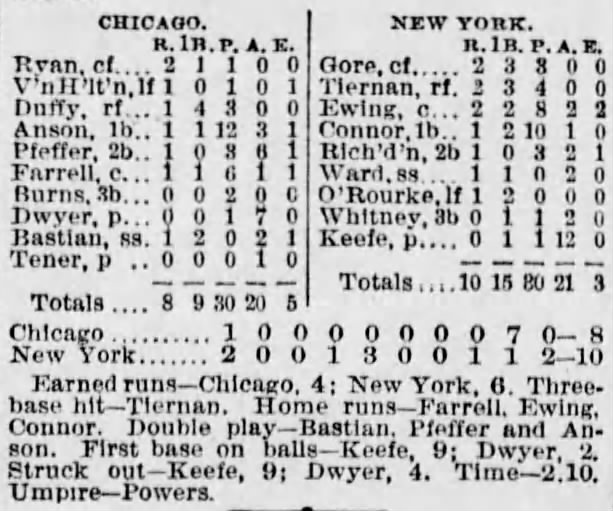
Chicago scored seven runs off Tim Keefe in the ninth to tie the score at 8.  The crowd’s “disapproval resolved itself into a continued groan.”

The Giants scored two runs in the tenth, and when the white Stockings came to bat in the last half of the inning:

“(T)he crowd watched more intently than at any time before.As each Chicago man went out there was a yell, and when they all went out without having made a run it was impossible to say a word that could be heard.”

The Box Score

The Box Score

The paper commemorated their innovation with a poem:

A boy was passing down the street,

Another lad he chanced to meet;

‘I’ll bet,’ he said, ‘we’re licked once more.

What is the score?’

A merchant coming down that way,

Lifted his bearded head so gray;

And ceased o’er book and cash to pore—

‘What is the score?’

A preacher wrestled with his text,

And wondered what he’d best say next;

Then called out through his study door;

What is the score?’

The Mayor in his office sat

And pondered over this and that,

The said: ‘I’m sure the game is o’er.

What is the score?’

If they had only chanced to go

Into the middle of Park Row,

And see the bulletin of The World,

And the glorious pennant there unfurled,

They’d never ask the question more

‘What is the score?’

The  World predicted the initial crowd was just the beginning:

“Today’s game between the Chicagos and the New Yorks will be duly recorded on the board.  There is room for everybody to see, and it is expected that the crowd will be twice as large as yesterday.”

The following day the paper did not say the crowd had doubled—to 20,000—but claimed it was “The largest crowd that had ever been on Park Row,” for the Giants 4 to 2 victory over the White Stockings.

Crowds continued to come to Park Row as the Giants battled the Boston Beaneaters and won the pennant on the final day of the season.

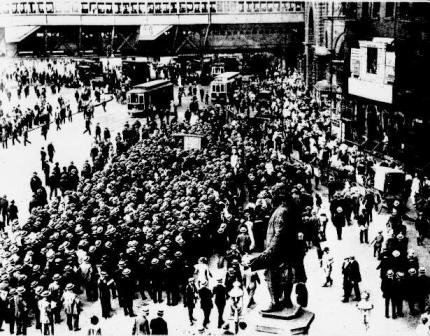
Baseball Bulletin Boards, and other versions of the concept, remained a popular feature well into the 20th Century. More often than not they were sponsored and presented by local newspapers.

The New York Sun presented their own "Baseball Bulletin Board"  on New York's Park Row in 1914

The New York Sun presented their own “Baseball Bulletin Board” on New York’s Park Row in 1914


“What Right has Hanlon to Show me How to Hit?”

23 Jun

How are hitters created?  Bozeman Bulger of The New York Evening World attempted to answer the question, and described the hitting styles of some of the game’s biggest stars in 1906:

“Batting is a natural gift and to be a success the player must be allowed to swing the willow in his own sweet way.”

Bulger said John McGraw who “For nine years…had a batting average of .330” (actually .346 from 1893 to 1901) was asked his secret:

“Don’t know, I simply used my eye and my arms and figured it out.”

When McGraw played for the Baltimore Orioles, Manager Ned Hanlon tried to show him “how to hit (and) on one occasion he corrected him sharply.”  McGraw said:

“That set me to thinking, and I went to my room and dug up a lot of old records.  In these I saw that Hanlon had never hit as good as .300, that is for a period of two or three seasons (Hanlon hit .302 in 1885) while I had been hitting over .300 right along.  Therefore, I asked myself ‘what right has Hanlon to show me how to hit?’”

Ned Hanlon

Ned Hanlon

Bulger said

“In the past few years Yale and Harvard and Princeton and other colleges have employed coaches to teach them how to hit.  The experiment was futile, and no hitters were developed that did not already possess the gift.

“Take the great batters of to-day and you will find that no two of them stand at the plate alike.  Long since astute managers have found that it is a useless waste of time to attempt a correction of habits easily acquired.  To be successful a ball player must do everything in a perfectly natural manner.  This is paramount in batting.”

Bulger then wrote about the “peculiarities” of some contemporary hitters:

Sam Mertes of the Giants invariably pulls his left foot back as he swings at the ball.  Mertes also crouches with somewhat of a forward lean and keeps his feet wide apart.

Roger Bresnahan and Mike Donlin, two of the greatest hitters in the world, are what are called vicious swingers.  Bresnahan has absolutely no fear.  He never thinks of being hit, but runs squarely into the ball, and when he plants his bat squarely against it a scorching line drive follows.  Nobody hits a ball with more force than Bresnahan.

“Donlin stands with his feet about one foot apart and usually holds the bat perfectly rigid at his waist, slanting at an angle of about 45 degrees.  He can either ‘chop’ or swing hard with the same degree of accuracy.  Donlin is said to be the greatest natural hitter in the business.  He says he has no idea how he does it.

George Stone, one of the most remarkable batters of the age, has a (boxer Jim) Jeffries  crouch at bat which has caused experienced baseball managers to say George wouldn’t last as soon as the pitchers got next to him.  Stone puts a terrific amount of weight into one of his blows, swinging with his shoulders and smashing a line with fearful force.

George Stone

George Stone

“His position has been termed awkward, inelegant, and not conducive to good hitting, but Stone to-day leads the American League with a better average than the great (Napoleon) Lajoie.

“Larry is the personification of grace and elegance at bat.  He has that careless indifferent method which attracts, is devoid of nervousness but active and alert.  Infielders will tell you that there is a force in the balls smashed by Lajoie which makes them unpleasant to handle.  Lajoie is the finished artist.

“His great rival in the National League Honus Wagner is just the opposite.  Hans grabs his stick at the end, holds it high about his shoulders, and when he swings his legs are spread from one end of the batter’s box to the other.  Wagner is awkward standing almost straight and goes after outcurves and drops with equal avidity.  Hans often reaches to the far outside of the plate for a low outcurve and plants it into right center field.

Charlie Hickman stands at the outer edge of the box and swings with his body and shoulders His fondness for the balls on the outside of the pan are known to opposing pitchers.  Lave Cross puts his two feet into the angle of the batter’s box nearest the catcher, while (Dave) Altizer usually spreads out, varying this position with a crouching posture, from which he runs up on a ball.”