Tag Archives: National League

Albert Spalding on Superstitions

18 Dec

During a game in September of 1882 against the Worcester Ruby Legs, Albert Spalding, Chicago White Stockings President, sat “in the reporters’ stand” at Lakefront Park with a sportswriter from The Chicago Herald:

“The Worcesters had gained a run in the fourth inning, but the home team had been successfully retired for five straight innings.  The Chicagos were playing their best, but ‘luck was dead against them.’”

At that point Chicago outfielder Abner Dalrymple came to where the White Stockings’ president was seated and said:

“’Mr. Spalding, will you move other in some other chair?  That was the seat Harry Wright occupied during the games we had with his club.’  Spalding laughed, but hurried out of his place to a chair further down the line.  The home team made three runs in that inning and won—five to one.”

Abner Dalrymple

Abner Dalrymple

The reporter later asked Spalding about whether all players were superstitious:

“(A)nd he proceeded to explain some of the incidents and conditions supposed to influence the play.

“The players as surely believe that ducks or geese on the home ground presage defeat for that team as they do that an umpire can materially add to the discomfort of a nine,  Dalrymple had great belief that Spalding in Harry Wright’s seat would throw all the bad luck imaginable on the Chicago side.”

The Herald said when the second place Providence Grays came to Chicago that same month, the White Stockings “thought that by donning their old tri-colored caps…they would defeat them, and sure enough, they won three straight games.”

Spalding said it wasn’t limited to his own team:

“(Worcester) Captain (Arthur) Irwin always spits on the coin he tosses up for a choice of position in a game.  Jack Rowe (of the Buffalo Bisons) pulls the little finger of his right hand for luck, and all sorts of chance omens are seized upon by a club for indications of the great triumph they would like to win…(Terry) Larkin, now of the ‘Mets’ (the New York Metropolitans of the League Alliance), had an idea that he would get hurt some time for playing on Friday, and sure enough, in a game one year ago with a college team, he was struck with a ball in the stomach nd was so badly injured that his life was despaired of for a time.”

A.G. Spalding

A.G. Spalding

The 1882 White Stockings, due more to talent than superstition, won their third straight National League pennant beating Providence by three games.

Harry Wright Returns to Cincinnati

17 Dec

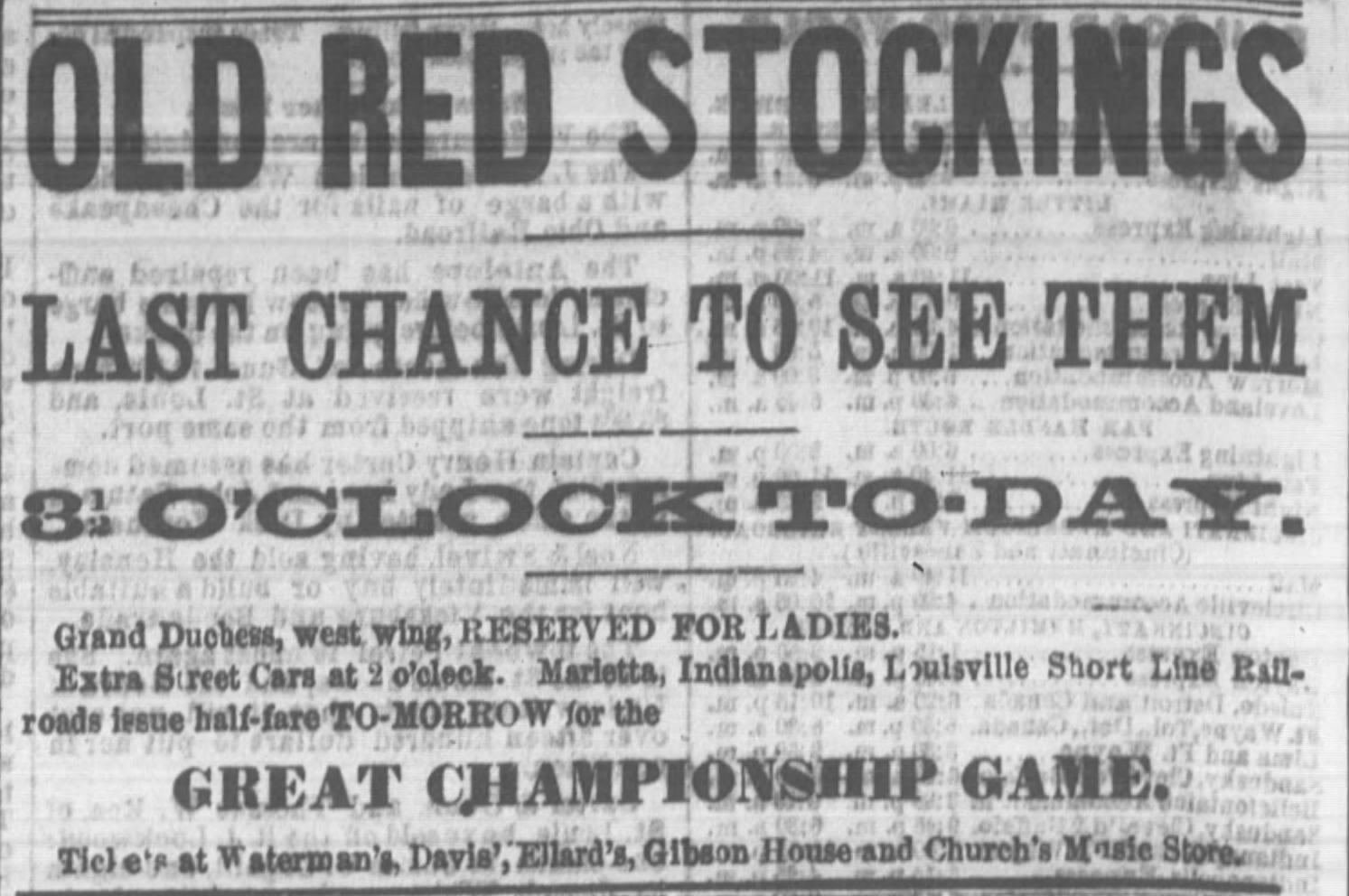
In 1871, Harry Wright took several of his Red Stockings players, as well as the team name, moved to Boston and joined the newly formed National Association.  Wright’s exit from Cincinnati was contentious, but despite that he was invited back for an exhibition game in July between his former team and a “picked nine” consisting of the members of Wright’s current team and the Washington Olympics.

Advertisement for the July 3, 1871 game

Advertisement for the July 3, 1871, game

The Cincinnati Enquirer said the two thousand people in attendance indicated “that the interest in base-ball is not dead in this city, but only needs the stimulus of first-class games to awaken it to renewed life.”

The paper said:

“The old Reds did not have the services of George Wright (who was injured), and did not play with the skill characteristic of them in 1868-’69, which may have been due to fact that there was nothing at stake than gate money.”

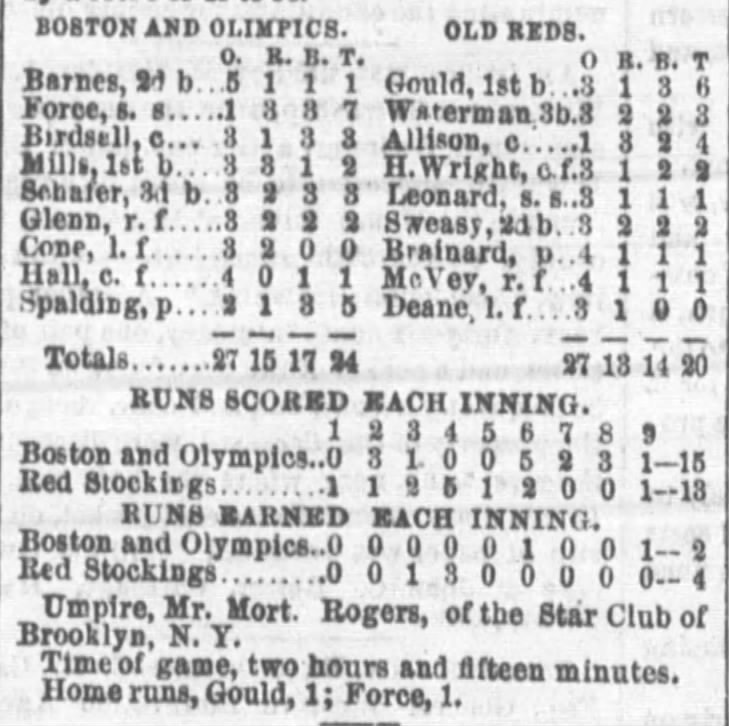
Albert Spalding pitched for the “picked nine” and beat Wright’s club, with Asa Brainard pitching, 15-13. The Enquirer said former Cincinnati players Cal McVey and Charlie Gould, who both joined Wright in Boston, “have improved in their batting powers.”

Wright’s team led 10 to 4 through five innings, but the opponents posted a five-run sixth which included a home run by Davy Force and added two in the seventh and three in the eighth.

The box score

The box score

One sign that all might not have yet been forgiven in Cincinnati:  while Harry Wright was listed in the box score and the inning-by-inning recap of the game, The Enquirer didn’t use his full name in any of the game advertisements or articles.

Professional baseball returned to Cincinnati in 1876 when the reds became an inaugural member of the National league.

Al Reach

12 Dec

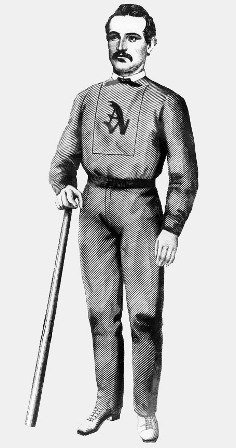
Alfred James “Al” Reach opened his first sporting goods store in Philadelphia in 1874 while playing for the Athletics in the National Association.  Within a decade he had built a hugely successfully business, began publishing “Reach’s Official Baseball Guide,” and established a National league franchise in Philadelphia.

In May of 1886 Reach talked to The Philadelphia Times about “one of the great industries of Philadelphia in the sporting line.”

“Men, women and children are employed in making base balls.  The cheaper ones are made by a press with leather shavings on the inside.  The body is wrapped with cotton and covered with leather.  The covering is done by hand.  The best balls—the ones in use by the American Base Ball Association—are a solid piece of Para rubber on the inside, covered with worsted yarn and then with an outside covering of horse-hide.  Men do this covering.  They are mostly harness-makers, yet they have to broken into the work, for even a good harness-maker may be a poor hand at covering and sewing a ball properly.”

Al Reach

Al Reach

Reach said the company had orders for “five hundred dozen, or six million, balls already for this season,” and the company was “two hundred thousand dozen behind” filling the orders:

“We have had the factory running until ten o’clock at night all winter.  Base balls sell from 5 cents to $1.25 apiece…Three-fifths of all the balls used in the country are made in Philadelphia.”

—–

“Base ball bats are made of willow, spruce and first and second-growth ash.  The latter wood makes the best bet.  They are sold at fifty, sixty and seventy-five cents each.  There are about sixty thousand bats used every season.  Our orders already indicate that we will dispose of at least fifteen thousand of the best quality.”

Reach said the company employed “upwards of five hundred persons.”

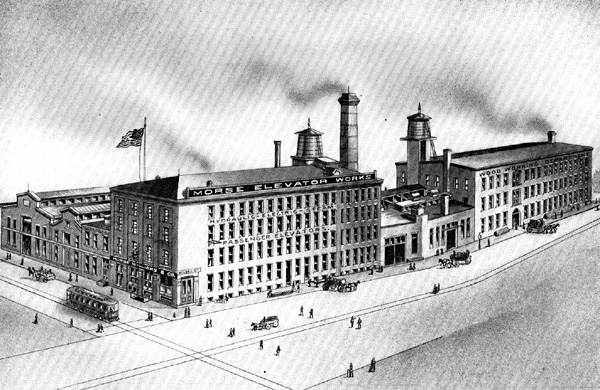
Reach's main factory in 1886 at Frankford Avenue and Wildey Street in Philadelphia---The Martin Landenberger Hosiery Mill Complex/Morse Elevator Works Building

Reach’s main factory in 1886 at Frankford Avenue and Wildey Street in Philadelphia–The Martin Landenberger Hosiery Mill Complex/Morse Elevator Works Building

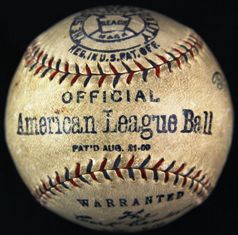
By the end of the decade Reach’s company was purchased by A.G. Spalding, with Reach staying on as an executive and the company continued to produce equipment with the Reach name, including the official American League baseball, which was used through the 1976 season.

Reach maintained controlling interest in the Phillies until 1899 and died in 1928.  He left an estate worth more than $1 million.

Reach Official American League ball 1920s

Reach Official American League ball 1920s

“The fans make us the ‘goat’ for Everything”

21 Nov

Chicago Orphans Manager Tom Burns suspended pitcher Bill Phyle without pay in August of 1899, even after Burns was replaced by Tom Loftus, Phyle remained in limbo.

Tom Loftus

Tom Loftus

In January Hugh Fullerton said in The Chicago Tribune that Loftus “probably will give him a chance.”  But in early February The Chicago Inter Ocean said even though Phyle had met with team President James Hart nothing had been resolved.  Phyle told the paper he was offered a contract but was “in no hurry to sign.”

Phyle finally signed at the end of the February, but The Tribune said Chicago would most likely trade him “although Loftus thinks highly of him.”

The team trained in West Baden Springs, Indiana, where according to The Tribune Phyle was “sarcastically called ‘Lucky,’ because of his proverbial hard luck, (he) rarely escapes a day without being hurt.”  He also managed to alienate his new manager.

After several days of poor weather in Indiana, Loftus decided to take the team further south, to Selma, Alabama on March 18.  According to The Tribune Phyle was not on the train:

“Phyle may not be with the team in Selma.  He left Friday (March 16), announcing he was going to see the fights in Chicago.  Manager Loftus hunted up the pitcher before he departed and told him it was a bad plan to start the year in such a manner.  Phyle then said he was ill and was making the journey in order to consult a physician in Chicago.”

Phyle did return from Chicago (where he claimed he had an unspecified operation), and joined the team on the trip south.  Upon his return he continued to suffer a series of illnesses and injuries, which included a bad reaction to a vaccination and a being hit in the knee with a thrown bat, both of which kept him inactive for several days.

Phyle was left in Chicago when the team opened the season in Cincinnati, and his imminent trade or release was speculated upon nearly daily in the Chicago press; he was finally traded to the Kansas City Blues in the American League with Sam Dungan and Bill Everitt for John Ganzel on May 18.  Phyle refused to report to Kansas City and spent the season playing for Chicago City League teams and a semi-pro team in DeKalb County, Illinois.  He was also a regular attendee at Chicago’s boxing venues and was said to own a piece of featherweight contender Eddie Santry.

Phyle returned to the National League in 1901 posting a 7-10 record for the New York Giants.  In 1902 he went to the California League as an infielder and never pitched again.  After his controversial exit from Memphis in 1903—and the aftermath—he continued to play until 1909.

Phyle worked as a boxing referee and as an umpire for more than 20 years in the Canadian, Eastern and Pacific Coast and International  Leagues, and was involved in two final controversies.

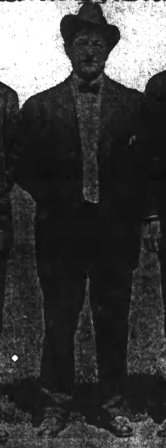
Bill Phyle, 1913

Bill Phyle, 1913

In 1920 a grand jury was impaneled in Los Angeles to investigate charges of game fixing in the Pacific Coast League.  Players Harl Maggert, William “Babe” Borton, Bill Rumler and Gene Dale were implicated.  While all criminal charges were eventually dismissed, the four were banned from baseball in 1921.

Phyle was called to testify in front of the grand jury, and said umpires were often blamed when players were crooked:

“The fans make us the ‘goat’ for everything that goes on during the ball game.  How many times we have suffered to suit the whims of a ballplayer who might have been working with the gamblers will never be known.  They just slough us around, call us whatever names they please and yell murder when we happen to fire them out of the game or have them suspended.

“An umpire should have the same authority as a referee has in the prize-ring.  If he believes a ballplayer isn’t giving his best toward the game, he ought to have the privilege of ousting him without taking the manager into confidence.”

In July of 1923 Phyle was working an International League game between the Baltimore Orioles and Rochester Tribe.  Phyle called a Rochester runner safe at first, then immediately reversed his decision.  He was dismissed the following day by league President John Conway Toole.

As a result of the dismissal, four other umpires resigned in sympathy.  Toole, who was attending the game, claimed he had not released him because of the blown call, but because Phyle had failed to work a double hitter he was assigned to earlier in the month.   The decision was upheld, and within three days the four other umpires withdrew their resignation.

Phyle ended his career back in the Pacific Coast League in 1926, and died in Los Angeles in 1953.

Burns “Put the Punishment on Phyle”

20 Nov

After holding out over a temperance clause the Chicago Orphans added to his contract, Bill Phyle finally signed in late March of 1899.  He reported to spring training in New Mexico anywhere from 10 to 30 pounds overweight (depending on the source) and struggled all season to regain the form he showed the previous season.

On April 17 he was beaten 8-0 by the Louisville Colonels in first start.

On April 25 he lost 3-2 to the St. Louis Perfectos.  The Chicago Tribune said “Phyle gave away the game by distributing bases on balls in just the spots where timely hits followed and transformed the favors into tallies that gave the victory.”

William Phelon, The Chicago Daily News baseball writer, disagreed.  He said Phyle’s “work was of sterling quality.”

Regardless, Chicago Manager Tom Burns didn’t give Phyle another opportunity to pitch for more than a month.

Phelon said it was a mistake for Burns to not use Phyle.  The Chicago Inter Ocean said after the team lost seven of nine games in May “it is passing strange that young Phyle is not given a chance.  On last year’s form Phyle is as good as, if not better than (Jack) Taylor.  The paper called Phyle’s performance in the St. Louis game “gilt-edged” and blamed the loss on “comrades that gave the victory to the enemy.”

Finally, on May 28 Phyle pitched again.   He lost 4 to 3 to the Washington Senators; he gave up three runs on five straight hits with two outs in the ninth.

He lost again on June 1, 7-1 to the Philadelphia Phillies.  Phelon’s opinion of the pitcher was unchanged, and said the losses were simply bad luck:

“Phyle has now lost four straight games.  It is Phyle’s luck to be stuck in whenever the other pitchers have won about three straight, and the team is just about unavoidably due to lose.”

On June 5 Phyle did his best pitching of the season–a victory he is not credited with in the record books.

With the Orphans trailing the Baltimore Orioles 3 to 2 in the third inning, pitcher Clark Griffith was ejected for arguing a called ball.  The Chicago Tribune said:

“It was a queer game.  Phyle pitched after Griffith had been benched…holding the Orioles helpless.”

Chicago won 9 to 4.  And while the Chicago newspapers credited the victory to Phyle, the record books do not.
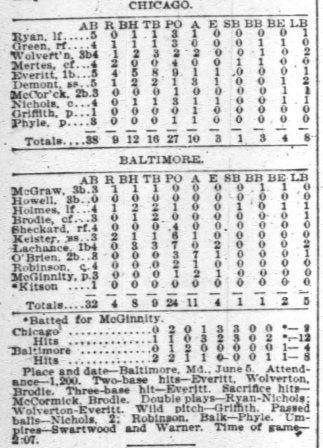
Box score for June 5 game.  Phyle relieved Clark Griffith in the 3rd inning.

Box score for June 5 game. Phyle relieved Clark Griffith in the 3rd inning.

Phyle became ill later the same week, (some sources said it was recurring malaria), a week later he fell off a bicycle and missed two more weeks.  When he returned to the team on June 22, the Boston Beaneaters beat him 5 to 1.

He was credited with his first “official” win on July 1—a game The Inter Ocean called “a comedy of errors,” and a “depressing exhibition.”   He beat the New York Giants 10 to 9, allowing 10 hits and giving up seven runs in the first two innings.  Each team committed seven errors.
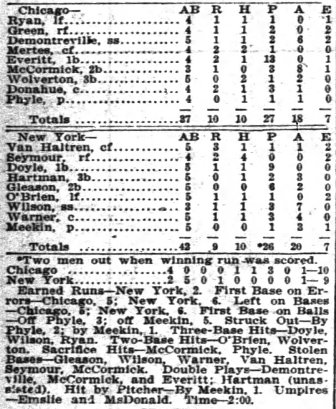
Box score of Bill Phyle's only "official" victory of 1899.

Box score of Bill Phyle’s only “official” victory of 1899.

Chicago went into a slump that would last for the rest of the season; after Phyle’s July 1 win the team was 38-24, in third place, and went 37-49 the rest of the way finishing eighth.

Phyle lost again on July 9 and July 24, and rumors began to circulate that he would be released or traded back to Charlie Comiskey’s St. Paul Saints.

On August 6 Phyle lost 10 to 9 to the Cleveland Spiders.  One week later while the team was on the road, The Inter Ocean reported that he “was sent home by manager Burns.”

The Tribune called Phyle “the scapegoat” and said he and three unnamed teammates  “celebrated after beating a horse race at Washington and Manager Burns, to call a halt, put the punishment on Phyle.

Phelon wrote in The Daily News:

“When the club started for Philadelphia he was told to go home ‘You are through young man, go back to Chicago,’ said Burns, and Phyle went back.  He went back in a rage too, and says he will tell (team president) Jim Hart a lot of things. He says that he has been held up to public derision as a drunkard, all season, and that Burns plays favorites, allowing his friends to jag up as much as they wish and turning all the trouble on others.”

Phelon remained supportive of the pitcher in The Daily News, but in The Sporting Life he reported that Phyle, a former boxer, had deserted the team in early August to go to “St. Louis to see a prize fight, and was not on hand when sorely needed.”

While the relationship between Hart and Burns was strained, and Burns would be replaced at season’s end, Phyle’s complaints went nowhere with the team president and he was suspended without pay.

Ten days after Phyle was suspended Phelon reported that the Baltimore Orioles had offered to trade for or buy Phyle,” (John) McGraw has taken quite a fancy to the young pitcher.”  Hart refused to make a deal.

Phyle never pitched for Chicago again, he is credited with a 1-8 record and 4.20 ERA.

The last Bill Phyle chapter—tomorrow.

“I’d be Perfectly Willing to Split with Uncle Sam”

14 Nov

In 1915, The Chicago Eagle reported on the difficulty the government was having “getting at the facts,” in order to collect income taxes from ballplayers after the passage of the 16th Amendment two years earlier.   But the paper predicted that  players in the three major leagues “will pay into the internal revenue department something like $5,000 in income tax.”  Five thousand dollars total.

“But for the fact that 50 per cent of the players in the American, National and Federal leagues are married and thereby permitted to claim an exemption of $4,000 in salary, the sum exacted by the government would be considerably greater.”

The Eagle said there were approximately 300 players in the three leagues who earned more than $3000 per season and were subject to pay income tax, but half of those were exempt because they were married and could claim an exemption up to $4,000.

“(T)here are about 200 who earn more than $4,000.  There are close to 100 who draw more than $5,000 and 50 whose contracts call for amounts ranging between $6,000 and $10,000.  There are less than a dozen who make more than that.  The notable ones are Eddie Collins, Ty Cobb, Tris Speaker, Walter Johnson and a few managers.  (John) McGraw is reputed to make $25,000 in salary.”

Tris Speaker was “the hardest hit” bachelor.  At a salary of $15,000 Speaker was taxed on $12,000 and paid income taxes for the year totaling $120.

Tris Speaker "hardest hit"

Tris Speaker “hardest hit”

Frank “Home Run” Baker of the Philadelphia athletics, who earned between $8,000 and $9,000, and was sitting out the 1915 season in a salary dispute said regarding his teammate Eddie Collins, who earned $15,000:

“Still, if they raise mine up to that of Eddie Collins I’ll be perfectly willing to split with Uncle Sam.”

Frank "Home Run" Baker, "willing to split with Uncle Sam"

Frank “Home Run” Baker, “willing to split with Uncle Sam”

“I Consider him a Weak, Foolish Talker”

13 Nov

Bill Phyle was a no-show.  He failed to appear before Southern Association President William Kavanaugh at the league’s hearing regarding his charges that the end of the 1903 season was fixed.  After the league suspended him he failed to appear in St. Louis to defend his charges in front of the National Association of Professional Baseball Leagues (NAPBL).  He claimed he was too ill to attend either meeting.

As a result he was expelled from organized baseball in October of 1903.  His appeal was denied in December.

Phyle had very few supporters by the time his fate was settled by the NAPBL, but he still had at least one—kind of:  Milwaukee Brewers Manager “Pongo” Joe Cantillon, the man who sold Phyle’s contract to the Memphis Egyptians.

Joe Cantillon

Joe Cantillon

Cantillon told William A. Phelon of The Chicago Daily News that his former player wasn’t too bright, but that he also wasn’t wrong:

“I consider him a weak, foolish talker, who opened his head when it did not do him any good.  Just the same, Billy Phyle had cause for the charges which he made, and I got it good and straight that there was work done in the Southern league last season which was on the scandalous pattern.”

Cantillon stopped short of saying the season was fixed—but not very far short:

“Understand I do not say, neither does Phyle charge, that any games were sold, or that either manager or club owners were in on any such deals.   Even though there are thousands who say—apparently with mighty good reason—that the league is crooked, always has been crooked since it started, and always will be crooked—I do not accuse anyone of selling out.”

Cantillon then came pretty close to accusing Atlanta of selling out:

“This is the way the thing was done—and if anybody wants to howl I’ll show the goods and produce the names.  When Memphis was playing Atlanta it was a case of anything to beat out Little Rock.  The Atlanta players, knowing that their only chances had gone glimmering, were anxious to help their friend’s to beat Mike Finn’s gang (Little Rock).  There was no sell out and there were no intentional errors—nothing so gross and coarse as that.  But a couple of the best regulars on the Atlanta team were laid off; a couple of substitutes were put in their places; a raw, unseasoned amateur was sent in to pitch, and then, to make assurances doubly sure, the Atlanta catcher told each Memphis batsman just what to expect as he came to the plate.”

Cantillon also said the Birmingham Barons were “trying to help (Little Rock) along,” and:

“Every player in the league was dead wise to the whole situation, but Billy Phyle was the only man who was foolish enough to open his face, and he got soaked proper.”

Cantillon claimed to “positively know” that Phyle had been sick, and that was the only reason he failed to appear to substantiate his claims in front the league and the NAPBL.  Regardless, he said Phyle would have had a difficult time:

“Even if he had been able to attend, what show would he have had, with every manager determined to clear his own skirts and swat Bill for the squeal he made?”

Cantillon challenged anyone in the Southern Association to refute his allegations.

In February of 1904 Cantillon cancelled a scheduled spring tour of the South and Phelon said in The Daily News that Southern Association teams had refused to play against Brewers.

The following month Clark Griffith, who was in the South with the New York Highlanders, told The Atlanta Constitution that Cantillon was “ a nice fellow,” who “had been misquoted and had not authorized the interview, and in fact knew nothing of it until it appeared in the press.”

Cantillon himself never directly denied his statement, but The Constitution, content to keep the focus of Southern wrath on Phyle was happy to give the Milwaukee manager a pass:

“(Griffith’s claim) puts a new light on the question and it is very probable that he has been judged too harshly in the south…Phyle as a baseball issue is now dead.  Any effort to revive him and bring him forward on the stage either as a hero suffering persecution or a sick man worrying his life out by the blacklist hanging over him, will meet with the opposition of every paper in the south.”

Phyle went to Toledo and spent the spring and summer wiring Southern Association President Kavanaugh asking for reinstatement so his contract could be assigned to the Mud Hens.  After his application was rejected in May, and again in July, Phyle joined the independent Youngstown Ohio Works team.  The team played exhibition games that summer with the Brooklyn Superbas and Pittsburgh Pirates—both National League clubs were fined $100 for playing against the blacklisted Phyle.

(Some sources list Phyle as a member of the 1904 Johnstown Johnnies in the independent Pennsylvania League, but several Pennsylvania newspapers, including The Williamsport Gazette and The Scranton  Republican said in August “Phyle turned down a $225 per month offer from Johnstown.”)

Phyle became part of another scandal in 1905.

Bill Phyle

Bill Phyle

Youngstown joined the newly formed Ohio-Pennsylvania League, and needed to submit a roster to the NAPBL for approval.  Phyle’s name did not appear on the submitted list, but he played third base for the club all season, including an exhibition with the Cincinnati Reds on August 31. Youngstown was fined $500 in mid September and ordered to release Phyle.  Cincinnati was fined $100.

Phyle was finally reinstated in February of 1906, after he submitted a letter to the directors of the Southern Association retracting all of his 1903 allegations.

His contract was assigned to the Nashville Volunteers who sold him to the Kansas City Blues in the American Association.  After hitting .295 in 72 games, Phyle got one last trip to the National League.  He was traded to the St. Louis; he hit just .178 for the Cardinals.  He retired after playing three years in the Eastern League with the Toronto Maple Leafs from 1907-1909.

More than twenty years later Joe Cantillon was apparently forgiven in the South.  He managed the Little Rock Travelers to back-to-back eighth place finishes in 1926 and 1927.

The rest of Bill Phyle’s story next week.

“The President of the League is the Supply Department”

31 Oct

Sixty to 75 balls are used on average in every Major League game (90 must be on hand)—and estimates are that between 115,000 and 160,000 balls are used each season.  How does this compare to the number of baseballs used during the 1890s?

In 1897 The Louisville Courier-Journal reported near the end of August that National League President Nick Young said league teams had used “400 dozen (4800) balls for the season,” up to that point.

Nick Young

Nick Young

Balls were stored at Young’s home in Washington D.C.’s Mount Pleasant neighborhood.  He said:

“The public, perhaps, are unaware of the method employed by the League in circulating the balls among the twelve clubs.  The average patron of the game is under the impression that the balls are sent direct from the factory, but, as a matter of fact, the clubs are obliged to order their stock of spheres through me.  By the terms of the article of agreement and the contract with the manufacturer, the President of the League is the supply department.”

“I was debating today over my stock of balls in store at my home at Mount Pleasant, and decided that I had enough balls in stock to last the remainder of the season.  If am right in my guess, the twelve teams in the big league will use about 480 dozen (5760) balls this season, which makes an average of 40 dozen (480) per club.

“I have noticed that since the present pitching distance became a rule, more balls have been used than under the old rule, and I should infer that the five-foot impost placed on the pitcher four years ago has boomed the trade for Al Spalding, who supplies the league with balls…Of course I can’t account for the increase in foul flies that are sent over the stand, and that result in losing the balls, but the fact remains that more balls are used under the new rule.”

Young said he couldn’t explain why exactly more balls were being used because of the increased pitching distance:

“Perhaps the batsmen hit at the ball too soon or too late to connect for a safe hit, and their effort to make a safety resulted in a foul fly.”

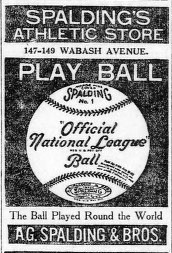
Spalding advertisement from 1890s

Spalding advertisement from 1890s

Ball clubs would wire Young when they needed additional balls:

“Every ball is weighed before shipment to the club.  Each club stand the expense of the balls ordered by its manager or owner, and this season the League will have paid out about $6,000 for the sphere of horsehide, or an average of $500 per club, which is quite an item of expenditure for this necessary tool of the trade.”

Davy Force

28 Oct

David W. “Davy” Force was a popular figure in 19th Century baseball.  Francis Richter, founder and editor of The Sporting Life said the five-foot four-inch Force was, along with George Wright ”the two greatest shortstops of the early days of baseball.”  Nick Young, National League president, told Ren Mulford Jr. of The Cincinnati Enquirer that Force was second only to Wright as the greatest.

Davy Force

Davy Force

Force played in the National Association and National League from 1871 to 1886, and finished his professional career in the Western Association with the Sioux City Corn Huskers.

He remained popular, and well-known enough that multiple newspapers reported in 1890 that the former player “sided with the Brotherhood,” and supported the Players League; he even made news that year for growing a beard:  “Force has raised a crop of whiskers as long as himself. “

So when it was reported on Christmas Eve of 1896 that Force had shot and killed a man—a former ballplayer no less–in a San Francisco bar and then fled, the news was reported in papers across the country.

The Louisville Courier Journal:

Ball Player Kills Another

The Cincinnati Enquirer:

Old Cincinnati Ball Player Kills a Man in Frisco

The Salt Lake City Tribune:

Baseball Player Shoots Another Without Warning

The Chicago Tribune:

Police now on Lookout for Force

The Baltimore Sun:

‘Davy’ Force Wanted for Killing a Man

Towns where Force had been a popular player were quick to distance themselves.  The Sioux City Journal said that while fans “took a sort of paternal and patronizing interest” in Force when he played in Sioux City “the Golden Gate murder is quite another story…If he has been leading a wild, reckless life, possibly discouragements and vicissitudes have made a different man of him.”

The victim, Joseph Manning, was described as “an ex-ballplayer,” and in various articles was conflated with former big leaguers Jim Manning and Tim Manning.

Once it was determined Manning was not Jim or Tim, no one seemed to know anything about him.

Seven days after the murder, Abraham Mills, former National League president, issued a statement:

“I have known Davy Force almost continuously since I engaged him in 1867 to play in the Olympic Base Ball Club of Washington.  For the last seven years he has been in the employ of the company for which I am an officer, (The Otis Elevator Company) and is a steady, hard-working man, and I fully believe his statement that he never knew a Joseph Manning, and that he has never had any serious difficulty with or made any assault of any kind upon any ballplayer, either during or since his professional career.”

Mills’ statement was printed in only a fraction of the newspapers that reported the shooting.

The accusations faded, and by the time Force died in 1918 there was no mention of the case of mistaken identity in the ballplayer’s obituary.

Who exactly Joseph Manning was, and whether he was actually a professional baseball player, remains a mystery; as does the identity of the “Davy Force” who killed him in San Francisco.

“A Game before the Kings and Many Nobles”

24 Oct

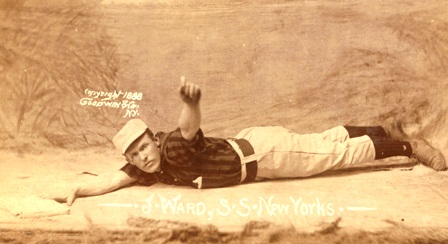
While traveling around the world as a member of A. G. Spalding’s 1888-1889 world tour, John Montgomery Ward wrote a series of dispatches for The New York World.  On February 23, 1889 the team played in Rome:

“In the picturesque Piazzi di Siena of the grounds of the Villa Borghese today the American baseball teams played a highly exciting game.  This is one of the favorite resorts of Roman citizens.  Never before in all my experience on the diamond have I seen so many distinguished persons among the crowd of baseball spectators as were in attendance here this afternoon.  The nobility was out in all its glory, and in there center stood his Majesty King Humbert.  He was dressed in a civilian’s suit and apparently enjoyed the sport. “

King Humbert "enjoyed the sport"

King Humbert “apparently enjoyed the sport”

Ward listed every member of the royal party and other “Roman princely families” who were present at the game.

“Nearly all the local literary and artistic celebrities were in the unprecedented royal and papal assemblage, and the applause at times would have stirred the heart of the most enthusiastic admirer of the American national game.  The last time the Piazzi di Siena was used was on the occasion of the marriage of the King’s brother, when the celebration was held on these magnificent grounds.

“The day was beautiful and the players were in fine condition.  During the preliminary practice the crowd of 5000 people was simply amazed at the skill displayed by the boys in batting, throwing and catching the ball.  The game itself was extremely well played, and resulted 3 to 2 in favor of Chicago.   The batting was lively, but nothing could pass the fielders, who played with remarkable energy.”

John Montgomery Ward

John Montgomery Ward

On the day of the game in Rome Ward said the players received word that National league owners were instituting the Brush Salary Classification Plan; a system developed by Indianapolis Hoosiers owner John Tomlinson Brush,  which rated players and placed them into five categories, each with a capped salary.  The Brush Plan, along with the Reserve Clause, would be the major impetus for the formation of the Players League:

“I interviewed every one of the men on the subject.  The scheme, as it is now understood by us, is regarded as a great mistake.  President Spalding, Captain Anson and Ned Hanlon concur in this opinion and say the plan is impossible and will not last long.”

Another issue that rankled players in Rome was the news that National League owners were demanding that the players return to the states by April 1 to prepare for the 1889 season; Ward said of the demands:

“From letter received by various members of the All-American team it is evident that certain managers are endeavoring to force the players to report for duty by April 1st.  For the information of these magnanimous gentlemen I will say that every player in the party will play the trip out.”

The All-Americans returned on April 6.