Tag Archives: National League

“He must either admit that he sold yesterday’s game or acknowledge that he cannot play ball”

20 Aug

Heading into the 1875 season Chicago White Stockings manager Jimmy Wood was confident about his team’s chances.  The Chicago Tribune said:

“(Wood) says the men are strictly temperate, are all first-class ball players, and will enter the field without any of the petty jealousies and ill-feelings that weakened the nine last year.”
The St. Louis Democrat also printed “private” comments Wood made maligning the abilities of the Brown Stockings in comparison to his team.

Jimmy Wood

Jimmy Wood

Unfortunately for Wood the decline of the White Stockings began even before opening day.

The first blow to the team was what became known as “the Davy Force” case.  Force signed a contract to return to the White Stockings for the 1875 season on September 18, 1874; unfortunately for Chicago he also signed a contract to play for the Philadelphia athletics on December 5.  The Sporting News described the adjudication of the Force case:

“(In December) the matter was brought up and the judiciary committee (of the National Association) awarded Force to the Chicago club…At the spring meeting of the Association, held in Philadelphia, the Athletic club got in its political work.  Mr.(Charles) Sperling, of Philadelphia, was elected president of the Association, and he appointed a new judiciary committee which reversed the ruling of the old committee.”

The arbitrary nature of the new ruling—that Chicago did not have the right to sign Force for 1875 before the end of the 1874 season—enraged White Stocking President William Hulbert, and was one of the many complaints about how the National Association operated that led to the organization of the National League the following season.

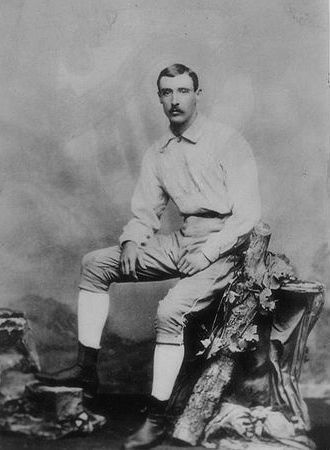
With Force gone, Wood chose Dick Higham to be the team captain.  The 23-year-old Higham had played for the Baltimore Canaries and New York Mutuals, and Wood described him as “one of the surest and heaviest batters in the country, has experience and is a first-class base-runner. “  That perception of Higham quickly changed in Chicago.
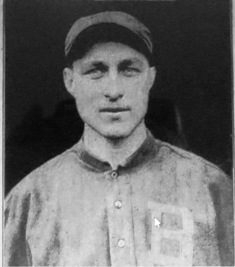
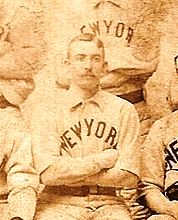
Dick Higham

Dick Higham

Despite starting the season with an 11-2 record, the White Stockings were never going to catch the first place Boston Red Stockings, who won their first 26 games, and as the losing began team morale suffered.

As the team struggled, blame fell to Higham from fans, the press, and management.  The Tribune went so far as to question his integrity:

“It is not a pleasant thing to say of any ballplayer that his being left out of a nine increase interest of a game, but this is true of Higham; and yet he is one of the best players in the country when he wants to be…It may be Higham’s fault, or his misfortune, that he is suspected of purposely losing games.”

By the end of June Scott Hastings had replaced Higham as catcher (he was moved to second base) and he was stripped of his captaincy, which was given to outfielder John Glenn.

The Chicago Inter-Ocean had defended Higham in July declaring that there was “no tangible evidence” for the “charges…bandied about the streets,” but that would change by August after an 8 to 4 loss to the Athletics during which Higham “let balls go by him without attempting to stop them” and made two throwing errors:

“Higham’s play in yesterday’s game has caused some very ugly rumors to be circulated, in which he predominates as the leading character.  His play in the eighth inning was something extraordinary, and it was quite evident he did not want to save the Chicagos from defeat.  Many are fearless in asserting that he sold the game, and base their accusation on a circumstance that seems very plausible.  Probably Higham can explain what he was doing with a Chicago character at Pratt’s billiard hall waiting for the pool selling, and when he found out there was none what point he gave his companion when they both went to Foley’s and there bought pools on the Athletics.  Many persons, who claim to know, boldly assert that Higham was in partnership in the investments. ..He must either admit that he sold yesterday’s game or acknowledge that he cannot play ball.  In either case the Chicago management can easily do without him. “

The Tribune said the directors of the White Stockings had offered a $500 reward for evidence that any player had been “tampered with,” in any way:

“This offer is meant to cover proof that a player has received money to sell a game, or has promised to help lose a game with a view to profit.  The directors will not insist on absolute proof, such as the law would require, but will pay the reward named for evidence that will convince any fair man of the guilt of the accused party.”

It was never reported whether the reward was given to anyone, or if anyone made an effort to claim it.

On August 20 the White Stockings released Higham; as a result The Inter-Ocean said, “(T)he patrons of the game have begun to think more favorably of the nine, and generally remark that now they can witness an honest game.”

Higham finished the season with the New York Mutuals.  His unpleasant months in Chicago were not the first or last time his integrity was questioned.  While with the Mutuals in 1874 there were allegations that he had been involved in throwing a game against Chicago, and In 1882, Higham, while serving as a National League umpire, was dismissed for what The New York Times called, “’crookedness’ in his decisions in games between the Detroit and other clubs.”

During the drama over Higham, The Inter-Ocean also reported that utility infielder Joe Miller, who was slated to replace Higham at second base “had some misunderstanding,” with Wood and his “connection with the Chicago nine was severed.”

With the team mired in sixth place, and the former team captain chased out-of-town under a cloud of suspicion, it wasn’t surprising when the local papers started to predict the end of the line for the manager.

The Inter-Ocean not only said that the White Stockings would likely relieve Wood of his duties at the end of the year “attributable to his leniency to the players, which is truly a part of bad management,” but correctly speculated  “(Boston Red Stockings pitcher Albert)  Spalding will be the manager,” in 1876.

There’s one more chapter in the story of the 1875 White Stockings—tomorrow.
“Figures of your kind are Pathetic”

13 Aug

John McGraw made news for an “innovation” in 1909.  The Associated Press said:

“McGraw has adopted an innovation in baseball which will appeal to fandom throughout the National league circuit and probably prevent (Fred) Merkle and others from running to the clubhouse before they ‘touch second.’ The innovation is the signing of the once famous player Arlie Latham as coach for the base runners.”

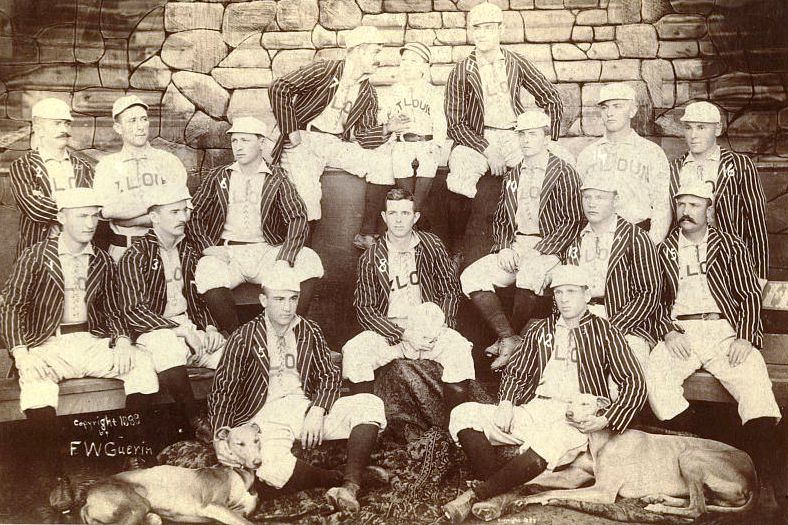
Arlie Latham, top center, facing team mascot, with 1888 American Association champion St. Louis Browns

Arlie Latham, top center, facing team mascot, with 1888 American Association champion St. Louis Browns

Walter Arlington “Arlie” Latham, was “particularly known for his humor” in the 1880s and 90s.  Primarily a third baseman with the St. Louis Browns in the American Association, the Chicago Pirates in the Players League and the Cincinnati Reds in the National League, Latham was nicknamed “The Freshest Man on Earth.”

The Associated Press said Latham:

“(B)rought much enjoyment to spectators of the Cincinnati club’s games and the Reds kept Latham a long while after he deteriorated as a player because of his drawing power as a comedian and humorist.

“Latham will don the uniform of the Giants and take his place in the coacher’s box while the Giants are at bat and between coaching the baserunner and batsmen and ‘getting the goat’ of the opposing pitchers will furnish an interesting sidelight to the New York games.”

Things did not go smoothly when Latham joined the team.  During spring training in Marlin, Texas Latham and McGraw were returning to their rooms at the Arlington Hotel when Giants outfielder James “Cy” Seymour, according to The St. Louis Post Dispatch, “knocked him down, and then bit him on the cheek.”  The article said McGraw and Latham did not know the “reason (Latham) was attacked,” but McGraw announced that Seymour was given his unconditional release.  McGraw said:

“Seymour is done with the New York club, and that goes.  It was the worst thing I ever saw pulled off.  Nothing like that can go on the New York club.”

Despite what he said McGraw did not release Seymour; the outfielder was suspended for the first week of the regular season, and The Dallas Morning News said McGraw made Seymour pay “his own expenses in Texas after the unpleasant episode.”

Arlie Latham, New York Giants coach

Arlie Latham, New York Giants coach

Latham was often criticized for his antics and even more often for the quality of his work as a coach, which became such a running joke that The New York Times said after the Giants had beaten the Cardinals in a September 1910 game:

“Arlie Latham’s team won it with their eyes shut, 11 to 3.  Latham’s coaching was invaluable yesterday.  He advised the players to touch every base and this tip won the game for them.”

The Sporting Life said:

“(Latham) undoubtedly lost a lot of games by bad coaching.  He got so unreliable that in a tight pinch McGraw would shift him from third to first and take the third line himself.”

The Sporting Life also said that Latham served as McGraw’s spy;  a position that would later be filled by another colorful McGraw coach, Dick Kinsella.

Giants outfielder Fred Snodgrass told Lawrence Ritter in “The Glory of their Times,” that Latham “was probably the worst third base coach who ever lived.”

It looked like the end of the line for baseball’s first full-time coach after the 1910 season.  The New York Herald said Latham “will not wear a Giant uniform next season,” and:

“He may amuse old timers, who remember him as a great ball player with (Charlie) Comiskey’s St. Louis Browns, but the new generation of fans seems to regard his efforts with disfavor.”

Despite the criticisms and predictions of his impending firing, Latham was back with Giants in 1911.  After the Giants pennant winning season Latham again joined the Giants for spring training in Texas in 1912, but in March, according to The Associated Press:

“(Latham) was carried as one of the twenty-five men permitted on the payroll.  McGraw did not want to let Latham go, but needed the place on the payroll for a real player.”

While McGraw didn’t want to lose his coach, most of baseball thought the end of Latham’s coaching career was a good thing; but even the New York press was not as harsh in their assessment of Latham as was Ed Remley, the baseball writer for The Fort Worth Star-Telegram:

“Arlie Latham has passed.

“May he rest in peace, for he is truly dead…Arlie has been called the fool of baseball and with much justice.  He was not the fool in any modern sense but more like the professional jesters who were kept in the courts of kings in the middle ages.

“Today, reading descriptions of the position of the court jesters, their crude horseplay jokes, we are not filled with laughter but with pity…The crude vassals of a former generation thought the brutal jokes of the court fool were funny; the bleacherites of today laugh at Arlie Latham pretending an engrossing interest in a game which he cannot even play himself…Vale, Latham—You have our sympathy, but we are not really sorry you are gone.  Figures of your kind are pathetic and pathos has nothing to do with baseball.”

Latham was next heard from when he accepted a coaching position with Patrick “Patsy” Flaherty’s Lynn Fighters in the New England League; that job only lasted until June.  Latham managed to run afoul of the entire Lynn team.  The Associated Press said he was forced to resign because “Players thought he was after manager Flaherty’s job and threatened to go on strike unless he was dismissed.”

Latham finished the 1914 season as an umpire in the Massachusetts and Rhode Island based Colonial League.  He did not return the following season, and in May of 1915 The Pittsburgh Press reported under the headline “Arlie Latham Has Quit The Diamond for All Time Now,” that he had found a new line of work; operating a deli in the Washington Heights neighborhood in Manhattan:

“He declares that as a delicatessener he is batting only .106 at present, but that when he gets properly warmed up and learns how to shave 15 ½ ounces of ham for a pound he will hit with the best of them in the delicatessen league.”

By 1917 Latham was in Europe, for the last act of his baseball career.  From 1917 to 1923 he lived in London and organized baseball leagues for military personnel.  The highlight of his stay was the July 4, 1918 game between the Army and Navy teams.  Latham served as umpire and greeted the most important dignitary at the game, King George V.  The Associated Press said:

“It had been planned to have the king throw out the first ball, but this was abandoned because of the netting in front of the royal box, so the king brought the ball out on the field and handed it to the umpire.  One of the balls used was autographed by the king with an American fountain pen and mailed tonight to President Wilson as a souvenir. “

Arlie Latham, front row center, with army team in London, 1918

Arlie Latham, front row center, with army team in London, 1918

After returning to the States, Latham first returned to the deli, then later was hired to work in the press box at the Polo Grounds, he remained a fixture at the New York ballpark until his death at age 92 in 1952.

As a result of outliving his critics and becoming one of the last surviving links to the 19th Century game by the time of his death, memories had faded about the “pathetic” figure of Latham, and only the image as  “baseball’s clown prince” remained.

Lost Advertisements–Edelweiss Beer–“Slide, you rummy, Slide”

9 Aug

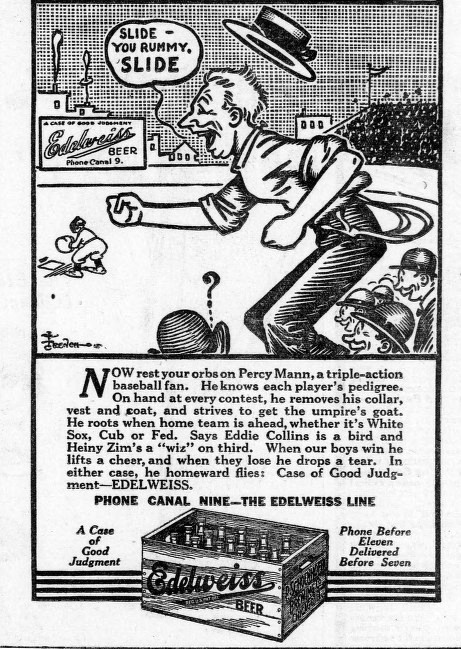
Edelweiss


A 1915 advertisement for Edelweiss Beer which appeared in Chicago newspapers.

“Now rest your orbs on Percy Mann, a triple-action baseball fan.  He knows each player’s pedigree.  On hand at every contest, he removes his collar, vest and coat, and strives to get the umpire’s goat.  He roots when home team is ahead, whether it’s White Sox, Cubs, or Fed.  Says Eddie Collins is a bird and Heiny Zim‘s a ‘wiz’ on third.  When our boys win he lifts a cheer, and when they lose he drops a tear.  In either case, he homeward flies:  Case of Good Judgment–Edelweiss”

Lost Advertisements–“Our ‘Pennant’ Hat Looks well on ‘Dut’ Chalmers

26 Jul

chalmers

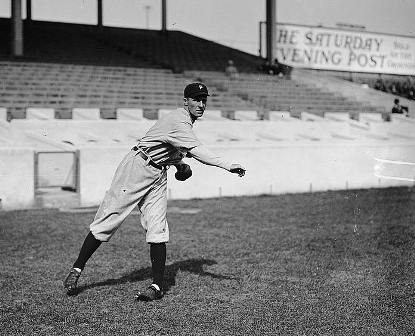
George “Dut” Chalmers, pitcher for the 1915 National League Champion Philadelphia Phillies in an advertisement for Geo. B. Wells Hats.

“Our ‘Pennant’ Hat Looks well on ‘Dut’ Chalmers

“As full of graceful curves as the shoots Chalmers puts across!

“You’ll find the right hat for your head in our very high-grade offerings at $2 and $3.”

Chalmers is one of only eight big leaguers to have been born in Scotland.  He was 8-9 with a 2.48 ERA in 26 games for the Phillies in 1915, and lost game 4 of the World Series 2-1 to the Boston Red Sox–Boston won the Series 4-1.

Chalmers was 29-41 in seven seasons, all with the Phillies.

George "Dut" Chalmers

George “Dut” Chalmers

Butcher Boy Schmidt

25 Jul

Charles John “Butch” “Butcher Boy” Schmidt was credited by Connie Mack with being the catalyst for the Boston Braves World Series upset of Mack’s Philadelphia Athletics in 1914; one year later Schmidt walked away from baseball in his prime.

Butch Schmidt

Butch Schmidt

He was born in Baltimore in 1886, and played amateur ball while working in the family meat market, which earned him his nickname.

Schmidt signed as a pitcher with the Baltimore Orioles  in the Eastern League and assigned to the Holyoke Papermakers in the Connecticut State League, where he posted a 10-9 record.  In late August the Orioles recalled him, and he went 5-1 in 11 games with Baltimore.

The New York Highlanders drafted Schmidt and the 22-year-old pitcher started the 1909 season in New York.  He appeared in only one game, on May 11, giving up 10 hits and eight runs, four earned, in five innings.  Early in June he was returned to the Orioles.

After appearing in eight games on the mound with the Orioles, Schmidt was moved to first base.  After hitting .244 for the remainder of ’09, he hit .292, .291, and .274 the next three seasons, and was sold to the Rochester Hustlers in the International League, where he hit .321; he was purchased by the Boston Braves on August 22, and hit .308 in 22 games playing in place of Ralph “Hap” Myers.

At the end of the 1913 season Boston sold Myers’ contract to Rochester; The Boston Post reported that Braves manager George Stallings simply didn’t like Myers.  (Myers had a different theory for his release—that story next week)

Schmidt was installed as the Braves first baseman in 1914, and as Boston made their improbable run to the National league pennant Schmidt   hit .285 with 71 RBI and .990 fielding percentage, and finished 16th in the voting for the Chalmers Award, for the most valuable player in the National League; teammates Johnny Evers and Rabbit Maranville finished first and second in the voting.

Grantland Rice said in The New York Tribune:

“There are few greater first basemen in baseball and none who is steadier or a better fighter.  For Schmidt is also of the aggressive type and a hustler every second.”

The New York Times didn’t think quite as highly of Schmidt and on the eve of the World Series said the “advantage favors the Athletics” at first base:

(John “Stuffy”) McInnis makes exceptionally brilliant plays…has been through Worlds Series fire and proved just as cool as if he were playing an exhibition game in the springtime.  Schmidt has yet to face the strain and tension of the big baseball classic…While Schmidt is not a scientific batsman, he is a free swinger and hits the ball hard, but he doesn’t hit it often.”

The pressure of the series didn’t seem to bother Schmidt, the Braves first baseman hit .294 with five hits, two runs and two RBIs in the four game sweep of the Athletics; McInnis hit just .143.

In game one he made a play in the first inning that Connie Mack said set the tone for the series and “sparked the Braves.”  With runners on first and second with one out, Athletics third baseman Frank “Home Run” Baker hit a foul pop-up into short right field.  Athletics outfielder Eddie Murphy tagged up and attempted to go to third; The Associated Press said Schmidt made a “great throw…from a difficult angle,” to third baseman Charlie Deal to retire Murphy.

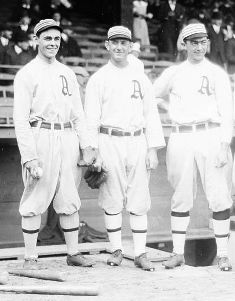
Stuffy McInnis, Eddie Murphy and "Home Run" Baker,

Stuffy McInnis, Eddie Murphy and “Home Run” Baker,

Early in the 1915 season Braves manager George Stallings called Schmidt “The best first baseman in the game,” but his performance at the plate slipped.  Schmidt hit just .251 with 60 RBIs.  The Braves again found themselves in 8th place in July, and while they made another strong run, finished 2nd, seven games behind the Philadelphia Phillies.

Despite the mediocre season at the plate, it was assumed the 28-year-old Schmidt would remain the Braves first baseman.  Schmidt shocked Stallings, Boston fans, and all of baseball when he announced in January of 1916 that he was retiring from baseball.

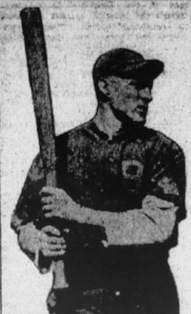
Butch Schmidt at bat

Butch Schmidt at bat

The Associated Press said Schmidt was leaving “to devote his entire time to his private business.”

Grantland Rice said Schmidt’s business included “six meat markets in Baltimore,” and that he earned $8000 a year from his stores.

The Sporting Life said it was just as likely that Schmidt, listed at 200 pounds, retired because:

Hard work in that old rubber shirt to get down to weight, especially when the extra weight comes off slowly, more slowly each succeeding season, is a trial that anyone would like to sidestep if he could. “

Boston manager George Stallings filled the void left by Schmidt by purchasing Ed Konetchy from the Pittsburgh Rebels from the newly defunct Federal League.

The Boston Post said the change at first base would not hurt the Braves:

“Konetchy, a heavier hitter than Schmidt, is just about as capable in other ways.”

Despite the confidence of The Post, Stallings was not convinced and continued to try to induce Schmidt to return; his efforts were unsuccessful.

After Konetchy hit .260 for the third place Braves in 1916 it was reported that Schmidt would return to the team.  After several weeks of speculation, Schmidt told The Boston Globe “no offer” could induce him to return to Boston.

Konetchy hit .272 and .236 the next two seasons, and each off season it was rumored Schmidt would return, and every year he stayed home where he continued to run his business and play semi-pro ball in Baltimore’s Inter-City League.

Before the 1919 season Konetchy was traded to the Brooklyn Robins and the Braves acquired Walter Holke from the Cincinnati Reds.  Holke hit .292 for the Braves in 1919, but rumors continued that Schmidt, out of organized baseball for four years, would be returning to Boston.  The Associated Press said:

“George Stallings of the Boston Braves is trying to get Charlie “Butch” Schmidt, the Baltimore butcher boy who played first base for the world’s champions of 1914, to return to the Boston Braves.  Schmidt is reported to be in wonderful condition as he has kept in practice since his retirement.”

Schmidt never returned to professional ball, and was finally removed from Boston’s reserve list in 1922.

Butch Schmidt walked away from professional baseball and never looked back; he died in 1952 of a heart attack while inspecting cattle at the Baltimore Union Stock Yards.

“There was probably none so Unique as Shreve”

24 Jul

Leven Lawrence “Lev” Shreve II came from a prominent family in Louisville, Kentucky.  His great-uncle, and namesake, had been president of the Louisville Gas and Water Company, and the Louisville & Nashville Railroad.

The 19-year-old made his professional debut in 1886, playing with Savannah, then Chattanooga; he was a combined 12-9 with 1.52 ERA.  Shreve was signed by Billy Barnie to join his young pitching staff with the Baltimore Orioles in the American Association.  He came to Baltimore with great expectations.

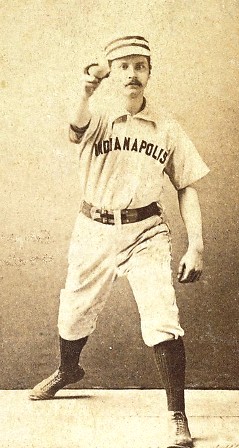
Lev Shreve

Lev Shreve

The Baltimore Daily News called him “Barnie’s phenom.”  In wasn’t the first time a relatively unknown pitcher was given that name by the Baltimore press.

Shreve had trouble getting as Barnie primarily relied on 21-year-old Matt Kilroy and 22-year-old Phenomenal Smith; Shreve, and fellow 20-year-old Ed Knouff saw limited action in the first two months of the season.

The Sporting Life said he wasn’t happy:

 “Shreve, the Louisville boy…complains that he does not get a fair deal.  He affirms that his arm is in fine trim, but that he is not allowed to pitch. Shreve is an ambitious ball player, and desires to show what is in him.  He says he will quit if Barnie does not play him.”

The Baltimore Sun said

“People are asking why Shreve isn’t given a chance.”

The Sporting Life, perhaps, provided an explanation for the lack of work later that month:

“Cigarette smoking is said to be impairing the efficiency of two Baltimore pitchers, Shreve and Knouff”

It would not be the last mention of cigarettes and Shreve in The Sporting Life;  the pitcher was also said to be “a cigarette fiend,” and “as noted for his cigarette habit” as his pitching.

Neither Shreve, who was sold to the Indianapolis Hoosiers in the National League, nor Knouff, who was sold to the St. Louis Browns, would finish the season with Baltimore; it’s unknown whether smoking was the cause.

Shreve was 3-1 with a 3.79 ERA in five games in Baltimore.

The sale to Indianapolis didn’t seem to hurt Shreve’s confidence according to George Myers, his catcher with the Hoosiers.  Meyers, two decades after playing with Shreve, said the pitcher was talented, cocky and erratic, and described Shreve’s first National League game; a 4-1 10-inning victory over the first place Detroit Wolverines on August 19:

“There was probably none so unique as Shreve…My, but he was a fresh youth…He had awful speed and good curves and perfect control of the ball.  His confidence and egotism were astounding.  I remember one day we were to play against Detroit (Wolverines).  It was when the big four, (Jack) Rowe, (Deacon) White, (Hardy) Richardson and (Dan) Brouthers were on the team.

“Mr. Shreve, who had been assigned to pitch, strutted to the box with the swagger that would have made John L. Sullivan look cheap when John L. was monarch of all in the fistic business.  ‘Just watch me fellows, and see what I do to those swell-headed guys from Michigan,’ said the smiling Shreve.  ‘I am going to make ‘em look like a lot of suckers.’

“Richardson was the first batter up…’So you are the great invincible Hardy Richardson, eh?’ drawled Mr. Shreve.  ‘Well Hardy, old chap, I’m going to show you that you are easy for a good pitcher…Shreve let go the first ball and it went around Hardy’s neck like a shot.  He struck at it after I had it in my hands.  Bang goes the second, also a strike, and the third a wide, slow, outshoot, fooled the great batter completely and Shreve said mockingly: ‘Back to the bench Hardy, I told you that you were easy.

“Big Dan Brouthers, who was always a terror to pitchers, came next and he had blood in his eye…’so this is the terrible Mr. Dan Brouthers,’ grinned the fresh pitcher.  ‘Hate to tell you Dan, how soft a mark you are’…Dan missed the first two, which went close to his chin, and the next he hit like a shot at the pitcher.  Shreve caught it in easy style and gave Brouthers the ‘ha ha’ in most tantalizing fashion as Dan ambled to the bench.

“Deacon White came next and Shreve kidded him unmercifully.  ‘Deacon who told you that you could hit anything?’ was the greeting white was given.  The Deacon scowled and muttered ominous.  ’Duck soup is what you are for me.’ Sand Shreve, as White missed the first ball by several inches.  ‘Oh, how easy,’ was the next rejoinder, and Deacon smashed blindly at an outshoot, a moment later striking out on one of those speedy ones such as had sent Richardson to the bench.

“The Big Four could do absolutely nothing with Shreve’s delivery, and the other members of their team were just as helpless…This fellow Shreve was one of the best pitchers I ever met, but he was an erratic chap, and dreadfully hard to handle.”

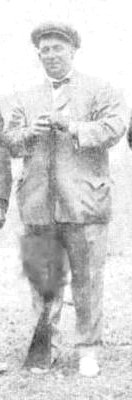
George Myers

George Myers

After beating the eventual National League champions in his first start, Shreve ended up a disappointing 5-9 with a 4.72 ERA for Indianapolis.

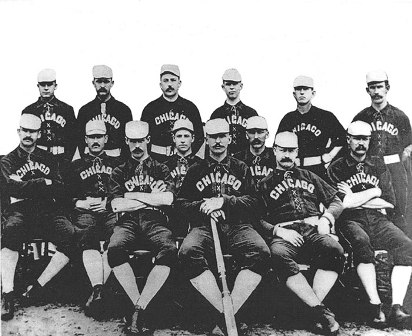
Myers said on another occasion Shreve approached him before pitching against the Chicago White Stockings, who had won the National League championship in 1886:

“’Say, George, what team is this we are up against today?’

“I immediately began to read him a lecture, telling him that a young man just starting in on his career as a professional ballplayer shouldn’t deport himself in such a manner. ‘The idea of you coming on to the grounds when the champion Chicagos are here, and not knowing it, why—‘  ‘The champion Chicagos,’ interrupted Shreve, ‘Never mind, George, just watch me.  Oh just wait and see what I will do to that bunch.”

Myer s said Shreve shutout the White Stockings.  (This story appears to be either apocryphal or conflated with another incident as Shreve did not shutout Chicago that season).

Shreve was 11-24 in 1888 and 0-3 in 1889 when he was released by the Hoosiers.  He played three minor league seasons and was out of professional baseball by the age of 24.

Myers said his former teammate was “erratic as Rube Waddell,” and:

“I could tell story after story about this man Shreve.  If he had taken care of himself he would have been the greatest pitcher in baseball history.”

“He was Not Crazy as Reported”

18 Jul

Ervin Thomas “Erve” “Dutch” Beck hit the first home run in the American League; on April 25, 1901, the second day of the season, as a member of the Cleveland Blues; Beck homered off White Sox pitcher John Skopec at Chicago’s South Side Park.

It was a highlight in a short, promising career, like many at the turn of the 20th Century, destroyed by alcoholism.

Beck was considered the best young player in Toledo, Ohio when he joined the Adrian Reformers in the Michigan State League as a 16-year-old in 1895, then for the next five seasons, he was the star of his hometown Toledo Mud Hens in the Interstate League.  For the two seasons in Toledo for which complete records survive, Beck hit .298 in 1898 with 11 home runs and, a league-leading .360 with 15 home runs in 1900.

Erve Beck

Erve Beck

Earning the Nickname “Home run Dutch” in the Toledo papers, Beck was credited with 67  during his five seasons with the Mud Hens;  he would remain the team’s all-time career home run leader until 2007 when Mike Hessman (currently with the Louisville Bats in the International League) hit his 68th as a Mud Hen.

Beck also had a brief trial with the Brooklyn Superbas in the National League in 1899, hitting .167 in eight September games.

It’s unclear exactly when Beck’s problems with alcohol began, but according to fellow Ohioan Ed Ashenbach (alternately spelled Ashenback by several contemporary sources), a minor league contemporary who wrote a book in 1911 called “Humor among the Minors”,  it was well-known during Beck’s career that he was “addicted to strong drink,” and as a result suffered from “hallucinations.”

Ed Ashenbach

Ed Ashenbach (Ashenback)

Before the 1901 season, Beck, whose rights were held by the Cincinnati Reds, jumped to the Cleveland Blues in the newly formed American League; the twenty-two-year-old hit .289 and accounted for six of Cleveland’s twelve home runs.

Beck jumped back to the Reds before the 1902 season and received rave reviews early in the season.  The Cincinnati Tribune seemed to like him more at second base than veteran Heine Peitz:

“Erve Beck looks more like a second baseman than anyone who has filled the position since (Bid) McPhee went into retirement (in 1899).  He covers the ground, seems to know where to play and is capable of swinging the bat with some effect.”

His teammate, pitcher Frank “Noodles” Hahn claimed Beck hit the ball “harder than (Napoleon) Lajoie.”

Beck hit better than .300 playing second base in May but went to the bench when Peitz, who was filling in behind the plate for an injured Bill Bergen returned to second.

In June first baseman Jake Beckley missed a week with an injury and Beck filled in there; The Cincinnati Enquirer’s Ren Mulford said:

“(Beck) played the bag in splendid style…In handling ground balls Beck is as good as Beckley, and he is a better thrower… Beck gave another display of his versatility by plugging up a hole in right field.  He made one catch that was a lollapalooza…Most players would have lost heart when benched as Beck was, but he remained as chipper as a skunk during his term of inactivity, and gladly accepted the opportunity to get back into the swim. Beck is a phlegmatic soul, who takes life, as he finds it without a growl.”

In spite of a .305 batting average in 48 games and the great press he received, Beck was released by the Reds in July.  Whether the release was simply because he was the odd man out with Peitz, Beckley and right fielder Sam Crawford healthy or as a result of drinking is unknown.

Beck was signed almost immediately by the Detroit Tigers where he took over at first base after Frank “Pop” Dillon was sent to the Baltimore Orioles.  He hit .296 in 41 games but was again released at the end of the season.

Beck would never return to the big leagues.

In 1903 he .331 for the Shreveport Giants in the Southern Association, he jumped Shreveport the following season and played for the Portland Browns in the Pacific Coast League.   He returned to the Southern Association with the New Orleans Pelicans in 1905.  After starting the 1906 season in New Orleans, he was released in July and signed by the Nashville Volunteers; his combined average with both Southern Association teams was .211.

Beck’s drinking was, according to Ashenback and contemporary newspaper accounts, common knowledge by the time he wore out his welcome in Nashville in August and was sold to the Augusta Tourists in the South Atlantic League.

That stop would last for only one game.

The 27-year-old, four years removed from the American League, played first base for the Tourists on August 6.  Augusta second baseman Ed McKernan said, “It was evident when he reported there was something amiss with him,” and claimed Beck chased “an imaginary flock of geese away from first base” during the game.

The following day, according to The Augusta Chronicle, Beck “created a sensation in the clubhouse…causing all but two of the players to leave the house.”  As a result, Augusta released him.

The following day The Chronicle said:

“(Beck) ran amuck this morning and created great excitement on the street.

“While in a room on the third floor of the Chelsea hotel the big infielder suddenly began to see things and sprang from the third story window to the ground below.  Only two intervening telephone wires and a rose bush saved his life.

“He then darted down an alley and hid himself in a store.  He was finally captured and came quietly back to his room with a policeman and (Tourists outfielder Frank) Norcum.”

The Sporting Life assured their readers that Beck “was not crazy, as reported, but only suffering from the effects of a (drunken) spree.”

McKernan said “During his convalescence…Beck would smilingly avow his determination to abstain from strong drink.”

There were varying reports regarding the extent of his injuries, and it’s unknown whether he was physically able to play after the fall, but Beck would never play professionally again.

He returned to Toledo where he operated a tavern and appears to have been unable “to abstain from strong drink;” he died in 1916 of Articular Rheumatism complicated by Hepatic Cirrhosis.

“I Object to Being Made a Freak.”

17 Jul

In 1913 American League President Ban Johnson set out to put an end to the practice the Baseball Writers Association called “A growing Evil,” ghost-written articles appearing under the by-lines of famous ballplayers.

William Peet of The Washington Herald revealed the identities of the ghost writers in March of 1913; Gerhard “Roger” Tidden of The New York World had been the man responsible for articles bearing the name of Ty Cobb, but Tidden died just three months after the revelation.   While the practice waned after 1913, Cobb remained defiant, and continued “authoring” a syndicated column for the next several years.

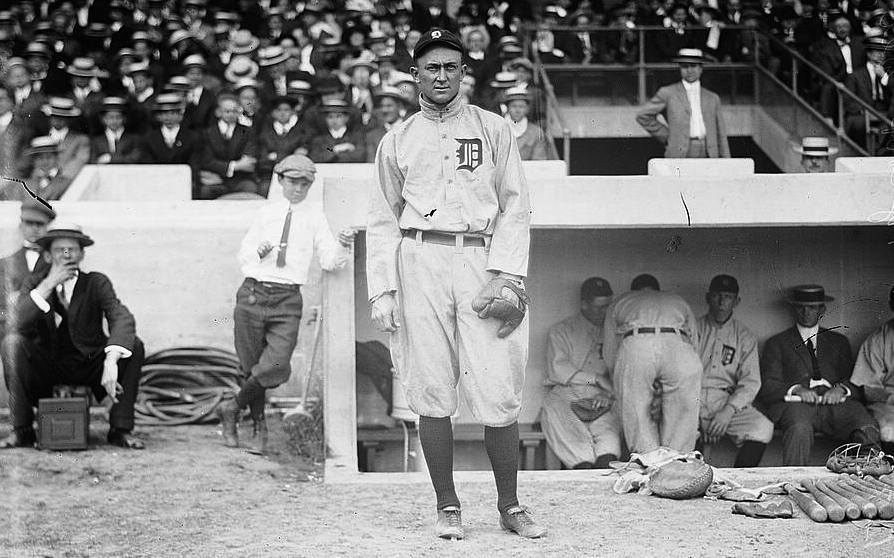
Ty Cobb

Ty Cobb

Cobb’s articles, for the most part, steered clear of trouble with the league president, but the assertions he made about the Chicago White Sox and manager Clarence “Pants” Rowland in June of 1915 caused a major stir.

Cobb said:

“Battery signal stealing, which has been the cause of several scandals in big league baseball threatens to make more trouble this season if anyone is able to prove what is generally suspected about one of the American League clubs.

“I will not mention the name of the organization which has been accused by the opposing players…because I couldn’t present any proof.”

Cobb then went on for seven paragraphs trying to present proof, and provided enough hints to make it clear he was talking about the White Sox.

Cobb’s said

 “The team I have in mind has won almost all its home games…It looks mighty funny, though, the way this club could hit at home and the feeble manner in which it has been swatting on the road and almost all of the Tigers will take an oath that something out-of-the-way is coming off.”

Chicago, through 49 games, was in first place; 22-8 at home and 9-10 on the road.  Detroit was in second place a game back.  If he left any doubt Cobb said later in the column when discussing the American League pennant race in general:

“The White Sox, who burned up things at home, have not been doing so well on the road.”

Everyone, including American League President Ban Johnson, assumed Cobb was talking about the Sox.  Johnson said:

 “(Cobb) must prove the charges, or I will keep him from playing baseball.  If any man in the American League makes a charge of dishonesty and refuses to back up his charge with the absolute evidence, that man will have to get out of the game.”

The White Sox were less concerned; The Chicago Tribune said the charges made Sox players “grin,” and Rowland told reporters:

“I suppose we had out tipping instruments planted in the Polo Grounds when we made nineteen hits in New York the other day.”

Clarence "Pants" Rowland

Clarence “Pants” Rowland

In his next column Cobb issued a non-denial denial and at the same time openly, and loudly, defied Johnson:

“I made no specific charge against the White Sox…What I did say was that a strong rumor of sharp practice was abroad, and I reiterate that statement right here.”

___

“Mr. Johnson even went to the extreme of saying that he would drive me out of baseball.  He hasn’t done this yet and I expect to stay around for a few more days.  If the league president is willing to pay the salary that my three-year contract calls for, I will be perfectly willing to take a vacation at that, for I have long wanted to do a number of things that baseball interferes with.”

Cobb reiterated the charges and offered no evidence, but said he was justified in making the claims because his manager might have believed them:

“(Tigers) Manager (Hughie) Jennings thought the report sufficiently serious to detail one of our players for plain clothes duty in the bleachers, and he also wrote Manager (Bill) Donovan of New York, telling him of a warning we had received and cautioning him to be on the lookout.  So you see the signal tipping report was not a creature of my own imagination, but a matter of sufficient seriousness to warrant an investigation by our manager in his official capacity.”

Cobb’s only bit of backtracking was to say that if “it should be proved the White Sox tried signal stealing it would be without the knowledge of Mr. (Charles) Comiskey.”  Cobb said Comiskey “wouldn’t countenance anything of this sort for a moment.”

Cobb took one last swing at Ban Johnson, charging the league president with giving “sensational interviews” about him to get “the people excited artificially. If this is Mr. Johnson’s idea, I wish he would abandon it.  I object to being made a freak.”

If there was any doubt whether the American League’s star player or the league president wielded more power, it became obvious within a week.

Johnson, who The Associated Press said “long has been opposed to players permitting their name to be used over baseball stories,” decided not only had Cobb not written the columns, but claimed “a Detroit newspaperman” made up the allegations “out of whole cloth,” and incredibly said that Cobb had “no knowledge,” of the columns despite Cobb being quoted by numerous sources discussing the charges.

Ban Johnson

Ban Johnson

Hugh Fullerton of The Chicago Examiner summed it up best:

“We are rather surprised each morning upon picking up our newspaper to discover that Ty Cobb is still making two-base hits, two steals and catching a few flies instead of being driven out of baseball by (Ban) Johnson.  By the way how did Johnson get into baseball?”

As quickly as Johnson backed down, the charges went away.  Despite the strong start the White Sox faded, and continued to fade even after the acquisition of “Shoeless Joe” Jackson on August 21, finishing third, nine and a half games behind the pennant-winning Boston Red Sox and seven games behind the Tigers.

Cobb led the league for the ninth straight season, hitting .369.

The one legacy from the brief 1915 controversy seems to be Cobb’s dislike of Rowland, who later became a scout for the Tigers.  In his 1984 book “Ty Cobb,” Charles C. Alexander said Cobb only agreed to manage the Tigers before the 1921 season because he was told:

 “Pants Rowland, whom Cobb considered an incompetent fraud, might very well get it and Cobb would have to play for him.”

Rowland, who remained in baseball until 1959 as a manager, scout and executive with the Los Angeles Angels in the Pacific Coast League and Chicago Cubs in the National League, appears to have also held a grudge.   Up until his death at age 90 in 1969, Rowland often said two of his former players, Jackson and Eddie Collins were better than Cobb.

 In 1953 at the Old Timers Baseball Association of Chicago Banquet Rowland said “I wouldn’t have traded (Collins) for Cobb.  What made him greater than Cobb was that he inspired the entire ball club.  Ty was an individualist.  He was interested only in Cobb.”

Rowland called Jackson the “greatest natural hitter,’ he ever saw, and said Ted Williams, not Cobb, was the only player “of the same make-up.”

Charles Murphy’s Last Stand

16 Jul

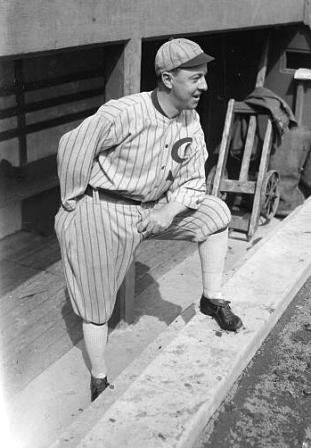
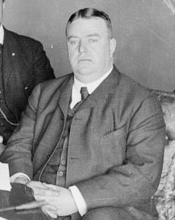
The National League had almost completely rid themselves of Charles Webb Murphy in 1914; the owner who had ongoing feuds with nearly every other league magnate, league officials, umpires, and many of his own players, had sold his interest in the Chicago Cubs to his financial benefactor Charles Phelps Taft.

Murphy returned to his home in Wilmington, Ohio; his only connection to the National League was his part ownership of the Baker Bowl, the home of the Philadelphia Phillies.  Murphy’s other ballpark ownership stake was in Chicago’s West Side Grounds, but that investment had lost most of its value after Taft sold the Cubs to Charles Weeghman, who moved the team to his ballpark on the North Side.  The Cubs former home field was used for amateur and semi-pro games, even  Buffalo Bill’s Wild West Show, but the park was not making Murphy money.

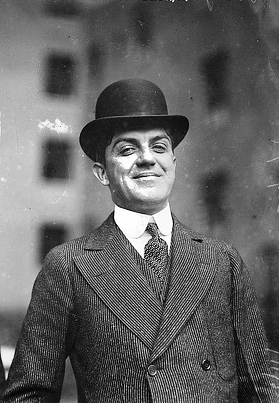
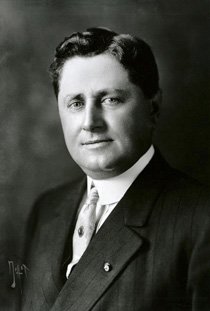
William Wrigley Jr., and his brothers were minority investors in the team in 1916, but Weeghman began struggling financially almost as soon as he bought the team, and the Wrigley brothers began buying Weeghman’s stock.

Charles Weeghman

Charles Weeghman

Between the 1918 and ’19 seasons the Wrigley’s acquired controlling interest in the Cubs.  (Some recent sources say Wrigley did not have controlling interest until 1921, but numerous contemporaneous sources said the Wrigley family had control of the team before the 1919 season began).

William Wrigley Jr.

William Wrigley Jr.

In February of 1919 Joe Vila, sports editor of The New York Sun wrote a story that said the Cubs were moving out of Weeghman Park and back to the West Side Grounds:

“National League men are gratified to learn that there will be a change of ball parks in Chicago, probably before the championship season opens on April 23.  The Cubs who have occupied the grounds of the defunct Chicago fed on the North Side since 1916, are preparing to return to their old home, West Side Park, which still is the property of Charles Webb Murphy and, presumably Charles P Taft.  The North Side plant never could accommodate more than 18,000 spectators, sitting and standing, whereas as many as 30,000 attended games at West Side Park in the days when Frank Chance had a world’s championship ball club.  Last fall the Cubs played their world’s title games with the Red Sox in Chicago at the home of the White Sox for the reason that the former Chifed arena was too small.”

Vila said Murphy saw an opportunity in the new ownership arrangement:

“Naturally, with an eye to business, Murphy promptly suggested to the Wrigley’s, who control the Cubs stock, the transfer of the Cubs…The Wrigley’s, who know little or nothing about practical baseball methods, regard Murphy as an oracle and there isn’t  a doubt that they will accept his suggestion.”

westsidegrounds

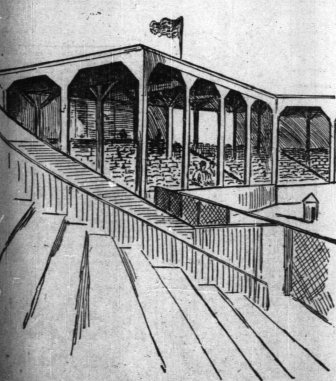
The Grandstand at West Side Grounds

It’s unclear whether the move, for which Vila said “there isn’t a doubt,” was ever even a possibility; it seems just as likely it was a story planted by Murphy.  Vila’s description of the ousted Cubs owner would suggest, at the very least, that Murphy had a sympathetic ear with The Sun sports editor:

“Murphy is one of the smartest men in baseball…When Murphy was president and of the Cubs the club didn’t have a losing year financially…In other words the Cubs under Murphy were tremendously successful.”

Vila also blames the Horace Fogel incident for all of “Murphy’s unpopularity that led to his retirement,” Not mentioning Murphy’s numerous feuds.

The Wrigley’s did not end up accepting Murphy’s suggestion, and the team remained at Weeghman Field, renamed Cubs Park before the 1920 season, and finally Wrigley Field before the 1926 season.

Murphy’s last stand having failed, he had his ballpark torn down in 1920.

It wasn’t until 1927 that the seating capacity at Wrigley Field finally surpassed that of the west Side Grounds.

“The Ty Cobb of Trapshooters”

15 Jul

Lester Stanley “Les” German broke into professional baseball with a bang in 1890.  The 21-year-old played for Billy Barnie’s Baltimore Orioles, a team that had dropped out of the American Association and after the 1889 season and joined the Atlantic Association, a minor league.

German was 35-9 in August when the American Association’s Brooklyn Gladiators folded in August, the Orioles returned to the association, and German returned to Earth; posting a 5-11 record for the big league Orioles.

German was a minor league workhorse for the next two and a half seasons.  He was 35-11 for the Eastern Association champion Buffalo Bisons in 1891; he appeared in 77 games and pitched 655 innings for the Oakland Colonels in the California League in 1892, and was 22-11 for the Augusta Electricians in the Southern Association in July of 1893 when his contract was purchased by the New York Giants.

Les German, 1894

Les German, 1894

German would never win in double figures again; In five seasons in the National League he was 29-52, including a 2-20 mark with the 1896 Washington Senators.

It was German’s next career that earned him the most notoriety.  A crack shot, German became one of the most famous trapshooters in the country for the next thirty years.  He won numerous championships and was often featured in Buffalo Bill’s Wild West Show with Annie Oakley.

A National Sports Syndicate article in 1918 said “Lester German is the Ty Cobb of trapshooters.”  The article said that beginning in 1908, when official records were first kept, German had maintained a “remarkable average,” shooting a t a better percentage than any other professional marksman.

Les German, 1918

Les German, 1918

As German’s reputation as a shooter grew, his legacy as a pitcher became inflated.

A mention of his baseball career in a 1916 issue of “The Sportsmen’s Review”, credited German, and his 9-8 record,  with “leading the Giants,” to their 1894 Temple Cup series victory over the Baltimore Orioles, there was no mention of Amos Rusie’s two shutouts .  A 1915 article in The Idaho Statesman inexplicably said German “headed the National League in both pitching and fielding” in 1895—German was 7-11 with a 5.54 ERA and committed 2 errors in 45 chances on the mound; he also made eight errors in 11 games he filled in for the injured George Davis at third base.

German operated a gun shop and continued to organize and participate in shooting tournaments until his death in Maryland in 1934.