Tag Archives: New York Giants

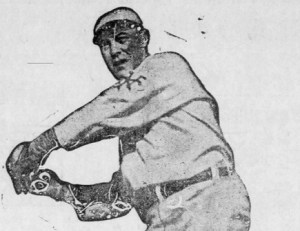
Ray Schalk on “Baseball Brains”

1 Feb

After the Chicago White Sox defeated the New York Giants in the 1917 World Series, Sox catcher Ray “Cracker” Schalk took to the pages of “Baseball Magazine” with his opinion of statistics:
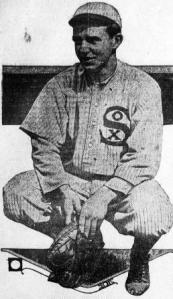
Ray Schalk

Ray Schalk

“Offhand I would say that fielding averages are pretty bad, pitchers’ averages rather punk, batting averages merely fair.  But the worst of all are catchers’ averages.

“How are you going to tell a good catcher?  By his batting average?  By his fielding average?  By the runs he scores?  Of course all these things are important.  But they haven’t any direct connection with good, bad or indifferent catching as such.  A catcher may or may not be a good batter or base runner.  And whatever his hitting or run getting ability he may be a great or mediocre catcher.”

Schalk said it was “easy…from the records” to determine an outfielder or shortstop’s ability:

“But a man might be the best catcher the world ever saw or the worst, and there would be no way under heaven to gain that information from the season’s statistics.

“First of all, a catcher must have baseball brains.  It isn’t enough to say brains; you must add the adjective ‘baseball’ to describe what you mean.”

Schalk noted that many of his contemporaries were educated:

“I admit this is the day of the college player in baseball.  I admit that the better education a man has, other things being equal, the better ball player he will be.  But he might know a lot of philosophy or Greek literature and be a frost on foul flies.  Ty Cobb has the ideal baseball brains.  But Ty isn’t a college man.  On the other hand I used to play in the minors with a graduate of a well-known university who was a brilliant scholar and a good natural athlete.  But he was positively the limit in playing baseball.  He would do the most incomprehensible things.  In fact, he was impossible.

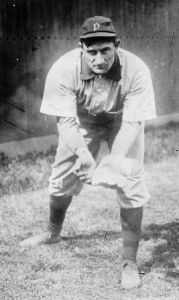
Hans Wagner and Nap Lajoie are not college men, have not enjoyed as liberal an education, perhaps, as most of the rest of us.  But if any medical laboratory wants a sample of a real baseball brain, let him open negotiations with the Dutchman or the Frenchman for the use of his skull when he is thru with it.

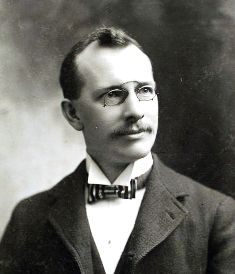
Honus Wagner

Honus Wagner

“I believe there are fellows with a natural born instinct to play baseball.  They invariably do the right thing at the right time.  That is what I mean by baseball brains.  Furthermore, such a brain must above all act quickly.  There are many thousands of people, even in the stands, who understand good baseball and could dope out the proper thing for a fielder or a batter to do under given conditions.  But that isn’t enough.  The man with a baseball brain must not only do the right thing but he must do it instantly.  It is quickness of thought quite as much as correctness which marks the star player.  Hal Chase and Ty Cobb are scintillating examples of quick thought on the diamond.”
And, said Schalk, “quick thought” was most important behind the plate:

“Now the catcher, above all men, must have a good baseball brain.  Most of his work, the most important part of his work, is hidden from the spectators’ eye.  The man in the stands can seldom follow what is going on in the catcher’s brain.  But the catcher, much more than the pitcher, holds the game in the hollow of his hand.  The catcher, much more than the pitcher, is the keystone of the baseball arch.”

The man who thought statistics didn’t have “any direct connection” to a catcher’s value made it into the Hall of Fame in 1955.  He has the lowest career average (.253) among enshrined catchers.

“Soldiers ‘Over There’ Sore on Baseball Players”

25 Jan

In August of 1918 Harry “Moose” McCormick returned to the United States from the front lines in France—he served in the 42nd Infantry, The Rainbow Division, and according to The Washington Herald “has been in the front line trenches for nearly six months.”

Moose McCormick

Moose McCormick

The former outfielder-pinch hitter, who played his final big league game with the New York Giants in 1913, was at the Polo Grounds to watch the Giants sweep a doubleheader from the Boston Braves, and he came to deliver a message; one that had come repeatedly from the general public, but not yet from someone within baseball.

McCormick told reporters that while baseball was hugely popular among the troops in Europe, the major leagues were not.  The Washington Times said, under the headline:

Soldiers ‘Over There’ Sore on Baseball Players

“It may surprise the professional ball players of the United States to know that the American soldiers now fighting in France do not hold them in high esteem; that they do not scramble for news of how the big league races are going, and that they do not care whether (Ty) Cobb, and (Tris) Speaker, and (Frank) Baker are hitting .300 or 3,000.

“The fact that the ball players aren’t hitting in the big, big game across the water is the reason for this feeling.”

The Washington Times said McCormick, then a Lieutenant, “who had just returned from the shell-swept front,” and was in the states “under orders, the nature of which is secret.”

There were various reports as to why McCormick had returned.

The New York Globe said he had come home with “Wound Chevrons on his arm,” having received the badge after being “Mussed up considerably by a German shell.”  The New York Tribune said he had been “Invalided home” suffering from “Shell shock.”  The New York World said he returned with “A hacking cough caused by gas.”

McCormick told reporters:

“The feeling among the boys over there seems generally to be that the ball players haven’t acted on the level.  The soldiers feel that there has been too much evasion, too much hanging back, too much side stepping by the ball players when other men, just as good, have given up paying places and gone into the big game.  That seems to them the ONLY thing for real men just now.

“The boys are generally incensed over the statements they read to the effect that ball players have sought work in munitions plants and shipyards, where they can keep playing ball.  They regard that as ducking, as a sort of dodging of the issue.”

McCormick said, so complete was the disgust with baseball that “Stars and Stripes, the soldiers’ paper, has stopped printing the big league scores and standings.  That, it seems to me, ought to make baseball men, both players and owners, wake up.”

He said the men at the front were still “interested in baseball,” and “like to play ball,” but were having trouble getting enough baseballs:

Baseball game with members of the Twenty-eighth Division, Three Hundred and Second U.S. supply train in France

US Soldiers play in France

Governor (John) Tener sent me two every week, and they were worth their weight in gold.  The soldiers get plenty of chance to play it themselves.  They don’t take any interest in men playing it here anymore.”

McCormick, who would be promoted to the rank of captain by the war’s end, concluded that the consensus at the front was that America’s game had failed the country:

“The talk of the soldiers is that the ball players should have volunteered in a body and made up one big organization and gone into the country’s service to fight right at the start.  That would have been a great thing to do.”

Lost Advertisements-Tris Speaker and Larry Doyle, Lewis 66

20 Jan

1913whiskey

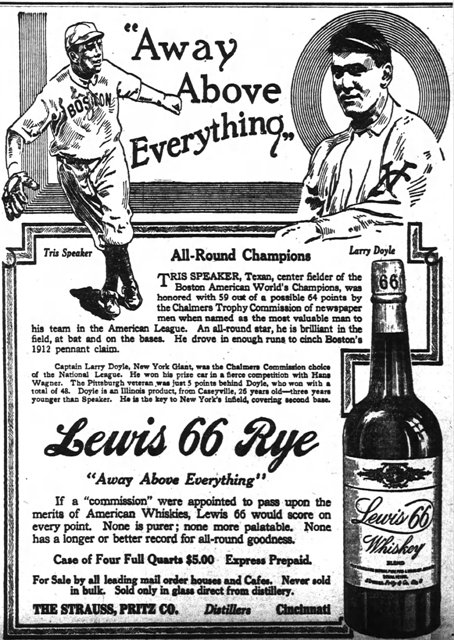
A 1913 advertisement for Lewis 66 Rye Whiskey from The Strauss, Pritz Company, a Cincinnati-based distiller featuring Tris Speaker and Larry Doyle:

“Tris Speaker, Texan, center fielder of the Boston American World’s Champions, was honored with 59 out of a possible 64 points by the Chalmers Trophy Commission of newspaper men when named as the most valuable man to his team in the American League.  An all-round star, he is brilliant in the field, at bat, and on the bases.  He drove in enough runs to cinch Boston’s 1912 pennant claim.

Captain Larry Doyle, New York Giant, was the Chalmers choice of the National League.  He won his prize car in a fierce competition with Hans Wagner.  The Pittsburgh veteran was just 5 points behind Doyle, who won with a total of 48.  Doyle is an Illinois product, from Caseyville, 26 years old–three years younger than Speaker.  He is the key to New York’s infield, covering second base.”

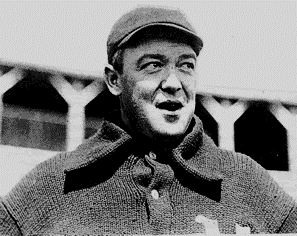
Larry Doyle

Larry Doyle

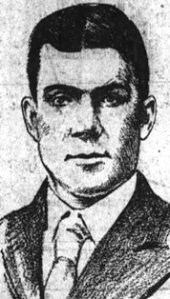
The cars–each a 1913 Chalmers 36– were presented before World Series games at each player’s home ballpark by company president Hugh Chalmers.  Former Cincinnati sportswriter turned advertising executive and chairman of the Chalmers Commission, Ren Mulford introduced the automobile executive at the Polo Grounds for Doyle’s presentation, and said:

Ren Mulford

Ren Mulford

“What (Sir Thomas) Lipton is to Yachting, and what (William Kissam) Vanderbilt is to automobile road racing, Hugh Chalmers is to baseball.  The Chalmers trophy is now a recognized baseball classic.”

The “recognized baseball classic” was discontinued after the 1914 season.


“Everyone Knows the Human Insect”

13 Jan

Arthur “Bugs” Raymond, obtained by New York Giants at the end of 1908 in the trade that sent Roger Bresnahan to St. Louis, was a great talent but long considered second only to Rube Waddell as baseball’s most eccentric pitcher.

Manager John McGraw was convinced he could succeed with Raymond where other managers had failed.  James Hopper, college football coach, turned novelist and journalist, wrote about Raymond’s first spring with the Giants in “Everybody’s Magazine:”

“’Bugs’ Raymond belongs to the old type of professional baseball player. He is a big child, thoughtless, improvident, a wonder of efficiency at his craft, but totally irresponsible outside of it.  He has been pitching for several years on ‘tail-ender’ clubs—indifferently, in spite of natural gifts, because always out of condition… (McGraw) thinks he can ‘handle’ him.  And he is doing so, thus wise;

“He does not let him have any money. ‘Bugs’ is married and his wife is an invalid.  The contract between (The Giants) and ‘Bugs’ provides that the latter’s salary each month shall go in toto to Mrs. Raymond…Result, a perpetually penniless ‘Bugs’ living an enforced simple life.”

Bugs Raymond

Bugs Raymond

As a result, Hopper said Raymond had behaved and “gradually regained the lithe lines of an athlete,” during the spring in Marlin Texas.

And, six weeks into the 1909 season, it appeared McGraw’s strategy was working.  Raymond won five of his first seven decisions for a team that was 17-17 at the end of May.

Most of what was written about Raymond that season was superficial; many of the stories apocryphal, nearly all of them portrayed him as a simple-minded clown.  One exception was a profile written in May by Sid Mercer of The New York Globe—it remains one of the only articles about Raymond that doesn’t reduce him to a caricature:

“It isn’t necessary to introduce Mr. Arthur Raymond.  Everybody knows the Human Insect.  He’s the easiest fellow to get acquainted with that you ever met.  Just at present, he is the leading pitcher of the Giants, although that is not much of an honor, considering the position of the team.  However, the Chicago citizen is delivering the goods in large packages…Raymond is one of the great pitchers of the country, yet he does not take baseball seriously.

Bugs

Bugs

“He never has got over being a boy, although he is close to 30-years old.  He gets lots of amusement out of the ordinary things of life and of course, his escapades are usually exaggerated.  But do not take the eccentric twirler for a simple fellow.  Raymond has no use for money except to spend it, but he is nevertheless fairly well educated, and when his mind turns to serious thoughts he is quite a different person than the fans imagine he is.

“’I may be crazy,’ he once remarked.  ‘but I ain’t as crazy as Rube Waddell, and I’m no fool.’

“While it cannot be said on good authority that Raymond is a total abstainer, yet he seldom pitches a bad game.  Whatever his faults or weaknesses he earns the salary that is paid to him. His rollicking disposition long ago developed in him a distaste for the accumulation of wealth, so the most of his salary goes to Mrs. Raymond and three children ([sic] Raymond had just one child) in Chicago, while Bugs gets along on a little and has just as good a time as if he handled it all.

“Raymond was originally a pressman on a Chicago newspaper and he has already visited the press rooms of most of the New York papers.  There is nothing of uppish about him and the pressmen are all strong for him…With the bleacherites Raymond is a big favorite.  He is one player who likes to talk baseball to the fans, and his disposition is one that makes friends.  The big fellow is big hearted and generous and there isn’t a mean streak in him.”

Raymond did not finish the 1909 season with the Giants.  He was 18-12 with a 2.47 ERA in mid-September when he left the club, or was asked to leave, or left by mutual agreement, depending on the source.

He was said to be tending bar in New York in late September—but that story is questionable as most contemporary accounts say he was with the Giants when they arrived in Pittsburgh on September 27 and returned to his home in Chicago on September 29.  He told The Chicago Daily News:

“I was fined again and again and suspended until I couldn’t stand it any longer.  My salary for the year was $4500 but McGraw fined me $1700 on one pretext or another, so I’ve got only $2800 for my work this year.

“I was unjustly suspended a short time ago, and this was the last straw.  McGraw didn’t seem inclined to give me a chance to work, and so I quit the team and came home to Chicago.  I may pitch a few games here for some local teams.”

McGraw tried and failed two more times with Raymond—he was 10-15 in 1910 and ’11 with the Giants.  He was dead 15 months after his final game with New York.

The Decline of Baseball, 1899

8 Jan

Late in the 1899 season, The Chicago Tribune editorialized on the state of the game.  The paper was convinced that baseball’s best days were behind it:

“Once upon a time this city put on mourning when its ball club lost a game and when the club returned from a victorious tour it had a Dewey welcome.  Men left stores and offices to go to the ball field.  They knew the players on the home team and exulted in their powers.  There is no more of that.  There is no longer any civic pride in the local team.  Business men no longer attend the games.  In this city and in other cities baseball has ceased to be a high-class sport.  It has become a low-grade pastime.  It is patronized by the class of people who are interested in bicycle races, long-distance pedestrian contests, gamblers, horse races and poolrooms.  Baseball, once the sport of men and women of taste, is now the diversion of hoodlums.”

As for why the game was no longer of interest to “men and women of taste,” The Tribune said:

“There is no room for doubt as to what has pulled it down from its former high state.  Commercialism in part has done it.  The players have become chattels.  Teams are bought and sold and are transferred from city to city as if they were livestock.  The men who are playing in Chicago this year may be playing in Cleveland or New York the next.  That cuts up all sense of local pride in a club…There have been teams which really belonged to Chicago.  Of late years, there have simply been organizations of hirelings whose owners instructed them to hail from here.

“Professional baseball is in the hands of a few men whose sole object is to make all they can out of a sport they have ruined.  There is no competition among them.  That championship, in the winning of which cities took so much pride once, has become a farce.”

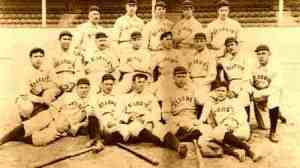
The actions of Frank DeHass and Martin Stanford “Stanley” Robison was a particular source of the paper’s ire. The Robison brothers, owners of the Cleveland Spiders, purchased the bankrupt St. Louis Browns and transferred Cleveland’s best players, including Cy Young, Nig Cuppy, and Jesse Burkett to the St. Louis club, now called the Perfectos.  What was left of the Spiders finished with a 20-134 record.

 “Sometimes one man owns two clubs and makes draft on one to help out the other. If it becomes evident that Cleveland must be at the tail of the procession, its best men are shifted over to the St. Louis organization, both being under one ownership.  Requisitions are made on Baltimore for the benefit of Brooklyn and on New York for that of Boston.  No city can have any feeling of city proprietorship in a club under such circumstances.”

The 1899 St. Louis Perfectos

The 1899 St. Louis Perfectos

The behavior of fans was of equal concern:

“Rowdyism has come in along with commercialism and has finished what interest was left in the game. Quiet, decent people can no longer go to baseball games because of the vulgarity and ruffianism displayed there.”

The Tribune felt current players were of lower moral character than those of the previous generation:

The morals of the players have deteriorated.  They used to try to behave like sportsmen.  They act now like foul-tongued bullies.  When a question comes up for the umpire to settle, the players surround him and blackguard and threaten him.  He is fortunate if he escapes without bruises.  Fair decisions cannot be expected from a man in danger of being mobbed.  Occasionally the contending players come to blows and the spectators, who went to see a game of ball, have to witness a game of slugging, garnished with profanity.”

How low had the game gone?

“Baseball has fallen so low that gamblers do not think it is worth paying any attention to.  They have not dropped it because they fancy it is not ‘on the square,’ but because it has become an uninteresting, second-class sport.  It does not interest them now any more than a race between professional bicyclists does.  Baseball has become a recreation of the people whom commercialism, vulgarity, and Rowdyism do not displease.”

The Tribune continued their crusade against the “uninteresting” sport a month later, with an “account of the more disgraceful of the many rows witnessed by spectators of baseball games.”

“Frank Chance Stands Forth as the Biggest Individual Failure”

21 Dec

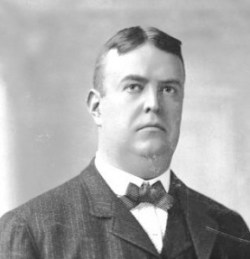
It was widely assumed that American League President “Ban” Johnson had a hand in the transactions that resulted in Frank Chance coming to New York to manage the Yankees in 1913—Chance was claimed off waivers by the Cincinnati Reds in November of 1912, then waived again and claimed by the Yankees a month later.

Ban Johnson

Ban Johnson

William A. Phelon, the sports editor at The Cincinnati Times-Star noted “(T)he strange fact that all the clubs in the older league permitted him to depart without putting in a claim,” as evidence of the fix being in.  And, in “Ban Johnson: Czar of Baseball,” author Eugene Murdock said “Johnson masterminded a series of intricate maneuvers,” to bring “The Peerless leader” to New York.

Chance’s arrival in New York was heralded as a turning point for the franchise, and he made no effort to downplay his confidence.  On January 9, 1913, The Associated Press reported that chance told Yankees owner Frank Farrell:

“I will win the pennant for you before I get through in New York. That may sound like a bold statement to make at this time, but I ask you to remember my promise.”

Frank Chance

Frank Chance

Despite the maneuvers on Chance’s behalf and Chance’s own confidence, he failed miserably in New York. The club finished seventh with a 57-94 record in 1913. The following season, the team was 60-74 when Chance resigned.   The resignation came after a tumultuous season which included charges by Chance that the team’s failures were largely the result of scout Arthur Irwin’s failure to sign decent players.  He also secured a guarantee of his 1915 salary from Farrell before he resigned.

Two months after Chance’s exit, the man who “masterminded” the moves that brought him to New York, unleashed his wrath on the former manager to Ed Bang of The Cleveland News:

“You can say for me that Frank Chance stands forth as the biggest individual failure in the history of the American League.  That’s the sum and substance of what B. B. Johnson, president of the American League said a short time since when “The Peerless Leader” came up for discussion, ‘and what’s more, you can write a story to that effect and quote me as strong as you’d like,’ Ban continued.

“President Johnson had great hopes of Chance molding a winner in New York, and when, after almost two years as the leader of the Yankees, he quit a dismal failure, the blow all but floored Ban for the count.  The American League has always played second fiddle to the Giants in New York, and Ban and other American Leaguers figured that Chance was the man to bring about a change in the condition of affairs.”

Bang said Johnson took Chance’s failure “to heart,” because he believed he “made a ten-strike” for the league when Chance came to New York.  Johnson told him:

“’Chance had the material in New York and I think any other man would have made a success og the venture,’ said Ban.  ‘Surely no one could have done any worse.  Of all the players that were on the New York roster in 1913 and 1914, and there were any number of likely looking recruits, Chance failed to develop even one man of class.  Why, it was an outrage.’

“’And then when he made up his mind that he was a failure, or at least when he was ready to step down and out he had the unmitigated nerve to ask for pay for services that he had not performed.  That surely was gall, to say the least.”

Johnson finished by comparing Chance unfavorably with the Yankees’ 23-year-old captain who replaced him and guided the team to a 10-10 finish:

“’Why, Roger Peckinpaugh, youth though he is, displayed far more class as manager of the Yankees in the short time he was at the helm than Frank Chance ever did.”

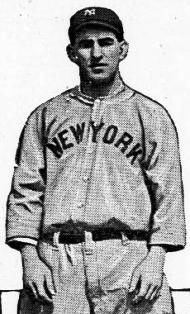
peckinpaugh2

Roger Peckinpaugh

Irwin left the Yankees in January of 1915 when Farrell and his partner William Devery sold the team to Jacob Rupert and Cap Huston.  Peckinpaugh remained captain but was replaced as manager by Bill Donovan, who guided the Yankees for three seasons–a fifth, a fourth and a sixth-place finish with an overall record of 220-239.

Lost Advertisements–Ty Cobb, Lewis 66 Rye

11 Dec

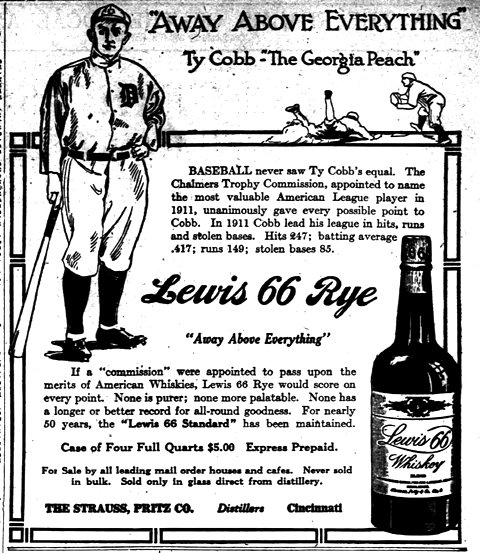
cobblewis66

A 1912 advertisement for Lewis 66 Rye Whiskey from The Strauss, Pritz Company, a Cincinnati-based distiller:

“Away Above Everything”

Ty Cobb–‘The Georgia Peach’

“Baseball never saw Ty Cobb‘s equal.  The Chalmers Trophy Commission, appointed to name the most valuable American League player in 1911, unanimously gave every possible point to Cobb (he received all eight first-place votes–the commission consisted on one sportswriter from each league city).  In 1911, Cobb led his league in hits, runs, and stolen bases.  Hits 247; batting average .417; runs 149, stolen bases 85 [sic 248; .420; 147, 83].”

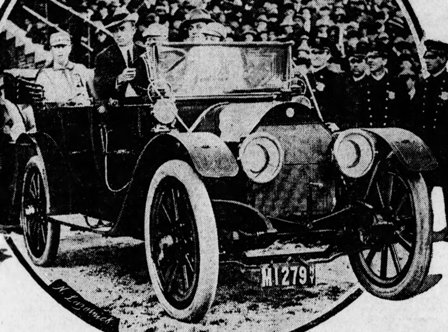
Cobb was presented with a Chalmers “36” at Shibe Park in Philadelphia on October 24, 1911, before game four of the World Series. Jack Ryder, covering the series for The Cincinnati Enquirer said of the presentation:

“President (John T.) Brush of the Giants declined to allow this ceremony at the Polo Grounds, so it was pulled off very quietly here this afternoon…The event took place 10 minutes before the game and was coldly ignored by the Giants though the Athletics took a keen interest in it and several of them had their pictures taken with Cobb. Ty now has three cars, but he says this one is much the best of the lot, and he expects to drive it to his home in Georgia as soon as the series is over.”

Cobb in his Chalmers at Shibe Park

Cobb in his Chalmers at Shibe Park

While Cobb was the unanimous choice of the eight-man commission, the second place finisher in the American League received a more valuable car.

The Chicago Inter Ocean said Chicago White Sox fans, unhappy that pitcher “Big Ed” Walsh finished second to Cobb, “Undertook to raise a fund to purchase an automobile,” for him.

But, said the paper, the fans:

“(F)ound themselves confronted with a dilemma–they had too much money in the fund to buy a duplicate of the Chalmers touring cars presented to Ty Cobb and (National League winner, Chicago Cubs outfielder) Frank Schulte.”

Two days before Cobb received his Chalmers in Philadelphia, Walsh was presented with his car before a charity game at Comiskey Park.

Ed Walsh

Ed Walsh

No Chicago newspaper reported the make and model.  The Daily News called it “A handsome automobile.”  The Inter Ocean said it was “A $4,000 automobile,” and The Tribune said simply that he had received an “(A)utomobile subscribed for by the fandom of the city.”  The Examiner also failed to mention the type of car Walsh received but said the Cubs’ Schulte “gave $25” to the fund.

According to The Tribune, Walsh promised to “‘(L)earn how to run it before spring,’ and the stands cheered loyally.”

Lost Pictures–The Best Eyes in Baseball

4 Dec

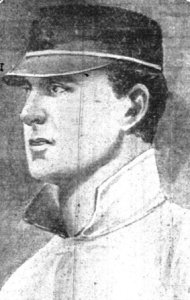
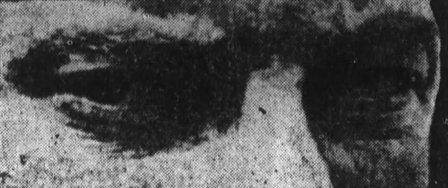
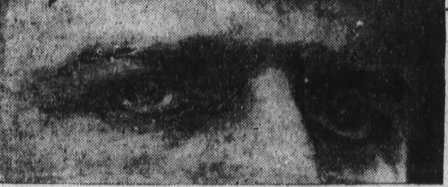
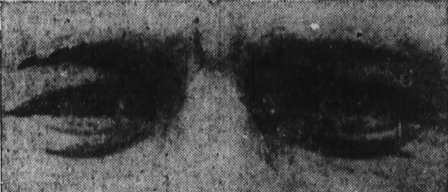
eyeszimmerman

eyesdaubert

eysspeaker

Above, three sets of eyes, 1916.

Harold “Speed” Johnson of The Chicago Herald said:

“It’s the eye and not the wallop that counts in the national Pastime.  Some eyes are more durable than others.  Larry Lajoie possesses such a pair; so does Hans Wagner, Terry Turner, Tris Speaker, Jake Daubert, Frank Schulte, Larry Doyle, Heine Zimmerman, Tyrus Cobb, Joe Jackson and Bill Hinchman.”

Johnson informed his readers that “Most of these birds refrain from reading during the offseason, thereby sparing their eyes.”

As for the three sets pictured above, Jonson said:

“Heine Zimmerman is another notable example of the batter who possesses the keen optics.  He eccentric third sacker of the Chicago Cubs, when at peace with the world, is one the greatest natural sluggers of all time.  His eyes never have troubled him but his temperament frequently has caused him to slump, swinging frantically at any old pitch.  Right now Heinie is seeing in exceptionally good form as witness his average of .336 for 48 combats.”

[…]

“There is nothing wrong with Jake Daubert’s glims as a slant at the latest averages will indicate…His heavy cannonading has been a principal factor in the upward climb of the Robins…For a pair of eyes that have been in use as long as Jake’s in the big set they’re holding out famously.”

[…]

 “Nine seasons of big league milling haven’ dulled the lamps of Tristram Speaker who right now is going better than he did in his banner years with the Boston Red Sox.  Not only is the big Texan rattling fences  at Dunn Field, Cleveland, where for seven years he averaged .381 on visits with the Bostonese, but he is keeping up his terrific pace abroad.”

Zimmerman’s temperament caught up with him again.  He wore out his welcome in Chicago in August of 1916, was traded to the New York Giants and finished the season with a .286 average.

Daubert’s eyes held out.  He hit .316 and led Brooklyn to the National League pennant.

Speaker kept hitting at Dunn Field and everywhere else, finishing the season with a major league-leading .386 average.

Lost Advertisements-1922 World Series, Lord and Taylor

13 Nov

1922ws

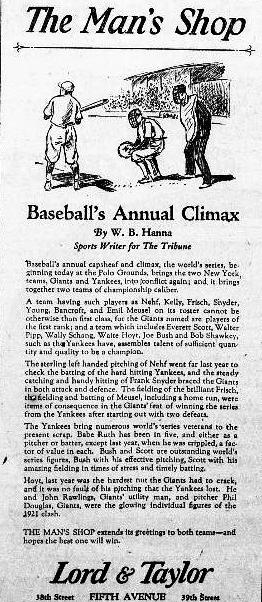
An October 1922 Advertisement for The Men’s Shop at Lord & Taylor.  The ad featured a preview of the World Series–a rematch of the 1921 series–written by William Blythe Hanna of The New York Tribune:

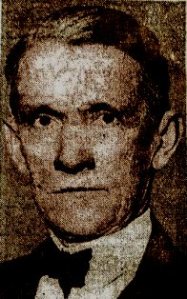
William Blythe Hanna

William Blythe Hanna

“Baseball’s annual capsheaf and climax, the world’s series, beginning today at the Polo Grounds, brings the two New York teams, Giants and Yankees, into conflict again; and it brings together two teams of championship caliber.

“A team having such players and (Art) Nehf, (George “High Pockets”) Kelly, (Frankie) Frisch, (Frank) Snyder, Young (Dave) Bancroft, and Emil (“Irish”) Meusel on its roster cannot be otherwise than first class, for the Giants named are players of the first rank; and a team which includes Everett Scott, Walter Pipp, Wally Schang, Waite Hoyt, Joe Bush and Bob Shawkey, such as the Yankees have, assembles talent of sufficient quantity and quality to be a champion.

“The sterling left-handed pitching of Nehf went far last year to check the hard-hitting Yankees, and the steady catching and handy hitting of Frank Snyder braced the Giants in both attack and defense.  The fielding of the brilliant Frisch, the fielding and batting of Meusel, including a home run, were items of consequence in the Giants’ feat of winning the series from the Yankees after starting out with two defeats.

“The Yankees bring numerous world’s series veterans to the present scrap.  Babe Ruth has been in five, and either as a pitcher or a batter, except last year when he was crippled, a factor of value in each.  Bush and Scott are outstanding world’s series figures, Bush with his effective pitching, Scott with his amazing fielding in times of stress and timely batting.

“Hoyt, last year was the hardest nut the Giants had to crack, and it was no fault of his pitching that the Yankees lost.  He and John Rawlings, Giants’ utility man, and pitcher Phil Douglas, Giants, were the glowing individual figures of the 1921 clash.

“The Man’s Shop extends its greetings to both teams–and hopes the best one will win.”

The Giants repeated, beating the Yankees four games to one–there was also a controversial tie in game 2.

22giants

The Giants

Veteran’s Day—The 1917 “Smokes for Soldiers Game”

11 Nov

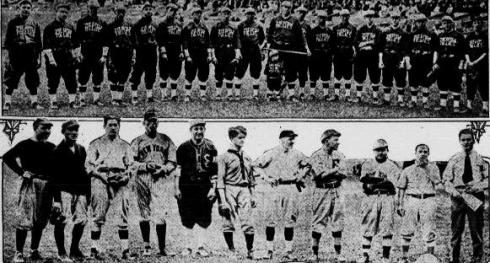
In August of 1917, a benefit game was played in New York to raise money to send cigarettes to US soldiers fighting in Europe.  The New York Sun said:

“The crowd that turned out at the Polo Grounds yesterday afternoon to see the Ziegfeld Follies high diving ball tossers play the Friars Club for the benefit of The Sun’s Tobacco Fund for our soldiers in France that even Fatty Arbuckle was inconspicuous.”

The Follies (top) and the Friars

The Follies (top) and the Friars

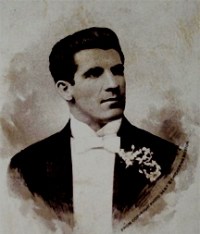
New York Giants’ outfielder turned actor, Mike Donlin and boxer Jim Jeffries served as umpires and drawing cards:

“Donlin, mightiest ball slugger…batted for someone or other and knocked a pop fly and was promptly knocked by 7,000 fans, and Jim Corbett oiled up the old biceps machinery by rapping fungoes before the game.”

Donlin

The Sun said the game drew nearly 7,000 fans and raised $937.60—other new York paper put the attendance closer to 5,000—but told readers that many of them were “(S)mall boys or Harlem youths at the voice cracking age whose contributions amounted to dimes and even pennies—gifts that measured the extent of their bankroll and therefore doubly welcome and all going far toward swelling the total for smokes and makin’s for our soldiers.”

Tobacco, said the paper, was critical to the war effort:

“Do you realize what a notable and beneficial part tobacco has played in the wars of the last century, from the Battle of Waterloo; say to the great conflict now raging?  Probably its solacing and inspiring qualities were never more strongly manifested that in the Franco-Prussian War of 1870.  It might be said, indeed, that the defeat inflicted on the French was due largely to the soldiers’ lack of tobacco, added, as it was, to the breakdown of the commissariat, whereas on the other side the Germans did all they could to ensure a plentiful supply to their troops. “

As for the game:

“(O)ne might say that a baseball game was but incidental to the baseball game…what with wild applause the minute Jim Corbett stalked onto the field., bat in hand, to oil the upper cutting wings before settling down to umping, and then the three deafening cheers  when Mike Donlin strode out toward the spot where he used to stamp down the right field grass in the old days, and the ‘Aaaahs’ and  ‘Oooohs’ from ecstatically admiring thousands as (actresses and donation collectors) Miss (Ann) Pennington, Miss Frances White…and all their friends piled on the field.”

Corbett

Corbett

The Follies defeated the Friars 7 to 5.