Tag Archives: New York Giants

“There’s one thing you mustn’t do when you get to New York”

26 Oct

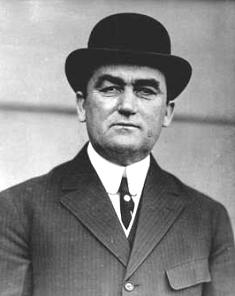
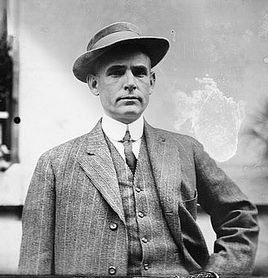
“Sinister Dick” Kinsella is primarily known as John McGraw’s equally pugnacious right-hand man and scout.  He was at McGraw’s side for one of the manager’s most famous brawls; a battle with Giants catcher Larry McLean in the lobby of the Buckingham Hotel in St. Louis, he also boasted an impressive list of “finds” including Carl Hubbell, Chief Meyers, Hack Wilson and Larry Doyle.

"Sinister Dick" Kinsella

              “Sinister Dick” Kinsella

Kinsella credited a career minor league player and manager for his discovery of Doyle, who he sold to the New York Giants in July of 1907.  After Doyle hit .310 in 1911, a syndicated Newspaper Enterprise Association told the story of how he acquired Doyle after the 1906 season from the Mattoon Canaries of the Kitty League, having never seen him play:

“Mattoon was in need of a pitcher and appealed to President Dick Kinsella of the Springfield Three-Eye League team for aid…Kinsella saw a chance to make a bargain when Mattoon hoisted the distress sign and struck one.  ‘I’ll let you have a pitcher for the pick of your team at the end of the season,’ Kinsella told the Mattoon people.  His offer was accepted and pitcher (John) Jokerst was sent  to the Kitty League team by Springfield.

“Doyle didn’t do well with Mattoon (.225 in 91 games) that season.  Kinsella had not even considered him in deciding what player to pick.  He had almost made up his mind to take a veteran pitcher.”

Fate intervened when Kinsella mentioned the Mattoon deal to Frank Belt, manager of the Kitty League’s Jacksonville Jacks.  Belt asked Kinsella if he had ever seen Doyle:

“’No,’ answered Kinsella.

‘”Well, don’t pick anyone until you do, and then pick him.  He’s the coming ballplayer of that club.  He hasn’t looked good in the box scores, but he’s ‘there’ any way you take him.  He’ll bring you more money inside of a year than you ever got for a player.”

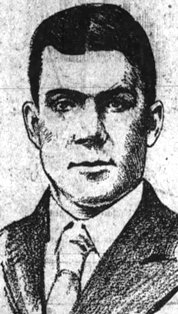
Larry Doyle

                  Larry Doyle

Sight unseen, Kinsella took Belt’s advice.  Doyle played third base and hit .290 in 66 games for Kinsella’s Springfield Senators.  He became the subject of a bidding war with the Giants winning out over the Detroit Tigers and Washington Senators for his services on July 16.

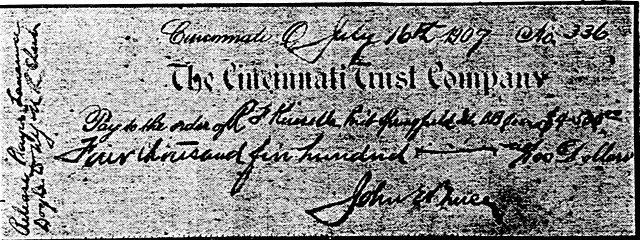
Kinsella was paid a then-record $4500 for Doyle—a record eclipsed the following year when Kinsella sold Rube Marquard to the Giants for $11,000.

The $4500 check to Kinsella for the sale of Doyle

                              The $4500 check to Kinsella for the sale of Doyle

According to The Springfield Journal Kinsella sent Doyle off to New York with just one piece of advice:

“There’s one thing you mustn’t do when you get to New York.  You must quit sliding to bases on your head.  If you don’t, they will think you’re from the brush.”

Doyle was moved to second base, hit .290 over a 14-year big league career, and presumably took Kinsella’s advice about sliding head first.

Things I Learned on the Way to Looking Up Other Things #16

21 Oct

Pirates Slump, 1921

The first place Pittsburgh Pirates were preparing for a doubleheader with the New York Giants on August 24, 1921, when the team took time out to pose for a photo.  The Pittsburgh Leader said:

“Someone happened to mention, as the photographer moved away, that for a whole team to watch the little birdie at once was a jinx.”

The team promptly went out and dropped the doubleheader, then lost three more to the Giants.  The paper said of the five straight losses:

“It doesn’t prove the jinx exists.  But it does prove that to imbue a man or a team of men, with the idea that they can’t win a ballgame generally means that they won’t win.  For their pep and enthusiasm has been stolen.”

The Pirates finished second, four games behind the Giants.

Anson’s All-Time Team, 1918

While visiting St. Paul, Minnesota in the summer of 1918, Cap Anson was asked by a reporter for The Associated Press to name his all-time all-star team.  The reporter said the team was most “notable for including in its makeup not one” current player:

"Cap" Anson

                        “Cap” Anson

“According to Captain Anson, at  least four outfielders of old times are better than (Ty) Cobb or (Tris) Speaker and (John) Clarkson, (Amos) Rusie, and (Jim) McCormick, he thinks were better pitchers than (Grover Cleveland)  Alexander  or (Walter) Johnson.  His line-up would be:

Catchers—William “Buck” Ewing and Mike “King” Kelly

Pitchers—Amos Rusie, John Clarkson, and Jim McCormick

First Base—Captain Anson, himself

Second Base—Fred Pfeffer

Third Base—Ned Williamson

Shortstop—Ross Barnes

Outfielders—Bill Lange, George Gore, Jimmy Ryan and Hugh Duffy

Cy Young’s Five Rules, 1907

Forty-year-old Cy Young won 21 games for the Boston Americans in 1907 and his longevity became a popular topic of newspaper copy until he pitched his final major league game four years later.

Cy Young

                                             Cy Young

During that 1907 season he gave a reporter for The Boston Post his advice for young players:

“(T)o the young player who seeks his advice about getting in condition and being able to stay in the game as long as the veteran himself, Cy lays down a few simple rules, which are as follows:

  1.  Live a temperate life
  2. Don’t abuse yourself if you want to attain success
  3. Don’t try to bait the umpires; abusing the arbitrators does a player no good and harms him in the eyes of the umpires, players and public in general
  4. Play the game for all you are worth at all times
  5. Render faithful service to your employers

Regarding his “rule” about umpires, Young said:

“What’s the use in kicking?  The umpire won’t change his decision, and kicking will give him another chance to get back at you for your silly abuse.”

Lost Advertisements–Larry McLean for Sweet Caporal

25 Sep

mclean

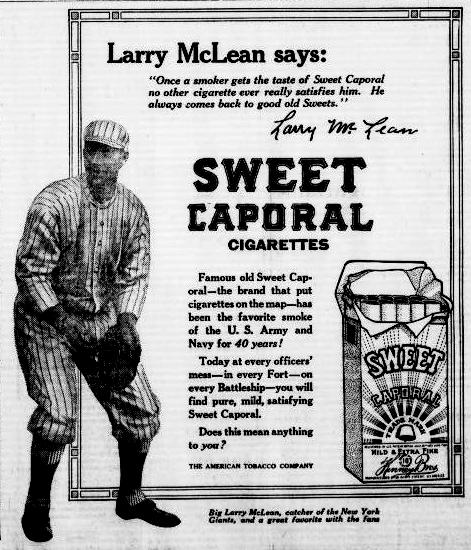
A 1914 Sweet Caporal Cigarette advertisement featuring New York Giants catcher Larry McLean “a great favorite of the fans:”

“Once a smoker gets the taste of Sweet Caporal no other cigarette ever really satisfies him.  He always comes back to good old Sweets.”

McLean wore out his welcome in New York and ended his major league career the following season when he fought with Manager John McGraw, and McGraw’s right-hand man, “Sinister Dick” Kinsella in the lobby of the Buckingham Hotel in St. Louis.

It was hardly the first controversy for McLean, who battled–albeit not physically–with every manager he played for during his 13-year-career.  Sam Crane, the sports writer and former infielder, summed up McLean well in a 1910 article for “Pearson’s Magazine:”

“Larry McLean, of the Cincinnati Reds, as a mere mechanical catcher is hard to beat.  He has a splendid arm and can throw like a streak.  Larry is too, perhaps, the best batting catcher in either league, but his erratic habits make it impossible to place any confidence in him.”

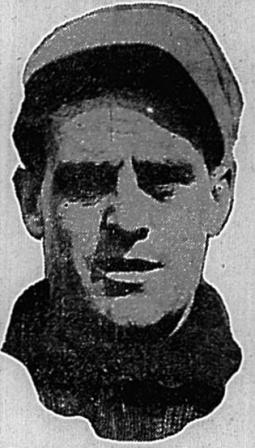
Larry McLean

                                  Larry McLean

A year earlier, in May, McLean had deserted the Reds during an East Coast trip and was “suspended indefinitely” by Manager Clark Griffith, who told The Cincinnati Enquirer:

“When you have a man who is liable to run out at the first call of the wild, you are in an uncertain position all the time. I am perfectly free to say that I might not take McLean back on the team at all, and certainly not until he shows me that he means business.”

McLean was back in the lineup within days, and as he did throughout his career, pledged to a reporter from The Cincinnati Times-Star that he would “(C)onduct himself properly from now on.”

It was a pledge McLean made and broke several times throughout his career which ended at age 33.  He would be dead six years later, the result of a fight in a Boston bar.


“Age is a Hard Master”

21 Sep

“Turkey Mike” Donlin spent his later years trying to earn a living as an actor; his limited success on the stage and screen forced him to accept several baseball jobs as well.  In 1922, he was hired as a scout by the Boston Red Sox—it was his most active season in the game since his final game with the New York Giants in 1914.

Mike Donlin

                Mike Donlin

Like most players of his era, he had a general disdain for the current state of the game.  He shared his disgust with a reporter from The Associated Press (AP) when he arrived in San Francisco after a trip through Texas:

“In the Texas League I found a majority of the players ill with a strange disease consisting of absolute refusal to run out flies or ground balls that look like easy outs. That kind of baseball is beyond me.

“I saw Texas League players getting as high as $700 a month loafing on balls hit to the infield and running to the bench on high flies.  They couldn’t do it and get away with it in my time.

“When I was starting $300 a month was a big salary and believe me, we earned all we got.  We ran out all our hits in those days and, not only that, we had to fight every inch of the way, not alone with spirit, but with our fists.”

The money seemed to bother him as much as the lack of hustle.

While in San Francisco he met Willie Kamm, who the Seals had agreed to sell for the then record amount of $100,000 (and three players) to the Chicago White Sox.  Donlin, who said the St. Louis Perfectos purchased him from Santa Cruz in the California League for $500 in 1899.

According to The AP when they were introduced Donlin said:

“I wanted to meet you, young fellow, because you’re the highest priced minor leaguer ever sold, and I’m the cheapest.”

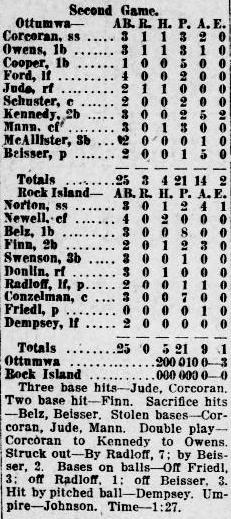
Always short of money and never  one to refuse a paycheck, and perhaps encouraged by what he considered to be the lesser quality of current players, Donlin accepted an offer to join the Rock Island Islanders of the Mississippi Valley League for two games while he was scouting in the Midwest during August.

According to The Rock Island Argus, Donlin “one of the most picturesque characters the national pastime has ever produced,” was signed to a one-day contract to “keep within the league rules.”  There is no record of what the Islanders paid Donlin for the one-day stunt.

He played in both games as the Islanders dropped a doubleheader to the Ottumwa Cardinals.  The Argus said of his performance:

“Even Mike Donlin, once peerless performer for the New York Giants, fizzled as a mascot.  Mike donned an Islander uniform as per announcement and was seen in right field in both games.  Age is a hard master.”

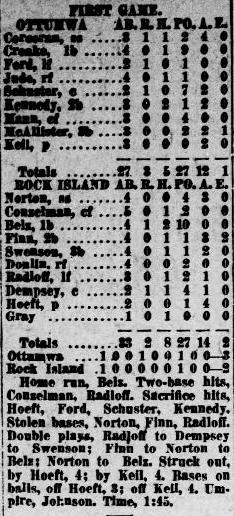
Donlin “handled two chances cleanly” in the first game, but was 0 for 4 at the plate with two strikeouts, a foul out to third and a fly out which “sent the centerfielder to the scoreboard to haul (it) in.”

He fared slightly better in the second, going 1 for 3 with two ground outs and a single on a “Texas Leaguer into right field territory.”  No balls were hit to him in the second game.

donlin1

      The Box Scores

donlin2


He was no more successful as a scout than he was as a player that week in Rock Island.

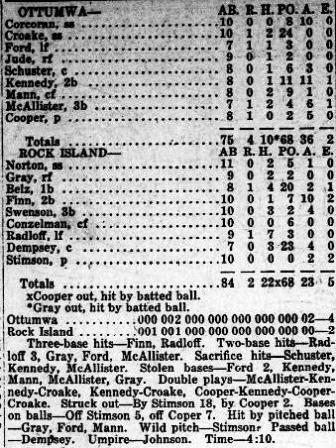
Two days before he played with the team, Donlin watched the Islanders’ Carl Stimson pitch a 23-inning complete game against Ottumwa.  Stimson lost the game 4 to 2—he committed two errors in the 23rd inning—but allowed only 10 hits and struck out 18.

The 27-year-old Stimson was a sub .500 pitcher (10-15) who had come to Rock Island in a trade with the Waterloo Hawks just a month earlier, but Donlin was impressed with the performance and Stimson’s 6’ 5” frame—Stimson also might have benefitted from a minor illness his wife suffered that month, The Argus said he left the team for several days to attend to her and Donlin was not able to stay long enough to watch him pitch a second time.

The 23-inning game box score

       The 23-inning game box score

Despite only seeing him once, The Argus said Donlin was “convinced that Carl is worthy of a trial in the big show,” and recommended that the Red Sox purchase his contract.

Stimson joined the Red Sox the following spring, but was slowed by an ear infection and finally joined the club in June.  Donlin’s discovery appeared in just two games over one month in the big leagues, giving up 12 hits, five walks, and 10 earned runs over four innings before being released.

Donlin continued making appearances on the stage, had small acting roles in dozens of movies, occasionally worked as a scout, and struggled to make a living.  In 1927, he began to suffer from a heart ailment and remained broke and in poor health and until his death in 1933.

The Pursuit of Elmer Foster

9 Sep

Elmer Ellsworth Foster was the talk of the Northwestern League in 1887.

His career as a pitcher had lasted just one season; in 1884, while pitching for the St. Paul Apostles, he snapped a bone in his arm while throwing a pitch.

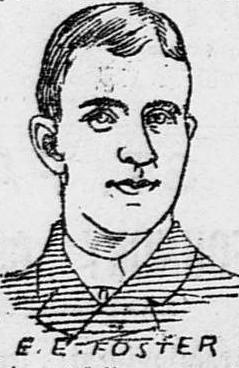
Elmer Foster, 1887

            Elmer Foster, 1887

After he recovered, he returned the following year as an outfielder and second baseman with Haverhill in the Eastern New England League and hit .309.

The following spring, The Sporting Life’s Haverhill correspondent said the New York Metropolitans “have taken Elmer Foster from us.”

Hitting just .184 and, as The Sporting Life put it “reckless at the bat,” Foster went back to Haverhill in August.

In 1887, he returned to Minnesota, this time as centerfielder for the Minneapolis Millers.  The club was owned by his brother Robert Owen Foster, a successful dealer of musical instruments, who with his partner J. E. Whitcomb, had taken over operations of the Millers in January.

The Northwestern League of 1887 was a hitter’s paradise owing mostly to the single-season experiments with the four-strike rule and walks counted as hits—nineteen players with at least 350 at-bats hit better than .350—and Foster led with a .415 average and 17 home runs.   While his performance with the bat was noted, he received an equal amount of publicity for his great fielding.

Throughout the season, Minnesota newspapers reported that Foster’s contract would be sold to a major league team—the Indianapolis Hoosiers were the most frequently mentioned—but the deal never materialized.

When the season ended, The Philadelphia Times said Foster was in high demand:

“During the past week agents from nearly every League and Association (club) have been to Minneapolis to secure (Foster) for next season.  (Horace) Phillips of Pittsburgh; (Gus) Schmelz of Cincinnati; Ted Sullivan, agent for Washington; (Emery “Moxie”) Hengel agent for Detroit; (Charlie Hazen) Morton, agent for (A.G.) Spalding, and agents for the Brooklyn, Metropolitan, and Baltimore Clubs have tried to get him.

(John) Day, of New York, sent him this message:  ‘Multrie on the way to Minneapolis.  Make no promise until you see him.’  Boston also wired him for his terms.  (Horace) Fogel of Indianapolis arrived one night and had Foster in tow all the next day.  The bidding of all these clubs has been going on briskly, until now he is offered exorbitant figures by all the clubs.”

Foster called the fight for services a “circus;” it also turned into a controversy, with two teams claiming to have signed him.  The Saint Paul Globe said:

“The circus he speaks of is a curious one, but he is sublimely unmindful of the part he took in it.  The rules of the baseball covenant prohibit the signing of players until Oct. 20…Manager Fogel of Indianapolis approached Foster before that time and made a verbal contract with him, but Manager (Jim) Mutrie, of New York, took him out to Delano (Minnesota), and after midnight  (on the 20th) got his signature.”

Jim Mutrie

                       Jim Mutrie

Years later, Ted Sullivan, who was perusing Foster on behalf of his Washington Nationals, described Mutrie’s method to sign Foster as a kidnapping:

“Jim Mutrie of New York (Giants) grabbed the great fielder Foster on the streets of Minneapolis…bound and gagged him, threw him into a cab and brought him ten minutes out of the city, held him there and dined and wined him until midnight…then compelled him to take $1000 advance money and a contract of $4500 (various other sources put Foster’s salary at $2400, and $4000).”

Foster, it turned out, didn’t simply have a “verbal contract” with Fogel and Indianapolis when he disappeared with Mutrie, but had, as The Sporting News said, accepted “a draft for $100,” from Fogel at the time the two agreed to terms.  Fogel and Indianapolis owner John T. Brush told The Indianapolis News and The Indianapolis Times that there was “a written agreement” between Foster and the club.

Foster’s wife gave birth to a daughter during the height of the controversy.  He told The Globe:

“If she had been a boy I would have named him Mutrie Fogel, in memory of the baseball managers I have been having a circus with.”

In the end, Indianapolis acknowledged that the agreement with Foster, whether written or verbal, was entered into three days before the legal signing date of October 20 and National League President Nick Young awarded Foster to the Giants.

Foster never had success at the plate during his brief major league career; he hit just .187 in 386 at-bats over parts of five seasons.  But Mutrie called him “(O)ne of the best fielders in the country,” and Sullivan said of Foster’s time in the National League, “(H)e was a wonderful fielder in that league.”

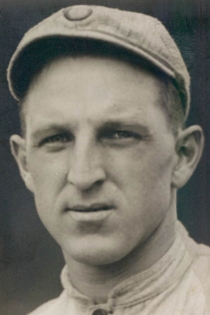
Elmer Foster

      Elmer Foster

After he was released by the Giants, he played 31 games with the Chicago Colts in 1890 and ’91, but his brief stay with the club allowed his name to live on with fans long after his career ended.  One of the favorite subjects of Chicago sportswriter Hugh Fullerton, who called him “The rowdy of the rowdies,” Foster’s name was a staple of Fullerton’s stories for three decades after his career ended.

“He is a Model for the Young Ballplayer to Emulate”

21 Aug

March of 1916 was a bad month for “Prince Hal” Chase.

According to The International News Service, Chase, who spent the winter in San Jose, California playing for the Maxwells—a team sponsored by the automobile company–was “the last of the stars” of the defunct Federal League who had still not signed with a professional team.
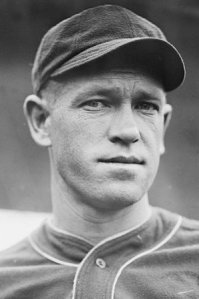
Hal Chase

                          Hal Chase

It got worse when he was arrested for failure to pay alimony and support to his ex-wife Nellie and their son Hal Jr.

He was released on $2000 bond, and it is unclear whether the case was ever fully adjudicated. After his release, Chase continued playing with the Maxwells and working out with Harry Wolverton‘s San Francisco Seals while rumors of who he would play for during the regular season were advanced on a daily basis.

The strongest rumors were that Chase would go to the New York Giants in a deal which would include Fred Merkle, who would be displaced at first base, going to the Chicago White Sox, the team Chase jumped to join the Federal League.

The Pittsburgh Post-Gazette said the deal was eventually foiled by Pirates Manager Jimmy “Nixey” Callahan, who “refuse(d) to waive.”

At the same time the papers in Cincinnati said Chase would be joining the Reds while West Coast papers said he might stay in California and join the Seals.

The Cincinnati Enquirer said Reds’ Manager Charles “Buck” Herzog “vigorously denied,” that Chase would join his club and said he would stick with Frederick “Fritz” Mollwitz at first base.
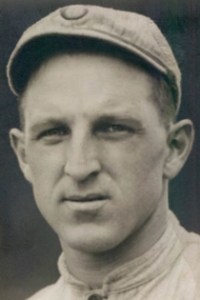
Buck Herzog

                     Buck Herzog

Herzog was even more forceful in his denial in The Cincinnati Times-Star:

“I wouldn’t have Chase at the camp.  Mollwitz is a very much better player, and he won’t jump when he is most needed.”

An even stronger indictment of Chase came from Detroit Tigers Manager Hugh Jennings, who told The Detroit News:

“As a player, there is nobody who can touch Chase for holding down first base.”

Jennings went on to note Chase’s intelligence, speed, and “superb” fielding:

“Yet for all his ability I would not have him on my club, and I do not believe any other major league manager will take a chance on him.  He will not heed training rules and has a demoralizing influence on the younger players.”
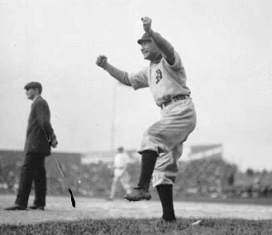
Tiger Manager Hugh Jennings

Tiger Manager Hugh Jennings

Jennings said while Chase managed the New York Highlanders in 1910 and ’11, led his team “astray,” instead of “trying to keep his players straight.”

Perhaps most damaging, Jennings said Chase was a source of dissent on the clubs he played for:

“One of his favorite stunts is to go around telling on man what another is supposed to have said about him, with the result that in a very short time he has the fellows pulling in all directions  instead of working together.  He is apt to take a dislike to the manager and work against him with the players until the whole squad is sore and will not give the sort of work that it is paid for.”

Jennings, whose team finished second in 1915 with George Burns at first base, said:

“The Tigers would win the pennant beyond question with a player of Hal’s ability on first this season, but I wouldn’t risk introducing a man who had such a bad disposition.  I believe that we can accomplish better results by having harmony on the squad, even if we have to get along with a first baseman with less talent.”

Despite the negative press, and over the objection of Herzog, the Reds purchased Chase’s contract from the defunct Buffalo Blues on April 6.

The New York Times lauded the move and defended Chase against his detractors.  The paper said “His failure with the New York Americans was due to petty controversies and rebellion against the club’s discipline,” and “(W)hen he is at his best there is not a player in the major leagues who is more spectacular than ‘Prince Hal.’”

Chase initially balked at reporting to Cincinnati, telling The San Francisco Chronicle “I haven’t made up my mind…it is possible that I would prefer to remain in California, even if there is no chance to play ball.”

Six days later, while his new team opened the season, Chase was on a train to Cincinnati.  The Associated Press said he agreed to join the Reds after receiving “word from Cincinnati that his entire contract with the Federal League, which calls for a salary of $8,000 a year, has been taken over,” by the Reds.

When Chase arrived in Cincinnati on April 15, the Reds had won three straight after losing their opener, and Mollwitz had played well at first base with five hits in 13 at-bats and just one error.

According to Frederick Bushnell “Jack” Ryder–college football star and Ohio State football coach turned sportswriter–of The Enquirer, Herzog had no intention of putting Chase in the game April 16:

“Herzog had little thought of playing him, as Fritz Mollwitz was putting up a bang-up game and hitting better than any member of the club,” until “Mollwitz made a bad mental mistake in the third inning.”

After Umpire Hank O’Day called a strike on Mollwitz, “the youngster allowed his tongue to slip,” and was ejected.
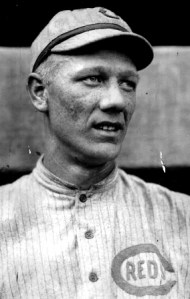
Fritz Mollwitz

                 Fritz Mollwitz

Chase came to bat with an 0-2 count and doubled off of Pirates pitcher Frank Miller, stole third, and after catcher Tommy Clark walked “(Chase) caused an upheaval in the stands by scoring on (a) double steal with Clark.”

Chase also wowed the crowd in the ninth.  After making “a nice stop” on Max Carey’s hard ground ball over first base and with pitcher Fred Toney unable to cover first in time, Chase dove “headforemost to first base to make a putout on the fleet Carey.”

In all, he played 98 games at first base, 25 in the outfield, and 16 at second base, he also hit a league-leading and career-high .329.

While the Reds struggled, Chase was wildly popular in Cincinnati.  The Enquirer’s Ryder was possibly his biggest fan—the writer raved about Chase’s performance in the outfield, his adjustment to playing second base, and his consistent bat.

While Chase thrived, Herzog, who had a contentious relationship with Reds’ owner August Herrmann, exacerbated by the signing of Chase against his wishes, began to unravel as the season progressed.  On May 30, he was hit in the head and knocked unconscious, by a throw from catcher Ivey Wingo during pregame warm-ups.  While he recovered physically, he became increasingly frustrated by the club’s performance.  On July 5—with a 29-40 record– he announced that he would retire at the end of the season when his contract expired.  He told The Times-Star:

“It would be a great blow to my pride to continue as a player, after being a manager for three years.”

The following day it was reported that the Chicago Cubs and New York Giants were interested in acquiring Herzog.  Within a week, it was reported that Herzog was heading to New York in a trade that would bring Christy Mathewson to Cincinnati to manage.  The negotiations continued over several days but floundered.  The Cubs reentered the picture—Owner Charles Weeghman told The Chicago Daily News “I brought the bankroll along…and I’ll get Herzog so quick I’ll make (the Reds) eyes pop.”  He later told the paper he offered “$25,000 and an outfielder” for Herzog.

At the same time The Brooklyn Daily Eagle said the Dodgers were after Herzog, and The Pittsburgh Post said the Pirates were in pursuit as well.

The pressure got to Herzog who held himself out of the lineup of July 17, The Enquirer said:

“The managerial situation is worrying Herzie, who had expected by this time to be cavorting at the third corner for the giddy Giants.  With the deal held off for various reasons, the Red leader is naturally a bit anxious.”

Herzog’s destination was unclear, but it was clear he would be gone.  With Mathewson seeming to be out of the picture, rumors persisted—fueled by Ryder of The Enquirer and William A. Phelon in The Times-Star—that Chase would be the new manager.

On July 20, Ivey Wingo managed the team to a doubleheader split with the Philadelphia Phillies, and the papers reported on Herzog’s successor:

The Enquirer ran Chase’s picture under the headline “Reds’ New Manager,” although they hedged in another headline which said he would “probably” be named.

The Times-Star said “Hermann has decided to allow Hal Chase to manage the team for the remainder of the season, and for this reason he does not want Mathewson.”

They were both wrong.

Within hours of the papers hitting the streets, a trade involving three future Hall of Famers was agreed to.  Herzog, along with catcher Wade “Red” Killefer went to New York for Mathewson, Edd Roush, and Bill McKechnie.  Mathewson was immediately named manager.
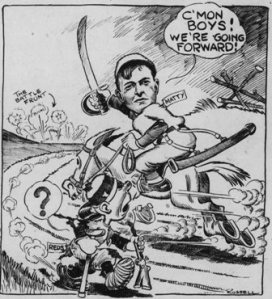
Cartoon accompanying the announcement of Mathewson's appointment.

          Cartoon which accompanied the announcement of Mathewson’s appointment.

Ryder said in The Enquirer that “Chase was greeted with a great round of applause” when he stepped to the plate for the first time on July 20:

“The fans at that time did not know of President Herrmann’s change of mind with regard to Matty, and they thought Chase was the new leader of the team.  The universal and hearty applause showed how popular the star third-sacker has become in this town.”

The Chase story is well-known; two years later Mathewson would suspend him, charge him with “indifferent playing.”  With Mathewson in Europe when the charges were heard by National League President John Heydler that winter, three Reds teammates, and Giants Manager Pol Perritt testified Chase had thrown games.

But in October of 1916 Chase appeared to have repaired his reputation, and his difficult March appeared to be far behind him.  In a season wrap-up, The Enquirer–there was no byline on the article, but it was likely the work of Ryder–published a glowing profile of the National League’s leading hitter and the man who nearly became the Reds’ manager:

“What has become of all the talk about Chase being a bad actor, a disorganizer, a former of cliques and a knocker of managers?  All gone to the discard.  Chase has not only played brilliant ball for the reds all season, but he has been loyal to the club and the managers.  He worked hard for Herzog and equally hard for Matty.  He has been a wonderful fellow on the club.  Chase is modest and does not seek notoriety or approbation…He played game after game in midseason when he was so badly crippled with a Charley horse that he could scarcely walk.  When Manager Herzog wanted to make an outfielder out of him he went to the garden and played sensational ball…Later in the season he filled in for several games at second base, a difficult position for a left-hand thrower, but he put up great ball there.  He is a natural ballplayer of the highest class, and with it all a perfect gentleman, both on and off the field.”

The profile concluded with this assessment of the man who would become synonymous with the baseball’s greatest sins:

“Chase has been a great man for the Reds, and there is many a manager of today who wishes that he had got in ahead of the Cincinnati club in signing him.  He is the smartest ballplayer and the quickest thinker in the National League today.  He is a model for the young ballplayer to emulate, because he is a real artist in his profession.”

Griff’s Invention

5 Aug

Bob “Buster” Bescher arrived in Cincinnati a right-handed hitter.  In 1909, he led the National League with 54 stolen bases but hit just .240.

Bescher

Bescher

Bescher’s manager, Clark Griffith would compare him to Ty Cobb in an interview with Harry Salsinger of The Detroit News:

“If Bescher could hit he would probably set a pace for base-stealing that would never be equaled…Bescher gets away like Cobb, and his success lies mostly in getting away.  He is running in his first few steps.  He has a great pair of limbs and is in stride at the jump.  He is lightning fast.”

The Cincinnati Enquirer said:

“Bescher is a big, strong fellow, naturally left-handed, who was, unfortunately, coached to bat right-handed when he was a kid.”

Griffith set out to change that before the 1910 season.  In January, The Enquirer said:

“A device for batting practice was shipped to Bob Bescher at his home in London (Ohio) by Manager Griffith yesterday.  The arrangement was constructed according to Griff’s order, and it was designed to give Buster practice in batting left-handed before he goes South with the club six weeks or so hence.”

Clark Griffith

Clark Griffith

The paper described Griffith’s invention:

“The device consists of a ball of regulation size, but fitted with an extra cover, to which stout rubber cords are attached, one on each side.  One of the cords is to be fastened to the floor and the other to the ceiling, allowing the ball to swing loosely at about the height of the batter’s waist.  When the ball is struck with a bat, the flexible cord allows it to swing several yards and it returns with great force, coming back at about the speed of a pitched ball.  Then it is time for Buster to get busy with the club and soak it out again.”

A diagram of Griffith's invention.

A diagram of Griffith’s invention.

The Enquirer said Griffith hoped Bescher would add “30 or 40 points” to his average batting left-handed.

“He is the best base runner in the National League…Griff has sent him instructions to hit only left-handed with the new machine, and he hopes that Bob will be a regular Ty Cobb when he reports in March.”

Bescher batted almost exclusively left-handed during spring training in Hot Springs, Arkansas and became a switch-hitter that season, and seems to have benefitted from Griffith’s invention—but never became a “regular Ty Cobb.”

He improved his average to .250 in 1910 and again led the league with 70 stolen bases.  The next two seasons he hit .275 and a career-high .281, leading the league with 81 and 67 steals.

Bescher

Bescher

In 1913, Bescher slowed, hitting just .258 and stealing 38 bases.  He bounced from the New York Giants to the St. Louis Cardinals and Cleveland Indians over the next five seasons, never hitting better than .270 or stealing more than 39 bases.  He played minor league ball through the 1925 season.

“Slow Man’s Steal”

3 Aug

The New York Evening Journal said:

“The newest wrinkle in the baseball season of 1911 is a discovery by (John) Chief Meyers.”

Chief Meyers

Chief Meyers

The New York Giants’ catcher called is the “Slow man’s steal.”

“On two occasions now the Indian has pulled this play, and the National League is laughing because he worked it successfully on (Bill) Bergen and (George) Peaches Graham, two of the best catchers in the league.

“Some time ago the Chief realized that it would be impossible for him to trust his speed, which he has not, in stealing a base so he decided to work it with his head.”

Meyers, the paper said, knew that as a slow runner he could induce catchers to throw to first base if he took a long lead off.

“Having figured this out, the Chief gets on the bag and gradually eases himself down the line until he sees the catcher is watching him.  He then takes another step towards second base and the catcher naturally shoots the ball to first.  Instead of making an effort to get back to the base the Indian starts for second the minute he sees the catcher draw back his arm.  Both times that he has worked it the first baseman has been caught making a touch for the runner sliding back to first, only to look up and see him sliding into second. “

The Evening Journal called it “(O)ne of the greatest mirth-provoking plays on the diamond,” and said when Meyers worked the play on Graham and Boston Rustlers first baseman Fred Tenney, (T)he stands broke into howls of laughter.”

Fred Tenney

Fred Tenney

Meyers said:

“I call it the slow man’s steal because a fast man couldn’t do it.  The catcher would expect him to run to second and a good throw would head him off.  Besides, the pitcher would hold a fast man up at first and not allow him to take the lead.”

Meyers stole five more bases the rest of 1911, there is no record of how many of those incorporated the “Slow man’s steal.”

“A Lajoie Bunt”

22 Jul

Francis “Red” Donahue was a teammate of Napoleon Lajoie in Philadelphia and Cleveland.  During a road trip in New York with the Indians in 1904 he told a story to Elmer Ellsworth Bates of The Cleveland News:

“I never come to New York without recalling the first time (Fred) Dutch Hartman of the old New York team ever saw Lajoie in a game.  Hartman had just began playing third base for the Giants and he had to be coached all the time by his teammates.

Fred "Dutch" Hartman

Fred “Dutch” Hartman

“The Phillies came over here and when Larry came to bat Hartman appealed to his fellow players for instructions.

“‘Play in for this fellow,’ was the tip.  ‘He’s liable to bunt.’

“Hartman went in about 30 feet and pushing his cap back on his head waited for the bunt.  The pitcher swung up a nice one and Larry smashed it.  The ball went away at awful speed.  It brushed the top of Hartman’s head, struck squarely in the middle of his cap and carried that piece of headgear with it clear out against the left field fence.  The other 17 players roared, but Hartman couldn’t see the joke.

Napoleon Lajoie

Napoleon Lajoie

“‘I thought you said he would bunt,’ said he.

”That was a Lajoie bunt’ said (Giants center fielder George) Van Haltren.  Wait and see him hit one with no cap to interfere with the ball.”


“Three of the Greatest Pitchers the Game ever has Produced”

15 Jul

In 1915, Frank G. Menke, who wrote for the Heart Newspaper’s International News Service told readers:

“The color line drawn so tightly around major league baseball has barred from major league fields three of the greatest pitchers the game ever has produced.”

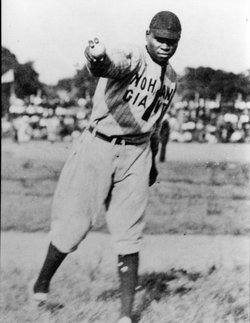
The three were John Donaldson, Frank Wickware, and Jose Mendez.

In May, Donaldson, who pitched for the All Nations, had thrown 30 consecutive no-hit innings against Kansas City based semi-pro clubs.

Sketchy contemporary accounts with some transposed numbers in newspaper articles seem to have led to confusion about Donaldson’s feat in later years: some sources claim the streak was over two games—a regulation contest and a 21-inning game , but it appears from the earliest reports in The Kansas City Times and The Indianapolis Freeman that he pitched a nine-inning and 12-inning no-hitter against the Schmelzers, a powerful semi-pro club sponsored by the Schmelzer Arms Sporting Goods Company in Kansas City and another no-hitter against a team called the KCK (Kansas City, Kansas) All-Stars.  (Later in the summer of 1915, Schmelzers became the sponsor of the All Nations after the club lost their original sponsor, Hopkins Brothers Sporting Goods).

John Donaldson

John Donaldson

Menke quoted New York Giants Manager John McGraw’s assessment of the All Nations’ star after having watched him pitch in Cuba:

“If Donaldson were a white man, or if the unwritten law of baseball didn’t bar Negroes from the major leagues, I would give $50,000 for him—and think I was getting a bargain.”

Menke said of Wickware of the Chicago American Giants:

“(He) is another Negro pitcher who would rank with the Walter Johnsons, Joe Woods and Grover Alexanders if he were a white man…Wickware has marvelous speed, a weird set of curves and wonderful control.  And he has a trick that has made him feared among batters.  He throws what seems like a ‘bean ball,’ but his control is so perfect that he never yet has hit a batter in the head.  But when the batters see the ball, propelled with mighty force, come for their heads, they jump away, and the ball, taking its proper and well-timed curve, arches over the plate for a strike.”

Frank Wickware

Frank Wickware

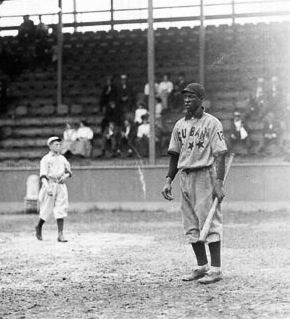
The final pitcher on Menke’s list was Mendez,  another member of the All Nations:

“He’s known as “The Black Matty” and his work has been almost as brilliant as that of “The Big Six” of the Giants.  Mendez is only of medium height (5′ 9”), but he has terrific power in his arm.

“The Cuban Negro has a canny brain and he always has used it.  He has mixed his fastball with his slow one, has an assortment of beautiful curves and perfect control…Like Mathewson, he never pitches air-tight ball unless he has to.  He conserves his strength.  But when he needs to pitch hitless ball he does it.  When he needs to strike out a man he usually succeeds.”

Jose Mendez

Jose Mendez

Incredibly, a story about three pitchers who deserved notice by the major leagues written by an influential white sportswriter received barely a notice in the black press.

The Indianapolis Freeman ran the story with no further comment, and no mention of who wrote the original story, simply attributing it to The Indiana Daily Times which had run Menke’s piece.

The Chicago Defender and The Pittsburgh Courier ignored the story entirely.  The New York Age didn’t mention Menke’s story, but the same week did make a pitch for black players—not with the positive portrayal of three great pitchers as Menke had done, but by highlighting the bad behavior of some major leaguers.

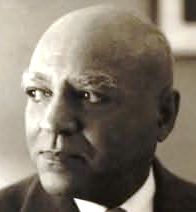
Lester Aglar Walton, who wrote about baseball and theater for The Age and later became the United States Ambassador to Liberia, said:

“(I)f baseball magnates are not color prejudiced can it be that they have misgivings as to how Negro players would conduct themselves on and off the field if permitted to play in the big leagues?  However, if this is their chief cause of concern and the stumbling block in the way of crack Negro players, big league managers should be reminded of the Ty Cobbs, Larry McLeans and others who have distinguished themselves by acts of ruffianism on and off the diamond.”

Lester Aglar Watson

Lester Aglar Watson

Walton related the story of McLean’s recent fight with Giants Manager John McGraw and coach “Sinister” Dick Kinsella in the Buckingham Hotel in St. Louis.

“(H)ad McLean been a colored player the incident in St. Louis would have brought about the disbarment of all Negroes from hotels in St. Louis—had a policy of accommodating Negroes existed.”

Larry McLean

Larry McLean

Walton also noted that when white teams met black teams on the field after the regular season, “The mixing of the races does not provoke racial conflicts and the best of feelings exist” among the players.

Then, he asked the men who owned major league clubs:

“The question is therefore put up to big league magnates that if the Indian with his dark skin and the Cuban are permitted to play in the big leagues, and if there is not the least possibility of the record for ruffianism established by the Ty Cobbs and Larry McLeans being eclipsed, why not give the Negro player a chance?”

As would be the case for three more decades, there was no reply.