Tag Archives: New York Giants

“It smacks of Old-fashioned Common Sense”

26 Jun

For more than a century, major league baseball has looked for ways to increase hitting.  Or, as Bozeman Bulger of The New York World put it in 1917

“Overhauling the rules of baseball to make it harder for the pitcher and more of a joy ride for the boys who wield the ash has always been a favorite winter pastime.”

Burger said former pitcher and current National League President John Tener was “(C)onvinced that the public wants more hitting.”

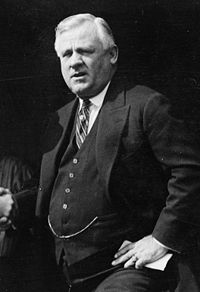
John Tener

John Tener

Tener and others shared their ideas for rule changes with Bulger on the eve of the meeting of the rules committee.

“Tener proposes making the home plate larger and at the same time allowing a batter to take his base on three balls instead of four.”

[…]

“Then comes Charlie (Buck) Herzog (of the New York Giants) with a suggestion, perhaps the most interesting of all.  It is the outpost of a real imagination that is comprehensive. Before announcing his plan, Herzog calls attention to the injustice of calling strikes on very hard hit line drives that fall foul by inches.  To all intents and purposes, those are real scientific hits, and the fact that luck causes them to fall foul should not act upon the batter as a penalty.  In other words, he is being severely punished for really doing scientific work. Herzog suggests, therefore, that a zone be described along those two foul lines between third and the fence and between first and the ground limits.  This zone should be at least ten feet in width, and any ball hit therein is not to be called a foul.  At the same time, it is not to be called a safe hit.  In other words, the batter loses his hit by bad luck, but it relieves him of an unjust penalty.”

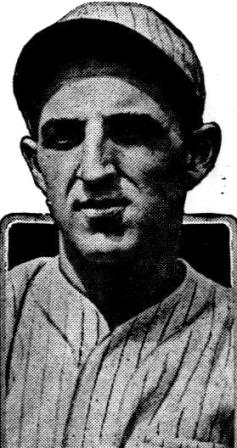
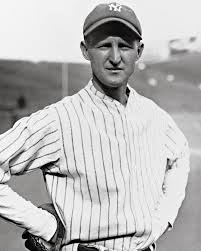
Buck Herzog

Buck Herzog

Incredibly, Bulger completely endorsed Herzog’s proposed rules change and claimed, “Every ballplayer in America” would agree, because “It smacks of old-fashioned common sense.”

Another rule change was proposed by Percy Duncan Haughton.  Haughton, a long-time college football coach (Cornell and Harvard), and Harvard baseball coach in 1915 (he also played both sports at Harvard) had become a part-owner of the Boston Braves in 1916.  Bulger said:

“Mr. Haughton’s scheme has not been taken very seriously by those who were studying these problems while he was still a football player, but there is a real satisfaction in finding a new magnate so much interested in the sport.  The President of the Braves proposes that the distance from third to home and from home to first be lessened by several inches.  It might help the batter a little, but an extreme change like that would be pecking at the one fundamental of the game that has stood all tests.”

The most practical suggestion came from Giants Manager John McGraw, who proposed that no rules be changed, but advocated a more lively ball.

Bulger, however, was sure some rules would change:

“(T)he powers that be appear to be intent upon really turning out a new model.”

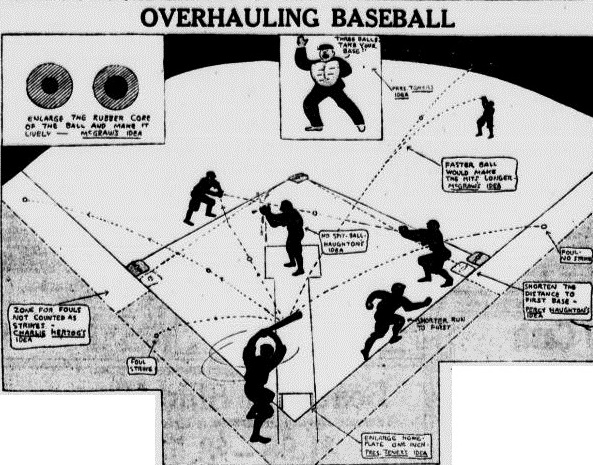
The New York World's rendering of the proposed changes.

The New York World’s rendering of the proposed changes.

When the meetings at the Waldorf Astoria in New York ended two weeks later, Jack Veiock of the Hearst Newspapers International News Service said:

“(I)t was confidently expected that the members of the rules committee would get together and make a few alterations in the baseball code as it stands today.

“But the rules committee did nothing of the kind  The wise old heads who are in control of baseball are satisfied with the rules.”


“Probably the ‘Boniest’ Bonehead Play Ever”

22 Jun

While some of the details changed in subsequent tellings, this story stayed substantially the same from when it was first presented in a column by sports writer William A. in 1913, until the final published version in 1957 in The New Orleans Times-Picayune.  One version called it, “Probably the ‘boniest’ bonehead play ever”

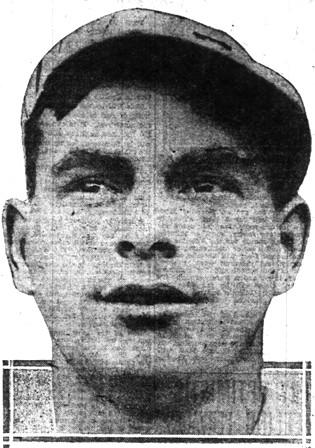
The story was told by and told about lefty Evan “Rube” Evans.  Born on April 28, 1890, in Sebring, Ohio, Evans was a career minor league pitcher who, when the story first appeared, seemed to be headed to the big leagues. 
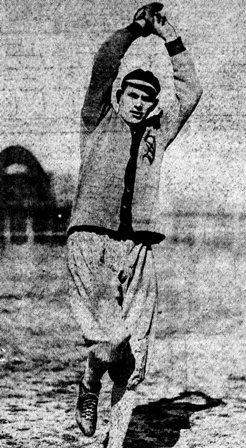
Rube Evans

Rube Evans

The tall–he was reported by various sources as anywhere from 6′ 2″ to 6′ 4″–began his professional career with the Dallas Giants in the Texas League in 1910; he was 15-12 for the pennant winners, but The Dallas Morning News said he didn’t “take baseball seriously” until the following year, when he was 18-16 for the Giants:

“Before that, it seemed, the big, husky flinger looked at playing baseball something in the light of a joke.  Last season, though he came back into the game with a different viewpoint. He seemed to realize that ball playing was a man-sized business.”

After his 1911 performance, Evans’ contract was purchased by the New York Giants, and he joined the team for spring training in Marlin, Texas in 1912.  The Morning News said if he maintained his new found focus “and works as hard as he knows how to work he ought to stick.”

Evans quickly impressed the Giants with a pitch “takes a most freakish break,” according to The Washington Times:

“Rube Evans, the Giants left-handed recruit pitcher from Dallas, surprised bot Manager (John) McGraw and Coach Robby (Wilbert Robinson) by showing them a curve that is entirely new to the big league…The ball is delivered in exactly the same manner as the spitball, but he does not moisten it.”

The paper did not elaborate on how Evans’ “dry spitter” was different from versions reported on during previous seasons–including the one thrown by Christy Mathewson of the Giants–but according to The New York World, “McGraw says he will try and teach it to Rube Marquard.”

Despite his “dry spitter,” Evans failed to make the team and was returned to Dallas where he posted a 22-12 record for the Giants.

In 1913, he joined the New Orleans Pelicans in the Southern Association but appeared to be headed to the Cleveland Naps before he threw a pitch in the regular season for the Pelicans.  In March, Evans shut down the Detroit Tigers 3 to 1 on five hits and followed that up with a four-hitter (and 3 to 1 victory) against the Naps.

The Cleveland Press said, “(Naps Manager Joe) Birmingham plans to cut down his squad considerably.  It is said recruits (Hugh) Peddy, (Pete) Shields and (Ward) McDowell will be left here in trade for one good pitcher, probably Southpaw Rube Evans.”

With Evans apparently on the verge of joining the Naps, the story of his “bonehead” play was told by Phelon, then repeated widely:

“(Evans) has one curious habit—a trait which has aroused much wonder on the part of every manager under whom the southpaw has been toiling.  When given an order by his manager or captain, Mr. Evans always stops, cocks his ears, and demands a repetition of the directions.  Naturally he is first taken for a simp, or bonehead, but when further acquaintance with him shows that he is a gentleman of intelligence and high mentality, the field leaders are muchly puzzled.

“’I always want my orders repeated,’ quoth Mr. Evans, ‘so that I will never again make such an error.”

(The 1913 version of the story, which quotes Evans,  places the incident in McKeesport, Pennsylvania, some later versions say it happened in 1913 with the Pelicans, still others say it was in Portland, Oregon; however, the original publication predates Evans’ time on the West Coast which did not begin until May of 1914).

Evans said he had pitched into the ninth inning when the opposing team put a runner on third with one out, when his manager told him if the other team attempted a squeeze play to “bean him.”  Evans said:

“’I knew no more what a squeeze play was than the man in the moon, but my orders rang in my ears as I started winding up.  Just as a swung up my arm, the fellow on third tore for the plate…I took careful aim at the oncoming runner, and pickled him with a fine shot to the back of the cranium.  Three seconds later the crowd was coming towards me with roars of fury, and I got over the back fence just in time.

“’Well how was I to know that I should have hit the batter and not the runner?  Ever since I have insisted on duplicate orders, so that I would know just what to do.’”

His acquisition by Cleveland never materialized and he had a disappointing 12-15 record in 1913, in a season split between New Orleans and the Birmingham Barons.

It is also in question whether Phelon’s characterization of Evans as a “gentleman of intelligence and high mentality,” was entirely accurate given his inability to stick with clubs who were impressed with physical abilities.  After his second chance to pitch in the majors didn’t materialize, the remainder his of career was marked by long stretches of mediocrity, charges of bad behavior and comparisons to another left-handed “Rube.”

In August of 1913, he was suspended for the remainder of the season by the Birmingham Barons for, according to The Birmingham Post-Herald, “Failure to keep in condition.”  The Sporting Life’s Chandler Richter called him “Erratic,” The Oakland Tribune said he was”Eccentric,” a wire service retelling of the “beanball” story from 1915 said he “earned a nationwide reputation as a ‘squirrel,” another called him “the real eccentric,” when compared to Rube Waddell.
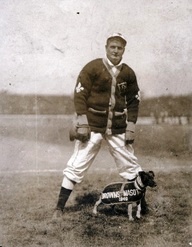
The other left-handed Rube

The other left-handed Rube

His two-year tenure with the Portland Beavers in the Pacific Coast League (PCL) began when he wore out his welcome in New Orleans in May of 1914 and was sold to the Beavers.  It was particularly rocky.  The Spokane Daily Chronicle said Evans and Beavers manager Walter “Judge” McCredie “got along like a pair of strange bulldogs.” He was suspended at least once, again for the euphemistic “failure to be in proper condition,” and gave up a game-winning home run to Jack Ness of the Oakland Oaks when he accidently threw a pitch over the plate while attempting to intentionally walk Ness.  At the close of the 1915 season, Portland let him go for what The Portland Oregonian called “His inability to take care of himself.” Of his 9-22 record the paper said:

“Rube ran into gobs of adversity.”

After leaving Portland, Evans played parts of three seasons for the Salt Lake City Bees in the PCL–in 1917 he was 21-9, but when McCredie was named manager of the Bees in 1918, Evans time with the team was nearly over.  Before the season, The Oregonian said, “Evans did not take kindly to the idea of having to take orders” from his former manager and was threatening to jump the club.  He finally did jump in June after appearing in 14 games and posting a 3-8 record.

Evans went to Portland and finished the 1918 season in the semi-pro Shipyards League, The Oregon Daily Journal said upon his arrival:

“Rube Evans was through at Salt Lake and McCredie was probably saved the trouble of wearying his hand by writing out Rube’s release, when Rube left.”

In 1919, he played for the Rupert franchise in the semi-pro Southern Idaho League; while successful, his reliance on the emery ball for his success didn’t make him friends.  The Twin Falls Times said:

“When Rube Evans lugged the emery ball into the S.I.L. he failed to do anything beneficial to the league.  Rube will win a few more games for the Rupert club, but he has lowered the standard of sport in the league.”

Evans had one more season in professional baseball, posting a 10-7 record with the Regina Senators in the Western Canada League in 1920.  In an August 15 doubleheader against the Edmonton Eskimos Evans was ejected for arguing with the umpire while facing the second batter of the first game; he came back to lead the Senators to 5 to 3 victory in the second game, giving up two runs in 7 2/3 innings, and hitting a three-run home run in the sixth.
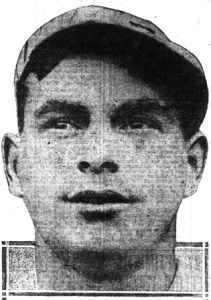
Rube Evans

Rube Evans

After the 1920 season, he returned to Ohio and spent the next decade playing semi-pro baseball there and in Western Pennsylvania.  His last headlines came in 1924 when he pitched six innings for the Sharon (PA) Elks team in an exhibition game against the New York Yankees.  The Elks lost 10-8, Babe Ruth went 2-4 with a double for the Yankees.

Evans’ playing days ended in Akron, Ohio.  He pitched for and managed the Goodyear Tire and Rubber Company team, and stayed on with the company as a rubber worker.  He died on January 30, 1950.

A clue to some of Evans’  erratic behavior is contained in his death certificate.  The pitcher spent the last three and a half years of his life in Ohio’s Cambridge State Hospital; his cause of death was listed as “General Paresis,’ brought on by syphilis.

A shorter version of this post appeared on June 3, 2013

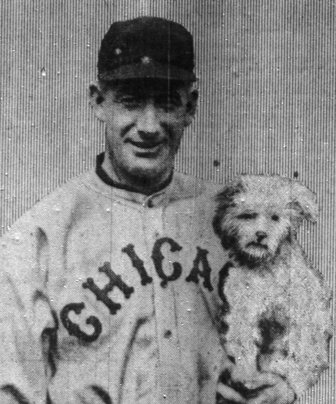
Lost Pictures–Roger Bresnahan and Toy

19 Jun

bresnahanandtoy


The Chicago Cubs were 14 games over .500 and in second place, just two a half games behind the New York Giants on July 25, 1914.  The team lost 14 of their next 17 and wound up in fourth place.  (the Giants finished second to the Boston Braves).  At the end of the season, first-year Manager Hank O’Day was let go by the Cubs and returned to umpiring.  Catcher Roger Bresnahan was named as O’Day’s replacement.

Later in the off-season, there was another drama taking place off the field.  It involved Clara Maduro:

In December, The Chicago Daily News said:

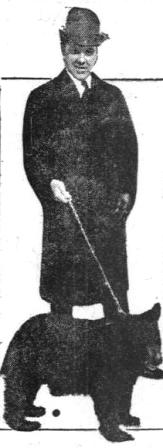
“Because the female of the species is more deadly than the male, Clara Maduro, the brown bear mascot of the Cubs, must die.  The wee cub, which fans saw drinking milk from a bottle or eating ice cream cones at the West Side park last summer, has grown to giant proportions, and while of a pleasant disposition is inclined to break loose at times. Hence, Clara will be executed New Year’s Day.”

A month earlier, The Chicago Tribune reported:

“‘There’s a woman being strangled at Wood and Taylor Streets,’ was the message received by Desk Sergeant Comstock of the Warren Avenue station last night.  ‘Send a lot of policemen.’

“The patrol wagon with a number of detectives was sent to the location, which proved to be on the west side of the National League ballpark.

“A loud howling was heard from the inside, and upon investigation it was found the bear mascot of the Cub team, which had been locked in a cage in the team’s quarters had broken its chains and was roaming about.”

After an outpouring of outrage and concern from Chicagoans, The Daily News reported that Clara Maduro “has been saved through the protest that followed the announcement.”  The bear was initially placed with a local saloon owner named Joe Biggio; later reports said the bear went to the Lincoln Park Zoo.

With Clara out, it was determined that a bear cub mascot was not the best idea for 1915.  So in March, the team introduced their new mascot, Toy.

The Tribune said:

“‘Toy,’ the 1915 Cub mascot is a canine of high degree and more likely to become a permanent fixture than the baby bear which grew so big and developed such a crabbed disposition that he [sic] had to be discarded last fall.  ‘Toy’ used to be the mascot and assistant caddie of a feminine golf expert who was a visitor at Tampa during the Cubs stay there and who became such an ardent baseball fan that she bestowed her pet on the team when the Cubs departed for the north.”

The Cubs started the season strong and led the National League until mid-July, but the team faltered badly and ended the season in fourth place with a 71-82 record.

Toy did not “become a permanent fixture;” when Charles Weeghman bought the team after the 1915 season he replaced both Bresnahan and Toy.

Weeghman did not learn from the past and introduced the Cubs new mascot in November.  A bear cub whose mother was killed during a Wisconsin hunting trip, was presented to the team by the hunter, either a state senator named Albert J. Olson or Cubs stockholder J. Ogden Armour–newspapers reported both, but the bear’s name, Joa, would suggest the latter.

It is unknown what became of Toy.

Weeghman introduces Toy's replacement

Weeghman introduces Toy’s replacement


“If Baseball is really the National Game let the Club Owners go out and prove it”

4 May

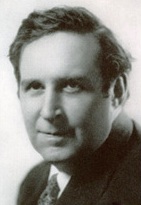
Haywood Broun, columnist for The New York World-Telegram, shook up the annual Baseball Writers Association dinner in February of 1933.  The Pittsburgh Courier said Broun “struck out boldly in advocacy of admitting Negroes to the charmed circle of big leagues.”

Heywood Campbell Broun

Heywood Broun

Broun said (and later wrote in The World-Telegram):

“I can see no reason why Negroes should not come into the National and American Leagues.

“Why in the name of fair play and gate receipts should professional baseball be so exclusive?”

[…]

“The introduction of a few star Negro ball players would do a great deal to revivify interest in the big leagues.  It would attract a number of colored rooters. And it would be a fair and square thing.  If baseball is really the national game let the club owners go out and prove it.”

Jimmy Powers of The New York Daily News said he polled the dinner guests after Broun’s remarks:

“I made an informal tour around the tables asking club owners and players their reactions to Broun’s little talk.  I was amazed at the sentiment in favor of the idea.”

Powers claimed that Yankees owner Jacob Rupert, St. Louis Cardinals General Manager Branch Rickey, and Babe Ruth were all in support of Broun’s statement.   John McGraw the dinner’s guest of honor—he had resigned as manager of the New Giants the previous summer due to his failing health—was, according to Powers, “The only prominent man present vetoing” the idea.

John McGraw

John McGraw vetoed the idea


Salem Tutt Whitney, a prominent star of the black vaudeville circuit, commented on McGraw in the pages of The Chicago Defender:

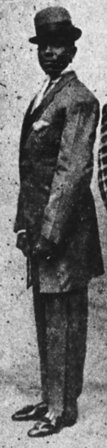
“John McGraw and his Giants have been the idols of the Colored baseball fans.  Whenever and wherever there had been talk about the color line in major league baseball, the Colored fans were a unit that declared that if John McGraw could have his way there would be no color line.  ‘Didn’t he play (Charlie) Grant at second base on the Giants!’  ‘Look how long he employed a Colored trainer (Ed Mackall)!’”

[…]

 “It is my opinion that if the Colored baseball fans of Harlem are not convinced that Mr. McGraw has nothing more to do with the Giants, there will be a lack of personal color in bleachers and stands at the Giants’ stadium this summer.”

Salem Tutt Whitney

Salem Tutt Whitney

Not content to simply report on Broun’s pitch for integration, Powers made his own:

“I would like to make a case for the colored baseball player.  In football, Duke Slater, Fritz Pollard and Paul Robeson and stars of similar complexion played with and against the cream of Nordic colleges.  Eddie Tolan, Ralph Metcalfe and Phil Edwards have conducted themselves in a gentlemanly—not to mention championship—fashion.  Boxing has known Joe Gans, Sam Langford, Joe Walcott and Tiger Flowers.  There are only three popular sports in which the dark-skinned athletes are snubbed—tennis, golf and baseball.”

The New York Age approved:

“Here’s hoping all the other big white sportswriters have the courage of Jimmy Powers.”

Chester Washington, a sports writer at The Pittsburgh Courier announced that the paper was launching “A symposium of opinion, coming from outstanding figures in baseball circles,” designed to demonstrate a broad coalition of support for integration.

The Courier reported “The first of these statements,” in response to Washington’s outreach the following week—and it was a rather incredible one from John Heydler, president of the National League, who said:

“Beyond the fundamental requirement that a major league player must have unique ability and good character and habits, I do not recall one instance where baseball has allowed either race, creed or color enter into the selection of its players.”

Gerald Nugent “aggressive young owner of the Phillies,” was next to respond to The Courier:

“Nugent calls attention to the fact that no ‘color line’ is drawn on the dollars which are spent by colored and white fans for admissions in the various big-league parks…He further declares that the average colored semi-pro league player is better than his white brother in the same category.”

Support continued to come.  Chicago White Sox President J. Louis Comiskey:

“You can bet your last dime that I’ll never refuse to hire a great athlete simply because he isn’t the same color of some other player on my team if the alleged bar is lifted.”

While Commissioner Kennesaw Mountain Landis did not respond to The Courier, his right-hand man, Leslie O’Connor said “(T)here isn’t any rule which keeps colored players out.”  But, like Heydler, he made the incredible claim that “the subject of Negro ball players had never been brought up,” among the Major League Advisory Council.

Based on the initial responses, William Goldwyn Nunn, The Courier’s managing editor, expressed great, if premature, optimism:

“And the color will be black!

“As sure as the Ides of March are approaching, there’s going to be some added color in the Major Leagues.  AND, THAT COLOR WILL BE BLACK!”

Meanwhile Jimmy Powers quoted Lou Gehrig and Herb Pennock of the Yankees and Frankie Frisch of the Cardinals in The Daily News, all said they were “open-minded,” about the possibility integration.

pennock

Pennock “Open-minded”


Two more prominent sportswriters came out in support:  Dan Parker of The New York Daily Mirror, and Gordon Mackay, who had been sports editor of three Philadelphia papers—The Enquirer, The Press and The Public Ledger.

And then, as abruptly as it began, the movement died.

Despite the brief groundswell of support, by the time the major league season opened Alvin J. Moses, another writer for The Courier admonished the papers readers:

“Aren’t you somewhat ashamed of yourselves that you haven’t seen fit to spare the time to flood (the paper) with letters that cry out against these NEGROPHOBES who for more than half a century have kept Negro ballplayers out of league competition?

“The cry of ‘Play Ball, Play Ball, Play Ball?’ is heard today in hundreds of parks the county over, and baseball statisticians have figured to show more than 40,000,000 fans walk past the turnstiles.  But what does that cry mean to you, and you, and you? Well, I’ll tell you—absolutely nothing.”


Lost Advertisements–“Spark plug of Huggins’ Machine”

17 Apr

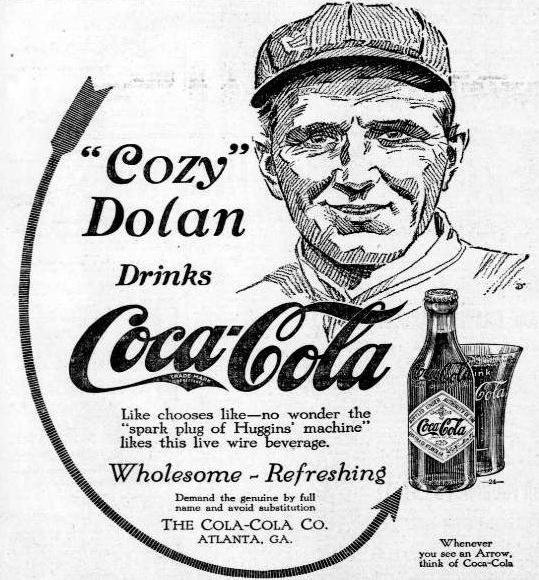
cozydolanA 1915 Coca-Cola ad featuring Albert “Cozy” Dolan of the St. Louis Cardinals.

“Like chooses like–no wonder the ‘spark plug of (Manager Miller) Huggins‘ machine’  likes this live wire beverage.”

Dolan, a 32-year-old utility infielder and outfielder who had never appeared in more than 100 games in a season before 1914, was an unlikely spokesman, given that most Coca-Cola ads of the period featured the game’s biggest stars.

He stole 42 bases for the Cardinals in 1914, but he hit just .240. In 1915, he hit .280 and stole 17 bases in 111 games.

While hardly great numbers, Dolan’s time in St. Louis was a huge success when compared with his disastrous 35-game tenure with the Pittsburgh Pirates.

Dolan was traded to the Pirates by the Philadelphia Phillies for third baseman Bobby Byrne and pitcher Howie Camnitz in August of 1913 and became the team’s starting third baseman but hit .203, had a fielding percentage of .937 and became the target of angry fans.

Cozy Dolan

Cozy Dolan

Richard Guy of The Pittsburgh Post-Gazette described his time with the Pirates:

“He looked bad and he was object of revile by those who criticize, and he failed.”

Joe Kelly of The Pittsburgh Chronicle said:

“No player ever was ridden harder by players and fans than was the former International League speed boy when he performed at Forbes Field.  Perhaps few who held down a berth regularly ever deserved more criticism, for his performances were on the awful order.  But it’s a hard job to make good when hoots and howls follow every poor play, and the few successful ones are greeted with ironical applause.  Dolan got off wrong at Forbes Field and he seemed to be sensitive, too sensitive, to the crowd’s attitude.  There comes to mind a scene last summer when the Pirates were leaving their club house.  They came out in twos and threes, laughing and joking, but among the first was Dolan, all alone.  His face was strained and drawn and worried.  He had failed that day, and he knew it…The fans poured their criticism on his head, and he sat tight and took it without a whimper.  There is something in a guy like that, or the major league managers wouldn’t keep him sticking around.”

Dolan stopped “sticking around” after 1915.  Huggins released his “spark plug” at the end of the season.  He returned to the minor leagues, playing three seasons in the American Association, then became a coach for the New York Giants in 1922.

In 1924, received a lifetime ban from Commissioner Kenesaw Mountain Landis for his role in an attempt to fix a game.


Lost Advertisements–Larry Doyle for Coca-Cola

20 Mar

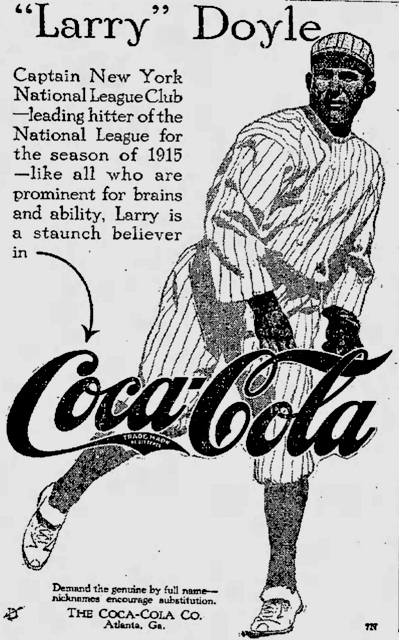
larrydoylecoke

A 1916 advertisement for Coca-Cola featuring New York giants Captain Larry Doyle.

Four years earlier, when Doyle led the Giants to a National League championship–hitting .330 and winning the Chalmers Award as the league’s most valuable player–he told a reporter from The New York Evening Journal that his success was driven by a snub from White Sox Manager Jimmy “Nixey” Callahan:

“When he was playing in a western minor league city (the Three-I League with the Springfield Senators) the (New York) Highlanders heard of him and asked Callahan, then playing independent ball (in Chicago’s City League), to look him over.  Callahan watched Doyle perform in several games and then wired the Highlanders:

“‘He isn’t fast enough.  Can’t field and isn’t a first-class hitter.’

“So Doyle was passed up and Callahan sent in a bill for $200 to cover his expenses and time.  Then (John) McGraw walked up…and paid $4,000 (actually $4,500) for Doyle, who couldn’t be purchased now for three times that amount.  All of which goes to show that some of the best judges of ball players make serious mistakes.”


Cecil and Josh

21 Jan

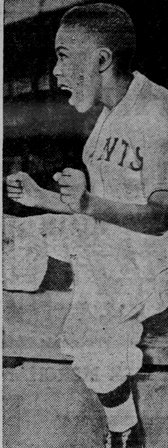
Newspapers across the country saw it as a human interest story about baseball; the Black Press saw it very differently.  With his team in a slump, New York Giants Manager Bill Terry brought in 13-year-old Cecil Terry to “bring the Giants some badly needed luck.”

Cecil Haley

Cecil Haley

The Associated Press said of Haley’s first day on the job:

“Cecil, a Negro mascot, was given a Giant uniform yesterday, allowed to sit in the dugout for the first time and promised a trip West if he’d bring the Giants some badly-needed luck.  The net result of his work?  Pirates 4, Giants 3.”

Very different stories appeared in the Black press.  The Washington Afro-American said:

“(O)rganized big leagues will have colored mascots but steadfastly refuse to accept them as players.  The proud lad sits under the bat rack in the Giants’ dugout, but to date, something must be wrong, because the Giants are hopelessly battling for fifth place.”

The New York Age said:

“Cecil Haley, New York Giants colored mascot, will know better when he grows older and tries to get a job playing for the same team.”

The same day that Haley appeared on the bench with the Giants, New York pitcher Carl Hubbell spoke with The Pittsburgh Courier about Josh Gibson:

“‘(H)e’s one of the greatest backstops in the history of baseball, I think…Boy–how he can throw!’ exclaimed Hubbell.

josh

“There seems to be nothing to it when he throws.  He just whips the ball down to second base like it had a string on it.  He’s great, I’m telling you.  Any team in the big leagues could use him right now.’

“But, with all that,’ said Hubbell, ‘the thing I like best about him is that he’s as fast as greased lightening.  You know, after a few years a catcher usually slows up considerably from bending down so much.  But that guy–why, he’s never slowed down.”

That summer, a new effort was underway to integrate baseball.  A petition drive led by the Young Communist League collected between 25,000 and 100,000 (reports varied) and delivered to National League President Ford Frick,  and Commissioner Kenesaw Mountain Landis at the 1939 winter meeting in Cincinnati.

The Afro-American said Frick “avoided the issue by declaring that a ‘social problem’ was involved for which the big leagues were not responsible.”

There is no public record of the commissioner’s response.

Josh Gibson, with two-time Communist Vice-Presidential Candidate James W. Ford looking on, signs the 1939 petition to end racial discrimination in professional baseball.

I published a shorter version of this post on August 27, 2012.

McGraw’s “Rubber”

2 Jan

In 1903 and ’04 the Boston Beaneaters finished sixth, and seventh, while the New York Giants followed a second place finish in 1903 by winning the pennant in ’04.

Jacob Charles “Jake” Morse of The Boston Herald said he it wasn’t just talent that made the Giants more successful:

“It is astonishing that so little attention is paid to the care of baseball players during the training season and the playing campaign, especially the former.  It is in the spring that arms need the most careful cultivation and a first-class expert is almost indispensable.

“A first-class ‘rubber’ ought to be taken by every club that goes South, and if this were done sore arms and muscles would be reduced to a minimum.

“Here in Boston neither club has what is called a trainer or a ‘rubber.’ The New York National League club has had the services of the well-known ‘rubber’ Gus Guerrero, for several seasons, and he has given satisfaction.”

Before coming to the Giants as the team “Rubber,” Guerrero had made a name for himself as a competitive walker and runner.  The San Francisco Call said of him:

“Back in the late (eighteen) seventies Guerrero was the one best bet when it came to a foot race, whether for one or for 500 miles, six-day match, or even if the proposition called for a jaunt from the Pacific to the Atlantic coast.  Anything went with Guerrero; he ran for 48 hours, making 300 miles flat in that time, and once in 1884 he trundled a wheelbarrow from San Francisco to New York City.”

Gus Guerrero

Gus Guerrero

Guerrero, often billed as “The Mexican,” and “The best athlete Mexico ever produced,” was actually born in Northern California.  He became an athletic trainer in New York in the 1890s and began working for the Giants in 1900.

John McGraw inherited Guerrero when he came to New York in 1902, and swore by his “Rubber.”

The Associated Press said, in 1904 when McGraw, trying to rehabilitate his injured knee, took Guerrero on the spring training trip south:

“Last year (McGraw) depended on local massage men to rub and bandage the bad knee, but they did not understand the job.  Guerrero, a professional, has been spending several hours per day solely on McGraw’s weak muscles and has succeeded in hardening them so that the joint is fairly protected and does not spring at a critical moment.”

The New York Press said of Guerrero:

“(He) wears a baseball shirt labeled ‘New York’ all the time.  McGraw says he believes Gus sleeps in it. As the men come in he looks them over, particularly the pitchers.  If a box man complains of a stiff arm the trainer attends to it as carefully as a physician looks after the throat of an operatic prima donna.  He makes the player strip, steams him, puts him on a slab, massages him, and then rubs in a liniment of his own concoction which he declares would take the stiffness out of a telephone pole.  It is equal parts of witch hazel and alcohol to a quart; with half a teaspoon of oil of wintergreen and a dash of something else that Guerrero says is his secret.”

While McGraw seemed impressed with Guerrero, it appears some of his players were not.

When the team was training in Birmingham, Alabama during the spring of 1904, The New York Globe’s Allen Sangree, who was traveling with the Giants, wrote about an exchange between Guerrero and Christy Mathewson:

“Mathewson, in particular, was feeling grouchy yesterday.  ‘How’s your arm?’ asked Gus Guerrero, the rubber, as he put the finishing touches on him…’Arm alright,’ said Matty, ‘but I don’t feel good.’

“’Well, what’s the matter?’ pursued the rubber.

“’Nothing, didn’t I tell you!’ yelled the big fellow, in exasperated tones.  ‘Just nothing, only I don’t feel good; and don’t bother me either.’”

Just after Jake Morse wrote about the advantage McGraw’s “Rubber” had given the Giants, it was announced that he would no longer be the team’s trainer.

The New York Herald said:

“Gus and the players could not get along well, so he resigned.”

McGraw, who remained “a strong believer in massage treatment for pitcher’s arms before and after the game,” and replaced Guerrero with Harry Tuthill—Tuthill had trained several fighters, including William “Young Corbett II” Rothwell, and “Mysterious” Billy Smith.   Tuthill was with New York until 1908 when he joined the Detroit Tigers.

Harry Tuthill, with Tigers pitcher Del Gainer

Harry Tuthill, with Tigers pitcher Del Gainer

Guerrero never worked for another major league club. He continued to participate in races, and eventually returned to California where he died in 1914.

Things I Learned on the Way to Looking up other Things #13

22 Dec

Chief Meyers on the Plight of the Native American, 1913

John W. McConaughy, the former sports editor of The St. Louis Post-Dispatch, was no longer writing about baseball regularly as the New York Giants prepared to face the Philadelphia Athletics in the 1913 World Series.  McConaughy, who was the Washington correspondent for The New York Journal, was enlisted by the paper to write about some of the key figures of the series.

The result was, in the case of John “Chief” Meyers, a profile that went beyond a typical baseball story:

Chief Meyers

Chief Meyers

“Meyers is one of the coolest, shrewdest and quickest thinking catchers that ever came to the big leagues.  He has both gray matter and gumption, and the one is useless without the other in baseball as elsewhere.  He has a fund of general information that runs from national politics to the philosophy of Plato, and a delicately adjusted sense of humor, and these two combine to give him a good perspective of the national game.”

[…]

He is ready to fight any time for justice and fair play and he is so good-natured that he isn’t seriously annoyed when the fans perpetrate that bum war-whoop every time he comes to bat.

[…]

“One day in Cincinnati he asked the writer to go out to the art museum with him.  We came upon a bronze—an Indian turning to shoot an arrow at his pursuers.

“’There’s the idea.’ He said, pointing to the warrior.  ‘They never learned how to fight.  They had nothing but the willingness.  If Tecumseh had been as big a man as Napoleon he would have killed off the medicine men as his first official act, learned the white man’s style of warfare—and there would have been an Indian nation here today.

“’I don’t mean that the white man would not have been here, too.  But with a few leaders—real big men—our fathers would have come to see that the white man’s type of civilization was the highest, just as the (Japanese) have done.  We would have had great states and communities in the union, and we would have been useful, progressive citizens.

“’As it is the Indian is robbed by agents and shifted from reservation to reservation whenever anyone happens to want their land.  Tribe after tribe is scattered, and in another hundred years my people will have gone the way of the Aztecs.’

“Still, there will always probably be a few fans who will think it bright to pull the war-whoop when the Chief comes to bat.”

Tom Lynch Cracks Down, 1910

In June of 1910, The Associated Press said that after a 5 to 4 New York Giants victory over the St. Louis Cardinals, umpires Jim Johnstone and August Moran “stood in front of the press box and made remarks about the baseball writers.”

National League President Thomas Lynch, who had announced his intention to “break this habit of having players call the arbitrators bad names” said in response:

“I also will not stand for umpires talking back to spectators or taking it upon themselves to criticize newspaper men.”

National League President Thomas Lynch

National League President Thomas Lynch

He fined Johnstone and Moran $25 and $15 respectively for the incident.

In that era of newspapermen as frustrated poets, George E. Phair, then of The Milwaukee Sentinel, was one of the most prolific, often including a poem in his articles.  He dedicated the following verse to the National League President:

Old Thomas Lynch, who runs a league,

     Would propagate urbanity;

In fact, Sir Thomas would intrigue

     To curb the umps’ profanity.

He warns his umpires while within

     The baseball scribes vicinity

To speak no words that reek of sin,

     But emulate divinity.

He tells them not to harm the scribes,

     Nor flout at their ability;

Nor pester them with jokes or jibes;

     Nor laugh at their senility.

He plasters fines upon his umps

     For showing their ferocity

And calling scribblers ‘mutts’ and ‘chumps’

      With Teddy-like verbosity.

The veteran Sir Thomas is

     Most generous and affable,

But we’re inclined to think that his

     Solicitude is laughable.

The ump may blunder now and then

     And break into profanity;

The scribbler jabs him with his pen

     And drives him to urbanity.

Comiskey Tells a Tommy McCarthy Story, 1899

George Erskine Stackhouse, the baseball editor of the editor of The New York Tribune, spoke to Charles Comiskey in 1899 and found him in a “somewhat reminiscent mood.”  Comiskey told a story Tommy McCarthy when the two were with the St. Louis Browns:

Tommy McCarthy

Tommy McCarthy

“I heard in Chicago the other day that tom is in Boston, as fat as a Tammany alderman, and making money out of a big bowling alley.  (Hugh) Duffy owned an interest in it, but they say Tom bought him out.  I had Tom with me in St. Louis.  And say, St. Louis is the best town on earth for a winner.  They used to distribute among the players every season watches and rings and studs and pins enough to stock a jewelry store.  There was a diamond medal offered one year for the best base runner on the Browns.

“Tom McCarthy was quite a boy to steal bases, and after the medal was offered he wouldn’t run out his hits.  If he made a two-bagger, he would stop at first, and if he slammed the ball for a triple, he would manage to bring up at second, so as to get a chance to steal a base.  Of course, after a bit, I got on to him, and I had to warn him that if he didn’t stretch those hits I would have to lay him off altogether.  That helped some, but he was always hanging back when he thought he could get away with it.  I remember once that he had a chance to go down to second on a wild throw to first, and what does he do but toss his head and drop off his cap, so that he could stop and come back after it and stick at first.  He won that medal.”

“Take a Chance, any time, and Fight all the Time”

19 Dec

John W. McConaughy was just 19 when he became the sports editor of The St. Louis Post-Dispatch in 1903.  Over the next 30 years he worked as the Washington Correspondent for The New York Evening Journal, was the production manager for William Randolph Hearst’s film company, Cosmopolitan Productions, and was a member of the Creel Committee, created by President Woodrow Wilson to influence public opinion at home and abroad during World War I.  He also published several books on crime, politics and sports, including: “From Cain to Capone,” “Who rules America?: A Century of Invisible Government,” and “Big Jim Jeffries: His Twelve Greatest Battles.”

But, he continued to write about baseball long after he left St. Louis, including a profile of New York Giants Manager John McGraw on the eve of the 1913 World Series for The Evening Journal:

“The most distinctive and aggressive personality in baseball—this is John J. McGraw, the wonderful leader of the Giants.  He has been at one and the same time the most abused and most admired man in the national game.

John McGraw

John McGraw

“He has been called a rowdy and a Napoleon in equal parts.  He has been mixed up in more rows than any big league manager; but he has also been mixed up in more pennants… (Connie)Mack is his only rival for the title of greatest manager in the game and no two men in the world were ever more widely apart in character and methods than these two.  The old fox of Philadelphia has been dealt with elsewhere.  His system is carefully constructive work, leaving nothing to chance.

“McGraw’s motto is:

“’Take a chance, any time, and fight all the time.’

“He believes especially in fighting, but he is of the mind of Polonius in not advocating fighting as an end.  It is always a means with McGraw.  There is method in his mixing.  He has been represented as running amuck through baseball for the love of a rough-house.  Nothing is further from the truth.  When McGraw has a row on the ball field he figures that he is going to win something material at some time as a result.

“For instance, you never hear of any of the Giants being suspended or fined for battling with the umpires these days.  Why?  Because McGraw discovered that the magnates meant business in their manifestos against bully-ragging the arbiters and the chief of the Giants decided that a star on the field was worth six on the bench, recovering from the effects of ea sing their mind to an umpire.

“’I’ll do all the kicking from now on,’ he told his warriors.  ‘If any man is benched by an umpire I’ll fine him myself.  Let ‘em put me out of the game.  I’m not out there playing.’”

McConaughy said the two things McGraw looked for when evaluating players was “speed and brains,” but only the first one was non-negotiable:

“’It is possible to get good baseball out of a bonehead,’ he said once, ‘if you never expect him to think. Whenever there is any thinking to be done do it for him, and land on him with both feet if he tries to do any himself.

“By following this system he has actually made popular heroes out of notoriously slow-witted athletes.  He is out there on the coaching line thinking for them.”

McGraw, he said, was the “quickest and most daring thinker” in the game:

“It is characteristic of his aggressive mind that he is the only baseball leader who has no use for the sacrifice hit.  There is no doubt that he has lost many ball games by not using it, but there is also no doubt that he has won many a game by discarding it.  He follows offensive tactics of the dashing kind.  He is all for the hit-and-run and the double steal.  He believes in hitters and always has at least one a better than average hitting club, and his argument is that there is no sense in getting .300 hitters and ordering them to chuck away a one-in-three chance for a clean hit to advance a man a base at the cost of an out.”

McConaughy said McGraw was the ultimate player’s manager:

“He is the boss-he gives the orders and takes the blame.  He never breaks into print with anything like criticism of any man on his team no matter how much to blame any man may be for any disaster.

“He demands strict obedience and whole-hearted loyalty from his men, and he stands by them against all comers all the time and under all circumstances.  It doesn’t make any difference if every fan and sporting writer on the circuit has turned down his thumbs on a ballplayer.  This is usually a good reason, in McGraw’s system for moving him up a few places in the batting order and making him a regular player in a prominent position.

“There is scarcely a manager in the country who would have clung to (Fred) Merkle under the terrific panning that unfortunate man was let in for by his historic play at second base.  McGraw’s answer to the storm of abuse was to make him regular first baseman of the club, a place he has filled with credit.”

While McGraw did always defend Merkle for “his historic play, “he did not make him the “regular first baseman,” during “the storm of abuse” immediately following “Merkle’s Boner” in September of 1908, but  rather after the release of Fred Tenney following the 1909 season.

McConaughy summed up McGraw:

“His men are always looking for a chance to swear by him, and the fans around the circuit are equally keen for a chance to swear at him.”

Connie Mack, who McConaughy said was McGraw’s “only rival” for the title of baseball’s best manager, guided his Philadelphia Athletics to a four games to one victory over McGraw’s Giants in the 1913 world Series.

McGraw and Mack two years earlier at the 1911 World Series.

McGraw and Mack two years earlier at the 1911 World Series.