Tag Archives: New York Highlanders

Butcher Boy Schmidt

25 Jul

Charles John “Butch” “Butcher Boy” Schmidt was credited by Connie Mack with being the catalyst for the Boston Braves World Series upset of Mack’s Philadelphia Athletics in 1914; one year later Schmidt walked away from baseball in his prime.
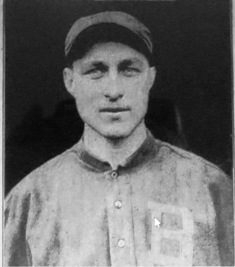
Butch Schmidt

Butch Schmidt

He was born in Baltimore in 1886, and played amateur ball while working in the family meat market, which earned him his nickname.

Schmidt signed as a pitcher with the Baltimore Orioles  in the Eastern League and assigned to the Holyoke Papermakers in the Connecticut State League, where he posted a 10-9 record.  In late August the Orioles recalled him, and he went 5-1 in 11 games with Baltimore.

The New York Highlanders drafted Schmidt and the 22-year-old pitcher started the 1909 season in New York.  He appeared in only one game, on May 11, giving up 10 hits and eight runs, four earned, in five innings.  Early in June he was returned to the Orioles.

After appearing in eight games on the mound with the Orioles, Schmidt was moved to first base.  After hitting .244 for the remainder of ’09, he hit .292, .291, and .274 the next three seasons, and was sold to the Rochester Hustlers in the International League, where he hit .321; he was purchased by the Boston Braves on August 22, and hit .308 in 22 games playing in place of Ralph “Hap” Myers.

At the end of the 1913 season Boston sold Myers’ contract to Rochester; The Boston Post reported that Braves manager George Stallings simply didn’t like Myers.  (Myers had a different theory for his release—that story next week)

Schmidt was installed as the Braves first baseman in 1914, and as Boston made their improbable run to the National league pennant Schmidt   hit .285 with 71 RBI and .990 fielding percentage, and finished 16th in the voting for the Chalmers Award, for the most valuable player in the National League; teammates Johnny Evers and Rabbit Maranville finished first and second in the voting.

Grantland Rice said in The New York Tribune:

“There are few greater first basemen in baseball and none who is steadier or a better fighter.  For Schmidt is also of the aggressive type and a hustler every second.”

The New York Times didn’t think quite as highly of Schmidt and on the eve of the World Series said the “advantage favors the Athletics” at first base:

(John “Stuffy”) McInnis makes exceptionally brilliant plays…has been through Worlds Series fire and proved just as cool as if he were playing an exhibition game in the springtime.  Schmidt has yet to face the strain and tension of the big baseball classic…While Schmidt is not a scientific batsman, he is a free swinger and hits the ball hard, but he doesn’t hit it often.”

The pressure of the series didn’t seem to bother Schmidt, the Braves first baseman hit .294 with five hits, two runs and two RBIs in the four game sweep of the Athletics; McInnis hit just .143.

In game one he made a play in the first inning that Connie Mack said set the tone for the series and “sparked the Braves.”  With runners on first and second with one out, Athletics third baseman Frank “Home Run” Baker hit a foul pop-up into short right field.  Athletics outfielder Eddie Murphy tagged up and attempted to go to third; The Associated Press said Schmidt made a “great throw…from a difficult angle,” to third baseman Charlie Deal to retire Murphy.
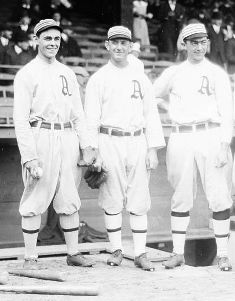
Stuffy McInnis, Eddie Murphy and "Home Run" Baker,

Stuffy McInnis, Eddie Murphy and “Home Run” Baker,

Early in the 1915 season Braves manager George Stallings called Schmidt “The best first baseman in the game,” but his performance at the plate slipped.  Schmidt hit just .251 with 60 RBIs.  The Braves again found themselves in 8th place in July, and while they made another strong run, finished 2nd, seven games behind the Philadelphia Phillies.

Despite the mediocre season at the plate, it was assumed the 28-year-old Schmidt would remain the Braves first baseman.  Schmidt shocked Stallings, Boston fans, and all of baseball when he announced in January of 1916 that he was retiring from baseball.
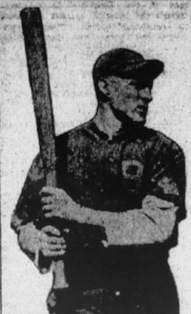
Butch Schmidt at bat

Butch Schmidt at bat

The Associated Press said Schmidt was leaving “to devote his entire time to his private business.”

Grantland Rice said Schmidt’s business included “six meat markets in Baltimore,” and that he earned $8000 a year from his stores.

The Sporting Life said it was just as likely that Schmidt, listed at 200 pounds, retired because:

Hard work in that old rubber shirt to get down to weight, especially when the extra weight comes off slowly, more slowly each succeeding season, is a trial that anyone would like to sidestep if he could. “

Boston manager George Stallings filled the void left by Schmidt by purchasing Ed Konetchy from the Pittsburgh Rebels from the newly defunct Federal League.

The Boston Post said the change at first base would not hurt the Braves:

“Konetchy, a heavier hitter than Schmidt, is just about as capable in other ways.”

Despite the confidence of The Post, Stallings was not convinced and continued to try to induce Schmidt to return; his efforts were unsuccessful.

After Konetchy hit .260 for the third place Braves in 1916 it was reported that Schmidt would return to the team.  After several weeks of speculation, Schmidt told The Boston Globe “no offer” could induce him to return to Boston.

Konetchy hit .272 and .236 the next two seasons, and each off season it was rumored Schmidt would return, and every year he stayed home where he continued to run his business and play semi-pro ball in Baltimore’s Inter-City League.

Before the 1919 season Konetchy was traded to the Brooklyn Robins and the Braves acquired Walter Holke from the Cincinnati Reds.  Holke hit .292 for the Braves in 1919, but rumors continued that Schmidt, out of organized baseball for four years, would be returning to Boston.  The Associated Press said:

“George Stallings of the Boston Braves is trying to get Charlie “Butch” Schmidt, the Baltimore butcher boy who played first base for the world’s champions of 1914, to return to the Boston Braves.  Schmidt is reported to be in wonderful condition as he has kept in practice since his retirement.”

Schmidt never returned to professional ball, and was finally removed from Boston’s reserve list in 1922.

Butch Schmidt walked away from professional baseball and never looked back; he died in 1952 of a heart attack while inspecting cattle at the Baltimore Union Stock Yards.
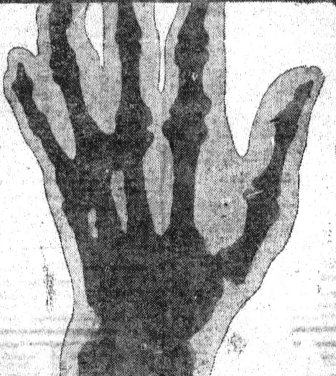
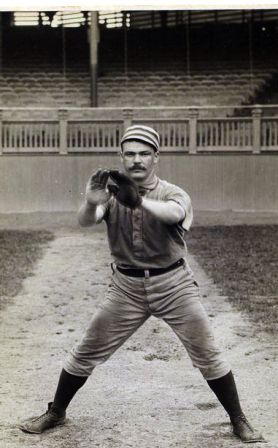
A Thousand Words—Deacon McGuire’s Left Hand

14 Jun

mcguirehand


James “Deacon” McGuire caught more than 1600 games in a career that spanned parts of 26 seasons between 1884 and 1912.  He broke every finger on both hands and suffered thirty-six separate injuries to his left hand.  In 1906, his x-ray was acquired by the New York papers after yet another injury.

The New York World said doctors were “amazed to see the knots, like gnarled places on an old oak tree, around the joints, and numerous spots showing old breaks.”

Deacon McGuire

Deacon McGuire

More Superstitions

25 Apr

Billy Evans, “The Boy Umpire,” joined the American League staff at the age of 22.  Before becoming an umpire, Evans was a reporter for The Youngstown Vindicator and continued to write occasional, syndicated newspaper articles throughout his career.

Billy Evans

Billy Evans

In a 1907 article he wrote about superstitions:

“Baseball players are the most superstitious class of people in the world.  There are many superstitions in general in which all members of the profession have implicit confidence and nearly every player has some pet belief that is all his own.”

Evans mentioned one of the most superstitious players of all-time, Detroit Tigers pitcher “Wild Bill” Donovan, who as mentioned in an earlier post, believed that striking out the first batter he faced was bad luck.  According to Evans he also had a strange belief about the first game of the season:

“Donovan has a dread of working in shutout games on his first appearance.  He believes it a season hoodoo and would do almost anything to prevent it.”

Evans worked as an umpire in Donovan’s first start of the 1907 season, and the pitcher took a shutout into the ninth inning:

“I happened to be working back of Donovan that day and noticed that he seemed to let up in the ninth , also that he used nothing but a straight fast ball.  A pass, an error and a cracking hit by Charley Hickman sent a couple of tallies over the pan.”

Evans said he asked Donovan after the game if he “(lost his stuff,” in the ninth, Donovan said no:

“I have no desire to win a shutout game right off the reel…shutouts on your debut are not lucky.”

Bill Donovan

Bill Donovan

Evans said Fred “Lucky” Glade, a St. Louis Browns pitcher who had just been traded to the New York Highlanders, had a phobia of pitching if the sun wasn’t out:

 “According to Glade, he has never during his career won a game on a dark day.”

The pitcher also “started each inning…by tossing a ball to (Browns first baseman) Tom Jones.  Next year he will have to use (Highlanders first baseman) Hal Chase

Chase must not have been an adequate substitute; Glade struggled with arm and stomach problems, posted an 0-4 record in five starts for the Highlanders, before returning home to Nebraska in June.  He signed a contract for 1909, but never reported and never pitched again.

Fred Glade

Fred Glade

Ty Cobb had numerous superstitions; one had to do with the “position of the broom with which the umpires use to dust off the plate.”  Evans said:

“The umpires find it handy to keep the broom to the left of the plate, while Cobb, when at the bat, always desires it to the right.  Whenever he steps to the plate Cobb always picks up the broom and tosses it to the right side of the batter’s box.”

Additionally:

“When in a batting slump Cobb always makes three crosses as he takes his position at the plate.  When Cobb reaches first base on his journey from right field to the bench he always gives the bag a terrific kick in the direction of the plate…Cobb insists that the short distance he moves the bag toward the plate with his kick often is the means of winning a close decision at first for his team.’

Ty Cobb

Ty Cobb

Evans said of superstitions in baseball:

“No doubt a close investigation would reveal that every player from the smallest bush league up has his pet theory.”

Lost Advertisements—Old Underoof Whiskey, 1909 World Series and 1910 A.L. Race

11 Apr

oldunder1909ws

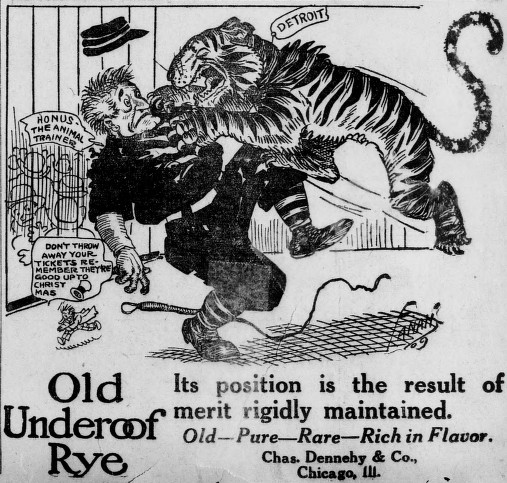
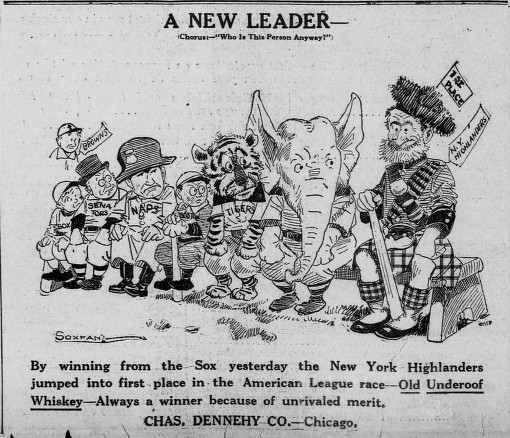
During the first decade of the 20th Century cartoon ads from Chas. Dennehy & Co., distributor of Underoof Bourbon and Rye Whiskey appeared regularly in Chicago newspapers.  Most focused on the Cubs and White Sox, the two featured today do not.

The ad above appeared after game 4 of the 1909 World Series when the Detroit Tigers evened the series with the Pittsburgh Pirates at two games apiece on George Mullin’s a five hitter;  Pirate star Honus Wagner, who would hit .333 for the series was held hitless by Mullin.  The Pirates would go on to win the series in seven games.

The one below was published on June 6, 1910 when the New York Highlanders, after winning two of three in a series with the White Sox, moved into first place.  The Philadelphia Athletics quickly overtook New York and would win the American League Pennant by 14 1/2 games.


oldunder1910Highlanders

Stallings Stealing Signs

17 Oct

George Stallings had turned the New York Highlanders around.

Hired by owner Frank Farrell after New York’s disastrous 51-103 season in 1908, Stallings guided the Highlanders to 74-77 record in 1909.

George Stallings

American League President Ban Johnson said he knew why Stallings’ team had improved.

During a series with the Highlanders in the summer of 1909 Washington Senators Manager Joe Cantillon thought he noticed something unusual past the center field wall in Hilltop Park.  He passed his suspicions on to Detroit Tigers Manager Hughie Jennings.

Tiger Manager Hughie Jennings

The Highlanders hit Detroit pitcher Ed Summers hard during the first game of Detroit’s next series in New York.  Jennings sent pitcher Bill Donovan out to center field to investigate, but according to The Sporting Life:

“Bill returned without having shown any ability as a Sherlock Holmes.”

Jennings then assigned trainer Harry Tuthill to the job.  Tuthill noticed that the letter “H” in a hat advertisement on the center field fence was moving, scaled the fence and made a discovery.

Initially the Tigers did nothing, Jennings had more on his mind; Detroit was headed to the World’s Series and despite New York’s improvement they were a fifth place team.

But rumors spread and the story was picked up by The Sporting Life, getting the attention of  the American League president.

Johnson sent a telegram to Tuthill threatening to bar him from the league if he did not provide the his office with a full report of what he knew.  Tuthill said that after he noticed the letter in the sign moving he went to the center field wall and upon climbing to the other side discovered a small area behind the sign where a man sat with a pair of field glasses.  According to Tuthill “The man ran out as I came in, I think I know who it is but can’t be positive.”

In other reports Tuthill said he was sure who the man was but would not reveal his identity—it was later alleged to be former Major League pitcher Gene McCann.

Trainer (and detective)  Harry Tuthill with Tigers first baseman Del Gainer

Jennings was convinced the Highlanders were stealing signs all year as did The Sporting Life:

“It has been a noticeable fact all season that the Highlanders always hit like fury at home and were punk batters on the road.”

The Highlanders scored 338 runs in 76 homes games; 251 in 75 road games.

The Sporting Life also speculated that Stallings, who had a poor relationship with the American League president, might be expelled from the league as a result of the allegations:

“President Johnson has conclusive evidence…and it is all but natural to suppose that the man in charge of the team which benefited by the system employed knew of its existence, and it is on this theory that Stallings’ resignation will be asked.”

Despite the speculation there was no rule at the time which prohibited stealing signs in the manner the Highlanders were accused

At the winter meetings that December the American League Board of Directors exonerated Stallings, but in their ruling vowed that any team official found stealing signs in the future would be “Barred from baseball for all time.”

Stallings was at the helm of the Highlanders for most of the 1910 season, and became embroiled in another sign stealing controversy in late July when “Big Ed” Walsh and several members of the Chicago White Sox accused the Highlanders of stealing signals in the same manner.

The Chicago Tribune said:

“There is not a player on the Sox club who isn’t confident the catcher’s signs are being tipped off.”

Stallings again denied the charges and said the White Sox pitching staff was tipping their pitches:

“What are you going to do when practically every Chicago pitcher insists on giving his own signals from the box and the signals get familiar, they are repeated so often?”

Stallings was again cleared of wrongdoing, but in spite of a guiding the Highlanders to a 78-59 record through September 19, he was replaced as manager after losing a struggle for control of the team with first baseman Hal Chase, who was named as his replacement.

Stallings went on to manage the World’s Series winning Boston Braves in 1914.