Tag Archives: Philadelphia Athletics

Baseball on Skates

28 Aug

In the winter of 1866 the Athletic Base Ball Club of Philadelphia had a novel idea.  The Philadelphia Inquirer said:

“It would naturally be supposed that, with the advent of ‘winter’s rude blasts,’ the noble game of base ball would be laid on the shelf and kept there until the season when the earth brings forth its products in the shape of green leaves and budding flowers, but not so, for our base ball devotees are such enthusiasts in the game that they have resorted to the novelty of playing it on skates, thus indulging in two exhilarating recreations at the same time.”

The Athletics were scheduled to play the team from the Hamilton Club of Philadelphia.  When several of the Hamilton players were unable to participate, an ad hoc team was assembled which also included players from the Camden, Olympic, Philadelph’s, and Keystone clubs.

alreach

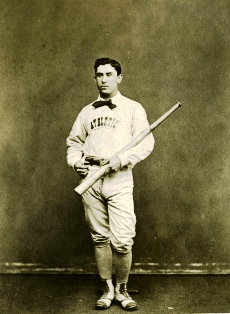
Al Reach batted third for the Athletics on skates

The Inquirer said:

“The game was “witnessed by several hundred persons, and excited great amusement, owing to the trouble experienced by the players endeavoring  to do two difficult things at the same time, i.e. keep their equilibrium on skates and play base ball well.  The game was remarkably well-played, taking into account the pedal difficulties.”

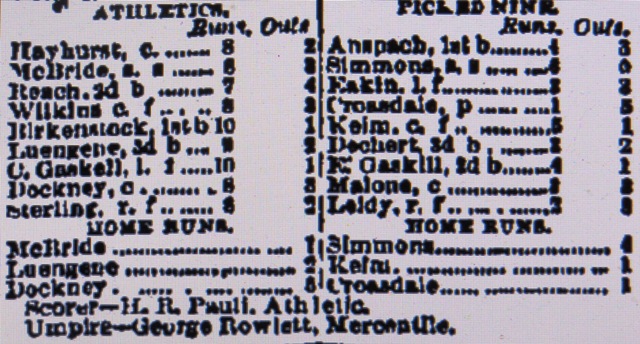
The Athletics won 76-35

The Box Score

The Box Score

Within two weeks a “base ball match on skates” was played between the  Active and Eureka clubs in Newark, New Jersey.  The Trenton State Gazette said Eureka won 26-16, and that the game was “very interesting,” and “witnessed by five thousand people, including many ladies.”

For the next 50 years games played on ice would occasionally be staged, usually with amateur teams.

Lost Advertisements–“Home Run” Baker for Coca-Cola

23 Aug

???????????????????????????????


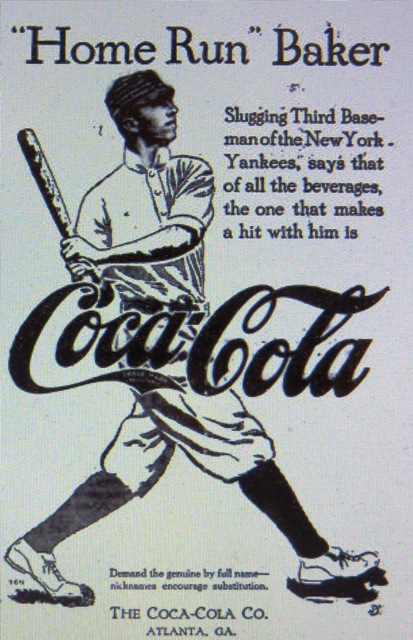
A 1916 advertisement featuring Frank “Home Run” Baker.

Slugging Third Baseman of the New York Yankees says that of all the beverages, the one that makes a hit with him Coca-Cola

Baker was sold to the Yankees for $37,500 in February of 1916 after the star of the Philadelphia Athletics had sat out the 1915 season over a salary dispute with Connie Mack.  The Hall of Famer remained a star while in New York, but never again put up the numbers he did before missing an entire season in the prime of his career.

“Offered him $1,000 to Throw the Game”

21 Aug

Pitcher George “Charmer” Zettlein began his professional career with the Chicago White Stockings in 1871 when his friend, manager Jimmy Wood convinced him to leave the Brooklyn Atlantics.  He followed Wood to the Troy Haymakers, Brooklyn Eckfords and Philadelphia Whites, and they returned to Chicago together in 1874.

1875 would be the end of their professional association.

It’s unclear where the trouble began.  When Wood’s “private” conversation with a reporter from The St. Louis Democrat was printed verbatim in the newspaper, Zettlein was the only Chicago player he said anything negative about—referring to his friend “as a poor batter and runner.”   Whether the comment contributed is unclear, but shortly after the season began, and the team started struggling, The Chicago Tribune said there was undisclosed “trouble” between the pitcher and manager.

George Zettlein

George Zettlein

Rumors of tension between the two heated up when allegations of throwing games were leveled at team captain Dick Higham; Zettlein also became a target of rumors, including second-hand reports that Wood accused him of “laying down.”  The Tribune said the day after Higham was replaced as team captain:

“It is known that the name of Zettlein was brought before the meeting (of the White Stockings directors) in connection with hints before made that affected his honesty.  It is due to Mr. Zettlein to say that no charges were made against him…the conviction is generally expressed that the White Stockings pitcher works hard to win.”

After the White Stockings and Zettlein lost 15-3 to the Mutuals in New York on July, 31 Wood and his pitcher were finished.  Zettlein sent a letter to club President William Hulbert accusing Wood of “arbitrary and unjust” treatment, and demanded his release.

The Tribune said:

“(Zettlein) will play ball in Chicago no more, except as the member of some visiting club.  He has asked to be relieved from the contract which binds him to the Chicago management.  His request has been granted, and he will not return here with the club…Zettlein states that Wood’s conduct towards him during their Eastern trip has been unbearable.”

Part of Zettlein’s dissatisfaction was that Wood played him at first base in three games; although he had played at least one game in the field every season except 1874, seemingly with no complaints.

The Tribune said Zettlein claimed Wood “has systematically imposed upon him to such an extent that he cannot remain.”

Already on the East Coast, Zettlein immediately signed with the Philadelphia Whites.  His troubles weren’t over.

After less than a month with the Whites, the vague rumors in Chicago turned into direct allegations from his new teammates.  The Philadelphia Times said on August 31, after an 11-3 Athletics loss:

“After the game between the Philadelphia and Hartford (Dark Blues) clubs yesterday, while the (Athletics) players were undressing an exciting discussion took place to the cause of the severe defeat.  (Third baseman/manager Mike) McGeary was angry and he charged (outfielder Fred) Treacy with being in collusion with the gamblers and selling the game, and pointing to Zettlein, said, ‘And there’s another one who’s in it.’”

Zettlein and Treacy had been teammates, with Wood, on the 1871 White Stockings.  Both players denied the charge, and both were immediately suspended by the team pending an investigation.  At the same time the two suspended players charged that McGeary was the gambler, and said a Hartford player, well-known for his integrity could back up their allegations.  The Times said:

“Zettlein and Treacy had a talk with (Jack) Burdock, of the Hartfords…a meeting of the Philadelphia club was held, at which the subject was brought up.  Zettlein and Treacy were present, and made statements to the effect that Burdock (intended to show) that prior to the game McGeary had approached him and told him he had a large amount of money bet on the success of the Philadelphias and offered him $1,000 to throw the game so that the Philadelphias should win, and that he refused to have anything to do with such an arrangement.”

Burdock was also said to have additional information, including a charge that “McGeary approached him with (other) offers, saying they could make plenty of money,” but there is no record of Burdock ever discussing McGeary, or the allegations publicly.  The Times said “there was an exciting discussion over these astounding charges, “and that a committee was appointed to conduct an investigation.

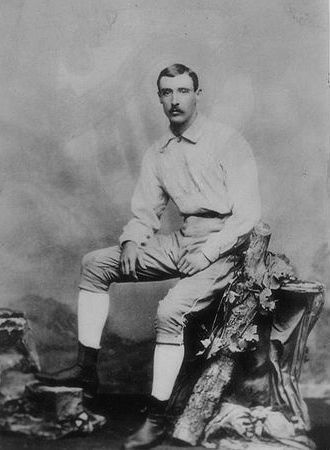
Mike McGeary

Mike McGeary

Like most of the “investigations” into allegations of gambling in the National Association there appears to have been little real investigation of any of what was happening with the Philadelphia Whites.  Within a week the team announced that the “charges were not sustained.”  The only fallout from the scandal was that Bob Addy replaced McGeary as manager for the final seven regular season games.

In October when the Whites met the Athletics in a 10-game Philadelphia series, Zettlein walked off the mound during the sixth inning of the tenth game with his team behind 7 to 3.  The Philadelphia Inquirer said “Zettlein left the field, giving as an excuse that some of his men were trying to lose the game.”

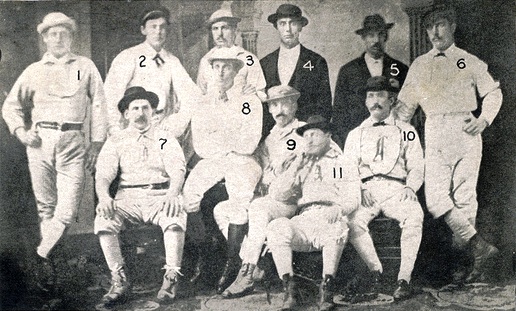
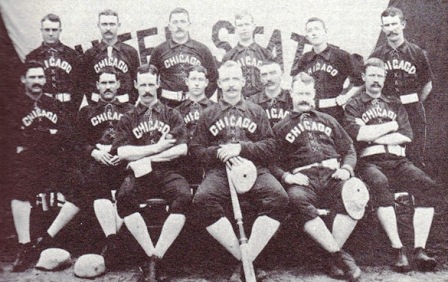
Zettlein, (7), Wood (8), Treacey (9), as teammates with the 1871 Chicago White Stockings.

Zettlein, (7), Wood (8), Treacey (9), as teammates with the 1871 Chicago White Stockings.

Jimmy Wood never managed again after 1875.

After poor seasons during the National League’s inaugural year in 1876, Zettlein (4-20 for the Athletics) and Treacy (.214 and 39 errors for the New York Mutuals), two of the principals in the 1875 scandal were out of baseball.  McGeary, who joined the St. Louis Brown Stockings in 1876, would become a major figure in the 1877 game fixing scandal of 1877.  As with the charges 1875, nothing was proven and after sitting out the 1878 season McGeary returned to the National League and played until 1882.

“He must either admit that he sold yesterday’s game or acknowledge that he cannot play ball”

20 Aug

Heading into the 1875 season Chicago White Stockings manager Jimmy Wood was confident about his team’s chances.  The Chicago Tribune said:

“(Wood) says the men are strictly temperate, are all first-class ball players, and will enter the field without any of the petty jealousies and ill-feelings that weakened the nine last year.”

The St. Louis Democrat also printed “private” comments Wood made maligning the abilities of the Brown Stockings in comparison to his team.

Jimmy Wood

Jimmy Wood

Unfortunately for Wood the decline of the White Stockings began even before opening day.

The first blow to the team was what became known as “the Davy Force” case.  Force signed a contract to return to the White Stockings for the 1875 season on September 18, 1874; unfortunately for Chicago he also signed a contract to play for the Philadelphia athletics on December 5.  The Sporting News described the adjudication of the Force case:

“(In December) the matter was brought up and the judiciary committee (of the National Association) awarded Force to the Chicago club…At the spring meeting of the Association, held in Philadelphia, the Athletic club got in its political work.  Mr.(Charles) Sperling, of Philadelphia, was elected president of the Association, and he appointed a new judiciary committee which reversed the ruling of the old committee.”

The arbitrary nature of the new ruling—that Chicago did not have the right to sign Force for 1875 before the end of the 1874 season—enraged White Stocking President William Hulbert, and was one of the many complaints about how the National Association operated that led to the organization of the National League the following season.

With Force gone, Wood chose Dick Higham to be the team captain.  The 23-year-old Higham had played for the Baltimore Canaries and New York Mutuals, and Wood described him as “one of the surest and heaviest batters in the country, has experience and is a first-class base-runner. “  That perception of Higham quickly changed in Chicago.

Dick Higham

Dick Higham

Despite starting the season with an 11-2 record, the White Stockings were never going to catch the first place Boston Red Stockings, who won their first 26 games, and as the losing began team morale suffered.

As the team struggled, blame fell to Higham from fans, the press, and management.  The Tribune went so far as to question his integrity:

“It is not a pleasant thing to say of any ballplayer that his being left out of a nine increase interest of a game, but this is true of Higham; and yet he is one of the best players in the country when he wants to be…It may be Higham’s fault, or his misfortune, that he is suspected of purposely losing games.”

By the end of June Scott Hastings had replaced Higham as catcher (he was moved to second base) and he was stripped of his captaincy, which was given to outfielder John Glenn.

The Chicago Inter-Ocean had defended Higham in July declaring that there was “no tangible evidence” for the “charges…bandied about the streets,” but that would change by August after an 8 to 4 loss to the Athletics during which Higham “let balls go by him without attempting to stop them” and made two throwing errors:

“Higham’s play in yesterday’s game has caused some very ugly rumors to be circulated, in which he predominates as the leading character.  His play in the eighth inning was something extraordinary, and it was quite evident he did not want to save the Chicagos from defeat.  Many are fearless in asserting that he sold the game, and base their accusation on a circumstance that seems very plausible.  Probably Higham can explain what he was doing with a Chicago character at Pratt’s billiard hall waiting for the pool selling, and when he found out there was none what point he gave his companion when they both went to Foley’s and there bought pools on the Athletics.  Many persons, who claim to know, boldly assert that Higham was in partnership in the investments. ..He must either admit that he sold yesterday’s game or acknowledge that he cannot play ball.  In either case the Chicago management can easily do without him. “

The Tribune said the directors of the White Stockings had offered a $500 reward for evidence that any player had been “tampered with,” in any way:

“This offer is meant to cover proof that a player has received money to sell a game, or has promised to help lose a game with a view to profit.  The directors will not insist on absolute proof, such as the law would require, but will pay the reward named for evidence that will convince any fair man of the guilt of the accused party.”

It was never reported whether the reward was given to anyone, or if anyone made an effort to claim it.

On August 20 the White Stockings released Higham; as a result The Inter-Ocean said, “(T)he patrons of the game have begun to think more favorably of the nine, and generally remark that now they can witness an honest game.”

Higham finished the season with the New York Mutuals.  His unpleasant months in Chicago were not the first or last time his integrity was questioned.  While with the Mutuals in 1874 there were allegations that he had been involved in throwing a game against Chicago, and In 1882, Higham, while serving as a National League umpire, was dismissed for what The New York Times called, “’crookedness’ in his decisions in games between the Detroit and other clubs.”

During the drama over Higham, The Inter-Ocean also reported that utility infielder Joe Miller, who was slated to replace Higham at second base “had some misunderstanding,” with Wood and his “connection with the Chicago nine was severed.”

With the team mired in sixth place, and the former team captain chased out-of-town under a cloud of suspicion, it wasn’t surprising when the local papers started to predict the end of the line for the manager.

The Inter-Ocean not only said that the White Stockings would likely relieve Wood of his duties at the end of the year “attributable to his leniency to the players, which is truly a part of bad management,” but correctly speculated  “(Boston Red Stockings pitcher Albert)  Spalding will be the manager,” in 1876.

There’s one more chapter in the story of the 1875 White Stockings—tomorrow.

Things I Learned on the Way to Looking up Other Things #5

8 Aug

Johnny Evers “Ardent Worshipper of Hoodoo Lore”

Edward Lyell Fox was a war correspondent in World War I; after the war he was accused of taking money to write stories favorable to the German government.  Before that he wrote extensively about baseball for several American magazines.

In 1910, writing for “The Columbian Magazine”, Fox interviewed Johnny Evers of the Chicago Cubs about the “almost unbelievable efforts made by ballplayers to offset what they firmly believe to be ‘hoodoos.’”

Evers was one of the most superstitious players in the game, “an ardent worshipper of voodoo lore,” according to Fox, and Evers said the Cubs “are more superstitious than any team in the big leagues,” and that manager Frank Chance “is one of the most ardent respecters of diamond ‘hoodoos.’”

It’s not certain that Evers’ claim that “most players firmly believe in,” the superstitious he listed for Fox, but it’s clear he believed them:

 “If any inning is favorable to a player, he will try to lay his glove down on the same spot where he had placed it the inning before.

“While going to different parks in cars, the sight of a funeral cortege is always regarded as an ill omen.”

Evers also said the sight of a handicapped person was also an “ill omen…unless you toss him a coin.”

On the other hand Evers said a wagon load of empty barrels was a sign of good luck.

Johnny Evers,

Johnny Evers,


“Too much of a Good Thing”

Even in baseball’s infancy that were critics that said the popularity of the game was “too much of a good thing.”

In September of 1865 The Philadelphia Inquirer editorialized:

 “Let us take, for instance, the base ball (sic) pastime, which is now assuming the proportions of a violent and widespread mania.”

The culprit, according to the editorial, was the athletic club teams that were growing in popularity and  no longer “satisfied with a game or two a week.”

 “(S)ome of these associations devote, three, four or five days at a time to their games; that they are not satisfied with playing on their own grounds for their own benefit and amusement, but that they thirst for popular applause, and are rapidly transforming their members into professional athletes…They issue their challenges, and hotly contend for mastery with clubs belonging to other cities.”

 The Inquirer did predict one aspect of baseball’s new popularity:

 “It can be easily seen that this spirit must soon lead on to gambling. So far the only prize of the base ball and cricket matches has been a ball or some implement of the game, but private wagers have undoubtedly been laid upon the playing of certain clubs, and money has changed hands upon results.”

The Enquirer was also concerned that the game defied “common sense” because “during the heats of summer violent bodily exercise should be avoided; but upon this subject common sense and the base ball mania seem to be sadly at variance.”

The editorial concluded that “the young men,” make sure “they do not depreciate themselves to the level of prize fighters or jockeys, who expend their vim on horse races and matches made for money.”

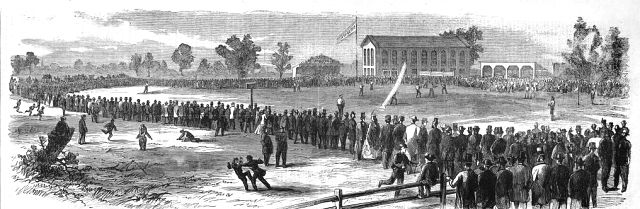
Athletic of Philadelphia versus Atlantic of Brooklyn, in Philadelphia October 30, 1865--"a violent and widespread mania."

Athletic of Philadelphia versus Atlantic of Brooklyn, in Philadelphia October 30, 1865–“a violent and widespread mania.”


Odds, 1896

Early in 1896 The New York Sun reported on “an early development of interest.”  A local bookmaker had issued odds on the 1896 National League race:

“He lays odds of 3 to 1 against Baltimore finishing first; 7 to 2 against Cleveland and Boston;  4 to 1 Philadelphia and New York; 7 to 1 Chicago; 8 to 1 Brooklyn and Pittsburgh; 15 to 1 Cincinnati; 40 to 1 Louisville; 100 to 1 Washington, while (Christian Friedrich “Chris”) von der Ahe’s outfit (St. Louis) is the extreme outsider on the list.  Any lover of the German band can wager any amount and “write his own ticket.”

The final standings:

1. Baltimore Orioles

2. Cleveland Spiders

3. Cincinnati Reds

4. Boston Beaneaters

5. Chicago Colts

6. Pittsburgh Pirates

7. New York Giants

8. Philadelphia Phillies

9. Washington Senators

10. Brooklyn Bridegrooms

11. St. Louis Browns

12.  Louisville Colonels

1896 Orioles, 3 to 1 favorites, won the National League Championship.

1896 Orioles, 3 to 1 favorites, won the National League Championship.

Butcher Boy Schmidt

25 Jul

Charles John “Butch” “Butcher Boy” Schmidt was credited by Connie Mack with being the catalyst for the Boston Braves World Series upset of Mack’s Philadelphia Athletics in 1914; one year later Schmidt walked away from baseball in his prime.
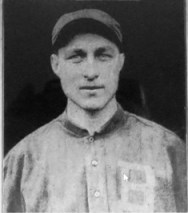
Butch Schmidt

Butch Schmidt

He was born in Baltimore in 1886, and played amateur ball while working in the family meat market, which earned him his nickname.

Schmidt signed as a pitcher with the Baltimore Orioles  in the Eastern League and assigned to the Holyoke Papermakers in the Connecticut State League, where he posted a 10-9 record.  In late August the Orioles recalled him, and he went 5-1 in 11 games with Baltimore.

The New York Highlanders drafted Schmidt and the 22-year-old pitcher started the 1909 season in New York.  He appeared in only one game, on May 11, giving up 10 hits and eight runs, four earned, in five innings.  Early in June he was returned to the Orioles.

After appearing in eight games on the mound with the Orioles, Schmidt was moved to first base.  After hitting .244 for the remainder of ’09, he hit .292, .291, and .274 the next three seasons, and was sold to the Rochester Hustlers in the International League, where he hit .321; he was purchased by the Boston Braves on August 22, and hit .308 in 22 games playing in place of Ralph “Hap” Myers.

At the end of the 1913 season Boston sold Myers’ contract to Rochester; The Boston Post reported that Braves manager George Stallings simply didn’t like Myers.  (Myers had a different theory for his release—that story next week)

Schmidt was installed as the Braves first baseman in 1914, and as Boston made their improbable run to the National league pennant Schmidt   hit .285 with 71 RBI and .990 fielding percentage, and finished 16th in the voting for the Chalmers Award, for the most valuable player in the National League; teammates Johnny Evers and Rabbit Maranville finished first and second in the voting.

Grantland Rice said in The New York Tribune:

“There are few greater first basemen in baseball and none who is steadier or a better fighter.  For Schmidt is also of the aggressive type and a hustler every second.”

The New York Times didn’t think quite as highly of Schmidt and on the eve of the World Series said the “advantage favors the Athletics” at first base:

(John “Stuffy”) McInnis makes exceptionally brilliant plays…has been through Worlds Series fire and proved just as cool as if he were playing an exhibition game in the springtime.  Schmidt has yet to face the strain and tension of the big baseball classic…While Schmidt is not a scientific batsman, he is a free swinger and hits the ball hard, but he doesn’t hit it often.”

The pressure of the series didn’t seem to bother Schmidt, the Braves first baseman hit .294 with five hits, two runs and two RBIs in the four game sweep of the Athletics; McInnis hit just .143.

In game one he made a play in the first inning that Connie Mack said set the tone for the series and “sparked the Braves.”  With runners on first and second with one out, Athletics third baseman Frank “Home Run” Baker hit a foul pop-up into short right field.  Athletics outfielder Eddie Murphy tagged up and attempted to go to third; The Associated Press said Schmidt made a “great throw…from a difficult angle,” to third baseman Charlie Deal to retire Murphy.
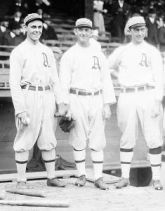
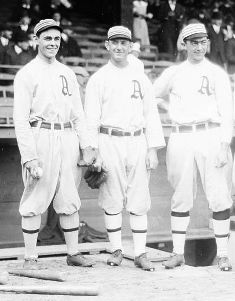
Stuffy McInnis, Eddie Murphy and "Home Run" Baker,

Stuffy McInnis, Eddie Murphy and “Home Run” Baker,

Early in the 1915 season Braves manager George Stallings called Schmidt “The best first baseman in the game,” but his performance at the plate slipped.  Schmidt hit just .251 with 60 RBIs.  The Braves again found themselves in 8th place in July, and while they made another strong run, finished 2nd, seven games behind the Philadelphia Phillies.

Despite the mediocre season at the plate, it was assumed the 28-year-old Schmidt would remain the Braves first baseman.  Schmidt shocked Stallings, Boston fans, and all of baseball when he announced in January of 1916 that he was retiring from baseball.
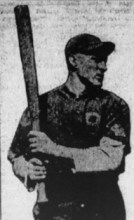
Butch Schmidt at bat

Butch Schmidt at bat

The Associated Press said Schmidt was leaving “to devote his entire time to his private business.”

Grantland Rice said Schmidt’s business included “six meat markets in Baltimore,” and that he earned $8000 a year from his stores.

The Sporting Life said it was just as likely that Schmidt, listed at 200 pounds, retired because:

Hard work in that old rubber shirt to get down to weight, especially when the extra weight comes off slowly, more slowly each succeeding season, is a trial that anyone would like to sidestep if he could. “

Boston manager George Stallings filled the void left by Schmidt by purchasing Ed Konetchy from the Pittsburgh Rebels from the newly defunct Federal League.

The Boston Post said the change at first base would not hurt the Braves:

“Konetchy, a heavier hitter than Schmidt, is just about as capable in other ways.”

Despite the confidence of The Post, Stallings was not convinced and continued to try to induce Schmidt to return; his efforts were unsuccessful.

After Konetchy hit .260 for the third place Braves in 1916 it was reported that Schmidt would return to the team.  After several weeks of speculation, Schmidt told The Boston Globe “no offer” could induce him to return to Boston.

Konetchy hit .272 and .236 the next two seasons, and each off season it was rumored Schmidt would return, and every year he stayed home where he continued to run his business and play semi-pro ball in Baltimore’s Inter-City League.

Before the 1919 season Konetchy was traded to the Brooklyn Robins and the Braves acquired Walter Holke from the Cincinnati Reds.  Holke hit .292 for the Braves in 1919, but rumors continued that Schmidt, out of organized baseball for four years, would be returning to Boston.  The Associated Press said:

“George Stallings of the Boston Braves is trying to get Charlie “Butch” Schmidt, the Baltimore butcher boy who played first base for the world’s champions of 1914, to return to the Boston Braves.  Schmidt is reported to be in wonderful condition as he has kept in practice since his retirement.”

Schmidt never returned to professional ball, and was finally removed from Boston’s reserve list in 1922.

Butch Schmidt walked away from professional baseball and never looked back; he died in 1952 of a heart attack while inspecting cattle at the Baltimore Union Stock Yards.

“Is the Best the Game has Known”

23 Jul

Joining the Boston Braves for the 1914 season provided second baseman Johnny Evers with the opportunity to appear in one more World Series, and gave him the chance to take a very public swipe at one of his most famous former teammates, shortstop Joe Tinker.

In December of 1912 the Chicago Cubs traded Tinker to the Cincinnati Reds, and depending on which version of the story was to believed, Tinker and Evers had not spoken a word to one another for either five or six years.

Johnny Evers

Johnny Evers

Tinker said the two stopped talking in 1908 after Evers jumped in a horse-drawn cab leaving Tinker and other teammates behind before an exhibition game in Indiana leading to an on-field fight between the two later that day; Evers said a year earlier Tinker initiated the bad blood between the two by throwing a ball so hard to the second baseman on a force play that it injured his finger.

Evers said years later:

“I yelled to him, you so-and-so. He laughed. That’s the last word we had for-well, I just don’t know how long.”

The 1914 Braves got off to a horrible 4-18 start, and were still in eighth place on July 18, but surged to second place by August 10, winning 18 of 21 games.  By September 2 the Braves had first place to themselves, and ended up running away with the pennant, beating the second place New York Giants by 10 ½ games, and sweeping Connie Mack’s Philadelphia Athletics in the World Series.

Evers, named Boston’s captain by manager George Stallings, led National League second basemen in fielding; hit .279 for the season, and .438 in the World Series.  Evers received baseball’s last “Chalmers Award,” a forerunner of the Most Valuable Player Award, which was presented from 1911-1914.  The award was sponsored by the Chalmers Motor Car Company and was presented to Evers along with a new car.

The runner-up for the Chalmers Award was Evers’ teammate, shortstop Walter James Vincent “Rabbit” Maranville.  Maranville, Evers and first baseman Charles “Butch” Schmidt were an excellent double-play combination throughout the season; Evers participated in a career-high 73 twin killings, more than he’s ever turned in a season with Tinker and Frank Chance.

Years later Maranville said of Evers:

“It was just Death Valley, whoever hit a ball down our way.  Evers with his brains taught me more baseball than I ever dreamed about.  He was psychic.  He could sense where a player was going to hit if the pitcher threw the ball where he was supposed to.”

Two days after the Braves won the World Series; Evers took the opportunity to take a swipe at his former teammate Tinker.  Evers told William Peet, sportswriter for The Boston Post that:

“(Maranville’s) the best shortstop the game has ever known.

“Better than Joe Tinker; your old side partner?

“Yes, he’s better than Tinker.”

Joe Tinker

Joe Tinker

Peet sad:

“Evers has been given credit for making Maranville the great player he has shown himself to be this season, but Johnny declares this s untrue, stating that Maranville learned the game and all its fine points unaided.”

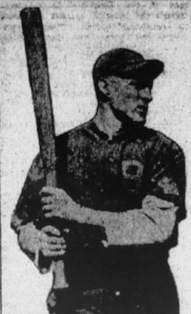
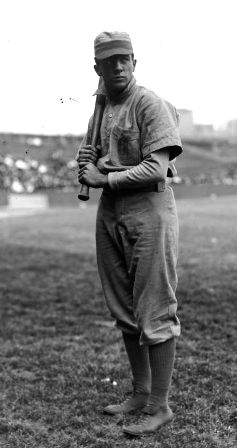
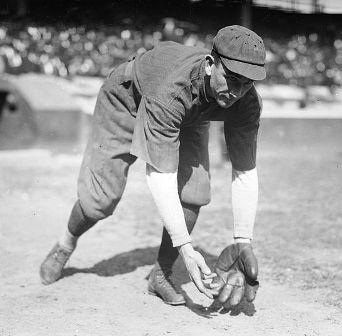
Peet said Evers’ claim that Maranville “is a greater shortstop than Tinker is about the highest praise anyone can shower on the peppery little chap who was such a prominent factor n the Braves’ victory.”

Rabbit Maranville

Rabbit Maranville

Evers and Peet failed to mention where Honus Wagner would be ranked if Maranville was, in fact, “the best shortstop the game has ever known.”

No response from Tinker was recorded.

Evers and Tinker would not speak again for another decade.  In 1924, the two finally spoke when they were summoned to California by Chance, their former teammate and manager, who was dying.

Tinker, Evers and Chance

Tinker, Evers and Chance

Tinker, Evers and Chance were inducted into the Hall of Fame together in 1946 by the veterans committee; Maranville was elected by the Baseball Writers Association of America in 1954.

“Baseball by Electricity”

11 Jul

In 1886, The Electrical Review told the story of the first attempts at “reproducing almost instantly a vivid view of the exact situations and plays in a game of baseball.”

The original plan was hatched by three telegraph operators in Nashville, Tennessee who “turned their enthusiasm for baseball to good account.”   J. U Rust, E.W. Morgan, and A.H Stewart made the first attempt to transmit a game between Chattanooga and Nashville in 1884:

“To do this they leased a wire from Nashville to Chattanooga, one end of which was on the ball field, with an expert operator, who was accurately informed in baseball playing, seated watching the game and immediately telegraphing each play as it progressed.  At the Nashville end of the wire were two other telegraphic and baseball experts.  As they received the record from their partner, one man reproduced it verbally to the audience, while the other man manipulated cards bearing the names of the players, around a painted view of the ball field which was placed in full view of the audience.”

The following season Southern League games were transmitted to opera houses in several of the league cities by Morgan & Co. “the ingenious firm” created by the three telegraph operators.

On July 9, 1886 Morgan & Co. transmitted the game between the Detroit Wolverines and the Chicago White Stockings from Chicago’s West Side Park to the Detroit Opera House. The “unique entertainment before a crowd of 600 persons,” was described by The Electrical Review:

“On the stage was a huge landscape—it would have done well as a drop curtain—having a well-painted perspective view of a baseball diamond and outfield.  At the points on the picture representing the positions of batsman, pitcher catcher and basemen, are openings into which may be shoved cards bearing the names of the players, and into which these names are placed as the telegraph operator seated at his instrument reads to the audience the progress of the game, even to the smallest details.”

The crowd at the Opera House “was wrought up to a very high pitch of enthusiasm.  For instance, when the operator read—with (Abner) Dalrymple’s name appearing as batsman—“foul fly to left,” the audience fairly held its breath, and when the next instant the operator called out, ‘and out to (James “Deacon”) White,’ there came a storm of applause, just such as heard on a veritable ball field…the excitement was intense.”

The Chicago White Stockings defeated the Detroit Wolverines 8-2 on July 9, on there way to the 1886 National League championship

The Chicago White Stockings defeated the Detroit Wolverines 8-2 on July 9, on their way to the 1886 National League championship

By the end of the 1886 season, games were presented in opera houses in Chicago, Boston, New York and Cincinnati.  By the end of the decade the practice would become commonplace in all big league cities.

By the mid 1890s the system for presenting games to the public had become much more advanced.

The Baltimore Morning Herald said in September of 1894:

“The ball game today between the Baltimore (Orioles) and Louisville (Colonels) clubs will be given as usual from the stage at Ford’s Grand Opera House at 4 o’clock by electricity.  The system utilized for the first game in the city is ‘The Compton Electric Baseball Game Impersonator.’   It has been used in New York and elsewhere with unbounded success.  It is a contrivance so ingenious that the slightest move of the players is visible, and the anxiety and interest of those present is just as great as though they had been occupying the grandstand.  Every strike is recorded and illustrated, and, whether at the bat, running the bases or in the field, all the players are known and watched…a visible reproduction of the game is given to the minutest detail.”

By the end of that season the Compton system was used to transmit games to fans in New York, Chicago, Philadelphia and Washington, and it, and numerous systems developed by competitors would become commonplace over the next four decades.

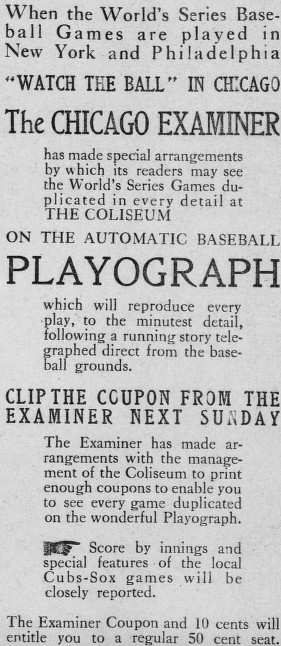
The Chicago Examiner sponsored the "automatic Baseball Playograph" exhibition of the 1913 World Series between the New York Giants and Philadelphia Athletics.

The Chicago Examiner sponsored the “automatic Baseball Playograph” exhibition of the 1913 World Series between the New York Giants and Philadelphia Athletics.

Usually sponsored by local newspapers, the exhibitions were an especially popular method for following the World Series in real-time.   It was not until 1938 (when the New York Yankees, New York Giants, and Brooklyn Dodgers became the last teams to have their games broadcast on radio) that the technological descendants of Morgan & Co. became completely obsolete.

Baseball’s “Growing Evil”

24 Jun

By 1913 newspaper articles under the byline of a famous player were common in newspapers across the country, and most of the game’s biggest stars were represented.

Most fans of that era assumed the players did their own writing until an expose appeared in The Washington Herald in March of 1913.  Sports Editor William Peet wrote:

“The dear old public fell for this stuff and swallowed hook, bait and sinker.  An article under the signature of Christy Mathewson led three-fourths of the fans to believe that the great pitcher himself wrote it.”

According to Peet, players were paid between $250 and $1000 for each story “and not one of them wrote a single word,” but it was still a good investment:

“The newspapers themselves regarded these feature articles as good investments, for the reason that the stories were syndicated to 25 or more outside publications and the revenues derived not only paid the amount guaranteed the baseball player for the use of his name, but left a handsome profit.”

Peet exposed the writers behind the articles “written” by the game’s biggest stars:

Christy Mathewson and Jeff Tesreau/John Wheeler, The New York Herald

Walter Johnson/Ralph MacMillan, The Boston Journal/The Boston Herald

John McGraw/Walter Turnbull, The New York Evening Sun

John “Chief” Meyers/Jim McBeth, The New York American

Richard “Rube” Marquard/Bill Farnsworth, The Atlanta Georgian/Hearst Newspapers

Denton “Cy” Young/Sam Carrick, The Boston Post

Tris Speaker/Tim Murnane, The Boston Globe

“Smokey” Joe Wood/Jim O’Leary, The Boston Globe

Ty Cobb/Roger Tidden, The New York World

Hughie Jennings/George “Stoney” McLinn, The Philadelphia Press

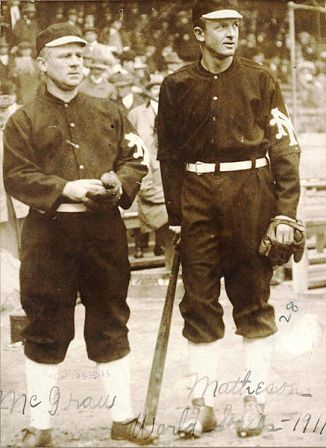
John McGraw and Christy Mathewson

John McGraw and Christy Mathewson

Peet called the practice dishonest, and said it had gone too far, and in New York and Boston the practice   had “become a mania.”  Peet singled out an article “written” by John McGraw criticizing “Chief” Myers that caused an “explosion,” and said the articles featuring “Rube” Marquard’s byline, and written by Farnsworth got Marquard “in bad with his teammates, for Farnsworth spared no one is his scathing criticisms.”

Pittsburgh Pirate manager Fred Clarke disagreed with the practice, telling Peet:

“I do not think it is any ball player’s place to butt into the newspaper end of the game…I think it is foolish for any player, especially those who take part in the world’s Series, to write about the games.”

As a result of Peet’s revelations the American League club owners condemned the practice of players’ names appearing on articles they did not write, but came just short of officially banning the practice. In September, the Baseball Writers Association petitioned the National Commission to end the “growing evil” of players authoring or appearing to author articles during the upcoming World Series.

The commission agreed, and American League President Ban Johnson informed Philadelphia Athletics manager Connie Mack on the eve of the World Series that star players Eddie Collins and Frank Baker “have been instructed not to write baseball stories or give the impression they are writing them.  If they ignore this request, a way of punishing them would be found. “

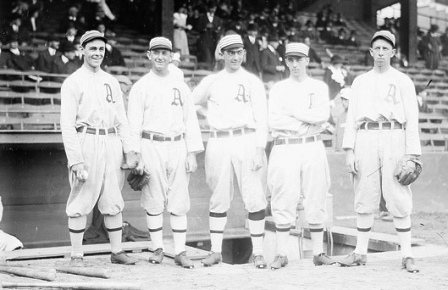
Frank Baker, center, Eddie Collins, far right,

Frank Baker, center, Eddie Collins, far right,

Johnson even threatened “Collins and Baker would not be permitted to take part in the World Series,” if they wrote articles or permitted their names to be attached to articles.

At one point Johnson and National Commission Chairman August Hermann said they would consider calling off the series if players refused to comply.  Dave Fultz, the former player, practicing attorney, and president of the Fraternity of Baseball Players, said members of the commission could be personally liable for damages if the series was cancelled.  Johnson and Herman’s threat to cancel the series as a whole was put to rest.

Mack argued that the players had contracts with newspapers and that Johnson had said earlier that players who were “capable” of writing their own articles would be permitted to do so, but as he prepared his team to play the New York Giants, he prepared for the worst, telling The Associated Press:

“(I)f the commission decides the players must not write under any conditions and players decide not to abide by the ruling, I will be prepared to put a team on the field,” The AP speculated that utility infielder John “Doc” Lavan  would play second base  and outfielder Rube Oldring would be moved to third base, with Amos Strunk taking Oldring’s place in the outfield.

Mack’s adjustments weren’t required.  Collins was allowed to write for The Philadelphia Record because his deal with the paper predated the commission’s ruling, and Baker did not write articles.  Together they led the Athletics to a 4-1 Series win, hitting .421 and .450.

Ghost written articles, and articles actually written by players never disappeared, but the practice became much less popular after the revelations and battles of 1913.

“Atlanta’s Baseball Bullies”

17 Jun

During the 1885 season, Lewis Henke of the Southern League’s Atlanta Atlantas was killed during a game; the death was attributed to on-field rowdyism by the Southern press who hoped the death of the popular player would help end brawling behavior in the league.

In January of 1886, the Atlantas hired a new manager, William Aloysius “Blondie” “Billy” Purcell.   Purcell had split the 1885 season between the Philadelphia Athletics in the American Association and the Boston Beaneaters in the National League, hitting .279 in 87 games.  The Sporting Life said:

 “Billy will make a good manager, and is capable of securing a team—even at this late date—to win the championship. “

William "Blondie" Purcell

William “Blondie” Purcell

Purcell came to Atlanta with an excellent reputation, The Philadelphia Inquirer described him as being “Of a genial, happy disposition,” who was very popular when playing for the Athletics, and in 1883 and ’84 as a member of the Quakers.

That changed quickly, just two weeks into the season The Macon Telegraph said under the headline “An Alleged Conspiracy against Purcell,” that the new manager had incurred the wrath of his players by “ruling the team with an iron hand.”

After the rough start, the team appears to have turned their wrath towards their opponents and became the most hated team in the league.

Over the course of the next four months, Southern papers chronicled the bad behavior of the Atlanta squad.

It started with a game against the Charleston Seagulls when Purcell was accused of cheating, The Charleston News and Courier said:

“Manager Purcell was playing in the left field and the Charleston team was at the bat.  During the inning one of the Charleston team batted a ball to left field.  It went over the fielder’s head and, after striking the fence, rebounded and then went into the ditch.  The fielder started for it, but after running only a short distance took a ball from his shirt pocket and through it to the diamond.  The remarkable rapidity with which the ball was fielded was loudly applauded at the time…The fielder subsequently went to the ditch, picked up the ball and tossed it in the diamond…The incident was witnessed by several people, and the statement can be substantiated if the proof is demanded.”

Cheating turned to “bullying” as the season progressed.

The Savannah Times dubbed the team “Purcell’s Plug-Uglies,” and said of them after a July game:

“From the start of the game yesterday the Atlantas began their rowdyism, (Tom) Lynch was running to first in the first inning, the ball got there just ahead of him, Lynch deliberately struck (Jim) Field with his fist…from then on the whole team began to kick and try to hack the umpire.  In this Purcell was ably assisted by (John “Monk”) Cline and (John “Cub”) Stricker, two of the rowdiest  ball players that have been seen on our field…The conduct of the Atlanta club was most reprehensible, and has placed them in an exceedingly unenviable light.”

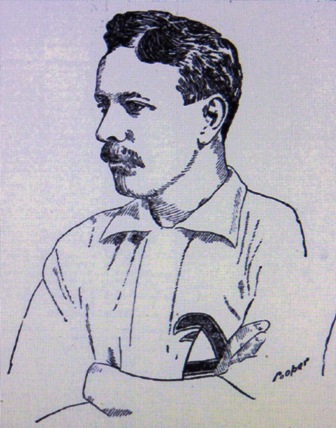
Tom Lynch, one of Atlanta's bullies

Tom Lynch, one of Atlanta’s bullies

Earlier that month after a couple of close wins over the Seagulls, The News and Courier again criticized the Atlantas saying the team “ought to be kicked out of the league,” and said:

“(T)here was an immense crowd present to witness the game, but their afternoon’s pleasure was completely spoiled by the disgusting behavior of the visitors, whose kicking and sharp practices are sufficient to drive any respectable audience from a ball field.”

After another game in Charleston, The News and Courier said Purcell’s team used “blasphemous and obscene language,” and:

“Those who attended the game this afternoon are outspoken in their condemnation of the disgraceful behavior of the Atlanta team, and declare that either they should not be allowed to continue in the league, or that they should be made to behave themselves at least decently in the presence of the communities where they have to play.”

The Macon Telegraph called the team “Atlanta’s Baseball Bullies,” and said after a game in which Purcell was fined $10 “for his ungentlemanly remarks,” that Atlanta played “good ball,” but that it was “marred” by their conduct.  The paper also said:

“The Atlanta team is evidently akin to the bulldozing idea.  The bullies and braggarts who compose the team have evidently been taught that an umpire is a very insignificant personage and to be influenced by blackguardism.”

Similar charges of “rowdyism” and “bullying” were made throughout the season.

The Atlanta Constitution saw nothing wrong with the team and blamed the criticisms from the papers in other Southern Association on “jealousy” over the team’s success.

With Atlanta holding on to a small lead for the league championship, the most serious charges would wait until the final weeks of the season, and include two of Atlanta’s most prominent citizens …tomorrow.