Tag Archives: Pittsburgh Pirates

“I mentioned Satchel and Josh and Cool Papa, I told Him he was Missing the boat”

18 May

After Heywood Broun’s remarks at the 1933 Baseball Writers Association dinner about integrating the game, The Pittsburgh Courier initiated a campaign to push the issue.  Despite some support inside baseball and from well-known newspapermen, the effort fell flat by opening day.

That summer, after the first East-West Game—won by the West All-Stars 11 to 7—at Comiskey Park, Henry L. Farrell of The Chicago Daily News suggested several “(M)ajor league club owners who are now on their knees might have their prayers answered,” by signing some the Negro League stars.

In the fall, The Chicago Defender briefly picked up the mantle from The Courier.  The paper asked their readers:

“How would you like to see the great baseball players of the Race performing in the major leagues? Wouldn’t you like to see Willie Foster, Satchel Paige and (Sam) Streeter pitch to Babe Ruth?”

If so:

“Sit down and write K.M. Landis commissioner of baseball, 333 N. Michigan Ave., Chicago.”

The following week, the paper reported that Landis’ office had refused to comment.  When baseball’s winter meetings commenced in Chicago in December, The Defender promised readers that the letters they had sent:

“(A)re not being passed on lightly as many suggested would be the case.  On the contrary, the club owners are downright concerned and from the inside word leaked out that some action would be taken.”

The optimism was tempered later that week when their reporter was barred from covering a meeting where he was told “vital points were discussed.”  The Defender reporter was told no newspapermen would be admitted, but:

“That sinister moves were being made against your author’s admission became a certainty when a well-known writer from one of the downtown papers came along, gave the high sign and was admitted.”

When 1933 came to a close, integration was no closer to being a reality than it was 11 months earlier as Broun stood to deliver his remarks to the baseball writers.

Four years later, Sam Lacy from The Baltimore Afro-American met with Washington Senators owner Clark Griffith in an attempt to revive the subject:

“I mentioned Satchel and Josh and Cool Papa, I told him he was missing the boat.”

Sam Lacy
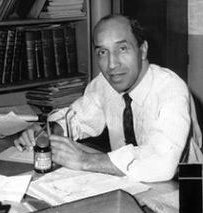
Sam Lacy

Griffith, he said, told him the timing was wrong, and that Southern-born players would not accept integration.

The next major effort came in 1939.

Political support had generally been limited to socialist and communist organizations—the Young Communist League spent the summer of ’39 gathering signatures to present to Commissioner Landis.  But, in July of that year, the Illinois House of Representatives adopted a resolution which read in part:

“Resolved, by the House of Representatives of the Sixty-first General Assembly.  That the owners of all professional baseball teams in the United States, both in the major and minor leagues be strongly urged to give baseball players of the colored race the same opportunity of becoming players on their respective teams as is accorded to such players of the white race.”

Another push came from Pittsburgh as well.

Wendell Smith, who was playing baseball at West Virginia State College when Broun made his speech in 1933, was now a reporter for The Courier. In July, he promised readers:

“The most exclusive, startling and revealing expose, of the attitude of the major league players and managers themselves, ever written.”

Wendell Smith
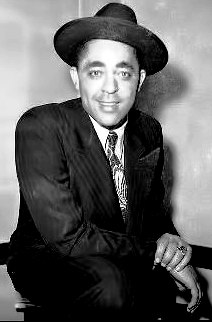
Wendell Smith

Over the course of several weeks Smith asked 40 players and eight managers as they passed through Pittsburgh, “Are Negro ballplayers good enough to ‘crash’ the majors?”

The Courier’s Chester Washington said in a column to introduce the series of articles:

“One of the major reasons why Mr. Smith’s discovery is so revolutionary is that the club owners, in trying to pass the buck, have blamed the ban on the players themselves.  They claimed that the injection of colored stars into the clubs would bring about friction and dissention… (Smith) practically disproves this contention.

“Fearlessly buttonholing the managers and outstanding players of all the National League clubs, Mr. Smith received scores of testimonials which should be a revelation to the owners.”

A sampling of the statements collected by Smith:

Ernie Lombardi, Cincinnati Reds:  “(Satchel) Paige is as good as (Dizzy) Dean.”

Johnny Vander Meer, Cincinnati Reds:  “I wouldn’t object.”

James “Doc” Prothro, Philadelphia Phillies: “If given permission I would jump at the opportunity to sign up a good Negro ballplayer.”

Leo Durocher, Brooklyn Dodgers:  “(Satchel) Paige, (Bill “Cy”) Perkins, (Mule) Suttles and (Josh) Gibson are good enough to be in the majors right now…I certainly would use a Negro ballplayer if the bosses said it was all right.”

Gabby Hartnett, Chicago Cubs:  “I am sure that if we were given permission to use them, there would be a mad scramble between managers to sign them.”

Gabby Hartnett

Gabby Hartnett

Dizzy Dean, Chicago Cubs: “If some of the colored players I’ve played against were given a chance to play in the majors they’d be stars as soon as they joined up.”

Pepper Martin, St. Louis Cardinals: “Some of the big league players would object, but on the whole I think they would be accepted.”

Pie Traynor, Pittsburgh Pirates: “believe me when I say I have seen countless numbers of Negro ball players who could have made the grade in the majors.  Only their color kept them out.  If given permission, I would certainly use a Negro player who had the ability.”

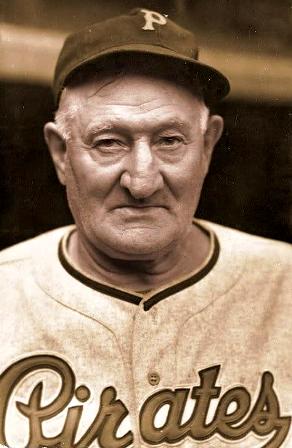
Honus Wagner, Pittsburgh Pirates:  “Yes, down through the years I have seen any number of Negro players who should have been in big league baseball.”

Over the next five years, Smith would interview more than 150 additional major leaguers, who would echo the sentiments of his original 40, keeping the pressure on professional baseball to desegregate.
“The Game is Stricter and Better now”

8 May

Honus Wagner was an exception.  Unlike most of his contemporaries, he didn’t spend his later years complaining that the game was just not the same and that current players would not be able to compete with the stars of his era.

Financially strapped as a result of the Depression, Wagner was offered a job by the Pittsburgh Pirates to join Manager George Gibson’s staff.   While in California with the team for spring training he spoke to Russell Newland of The Associated Press.   Wagner said:

“We’ve got more good players than we ever had.  That’s because there are more strong leagues.  The game is stricter and better now.  You can’t bully the umpire any more.  The boys used to be a rough and ready lot.  Now the umpire is a real authority and it’s all for the best.”

Wagner

Pirates Coach Honus Wagner

Wagner also felt that pitchers had to work harder than they did when he played:

“Our pitchers had the advantage of a dead ball and used the spitter, the shine ball and the emery ball.  They worked the old bean ball overtime.  All that’s out now.  Nowadays a pitcher has to throw a lot more balls.  He has to work the corners because that lively ball sure sails when the boys get one in the groove.  Actually he pitches a couple of games in nine innings, compared to the chuckers of my day.”

Wagner had no complaints about the comparatively large money stars like Babe Ruth were paid either:

“That $50,000 they’re offering the Babe reads like a lot of money to me, but if he can get them to raise it, I say ‘more power to him.’”

Wagner was also optimistic about baseball’s future:

“’Baseball is O.K.,’ he said as he crossed the most famous pair of bow legs in the history of the pastimes.  ‘They’ll be playing it a long time from now.”

Lost Advertisements–“Spark plug of Huggins’ Machine”

17 Apr

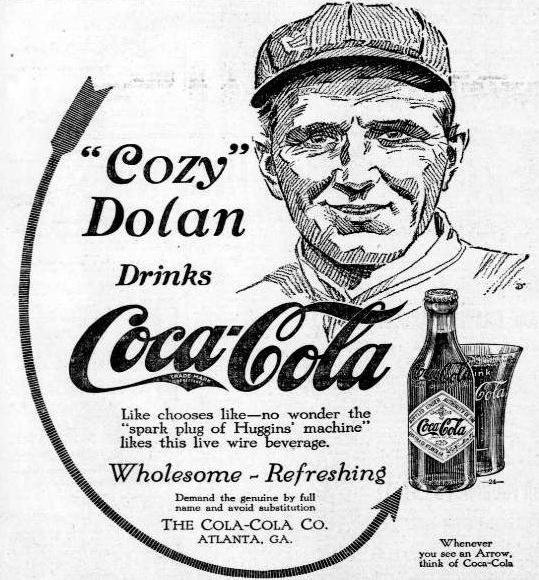
cozydolanA 1915 Coca-Cola ad featuring Albert “Cozy” Dolan of the St. Louis Cardinals.

“Like chooses like–no wonder the ‘spark plug of (Manager Miller) Huggins‘ machine’  likes this live wire beverage.”

Dolan, a 32-year-old utility infielder and outfielder who had never appeared in more than 100 games in a season before 1914, was an unlikely spokesman, given that most Coca-Cola ads of the period featured the game’s biggest stars.

He stole 42 bases for the Cardinals in 1914, but he hit just .240. In 1915, he hit .280 and stole 17 bases in 111 games.

While hardly great numbers, Dolan’s time in St. Louis was a huge success when compared with his disastrous 35-game tenure with the Pittsburgh Pirates.

Dolan was traded to the Pirates by the Philadelphia Phillies for third baseman Bobby Byrne and pitcher Howie Camnitz in August of 1913 and became the team’s starting third baseman but hit .203, had a fielding percentage of .937 and became the target of angry fans.

Cozy Dolan

Cozy Dolan

Richard Guy of The Pittsburgh Post-Gazette described his time with the Pirates:

“He looked bad and he was object of revile by those who criticize, and he failed.”

Joe Kelly of The Pittsburgh Chronicle said:

“No player ever was ridden harder by players and fans than was the former International League speed boy when he performed at Forbes Field.  Perhaps few who held down a berth regularly ever deserved more criticism, for his performances were on the awful order.  But it’s a hard job to make good when hoots and howls follow every poor play, and the few successful ones are greeted with ironical applause.  Dolan got off wrong at Forbes Field and he seemed to be sensitive, too sensitive, to the crowd’s attitude.  There comes to mind a scene last summer when the Pirates were leaving their club house.  They came out in twos and threes, laughing and joking, but among the first was Dolan, all alone.  His face was strained and drawn and worried.  He had failed that day, and he knew it…The fans poured their criticism on his head, and he sat tight and took it without a whimper.  There is something in a guy like that, or the major league managers wouldn’t keep him sticking around.”

Dolan stopped “sticking around” after 1915.  Huggins released his “spark plug” at the end of the season.  He returned to the minor leagues, playing three seasons in the American Association, then became a coach for the New York Giants in 1922.

In 1924, received a lifetime ban from Commissioner Kenesaw Mountain Landis for his role in an attempt to fix a game.


“He Drinks one Glass of Whiskey a day while Training”

8 Apr

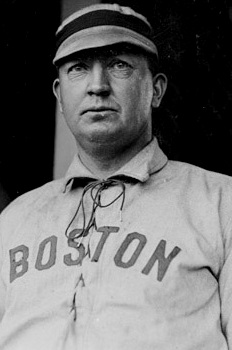
The Associated Press (AP) said in 1912 that 45-year-old Denton True “Cy” Young, “(B)aseball’s most interesting veteran has gone to Augusta, Georgia, to join his teammates of the Boston Nationals at their training camp.”

Young had gone to Augusta from Hot Springs, Arkansas, where T he had spent several weeks performing his annual ritual for getting into shape, “He started going there years ago.”

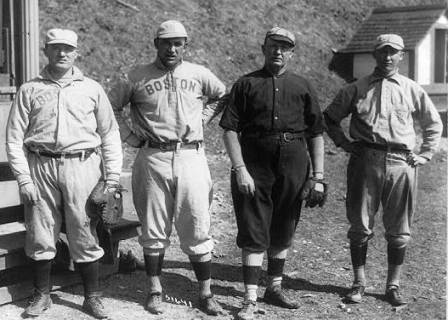
Cy Young, third from left, with Bill Carrigan, Jake Stahl and Fred Anderson at Hot Springs in 1912

Cy Young, third from left, with Bill Carrigan, Jake Stahl, and Fred Anderson at Hot Springs in 1912

Among his secrets: “He drinks one glass of whiskey a day while training.”

Young shared his training regimen with the wire service:

“First week: The regular daily baths at Hot Springs.

“Second week: Baths and road work. He dresses in flannels and sweater and does 10 to 15 miles on the road. He tramps, sprints and climbs hills. He does not touch a baseball.

“Third week: He continues baths and road work. He fields and tosses the ball. He handles bunts to reduce his stomach. At the end of the third week, he pitches his first ball.”

Cy Young

Cy Young

Young said after he began throwing pitches, he had no set rule for when to begin throwing hard:

“Young doesn’t attempt a fastball until he is just right and no one but himself can tell when this will be. He says he doesn’t know how he knows when the moment arrives, but he just naturally begins to speed them across and perhaps to put ‘something on the ball’ at the correct time. The result is you never hear of Cy Young complaining of a sore arm, or wrenched back, as many youngsters do.”

Young, by all accounts, pitched fairly well in games in Georgia and went north with Boston.

But, he never appeared in a game. An April story that said he was retiring to take a baseball writing job at The Boston American proved untrue.

Finally, on May 23, Young was scheduled to pitch against the Pittsburgh Pirates. The AP said:

“The veteran was sent out to warm up to pitch for Boston against the Pirates…but his salary wing refused to behave.”

Young vowed to return to his farm, “and get into shape,” in order to return before the end of the season.

His training regimen finally wasn’t enough. His career was over.

Hearing that Young was returning to his farm, his Boston teammates took up a collection, “to defray Cy’s expenses and $44.39 was raised.” The AP said some of the young players didn’t realize the collection “(W)as a joke…He is worth $75,000 and owns 160 acres of land in Ohio…Cy smiled and spent a good hour hunting up the younger players and returning their money.”

“Why not bring one of the Big League Teams to Phoenix for Spring Training?”

18 Feb

Grover Cleveland Land was a visionary.

In 1921 The Arizona Republican asked the question the former catcher had put to several major league clubs:

“Why not bring one of the big league teams to Phoenix for spring training?”

Land, a Kentucky native who spent the last 40 years of his life as a Phoenix resident,  was encouraged by a report that Connie Mack had announced that his Philadelphia Athletics would no longer train in Lake Charles, Louisiana;  according to The Associated Press Mack said “certain things happened at the Louisiana resort last March that handicapped” the team.

Grover Land

Grover Land

Land, the former catcher for the Cleveland Naps and the Brooklyn Tip-Tops, said:

“I have played ball in every section of the country, and I have yet to find a climate more suited for baseball training than I find right here in Phoenix…Major league managers have been sending their players to Texas and other southern states for many years and I can safely state that there is not one manager entirely satisfied with the present training camp sites.  Fully one-third of the training period is hampered by rain and storms and by the time the training season is ended the players are just beginning to round into shape.”

He said he understood that “local boosters” had made some effort to bring teams to Arizona in the past—the Chicago White Sox, Cubs, and Pittsburgh Pirates had played spring exhibition games in the state several times since 1909—but Land said he would “make an effort to induce one of my manager friends to come down here…I am certain that if one of the managers could be induced to come here for a few weeks Phoenix would have no difficulty getting on the sport pages.”

He said the local chamber of commerce was getting behind the push, and that he had “already written to one of the major league managers and I have been corresponding with several sports writers in the east,’ to make the case for Phoenix.

“If the local fans get behind the move and convince Connie Mack that they want his team here next spring I have every confidence that the Philadelphia Athletics will do their 1922 training in Phoenix.”

Land was a bit overconfident in regard to Philadelphia; Mack chose to take the Athletics to Eagle Pass, Texas in the spring of 1922.

No team would train in Arizona until 1929—the Detroit Tigers came to the state for one season—but chose California the following year.

The Detroit Tigers in Arizona, 1929

The Detroit Tigers in Arizona, 1929

But Land, who died in 1958, lived long enough to see his adopted home become the spring training location for four clubs.

Nick Maddox

9 Feb

Nicholas “Nick” Maddox burst on the National League scene in 1907. Born in Maryland on November 9, 1886, Maddox’ was born Nicholas Duffy, but adopted his stepfather’s name Maddox.

In 1906 the 19-year-old was given a trial in the spring with the providence Grays in the Eastern league.  He was released before the season began and signed with the Cumberland Rooters in the Pennsylvania-Ohio-Maryland League (POM).  Maddox had played in 1905 for the Piedmont team in the semi-pro Cumberland and Georges Creek League.

He was the best pitcher in the POM; The Sporting Life said Maddox was 22-3 for the Rooters who finished the season in fourth place with a 50-45 record, and was “the fastest pitcher in the league.”

Nick Maddox

Nick Maddox

Maddox spent most of 1907 with the Wheeling Stogies of the Central League.  He posted a 13-10 record and no-hit the Terre Haute Hottentots on August 22.  Maddox was purchased by the Pirates the following month and made his big league debut on against the St. Louis Cardinals.

The Cumberland Times noted that he faced a “double-jointed hoodoo of commencing his National League career on Friday, September the 13th.”

The Pittsburgh Press said:

“Nick was ‘on the job’ yesterday from start to finish, and acted more like a man with many years’ major league experience than like a minor leaguer who has been in the business but a few seasons.”

Maddox shut the Cardinals out on just five hits, struck out 11 and got his first hit, a single in his first at bat.

Eight days later Maddox threw the first no-hitter in Pirates’ history, beating the Brooklyn Superbas 2 to 1—Brooklyn scored on two fourth-inning errors.   Years later, Maddox said of his own throwing error that put Emil Batch on base:

 “They scored me with an error, but hell man, I threw it straight to the first baseman (Harry) Swacina.  Sure it went over his head but he should have jumped for it.”

Batch scored on an error by shortstop Honus Wagner.  Maddox said:

“I don’t hold that against Honus, he saved my no-hitter in the ninth.  A ball was hit right over my head and ‘pfft’ Wagner was over there to get it.  I don’t think he ever held the ball, he just swooped it over to first.”

The rookie started six games Pittsburgh, won his first four, and finished with a 5-1 record with a 0.83 ERA.

The Pittsburgh Leader said Pirates’ President Barney Dreyfuss claimed Maddox would be “the sensation” of 1908.  He wasn’t far off.

The 21-year-old was an impressive 23-8 with a 2.28 ERA with five shutouts.  Despite his success there was concern about control—he walked 90 batters while striking out just 70 in 260 innings, and hit 11 batters.

After three second and one third-place finish the four previous seasons, Pittsburgh, and Maddox, came into 1909 with high expectations.  The Pittsburgh Press said:

“Nick Maddox is facing a very successful summer, and with an even break and barring accidents he ought to push any other twirler in the National League for first honors.  He has everything a pitcher needs, and youth with it.”

The Press also said he would “start out with good control” based on his performance in March games in Hot Springs, Arkansas.

The Pirates lived up to expectations, taking over first place on May 5 and cruising to the pennant; Maddox did not.

The 22-year-old struggled for the first half of the season.  The Leader said he was having “a hard time getting into condition,” and was wild as a March Hare.”  Maddox got on track in July pitching a 2-hit shout against the Cincinnati Reds on the 6th, and four-hit shutouts against the Brooklyn Superbas and Boston Doves on the 14th and 23rd.

He ended the season 13-8 with a 2.21 ERA—overshadowed by teammates Howie Camnitz (25-6), Vic Willis (22-11), Albert “Lefty” Leifield (19-8) and rookie Charles “Babe” Adams (13-3 as a reliever and spot starter).

Babe Adams

Babe Adams

Despite going into the World Series against the Detroit Tigers with such a strong pitching staff, Manager Fred Clarke opted for the rookie Adams in game one and he responded with a 4 to 1 victory.

The Tigers beat Camnitz 7 to 2 in game 2.

Three years later, Fred Clarke spoke to James Jerpe of The Pittsburgh Gazette-Times about his decision on a pitcher for game three:

“I was in an awful predicament.  Adams had been used up.  It was had been raining, and it was very cold.  The chilly drizzle was something frightful.  The ball would get wet and water-logged and the problem was to get a pitcher who could handle the wet ball.  I looked the gang over.  Adams was out of the question.  He had been used up.

“I was figuring on the others, and I asked ‘Who can go out there today and handle a wet ball and win?’  Poor Maddox, sitting in a corner of the bench all bundled up with sweaters and other stuff, shed his extra clothes and jumped up.  Grabbing a ball, he said: ‘Gimme a catcher till I warm up.  I’ll handle this wet ball and beat them or break a leg.’  His confidence gave me a hunch, and I acted on it.”

Ring Lardner said of the game:

“Detroit’s record crowd, 18,277, saw the Tigers beaten by the Pirates 8 to 6, today in one of the most exciting and most poorly played world’s series games in baseball history.”

The Pirates scored five runs in the first inning off Detroit’s Ed Summers, and Maddox shut the Tigers down for the first six innings.  Detroit scored four runs in the seventh, aided by two Pirate errors.  Clarke said:

“Maddox wouldn’t have been in so much trouble if we had played ball behind him.”

The Pirates took a 8 to 4 lead into the ninth–Detroit scored two more runs, helped by another error—but Maddox held on and picked up the win.

He did not appear in another game during the series.  The Pirates won in seven; with Adams picking up complete game wins in games five and seven.

09pirates

1909 World Series Champion Pirates, Maddox is ninth from left.


The defending champions got off to a quick start again, but Maddox again started slow.  By July, The Leader said:

“Nick Maddox should have rounded into form..He is big and strong this year, but does not seem able to pitch good ball for nine rounds.”

He never “rounded into form.”  Maddox struggled all season.  He started just seven games, pitched in relief in 13 others, and was 2-3 with 3.40 ERA.

By August, with the Pirates in second place, six games behind the Chicago Cubs, The Pittsburgh Gazette asked “what was the matter?” with Maddox and why the Pirates had not cut him loose.

He made his last appearance on September 12, giving up a run, a hit and walking two batters in two innings of relief during a 4-0 loss to the Reds.  He was sold to the Kansas City Blues in the American Association 10 days later.

Maddox won 22 games for the Blues the following season, but continued to be plagued by wildness and arm trouble.  His major league career was over, and he was finished professionally in July of 1914 at 27-years-old when he was released as manager and pitcher for the Wichita club in the Western League after posting a 3-13 record.

Fred Clarke was convinced Maddox’ career really came to an end on that rainy day in Detroit.  James Jerpe of The Pittsburgh Gazette-Times said that in 1910 Dreyfuss asked Clarke to release Maddox long before he sold the pitcher to Kansas City:

“’Why don’t you let Maddox go? You aren’t pitching him.’

“’No,’ replied the Pirate Chief sadly.  “I’m not pitching him.  He ruined his arm helping Adams win the world’s series.’

“And Fred narrated (to Dreyfuss) more of Nick’s gameness on that bleak and drizzly October day in Detroit when he gave his arm for a championship.  Nick was carried for a whole year and the club has been interested in his welfare ever since.”

Fred Clarke

Fred Clarke

Maddox, who lived in Pittsburgh, and worked for the Fort Pitt Brewing Company, after his retirement, lived long enough to listen on the radio to the last two innings of the next no-hitter thrown by a Pirate pitcher—Cliff Chambers defeated the Boston Braves 3-0 on May 6, 1951.

Nick Maddox died in 1954 at age 68.

Cecil and Josh

21 Jan

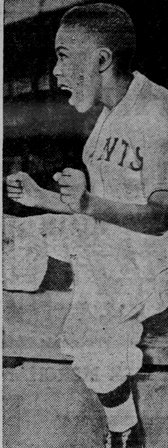
Newspapers across the country saw it as a human interest story about baseball; the Black Press saw it very differently.  With his team in a slump, New York Giants Manager Bill Terry brought in 13-year-old Cecil Terry to “bring the Giants some badly needed luck.”

Cecil Haley

Cecil Haley

The Associated Press said of Haley’s first day on the job:

“Cecil, a Negro mascot, was given a Giant uniform yesterday, allowed to sit in the dugout for the first time and promised a trip West if he’d bring the Giants some badly-needed luck.  The net result of his work?  Pirates 4, Giants 3.”

Very different stories appeared in the Black press.  The Washington Afro-American said:

“(O)rganized big leagues will have colored mascots but steadfastly refuse to accept them as players.  The proud lad sits under the bat rack in the Giants’ dugout, but to date, something must be wrong, because the Giants are hopelessly battling for fifth place.”

The New York Age said:

“Cecil Haley, New York Giants colored mascot, will know better when he grows older and tries to get a job playing for the same team.”

The same day that Haley appeared on the bench with the Giants, New York pitcher Carl Hubbell spoke with The Pittsburgh Courier about Josh Gibson:

“‘(H)e’s one of the greatest backstops in the history of baseball, I think…Boy–how he can throw!’ exclaimed Hubbell.

josh

“There seems to be nothing to it when he throws.  He just whips the ball down to second base like it had a string on it.  He’s great, I’m telling you.  Any team in the big leagues could use him right now.’

“But, with all that,’ said Hubbell, ‘the thing I like best about him is that he’s as fast as greased lightening.  You know, after a few years a catcher usually slows up considerably from bending down so much.  But that guy–why, he’s never slowed down.”

That summer, a new effort was underway to integrate baseball.  A petition drive led by the Young Communist League collected between 25,000 and 100,000 (reports varied) and delivered to National League President Ford Frick,  and Commissioner Kenesaw Mountain Landis at the 1939 winter meeting in Cincinnati.

The Afro-American said Frick “avoided the issue by declaring that a ‘social problem’ was involved for which the big leagues were not responsible.”

There is no public record of the commissioner’s response.

Josh Gibson, with two-time Communist Vice-Presidential Candidate James W. Ford looking on, signs the 1939 petition to end racial discrimination in professional baseball.

I published a shorter version of this post on August 27, 2012.

“I guess I am Rotten”

24 Nov

It was in doubt where Pete “The Gladiator” Browning would play in 1892.

There is no record of exactly how he parted ways with the Cincinnati Reds—Released by the Pittsburgh Pirates, Browning hit .343 for the Reds in 55 games in 1891 after signing with the club on June 29—but, by January of 1892 there were a steady stream of rumors about where he would sign.

Pete Browning

Pete Browning

Speculation included the Baltimore Orioles and St. Louis Browns, but Browning opted to return home to Louisville, and signed with the Colonels—he was released again after an early spring salary dispute, but signed a new contract with the team a week into the season.

Browning returned Louisville with much fanfare.  The Courier-Journal said, after he contributed two singles and two sacrifice hits in a 7 to 2 victory over the Chicago Colts:

“Prodigal Pete…walked out—‘Prods’ do not return in carriages—to his old home in left field at Eclipse Park yesterday afternoon, where he had spent a happy, happy youth before the false adulation of the outer world called the Gladiator away.”

After am 11-3 start, the Colonels were returning to form, and were beginning to look like the ninth place team with a 63-89 record they would be at season’s end.

To make matters worse, “Prodigal Pete” struggled after his first game, hitting just .247—94 points less than his career average—in 21 games.

Browning explained his sump to Harry Weldon of The Cincinnati Enquirer:

“’I guess I am rotten. I guess I ought to be out of the business,’ said Pietro Gladiator Browning, as he walked on the field.  ‘Old Gladdy ain’t to his speed yet, but he’s hitting ‘em, and hitting ‘em good, but not as good as he will hit ‘em though, cause he’s got the catarrh, and is stopped up in the head.  When you’re stopped up your ‘lamps’ ain’t right.  Wait until the sun gets hot and the catarrh leaves the old hoss.  Then the pitchers will have to look out.  Will I lead the league in hitting?  Why not?  Look out for me.  None of ‘em are getting away from me in the outfield.  Did you read about me going up in the seats and pulling down a fly that saved the game?  I can do it right along.  None of them big stars, Jim) McAleer, Curt Welch or any of the rest of them fellows have the best of old Pete on fly balls.  The old boy is still ready money, and worth one hundred cents on the dollar.”

Within days the Colonels gave up on the Gladiator and handed him his release on May 18.

For a time Browning got his “lamps’ right again.  After signing with the Reds again, he hit .303 the rest of 1892.  He returned to Louisville in 1893 and hit .355 in part-time role.

“Is Napoleon Lajoie a Hoodoo?”

14 Nov

Napoleon Lajoie had his share of superstitions and sought to avoid “Hoodoo,” like most players of his era.  But, as Lajoie was winding down his long career, hitting un-Lajoie like .246 for a horrible Philadelphia Athletics team (36-117) in 1916, The Philadelphia Bulletin presented a case that Lajoie himself was the problem:

“Is Napoleon Lajoie a hoodoo?

Napoleon Lajoie

Napoleon Lajoie

“Several baseball managers and ‘Larry’ himself would like to know the answer.  And here is why:

“Lajoie, for many years recognized as the king of second basemen and dubbed ‘King Larry,’ now has visions of the waning of his baseball star of fame, and he has never played on a pennant-winning team…For years he hit well over the .300 mark—once over .400—was one of the most dangerous men to pitch to in a pinch, and fielded his position around second base in a finished, manner—so finished in fact, that he won the distinction of being the classiest second-sacker in baseball.  Every move of the big Frenchman was grace personified.

“Notwithstanding the fact that he was a star of the first magnitude, ranking with Hans Wagner of Pittsburgh—and they are the two real stars of baseball of former years—he never was able to help his team to the pennant.  So, when Lajoie was sold to Connie Mack dopesters and Larry himself thought he eventually would get into a World Series.  But alas!

“Larry joined the Athletics in the spring of 1915, and while his admirers were expecting him to get back his batting eye, which had apparently been dimmed while he was in Cleveland, Connie Mack decided to tear down his wonderful machine.  (Eddie) Collins, (Ed) Plank, (Charles “Chief”) Bender, (Jack) Coombs, and (Jack) Barry were sold (or released), while (Frank) Baker played bush league ball because Connie would not meet his salary demands, and the famous $100,000 infield of the Athletics was wrecked and the run making machine of the world champions was put out of commission.  And the hopes of Larry and his enthusiastic followers went glimmering.  He is on a tail-end team, just like he was at Cleveland.

“And worst of all from Lajoie’s point of view, the Cleveland team has been holding down first place in the American League for many weeks and is a contender for the pennant.

“The question, ‘Is Napoleon Lajoie a hoodoo?’ Again presents itself.”

While Cleveland was in first place as late as July 12, the Lajoie-hoodoo-free Indians still faltered and finished seventh in 1916.

After Philadelphia’s disastrous season—they finished 54 and a half games back—Lajoie accepted the position of player-manager with the Toronto Maple Leafs in the International League.  The 42-year-old second baseman hit a league-leading .380 and led the Maple Leafs to the championship in 1917—the first, and only of his career.

“The Words ‘Baseball Team’ are used Advisedly in this Instance”

22 Oct

Far from considering their local club a source of civic pride, The Springfield Leader was not thrilled about the prospects for the Missouri city’s baseball team, the Midgets on the eve of the 1907 Western Association season:

“Springfield will have a baseball team this spring.  The words ‘baseball team’ are used advisedly in this instance and with somewhat of a reserve.  A ball team is made up of nine men, not all of whom are ballplayers and sometimes not any of them.  Nine men dressed in similar uniforms and scattered in the orthodox fashion over the diamond and in the outer gardens, are generally understood to constitute a baseball team.  The difference between that sort of a team and a team as defined and understood by a genuine fan and follower of the game is almost as wide as the gulf that separates two classes of residents in the next world.

“In the cranium of the thoroughbred lover of the great national game a ball team is made up of ball players.  The mere wearing of a glove and uniform and being stationed somewhere in the playing field is not the only essential to a ball team as far as the fan is concerned.  The real test of a ball team is the ability of the bunch to play ball.  That is what the fans demand and what they expect.  Of course they do not object to the men wearing uniforms and gloves, but those are merely minor affairs, wholly secondary to the skill of the men in putting up a stellar exhibition of the game.  No ball team is a ball team unless the individuals who compose that team can play ball.  That is the doctrine of the fans, tested in the furnace of experience and labeled bottled in bond 100 percent pure.

“With these two propositions laid down and comprehended it is necessary to see which class the Queen City of the Ozarks will be when his honor, the umps, announces the batteries and informs the rivals that it is time to play ball.

“Springfield will have nine men with uniforms and gloves.  That is a settled fact.  They will undoubtedly have the pleasure of seeing a few men on the field who can play ball.  But so far as the ability of the outfield to put up a kind of game that father used to make is concerned—as Hamlet the melancholy Dane of Shakespearean repute once remarked in of  his famous after dinner speeches—‘Aye, there’s the rub.

“Somewhere in the neighborhood of two score men have been signed by Manager (Frank Richmond) Pierce (a Springfield bank executive) to try out with the bunch that is to report now in a few days.  A few, a very small few, are known to have played ball before.”

The paper singled out on player in particular for ridicule; shortstop John Welter hit .201 the previous season, and committed 60 errors in 88 games:

“(T)he big shortstop made a very poor impression last season and it is not likely that he could have signed in a 10-year-old kid corner lot league.”

The Leader was also upset about the sale of the team’s two best players, pitcher Harley “Cy the Third” Young, who won 24 games, and third baseman Gus Hetling, who led the team in most offensive categories, to the Wichita Jobbers:

“Both these players were good, and as the city did not need good players they were sold to make a little money.  As long as the fans don’t care for a good article of ball there is no use in paying the salaries to men who can play. Duds are good enough for any fan to watch and they are considerably cheaper, so what is the use in wasting money.  The fact that Wichita will likely come here and Young will allow the Midgets about one or two hits and Hetling will field without an error and knock the ball out of the lot three or four times, will make no difference.  The fans will still have the pleasure of seeing them play.”

The Leader said Pierce was not entirely to blame, because his stockholders “refused to come across with any coin.”

In response, Pierce told the city’s other newspaper, The Republican; his team would consist of “some of the highest salaried players that have ever signed with Springfield.”

Despite Pierce’s claim, the team fared about as well as The Leader predicted; winning just 46 games, with 92 losses, and Pierce sold his interest in the team in June—his first, and last, tenure as a baseball executive lasting just a few months.

After acquiring Springfield’s two best players—Young and Heitling—Wichita cruised to the league championship with a 98-35 record.

With the addition of Heitling (4) and Young (10) Wichita easily won the 1907 Western Association championship.

With the addition of Heitling (4) and Young (10) Wichita easily won the 1907 Western Association championship.

Young was 29-4 for Wichita; after the 1907 season he was sold to the Pittsburgh Pirates.  His major league career consisted of just 14 games with the Pirates and Boston Doves, posting a career 0-3 record.  He played seven more seasons in the minor leagues, but never won twenty games again.

Heitling hit .275 for the champions and played 10 more seasons, most on the Pacific Coast.

Welter, the shortstop The Leader said didn’t belong “in a 10-year-old kid corner lot league,” hit .222 (there are no surviving fielding totals for the season) and never played professionally again after 1907.

After two more seasons as one of the doormats of the Western Association this incarnation of the Springfield Midgets folded in 1909.