Tag Archives: St. Louis Browns

“Leather-Fisted Phil”

12 Apr

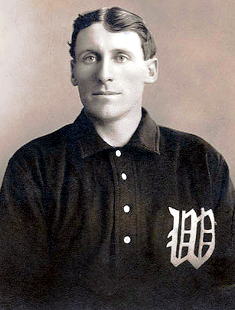
“Leather –Fisted Phil” is what Phillip J. Powers was called in his 1914 Associated Press obituary which said:

“(Powers) was famous for his ability to stop the swiftest throws of the league’s star pitchers.”

He most likely earned the nickname in 1877 when, like many other catchers of the era, he began using a small, leather pad on his hand while with the London Tecumsehs of the International Association.

After the London team disbanded in August of 1878 Powers joined the Chicago White Stockings.  According to The Chicago Inter Ocean:

“He is a tall young fellow…He is described as a good catcher, but liable to get hurt, fair at the bat, and a genial man on the grounds.”

Powers would spend parts of seven seasons and 155 games in the National League and American Association with the Boston Red Stockings, Cleveland Blues, Cincinnati Red Stockings and Baltimore Orioles, hitting .180.  In between his engagements as a player Powers was an umpire.

It was as an umpire that he made a name for himself, but it probably wasn’t what he had in mind.  Few umpires, even in an era when members of the “profession” were poorly trained and underpaid, were the target of as much criticism as Powers.

In 1881 he began the season as a National League umpire.  By July he had become a target in several cities,

The Detroit News said:

“Phil Powers has acquired reputation enough in the last two weeks to last him a lifetime.  The erroneous umpiring he did here, people were inclined to regard as errors of judgment, but to say the least his ‘mistakes’ have become so numerous that his utter unfitness for the position he holds is unquestioned.”

The Cleveland Plain Dealer took the criticism even further:

“Powers is said to have been offered $150 to play ball (for the Detroit Wolverines) for one month, but refused it.  As an umpire he cannot, if square, earn more than $15 or $20 a week and expenses; and must take the chance at that of being chosen an umpire.  He preferred to be an umpire.  Several of his decisions on Saturday were grossly unfair, and, what is worse, they bore heavily on Cleveland.  They were so one-sided that many of the spectators believed he deliberately purposed to give the game to Troy.”

Despite the ill feelings in Cleveland, Powers joined the Blues in August and caught five games for the team after Michael “Doc” Kennedy was injured and John Clapp was “called away by an illness in his family.”   He finished the season with the New York Metropolitans in the Eastern Championship Association.

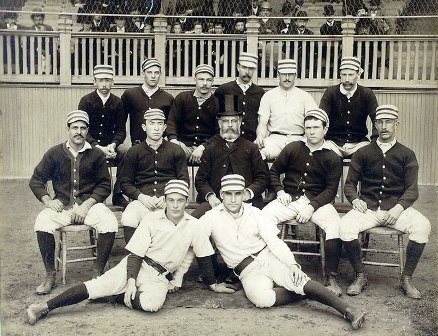
Powers again became a full-time player from 1882-1885, and was part of the Red Stockings American Association championship team in 1882.  He was released by Cincinnati in July of 1885, signed with the Baltimore Orioles and was again released the following month.
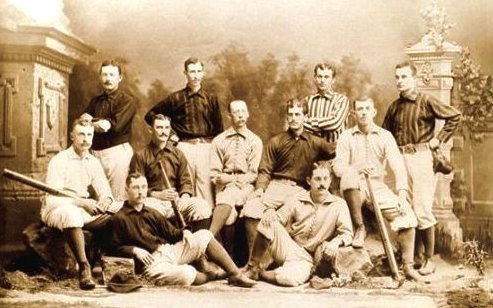
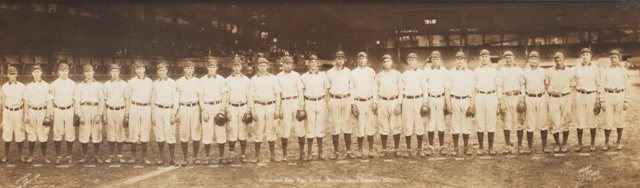
1882reds

1882 Cincinnati Red Stockings, Phil Powers standing 2nd from left

Powers was signed by the St. Louis Browns in the spring of 1886, but released before the beginning of the season, and was added to the National League umpiring staff in August.  He again worked as an umpire through the 1887 season, left to return to London, Ontario to manage the Tecumsehs in the International Association, but again returned to the National League as an umpire in August of 1888.   He came back just in time to find himself in the middle of a controversy involving two Hall of Famers.

New York Giants catcher/captain William “Buck” Ewing was hit on the wrist by a ball during a game with the White Stockings in Chicago.  In 1888 the opposing team’s captain had to agree that an injury was serious to necessitate a substitution; Chicago’s “Cap” Anson said he did not agree to a substitution when backup catcher “Big Bill” Brown entered the game in the 6th inning.  Anson appealed to the umpire, and according to The Chicago Inter Ocean, “(Powers) said that Captain Ewing was not so badly hurt that he could not play.”

After a heated argument, during which The Inter Ocean said Ewing acted “in a childish and fatuous manner,” Powers declared the game “forfeited to Chicago by a score of 9 to 0.”
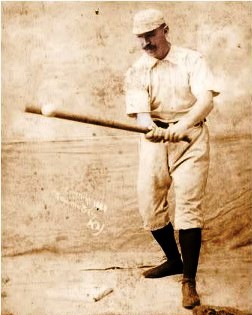
Buck Ewing acted “in a childish and fatuous manner”

Buck Ewing acted “in a childish and fatuous manner”

Powers had been involved in a similar situation in 1886, refusing to allow Philadelphia Quakers catcher “Deacon” McGuire to leave a game after an injury.  The Chicago Tribune said Quakers captain Arthur Irwin “told McGuire to catch ‘away back’ (from the plate).” The Tribune said Irwin’s actions created a “scene” and “pandemonium reigned,” until Anson agreed to allow Philadelphia to replace McGuire.  White Stockings President A.G. Spalding “preferred charges against umpire Powers” for losing control of the game.

The substitution rule was changed in 1891, putting an end to controversies regarding the replacement of injured players.

But controversies involving Powers continued.  More on Monday.
Things I Learned on the Way to Looking Up Other Things #2

8 Apr

A few items from 1888 to 1890:

Largest bat 

Jonah William “Quiet Joe” Knight appeared in the National League as a pitcher for six games with the Philadelphia Quakers in 1884, posting a 2-4 record, and returned in 1890 as a left fielder with the Cincinnati Reds, hitting .312 in 127 games.  He also spent 16 seasons in the minor leagues and was one of the premier hitters in the Eastern League.

When Knight joined the Reds in 1890 The Cincinnati Post said he “uses a larger bat than any other professional.”  Reds shortstop Ollie Beard said:

“I can hardly swing the bat Knight uses let alone hit a ball with it.”

It was said Knight had his bats made to order in his home town St. Catherine’s Ontario, Canada.

joeknight

“Quiet Joe” Knight

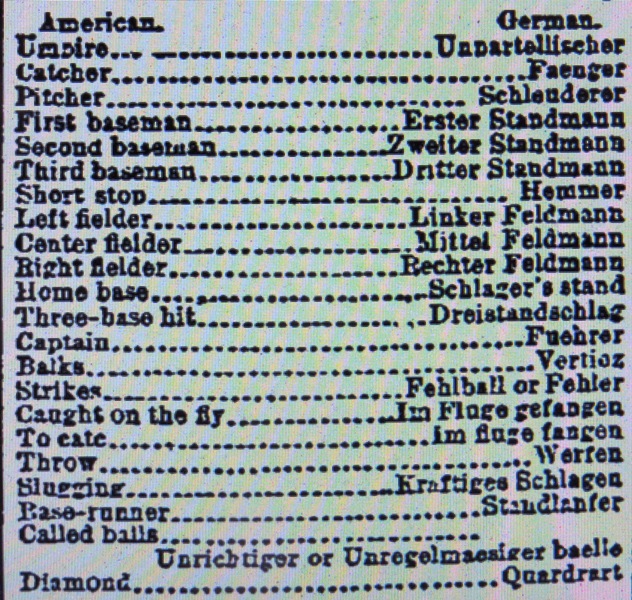
Baseball in German

The Boston Herald reported in 1890 that New York’s German language paper Staats-Zeitung hired a baseball editor and would be recapping National League and American Association games:

“Naturally he has been obliged to invent words to describe the technical plays and points and how well he’s succeeded  will be seen from the following:”

???????????????????????????????

Harry Wright’s Team Unimpressive

After the 1887 season Hall of Famer and baseball pioneer Harry Wright took his Philadelphia Quakers on a tour of West Coast along with the Chicago White Stockings, New York Giants and St. Louis Browns; playing exhibition games against each other and with California League teams.

After seeing Philadelphia play The San Francisco Call was unimpressed with the National League’s second place team:

“The ‘Phillies’ will have to improve wonderfully to make their games at all interesting.  They may plead excuses, but they cannot disguise the fact that they played rank ball, and very rank at that.  Their initial effort stamps them as about fourth class, and it will require a brilliant rally to convince people in this section that they are ball-players.  There is not a team in the California League that will not give them a hard game and perchance defeat them.”

Unfortunately there is no record of  how Philadelphia fared on the rest of the tour.

Harry Wright, center, with his 1887 Philadelphia Quakers

Harry Wright, center, with his 1887 Philadelphia Quakers

“Not Quite Such an Idiot”

5 Apr

The 1889 American Association season began and ended as a two-team race between the Brooklyn Bridegrooms and St. Louis Browns, who had won four straight championships—the third place Philadelphia Athletics finished 16 games back.  The battle between Brooklyn and St. Louis was bitter and culminated in September with a charge of umpire bribery.

St. Louis owner Chris von der Ahe made a charge of attempted bribery of an umpire.  He said Brooklyn Captain William “Darby” O’Brien had attempted to bribe umpire John Kerins “$100 and the chance for him to umpire in the World’s Series if Brooklyn got there.” (Some accounts claim the amount was $1000, but the overwhelming number of contemporaneous stories put the figure at $100).

Chris von der Ahe

Chris von der Ahe

The Browns owner claimed “I can prove,” the charges and said “Kerins himself told the story in my presence.  Captain (and manager Charles) Comiskey and another party were in the carriage at the time.”

The other “party” never materialized, and Comiskey, no stranger to dubious charges, never fully backed his boss with a statement confirming the accusation.

Kerins, who since 1884 had bounced back and forth between playing in the American Association with the Indianapolis Hoosiers, Louisville Colonels and Baltimore Orioles, and working as a minor league and Association umpire, called the claim “Simply absurd.”

John Kerins

John Kerins


He said he never spoke to von der Ahe, and “I never told Comiskey that any attempt had been made to bribe me,” and that all the charges came from a misinterpreted conversation he had with Comiskey.

Kerins said he simply mentioned to the Browns manager that O’Brien had made “A casual remark,” that “I would give $100 out of my own pocket if Brooklyn could win the championship.”

Kerins said he told O’Brien he’d like to serve as an umpire in the World Series (against eventual National League champions the New York Giants), but it appears Kerins, like every other Association umpire, told many people he’d like to earn the additional money paid to post-season umpires.

Kerins told The Baltimore American that he was:

“Not quite such an idiot as to sell (myself) for the paltry sum of $100.”

O’Brien issued an indignant statement about the charges that appeared in The Chicago Times and other newspapers:

“I was completely nonplussed when I read that story, and, as it was the first intimation I had had of it, you can well imagine my surprise.  To think that that story should reach the eyes of my folks in Peoria and that they might believe me capable of stooping to a dishonest act is what galls me.”

Darby O'Brien

Darby O’Brien

Brooklyn went on to beat the Browns by two games for the American Association Pennant and lost the World Series to the Giants six games to three.

Nothing came of the charges, and it seems doubtful von der Ahe and Comiskey actually believed they were true.

A postscript:  After Comiskey jumped the Browns the following season to join the Chicago Pirates in Players League, von der Ahe signed Kerins (who had all but called him a liar six months earlier), and named him manager in May (one of five Browns managers that season) for 17 games; under Kerins the browns were 9-8.  In June Kerins, hitting .127, was replaced as manager and released by the Browns.

Dave Altizer

4 Apr

David Tilden Altizer did not begin playing professional baseball until 1902 when he was 25; he made his debut with the Washington Senators four years later.  A member of the US Army, he was in China for the Boxer Rebellion and the Philippines during the Spanish-American War; he began playing baseball while in the service.

Most recent mentions of Altizer list his nickname as “Filipino,” but while his service was often mentioned, this nickname is rarely found in contemporaneous stories; rather he regularly referred to by the nickname “daredevil.”

Dave Altizer 1909

Dave Altizer 1909

Altizer was one of the more colorful figures of his era and made good copy, but many of the stories have been lost for years.  Here are a few:

In 1910 Altizer was drafted by the Cincinnati Reds from the Minneapolis Millers of the American Association.  Unaware he had been drafted; Altizer went to Chicago at the close of the millers’ season and disappeared.  The Associated Press said he thus became “the only ballplayer who has been ‘found’ with a newspaper want ad.”

The story said Reds manager Clark Griffith, unable to find Altizer, contacted “Nixey” Callahan, who was playing in Chicago’s City League, and asked him to put an ad in Chicago newspapers to find Altizer.

“This was done and in the early hours of the morning some unknown person called Callahan and gave him Dave’s number.”

Altizer appeared in three games for the Reds after he was located; he had six hits in 10 at bats, walked three times and scored three runs.

Altizer had been the starting  shortstop for the Senators in 1907.  In December The Pittsburgh Press ran a wire service story from Washington under the headline “Dave Altizer is Dead Broke:”

“Dave Altizer, the most popular player on the local team, recently fell victim to a pickpocket, and was relieved of his year’s savings.”

The story said Altizer, alarmed by the “financial stringency (the Panic of 1907)…has carried his savings on his person, not wanting to take any chances of having them tied up in a bank.”

Altizer went to sleep in a Pullman car on a train to California with “$1,475 in large bills” in his vest pocket and discovered when he awoke that the money was gone.  It was never reported if the money was recovered of if the thief was caught.

Altizer with Washington

Altizer with Washington

Gabby Street claimed he saw Altizer do the dumbest thing he had seen in a game, and “topped (Fred) Merkle,” while they were teammates in Washington:

“St. Louis had us beat, 3 to 2, and there were two outs in the ninth.”

Altizer was batting with two strikes and runners on second and third.

“The next strike came over and (umpire John) Sheridan called it a strike.  The ball whizzed right through (Tubby) Spencer’s mitt and bounded up against the grandstand and shot off at an angle, while the chubby Spencer pursued it.  Both of the Washington runners on the bases scored easily.

“But all the time Altizer refused to leave the plate.  He was in a hot argument with Sheridan and insisted the ball wasn’t over the plate and was two feet wide.  In the meantime Spencer got the ball.  There was no chance to get either of the runners at the plate, but he fired to first and retired Altizer.  It made the last out of the game and Altizer’s failure to run cost us the two runs and lost the game for Washington.  And they talked about Merkle.”

Gabby Street

Gabby Street

After Altizer finished his Major League career with the Reds in 1911, he returned to Minneapolis where he played until 1918.  He played and managed two more seasons with the Madison Grays in the South Dakota and Dakota Leagues, before retiring from baseball at age 44.  He died in Pleasant Hill, Illinois in 1964 at age 87.

“Death to Flying Things”

3 Apr

The nickname “Death to Flying Things,” is likely the only thing most baseball fans would know of John Curtis “Jack” Chapman, and even that is a morass of different and often questionable research.  He shares the nickname with one-time Brooklyn Atlantics teammate Bob Ferguson, and competing versions of the story disagree about whether first baseman/outfielder Chapman or infielder Ferguson is the one most commonly referred to by the nickname—and never with contemporaneous citations to back up the assertions.

Regardless, Chapman was an important figure during the advent of the game.

He was a well-known amateur player in the 1860s with the Brooklyn Atlantics (as opposed to the National Association team of the same name he and Ferguson played for in 1874) and the Quaker City’s of Philadelphia. Beginning at age 30 he played a total of 113 in the National Association, with Brooklyn and St. Louis, and during the National League’s inaugural season in 1876 he played and managed the Louisville Grays.

Jack Chapman, far right, with 1868 Brooklyn Atlantics

Jack Chapman, far right, with 1868 Brooklyn Atlantics

After the 1876 season, the career.246 hitter retired as a player.  Over the next 22 years he managed parts of ten seasons in the National League and American Association; including an 88-44 finish and American Association championship with the Louisville Colonels in 1890.  He also managed for 11 seasons in the minor leagues, retiring from baseball after the 1899 season.

When his managerial career ended Chapman was often asked to discuss the current state of baseball; carrying on a tradition as old as the game, and one that will never end, Chapman was adamant that the game as it was currently being played did not measure up the game during his prime.  In a column that appeared in several newspapers in 1900 he said:

“Our great national game is today in bad shape both financially and in other ways.  Whether this situation is caused by the rowdyism of the players I cannot say, but it seems to me that if the rules were strictly lived up to and the chief of umpires and his staff did their duty the game would soon climb back to the high plane it once occupied.

“The players of 10 and 15 years ago were just as fast, tricky and well up in the game as those of today…Years ago the ball used to have two and one-half ounces of rubber in it, whereas now there is only one ounce.  This reduction has made the sphere less lively and consequently easier to field…The men are now harnessed almost like football players, with gloves, pads masks and other paraphernalia.  We hadn’t these accessories in the old days, yet I don’t think the fielding is much improved.”

But mostly Chapman seemed to be concerned with his legacy as a manager:

“Probably no other man has brought out so many players as I have, mainly because I always have made it a point to be on the lookout for new blood by means of which I could improve my team…I think I may claim without anyone gainsaying my assertion, that I have turned out and sold to the National and other leagues more players who have proved to be crackerjacks than any other man living.

Robert Winchester and Mickey Welch, two old timers were ‘finds’ of mine, while Hugh Jennings, Roger Connor, Jimmy Collins, (Bill) Hoffer, (Harry) Howell and many others too numerous to mention in the major and minor leagues were developed by myself.”

Jack Chapman 1900

Jack Chapman 1900

Unfortunately, he said little and provided no details about the most significant incident of his career: as manager of the Louisville Grays in 1877 his team was the first to be involved in a gambling scandal:

“I had four men of my own team—(George) Hall, (Bill) Craver, (Al) Nichols and (Jim) Devlin—put out by the league because they were caught throwing a game.  That was the first time such a thing had ever happened, and it caused a great sensation at the time.”

“Death to Flying Things” died in 1916 in Brooklyn at age 73.

Count Campau Explains the “Science of the Sport”—the Battery

20 Mar

Charles Columbus “Count” Campau earned his nickname because of his regal appearance and his background; he was a member of a prominent Detroit family and educated at Notre Dame, and was regarded as one of the smartest players of the late 19th and early 20th Centuries.

His Major League career was brief, just 147 games with the Detroit Wolverines, St. Louis Browns and Washington Senators, but he was one of the best known, and highest regarded minor league players for 20 years.

Charles Columbus "Count" Campau

Charles Columbus “Count” Campau

Campau was especially popular in New Orleans, where he played for parts of four seasons, managed for one, and adopted as his home.

In 1893 Campau, who The New Orleans Times-Picayune called “one of the best students of baseball,” wrote an article as “Advice for Amateurs” about the “Science of the Sport:”

 “Many a time I have been asked for my views on the successful way to make a good ball player.  From a player’s standpoint a ball player is born and not made.  But with continued practice and coaching from and older and experienced head the amateur will probably reach the top notch in the profession.  There are two things, when combined, (which) will make a good ball player.  A practical and intellectual knowledge of the pastime or sport will aid the amateur.”

The New Orleans Pelicans captain explained what passed for “scientific baseball” in 1893; position by position:

“The most important position is the pitcher. For three reasons he ranks as the most important player on the team. He is the pivot upon which the victory of the team rests.  Should he be slightly disabled or out of condition all hopes of victory would go glimmering and the rest of the team would not put up a good game of ball.  A good pitcher, with fair fielders, is better than a poor pitcher with brilliant fielders.  With a weak pitcher, a fast fielding team would make a sport, and with good hitters would likely win one game out of ten.”

Campau blamed pitching for the Pelicans slow start that season; in spite of being “as hard a batting team” as there was in the league, they “could not win for the reason that the box was decidedly weak.”

“Another important factor in a game is the catcher…A catcher with good judgment and a quick brain will prevent the speedy base runner from advancing, and will lessen the work of the pitcher by watching the bases.  A good battery, with judgment, will work a hard batter, and the chances are that he will pop up a fly or send a grounder to short.  The catcher’s work does not only consist of receiving the delivery of his pitcher, for such a catcher is not worth the chest protector he wears, and will never become a success…(Charlie) Bennett(Jack) Clements, (Buck) Ewing and (Morgan) Murphy are catchers who watch every point of the game.  They back up the first baseman at every safe opportunity.”

"Count" Campau

“Count” Campau

More from the “Count” next week.

Veeck and Paige–a third time?

27 Feb

In 1959, when Bill Veeck purchased the White Sox rumors swirled in Chicago that the Sox owner was planning on having Satchel Paige start on Opening Day. Later, as the Sox were making a run for their first American League Pennant in 40 years the rumors resurfaced that the ageless Paige would join the White Sox for the Pennant run.

???????????????????????????????

Bill Veeck and Satchel Paige, 1959

Paige, who had played for Veeck with the Cleveland Indians and St. Louis Browns, had spent 1956-59 with the Miami Marlins in the International League, winning 31 games. He had returned to barnstorming with the Cuban Giants and Indianapolis Clowns in 1959, but it was reported he was looking for another chance in the Major Leagues, and in June it began to be reported again that Paige would be joining the Sox.

A United Press International story in July said that Veeck had “sent Paige two new Chicago White Sox uniforms,” and quoted Paige:

 “If they want me they’d have to pay me big money.  I’m not going back for nothing.”

Whether it was ever a serious discussion, or simply two famous showmen milking rumors for the maximum publicity will never be known, but Veeck and Paige let the rumors swirl well into August before Veeck finally put them to rest, telling Jet Magazine:

“We’re not giving any thought to hiring him.  I’m very fond of LeRoy and I see him whenever he’s in town.  I gave him the uniforms because we’re old friend and for no other reason.”

And with that White Sox fans missed the chance to see the pitcher who Veeck called “The best righthander baseball has ever known,” pitch for the 1959 Pennant winners.

“Bill Abstein Denies he is a Bonehead”

20 Feb

Pittsburgh Pirate owner Barney Dreyfuss and manager Fred Clarke felt all they needed to win a World Series was a first baseman.  Since winning the National League Pennant with Kitty Bransfield in 1903, only one Pirate first baseman hit better than .260 (Del Howard .292 in 1905).

In 1908 the Pirates finished second with four different first basemen, Harry Swacina, Alan Storke, Jim Kane and Warren Gill; none played more than 50 games, none hit better than .258 and they combined for 29 errors.

The man who took over in 1909, and was with the Pirates for their World Series victory, might have preferred to have never been given the job.

Bill Abstein had played eight games at second base and in the outfield for the Pirates in 1906, before returning to minors.

-Abstein had put up respectable, but by no means spectacular, numbers with the Shreveport Pirates in the Southern Association and Providence Grays in the Eastern League from 1906 to 1908—but as early as August of 1908 The Pittsburgh Press said he was the answer to the Pirates problem at first base:

“Fred Clarke is very eager to secure Bill Abstein from Providence.  Bill is rated the best first baseman in the Eastern League, and he would no doubt strengthen the Pirates where they are weak.”

When Abstein joined the Pirates before the 1909 season The Press said:

“The acquisition of bill Abstein has rounded our infield nicely.  He’s the best first baseman we have had in years and he certainly fits in nicely.”

???????????????????????????????

Abstein, Providence 1908

In a letter sent to Dreyfuss with his contract, Abstein told the Pirate owner:

“Fred Clarke will not have to worry about a first baseman after he sees this big German hustling around the bag.”

In keeping with his career performance, Abstein had a respectable season for the pirates.  He hit .260 and drove in 70 runs.  His 27 errors were only a slight improvement over 1908’s first baseman by committee.

The Pirates won 110 games and won the National League Pennant by six and half games over the Chicago Cubs and met the Detroit Tigers in the World Series.  The series would be the beginning of the end of Abstein’s Major League career.

09pirates

1909 World Champion Pittsburgh Pirates, Abstein 11th from left.

Abstein struggled at the plate (6 for 29 with nine strikeouts) and in the field (5 errors total, 2 each in games 3 and 4).  The Pirates won the series in seven games, but despite the victory, Abstein quickly became the subject of ridicule in Pittsburgh.

An Associated Press article after the series said:

“During the games with Detroit Abstein appeared to forget all that he knew about base ball.  He ran the bases foolishly, made a number of costly errors, failed to hit and disobeyed orders.  In fact, his playing was worse than that of any other man on either team.  The other Pirates, seeing that Abstein was the ‘goat’ for the combination, kept up the cry against him…Before the series was ended many of the Pirates shunned Abstein and it was reported he would be traded.”

The Pittsburgh Press was less generous:

“Bill Abstein denies he is a bonehead and says baseball is largely a case of ‘if-you-can-get-away-with-it,’ well it’s a cinch that Bill couldn’t in the National League.”

The Pirates were unable to trade Abstein and finally put him on waivers.  He was claimed by his hometown St. Louis Browns.

Even though the Pirates had actually won the Worlds Series and even though Abstein was gone, that didn’t mean the Pirates, and The Pittsburgh Press, wouldn’t continue to pile on.

Barney Dreyfuss told The Associated Press shortly after Abstein was claimed by St. Louis:

“We have discarded the weakest offensive player we had—Abstein—and hope to improve the team by doing so.”

Dreyfuss also claimed:

“Fred (Clarke) told me as early as last June that we should get someone else for Abstein’s place in 1910, as Bill mixed up the team’s plays too frequently.”

The Pittsburgh Leader said:

“(Abstein) had deplorable batting weaknesses which the opposing pitchers were certain to fathom in time.”

The Pittsburgh Press was even less generous:

“Bill Abstein is reported to be making a hit with the Browns by his work in the spring practice.  Just wait about three months friends, before declaring Bonehead Bill a wonder.”

When the Pirates sold pitcher Vic Willis the St. Louis Cardinals in February of 1910, newspapers reported that Willis and Abstein had “engaged in a bitter fight,” during the series.

Abstein quickly wore out his welcome in his own hometown of St. Louis.  Abstein made 11 errors in 23 games at first base and hit .149; he was released on June 2, 1910.  It appears Abstein was no more popular with Browns Manager Jack O’Connor than he was in Pittsburgh.  O’Connor was quoted in The St. Louis Times in May:

“How did Abstein get away with it last year?  How could he make plays like he has been making for me and get away with it all year for Pittsburgh?  I never dreamed that some of the plays made by him were even possible.”

His Major League career over, Abstein returned to the minor leagues for seven seasons.  He had one above average year with the Los Angeles Angels in the Pacific Coast League in 1914; in 202 games he hit .308, with 234 hits and 40 doubles.

Abstein moved on, Pittsburgh apparently did not.  For years, Pittsburgh newspapers took every opportunity to take a shot at the first baseman.  In 1915 The Pittsburgh Press, in an article about the revolving door the Pirates still had at first base–in the five post-Abstein seasons, the Pirates had four different starting first baseman–(emphasis theirs):

“No one will ever forget the way Bill did NOT play the bag in the Worlds Series.  In fact, Bill did NOT play the bag all the time he was stationed there.”

Pittsburgh finally seemed to move on by the time they won their next world Championship in 1925.  Abstein died in St. Louis in 1940.

Fighting Jimmy Burke

2 Jan

James Timothy Burke had a stormy tenure with the Saint Louis Cardinals from 1903-1905, including a disastrous 35-56 record as player-manager in 1905, replacing Kid Nichols (who remained on the pitching staff)—Burke resigned in August, and the Cardinals were in such disarray that owner Stan Robison eventually took over the team for the remainder of the season.

Burke had been with five teams from 1898 through 1902 before being traded to the Cardinals.

Jimmy Burke

Jimmy Burke

During his time with the Cardinals Burke had various fights and feuds, it was said he was the ringleader in a group of players trying to undermine manager Patsy Donovan in 1903; he had a long-standing feud with shortstop Dave Brain and the two seldom spoke, and he feuded with Robison throughout his short tenure as manager.  After his resignation he said:

“When I took charge of the team it was with the understanding that I was to be manager or nothing.  I have suffered as Donovan and Nichols with too much interference.”

Burke also had trouble with a Saint Louis sportswriter named Joe Finnegan.  Their contentious relationship came to a head at the Victoria Hotel in Chicago in September of 1904 after Finnegan had written an article in which he called Burke “a cow’s foot,” (apparently those were fighting words circa 1904).

The Pittsburgh Press provided the colorful blow-by-blow of the fight:

“First round–Burke hit Finnegan in the lobby, and followed the blow with a left hook on the back of the neck, breaking the scribe’s collar.  Burke pressed the advantage and struck Finnegan near the cigar stand.  Finnegan blocked cleverly, uppercut with the left and caught Burke in the snout.  Finnegan crossed his right and landed on Jimmy’s potato-trap.  Burke jolted Finnegan in the rotunda and followed with a short swing near the Turkish parlor.  Finnegan shot the right to the ear, and the left to the lamp.  They clinched.  Terrific short-arm fighting, completely wrecking Finnegan’s collar and cuff.  Johnny Farrell separated the men. Time.

“Second round—The house detective threw both fighters out in the alley.  Time.  Decision to Finnegan.”

Burke’s Major League career ended after the 1905 season.  New Cardinal manager John McCloskey said he wanted to retain Burke as his third baseman, but Robison, against his manager’s wishes (and continuing the pattern which led papers to call Cardinals managers “figureheads”) waived Burke.

Burke became a successful minor league manager and returned to the Major Leagues as a coach with the Detroit Tigers in 1914.  He also served as a coach with the St. Louis Browns and managed the team for three seasons.

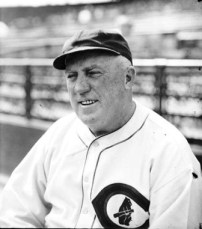
Jimmy Burke, Cubs coach

Jimmy Burke, Cubs coach

Burke served as Joe McCarty’s right hand from 1926-1930 with the Chicago Cubs and followed him to the New York Yankees where they continued together until a stroke necessitated Burke’s retirement after the 1933 season.  McCarthy had played for Burke with the Indianapolis Indians in the American Association in 1911.

Burke died in St. Louis in 1942.

Elton Chamberlain

17 Dec

Elton Chamberlain (for the last thirty years always referred to by the nickname “Icebox,” but that name was not in common use for him contemporaneously; although he was called Iceberg fairly often.) was primarily known for two things: A righthander, he pitched ambidextrously in at least one game, and on May 30, 1894 he gave up four home runs and a single to Bobby “Link” Lowe—17 total bases, a record which stood for 60 years.

He was also embroiled in one of the early controversies over gambling while playing for the Cincinnati Reds in 1893 when he was accused by his manager, Charles Comiskey, of throwing the first game of a July 4 doubleheader against the Philadelphia Phillies.

The Cincinnati Enquirer said:

“Pitcher Elton Chamberlain of the Cincinnatis is accused of throwing the game to the Philadelphias yesterday morning. He is charged with being in league with Joe Brill, a local gambler.”

The story said Comiskey, notified of the allegation:

“(D)ecided to investigate (and) after a consultation with a club official, put Chamberlain in for three innings to watch him. Chamberlain’s pitching was very bad and be was taken out of the game in the third inning.”

Chamberlain’s teammates Jim Canavan and Silver King quickly came to his defense. King said he thought he would be the starting pitcher, not Chamberlain, until just before the game started; therefore Brill and Chamberlain could not have conspired.

Chamberlain said of the story:

“It was cruel and cowardly to try to ruin a man like that.”

The Sporting Life ripped The Enquirer and Comiskey:

“This is not the first time The Enquirer has accused ball players of dishonesty, and once it got into and lost a libel suit with Tony Mullane for accusing him of crookedness. Comiskey in his time has also made similar charges and Insinuations against guiltless players.”

The New York Herald said “The whole affair was so silly,” and seemed to have Comiskey in mind with this statement:

“The club official who suspends a player on the charge of dishonesty should be made to prove his charges or himself be forever barred from further connection with any club.”

The Herald also recommended that steps be taken to officially clear Chamberlain and punish those who accused him:

“The National Board should at once take up pitcher Chamberlain’s case and investigate it beyond the limit of doubt and when they reach the facts, whatever the facts; someone should be made to suffer.”

Cincinnati’s management, Comiskey included, quickly repudiated the charges that appeared in The Enquirer, although from all indications they were directly responsible for the charges being reported in the first place.

Elton Chamberlain

Elton Chamberlain

The headlines of July faded by August; there was no official investigation and no one was “made to suffer.”

Charles Comiskey

Charles Comiskey

Chamberlain finished the season with a 16-12 record and his 3.73 ERA led the Reds’ pitching staff. The following year was his last full season in the Major Leagues.

In 1895 he played for the Warren (PA) franchise in the Iron and Oil League. The team won the pennant behind the pitching of Chamberlain and another former Major Leaguer, Tom Vickery.

They also had a 21-year-old shortstop named Honus Wagner.

No statistics survive for that season, but forty years later Wagner, writing for The Pittsburgh Press, said Chamberlain “Seldom lost a ballgame for us,” and that Chamberlain and Vickery “gave out plenty of their knowledge to us youngsters.”

Chamberlain bounced around minor and semi-pro leagues after one last Major League trial with the Cleveland Spiders in 1896. In 1898 he accepted, then rejected, an offer to serve as a National League umpire. After turning down the umpire job Chamberlain, a Buffalo native, said he would become a professional boxer and challenged a local middleweight named Jack Baty to a fight that would include a $500 side bet. Baty’s fight record indicates the bout did not take place.

Chamberlain attempted to resume his baseball career with the Buffalo Bisons in the Western League in 1899—by July he was released and The Sporting Life reported that Chamberlain, a rabid horse player “is once more following the races.”

Chamberlain Died in Baltimore in 1929.

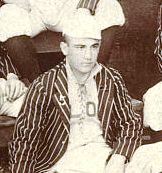
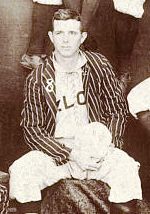
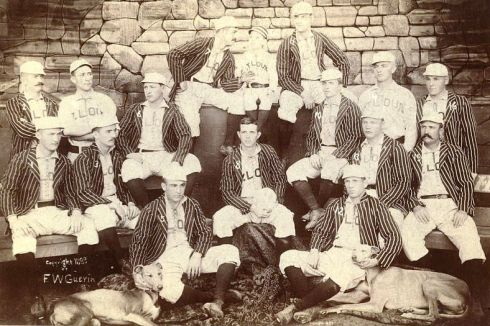
Chamberlain and Comiskey as teammates with the St. Louis Browns.  Chamberlain is 5, Comiskey 8.

Chamberlain and Comiskey were also teammates with the St. Louis Browns. Chamberlain is 5, Comiskey 8.