Tag Archives: St. Louis Browns

Cicotte’s Knuckleball

8 Feb

With the Chicago White Sox holding onto a slim lead in the American league race, John Brinsley Sheridan of The St. Louis Globe-Democrat said they were in first place because of the pitch he called “(T)he hobo of balldom, it’s course, even when under control, being entirely beyond the influence of the pitcher, so far as the break at the plate is concerned…It is a hobo!”

The “hobo” was the knuckleball of White Sox pitcher Ed Cicotte—never mind Toad Ramsey’s claim to the pitch, Sheridan said it was all Cicotte’s:


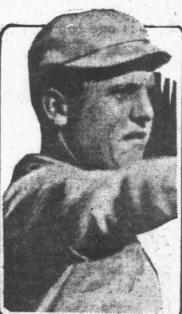
Ed Cicotte

Ed Cicotte

“It is a freak delivery; this knuckleball, Cicotte invented it, and is its greatest exponent.  Many other pitchers have tried it, some with more or less success.  Earl Hamilton did wonderful work with it in 1912.  Then he lost control of it.  Many others tried it. They use it now and then to this day, but Cicotte is the only pitcher who admits that the knuckleball is responsible for a greater part of his success.”

Cicotte talked to Sheridan about the pitch after he threw a no-hitter against the St. Louis Browns earlier that season:

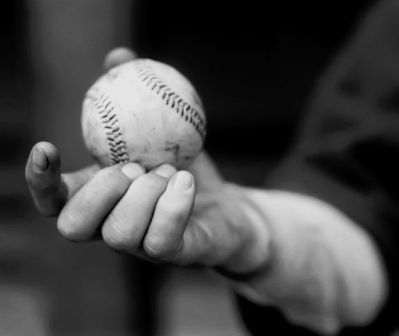
“I use it very frequently during a game, I vary pace on it, and very frequently I do not ask it to break at all.  I throw it with some rotation.  When I know a batter is going to hit—when I know and he knows that I must lay a strike over the plate—I pitch the ‘knuckle ball’ with as little rotation as possible, so that it may break as well as possible.  The different paces deceive the batter, and the break simply makes it impossible to hit safely save by the greatest fluke.

“The spitball has but one pace—fast.  The ‘fadeaway’ had but one pace—medium slow.  I can pitch the knuckleball at any pace from medium fast to dead slow.

Cicotte's grip

Cicotte’s grip

“I began using this ball when I was a kid.  It was always impossible to hit, but I found it very hard to obtain control of it. It was not until I joined Boston in 1908 that I began to get control of the ‘knuckle ball.’  Even then it evaded me for months at a time.  When I got it going right I was hard to beat.  Even now I often lose control of it.”

Cicotte, who would end 1917 with a league-leading 28 wins and 1.53 ERA, claimed his weight was a factor in his control of the pitch:

“I joined Chicago in 1912 and began to do better with the difficult delivery.  I had trouble, however, with my general control.  I had been a slim kid, but I was growing fat.  I weighed 135 when I had my first engagement with the Sault Ste. Marie team, way back in 1903.  I weighed 190 pounds in 1912.  Since that time I have tried to keep it down to 170 pounds, but I find it hard to do so.

“This year I made a special effort to reduce my weight.  I am down to 170 pounds, lighter than I have been in 10 seasons; I find that my control is better than it has ever been.  To this I attribute my early success this season.  You see, when I am fat I can’t get my arm to follow through with my pitch.  My upper arm hits my right breast and won’t go any farther.  Thus, I have been pitching with a short, jerky motion, which is not good for control.”

After an injury-plagued season and 12-19 record in 1918, Cicotte was 50-17 during the regular season in 1919-‘20 before his banishment.   Just two months before his final professional game he shut down Babe Ruth (0-3 with a walk) in front of an overflow crowd of 45,000 in Comiskey Park on August 1.  The crowd said Sy Sanborn of The Chicago Tribune “Left Comiskey Park disappointed because Babe Ruth did not get a home run.”

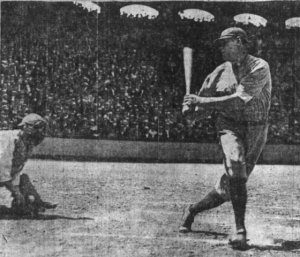
One of Cicotte’s last great moments with his famous pitch was captured by a Chicago photographer; Ruth looking back at the ball in the catcher Ray Schalk’s mitt, after striking out in the second inning of that game.

Cicotte strikes out Ruth

Cicotte strikes out Ruth

“A Knocking Umpire had Attempted to keep Speaker back”

11 Sep

Jesse Doak Roberts was a prominent figure in Texas baseball.  He was the two-time president of the Texas League (1904-’06 and 1920-’29), and had an ownership stake and managed clubs in the Texas and North Texas Leagues.

Jesse Doak Roberts

Jesse Doak Roberts, circa 1929

In 1911, the then owner of the Houston Buffaloes gave The Houston Chronicle his version of how Tris Speaker ended up in Boston:

“I want to tell you the story of the force that endeavored to act against the rise of Speaker—a force that did not succeed, but which cost me $700 in purchase money, and it was a knocking umpire.

“When Speaker was going at his best in his last year in this league (1906), I had made arrangements with Charlie Comiskey to purchase Tris for $1500…the deal was almost closed.”

Roberts said he was approached “by a (Texas) League umpire,” during a late-season game in Austin who, he claimed, demanded “a commission” for recommending Speaker:

“I told him that I had never asked an umpire to sell one of my players and would not—that I would prefer that they would not recommend any of them…I must have angered him, for he knocked the greatest Lone Star player to Comiskey (later) I got a draft from the Old Roman: ‘We can’t use Speaker.’

(George) Huff, then scouting for Boston, was in town.  He came around to see me and asked what I would take for Speaker.  I told him $1500.  He said that was too much for a class C player—that he would give me $500.”

Roberts said he then tried to sell Speaker to the St. Louis Browns (the biography “Tris Speaker: The Rough and Tumble Life of a Baseball Legend” said Roberts had attempted to sell Speaker to St. Louis earlier that season)

“I refused to accept (Huff’s) offer and wired (Jimmy) McAleer at St. Louis.  I told him I would sell him Speaker under a positive guarantee that he would make good.”

Tris Speaker "hardest hit"

                                 Tris Speaker 

Roberts said McAleer never responded and he “finally made an agreement to sell the boy for $800 cash,’ to Boston.

“A knocking umpire had attempted to keep Speaker back and had kept us from getting the difference between Comiskey’s price if $1500 and Boston’s of $800. And the White Sox lost a great player.”

Roberts never named the umpire who he said cost him $700.

“That Short but Trite remark shaped my Career.”

24 Aug

In 1906, William George “Billy” Evans became the youngest umpire in major league history.  “The Boy Umpire” was just 22-years-old.

A decade later, in a syndicated newspaper article, he told the story of how he, by chance, he began his career as an umpire.  Somewhat altered versions of the story were told over the years, including a version in his obituary; however, this was his earliest, direct telling of the story:

Billy Evans

                                         Billy Evans

“It was one day in 1903 that I journeyed out to the ballpark to cover the game for the paper (The Youngstown Vindicator).  There was a delay when the time arrived to start to the contest.”

Evans said the umpire had become ill and while “a number of ex-players” were at the ballpark, the opposing managers could not agree.

“Finally, my name was suggested and proved acceptable to both managers.  I was informed of their decision but declined with thanks.

“The crowd was impatient.  It became noised about that I was the only man acceptable to both managers, and that since I refused to work the game would probably be called off.”

Evans was determined not to work the game, but said a voice from the stands changed his mind.

“Just when it seemed that I was to escape the ordeal a fan in the bleachers with a decidedly loud voice yelled: ‘What’s the matter—have you lost your nerve?’

“That short but trite remark shaped my career.”

Evans said one of the managers told him he’d earn $15 for the game—later versions said Youngstown Ohio Works Manager Marty Hogan told him what he’s be paid:

“Fifteen dollars for a couple of hours’ work—almost as much as I was getting for carrying the title of sporting editor for an entire week!  It made umpiring appeal to me.  Attired in the very best clothes I had, I took the field for my debut.”

Evans said that first game—a 1-0 victory in thirteen innings for the visiting team from Homestead, Pennsylvania—had “but few close decisions, and I got along famously.”

The regular umpire was still sick the following day.

“I gathered in $15 more.  My bankroll was so large that for the first time in my life I felt that a pocketbook was a necessity instead of a luxury.”

The following day, Evans accepted a permanent position “(A)lthough there were many times when I seriously doubted my wisdom in accepting the position.”

Three years later, Evans made his big league debut in New York.

“When I stepped on the field it seemed that wherever I looked I could see grinning faces.  I imagined that all of them were laughing at me when as a matter of fact I suppose there was scarcely a single person on the field who noticed me.”

Evans, who was harshly criticized early in his career, also wrote about his most dangerous incident on the field.

“I have dodged a million pop bottles…I have had them pass just above my head, between my legs, and, in fact, graze almost every part of my anatomy; but never have I been hit by a missile really intended for me.  I did stop a bottle that was intended for somebody else, and that stop almost resulted in the Great Umpire declaring me out.

“I was working a game at St. Louis, between the Detroit and the St. Louis clubs in the fall of 1907.”

The Tigers were locked in a three-team race  with the Philadelphia Athletics and Chicago White Sox—entering the series in second place, the Tigers fell to third after losing a doubleheader on September 14.

On September 15 the teams met for another doubleheader.  An overflow crowd filled an area of left field in front of a “swinging gate about six feet long out in the left field fence, about ten feet above the ground…used to facilitate the delivery of bottled goods into the park.”

With the game tied in the fifth inning, St. Louis pitcher Harry Howell was batting:

“(Howell) hit a ball into left field.  As I followed its course I was surprised to see the opening in the fence.  A few minutes before I had occasion to glance in that direction, and had observed nothing wrong.  I afterward learned that the gate had been opened only a few seconds before Howell hit the ball.

“It was my bad luck to have the ball pass squarely through the opening.  When Howell made the hit I had run toward third base in order to be able to follow the ball more closely.  When it passed through the opening I was about fifteen feet back of third base.  Howell paused at second base, and I motioned for him to continue home.”

[…]

“I was at once surrounded by a group of Tigers players all talking at the same time.  There is no fairer man in baseball that Hughey Jennings, the famous leader of the Detroit team, and I told that gentleman that the easiest way to settle the argument was to get rid of the players, and the two of us would thresh it out, which he proceeded to do.”

As Evans and Jennings wrapped up the argument, Evans suddenly slumped to the ground unconscious.

“The next thing I remember was when I came to in the hospital, and inquired what happened.”

What happened was a 17-year-old Browns fan named Hugo Dusenberg threw a pop bottle which struck Evans at the base of his skull.  As Evans lay unconscious on the field, fans attacked Dusenberg.

The St. Louis Post-Dispatch said:

“(Dusenberg) was saved from lynching by the quick action of the players who formed themselves into a guard and held back with bats a mob that swarmed.”

The St. Louis Republic said:

“Fifty policemen fought their way through the mob, rescued the assailant and with the greatest difficulty conducted him out of the grounds.”

Initial reports said Evans’ injury was serious—The Associated Press said his chance of recovery was “slim,” The Washington Post said he was “Probably fatally hurt.”  By the following day, it was reported that Evans would recover, but would likely miss the remainder of the season. Despite the grave predictions, Evans returned to work on October 5, the second to last day of the regular season; he worked the bases, with Jack Sheridan behind the plate, in a game between the Tigers and Brows in St. Louis.

Dusenberg, an American citizen who worked as a clerk at the German consulate in St. Louis, was charged with assault with the intent to kill Evans.  The Republic said in the days following the incident that “Sentiment is for the prosecution to the limit.”

Two months later Dusenberg was released after paying a $100 fine.

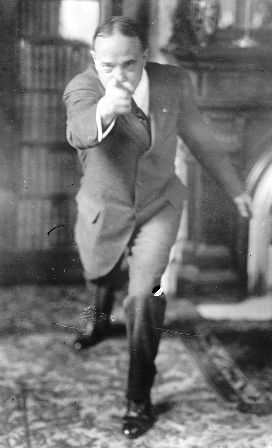
“If you say that Man was not out, you are a Liar”

24 Jun

At the height of Billy Sunday’s popularity as America’s most influential evangelist, his “gentlemanliness,” and ability, on the baseball field became more legend than fact.

Billy Sunday, evangelist

Billy Sunday, evangelist

John Brinsley Sheridan of The St. Louis Post-Dispatch attempted to dispel some of the legends in 1917:

“Sunday tells young men now ‘to play the game’ uprightly.  This is how Sunday played it in 1885:

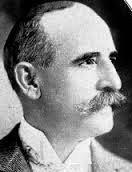
“The Browns and Chicago were playing for the world’s championship before 10,000 persons, who paid from 25 to 75 cents to see the game…The Browns kicked on the decisions of Umpire (David F. “Dave”) Sullivan and refused to play unless he retired from the game.  They could not do that sort of thing on the lots nowadays.  When Sullivan retired, (Cap) Anson and (Charles) Comiskey, the leaders of the teams, agreed that William Medart, a pulley manufacturer of St. Louis, should umpire.  Medart was a spectator at the games.  He put on a mask and a protector and proceeded to umpire. “

William Medart

William Medart

In the ninth inning of game four, with Chicago trailing 3 to 2, White Stockings pitcher Jim McCormick reached first on an error by Comiskey.  A contemporary account in The Chicago Tribune said:

“(McCormick) was standing with one foot on the bag when Comiskey made a motion to throw the ball.  He never moved, but by force of habit Comiskey touched him and laughed.  The umpire, who was not appealed to at all, electrified the spectators and players by calling McCormick out.”

Sheridan said, “This is how a baseball reporter of the day (from The Post-Dispatch) described what happened next:

“Sunday, fists clenched, eyes blazing, ran at Medart and cried, ‘Robber, robber.  That man is not out.’  Medart advanced to meet Sunday with firm step and beetling brow and aid, ‘If you say that man was not out you are a liar.’  ‘Who says that I am liar?’ Cried Sunday. ‘I do,’ said Medart, assuming a posture of defense.  ‘I’ll make you pay for that,’ cried Sunday, advancing on Medart.  ‘You can collect now,’ replied Medart, boldly.”

McCormick also attempted to attack Medart, but Mike “King” Kelly “(S)topped McCormick and then forced Sunday to sit down.”

But the future evangelist could not be calmed down:

“Sunday’s eyes were blazing and his teeth were set.  When he sat down he continued to abuse Medart, who said, “Shut up your mouth, there Sunday, or I’ll put you off the field.’ Sunday shut up his mouth, but continued to glare at Medart.”

Medart, before his death in 1913, described the scene to Sheridan:

“Billy was a cocky guy in those days and was not disposed to back down for any man.  Rather fancied himself.  I was somewhat of an athlete, gymnast and boxer.  I fancied myself, too.  I am sure that Sunday and I would have collided had it not been for Mike Kelly.

“Sunday was livid with rage.  I was mad myself.  I did not seek the job of umpiring.  I only took it to ensure the progress of the game.  I was there as a mere spectator.  Probably I was the only responsible man in the stand that was known to the managers of both teams, and, therefore, acceptable to them.  I did the best I could, but I have no doubt my work was bad.  I had not umpired ten games in my life.  I was just an amateur with a taste for ball games(Medart had umpired National League games in 1876-77 and worked at least one more St. Louis game in 1887).”

Sheridan said the man responsible for keeping Sunday and Medart from coming to blows, was also the first, and a somewhat unlikely, supporter when Sunday was “saved.”.

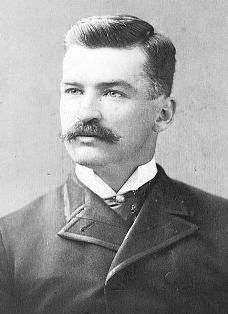
“Most of the baseball players of the day were men who lived lightly.  Among the gayest and lightest of the lot was Mike Kelly, the famous $10,000 beauty, by many said to have been the greatest of all baseball players.  Kelly had been reared in the Roman Catholic faith, but the “king” of the ballplayers was not overburdened with religion.  Ballplayers all speak well of Kelly.  He is their idol.  He was wild and wooly, he lived life and died at 35 [sic, 36], but he was sweet to all men.  Most of the ballplayers of Sunday’s day were wont to ridicule him for his conversion at first.  All but Kelly, the wildest of the wild.”

Mike "King" Kelly

Mike “King” Kelly

According to Sunday:

“Kelly was the first man to meet me after the news of the conversion became public.  He shook me by the hand and said, ‘Bill, I am not much on religion myself, but I am strong for a man who honestly believes.

“After that, the boys all were for me.  Whatever Kelly said was law with them.”

As for Sunday’s ability as a player, Sheridan said:

“Many people say Sunday is a great evangelist.  He was not a great baseball player.  One of his many biographers says that Sunday always tried to hit the baseball where it would hurt his opponents most and help his friends most.  The fact of the matter is that Sunday was lucky to hit the ball at all…(I)t is certain that, not at any time, was Sunday’s bat feared by opposing pitchers or players.

Billy Sunday

Billy Sunday

“Nor was the evangelist-to-be a great fielder or runner.  He was very fast on his feet.  That helped him a lot (and) in fact was his best asset as a ballplayer…He could outrun such men as Curt Welch and Dickey Johnston 3 yards to 2 yards, but Welch and Johnston could outfield Sunday, for they got quicker starts on batted balls than Sunday.  When it came to baserunning much slower men could beat Sunday because they knew when to run and how to get a good start on the pitcher.  Sunday never learned these little niceties of baseball.  As a matter of fact, hey are not really learned.  They are like Sunday’s gift for preaching, something given a man, his genius.”

“There were Absurd Errors, Collisions, Accidents, Spectacular Batting”

2 Mar

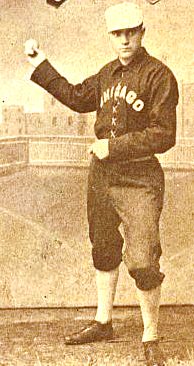
William Henry “Josh” Reilly had a memorable big league debut for the Chicago Colts in 1896.

Josh Reilly

Josh Reilly

Reilly filled in at shortstop for Bill Dahlen in a May 2 game against the St. Louis Browns.  The Chicago Tribune said Dahlen was “(E)ngaged at home in holding a hot water bag against a turbulent tooth.”

While the toothache story was reported in the Chicago papers, The Sporting Life was not sold on the reason for the hard-drinking Dahlen’s absence:

“Dahlen laid off—was sick, or—well, you know Dahlen.”

Bill Dahlen

Bill Dahlen

The Chicago Inter Ocean called the game “Worse than cough medicine,” and said:

“Of all the untabulated, unscheduled, unexpected, terrible, heartrending, frayed-out exhibitions of something or another that must be classed under the head of baseball, yesterday’s game with St. Louis was the worst.”

The Tribune said:

 “There were absurd errors, collisions, accidents, spectacular batting.”

Reilly was responsible for three of those “absurd errors,” and some of the “spectacular batting,” going 2 for 6 in his debut; he was also responsible for what The Tribune called “The electrifying feature of the game.”

The Inter Ocean described what happened:

(Monte) Cross got to first because (Chicago first baseman) George Decker thought his arm was as long as the legs of a man who has to stand on a ladder to comb his hair.  His arm was short by about six feet.  Then (Tom) Parrott made a single to center… (Duff) Cooley knocked a hot liner, and everybody started to sprint.  Reilly was playing at short, and stuck his finger nail into a loose stitch just as the ball shot past him.  He slammed it to (Harry) Truby, where Cross should have been, but was not, and Truby in turn, tossed it over to Decker to fondle while Parrott endeavored to correct himself.”

That game was the only highlight in Reilly’s major league career.  He played a total of nine games in Chicago—the other 8 at second base—and made a total of 11 errors.  And, after going 2 for 6 in his debut, he was just 6 for 36 thereafter.   Then, in late May Reilly became ill—accounts varied regarding what the illness was, The Sporting News said it was typhoid fever, The Sporting Life, and The Chicago Daily News said pneumonia.

Reilly returned home to the West Coast.  By September, his debut heroics were long forgotten, The Tribune simply said:

“(Reilly) was a disappointment and he was released.”

Despite his brief and relatively inauspicious big league career, Reilly was a popular minor leaguer for more than a decade.

An often told story about him, alleged to have taken place the year before his short trial in Chicago, illustrates just how superstitious 19th Century players could be.

The earliest telling was in 1897 in The Tribune, and it appeared on several occasions, in several papers, over the next 15 years with various embellishments.  There was no byline on the original story, but it was likely written by Hugh Fullerton–who retold it himself several times.

Reilly spent the 1895 season in Texas, playing with the San Antonio Missionaries and the Fort Worth Panthers in the Texas-Southern League.  Reilly opened the season with the Missionaries, who got off to a horrible start; they won just three of their first 28 games:

“The team was discouraged and sore.  They held a meeting and were on the verge of firing their mascot or committing violence upon his person when Josh Reilly…came to the rescue with a new proposition.  The mascot was put into a full dress coat, with gray baseball trousers and a silk hat, and the bats, some half a score of them, were pulled upon his back.  Then the team formed in line and marched down to the hotel, where “The Divine Healer,” Schlatter was stopping.”

Francis Schlatter was, at that time, walking across the American Southwest gaining fame and followers.  Three years earlier he had come to believe he received a “directive from God” to heal the sick, and became a messianic figure for many during his brief time in the spotlight.

Francis Schlatter

Francis Schlatter, “The Divine Healer”

“The divine was brought forth and made to pronounce a blessing upon the bats…and through all the season those inspired bats continued to give out base hits., and the team went close to the top of the league.”

While Reilly never disputed the story–and seemed to tell it himself on occasion–Fullerton’s ending was pure fiction. San Antonio continued to struggle and blessed or not, the Missionaries’ bats were mostly silent all season–the team never left the cellar and was 21-72 in August when they disbanded.

Josh Reilly, 1930--he died in San Francisco in 1938.

Josh Reilly, 1930–he died in San Francisco in 1938.

In different versions of the story, it was claimed that Reilly still used one or more of the “blessed bats.”  In another, Reilly “Hit .344” with one of the bats “and after he broke that bat he hit .189 for the rest of the season.”

Fullerton had one more Reilly story that he told often–first appearing in 1906 but recycled frequently for two decades–this one about his fielding troubles during his brief stay in Chicago and the impact the ire of fans has on a struggling player:

“(Reilly) was pretty bad as a fielder, and getting no better rapidly.  the jeers, hisses and hoots of the crowd merely made him mad.  He wanted to fight back.  His Irish blood was boiling.  For a time it seemed as if he would win and prove himself a great ball player merely by his nerve in playing at all under such a constant shower of criticism.  But one day Josh got through.  I found him frothing at the mouth out at the club house.  He was done.  He never would play again–unless he got a chance to kill a certain man.  When he grew calm enough.  I discovered the cause of it.

“‘He was a big man sitting in the bleachers’ said Josh.  ‘While they were all yelling at me for booting a hot one, he sat still.  I saw him and  said to myself ‘there’s one friend of mine up there.’  He never said a word until the seventh inning.  Then he stood up, stretched himself, walked down two or three steps and yelled:  ‘Reilly, you’re a disgrace to the Irish!’  If I had him I’d killed him.'”

“Throw Strikes. Home Plate Don’t Move.”

19 Jan

Satchel Paige told Dave Condon of The Chicago Tribune that early in 1965, with the help of his wife Lahoma, and 17-year-old daughter Pamela he “wrote letters to everyone in baseball just looking for a steady job.  Anything.”

After not one professional team responded, the spring and early summer were like most during his 40-year career as a pitcher—Paige traveled wherever there was a chance for a paycheck.

He had made appearances with the Harlem Globetrotters in the winter and spring and then hit the road; pitching for the barnstorming Indianapolis Clowns and whoever else would call.  In May, The Chicago Defender said Abe Saperstein, who was managing Paige’s appearances, took out an ad in The Sporting News:

“(T)he man, who may have been the greatest pitcher of all time, is letting it be known that he has glove and is willing to travel.  All that is necessary to secure his services is to contact Saperstein.”

One night Paige would be at Chicago’s Comiskey Park, in a White Sox uniform, pitching for the Clowns in front of a large crowd, or across town in Wrigley Field where 30,000 fans came out; another night would find him in Hastings, Pennsylvania taking “the mound for the Hastings VFW club,” or Wheatfield, Indiana pitching “for the Band Boosters against the Wheatfield Young Farmers,” in front of a few hundred people.
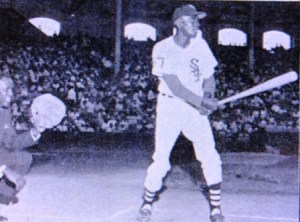
Paige at Comiskey Park in 1965--Chicago Cubs outfielder George Altman is the catcher.

Paige at Comiskey Park in 1965–Chicago Cubs outfielder George Altman is the catcher.

Things began to look up in late July when the Cleveland Indians inducted Paige into the team’s Hall of Fame between games of a Sunday doubleheader with the Yankees; in front of the team’s largest crowd of the season:  56,634.  According to United Press International:

“Satch tossed examples of his blooper, drooper and hesitation pitches to (former Indians teammate) Jim Hegan, now a Yankee coach and explained his philosophy of pitching thus: ‘Just take the ball and throw it where you want to.  Throw strikes.  Home plate don’t move.”

In August, he accepted an offer to pitch for and manage a team in Anchorage, Alaska called the Earthquakers.  In reality, Paige simply went to Alaska for a short series of exhibition games, and had no intention of staying there—he was already booked to appear at the old-timers game scheduled in September to mark the first season of the Houston Astrodome.  But he did his best to sell it as a possible long-term move.  He told a reporter for The Associated Press:

“Lately, I’ve wanted to leave barnstorming baseball to settle down somewhat to help the sport.  Anchorage seems to be the place to do it.”

In addition to his appearance in a handful of games in Alaska, his arrival in the state also resulted in a chance meeting that was reported in the press.

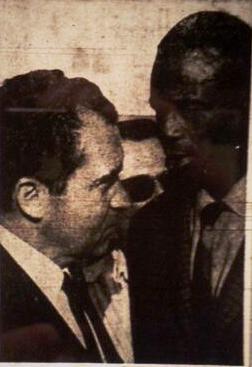
As a crowd of local residents gathered at the Anchorage airport to greet Paige, another plane arrived for refueling.  It carried former Vice President Richard M. Nixon on his way to Tokyo.  Nixon walked into the terminal while the plane was refueled, and when he asked about the crowd he was told they were waiting for Paige’s arrival.  Nixon joined the line to greet the pitcher.  The man who would be the leader of the free world in a little more than three years told a reporter from The Associated Press:

“I always like to meet celebrities.”
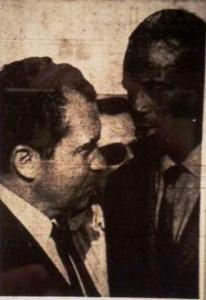
Nixon and Paige meet in Alaska

Nixon and Paige meet in Alaska

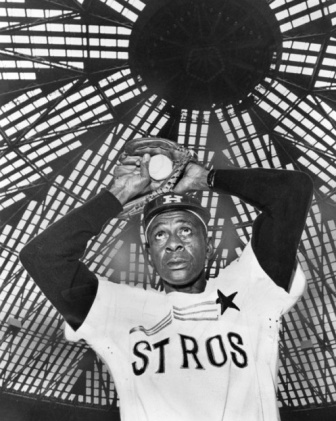
His commitment in Alaska over, Paige made it to the Astrodome on September 6.  The two-inning game, featuring a team of “immortals” versus “Texas All-Stars,” was an incredible collection of legends—more than 50 former players participated; twelve were already members of the Hall of Fame.  The Houston Post said of the player introductions:

Joe DiMaggio, the Yankee Clipper, got a deafening cheer.  So did Satchel Paige, peerless Negro hurler.”

The paper said the only others to receive a reception near that for Paige and DiMaggio were Dizzy Dean and native Texan Monty Stratton.
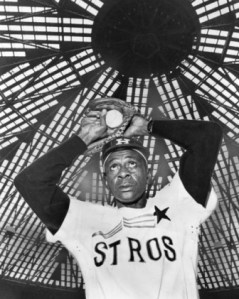
Paige in the Astrodome

Paige in the Astrodome

Perhaps it was the reception in Houston that caused one of the letters Paige, and his wife and daughter had written months earlier to finally be answered.

Charles Oscar Finley, who made his fortune in the insurance business and bought controlling interest of the Kansas City A’s before the 1961 season, was the one who finally responded.

That the signing of Paige appears to have been a spur of the moment decision for Finley after reading about the reception in Houston, is supported by the fact that it was announced by the marketing savvy Finley at what The Kansas City Times described as a “hastily called news conference,” which Finley, who was in Chicago, did not attend.

He appeared with General Manager Hank Peters and told reporters “I thought they were kidding” when Finley called and offered him a contract.

He said he was ready to pitch and brushed aside questions about his age:

“I think I can still pitch and help this club.  So what difference does it make what my age is if I can?”

Bill Veeck, who had signed Paige with the Cleveland Indians in 1948 and the St. Louis Browns in 1951, told The Times he hoped it wasn’t just a publicity stunt by Finley:

“I am hopeful he will be used as he should be—as a pitcher. Leroy should surprise a few people as he has for a long time.”
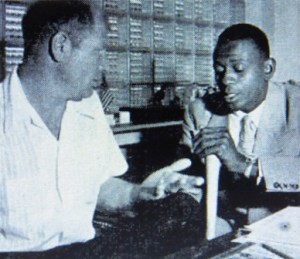
Veeck and Paige

Veeck and Paige

The controversial Veeck, more than a decade away from his return to the game, told The Kansas City Star he blamed himself for the pitcher’s  long absence:

“When I left Cleveland the first thing the new owners did was get rid of Satch.  When I sold the St. Louis Browns (and the team relocated to Baltimore), the same thing happened.  That’s nothing more than guilt by association.”

The signing of the 59-year-old Paige, who joined a team that included five 19 and 20-year-old pitchers who appeared in at least one game that year—Jim “Catfish” Hunter, John “Blue Moon” Odom, Ron Tompkins, Tom Harrison and Don Buschorn—inspired a short poem published in The Star:

“They’re either too

Young or too old,

When Charlie puts ‘em

In A’s Green and Gold.”

Papers across the country carried a photograph of Paige, seated on a chair, with one of Finley’s young pitchers, Catfish Hunter, on his knee.  While the photo was straight from Finley’s marketing plan, the impact of one future Hall of Famer on another, forty years his junior, seems to have been real.
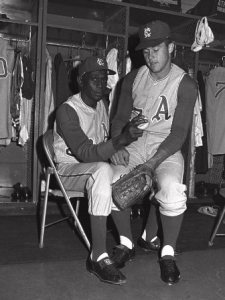
Paige and Hunter

Paige and Hunter

The Star spoke to Paige about his pitching philosophy one afternoon as Hunter stood nearby.  The paper said:

“Hunter listened intently as Satchel expounded his pitching theories.”

Paige was equally impressed with the 19-year-old, telling The Star:

“This young man has shown me a lot of poise.  He has a great future in this game.”

The next two weeks were filled with pictures of, and stories about, Paige in a rocking chair, a nurse seated nearby, watching the A’s play, and while a “Satchel Paige Night” was scheduled, there appeared little chance the pitcher would be used as anything but a prop for publicity.  Then Finley announced that his new pitcher would start on his night, September 25 against the Boston Red Sox.

What took place on the mound on September 25 has been written about many times. With his six children and wife Lahoma—pregnant with number seven—sitting in the owner’s box with Finley, Paige pitched three shutout innings, allowing just one hit—a Carl Yastrzemski double.

The only disappointment was the anemic crowd—just 9,289 Kansas City fans turned out to see a legend, the second largest crowd during that six-game home stand was 2,874.

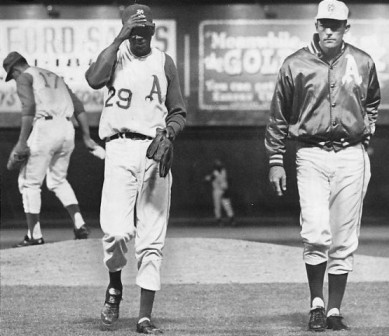
As Paige took the mound in the fourth inning, A’s Manager Haywood Sullivan, who was not consulted before Paige’s signing or before Finley announced he would pitch that night, came to the mound to remove Paige.  The pitcher walked off to a standing ovation.
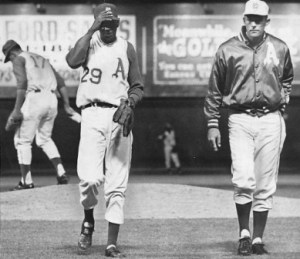
Paige walks off the field with Manager Haywood Sullivan while Diego Segui warms up.

Paige walks off the field with Manager Haywood Sullivan while Diego Segui warms up.

Paige returned to the clubhouse.  The Star said:

“In the clubhouse he was down to his long underwear, and talking about helping the A‘s out of the basement when someone rushed in a and screamed, ‘Satch, they want you back on the field.’

“The lights were out.  More than 9,000 matches flickered in the darkness, and on ‘Salute to Satchel Paige Night,’ they sang ‘Rockin’ Chair,’ ‘Darling I am Growing Old,’ and “The Old Gray Mare.”

After returning to the clubhouse, Paige was greeted by Finley, who called him “a real credit to the game.”  Paige “shook the owner’s hand” and said “I want to thank you for bringing me here.”

Whether he truly believed it or not, Paige told reporters he planned to pitch again in 1965.

“Everybody doubted me on the ballclub.  They’ll have more confidence in me now.”

He did not appear in another game but stayed with the club for the remainder of the season.  Two days after his three-inning performance, he was with the team in Baltimore.

A discouraging word had not been uttered by Paige during his time with the A’s.  Perhaps being in Baltimore—where his big league career effectively ended after Veeck sold the Browns—or maybe just the realization that a man capable of throwing three shutout innings at age 59 was not given an opportunity by a major league club the previous 12 seasons, changed that.

Lou Hatter wrote in The Baltimore Sun:

“Satchel Paige, the slender pitching ancient signed 2 ½ weeks ago by Kansas City, bared a deep-rooted wound here last night for the first time.”

Paige said to Hatter:

“You can put it this way.  You can say I resent being overlooked by organized baseball all these years while I threw away most of my best years pitching for a barnstorming club…All they ask me, though, is how old am I.  But nobody asks me why I stayed out of the major leagues for 15 [sic 12] years.  That’s a long time isn’t it?  That’s a lifetime for most professional players.

“Let me ask another question. When Baltimore bought the St. Louis ballclub, why did they turn me loose?

“When I went to the Miami club (again pitching for Bill Veeck with the International League Marlins) and was a top pitcher for three years (11, 10 and 10 win seasons with ERAs of 1.86, 2.42 and 2.95), how come nobody picked me up?…I know the answer, but I won’t tell that neither—like I won’t tell my age.”

Despite Finley telling reporters throughout September that Paige would return to the A’s in 1966, if not as a player, then as a coach, he was released in September. The next time he appeared on the mound at Kansas City’s Municipal Stadium, it was again as a member of the barnstorming Indianapolis Clowns.
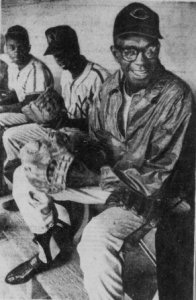
Paige back in Kansas City as a member of the Indianapolis Clowns in 1966.

Paige back in Kansas City as a member of the Indianapolis Clowns in 1966.

“Wallace’s Head is Abnormally Developed”

29 Dec

When Bobby Wallace was named manager of the St. Louis Browns in 1911, the local press, desperate for any ray of hope for a club that finished in eighth place with a 47-107 record, enlisted a “noted phrenologist” named Squeers from Hot Springs, Arkansas to examine the new manager.

Booby Wallace

Booby Wallace

Phrenology was a popular pseudoscience in the in the 19th and early 20th Century that claimed the structure of the skull determined a person’s mental ability and character.

The result of Wallace’s examination was reported in several newspapers:

“The eminent brain specialist pronounced the manager of the Browns one of the most normal-minded men he had ever examined.  He did not know his man when he made his diagnosis.

“Wallace’s head is abnormally developed on the left side.  This is as it should be, Dr. Squeers declares.  The left lobe of the brain governs the right side of the body…It is natural, asserts Dr, Squeers, that a man should be right handed, right-footed, right-eyed, that the right side (of the body) should be larger and stronger than the left.”

It was not enough to declare Wallace “normal minded,’ the “doctor” also “diagnosed” roughly 10 percent of the general population.  He said because “It is natural” to be right-handed, left-handers therefore, were “in many cases a bit abnormal.”

The litany of “abnormal” left-handers–Rube Waddell, Crazy Schmit, Nick Altrock, Slim Sallee, Lady Baldwin, etc…–were trotted out to demonstrate the “proof” of the assertion.

 “For whatsoever the reason may be, the man whose throwing arm is governed by the right lobe of his brain seems bound to be erratic.  Thus is Dr, Squeers, knows little of baseball, justified in pronouncing Wallace an ‘abnormally normal’ man.  Wallace is the farthest thing from erratic that any man could be.  He could not do a left-handed or wrong thing—could not act abnormally to save his soul.”

[…]

“Wallace has been the quietest, most regular, most normal human being in the world.  He is the perfection of moderation, of balance in all things.  He takes life quietly and is never disturbed or out of temper.  He has never made an enemy.  He is the favorite of everyone…It remains to be seen if normality means success when it is applied to the management of a baseball team.”

In this case it didn’t.

The Browns, awful in 1910, were awful again under Wallace in 1911; another eighth place finish with a 45-107 record.  After a 12-27 start in 1912, George Stovall replaced him as Browns manager.

Wallace managed one more time—he replaced Chuck Dressen as manager of the Cincinnati Reds in September of 1937.  The “most normal human being in the world” was 5-20.


“People who saw the Sport are still Laughing”

17 Dec

High expectations came with George W. “Big Mike” Mahoney to his hometown Boston Beaneaters in 1897.

A baseball, track and football star at Georgetown University—he played football until the University disbanded the team after his backfield mate George “Shorty” Bahen—a foot shorter than Mahoney– died from injuries sustained during the team’s Thanksgiving Day game against Columbia in 1894.

George "Big Mike" Mahoney

George “Big Mike” Mahoney

In 1895, he gained notice for his pitching after striking out 13 batters in a game with Yale.

The following year, The Philadelphia Times said:

“He has won enviable renown as a pitcher, where his remarkable strength, speed and ability to curve have made him a very formidable player.  He has also played football, where his remarkable physique, weight and strength have stood him in good stead.  One would imagine that his weight—236 pounds—would prevent his running with any remarkable speed, but it is so distributed—he being probably the largest athlete in the college world, measuring six feet five—that it is little of an encumbrance to him.”

In the spring of 1897, it was rumored that Mahoney would not return to Georgetown and instead sign with Boston.  The Philadelphia Inquirer said:

“(I)t is understood that he will play professionally with the Boston league team.  Mahoney is considered a wonderful pitcher, as well as being a fine catcher and first baseman.”

Shortly after signing with the Beaneaters, The Washington Evening Times said Mahoney had been offered the opportunity to take up yet another sport:

“(Mahoney) has a chance to shine pugilistically.  En route to Pittsburgh Sunday the Bostons had Bob Fitzsimmons for a traveling companion.  Fitz was smitten with Mahoney’s size, and offered to take him in charge and coach him into a high-class heavyweight.”

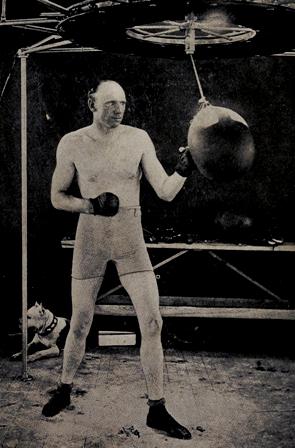
Bob Fitzsimmons-wanted to train Mahoney for the ring.

Bob Fitzsimmons-wanted to train Mahoney for the ring.

Mahoney turned down the offer.

On May 18 Boston was in Chicago; trailing the Colts 9 to 5 in the eighth inning, Mahoney made his big league debut on the mound for the Beaneaters.

The Colts and The Chicago Daily News were not kind to the rookie:

“Mr. Mahoney, the largest man seen in the League for many moons, made his debut in professional ball at the west Side Grounds yesterday.  He now wishes he had tarried at his Georgetown school.  The reception given Mr. Mahoney was one of the warmest ever seen around these districts since the year 1, and the people who saw the sport are still laughing.

“Mr. Mahoney is 6 feet 5 or more, and one of the finest looking men imaginable.  Small girls, who admire big men, could be heard squeaking, ‘Isn’t he cute?’ all of the stand.  He has been loafing around the park during the present series, doing nothing but taking life easy, and the multitude were really getting inquisitive as to who he was and what right he had to live.

“He went into the fray at a rather inauspicious time.  The Colts had just demolished (Ted) Lewis and had biffed fat (Jack) Stivetts in the solar plexus.  When Mr. Mahoney’s giant frame loomed up there was a shout of laughter, then a pause of dread lest the monster should prove strong and speedy in proportion to his fearful size.

“He threw a ball:  (Bill) Dahlen hit it.  He threw another: (Bill) Lange hit it.  He threw one more: (Walter) Thornton hit it.  And the picnic might have gone on had not the long man climbed eleven feet higher and pulled down a bounding ball (Mahoney had jumped high to rob Colts catcher Tim Donahue of a hit up the middle)”

Mahoney faced seven batters, allowed two runs, three hits, walked one and struck out one.

Mahoney

Mahoney

The Daily News ended the ridicule by allowing that Mahoney might, someday, be a good pitcher:

“The fate of Mr. Mahoney is no new experience for a young pitcher.  Many a man who has afterward been a star has been a horrible fizzle on his first appearance, while many a man who has panned out no good on earth has made a glorious debut.  Thornton was a conspicuous success on his initial day, and has been nothing in the way of box work since.  (Clark) Griffith did not do very well the first tie he pitched for (Cap) Anson, and he is the best of all nowadays.  Mr. Mahoney, if given a fair show, may yet become a (Amos) Rusie.”

Mahoney never received “a fair show.”  He never pitched in another major league game.  He caught one game for Boston, and went 1 for 2 with an RBI, but was released in July of 1897.  Mahoney appeared in two games for the St. Louis Browns the following season—he was 1 for 7 and committed one error.  For his four-game big league career he hit .111 and posted an 18.00 ERA.

After one more season playing for several East Coast minor league teams, Mahoney returned to Boston where he became a police officer; he died there in 1940.

“I guess I am Rotten”

24 Nov

It was in doubt where Pete “The Gladiator” Browning would play in 1892.

There is no record of exactly how he parted ways with the Cincinnati Reds—Released by the Pittsburgh Pirates, Browning hit .343 for the Reds in 55 games in 1891 after signing with the club on June 29—but, by January of 1892 there were a steady stream of rumors about where he would sign.

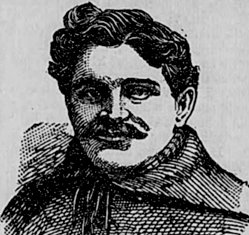
Pete Browning

Pete Browning

Speculation included the Baltimore Orioles and St. Louis Browns, but Browning opted to return home to Louisville, and signed with the Colonels—he was released again after an early spring salary dispute, but signed a new contract with the team a week into the season.

Browning returned Louisville with much fanfare.  The Courier-Journal said, after he contributed two singles and two sacrifice hits in a 7 to 2 victory over the Chicago Colts:

“Prodigal Pete…walked out—‘Prods’ do not return in carriages—to his old home in left field at Eclipse Park yesterday afternoon, where he had spent a happy, happy youth before the false adulation of the outer world called the Gladiator away.”

After am 11-3 start, the Colonels were returning to form, and were beginning to look like the ninth place team with a 63-89 record they would be at season’s end.

To make matters worse, “Prodigal Pete” struggled after his first game, hitting just .247—94 points less than his career average—in 21 games.

Browning explained his sump to Harry Weldon of The Cincinnati Enquirer:

“’I guess I am rotten. I guess I ought to be out of the business,’ said Pietro Gladiator Browning, as he walked on the field.  ‘Old Gladdy ain’t to his speed yet, but he’s hitting ‘em, and hitting ‘em good, but not as good as he will hit ‘em though, cause he’s got the catarrh, and is stopped up in the head.  When you’re stopped up your ‘lamps’ ain’t right.  Wait until the sun gets hot and the catarrh leaves the old hoss.  Then the pitchers will have to look out.  Will I lead the league in hitting?  Why not?  Look out for me.  None of ‘em are getting away from me in the outfield.  Did you read about me going up in the seats and pulling down a fly that saved the game?  I can do it right along.  None of them big stars, Jim) McAleer, Curt Welch or any of the rest of them fellows have the best of old Pete on fly balls.  The old boy is still ready money, and worth one hundred cents on the dollar.”

Within days the Colonels gave up on the Gladiator and handed him his release on May 18.

For a time Browning got his “lamps’ right again.  After signing with the Reds again, he hit .303 the rest of 1892.  He returned to Louisville in 1893 and hit .355 in part-time role.

“Then the Harder I threw the Harder they hit them”

3 Oct

Walter Newton Justis–often misspelled “Justus” during his career– performed an incredible feat in 1908.  While posting a 25-17 record for the Lancaster Links in the Ohio State League, he pitched four no-hit games between July 19 and September 13.

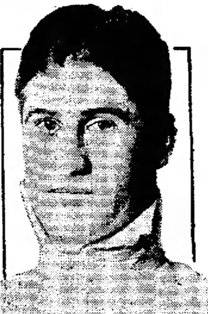
Walter Justis

Walter Justis

The performance earned him his second shot to make the big leagues.  The first consisted of two relief appearances (8.10 ERA in 3.1 innings) with the Detroit Tigers in 1905 when he was 21.  He said later that he wasn’t ready:

“All I knew was to burn them over.  And the harder they hit them the harder I threw.  Then the Harder I threw the harder they hit them.  Most of the time in the three months that I was there I lugged the big bat bag, and I guess I earned my salary then about as much as at any time I know of.”

Justis’ bizarre behavior often made as big an impression as his pitching.  Roy Castleton was pitching for the Youngstown Ohio Works in 1906 when Justis joined Lancaster (the team was in the Ohio-Pennsylvania League in 1906 and ’07, and joined the Ohio State League in 1908).

Castleton, while playing for the Atlanta Crackers two years later told The Atlanta Constitution  he thought “Rube Waddell and Bugs Raymond, two players well-known for their eccentricities…will have to take off their top pieces,” to Justis.  Castleton was staying in the same hotel as the Lancaster team:

“Early one morning he heard someone raising a disturbance in the hotel hallway and taking a look to see what was doing, he observed pitcher Justis…running down the hallway.

“’At the end of the hall Justice placed a pillow against the wall.  He would get a good start down the hall and after the fashion of a man on the paths would take a running slide at the pillow.  When he arrived at his destination he would hold out his hand as umpires do and yell ‘safe!’  Justis would keep this up for hours at a time playing base runner and umpire out in the hall at daybreak.’

“’Sometimes he would stop the double existence of umps and runner and would (just) be the judge of the play.  Standing over the pillow he would hold out his hand and yell ‘safe’ so loudly that he could be heard a block off.’”

The Constitution also said that Justis was superstitious:

“He never goes into a game without wearing a pair of ladies’ silk hose supported in the usual manner.  Regular baseball stockings would never do for him, as he believes his career as a pitcher would be cut short if he were to wear them in a game.”

He was signed by the St. Louis Browns, and Manager Jimmy McAleer told The St. Louis Globe-Democrat the pitcher’s eccentricities were a positive:

“McAleer says that the reason he signed pitcher Justis of Lancaster was because Justis bears the reputation of being a baseball ‘bug.’  ‘Bugs,’ says McAleer, ‘make good in St. Louis.  We have Waddell, while the Cardinals have ‘Bugs’ Raymond.’”

Justis joined the Browns in Dallas in the spring of 1909.

The Globe-Democrat said after he had a poor outing in an exhibition against the Houston Buffaloes of the Texas League:

“Justis pitched two innings for the Browns Saturday and the Houston team got six runs.  Until this bombardment he was tagged for the regular club, and the label hasn’t been removed yet, though slightly loosened.”

And Justis appeared to have made the team when they broke camp in Texas and returned to St, Louis in early April, but The Associated Press reported on April 6:

“Walter Justus, a pitcher recruit of the St. Louis Browns, is confined to his room by a severe nervous collapse, and the nurse in charge says he may be able to leave for his home in Indiana in a few days.  Justis lost his power of speech at the end of a wrestling bout with Arthur Griggs in Sportsman’s Park today.  It is claimed Justus fell to the floor, striking his head, and reopened an old wound received when a boy.”

Justis suffered similar attacks at least four other times during his career; in June of 1907, twice in 1908, and August of 1909.  In July, 1908 after a double-header with the Lima Cigarmakers, The Marion (Ohio) Daily Mirror said “(Justis) suffered a sudden brain stroke akin to apoplexy.  He fell in a dead faint at the close of the second contest.  He was removed to his hotel in an unconscious condition.”   In September, after another attack left Justis hospitalized, The Sporting Life said prematurely “physicians say he will never twirl another game.”   It is likely that he suffered from epilepsy.

Within days of returning to Indiana from St. Louis Justis fully recovered.  The Associated Press said “His recovery is one of the most remarkable in the history of athletes.”  But, despite his recovery, Justis was returned to Lancaster by the Browns, and lost his opportunity to return to a major league team.

He threw another no-hitter for Lancaster in 1909, on May 18 against the Marion Diggers, and went 19-16 for the season.  Justis continued pitching until 1913, finishing with the Covington Blue Sox in the Federal League—where he played with the equally eccentric, enigmatic Fred “Humpy” Badel.

Justis shut out the St. Louis Terriers 4 to 0 on the opening day of the Federal League season, but no complete records remain for the season.  By late September of 1913 he was back home in Greendale, Indiana pitching for a local team.  He remained in Greendale until his death in 1941.