Tag Archives: St. Louis Browns

Such Clanging of Bells and Blowing of Horns has never been Equaled in Athletic Park”

24 Feb

From the formation of the Cuban Giants as the first professional black team in 1885 until the establishment of the Negro National League in 1920 there were many attempts to form an organized league; and numerous advocates for the idea.

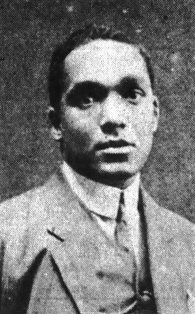
Lester Aglar Walton, editor of The New York Age, believed the color line was borne solely out of “the white man’s fear in open competition,” but also understood that the situation was not likely to change.
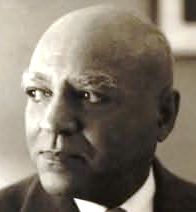
Lester Aglar Watson

Lester Aglar Watson

In 1911, Walton thought the conditions for starting a league were right, were right based on a three-game series in June—the Chicago Leland Giants traveled to St. Louis for a three-game series with Charles Alexander Mills’ St. Louis Giants:

“The figures, giving the attendance at the three games played, are interesting and furnish those who have been agitating the organization of a colored baseball league much cause for jubilation.  They are now enthusiastically pointing to figures to back up the assertion they have been making all along that a colored baseball league would pay;  also that the fans would give it their loyal support.”

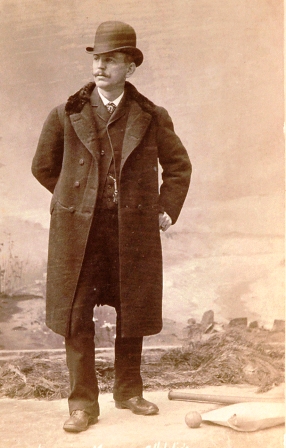
Charles Alexander Mills,

Charles Alexander Mills

The Freeman described the atmosphere at the first game:

“The Chicago Giants entered from the south entrance, headed by Captain Pettis (William “Bill” “Zack” Pettus), and followed closely by the entire squad, clad in blue caps and white uniforms.  The contrast was rich.  At the site of the Chicago boys the fans cut loose, and such cheerings in respect would be fit for a king.  Ten minutes later Captain (Richard Felix (Dick) Wallace and his squad emerged from the club house, all in a quick step, and when they came in view of the vast throng such clanging of bells and blowing of horns has never been equaled in Athletic Park.”

Bill Pettus
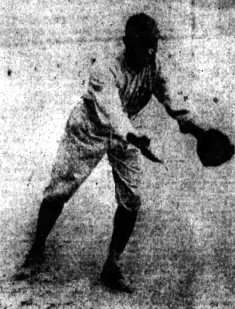
Bill Pettus

Walton noted that the opening game, played on June 21, drew 2,200 fans.  On the same day in Cincinnati, just 700 attended a Reds game against the St. Louis Cardinals.  The following day 2,500 hundred watched the two teams play, and about 2,600 attended on Friday.  The St. Louis Browns, playing the Chicago White Sox on Wednesday and Thursday at Sportsman’s Park, drew smaller crowds both days:

“It should not be overlooked that the fans turned out in goodly numbers to see the St. Louis Giants and the Chicago Giants on week days.  On Sundays it is not unusual for the St. Louis Giants to play before 5,000 people.  It is, however, generally admitted that strong colored teams are good Sunday attractions, but the difference of opinion has invariably come up over the question of whether the fans would put in their appearance in sufficient numbers on week days.

“What is also considered significant by those who favor the formation of a colored baseball league is that with few exceptions the crowds were composed of colored people, which proves conclusively that members of the race will support colored clubs when they put up a good article of ball.  The same can be said of white fans, and quite often, for instance, in greater New York, more whites attend baseball matches between colored clubs than colored.”

Walton said it was always understood that New York and Chicago could support a member club in an organized league, but there was “doubt as to whether devotees of the national game in St. Louis, Cincinnati, and Louisville etc…would turn out in sufficient numbers to ensure the players a nice check when payday rolled around.”  The series, he said, erased some of those doubts:

“Cincinnati, Louisville, Baltimore and other cities considered can make as good a showing as St. Louis.  Furthermore…these cities have but one big league team, while St. Louis has two, a condition which it is claimed, would argue in favor of the respective colored teams securing a larger white patronage.”

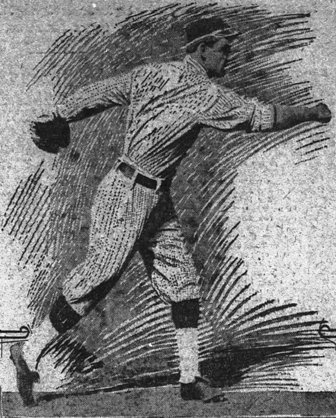
The St. Louis Giants swept the three-game series—winning all three in the bottom of the ninth inning; including a 2 to 1 victory behind “Steel Arm” Johnny Taylor over “Smokey Joe” Williams in game two—Taylor also won game one in relief.
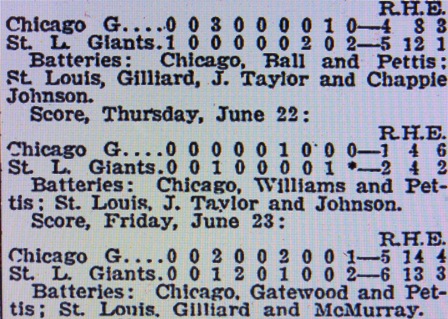
The line scores from the three games

The line scores from the three games

Despite the enthusiasm, three excellent, well–attended games, and the resulting optimism as a result of the attendance in St. Louis during three days in June of 1911, an organized black league was still nearly a decade away.
“Hilariously and Shockingly Drunk”

11 Dec

The Philadelphia Athletics were in second place, two games behind the St. Louis Browns in the American association pennant race in June of 1889; but The Philadelphia Times said the team was underachieving, and blamed it on drinking:

“Watch your men, Manager (Bill) Sharsig.

“It is a matter of notorious publicity that a portion of the best players on the Athletic Base Ball Club are not living up to their contracts.  They drink, carouse and make exhibitions of drunkenness that are disgusting the people who so liberally contribute to the support of the national game, and unless the management put an immediate stop to such proceedings the club will be certain to finish the season with a balance on the wrong side of the ledger.”

The paper said because it was “unjust to criticize the club as a whole” they would name the guilty parties:

“It is an open secret that (Denny) Lyons, (Curt) Welch, (Mike) Mattimore, (Henry) Larkin, (Harry) Stovey and sometimes (Frank) Fennelly and (Lou) Bierbauer are frequently in a beastly state of intoxication, and it is easy to prove when and where they have recently been seen so in public places.”

The Times singled out Welch, who was out of the lineup because Sharsig said he was ill:

“Sick he may be, and those who saw him in company with Lyons last Tuesday morning at the early hour of 3 O’clock wonder that he is not laid up.  That model pair were sitting on the curbstone on the South Penn Square side of the City Hall, hilariously and shockingly drunk.

“Saloon-keeper Irwin, who keeps on Juniper Street, told a friend that Welch and another ballplayer became so vulgarly and obscenely boisterous in his place on Monday night that he had to order them out.”

Curt Welch

Curt Welch

The Times said the Athletics loss on June 16—they were defeated 9 to 5 by the Browns—“was largely due to errors made by Welch, Stovey, Larkin and Lyons, all of whom showed traces of their Saturday night’s outing.”

The team’s activities were not limited to Philadelphia, from “every city on the circuit came stories of debauches and sprees,” involving the Athletics:

Chris von der Ahe, of the champion Browns, is responsible for the statement that on the last trip made by the Athletics to St. Louis six of the players became so drunk and noisy in the big Anheuser-Busch saloon that the proprietor had to have then ejected, and a ballplayer on another club that chanced to meet the Athletics in East St. Louis said yesterday that he never saw so many drunken men on one team and that their unseemly conduct was the subject of general talk around the depot.  From Baltimore and Brooklyn come well authenticated stories of boisterous sprees and hilarious conduct in public places.”

The Times said even the most famous umpire of the era, “Honest John” Gaffney, “whom a ballplayer has no truer friend,” commented on the state of the Athletics:

“He says that he has repeatedly seen some of them come up to bat so drunk that they could hardly stand.”

John Gaffney

John Gaffney

The paper said Sharsig, “an exceedingly clever gentleman,” had completely lost control of the team:

“The ballplayers all like him and avow their willingness to do for him whatever he asks, but he is apparently unable to keep them sober even at home and when away they are absolutely beyond his control.  He does not believe in imposing fines…Stovey, Welch and Larkin know that it would be hard to fill their places and laugh at threatened dismissal.”

The Athletics lost six straight games after the story appeared, and 16 of their next 22.  They ended the season in third place with a record of 75-58.

Manager Bill Sharsig

Manager Bill Sharsig

Mattimore was released in August.  Larkin, Bierbauer and Stovey jumped to the Players League after the season ended, and Fennelly was sold to the Brooklyn Gladiators.

Sharsig’s 1890 team led the American Association until July 17, then faded badly and finished in eighth place.  There was no mention in the Philadelphia press about whether drunkenness contributed to the 1890 collapse.

“The Great Baseball Question has been what will Capt. Comiskey do next Season”

3 Dec

In January of 1890 The St. Louis Globe-Democrat said what was on the minds of every baseball executive, writer, and fan:  “The great baseball question has been what will Capt. Comiskey do next Season”

For weeks there was speculation about whether Charles Comiskey, captain and manager of the St. Louis Browns, would remain in the American Association or join the Players’ National League of Professional Baseball Clubs (Players League), the league borne out of baseball’s first union the Brotherhood of Professional Base-Ball Players.

Charles Comiskey, against slang in baseball stories.

Charles Comiskey

On January 15, in a letter to The Sporting News, Comiskey announced his decision:

“During the past few weeks many interviews have appeared with me in different newspapers of the country relative to my having signed a contract with the St. Louis and Chicago Brotherhood clubs.  Up to this writing I am mind and fancy free.  But before Saturday night, January 18, I will have signed a contract to play at first base for the Chicago Brotherhood team.  I take this step for the reason that I am in sympathy with the Brotherhood.

“I believe its aims are for the best welfare and interest of the professional players.  I believe that if the players do not this time stand true to their colors and maintain their organization they will from this day forward be at the mercy of the corporations who have been running the game, who drafted the reserve rule and give birth to the obnoxious classification system.

“I have taken all the chances of success and failure into consideration, and I believe that if the players stand true to themselves they will score the grandest success ever achieved in the baseball world.

“But besides having the welfare of the players at heart I have other reasons for wanting to play in Chicago.  My parents and all my relatives reside there, and the all the property I own is located in the city.  I was raised there and have a natural liking for the place.  But, outside of all these reasons, my relations with the management of the St. Louis club have, during the past year been so unpleasant I do not care to renew them.  I have many friends in St. Louis, and for their sake I hate to leave here, but the other reasons out-balance this friendship, so I will cast my lines with the Chicago club.

“This is the first letter I have written on the subject which seems to have interested the baseball world throughout the whole of the present winter.

“Yours respectfully, Chas. Comiskey”

A week before the season began The Chicago Tribune said Comiskey’s new club “on paper, is the greatest team ever organized.”   Despite the hype, Comiskey’s Chicago Pirates finished in fourth place.  The Players League lasted only one season and dissolved in November of 1890.

Comiskey’s backing of the Brotherhood against “the corporations who have been running the game” would probably have come as a surprise to many of those who played for him when he owned the Chicago White Sox.  Arnold “Chick” Gandil, banned from baseball for his role in the 1919 Black Sox scandal said of Comiskey in a 1956 article in “Sports Illustrated:”

“ He was a sarcastic, belittling man who was the tightest owner in baseball. If a player objected to his miserly terms, Comiskey told him: “You can take it or leave it.” Under baseball’s slave laws, what could a fellow do but take it? I recall only one act of generosity on Comiskey’s part. After we won the World Series in 1917, he splurged with a case of champagne.”

Chick Gandil

Chick Gandil

Sam Barkley and the Mobster

29 Oct

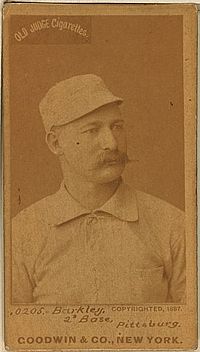
Samuel W. Barkley’s brief career on the diamond was highlighted by two legal disputes over his services; his life off the field was more complicated and interesting.

Barkley rose from amateur and semi-pro teams around Wheeling, West Virginia, to a solid season (.306, league-leading 39 doubles) as a 26-year-old rookie with the Toledo Blue Stockings in the American Association in 1884. Among his teammates in Toledo were Fleetwood and Welday Walker.

Toledo was only a major league franchise in 1884—The Toledo Blade said the team had lost “nearly $10,000–and disbanded,” selling five players, including Barkley, to the St. Louis Browns—the sale included pitcher Tony Mullane, who attempted to sign with Cincinnati after agreeing to sign with St. Louis, leading to his year-long suspension. By the time all the legal wrangling was done, only Barkley and Curt Welch reported to the Browns.

After a .268 season in St. Louis, owner Chris Von der Ahe sold him to the Pittsburgh Alleghenys, but Barkley had already signed a contract with the Baltimore Orioles. The American Association suspended and fined Barkley; Barkley sued. The dispute was settled with Barkley being reinstated and Pittsburgh paying the fine on his behalf.

Sam Barkley

Sam Barkley

After two years in Pittsburgh, he was purchased by the Kansas City Cowboys, and that’s when his life got more interesting.

In Chicago, he met an 18-year-old woman named Dora Feldman, who followed him to Kansas City, where as The Toledo News-Bee said, “most of his money was thrown at the feet of the young woman.”

The Chicago Inter Ocean said Barkley claimed, that the day before he married Dora, “she went to her room in a Kansas City hotel and took poison, fearing he would not marry her.”

Despite the suicide attempt, the two married.

He hit just .216 in 1888 but was hitting .284 the following year when he was sold to the Toledo Black Pirates in the International League. After just 50 games there his career was over. At some point during the 1888 season he suffered a knee injury he said ended his career:

“I knocked a safe one to left field, and was dancing around between first and second bags when (Mike) Mattimore, the Philadelphia (Athletics) pitcher attempted to catch me napping. He ran to the base line, and as I attempted to slide back to the first bag he unintentionally gave me the ‘knee’ and it injured severely the knee cap on my left leg.”

With his playing days behind him, Barkley, who was reported to have made as much as $1,800 a season with the Alleghenys, returned to Pittsburgh with a young wife who had aspirations to be an actress and opened a cigar store.

It didn’t end well.

After just more than a year in business, The Pittsburgh Press said Barkley’s store on Smithfield Street closed by order of the sheriff, due to “claims aggregating $3,600.”

The couple moved to Chicago.

Initially, things went better there.

Barkley opened a tavern at 292 West Madison Street, and he and Dora had a son who was born around 1895.

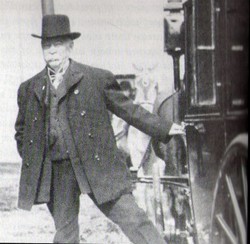
Shortly after they returned to Chicago Dora met Chicago’s first crime boss Michael Cassius “Mike” McDonald.

Richard Henry Little of The Chicago Tribune said McDonald, “never held office but ruled the city with an iron hand.”

McDonald built a gambling and protection syndicate, controlled the Garfield Park racetrack, and solidified his control of the city as leader of the local Democratic Party. He was also heavily involved in legitimate businesses—he owned The Chicago Globe newspaper and financed the building of Chicago’s first elevated rail line.

Mike McDonald

Mike McDonald

Years later Barkley told The Inter Ocean about his wife’s first meeting with McDonald:

“She was introduced to him at a box party in McVicker’s Theater shortly after the close of the big fair (World’s Columbia Exposition), in 1893…I remember the night distinctly. Dora came home to our place at 319 Washington Boulevard and told me that she had met a very fascinating old man (McDonald was 44), who was reputed to have a lot of money.

“’Watch me get a piece of that money,’ Dora said to me, jestingly, and fool that I was I laughed at the supposed joke.”

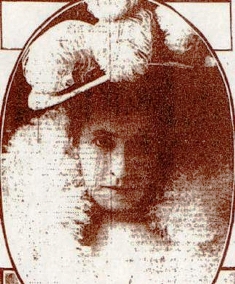
Dora Feldman Barkley McDonald

Dora Feldman Barkley McDonald

There are several versions of what happened next. One involves an elaborate (seemingly too elaborate) story that suggested Barkley was lured by a friend of McDonald into a compromising position involving women and drugs—only to be “caught” by his wife. The more likely version was that he was simply paid off—The Inter Ocean said he received $30,000 to divorce Dora.

Barkley never acknowledged receiving the money and only said:

“(Dora and McDonald) had planned between them to oust me, and no matter what I might have done, it would have been all the same in the long run. With his money and his influence, McDonald could put it over me any time he wanted.”

Dora eventually became McDonald’s second wife in 1898, (his first wife, who once shot a police officer—she was acquitted—had eloped to Europe with a soon to be former priest).

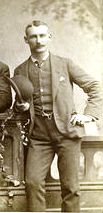
By 1897, Barkley had opened a new tavern at 15 North Clark Street, which was frequently in the news.

Sam Barkley

Sam Barkley

The Chicago Tribune called it a “notorious saloon,” and The Chicago Daily News reported on several occasions that the bar had its license revoked temporarily for various criminal activities and violations; in 1900 The Inter Ocean said a grand jury report was “almost an indictment of the city administration for its toleration of the dives, all-night saloons, and resorts for thieves and the depraved.” Of Barkley’s location the grand jury said:

“Men and women drinking, swearing and carousing, with music; open after midnight in the past. Several murders have been committed in front of this door.”

As with all such “clean-up” drives during that era in Chicago, nothing came of the grand jury report.

Dora again made headlines in 1907—and as a result so did her ex-husband.

The Inter Ocean said:

‘Mike ‘ M’Donald’s Wife Kills Artist in His Studio

“Dora McDonald, wife of Michael C. McDonald, millionaire, politician, traction man, and ex-gambler, shot and killed Webster S. Guerin, an artist, behind the locked doors of his studio in the Omaha Building, LaSalle and Van Buren Streets yesterday.”

Barkley was quickly contacted by reporters and told his sad story of how Dora had left him. The paper said:

“The story that Sam Barkley slowly grieved his life away over the loss of his pretty wife is disproved by the discovery of Sam Barkley alive and prosperous in Chicago today.”

Dora McDonald was eventually acquitted, but Mike McDonald did not live to see it, he died during her trial.

Barkley fell on hard times in Chicago soon after the killing. In August of 1908 a six-inning benefit baseball game was played at Comiskey Park between two Chicago City League teams–“Nixey” Callahan‘s Logan Squares and the Rogers Parks–“to raise enough money to start him in the cigar business.”

The Chicago Examiner said, “A fair-sized crowd turned out.”

Fred Pfeffer played first base for the Rogers Parks and “was the hero of the game with two hits besides fielding in grand style,” another former big leaguer, Emil Gross, served as umpire.

Shortly after that Barkley was operating a cigar store in his hometown, Wheeling, West Virginia.

There was one last chapter in the Barkley story. Soon after he returned to West Virginia he was living in poverty and became ill, and died on April 20, 1912. The Chicago Daily News said several days before his death a former baseball acquaintance was summoned to his side:

Billy Sunday called on him. He talked baseball for a while and then religion. At the end Sam liked both equally well.”

Billy Sunday

Billy Sunday

Dora McDonald was contacted for a comment:

“It is a closed incident—it’s so long ago that I knew him. But I’m sorry.”

She eventually married a doctor, moved to California and died in 1930.

“The Longest Hit in the World”

10 Oct

Walter “Judge” McCredie, longtime Portland Beavers player, manager and president said the longest home run he ever saw was hit by Otis L. “Ote” Johnson when Johnson played for him:

“The drive of Ote Johnson’s at Los Angeles (in 1909) was the longest clout I have ever witnessed.  Out in center field they had a pavilion 150 feet long.  Hits at Chutes Park in Los Angeles had never come within fifty feet of the pavilion…Johnson put the ball clean over the pavilion and the ball bounced into the bandstand for what I call the longest hit in the world.”

By the time he hit that ball in Portland he had already been called “Home run” Johnson for at least five years, a name earned in the Texas League when he hit 22 home runs in two seasons for the Dallas Giants—he finished third with 12 in 1903 and led the league with 10 in 1904.

Otis "Ote" Johnson

Otis “Ote” Johnson

Johnson was born in Fowler, Indiana in 1882, and grew up in Muncie.  The Dallas Morning News said fellow Indianan Claude Berry recommended Johnson to Dallas.  Primarily a shortstop, Johnson also played first, third and outfield, and appeared in more than 30 games as a pitcher during his professional career.

Johnson was sold to the Little Rock Travelers near the end of the 1904 season; he remained with Little Rock through 1906 but hit just .210 against “A” class Southern Association pitching.  He was sold to the Charleston Sea Gulls in the class “C” South Atlantic League before the 1907 season and hit .263, leading the team in doubles (27), triples (13) and home runs (10).

His performance in Charleston earned him another shot in the Pacific Coast League (PCL) when his contract was sold to Portland.  After a slow start at the tail-end of the 1907 season, Johnson regained his form, hitting .280 with 10 home runs in 1908 and .293 with 13 home runs (including his “longest hit in the world”) in 1909.

McCredie said the day Johnson hit his home run against Los Angeles scouts from the New York Highlanders was in the stands:

“(A)fter the battle they asked me to put a price on Ote.  I did, and a few days later the deal was consummated.”

The price was $4,000.

As Johnson prepared to join the Highlanders and manager George Stallings for spring training in Georgia, the New York press was excited about the team’s new prospect who was spending the winter in Muncie working and playing goalie Muncie’s professional roller polo team.  The New York Globe said:

“There is a ‘terrible Swede’ coming to New York next season.  He is a glass blower and makes from $6 to $7 a day in a factory at Muncie, Ind., and in the summertime he makes his living at swinging a large club and gathering bad and good bounders on the baseball field…The boy we’re harping about is Ote Johnson, who will be a member of the New York Americans. (In the PCL) he is known as ‘Home Run’ Johnson.  They say he has driven many a pitcher to the bench.”

George Stallings

George Stallings

Phil Cooney, a New Yorker, who played with Johnson in Portland, told The Globe:

“They seem to think that this boy Johnson can’t hit a curve ball, but Stallings will find out that he can hit any kind.”

On March 23 Stallings told The New York American that Johnson, who was playing third base and shortstop, “couldn’t hit.” Two days later The American said:

“Ote Johnson this afternoon gave an apt illustration of a home run and for the first time since he reported to Stallings the Portland demon found his batting eye.  But for the most daring burglaries on the part of (William) Birdie Cree, the big third sacker would have hit for 1.000 during the afternoon.  As it was he had a single and a homer in three times at bat.  His single might have been a homer had not (2nd baseman) Earle Gardner sprang into the air and retarded its progress by a blind stab.  But the four-base smash was beyond reach.

“Johnson got to one of (Dick) Carroll’s choicest curves and knocked the ball further than any had ever before traveled in Georgia.  Birdie Cree was playing deep for the big fellow.  The ball went so far that Cree had not gotten to it by the time Johnson crossed the home plate, and he only jogged from second.  The ball rolled to the fence, which is fully 300 yards from the plate.”

As late as April 1 it looked like Johnson might stick with New York.  The Trenton Evening Times said:

“The latest ‘phenom’ to be discovered is Otis Johnson, the New York Americans’ third sacker.  This recruit has been playing sensational games around the last station since he joined the club…Johnson is also quite a slugologist.  In the last few games the youngster has been batting like a Tyrus Cobb.  In a recent game at Athens, Ga., he made four hits in as many times at bat.  Among them was a home run.  Manager Stallings says he thinks Johnson will make a great name for himself this season.”

Despite the build up, and the reports of his prowess at the plate, Johnson did make Stallings’ club.  His contract was sold to the Jersey City Skeeters in the Eastern League.

The (Portland) Oregonian said New York “farmed out” the former Beaver star despite the fact that:

“New York critics credit Ote, nevertheless, with having more promise than some of the players retained by Stallings.”

Johnson hit just .223 with 9 home runs (second in the league) with Jersey City, but would benefit from unrest in the New York clubhouse.  Manager George Stallings accused his star first baseman, Hal Chase, of trying to throw a game in St. Louis (the first of what would become many accusations against Chase). Stallings said he would resign if Chase wasn’t let go; Highlander owner Frank Farrell sided with Chase and forced Stallings out in September; Chase was named manager.

Hal Chase

Hal Chase

After the season ended the New York papers said Johnson would on Chase’s club the following season, either at third base in place of Jimmy Austin (who was rumored to be on the market, and eventually traded to the St. Louis Browns), or to play shortstop in place of John Knight  who would be moved to second base to replace Frank LaPorte (also on the market, and also eventually traded to St. Louis with Austin).

More Otis Johnson on Monday.

“Pitchers Should be Taught how to Sleep”

24 Sep

Edward Tilden Siever had a theory about one of the greatest dangers facing pitchers:  how they sleep.

Edward Siever

Edward Siever

The Kansas native did not begin playing professionally until he was 24-years-old in 1899, and was 18-14 as a rookie with the Detroit Tigers two years later.  He injured his arm that season, had a sub .500 record the next three seasons with the Tigers and St. Louis Browns, and went to the American Association with the Minneapolis Millers in 1905. 

Siever’s arm recovered sufficiently to post a 23-11 record with the Millers and was purchased by the Tigers the following spring; he was 14-11 in 1906.

He was having the best season of his career in 1907; finishing with an 18-11 record and a 2.16 ERA for the American League Champion Tigers.  It was during that season that he told The Detroit Times about his theory:

“Pitchers should be taught how to sleep.  Don’t laugh, I mean that More than one good pitcher has lost his arm because he did not know how to sleep correctly.”

Siever claimed that fellow Kansan, St. Louis Cardinal pitcher Charlie “Dusty” Rhodes, missed much of 1906 with a bad arm brought on by the manner in which he slept:

“(Rhodes) used to rest his head on it when he was sleeping.  It deadened the muscles…No ballplayer should ever rest his head on his arms when he is sleeping.  It’s more dangerous than the average young man imagines.  Many a ball player loses his whip and doesn’t know how to account for it.  I’ll bet that’s the real reason in many a case.”

Charlie "Dusty" Rhodes

Charlie “Dusty” Rhodes

The Chicago Cubs defeated Siever in his only World Series appearance in 1907, and after a 2-6 start in 1908 he was sold to the Indianapolis Indians in the American Association; he pitched three more seasons in the minor leagues. 

He remained a popular figure in Detroit and worked for the city’s public works department until he died of a heart attack in 1920.

“An Almost Complete Surrender”

23 Sep

At the close of the Southern Association’s tumultuous 1902 season league president William Kavanaugh, and the majority of the team owners, led by the New Orleans Pelicans’ Abner Powell, set out to oust Charlie Frank of the Memphis Egyptians.

Charlie Frank

Charlie Frank

After a decade as a player, including two seasons with the St. Louis Browns in the National League, Frank was one of the founding members of the new Southern Association in 1901 and became the president and manager of the Memphis Egyptians.

The Atlanta Constitution said that right from the beginning Frank became “the storm center for southern baseball politics… (He) was constantly engaged in some sort of furious baseball litigation.”

After signing three players–Jim St. Vrain, Charlie Babb,  and Bill Evans—who were under contract with other teams during the 1902 season, Frank became embroiled in a months-long legal battle with the league and the National Association of Professional Baseball Leagues (NAPBL).

In October of 1902, Frank lost his legal battle, and it was thought that the time was right to force him out.  The New Orleans Times-Picayune said Powell and Kavanaugh were “confident that a new party” would take over the Memphis franchise and “do much better than the old.”

Powell, Kavanaugh, and the other league owners overestimated their influence in Southern baseball and underestimated Frank’s.

While Powell and company were trying to find a replacement for Frank, he was creating a new league.  The Constitution said:

“(Frank) determined to organize an outlaw league, got financial backing in Memphis and actually formed a circuit.”

The problem for the Powell group was that Frank’s proposed league, and its investors, were more financially sound than the existing league.  Charlie Frank challenged the Southern Association again, and again the Southern Association blinked.

Rather than losing the league, the other team owners accepted every one of Frank’s demands and welcomed him back.

The Associated Press called it “an almost complete surrender,” by the Powell-Kavanaugh contingent:

“Charles Frank retains the Memphis franchise; Memphis club and Frank restored to good standing; Memphis will be paid for all losses sustained during last season, on account of unplayed games, legal costs, etc…”

Additionally, Frank saw to it that every investor in his “new league” was reimbursed for their costs; the Association covered “all obligations made by the promoters,” including honoring the contracts of all players who had been signed, most of whom were absorbed into Southern Association teams.  Additionally, Chattanooga, Tennessee was dropped from the league and a franchise in Montgomery, Alabama was “awarded to the promoters” of Frank’s “new league.”

It was estimated that Frank received $5,000 in the settlement.  He put some of that money towards building a solid team for 1903, winning his first pennant.  Memphis won again in 1904; early in the season, Frank handed over the managerial reins to Lew Whistler.

Lew Whistler

Lew Whistler

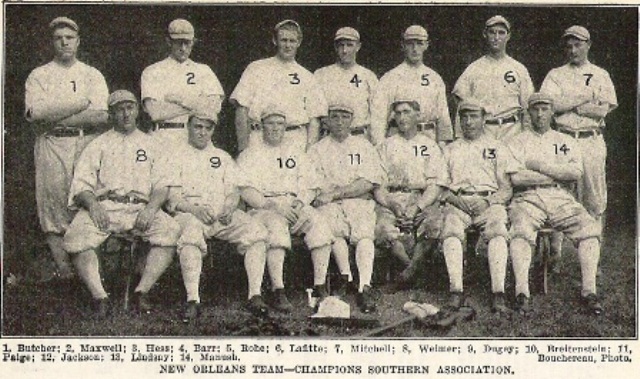
In 1905, Frank became president, principal owner, and manager of the New Orleans Pelicans, and promptly led them to a pennant— in spite of a Yellow Fever epidemic in New Orleans which required the team to relocate to Atlanta for part of the season.  Frank’s Pelicans also won pennants in 1910 and ’11.  He sold his interest in the team after the 1911 season but remained manager for two more years.

Charlie Frank's 1910 New Orleans Pelicans

Charlie Frank’s 1910 New Orleans Pelicans

In 1916 Frank returned to the Southern association again, organizing a stock company to purchase the Atlanta Crackers.  He managed Atlanta to a fifth place finish in 1916, and then won pennants in 1917 and ’19.

Frank sold his majority interest in the Crackers in May of 1921 but continued to manage the team.  In May of 1922, he resigned citing poor health—he died in Memphis three weeks later.

“And they Started Hitting like Demons”

4 Sep

Arthur “Artie” “Circus Solly” Hofman was one of the best utility men in baseball, and a member of four Chicago Cubs teams that went to the World Series.  When he was traded to the Pittsburgh Pirates in May of 1912, Bill Bailey of The Chicago American told a story about Hofman, baseball bats and why baseball players are superstitious about them:

“Some fans might think that Artie can hit with most any old stick that comes along, but he himself is very exacting about the one he picks out before he goes up to the plate.  There is always a great line of bats laying out in front of the players bench during a game.  Most of them are special makes of the big sporting goods companies and most of them are expensive products.”

Bailey said during the 1911 season the Cubs were mired in a mid-season hitting slump:

“And Hofman conceived an idea.  He was wandering through a department store in town when he saw a couple of bats on display.  They weren’t anything like the kind the Cubs had been using. “

Circus Solly Hofman

Circus Solly Hofman

Told the bats cost twenty-five cents each Hofman bought dozens of the bats and had them delivered to the West Side Grounds:

“Hofman took one himself and distributed the rest among his teammates…Every man in the lineup used one of Hofman’s bats that afternoon.  And they started hitting like demons.  Naturally they continued using the cheap bats. And they went on a batting rampage that lasted for a long time.  Everybody was slugging the ball.  When things like that happen, is it any wonder that the players have their superstitions about bats?”

“Bill Bailey” was the pen name of Bill Veeck Sr., who would become vice-president of the Cubs in 1917, and president of the club in 1919.  He, of course, was also the father of Cleveland Indians, St. Louis Browns and Chicago White Sox owner Bill Veeck.

Bill Veeck Sr./"Bill Bailey"

Bill Veeck Sr./”Bill Bailey”

Hofman’s greatest claim to fame was being the Cubs centerfielder on September 23, 1908.  He fielded Al Bridwell’s single that scored Harry “Moose” McCormick, seemingly giving the New York Giants a 2 to 1 victory.  It was  Hofman, according to umpire Hank O’Day, who realized that Fred Merkle of the Giants, who had been on first base,  failed to touch second before leaving the field.  “Merkle’s Boner” remains baseball’s most famous base running blunder.

“Figures of your kind are Pathetic”

13 Aug

John McGraw made news for an “innovation” in 1909.  The Associated Press said:

“McGraw has adopted an innovation in baseball which will appeal to fandom throughout the National league circuit and probably prevent (Fred) Merkle and others from running to the clubhouse before they ‘touch second.’ The innovation is the signing of the once famous player Arlie Latham as coach for the base runners.”

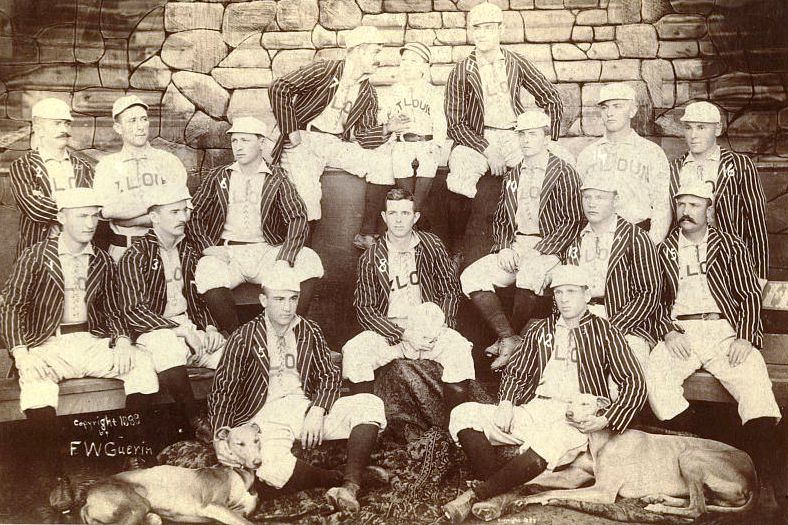
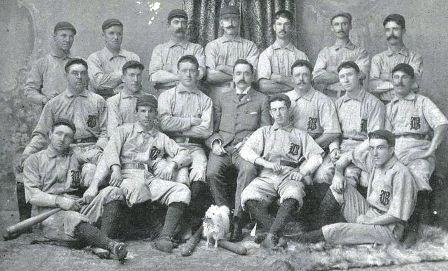
Arlie Latham, top center, facing team mascot, with 1888 American Association champion St. Louis Browns

Arlie Latham, top center, facing team mascot, with 1888 American Association champion St. Louis Browns

Walter Arlington “Arlie” Latham, was “particularly known for his humor” in the 1880s and 90s.  Primarily a third baseman with the St. Louis Browns in the American Association, the Chicago Pirates in the Players League and the Cincinnati Reds in the National League, Latham was nicknamed “The Freshest Man on Earth.”

The Associated Press said Latham:

“(B)rought much enjoyment to spectators of the Cincinnati club’s games and the Reds kept Latham a long while after he deteriorated as a player because of his drawing power as a comedian and humorist.

“Latham will don the uniform of the Giants and take his place in the coacher’s box while the Giants are at bat and between coaching the baserunner and batsmen and ‘getting the goat’ of the opposing pitchers will furnish an interesting sidelight to the New York games.”

Things did not go smoothly when Latham joined the team.  During spring training in Marlin, Texas Latham and McGraw were returning to their rooms at the Arlington Hotel when Giants outfielder James “Cy” Seymour, according to The St. Louis Post Dispatch, “knocked him down, and then bit him on the cheek.”  The article said McGraw and Latham did not know the “reason (Latham) was attacked,” but McGraw announced that Seymour was given his unconditional release.  McGraw said:

“Seymour is done with the New York club, and that goes.  It was the worst thing I ever saw pulled off.  Nothing like that can go on the New York club.”

Despite what he said McGraw did not release Seymour; the outfielder was suspended for the first week of the regular season, and The Dallas Morning News said McGraw made Seymour pay “his own expenses in Texas after the unpleasant episode.”

Arlie Latham, New York Giants coach

Arlie Latham, New York Giants coach

Latham was often criticized for his antics and even more often for the quality of his work as a coach, which became such a running joke that The New York Times said after the Giants had beaten the Cardinals in a September 1910 game:

“Arlie Latham’s team won it with their eyes shut, 11 to 3.  Latham’s coaching was invaluable yesterday.  He advised the players to touch every base and this tip won the game for them.”

The Sporting Life said:

“(Latham) undoubtedly lost a lot of games by bad coaching.  He got so unreliable that in a tight pinch McGraw would shift him from third to first and take the third line himself.”

The Sporting Life also said that Latham served as McGraw’s spy;  a position that would later be filled by another colorful McGraw coach, Dick Kinsella.

Giants outfielder Fred Snodgrass told Lawrence Ritter in “The Glory of their Times,” that Latham “was probably the worst third base coach who ever lived.”

It looked like the end of the line for baseball’s first full-time coach after the 1910 season.  The New York Herald said Latham “will not wear a Giant uniform next season,” and:

“He may amuse old timers, who remember him as a great ball player with (Charlie) Comiskey’s St. Louis Browns, but the new generation of fans seems to regard his efforts with disfavor.”

Despite the criticisms and predictions of his impending firing, Latham was back with Giants in 1911.  After the Giants pennant winning season Latham again joined the Giants for spring training in Texas in 1912, but in March, according to The Associated Press:

“(Latham) was carried as one of the twenty-five men permitted on the payroll.  McGraw did not want to let Latham go, but needed the place on the payroll for a real player.”

While McGraw didn’t want to lose his coach, most of baseball thought the end of Latham’s coaching career was a good thing; but even the New York press was not as harsh in their assessment of Latham as was Ed Remley, the baseball writer for The Fort Worth Star-Telegram:

“Arlie Latham has passed.

“May he rest in peace, for he is truly dead…Arlie has been called the fool of baseball and with much justice.  He was not the fool in any modern sense but more like the professional jesters who were kept in the courts of kings in the middle ages.

“Today, reading descriptions of the position of the court jesters, their crude horseplay jokes, we are not filled with laughter but with pity…The crude vassals of a former generation thought the brutal jokes of the court fool were funny; the bleacherites of today laugh at Arlie Latham pretending an engrossing interest in a game which he cannot even play himself…Vale, Latham—You have our sympathy, but we are not really sorry you are gone.  Figures of your kind are pathetic and pathos has nothing to do with baseball.”

Latham was next heard from when he accepted a coaching position with Patrick “Patsy” Flaherty’s Lynn Fighters in the New England League; that job only lasted until June.  Latham managed to run afoul of the entire Lynn team.  The Associated Press said he was forced to resign because “Players thought he was after manager Flaherty’s job and threatened to go on strike unless he was dismissed.”

Latham finished the 1914 season as an umpire in the Massachusetts and Rhode Island based Colonial League.  He did not return the following season, and in May of 1915 The Pittsburgh Press reported under the headline “Arlie Latham Has Quit The Diamond for All Time Now,” that he had found a new line of work; operating a deli in the Washington Heights neighborhood in Manhattan:

“He declares that as a delicatessener he is batting only .106 at present, but that when he gets properly warmed up and learns how to shave 15 ½ ounces of ham for a pound he will hit with the best of them in the delicatessen league.”

By 1917 Latham was in Europe, for the last act of his baseball career.  From 1917 to 1923 he lived in London and organized baseball leagues for military personnel.  The highlight of his stay was the July 4, 1918 game between the Army and Navy teams.  Latham served as umpire and greeted the most important dignitary at the game, King George V.  The Associated Press said:

“It had been planned to have the king throw out the first ball, but this was abandoned because of the netting in front of the royal box, so the king brought the ball out on the field and handed it to the umpire.  One of the balls used was autographed by the king with an American fountain pen and mailed tonight to President Wilson as a souvenir. “

Arlie Latham, front row center, with army team in London, 1918

Arlie Latham, front row center, with army team in London, 1918

After returning to the States, Latham first returned to the deli, then later was hired to work in the press box at the Polo Grounds, he remained a fixture at the New York ballpark until his death at age 92 in 1952.

As a result of outliving his critics and becoming one of the last surviving links to the 19th Century game by the time of his death, memories had faded about the “pathetic” figure of Latham, and only the image as  “baseball’s clown prince” remained.

Things I Learned on the Way to Looking up Other Things #5

8 Aug

Johnny Evers “Ardent Worshipper of Hoodoo Lore”

Edward Lyell Fox was a war correspondent in World War I; after the war he was accused of taking money to write stories favorable to the German government.  Before that he wrote extensively about baseball for several American magazines.

In 1910, writing for “The Columbian Magazine”, Fox interviewed Johnny Evers of the Chicago Cubs about the “almost unbelievable efforts made by ballplayers to offset what they firmly believe to be ‘hoodoos.’”

Evers was one of the most superstitious players in the game, “an ardent worshipper of voodoo lore,” according to Fox, and Evers said the Cubs “are more superstitious than any team in the big leagues,” and that manager Frank Chance “is one of the most ardent respecters of diamond ‘hoodoos.’”

It’s not certain that Evers’ claim that “most players firmly believe in,” the superstitious he listed for Fox, but it’s clear he believed them:

 “If any inning is favorable to a player, he will try to lay his glove down on the same spot where he had placed it the inning before.

“While going to different parks in cars, the sight of a funeral cortege is always regarded as an ill omen.”

Evers also said the sight of a handicapped person was also an “ill omen…unless you toss him a coin.”

On the other hand Evers said a wagon load of empty barrels was a sign of good luck.

Johnny Evers,

Johnny Evers,


“Too much of a Good Thing”

Even in baseball’s infancy that were critics that said the popularity of the game was “too much of a good thing.”

In September of 1865 The Philadelphia Inquirer editorialized:

 “Let us take, for instance, the base ball (sic) pastime, which is now assuming the proportions of a violent and widespread mania.”

The culprit, according to the editorial, was the athletic club teams that were growing in popularity and  no longer “satisfied with a game or two a week.”

 “(S)ome of these associations devote, three, four or five days at a time to their games; that they are not satisfied with playing on their own grounds for their own benefit and amusement, but that they thirst for popular applause, and are rapidly transforming their members into professional athletes…They issue their challenges, and hotly contend for mastery with clubs belonging to other cities.”

 The Inquirer did predict one aspect of baseball’s new popularity:

 “It can be easily seen that this spirit must soon lead on to gambling. So far the only prize of the base ball and cricket matches has been a ball or some implement of the game, but private wagers have undoubtedly been laid upon the playing of certain clubs, and money has changed hands upon results.”

The Enquirer was also concerned that the game defied “common sense” because “during the heats of summer violent bodily exercise should be avoided; but upon this subject common sense and the base ball mania seem to be sadly at variance.”

The editorial concluded that “the young men,” make sure “they do not depreciate themselves to the level of prize fighters or jockeys, who expend their vim on horse races and matches made for money.”

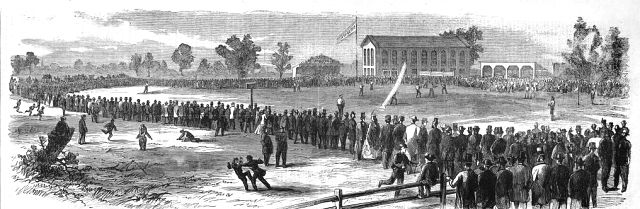
Athletic of Philadelphia versus Atlantic of Brooklyn, in Philadelphia October 30, 1865--"a violent and widespread mania."

Athletic of Philadelphia versus Atlantic of Brooklyn, in Philadelphia October 30, 1865–“a violent and widespread mania.”


Odds, 1896

Early in 1896 The New York Sun reported on “an early development of interest.”  A local bookmaker had issued odds on the 1896 National League race:

“He lays odds of 3 to 1 against Baltimore finishing first; 7 to 2 against Cleveland and Boston;  4 to 1 Philadelphia and New York; 7 to 1 Chicago; 8 to 1 Brooklyn and Pittsburgh; 15 to 1 Cincinnati; 40 to 1 Louisville; 100 to 1 Washington, while (Christian Friedrich “Chris”) von der Ahe’s outfit (St. Louis) is the extreme outsider on the list.  Any lover of the German band can wager any amount and “write his own ticket.”

The final standings:

1. Baltimore Orioles

2. Cleveland Spiders

3. Cincinnati Reds

4. Boston Beaneaters

5. Chicago Colts

6. Pittsburgh Pirates

7. New York Giants

8. Philadelphia Phillies

9. Washington Senators

10. Brooklyn Bridegrooms

11. St. Louis Browns

12.  Louisville Colonels

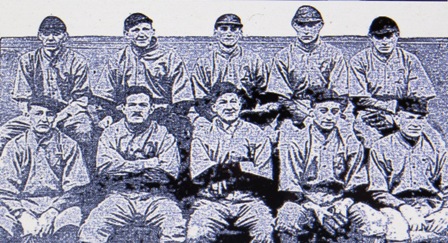
1896 Orioles, 3 to 1 favorites, won the National League Championship.

1896 Orioles, 3 to 1 favorites, won the National League Championship.