Tag Archives: Ty Cobb

“The Ty Cobb of Trapshooters”

15 Jul

Lester Stanley “Les” German broke into professional baseball with a bang in 1890.  The 21-year-old played for Billy Barnie’s Baltimore Orioles, a team that had dropped out of the American Association and after the 1889 season and joined the Atlantic Association, a minor league.

German was 35-9 in August when the American Association’s Brooklyn Gladiators folded in August, the Orioles returned to the association, and German returned to Earth; posting a 5-11 record for the big league Orioles.

German was a minor league workhorse for the next two and a half seasons.  He was 35-11 for the Eastern Association champion Buffalo Bisons in 1891; he appeared in 77 games and pitched 655 innings for the Oakland Colonels in the California League in 1892, and was 22-11 for the Augusta Electricians in the Southern Association in July of 1893 when his contract was purchased by the New York Giants.

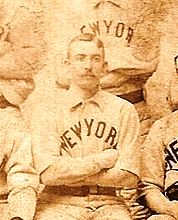
Les German, 1894

Les German, 1894

German would never win in double figures again; In five seasons in the National League he was 29-52, including a 2-20 mark with the 1896 Washington Senators.

It was German’s next career that earned him the most notoriety.  A crack shot, German became one of the most famous trapshooters in the country for the next thirty years.  He won numerous championships and was often featured in Buffalo Bill’s Wild West Show with Annie Oakley.

A National Sports Syndicate article in 1918 said “Lester German is the Ty Cobb of trapshooters.”  The article said that beginning in 1908, when official records were first kept, German had maintained a “remarkable average,” shooting a t a better percentage than any other professional marksman.

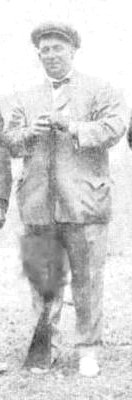
Les German, 1918

Les German, 1918

As German’s reputation as a shooter grew, his legacy as a pitcher became inflated.

A mention of his baseball career in a 1916 issue of “The Sportsmen’s Review”, credited German, and his 9-8 record,  with “leading the Giants,” to their 1894 Temple Cup series victory over the Baltimore Orioles, there was no mention of Amos Rusie’s two shutouts .  A 1915 article in The Idaho Statesman inexplicably said German “headed the National League in both pitching and fielding” in 1895—German was 7-11 with a 5.54 ERA and committed 2 errors in 45 chances on the mound; he also made eight errors in 11 games he filled in for the injured George Davis at third base.

German operated a gun shop and continued to organize and participate in shooting tournaments until his death in Maryland in 1934.

Baseball’s “Growing Evil”

24 Jun

By 1913 newspaper articles under the byline of a famous player were common in newspapers across the country, and most of the game’s biggest stars were represented.

Most fans of that era assumed the players did their own writing until an expose appeared in The Washington Herald in March of 1913.  Sports Editor William Peet wrote:

“The dear old public fell for this stuff and swallowed hook, bait and sinker.  An article under the signature of Christy Mathewson led three-fourths of the fans to believe that the great pitcher himself wrote it.”

According to Peet, players were paid between $250 and $1000 for each story “and not one of them wrote a single word,” but it was still a good investment:

“The newspapers themselves regarded these feature articles as good investments, for the reason that the stories were syndicated to 25 or more outside publications and the revenues derived not only paid the amount guaranteed the baseball player for the use of his name, but left a handsome profit.”

Peet exposed the writers behind the articles “written” by the game’s biggest stars:

Christy Mathewson and Jeff Tesreau/John Wheeler, The New York Herald

Walter Johnson/Ralph MacMillan, The Boston Journal/The Boston Herald

John McGraw/Walter Turnbull, The New York Evening Sun

John “Chief” Meyers/Jim McBeth, The New York American

Richard “Rube” Marquard/Bill Farnsworth, The Atlanta Georgian/Hearst Newspapers

Denton “Cy” Young/Sam Carrick, The Boston Post

Tris Speaker/Tim Murnane, The Boston Globe

“Smokey” Joe Wood/Jim O’Leary, The Boston Globe

Ty Cobb/Roger Tidden, The New York World

Hughie Jennings/George “Stoney” McLinn, The Philadelphia Press

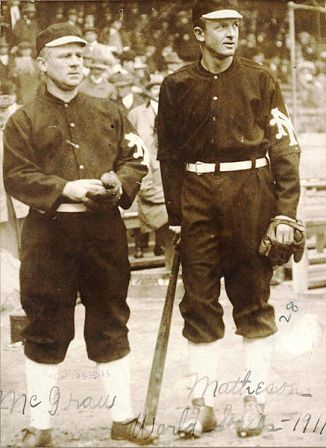
John McGraw and Christy Mathewson

John McGraw and Christy Mathewson

Peet called the practice dishonest, and said it had gone too far, and in New York and Boston the practice   had “become a mania.”  Peet singled out an article “written” by John McGraw criticizing “Chief” Myers that caused an “explosion,” and said the articles featuring “Rube” Marquard’s byline, and written by Farnsworth got Marquard “in bad with his teammates, for Farnsworth spared no one is his scathing criticisms.”

Pittsburgh Pirate manager Fred Clarke disagreed with the practice, telling Peet:

“I do not think it is any ball player’s place to butt into the newspaper end of the game…I think it is foolish for any player, especially those who take part in the world’s Series, to write about the games.”

As a result of Peet’s revelations the American League club owners condemned the practice of players’ names appearing on articles they did not write, but came just short of officially banning the practice. In September, the Baseball Writers Association petitioned the National Commission to end the “growing evil” of players authoring or appearing to author articles during the upcoming World Series.

The commission agreed, and American League President Ban Johnson informed Philadelphia Athletics manager Connie Mack on the eve of the World Series that star players Eddie Collins and Frank Baker “have been instructed not to write baseball stories or give the impression they are writing them.  If they ignore this request, a way of punishing them would be found. “

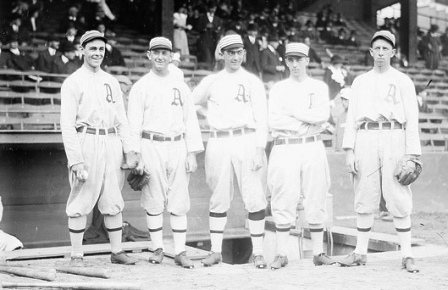
Frank Baker, center, Eddie Collins, far right,

Frank Baker, center, Eddie Collins, far right,

Johnson even threatened “Collins and Baker would not be permitted to take part in the World Series,” if they wrote articles or permitted their names to be attached to articles.

At one point Johnson and National Commission Chairman August Hermann said they would consider calling off the series if players refused to comply.  Dave Fultz, the former player, practicing attorney, and president of the Fraternity of Baseball Players, said members of the commission could be personally liable for damages if the series was cancelled.  Johnson and Herman’s threat to cancel the series as a whole was put to rest.

Mack argued that the players had contracts with newspapers and that Johnson had said earlier that players who were “capable” of writing their own articles would be permitted to do so, but as he prepared his team to play the New York Giants, he prepared for the worst, telling The Associated Press:

“(I)f the commission decides the players must not write under any conditions and players decide not to abide by the ruling, I will be prepared to put a team on the field,” The AP speculated that utility infielder John “Doc” Lavan  would play second base  and outfielder Rube Oldring would be moved to third base, with Amos Strunk taking Oldring’s place in the outfield.

Mack’s adjustments weren’t required.  Collins was allowed to write for The Philadelphia Record because his deal with the paper predated the commission’s ruling, and Baker did not write articles.  Together they led the Athletics to a 4-1 Series win, hitting .421 and .450.

Ghost written articles, and articles actually written by players never disappeared, but the practice became much less popular after the revelations and battles of 1913.

Crazy Schmit Stories

13 May

Fred “Crazy” Schmit was widely considered to be the first pitcher to keep a “book” on hitters, it was mostly attributed to his poor memory, and the pitcher kept an actual book in his pocket listing the weakness of each hitter.  The earliest reference to Schmit’s book was in The Sporting Life in 1894, but the story was repeated in newspapers for the next thirty years, usually as a story told by John McGraw or Hughie Jennings.

The article said Schmit kept:

“(A)n account of the weakness at bat of his opponents, setting them down in a small book, which he always carried with him on the diamond…One day when he had the Chicagos as opponents (it was the season that Captain Anson led the League in batting), Anson came to the bat. “Crazy” Schmit looked at the big first baseman, then went down into his pocket, and, taking out his book, read “Anson, base on balls.”

Over the years the story changed—the batter was sometimes Elmer Flick, Nap Lajoie, Ty Cobb, Honus Wagner, Tris Speaker, and as Jennings said in 1926, “Every good hitter since Anson’s day, but Anson is the player whose weakness was reported to be a base on balls.”

"Cap" Anson

“Cap” Anson

Jennings also claimed that during the 1890s as part of a prank by teammates aboard a ferry, Schmit’s suitcase, with his book inside, fell overboard, and said:

“Schmit was a losing pitcher from that time on.  He won a few games but lost a great many more…The bottom of Hudson River held his ‘pitching arm.’”

Pitcher turned sports cartoonist Al Demaree said Schmit “used to warm up with an old water-soaked ball that weighed several pounds—at a distance of 75 feet, and not the regulation 60 feet from his catcher.”

Al Demaree's Schmit cartoon--as with most references to the pitcher, his name is spelled incorrectly

Al Demaree’s Schmit cartoon–as with most references to the pitcher, his name is spelled incorrectly

After his final game with the Baltimore Orioles in 1901, Schmit continued to play with semi-professional and quasi-professional teams for more than a decade.  His antics continued to make the papers.

In 1906 Schmit joined Jim “Nixey” Callahan’s Logan Squares in the Chicago City League.  The Sporting News’ Revere Rodgers told a story (complete with Schmit speaking in a comic German accent) about the team going to Joliet, Illinois for a game:

“(The Logan Squares) knew the umpire was a ‘homer’—a man who couldn’t see a close decision without giving his team the best of it.  He stopped before the grandstand, hat in hand, and announced (the batteries)…’Crazy’ Schmit was right behind him and when (the umpire) finished Schmit took off his cap and making a sweeping bow said: ‘Laties and schentlmen, der umpire for der game today vill be Mister Miller of Joliet and he vill as usual slightly favor der home glub mit his decision.”

According to The Chicago Tribune’s Hugh Fullerton Schmit was deeply disappointed at the end of the 1906 season when Callahan did not allow him to pitch in the Logan Squares victories against the World Champion White Sox, and National League Champion Cubs.

Schmit continued to play in the Midwest and also did some scouting for John McGraw’s New York Giants.  A story that appeared in The Duluth News-Tribune said Schmit pitched a few games for the Fond du Lac in the Wisconsin-Illinois League (Schmit’s name does not appear on any Fond du Lac roster in either of the two years the other player mentioned in the story was with the team (1909, 1911)so the story may be apocryphal):

“Along about the seventh inning, with Rockford leading by 6 to 4 the first man up got on.  Schmit pitched out three times in an attempt to get the runner going down to second base, but the runner made no attempt to purloin the sack.  With the count three and nothing on the batter he grooved the next one, only to have the batter lean on it and drive it over the left field fence for a homerun.

“After the runners had circled the bases the umpire threw up another ball.  Schmit took it, shook his head and walked over to Bobby Lynch, who was playing third base…and said to him ‘Say, Bobby, no wonder I can’t beat these fellows.  I won’t pitch against them any longer.  I quit right now.  They don’t know how to play baseball and yet they are leading in this league.  The runner that was on first base just let me waste three balls and yet he does not attempt to steal; then when I put one over for the batter who has three balls and no strikes, he hits it.  Tell me, how can a man of my intelligence and baseball knowledge pitch a game of baseball against such boneheads and unscientific playing of the game?”

“Crazy” Smith died in Chicago in 1940.

“Mique” Fisher 2

7 May

On October 12, 1906, with the World Series between the Chicago White Sox and Chicago Cubs deadlocked at two games apiece, August “Garry” Herrmann, President of the National Commission, received a telegram from Fresno, California:

“Fresno will give $25,000 guarantee; guarantee 40,000 fans and sunshine for deciding game of World Series.

–Mike Fisher”

Fisher said the offer to bring the series and Fresno native Frank Chance to town was backed by “the businessmen here.”

It is doubtful Herrmann took the offer seriously, and it’s probably just as doubtful that Fisher took it seriously, but it was picked up by newspapers across the country, and Fisher enjoyed the publicity.

It was a last bit of publicity before his career in organized baseball ended.  Later in the month he was dismissed as manager of the Fresno Raisin Eaters, and the team was dropped from the Pacific Coast League (PCL) the following spring.

Within weeks Fisher had moved on to a new project; he announced that he was in the process of forming a team to travel to Hawaii.  The San Francisco Call said “It will be the first American ball team to make the trip across the Pacific in a little over nineteen years,” since Spalding’s world tour.

In conjunction with Jesse Woods, a Honolulu promoter, Fisher organized a tour of the Hawaiian Islands with a team of PCL stars.

Mike Fisher

Mike Fisher

Upon his return, Fisher got more ink on the West Coast, when he headed to Nevada with Charlie Irwin of the San Francisco Seals; the two met with businessmen in the mining towns of Goldfield and Tonopah to discuss forming a professional league—Fisher told The San Jose Mercury News that he was now “against organized baseball,” and if he got involved in the league “it will be an outlaw organization.”

Fisher chose not to get involved in the new league, but immediately went to work on an even more ambitious tour than the 1907 Honolulu trip.

With the sponsorship of the Reach Sporting Goods Company, Fisher would accompany a group of stars to China, Japan and the Philippines.  Early publicity promised the travelers would include Ty Cobb, Hal Chase, and Frank Chance.

When the ship set sail in November of 1908 those three stars were not on board, but “several hundred fans and friends” were present when the steamer China left the port in San Francisco to see the group off.  The team was substantially the same as the one that toured Hawaii the previous year—an aggregation of PCL stars and a few National and American League players– and consisted of: Jim Delahanty, George Hildebrand, Bill Burns, Pat Flaherty, Jack Bliss, Babe Danzig, Harry McArdle, Nick Williams, Joe Curtis, Heine Heitmuller, Jack Graney and Bill “Brick” Devereaux.

Despite the failure to land Cobb, Chase or Chance for the tour, the West Coast press applauded Fisher for even attempting the trip, The Call said:

“The undertaking which he has fathered and which is so successfully underway at the present time is a big proposition.  With the single exception of the around-the-world trip of the A.G. Spaldings years ago, nothing on as big a scale as this has ever been attempted.  To take a team of American baseball players over a journey that will total 10,000 miles before they return, to play games in China, Japan, Manila and Honolulu is something that two or three years ago would have been laughed at as an impossibility.”

The tour lasted more than three months, with the team barnstorming through Japan, China, the Philippines and Hawaii, playing local and US Service member teams.  Though reports varied, the team played between twenty and thirty games, and lost no more than four.

While they drew large crowds throughout the trip, the newspapers back home reported that the tour was a financial disaster; when the players arrived back in San Francisco on February 15, 1909 aboard the Tenyo Maru, Fisher responded to the reports:

“I hear that it has been said that the trip was a financial frost.  Well, anybody who says that is a liar.  We broke even in Japan and made money in Manila and Honolulu.  I am satisfied with the trip.”

Fisher didn’t mention the financial results in China; likely because that leg of the tour was a disaster financially.  Years later he would tell a story about the team’s experience there, complete with his usual exaggerations:

“In one game we played in Canton we had 150,000 people inside, and as the gatemen had been instructed to accept Chinese money it required the combined efforts of the entire team to tote the money up to the hotel.  A special staff of accountants was busy all night totaling it up and in the morning we discovered we had $46.15.”

Fisher promised to take a team to Australia the following year.  The trip never took place; instead Fisher purchased a Seattle dance hall called the Dreamland, and quickly became the target of the pious women of the city.  Early in 1910 Fisher was indicted by “The King County grand jury, as a direct result of the activity of the Women’s Clubs,” for violating liquor laws, allowing “unescorted women” into his dance hall, and other assorted charges.  A special prosecutor, Justice William Henry White, one of the most respected jurists in Washington State, was appointed to prosecute Fisher and other club owners targeted by the women.

Ever the promoter, Fisher used the indictment to promote his dance hall and rally public support.  After the indictment was handed down Fisher sponsored a “Sermon in the Dreamland rink.”  According to The Seattle Times, Fisher engaged Reverend Frank Herthum, who “has liberal ideas about amusements.”

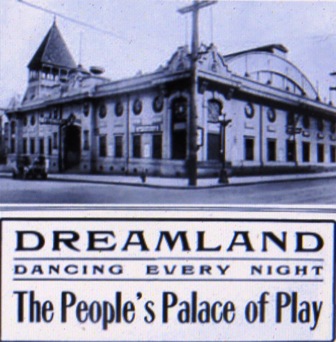
Mike Fisher's Dreamland Dancehall, Seattle

Mike Fisher’s Dreamland Dance Hall, Seattle

Herthum preached, and Fisher presented a free vaudeville show.  The paper said Fisher had stirred up a “protest against the effort to close the dance hall without having provided a substitute where clerks, servant girls and employees in the shops may pass an evening to their liking.”  At the same time The Times noted that the prosecutor was becoming impatient with the women who brought the charges because they continually promised to provide evidence that “has not yet come to light.”  The charges were quietly dismissed within weeks.

Fisher left Seattle sometime in 1911 and began operating the Arcadia Dance Hall in San Francisco.

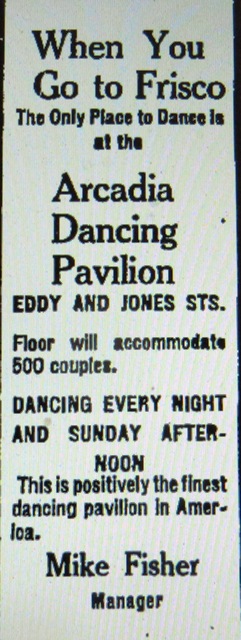
Advertisement for Fisher's Arcadia Dancing Pavilion.

Advertisement for Fisher’s Arcadia Dancing Pavilion.

In January of 1917 Fisher made headlines in California when he announced that he was directing an effort to restart the California State League, which had folded after the 1915 season.  He said he would have clubs in Sacramento, Fresno, Stockton and San Jose.  Within two weeks Fisher abandoned the plan.  The San Jose Mercury News was not surprised:

“Mr. Fisher, the wonderful getter of publicity, has his publicity and is through.  Probably he has done wonders for his dance emporium or whatever it is he runs.”

The following year the San Francisco Seals of the Pacific Coast League came on the market; the first name reported as a potential buyer was Mike Fisher.  Fisher again got his headlines, but it was his old friend Charlie Graham who got the team.  Graham, and a group of investors purchased the Seals and the former catcher was installed as manager.
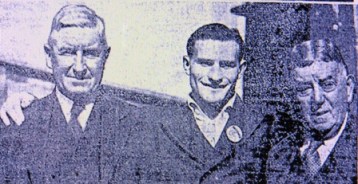
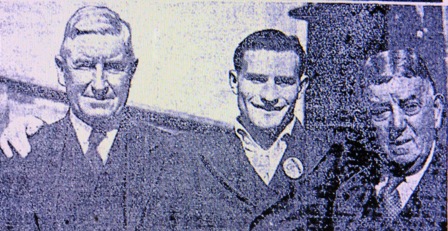
Charlie Graham, left, Mique Fisher, right, with World Middleweight Champion and actor Freddie Steele.

Charlie Graham, left, Mique Fisher, right, with World Middleweight Champion and actor Freddie Steele.

With his friend in charge The Mercury News said Fisher became a fixture “around the San Francisco ballpark ever since Graham bought in on the Seals in 1918,” he would remain a fixture at Recreation Park, and later at Seals Stadium for more than 20 years , and continued to provide copy for West Coast s sports writer

As a result of his friendship with Graham, who recommended he get the honor, 77-year-old Fisher was selected to travel to Cooperstown to represent the PCL at baseball’s centennial celebration in 1939.  The man who so loved seeing his name in the paper  received headlines one more time, when he died in San Francisco on June 6, 1943.

More Superstitions

25 Apr

Billy Evans, “The Boy Umpire,” joined the American League staff at the age of 22.  Before becoming an umpire, Evans was a reporter for The Youngstown Vindicator and continued to write occasional, syndicated newspaper articles throughout his career.

Billy Evans

Billy Evans

In a 1907 article he wrote about superstitions:

“Baseball players are the most superstitious class of people in the world.  There are many superstitions in general in which all members of the profession have implicit confidence and nearly every player has some pet belief that is all his own.”

Evans mentioned one of the most superstitious players of all-time, Detroit Tigers pitcher “Wild Bill” Donovan, who as mentioned in an earlier post, believed that striking out the first batter he faced was bad luck.  According to Evans he also had a strange belief about the first game of the season:

“Donovan has a dread of working in shutout games on his first appearance.  He believes it a season hoodoo and would do almost anything to prevent it.”

Evans worked as an umpire in Donovan’s first start of the 1907 season, and the pitcher took a shutout into the ninth inning:

“I happened to be working back of Donovan that day and noticed that he seemed to let up in the ninth , also that he used nothing but a straight fast ball.  A pass, an error and a cracking hit by Charley Hickman sent a couple of tallies over the pan.”

Evans said he asked Donovan after the game if he “(lost his stuff,” in the ninth, Donovan said no:

“I have no desire to win a shutout game right off the reel…shutouts on your debut are not lucky.”

Bill Donovan

Bill Donovan

Evans said Fred “Lucky” Glade, a St. Louis Browns pitcher who had just been traded to the New York Highlanders, had a phobia of pitching if the sun wasn’t out:

 “According to Glade, he has never during his career won a game on a dark day.”

The pitcher also “started each inning…by tossing a ball to (Browns first baseman) Tom Jones.  Next year he will have to use (Highlanders first baseman) Hal Chase

Chase must not have been an adequate substitute; Glade struggled with arm and stomach problems, posted an 0-4 record in five starts for the Highlanders, before returning home to Nebraska in June.  He signed a contract for 1909, but never reported and never pitched again.

Fred Glade

Fred Glade

Ty Cobb had numerous superstitions; one had to do with the “position of the broom with which the umpires use to dust off the plate.”  Evans said:

“The umpires find it handy to keep the broom to the left of the plate, while Cobb, when at the bat, always desires it to the right.  Whenever he steps to the plate Cobb always picks up the broom and tosses it to the right side of the batter’s box.”

Additionally:

“When in a batting slump Cobb always makes three crosses as he takes his position at the plate.  When Cobb reaches first base on his journey from right field to the bench he always gives the bag a terrific kick in the direction of the plate…Cobb insists that the short distance he moves the bag toward the plate with his kick often is the means of winning a close decision at first for his team.’

Ty Cobb

Ty Cobb

Evans said of superstitions in baseball:

“No doubt a close investigation would reveal that every player from the smallest bush league up has his pet theory.”

Ernie Diehl

18 Mar

Ernest Guy “Ernie” Diehl’s entire professional career consisted of less than 60 games.

Every year from 1900 to 1911 he was offered contracts by professional teams and despite his time with two National League teams and two minor league teams he never earned a penny as a ballplayer.

By the time the 25-year-old Diehl made his first professional appearance with the Pittsburgh Pirates in May of 1903, he was already a well-known player. Diehl was the star of the perennial powerhouse Avondale team in Cincinnati’s semi-pro Saturday League, which The Sporting Life called “a fast, clean league.”

diehl

Ernie Diehl

Diehl was born in Cincinnati in 1877, the scion of a Cincinnati distillery empire; His father Adam G. Diehl had made a fortune in the whiskey business with his brother-in-law; together they founded The Edgewood Distilling Company.

He attended the University of Cincinnati and established a reputation as one of the area’s best athletes.  Perhaps even better at tennis than baseball, Diehl was a prominent amateur tennis player during the first decade of the 20th Century.

In May of 1903 when the Pirates arrived in Cincinnati for a series, the team was decimated with injuries and Diehl joined the team for one game, playing left field on May 31, he went 1 for three in a 3-2 pirate victory.

Despite being offered a contract with Pittsburgh, Diehl chose to return to the distilling business and the Saturday Baseball League.

In 1904, with several Pirate players hurt, Diehl was again asked to join the team; this time for 12 games.  The Pittsburgh Gazette said Diehl also spent time with the Pirates in Hot Springs, Arkansas that spring.

The Baltimore American ran a story before the Pirates arrived in New York in August:

“New Yorkers who attend the games between the Brooklyn and Pittsburgh teams will be treated to an opportunity of seeing the work in the field of a millionaire ballplayer.”

While he hit just .162 for the Pirates in 1904, that did not diminish Pirate owner Barney Dreyfuss’ desire to sign Diehl.

Before the 1905 season Dreyfuss told The Pittsburgh Press:

“The one player I would like to get on the team is beyond my reach… His name is Ernest Diehl…He is one of the best baseball players I ever saw.”

Dreyfuss also called Diehl “One of the best all-around athletes,” he had seen.  The Press said that although Diehl was required to sign a contract for his time with the Pirates in 1903 and ’04:

“Diehl never received a penny of salary from President Dreyfuss.”

Barney Dreyfuss

Barney Dreyfuss

Dreyfuss, and every other owner who offered Diehl a contract was unsuccessful in securing him for the 1905 season; Diehl spent the season playing in the Saturday League and in several tennis tournaments across the country.

He again played tennis and semi-pro ball in 1906, until August when the Boston Beaneaters came to Cincinnati. Shortstop Al Bridwell was injured, and Diehl was signed (again for no salary) to play for Boston in the three-game series.

The Associated Press reported:

“’Ernie’ Diehl, a wealthy young distiller of this city, an enthusiastic athlete, long known as a brilliant baseball player on local amateur teams, distinguished himself in the series just played…He played three games in the Boston ranks…He made five hits in eleven times at bat…Diehl could not afford to enter professional ball if he desired, at the highest salary paid in the organization, on account of his business, but is delighted and satisfied with his experience…Besides his heavy batting, his fielding was strictly up to the professional standard.”

Just as he had in Pittsburgh, Diehl turned down an offer to stay with Boston for the remainder of the 1906 season.

In 1907, Diehl appeared in 21 games for the Toledo Mud Hens in the American Association, hitting .405.  The Toledo News-Bee said Diehl was spending “His vacation…helping out the Toledo club.”  The Associated Press said that as in the past, “Diehl is wealthy and refused to accept pay for his services.”

In addition to his business interests, amateur tennis and baseball career, and professional baseball “vacations,” Diehl also served on Cincinnati’s city council from, roughly, 1906-1910.

In 1909 Diehl played in one game of a doubleheader for the Boston Doves on August 12 against the Reds, he was 2 for 4 with a double—it would be his last in the National League

Diehl then joined the eventual American Association champion Louisville Colonels, at the request of his friend and fellow Cincinnatian, manager Heinie Peitz.  (Baseball Reference lists a player as “Diehl,” with no first name on the 1909 Louisville roster, with a .226 average in 20 games).

The Sporting Life said Diehl “figured very prominently in Louisville’s winning the championship of the A.A. will again be in Colonel garb,” in 1910; Diehl did not play for Louisville, or any other professional team again.

In 1911 The Associated Press and Cincinnati newspapers said the 33-year-old Diehl had a deal in place with Reds manager Clark Griffith to join the team at some point during the season; as with Louisville, that deal never materialized either.

Diehl was briefly mentioned as a candidate to replace Griffith as Reds manager in 1912, the job eventually went to Hank O’Day.

Diehl’s career was summed up well in a 1914 Baseball Magazine article by William A.  Phelon:

“For ten years it has been a tacitly accepted fact, around the big leagues and whenever players or managers assembled, that Ernie Diehl was not only of major league quality, but what might be called super-quality—the Wagner-Lajoie-Cobb variety.  He could hit, run, and break up a defense with anybody, and was a versatile artist in five or six positions.  Business held him; there never was a chance for him to spend a full season in the game; year after year, in short vacation frolics, he showed the professionals what he could do—and now, getting on in years, with business still gripping him, he sadly gives it up, and lays aside the bat and glove he never had a fair chance to use.”

Diehl’s Edgewood Distilling Company seems to have been dissolved sometime around 1918, and he eventually settled in Miami where he died in 1958.

Ty Cobb, Joe Jackson, Harry Hooper and Quackery

15 Feb

Baseball history is full of stories of products that have been routinely used in the belief they give players an edge.  Some, like steroids and amphetamines have obvious benefits; others like Power Balance bracelets provide none.

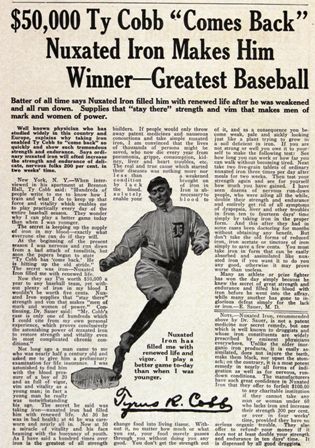
In 1916 advertisements began to appear in newspapers and magazines across the country for a new miracle drug from DAE Health Laboratories in Detroit: Nuxated Iron.

An ad featuring Ty Cobb said “Greatest Baseball Batter of all time says Nuxated Iron filled him with renewed life after he was weakened and all run down.”

Cobb said in the advertisement:

“At the beginning of the present season I was nervous and run down from a bad attack of tonsillitis, but soon the papers began to state ‘Ty Cobb has come back, he is hitting up the old stride.’ The secret was iron—Nuxated Iron filled me with renewed life.

“Now they say I’m worth $50,000 a year to any baseball team.”

cobbnux

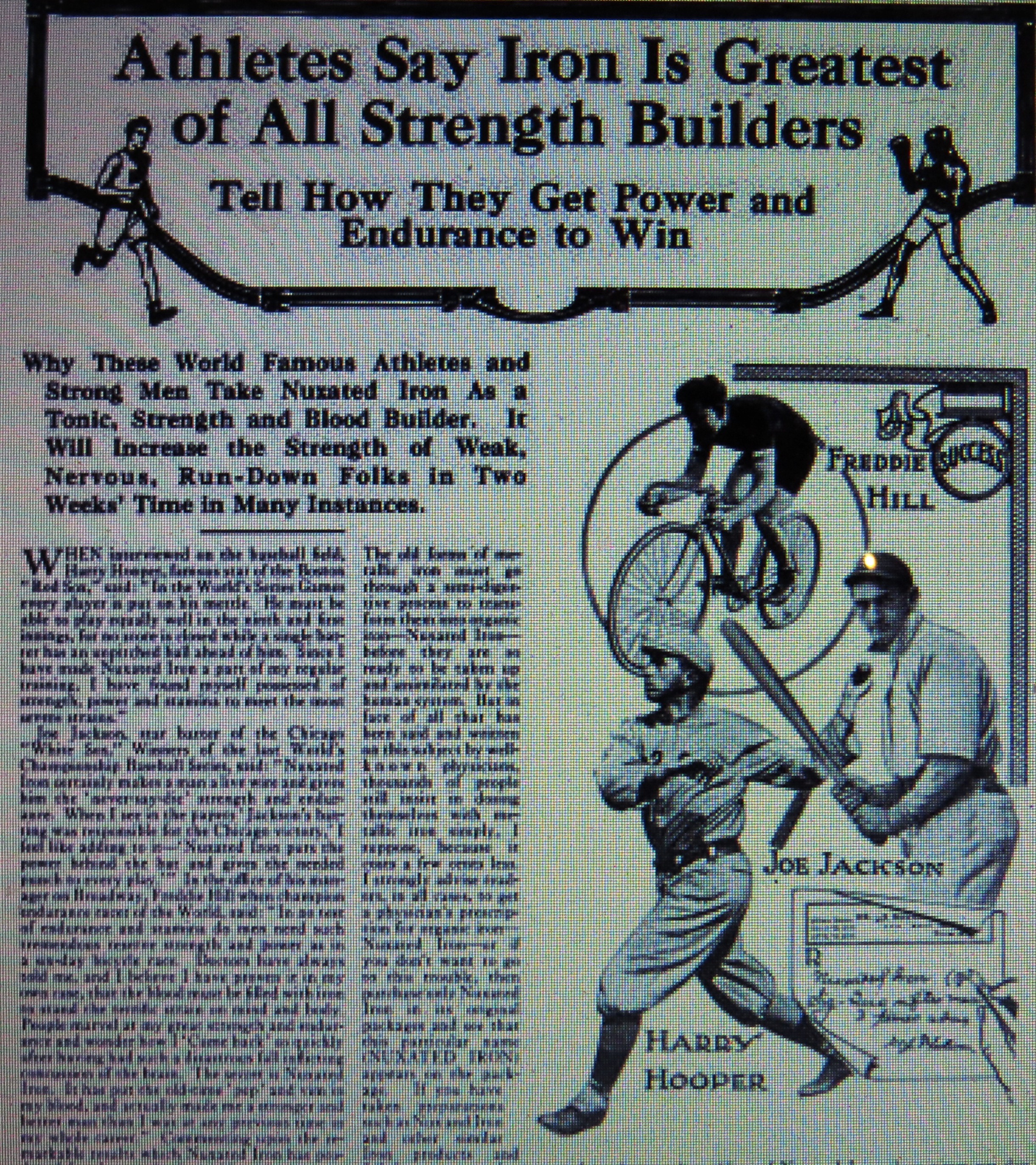
Other ads for Nuxated Iron began to appear, featuring boxer Jess Willard, cyclist Freddie Hill and baseball stars Harry Hooper and Joe Jackson.  Hooper said:

“Since I have made Nuxated Iron a part of my regular training, I have found myself possessed of strength, power and stamina to meet the most severe strains.”

Jackson said:

Nuxated Iron certainly makes a man a live wire and gives him the ‘never-say-die strength and endurance.”

The illiterate Jackson added: “When I see in the papers ‘Jackson’s batting was responsible for the Chicago victory,” I feel like adding to it—‘Nuxated Iron puts the power behind the bat and gives the needed punch to every play.’”

???????????????????????????????

The Journal of the American Medical Association took notice of the Nuxated Iron ad campaign and in October of 1916 had this to say about the “miracle drug:”

“Newspapers whose advertising ethics are still in the formative stage have, for some months past, been singing—at so much a song—the praised of “Nuxated Iron.”  The public has been that this nostrum is what makes Ty Cobb, “the greatest baseball batter of all time,” a “winner” and is what helped Jess Willard “to whip Frank Moran” besides being the “untold secret” of Willard’s “great triumph over jack Johnson.”

All that DAE would say about the ingredients were:

“Formula—The valuable blood, nerve force and tissue building properties of this preparation are due to organic iron in the form of ferrum peptonate in combination with nux vomica (strychnine) phosphoglycerate and other valuable ingredients.

But alas, The AMA Journal was not impressed with the claims made by Nuxated Iron’s endorsements:

“The Journal felt that it owed it to the public to find out just how much iron and nux vomica there were in ‘Nuxated Iron.’  Packages of the nostrum…were subjected to analysis.”

What the analysis found was that the formula that made Ty Cobb a “winner,” offered no health benefits:

“There is only one-twenty-fifth of a grain of iron in each ‘Nuxated Iron’ tablet, while the amount of nux vomica…is practically negligible…In a dollar bottle of ‘Nuxated Iron’ the purchaser gets, according to our analysis, less than 2 ½ grams of iron; in 100 Blaud’s Pills, which can be purchased at any drug store for from 50 to 75 cents, there are 48 grains of iron.”

To sum up their analysis The Journal called the claims made by Nuxated Iron “the sheerest advertising buncombe.”

Contemporary sources said Cobb earned as much as $1000 for his endorsement of Nuxated Iron; there is no record of what Hooper or Jackson were paid, but all three disappeared as paid spokesmen for the product by early 1917.

Nuxated Iron stayed on the market, and stayed in the crosshairs of the AMA until at least 1921.  But by then, the company no longer used baseball players to sing their players.

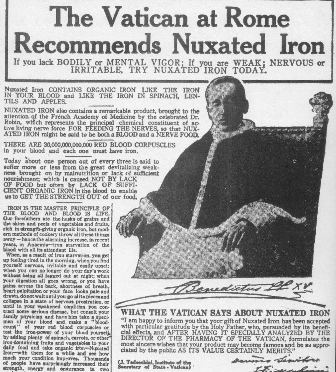
The 1921 ad campaign for Nuxated Iron sought a higher authority to promote the product’s benefits, and featured a picture of Pope Benedict XV under the headline:

“The Vatican at Rome Recommends Nuxated Iron.”

pope

Moriarty and Cobb

5 Feb

While the Detroit Tigers captain “jinx” almost cost George Moriarty his captaincy in 1912, he was also nearly traded to the Cleveland Naps in December of 1911.  The reason given for the Tiger’s desire to trade Moriarty was an alleged fight with Tigers star Ty Cobb.

Whether the fight actually took place is questionable, and an oft-told story about Cobb and Moriarty that grew out of the fight rumor is almost certainly untrue.

George Moriarty

George Moriarty

In December of 1911, The Associated Press reported the “Real reason for proposed trading of Moriarty.” The wire service said:

 “A battle royal between George Moriarty and Tyrus Cobb one day late in the season of 1911, is the reason why Detroit now wishes to dispose of the star third sacker.  Moriarty and Cobb started their argument upon the field at Detroit, and followed it up with an angry controversy at the club office.  Finally Cobb grabbed a bat and threatened to hit the big third baseman.  The latter armed himself in a similar manner, and they started to beat each other up.”

Ty Cobb

Ty Cobb

The story said the fight was broken up by teammates, and “Cobb then issued his ultimatum which was that he would not play with the Tigers if Moriarty was on the team, unless Moriarty apologized to him.”

Within days, both players and Tigers management denied that there had been any fight.  Cobb said:

“There has been a lot of talk that Moriarty and I almost had a fight in the clubhouse last season.  George and I are the best of friends.  We roomed together in the spring and were on the friendliest terms throughout the season.  The story that I put it up to (Tigers owner Frank) Navin to sell or trade George is a fabrication.  In the first place I had no grounds for such action, and in the second place I wouldn’t take such a step if I did have.  I wouldn’t put the Detroit club in a compromising position.”

While the story of a fight was told and retold over the next twenty years, Cobb and Moriarty always denied it happened.

The story that is still included in nearly every mention of Moriarty is that as he and Cobb were preparing to fight, Moriarty said “A fellow like you needs a bat to even things up when fighting an Irishman.”

The quote first appeared in a 1932 column by New York World-Telegram sportswriter Joe Williams when, as an American League umpire, Moriarty’s reputation as a fighter was renewed.  The Associated Press said after a double-header sweep by the Cleveland Indians, Chicago White Sox catcher

Charlie Berry followed the umpire into the runway of the clubhouse, accusing him of ‘missing’ a third strike on Earl Averill just before the Indian broke up the second game with a ninth-inning triple.

“Berry challenged Moriarty to a fight…Milt Gaston, Chicago pitcher, advanced himself.  The umpire felled Gaston…Then Berry, Frank Grube and Lew Fonseca rushed Moriarty, beating him until he was rescued by the Indians.”

In response to mentions of a fight with Cobb in the reports of the 1932 fight, Moriarty renewed his denial of a fight with Cobb, a denial he had also made in 1927 when he replaced Cobb as Detroit manager:

“Say anything else you like about me, but don’t spread the report that Ty and I fought.  We were roommates, and while we may have disagreed we never came to blows.”

Cobb and Moriarity relished their reputations as fighters, the fact that both continued to deny they fought long after it mattered would indicate that they often retold story is more wishful thinking than fact.

One more bit of trivia about Moriarity:  His grandson Michael Moriarty starred as Henry Wiggen in one of the greatest baseball movies, “Bang the Drum Slowly” with Robert De Niro.

Moriarty and De Niro in "Bang the Drum Slowly"

Moriarty and De Niro in “Bang the Drum Slowly”

Kauff and Perritt

29 Jan

Benny Kauff and Pol Perritt were two of the reasons why the New York giants won the National League Pennant in 1917.  Kauff led the team with a .308 average and Perritt was 17-7 with a 1.88 ERA.  Both came to the Giants by way of the Federal League, and with the help of “Sinister Dick” Kinsella, John McGraw’s right-hand man.

"Sinister Dick" Kinsella

“Sinister Dick” Kinsella

Kinsella was the former baseball magnate of Springfield, Illinois who went east to serve as McGraw’s chief scout.  He was a key player in the incident that led to Giants’ catcher Larry McLean’s banishment from organized baseball.

After the 1914 season, McGraw set his sights on the Indianapolis Hoosiers’ Kauff, who was being called the “Ty Cobb of the Federal League.”  Kauff led the league with a .370 average, 120 runs, 211 hits and 75 stolen bases.

When the debt-ridden Hoosiers were transferred to Newark for the 1915 season Kauff’s contract was sold to the Brooklyn Tip-Tops, and he joined the team in Browns Wells, Mississippi.

At the same time, Perritt coming off a 16-13 season was prepared to jump the St. Louis Cardinals and join the Pittsburgh Rebels in the Federal League.

Pol Perritt and Benny Kauff, 1917

Pol Perritt and Benny Kauff, 1917

Sportswriter Frank G. Menke of Hearst’s International News Service picks up the story:

“Dick Kinsella, scout for the Giants, according to the story we get, hustled to Browns Wells and got a job on a plantation…Kinsella didn’t dare to put up at the same hotel because he was known by Manager Lee Magee, Business Manager Dick Carroll and others of the Brookfeds.”

Kinsella, according to Menke, was pretending to be a farm hand and also observing Kauff’s workouts and reporting back to McGraw who, along with Jack Hendricks of the Indianapolis Indians in the American Association (who held Kauff’s rights) was sending coded telegrams to Kauff signed “Father.”  Kauff received telegrams saying, “Mother wishes to see her boy,” and “All is forgiven.”

According to Menke, the telegrams were intended to inform Kauff that McGraw wanted him with the Giants and:

“The “everything forgiven” telegram was to tip Kauff off that if he jumped the National Commission probably would let him play.”

While Kauff was in Mississippi, Pol Perritt was in the process of  jumping to the Federal League.

According to Menke, Kinsella left Mississippi in the middle of the operation to secure Kauff in order to talk to Perritt.  What Kinsella said to Perritt is unknown, but Perritt’s meeting with Pittsburgh manager Rebel Oakes pretty much put an end to any chance of joining the Federal League.  The Associated Press said:

“Pitcher ‘Pol’ Perritt who jumped to the Pittsburgh Federal recently had a fist fight with Manager ‘Rebel’ Oakes…Those who saw the fight say that the pitcher delivered one blow that knocked Oakes over a chair…Friends and acquaintances interceded and hushed up the whole affair before police arrived on the scene.”

The story said Perritt was meeting with Cardinals’ management to “flop back to organized ball,” within weeks the Cardinals sold Perritt’s contract to the Giants, The AP said:

“Carefully guarded by “Sinister Dick” Kinsella…Perritt was delivered to John J. McGraw this noon…Kinsella brought his man in from Shreveport without struggle, and states that he did not even sight a Federal submarine during the entire journey.”

An alternate version of the story, published in The New York Times said it was McGraw who met with Perritt rather than Kinsella and highlighted the manager’s journey to meet the pitcher:

“McGraw had to travel forty miles on one railroad, nine miles on another, and then drive nine miles through the mud to get to Perritt’s home in Louisiana.”

Perritt was in the fold.  After a 12-18 season in 1915, he would win 18, 17 and 18 from 1916-18.

Kauff would be a bit more complicated.

While Kinsella was gone from Mississippi securing Perritt, Kauff signed a $6000 contract with Brooklyn, which he immediately regretted and contacted McGraw.

kinsellamcgraw

Dick Kinsella and John McGraw, 1920

According to Menke, Kauff:

“Related the difficulty he had with Robert B. Ward, president of the Brookfeds, over the contract.  The Giants people thought that owing to Kauff’s trouble—or alleged trouble—over the Brookfed contract that he was not legally under contract.”

Menke said the Giants signed Kauff for $7000 a year for three years with a $7000 bonus.

National League President John Tener voided the contract and Kauff was forced to return to the Tip Tops; he again led the league with a .342 average.

McGraw finally got his second man at the close of the 1915 season.  After the Federal League folded and Kauff was reinstated to organized baseball he signed a two-year contract for $6500 a season and a $5000 bonus with the Giants.

New York had finished in eighth place in 1915. They improved to fourth in 1916 and won the pennant by 10 games in 1917. McGraw’s Giants lost the to the Chicago White Sox four games to two in the World Series.  Perritt appeared in three games in relief, and Kauff hit a disappointing .160, despite two home runs in the Giants’ game four victory.

After the 1917 World Series Perritt and Kauff faded fast.
Perritt was 18-13 in 1918, but would only win four more games over the following three seasons with the Giants and Detroit Tigers; he was out of professional baseball before his 30th birthday.

Kauff’s demise is better known; his professional career came to an end at age thirty, the result of allegations of his involvement with gamblers, in general, and 1919 World series fixer Arthur Rothstein in particular.  Kauff, who owned an automobile accessory business with his half-brother and Giant teammate Jesse Barnes, was charged with stealing and reselling an automobile.  Although he was acquitted at trial, Kenesaw Mountain Landis banned Kauff for life.  Kauff’s oft-told story is told best in two excellent books by David Pietrusza:  Rothstein: The Life, Times, and Murder of the Criminal Genius Who Fixed the 1919 World Series and Judge and Jury: The Life and Times of Judge Kenesaw Mountain Landis.

Perritt died in Shreveport, Louisiana in 1947; Kauff died in Columbus, Ohio in 1961.

A Thousand Words—Home for Christmas

25 Dec

japantour

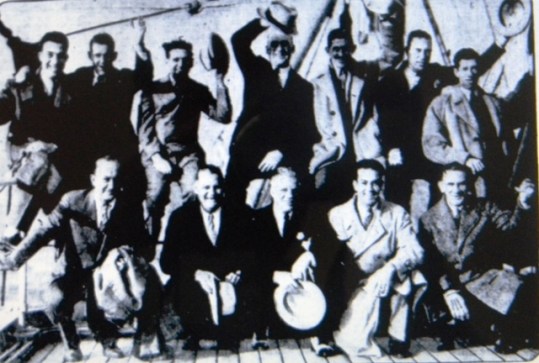
Members of the 1931 Tour of Japan delegation of Major League stars arrive in San Francisco two days before Christmas.  They were greeted on arrival by Ty Cobb:

Back Row: Al Simmons, Larry French, Muddy Ruel, Ralph Shinners, Mickey Cochrane, Lefty O’Doul, Lefty Grove.

Front Row: Ty Cobb, Leonard Knowles (New York Giants trainer), Herb Hunter (former minor league player who organized this and several earlier tours of Japan), Bruce Cunningham and Rabbit Maranville.