Archive | April, 2014

Brief Bios

7 Apr

Finley Yardley

Identified as “Findley” on Baseball Reference, Finley A. Yardley was born in Ben Arnold, Texas on March 21, 1895.

“Fin” Yardley was a good hitter, but his intelligence was questioned more than once during his career.

After a spring trial with the St. Louis Browns in 1917, he was released to the Little Rock Travelers in the Southern Association for 57 games, but according to The Arkansas Gazette, “Forgetting is what chased him out” and he was sent to the Spokane Indians in the Northwestern League.

Yardley hit well in Spokane (.339 in 115 at bats), but despite his success The Gazette noted that:

“His think tank still slips now and then.  Recently he hit a drive good for three bases but forgot to touch first.”

Fin Yardley was no rocket scientist—his son John Finley Yardley was.

John Yardley was an aeronautical engineer whose team from McDonnell Aircraft Corporation designed the Friendship 7 capsule in which John Glenn orbited the Earth in 1962—Glenn called him “one of the real pioneers of the space program.”  Yardley was also involved with the Gemini, Skylab and Space Shuttle Programs.

After his playing career, Finley Yardley settled in St. Louis where he worked as a sales manager at a car dealership.  He died in Tucson, Arizona on March 1, 1963.

Charles Gurtz

Charles Joseph Gurtz was born in DePauw, Indiana in 1890.  He served in the United States Army, where he was a member of the 22nd Infantry and played for the unit’s baseball team in the El Paso, Texas city league.  He then played in a number of leagues throughout the Southwest not recognized by the National Agreement, including stops with teams in the “copper circuit;” loosely connected teams and leagues in mining towns in New Mexico and Arizona

Gurtz was let out of his contract in Silver City, New Mexico in order to join the Bloomington Bloomers in the Three-I League in 1914.  He hit .333, finishing second to Howard Wakefield for the league batting title.

Shortly after the 1914 season ended, Gurtz broke his leg during a semi-pro game in Odell, Illinois and returned home to Indiana.

In February of 1915, The Associated Press reported that he was “suffering from mental trouble, due to excessive religious zeal (and) has been declared insane. “  He was committed to Indiana’s state hospital at Madison, where “Physician’s say that he should respond to treatment and become normal again if his mind can be kept off religion.”

A month later Gurtz was released from the state hospital, The Associated Press said the hospital’s “superintendent expressed the opinion that Gurtz would be able to play ball.”

Gurtz played, but not well.

He hit just .193 for Bloomington in 1915.  The following year he was released by Bloomington just before the season began, but was signed by the Oklahoma City Senators in the Western Association in May.  He split the 1916 season between the Senators and the Muskogee Mets in the same league, hitting just .210.  (Baseball Reference identifies the player with Oklahoma City and Muskogee in 1916 as “William Gurtz,” but contemporary references in The Oklahoma City Times confirm that it was Charles Gurtz)

Gurtz returned to his native Indiana after the 1916 season and died on November 9, 1989, three weeks short of his 100th birthday.

Jimmy Duchalsky

James Louis “Jimmy” “the Duke” Duchalsky was discovered in Hawaii between the 1922 and ’23 seasons when Herb Hunter’s touring big leaguers visited the island during their barnstorming trip which also included stops in Japan, Korea, China and the Philippines.

The International News Service, which called the 5’ 9” 150 lb. Duchalsky the “hardest hitting pitcher in Hawaiian baseball circles,” said he caught the eye of New York Yankee pitcher “Bullet” Joe Bush.  Bush “was so impressed with the youngster’s work in a game he pitched against the big leaguers that he recommended him highly to Duffy Lewis manager of the Salt Lake City Bees in the Pacific Coast League).”
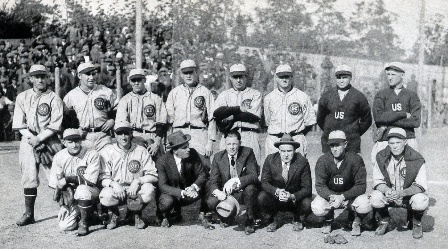
Joe Bush, front, second from right

Joe Bush, front, second from right  photographed during the tour.

Bush said the only thing he lacked was “a change of pace and that can be developed under the instruction of a good coach and manager.”

Duchalsky was 24-years-old (the Bees claimed he was just 21), but not as polished as Bush thought and struggled through 15 appearances, most in relief, for Salt Lake.  He posted a 1-3 record and 7.59 ERA in 51 innings—he did have 8 hits in 20 at bats, with one home run.   In May, he and teammate Tony Lazzeri were sent to the Peoria Tractors in the Three-I League; Duchalsky was 13-8 in 28 appearances.

The following season Duchalsky rejoined the Bees but pitched just one-third of an inning, allowing two runs and two hits in an 18-17 loss to the Oakland Oaks on April 10.  He was released later that week and returned to the Three-I League, this time as a member of the Decatur Commodores; he was 11-9 with a 4.13 ERA for the last-place (58-78) Commodores.
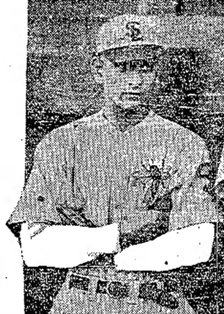
Jimmy Duchalsky 1923

Jimmy Duchalsky 1923

At the end of October he returned to Honolulu to play winter ball.

On December 7, 1924 Duchalsky was involved in an altercation with a cab driver. The Decatur Review said:

“Jim Duchalsky, known to all Three Eye League baseball fans as “The Duke,” has pitched his last game of ball… (he was) shot to death in his native city last evening after a street argument…It will be hard to convince Decatur baseball fans who have come in contact with Jim that he was the aggressor in any brawl that might have taken place for he was the most quiet player both on and off the field to ever appear here… Despite his quiet manners and the fact that he was not a mixer, many fans in both Decatur and Peoria will mourn his loss.  Duchalsky was admired by fans in every city where he played for his sportsmanlike conduct on the ball field and in all his games pitched at Staley Field was never seen disputing an umpire’s decision, even on balls and strikes.  He pitched his game and left the arguments out of his assortment.”

The Associated Press said, “The encounter was believed to have started in jealousy over a woman.”  The cab driver, John Emmeluth, claimed self-defense, but several witnesses said he approached and shot the pitcher with no warning.  He was sentenced to 20 to 25 years in prison.  Duchalsky was buried in Honolulu.
“Father isn’t Disappointed because I took up Dancing”

4 Apr

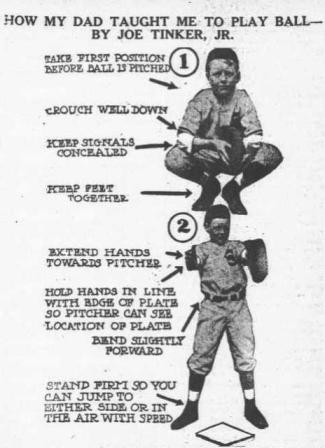
In the spring of 1916 Joe Tinker Jr., ten-year-old son of Chicago Cubs Manager Joe Tinker “wrote” a series of articles that appeared in newspapers across the country.  Tinker’s articles provided tips for playing each position:

“To be a winning pitcher you must have control…The best way to gain control is to get another boy to get in position as a batter then pitch to him.  Don’t throw at a stationary target.”

“(Catchers) Stand up close to the batter and don’t lose your head if the pitcher becomes wild.  Try to steady him with a cheerful line of talk.  Practice every spare moment.”

“Stand close to the plate when batting.  Don’t lose your nerve if the pitcher tries to bean you. Some fellows like to choke their bats or grip the handles about four inches from the end.  My father don’t approve of the style…Don’t argue with the umpire.  If you are hot-headed you hurt your chances to connect with cool-headed pitching.”

“Learn to start in a jiffy.  That is the first point emphasized by my dad in teaching me to run bases.”

“Playing short offers many chances for individual star plays and the work of a good man will have a great effect on the score card.”

Photos of Joe Tinker Jr. demonstrating what his dad taught him

Photos of Joe Tinker Jr. demonstrating what his dad taught him

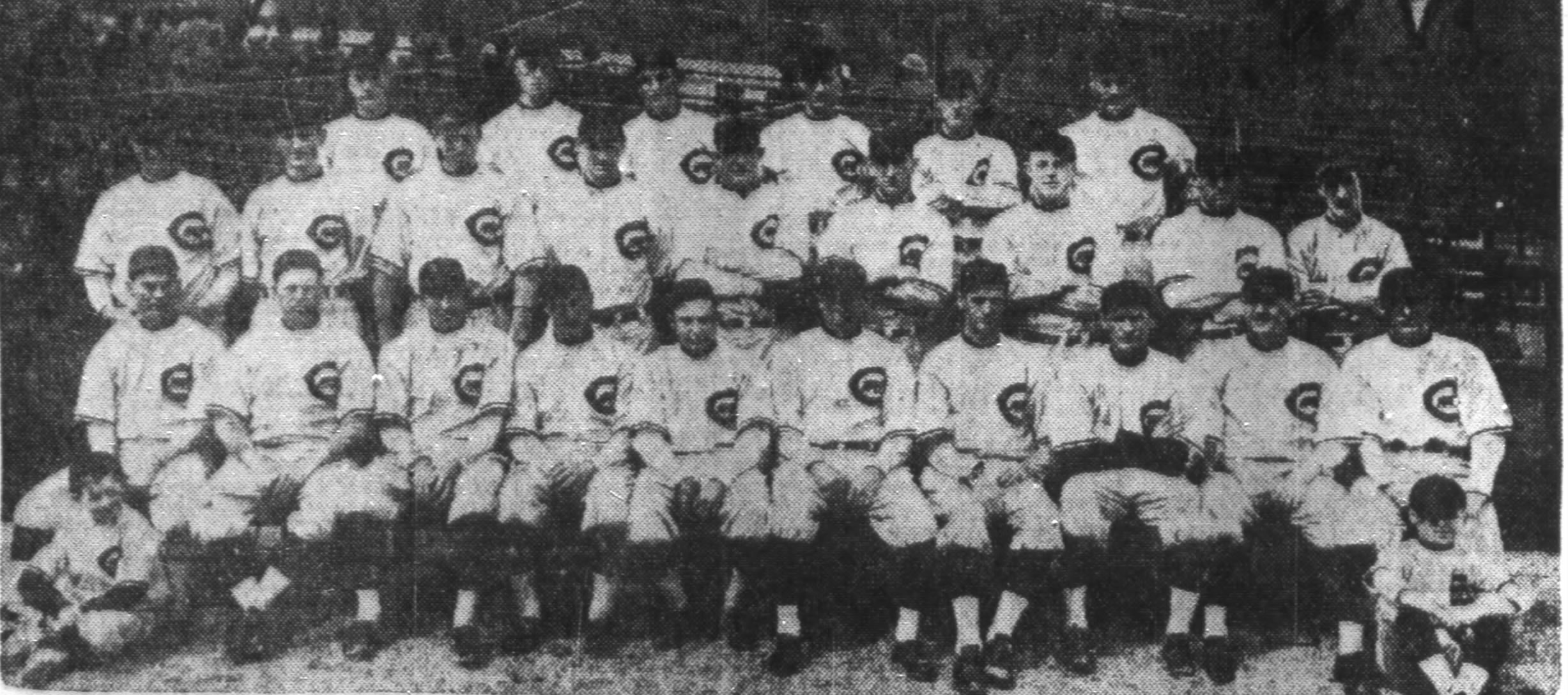
Joe Tinker Jr. and his younger brother Roland were the Cubs mascots during their father’s season as manager in 1916.  In 1924 Chicago newspapers reported that Tinker Jr. was headed to the University of Illinois to play baseball for Coach Carl Lundgren, the former Cub pitcher.  There is no record of Tinker ever playing at the school.

1916 Chicago Cubs.  Joe Tinker Jr. seated right, Roland Tinker seated left.

1916 Chicago Cubs. Joe Tinker Jr. seated right, Roland Tinker seated left.

Younger brother Roland played for two seasons in the Florida State League.

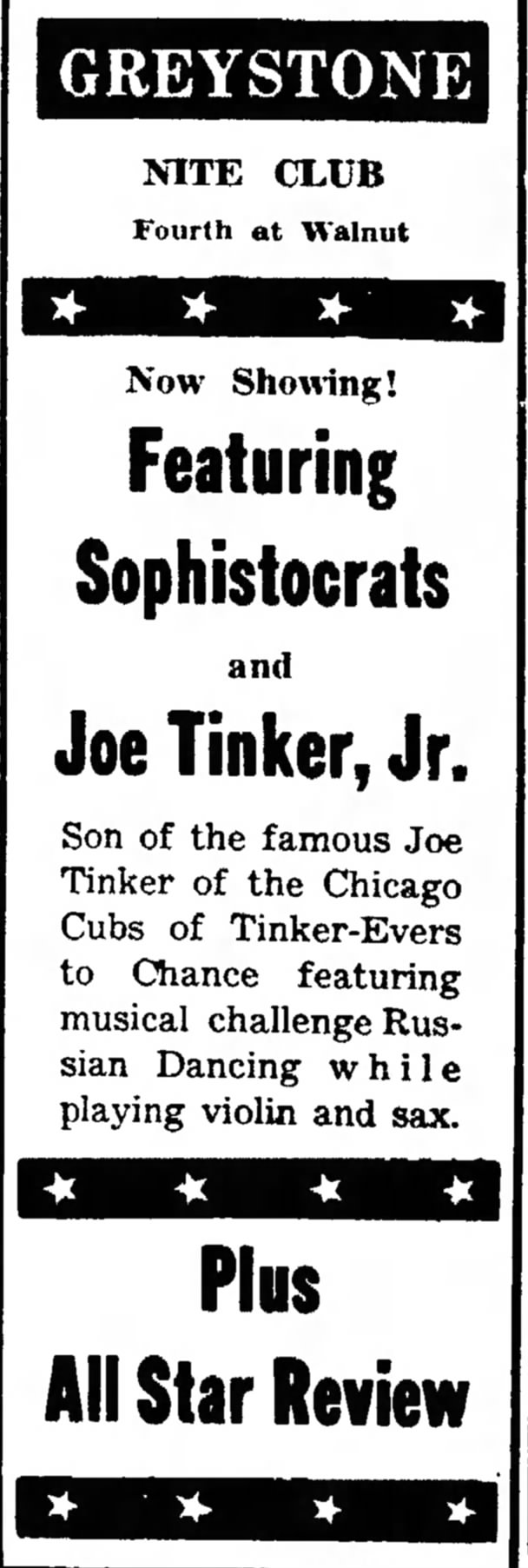
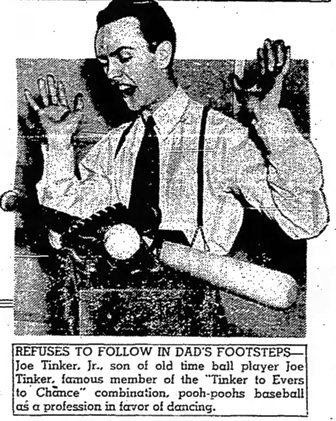
In 1938 newspapers reported that Joe Tinker Jr. had become a dancer with a vaudeville group called the Sophistocrats.  Tinker Jr. told reporters:

“Father isn’t disappointed because I took up dancing.  In fact he approves.”

It’s unclear whether “Joe Tinker Jr.” was actually Joe Tinker Jr.  The newspaper articles all said he was 22-years-old.  Joe Tinker Jr. would have been in his thirties; however his brother William Jay Tinker would have been 22 in 1938.


joetinkerjrdance


joetinkerjr1938

When Joe Tinker was elected to the Hall of Fame he compiled his all-time team for Ernest Lanigan, then curator of the Hall:

Pitchers: Mordecai Brown, Grover Cleveland Alexander, Christy Mathewson and Ed Walsh

Catchers: Johnny Kling and Roger Bresnahan

First Base: Frank Chance

Second Base: Eddie Collins

Third Base: Harry Steinfeldt

Shortstop: Honus Wagner

Outfield: Artie “Solly’ Hofman, Ty Cobb, Fred Clarke, and Sam Crawford.

Though he named several Cubs, Tinker did not include his former teammate Johnny Evers.  In 1914 Evers had famously slighted Tinker, with whom he was engaged with in a long-term feud, after Evers and his Boston Braves teammates won the World Series. William Peet wrote in The Boston Post :

“(Walter “Rabbit” Maranville’s) the best shortstop the game has ever known.

“Better than Joe Tinker; your old side partner?

“Yes, he’s better than Tinker.”

While the two finally broke their silence at Frank Chance’s deathbed in 1924, they never reconciled.

Evers died in 1947, Tinker in 1948.

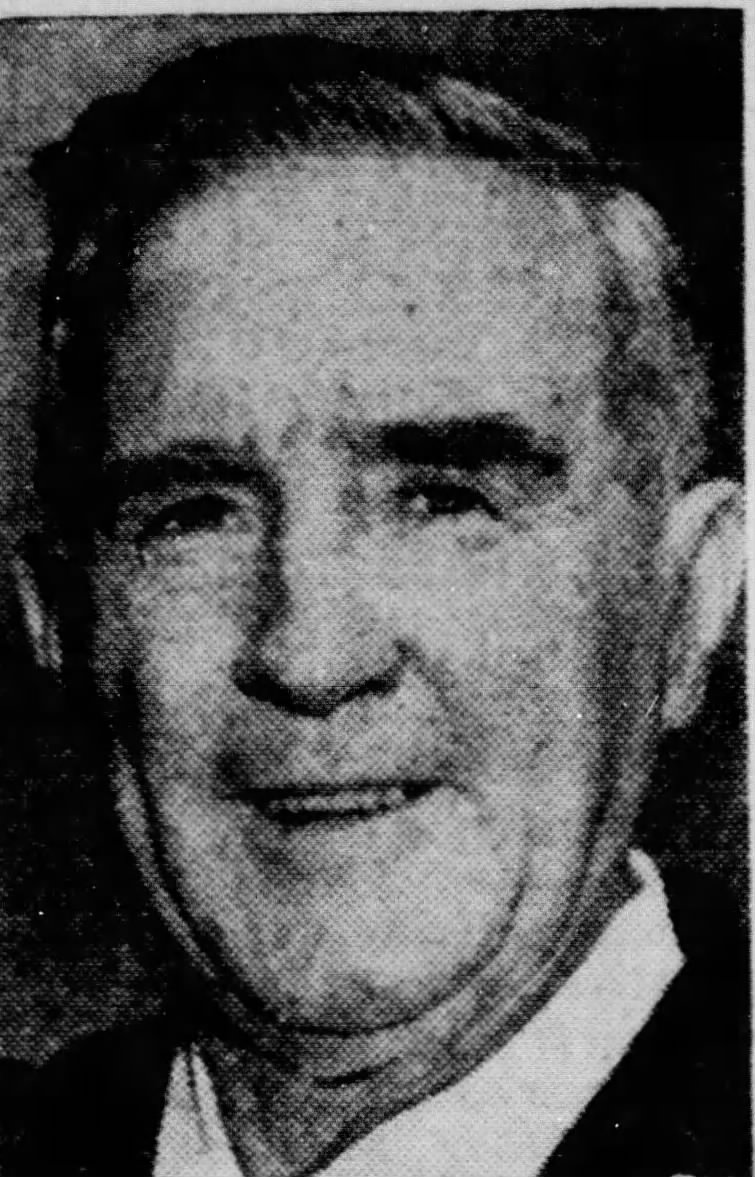
Joe Tinker circa 1946

Joe Tinker circa 1946

Joe Tinker Jr. died in 1981, Roland “Rollie” Tinker died in 1980, and William Tinker died in 1996.


Things I Learned on the Way to Looking up other Things—Women’s Baseball Edition

2 Apr

A Riot in Cuba

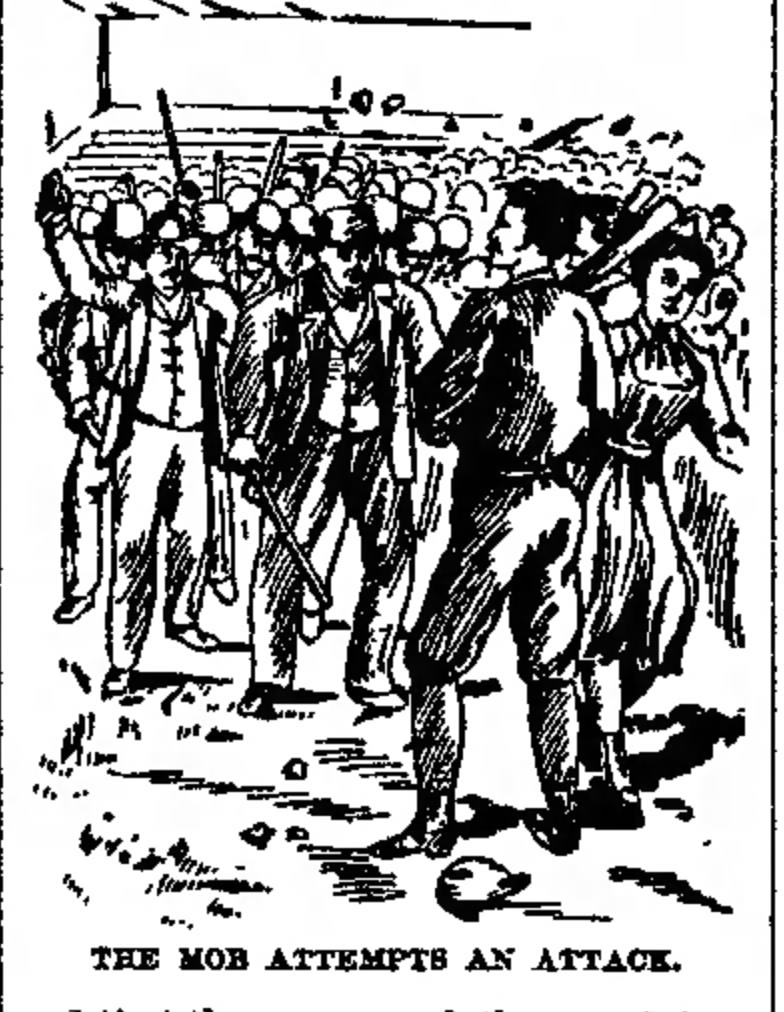
In early 1893 a team known as the “American Female Baseball Club” traveled to Cuba to play a series of games against male teams.  The Associated Press said the team was “going about playing against Cuban clubs and otherwise exhibiting themselves with more or less success,” until they arrived in the Almendares district of Havana for a game on March 5:

“The attendance included a share of the lowest dregs of society.  These became irritated at the playing of the American visitors and some of them declared that it was simply farcical and…claimed the young women were, in fact, not players at all.  They clamored for the restitution of their money, and at length broke seats and set fire to the fence around the play-grounds.

“This caused a general consternation among the female players, who were gallantly defended by the young men of the opposing Cuban club and by the respectable majority of the spectators.  Confusion ensued, and the shrieks of the frightened young women could be heard mingled with the execrations of the mob.  All the players, male and female, took refuge in a house.  The mob pursued them and succeeded in obtaining entrance.  Then the rioters pillaged the house.  The Cuban players fought bravely to save the young women; otherwise more of them would have been hurt.”

1893havana

Illustration that appeared with the story in several newspapers

Most of the nine players were injured in the melee, and when the team returned to New York on March 14 The associated Press said the team “brought suit for damages against the Spanish Government.  The manager of the team, a man named Joseph Bruckner, said not only were the players assaulted but the rioters “dragged down the American flag which the club carried, and destroyed it.”

The resolution of the suit, if there was any, was never reported.  And there is no record of the “American Female Baseball Club” playing again.

“Deserting Home for the Diamond Field”

The acting chief of the New Orleans police department received a telegram from Cincinnati in May of 1886:

“Arrest two runaway girls.  They will arrive on train No. 1 of the North-eastern [sic] Railroad.”

The Cincinnati Enquirer said two New Orleans officers were detailed, and:

“(U)pon the arrival of the train placed the two runaway girls under arrest and brought them to the chief’s office.  At the time of their arrest they were in the company of H. Freeman, the manager of the Female Base-Ball Club.  Arrived at the station they gave their names as Fannie Crambert and Ella Burke.  They stated that they got acquainted with the members of the club in Cincinnati, and that, believing it a pleasant life, they resolved to lead it.”

The paper noted that both “were over eighteen years of age,” and were “dressed in flashy sailor suits,” when they arrived in New Orleans.

The Chief “gave them sound advice, and stated that the ways of the female baseballists were too rough and dangerous for young and virtuous girls.”

The two were returned to their families in Cincinnati.

The manager of the team, Harry Freeman (The New Orleans Times-Picayune said his real name was Sylvester Wilson), was arrested  and “charged with being a dangerous and suspicious character…for inducing young girls to leave their homes and parents and join his troupe of baseball players.”

Freeman/Sylvester was given the choice of a $25 fine or thirty days in jail; he chose to pay the fine.

The Times-Picayune said:

“Female base ball playing in New Orleans has doubtless had its day, and there will be no more of it—this season at least.”

Bloomer Girls

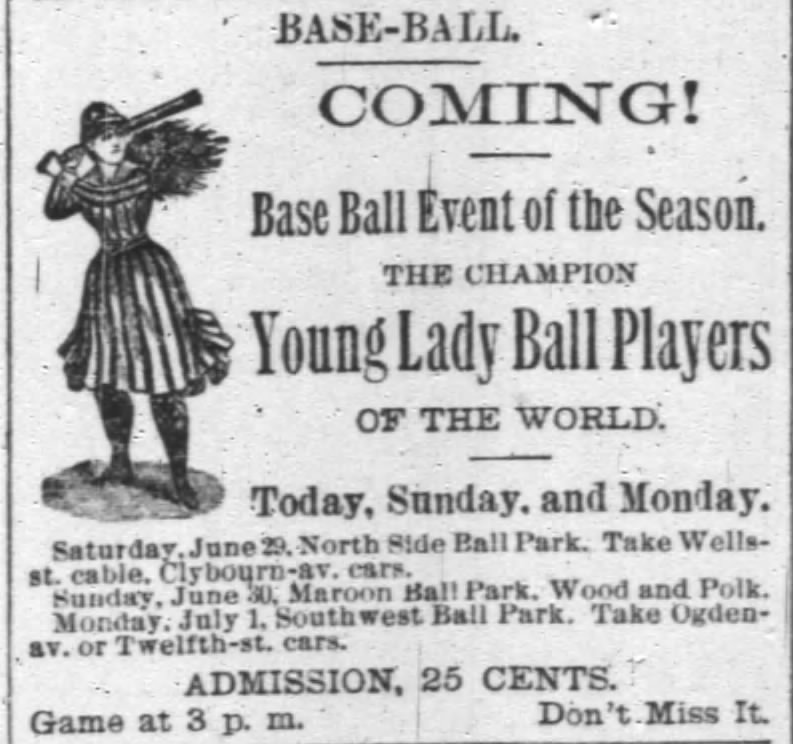
Below is an advertisement for the Chicago dates for a 1889 Barnstorming Tour of “Young Lady Ball Players of the World,” one of many teams generically called “Bloomer Girls,”  that played across the country in the late 19th Century.  This club played against male competition, and, like most women’s teams had between one and four male team members who would usually dress in drag.

womenjune1889chicago

“It is Claimed by these Citizens that the Pictures are Indecent”

In 1886, The Atlanta Constitution reported that a “cigarette picture sensation is agitating certain good people” in the city.

Cards inserted in packages of cigarettes were not new in Atlanta, or anywhere else; the practice was, at least, a decade old.  But these cards were different:

“They represent nine handsome female baseball players in attitudes common in that popular game.”

The cards were “displayed in a window” at the tobacco shop in Atlanta’s Kimball House Hotel.

“Since two weeks ago, it has been a daily occurrence for crowds to gather around the window and gaze admiringly upon the graceful forms depicted in the photographer’s art.  All sorts of people have been there, from the ragged boot black to the merchant prince.”

The cards quickly became controversial:

“A number of staid citizens have expressed themselves as being opposed to the exhibition of the pictures, and have declared their intention to request Mayor (George) Hillyer to interfere.  It is claimed by these citizens that the pictures are indecent.”

Atlanta was not the only city where the cards were a sensation, and controversial.

One of the cards that caused the sensation

One of the cards that caused the sensation–Pacholder Tobacco Company created the series to promote brands including Sub Rosa and Dixie–many extant examples of the set are part of New York’s Metropolitan Museum of Art collection

The New York Journal railed against the “objectionable pictorial advertisements in tobacco shop windows.”  Anthony Comstock’s Society for the Suppression of Vice contacted cigarette manufacturers and retailers ordering them to “cease these immodest displays, or prepare to face legal prosecution.”

The Journal said:

“Business men complain that some of the picture exhibited in the retail cigar stores…are of such a character that their wives and daughters hesitate to pass them, because of the open comments of boys and men who hang about the windows.”

While the displays were removed from many windows throughout the country, there is no record of any prosecutions of those who refused to remove the “offensive” cards.