Archive | October, 2014

“Stories of his Badness are told all over the League”

8 Oct

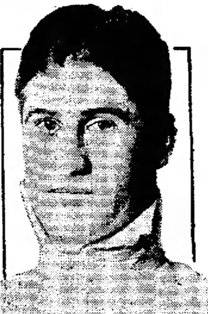
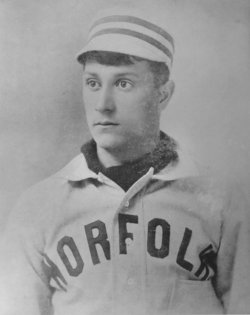
After “Bad Bill” Eagan finished the 1898 season with the Syracuse Stars –he hit just .227, his lowest recorded minor league season average—then returned to his native Camden, NJ–Eagan started his amateur baseball career in Camden as a pitcher, his catcher was another Camden native, William “Kid” Gleason.
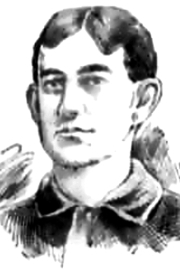
Bad Bill Eagan

Bad Bill Eagan

The Harrisburg Telegraph—Eagan had spent two seasons playing in the Pennsylvania city—told the story:

“Bill Eagan the once great second baseman of the Harrisburg Club, in a fair example of what rum will do when it gets the upper hand of a man.  Eagan would have been one of the leading players of the profession if he had left strong drink alone.  He was a sure fielder, hard batter and quick baserunner and ought to be in his prime as a player by this time, but he has drained too many mugs and now winds up in a police court at his home in Camden, NJ, on a charge of attempted murder.

“Eagan was intoxicated yesterday and displaying a 48-caliber revolver, placed it to his temple and remarked: ‘I am going to kill my wife and blow my brains out.’ He paid Barber Riceman fifty cents which he owed him, and also paid a nearby saloon keeper $1 for drinks that he had bought.  Then he returned to the barber shop, said good-bye to his friends, and exclaiming; “Now I am free from debt and am ready to do the job,’ he started for his home and put the threat into execution.

When he arrived home Eagan fired two shots at—and missed–his wife, and then attempted to shoot one of the responding police officers, but because of “a quick blow from (another police officer’s) club the murderous weapon was knocked from the crazed man’s hand.”

The Chicago Tribune said:

“William Eagan, or, as he is known in the baseball profession, ‘Bad Bill’ Eagan, is a player of national reputation.  He is an ignorant man, and stories of his badness are told all over the league.  He was considered one of the best ball players in the profession.”

The Tribune said about Eagan’s brief stay with Pittsburgh earlier in 1898:

“He failed to behave himself, and drunkenness was the charge which let him out as a Pirate.”

Eagan was held in the Camden jail from October of 1898 until March of 1899; it is unclear what he was formally charged with, and he was never tried.

In spite of his reputation, baseball wasn’t done with “Bad Bill” yet.  Shortly after his release from jail, Syracuse sold Eagan’s contract to the Western League’s Detroit Tigers.  His statistics for the season don’t survive, but Eagan seems to have gone back to his old habits.  After he sat out both games of a double-header with the Kansas City Blues in July, The Kansas City Journal said:

“’Bad Bill’ Eagan acquired a jag yesterday and succeeded in making a holy show of himself.  Such creatures and ‘Bad Bill’ should be out of the game.”

Eagan was also seriously injured the same month when, according to The Associated Press, during a game with the Columbus Buckeyes, while trying to stretch a double into a triple:

“Eagan threw himself, feet foremost toward the bag.  His spike caught in the base sack and his right leg was given a terrible wrench.  ‘Bad Bill’ screamed with pain and in an instant was surrounded by members of both teams… (He) had thrown out his kneecap.  (A doctor) pushed the cap back and then the injured player was carried to the bench.”

Whether the injury contributed or not is unknown, but by August The Sporting Life reported that he had again worn out his welcome:

“Bad Bill” Eagan has worn a Detroit uniform for the last time. Eagan has not behaved at all and (George) Stallings has got through for good and all with him.”

George Stallings

George Stallings

One more team was willing to take a chance on Eagan; he was signed for 1900 by the Youngstown Little Giants in the Interstate League.  After appearing in just 26 games The Sporting Life reported that:

“Eagan has been playing ball in Youngstown, OH, but he said he needed a rest.  He came to Detroit for that purpose Saturday morning, and he paid $5 in the police court this morning for the first installment. “Bad Bill” said he was so glad to get back and he met so many friends that he rather lost track of the proceedings. He had fallen Into a Rip Van Winkle sleep when the policeman picked him up. “Bad Bill” paid his fine and went out for the “rest.” Bill doesn’t think much of Youngstown, he says. “

The Youngstown Vindicator said Eagan was released by the Little Giants before he left for Detroit

In either case, he had finally run out of chances, and never played another professional game.

The Indianapolis News said, in late August of 1900, that Eagan was:

 “(P)icked up on the streets of Detroit) insane.  He was removed to the emergency hospital, where he became violent and it took a number of men to overpower him and take him to the station and confine him in a padded cell.  Drink caused Eagan’s downfall. Sober he was a hard working ambitious ball player; if a drink or two were given to him he became a dangerous maniac.”

He was released after several days, and the the many premature rumors of his death began at that point, while Eagan continued to tend bar in Detroit. In April of 1904 w he became ill and was sent to a tuberculosis sanitarium in Denver.  Ten months later “Bad Bill” was dead at age 35.

Despite having played just six games with Chicago in 1893 Eagan made such an William A. Phelon that more than 20 years later he wrote in “Baseball Magazine:”

 “Although the poor fellow had few chances given him in the big league, I always thought there never yet was a second baseman who mixed and mingled in the furtherance of infield plays like Bad Bill Eagan. Possibly I can best symbolize Eagan’s style of second-basing, for the present generation, by stating that he played second just about as (Fred) Tenney played first. (Eddie) Collins doesn’t go so far from second as Eagan did, nor does he carry out nearly so many plays—but it’s quite likely he could if he had to—if he didn’t have, through the past few years, the marvelous (Jack) Barry cutting in and taking his half of the proceedings.

Eagan, though, was almost uncanny at times. I saw him working with (Cap) Anson on first and (Bill) Dahlen at short. It might be taken for granted that Eagan would have to move round considerably on the side toward first, with the ponderous and fast-aging Anson on station one, but Dahlen was then in the flush of his youth and a moving streak at short—when he wanted to be. Yet I saw Eagan bewildering Dahlen as well as Anson by the phantom-like rapidity of his movements, and the way in which he suddenly appeared at the spot where the play should be kept going, arriving on the ground before Dahlen could even draw back his arm to throw.”
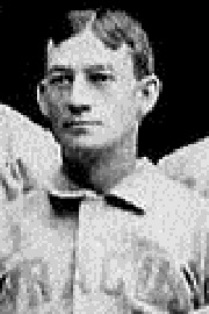
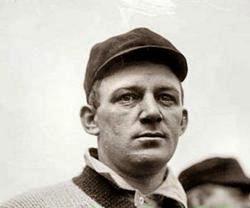
Bad Bill Eagan

6 Oct

William “Bad Bill” Eagan was just 35-years-old when he died from tuberculosis in 1905, but many people didn’t believe it when the news was first reported. The hard-living Eagan’s demise had been predicted and reported several times. In 1901, the year after his professional career ended, The Fort Wayne Sentinel said:

“’Bad Bill’ Eagan who died two or three times last year, is running a poker room in Detroit. Eagan dies on the average of three times a year and is about due for the first of this year’s series. Eagan captained and played first base for Youngstown before his second demise last season.”

Bad Bill

Bad Bill

In 1899 Connie Mack told The Philadelphia North American:

“Eagan would be one of the best second basemen in the business if he would keep in condition.”

He quickly wore out his welcome during all three of his brief stints in the big leagues. The first, with the St. Louis Browns in the American Association in 1891, ended, according to The Syracuse Standard after an incident with team owner Chris von der Ahe:

“(Eagan) was a jolly fellow and not afraid of discipline. The Browns got on a train at St. Louis to come East…von der Ahe’s nasal organ was rather large and red for its age and ‘Bad Bill’ determined to have some sport.

“Walking up to his employer, he caught the nose between his fingers, and said: ‘Say, Chris, how much did it cost to color that?’

“The owner of the cerise nose was furious with rage. He released Eagan at once. The train was ninety miles east of St. Louis, and at von der Ahe’s order the conductor put the nose twirler off the train.”

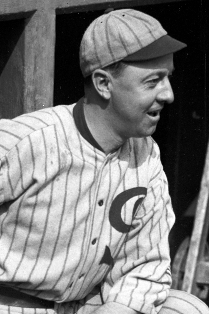
Two years later Eagan joined ‘Cap’ Anson’s Chicago Colts. Hugh Fullerton told the story of how he wore out his welcome there after just six games:

“Anson was a quick thinker on the ball field, but once he released the best second baseman that ever wore a suit for thinking a little quicker than anybody else on the nine.

“The second baseman in question was “Bad Bill’ Eagan. Everybody who remembers ‘Bad Bill’ will admit his supremacy on the second bag. When the play we celebrate came up there was a base runner on second. Chicago was one run to the good, and it was in the last half of the ninth inning.

(Bill) Dahlen was playing third base for Chicago. The man hit a sharp liner down to second. ‘Bad Bill’ started for it and at the same instant the man started for third base.

Bill Dahlen

Bill Dahlen

“The liner was a clipper and the ball struck ‘Bad Bill’s’ hands and bounded out. It struck the ground ten feet away, with ‘Bill’ right after it. Once he got his hands on it and without stopping to look where he was throwing. ‘Bill’ let the ball fly to third base.

“Most ball players after fumbling the ball would have tossed it to the pitcher or thrown it home if, after looking around, they saw that the base runner had started to try to score.

“In this case the base runner, after touching third, went on for twenty feet and then stopped for an instant to see what had become of the ball. He saw it coming straight as a die for third base, and went back there like a flash. But the ball beat him by ten feet. Unfortunately for the game, and also for “Bad Bill,’ Dahlen had taken it for granted that Eagan would throw the ball to the home plate, and was not looking for it to be thrown to him. Consequently the ball went by him, going within four inches of his nose, and striking the grand stand far behind.

“The result was that both base runners got safely home before Dahlen recovered himself and the ball, and the game was lost to Chicago.

“Anson was furious and immediately after the game gave ‘Bad Bill’ his release for making that throw. As a matter of fact, it was the best possible play under the circumstances, and Dahlen, rather than “Bad Bill’ was to blame for it not coming out as planned. If ‘Dal’ had thought as quickly as ‘Bill’ the game might have been settled right then and there.”

Eagan received one more trial with a major league team in 1898. He started the season on the bench for the Pittsburgh Pirates, but was given the opportunity to start when regular second baseman Dick Padden left the team over a dispute with Manager Bill Watkins in May.

Eagan hit .328, but committed 10 errors in 19 games. He was sold to Louisville Colonels on June 5. The Louisville Courier-Journal said:

“He is a clever fielder, a fair batsman, extremely aggressive and absolutely fearless (and will) certainly strengthen the team in one of its weakest spots.”

But he never appeared in a game for Colonels. The following day The Courier-Journal said the deal was off, and Manager Fred Clarke would only say, via telegram:

“Called deal for Eagan off for good reasons.”

The Colonels passed on Eagan despite being a team badly in need of a regular second baseman—Clarke tried nine different men there during the season, and his primary second baseman, Heine Smith hit .190 and committed 16 errors in 26 games.

Eagan finished the 1898 season with the Eastern League’s Syracuse Stars, where he had played from 1894 to 1897. He finished the year of 1898 in jail in his native Camden New Jersey.

That story Wednesday

“Then the Harder I threw the Harder they hit them”

3 Oct

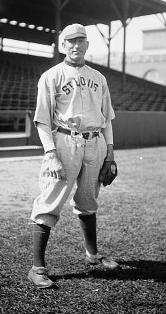
Walter Newton Justis–often misspelled “Justus” during his career– performed an incredible feat in 1908.  While posting a 25-17 record for the Lancaster Links in the Ohio State League, he pitched four no-hit games between July 19 and September 13.

Walter Justis

Walter Justis

The performance earned him his second shot to make the big leagues.  The first consisted of two relief appearances (8.10 ERA in 3.1 innings) with the Detroit Tigers in 1905 when he was 21.  He said later that he wasn’t ready:

“All I knew was to burn them over.  And the harder they hit them the harder I threw.  Then the Harder I threw the harder they hit them.  Most of the time in the three months that I was there I lugged the big bat bag, and I guess I earned my salary then about as much as at any time I know of.”

Justis’ bizarre behavior often made as big an impression as his pitching.  Roy Castleton was pitching for the Youngstown Ohio Works in 1906 when Justis joined Lancaster (the team was in the Ohio-Pennsylvania League in 1906 and ’07, and joined the Ohio State League in 1908).

Castleton, while playing for the Atlanta Crackers two years later told The Atlanta Constitution  he thought “Rube Waddell and Bugs Raymond, two players well-known for their eccentricities…will have to take off their top pieces,” to Justis.  Castleton was staying in the same hotel as the Lancaster team:

“Early one morning he heard someone raising a disturbance in the hotel hallway and taking a look to see what was doing, he observed pitcher Justis…running down the hallway.

“’At the end of the hall Justice placed a pillow against the wall.  He would get a good start down the hall and after the fashion of a man on the paths would take a running slide at the pillow.  When he arrived at his destination he would hold out his hand as umpires do and yell ‘safe!’  Justis would keep this up for hours at a time playing base runner and umpire out in the hall at daybreak.’

“’Sometimes he would stop the double existence of umps and runner and would (just) be the judge of the play.  Standing over the pillow he would hold out his hand and yell ‘safe’ so loudly that he could be heard a block off.’”

The Constitution also said that Justis was superstitious:

“He never goes into a game without wearing a pair of ladies’ silk hose supported in the usual manner.  Regular baseball stockings would never do for him, as he believes his career as a pitcher would be cut short if he were to wear them in a game.”

He was signed by the St. Louis Browns, and Manager Jimmy McAleer told The St. Louis Globe-Democrat the pitcher’s eccentricities were a positive:

“McAleer says that the reason he signed pitcher Justis of Lancaster was because Justis bears the reputation of being a baseball ‘bug.’  ‘Bugs,’ says McAleer, ‘make good in St. Louis.  We have Waddell, while the Cardinals have ‘Bugs’ Raymond.’”

Justis joined the Browns in Dallas in the spring of 1909.

The Globe-Democrat said after he had a poor outing in an exhibition against the Houston Buffaloes of the Texas League:

“Justis pitched two innings for the Browns Saturday and the Houston team got six runs.  Until this bombardment he was tagged for the regular club, and the label hasn’t been removed yet, though slightly loosened.”

And Justis appeared to have made the team when they broke camp in Texas and returned to St, Louis in early April, but The Associated Press reported on April 6:

“Walter Justus, a pitcher recruit of the St. Louis Browns, is confined to his room by a severe nervous collapse, and the nurse in charge says he may be able to leave for his home in Indiana in a few days.  Justis lost his power of speech at the end of a wrestling bout with Arthur Griggs in Sportsman’s Park today.  It is claimed Justus fell to the floor, striking his head, and reopened an old wound received when a boy.”

Justis suffered similar attacks at least four other times during his career; in June of 1907, twice in 1908, and August of 1909.  In July, 1908 after a double-header with the Lima Cigarmakers, The Marion (Ohio) Daily Mirror said “(Justis) suffered a sudden brain stroke akin to apoplexy.  He fell in a dead faint at the close of the second contest.  He was removed to his hotel in an unconscious condition.”   In September, after another attack left Justis hospitalized, The Sporting Life said prematurely “physicians say he will never twirl another game.”   It is likely that he suffered from epilepsy.

Within days of returning to Indiana from St. Louis Justis fully recovered.  The Associated Press said “His recovery is one of the most remarkable in the history of athletes.”  But, despite his recovery, Justis was returned to Lancaster by the Browns, and lost his opportunity to return to a major league team.

He threw another no-hitter for Lancaster in 1909, on May 18 against the Marion Diggers, and went 19-16 for the season.  Justis continued pitching until 1913, finishing with the Covington Blue Sox in the Federal League—where he played with the equally eccentric, enigmatic Fred “Humpy” Badel.

Justis shut out the St. Louis Terriers 4 to 0 on the opening day of the Federal League season, but no complete records remain for the season.  By late September of 1913 he was back home in Greendale, Indiana pitching for a local team.  He remained in Greendale until his death in 1941.

Bill Setley

1 Oct

William Warren “Wild Bill” Setley was a career minor league player and umpire, and one of the most colorful figures in 19th and early 20th Century baseball.

He was born in New Jersey in 1871—Setley often claimed he was born in 1859; his grave marker and several sources still list this date, but there is a New Jersey birth certificate that confirms the 1871 date.

Bill Setley 1895

Bill Setley 1895

Setley spent the early part of his playing career in the Pennsylvania State League (PSL).  The Shenandoah Evening Herald said in 1893:

“(Setley) kept the home management on the anxious bench for many weeks last summer by his daring and acrobatic plays on the diamond and his eccentric whims between games.”

As a pitcher, Setley was credited with introducing the hidden potato play (made famous nearly a century later when Williamsport Bills Catcher Dave Bresnahan pulled a similar stunt), and he was known for turning routine plays in the outfield into spectacular circus catches.

William A. Phelon said Setley was “crazier than Rube Waddell ever thought of being,” and described an incident “when the pennant hung on the final game,”  with the winning runs on base in the ninth inning:

“Out came a fly to Setley.  Instead of catching it squarely in both hands he deliberately turned his back, reached out behind and made a dazzling circus catch—almost an impossibility.”

Years later, another Pennsylvania paper, The Mount Carmel Item described him as:

“(O)ne of the most erratic players in his day and while here a dozen years ago he was in his prime, but for a pack of cigarettes or a drink of whiskey he was liable to throw a game.”

George McQuillan who played in several leagues Setley worked as an umpire said:

“He is one of the real wonders of the game, and it’s too bad the big league fans have never had the chance to see him in action.”

There were many versions of the most often told story about Setley, and  Clarence “Pants” Rowland told the version that most often appeared in print:

Pants Rowland

Pants Rowland

“’I was managing Dubuque in the Three-I League at the time,’ says Rowland.  ‘The game was being handled by Wild Bill Setley, who was quite the character in those days.

“’I was coaching at third base and we got a runner to first during the early innings.  The next batter made a single and our runner started on the dead run from first, rounded second and bore down on third.  Right at his heels was Bill Setley.

“The ball was quickly recovered and beat the runner to third by a couple of steps.  Setley waved him out, and I had nothing to say.  But you should have heard me yell when, on turning, he also called my other man out at second, although he was standing on the base.  The third sacker had whipped the ball down to the second sacker, trying to complete a double play on our man who was trying for the base.

“’Where do you get that way? I demanded.  You had your back turned on the play how could you call him out?’

“’Setley grinned, came over to me, and showed me a small mirror he had concealed in his hand.  ‘I had my eye on the play all the time,’ he said, ‘and you know he was out.’  I was stopped all right, had nothing further to say.’”

Setley, on a few occasions, told a different version of the story.  This one placed the event in Pennsylvania and substituted Jack Tighe for Rowland.

In this rendition, Setley claimed that on the way to the ballpark he received “an advertising mirror” as a present for his daughter.  During the game, Tighe scored from second base on an infield hit, but Setley said:

“(I) knew he couldn’t have reached there if he had gone within 50 feet of the third bag.  The crowd kept yelling ‘Throw the ball to third,’ and when the first baseman did so I called Tighe out.  ‘What’s that?  Out! What do you mean?’ He yelled, chasing out on the diamond like a wild man.  ‘You are out for cutting third.’  ‘Well, if I did you didn’t see me’…’Be reasonable, Jack’ I replied, pulling out the mirror and holding it up in the palm of my hand before my face.  ‘When I was running over to first I had this glass up this way watching you.’  That wilted Tighe and he walked back to the bench as meek as a lamb.”

The Texas League was one of the many minor leagues Setley worked as an umpire.  On September 5, 1910, a triple-header (the first two games were five innings each) was scheduled between the Houston Buffaloes and the Galveston Sand Crabs on the season’s final day, with Setley working as the umpire in all three games.  After the teams split the first two games, The Houston Post said:

“The last game of the Texas League race progressed nicely here until the second inning when (with Galveston at bat) (Gus) Dundon singled to left and (Joe) Kipp had walked.  Then (Houston pitcher  Roy) Mitchell and umpire Setley, while (Bert) James was at the bat, had some words.  Suddenly Mitchell turned on the umpire and knocked him down.  Setley arose and ran towards short position, when Mitchell threw the ball at him, striking him in the back of the head rendering him unconscious.  Immediately the crowd surged into the field.”

The Associated Press added a few details, including that Mitchell “ran up and cuffed (Setley) several times,” after hitting him with the ball, and:

“(S)everal thousand fans had swarmed into the field, all of them apparently in sympathy with Mitchell.

“Setley remained motionless on the ground and the rumor spread like wild-fire over the field that his neck was broken.  Six men picked him up, shouldered him and carried him to the club house, where a physician examined him only to discover that his pulse was perfectly normal and that he was uninjured.  It suddenly dawned on the physician that someone was playing possum.

“’Come out of it Setley,’ said the physician, ‘no one is going to hurt you.’

“Setley ‘came back’ with a grin and said nothing but his feelings had been hurt.”

During the “riot” on the field, the Galveston club left the ballpark in a wagon “and returned to town.”  The game was awarded to Houston as a forfeit.

Mitchell was arrested but quickly released on bond.  Five days later he made his big league debut for the St. Louis Browns, beating the Chicago White Sox 7 to 2.

Roy Mitchell

Roy Mitchell

Somehow the Texas League and the National Commission failed to take any action against Mitchell for more than a month.  The Sporting News said:

“It was a matter of surprise that Mitchell was allowed to come direct to St. Louis and continue play, as if nothing had happened.”

He was fined $50, and while it was announced he was also suspended indefinitely, he was allowed to begin the 1911 season with the Browns.

Setley was let go by the Texas League in November.  The Fort Worth Star-Telegram said:

“(He) will always remember his short sojourn in this league as an umpire, as it probably was one of the most strenuous periods of his existence.  His first appearance was in Fort Worth, where he narrowly avoided a serious conflict with a spectator, and he precipitated wrangles at nearly every point he officiated, with the climax coming in the memorable last day’s game at Houston.”

More Setley stories later this month.