Archive | 2015

Where are they Now?–1896 Edition

25 Mar

In 1896, The Buffalo Times noted the “delightful trait of character in the true blue base ball fan,” to know everything about “the fortunes of a favorite player…and (who) long after the object of his solicitude has retired from the glare of publicity, will make inquiries concerning his favorite’s occupation and residence.”

In an effort to satisfy the curiosity of the “true blue” fan The Times went “to pains to collect,” information regarding the current place of residence and employment of major leaguers from the previous decade:

Nearly 50 players had already died, and about 20 were still connected with the game as managers, umpires or sportswriters.

The profession with the highest concentration of former players besides those who remained connected with baseball, was the saloon business; The Times found 14 players engaged in saloons, including James “Pud” Galvin, Joseph “Reddy” Mack, and Frank Hankinson.

There were five police officers, including, Charlie Jones and Jack Lynch, of the New York police force.

Two were incarcerated—Charlie Sweeney was in California’s San Quentin Prison for manslaughter, and Frank Harris was in jail in Freeport, Illinois awaiting execution for murder; his sentence was commuted in April of 1896.

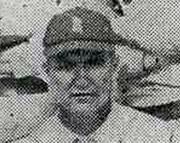
Frank Harris

Frank Harris, convicted murderer

Five former players were firemen, three of them, John “Monk” Cline, Tom McLaughlin and William “Chicken” Wolf, were all members of the Louisville Fire Department:  Wolf was involved in an accident while responding to a fire in 1901 which left him with a severe head injury and contributed to his death two years later.

Other highlights:

Clarence “Kid” Baldwin—Tramp (Baldwin died the following year in a Cincinnati mental hospital)

Warren “Hick” Carpenter—Pullman car conductor

William Holbert—United States Secret Service

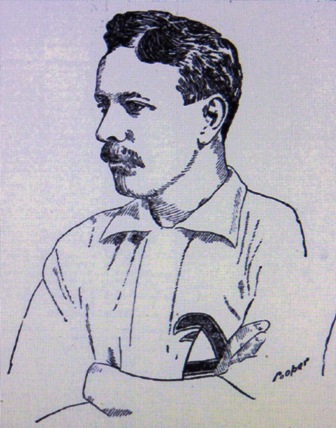
William “Blondie” Purcell—Racetrack bookie

William "Blondie" Purcell

William “Blondie” Purcell

Ed Andrews—Orange grower

George “Jumbo” McGinnis—Glassblower

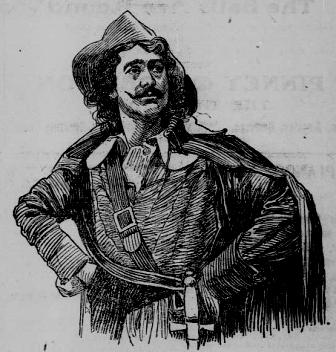
Daniel “Cyclone” Ryan—Actor

Pitcher turned actor Daniel "Cyclone" Ryan, circa 1903

Pitcher turned actor Daniel “Cyclone” Ryan, circa 1903

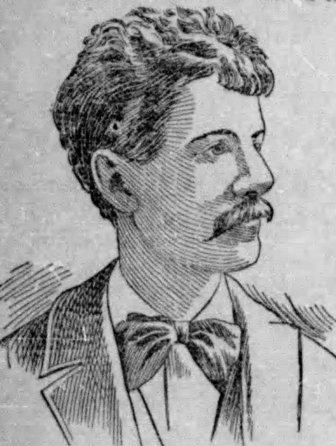
John Frank Lane (1880s umpire)—Actor, he was most famous for appearing in plays written by Charles Hale Hoyt, a former sports writer for The Boston Post, and the man responsible for putting Mike “King” Kelly on the stage.

Tragic Exits 3

23 Mar

Eddie Meade

Edward “Eddie” Meade appeared headed to the big leagues.  After beginning the 1926 season with the Kinston Eagles in the Virginia League, the 24-year-old left-hander was acquired at midseason by the St. Paul Saints of the American Association and posted a 12-7 record with a 3.40 ERA in 22 games.

Meade began the 1927 season with a 6-0 shutout of the Louisville Colonels on April 17.  The same week he recorded his first victory, The Associated Press said he was about to become a member of the defending American League champions:

“The Yankees talked of possible reinforcements in the shape of Eddie Meade, of St. Paul, called the best young pitcher in the American Association.”
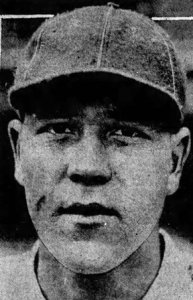
Eddie Meade

Eddie Meade

During the same week, Meade became ill; although the nature of the illness was never disclosed.  Eight days later he started a game with the Columbus Senators but was pulled after giving up six runs in the fifth inning of 9 to 8 loss.  Five days later he pitched in relief against Louisville, but The Minneapolis Journal said he lasted less than an inning due to his “impaired physical condition.”

When the Saints left Minnesota for a series in Kansas City on May 16, Meade stayed behind.  The following evening Meade checked into St. Paul’s Boardman Hotel and shot himself to death.

The day after his suicide, The Journal said, “it was learned today that Meade was slated to go to the New York Yankees in the fall.”

St. Paul Manager Nick Allen told The Associated Press:

“He was one of the hardest working youngsters we ever had on the club and the outlook for his future was bright, as he had only two years in baseball.  The only motive he could have had for such action would be mental depression.  He was not married.  The nature of his illness was no cause for alarm, but he apparently believed it otherwise.”

Tommy Coates

Thomas A. “Tommy” Coates was born in Omro, Wisconsin on February 18, 1886 (Baseball Reference lists his middle initial as “O” but birth and death records  list it as “A”).

After starring, along with his older brother Hiram, on Omro High School’s undefeated baseball team in 1901—The Omro Herald called the team “possibly the best in the state”—Coates played industrial league and semi-pro ball in Central and Northern Wisconsin.

After playing in Rhinelander, Wisconsin in 1908, The Oshkosh Northwestern said:

“Coates had lots of confidence in himself, and during the winter months the Omro boy came to the city one day and sought out “Pink” Hawley. Hawley agreed to give him a trial.”

Emerson Pink Hawley, a Wisconsin native who pitched in the major leagues for a decade, was the manager of the Oshkosh Indians in the Wisconsin-Illinois League.
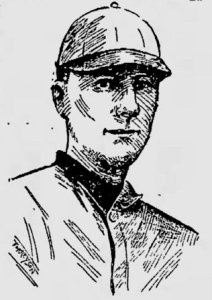
Tommy Coates

Tommy Coates

 “Coates came to this city from his home at Omro (for his tryout).  He donned baseball togs and he ‘made good’ from the start.”

Coates, who The Northwestern said  was “tall (and) built something like the great Ty Cobb,” became the Indians starting left fielder one week into the season and went on to lead  the team with a .299 batting average (he hit .002 better than his 19-year-old teammate Heinie Groh).

In September, The Sporting News reported that with just one season of professional experience, Coates “Looks good to Connie Mack,” and was drafted by the Philadelphia Athletics. He was the only member of the Indians drafted by a big league club in 1909.

At season’s end in September, Coates, with an invitation to train with Mack’s club in the spring, spent most of his time hunting.

On October 11 Coates was in a row-boat with a friend, hunting in a marsh near Omro.  The friend told The Omro Herald:

“Tom saw a mud hen rise up on the right hand side.  He turned about quickly and took hold of his gun which was at his left side and pulled it toward him…I turned about as soon as I heard the shot, and to my horror saw Tom lunge forward.”

Coates accidentally discharged his gun, shooting himself in the left eye.

Twelve days after the Oshkosh Indians received a $300 check from Connie Mack—his draft price—Coates was dead.

The Northwestern said:

“He was quiet and unassuming. After making a sensational play in the field or batting out the hit that won the game…the Oshkosh fans could not induce Coates to doff his hat.  He would return to the bench with face covered with blushes.”

[…]

“His more ardent admirers were confident he would make good in the American League, and one of their first thoughts upon hearing of the unfortunate accident, was the promising career he had before him.”

Lost Advertisements–Larry Doyle for Coca-Cola

20 Mar

larrydoylecoke

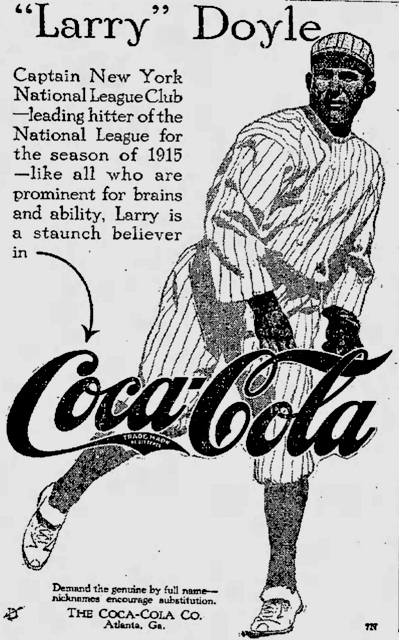
A 1916 advertisement for Coca-Cola featuring New York giants Captain Larry Doyle.

Four years earlier, when Doyle led the Giants to a National League championship–hitting .330 and winning the Chalmers Award as the league’s most valuable player–he told a reporter from The New York Evening Journal that his success was driven by a snub from White Sox Manager Jimmy “Nixey” Callahan:

“When he was playing in a western minor league city (the Three-I League with the Springfield Senators) the (New York) Highlanders heard of him and asked Callahan, then playing independent ball (in Chicago’s City League), to look him over.  Callahan watched Doyle perform in several games and then wired the Highlanders:

“‘He isn’t fast enough.  Can’t field and isn’t a first-class hitter.’

“So Doyle was passed up and Callahan sent in a bill for $200 to cover his expenses and time.  Then (John) McGraw walked up…and paid $4,000 (actually $4,500) for Doyle, who couldn’t be purchased now for three times that amount.  All of which goes to show that some of the best judges of ball players make serious mistakes.”


“The Next Babe Ruth”

18 Mar

After he hit 11 home runs in 1918, and for the next two decades, stories about the discovery of “The Next Babe Ruth” became commonplace in newspapers across the country.

One of the first was Joe Doyle, “The Babe Ruth of Great Lakes,” signed by the St. Louis Cardinals in November of 1918.  Doyle was the star of the team representing Camp Dewey at Great Lakes Navel Training Station where, The St. Louis Globe-Democrat said he made a name for himself, hitting “a dozen home runs and nine triples…(and) flogging a home run over the Camp Dewey Drill Hall, a smash that might be compared to a lift over the left fences of any major league park.”

Doyle began his professional career the following spring with the Houston Buffaloes in the Texas League and played his entire career in Texas.  “The Babe Ruth of Great Lakes” hit just eight home runs over five minor league seasons.

Ben Paschal had the distinction of being declared “The Next Babe Ruth” twice.  When the Boston Red Sox purchased Paschal from the South Atlantic League’s Charlotte Hornets in July of 1920, Manager Ed Barrow told The Boston Herald he had acquired “A second Babe Ruth.”

Paschal joined the Red Sox after Charlotte’s season ended in September.  He had 10 hit in 28 at-bats, but no extra base hits, and was returned to Charlotte after the season.

After four more excellent seasons in the South Atlantic League and Southern Association (he hit .335 with 68 home runs from 1921-1924) he was  purchased by the New York Yankees for $20,000 in August of 1924.

Ben Paschal

Ben Paschal

Paschal was again dubbed the “Second Babe Ruth” by newspapers.  His second stint as the second Ruth was longer and more successful than his first.  From 1924-1929 he hit .309 in with 24 home runs in 750 at-bats as an outfielder playing behind Ruth and Bob Meusel (Meusel was himself dubbed “Another Babe Ruth” by Manager Miller Huggins when he joined the Yankees in 1920).  On Opening Day in 1927 the Second Babe Ruth pinch-hit for Ruth (who was 0-3 and struck out twice) in the sixth inning; Paschal singled, and the Yankees went on to an 8 to 3 victory over the Philadelphia Athletics.

Then there was Dorothy Hodgens.  In 1921, Hodgens was a 20-year-old student at Wilson College in Chambersburg, Pennsylvania.  Hodgens briefly became a celebrity and was called the “feminine Babe Ruth” by many newspapers after The Associated Press (AP) reported that while growing up in Philadelphia Napoleon Lajoie said she was “the only girl he ever knew who could play ball.”

After her picture appeared in papers across the country, Hodgens, who played several sports at the school, was interviewed by The Harrisburg Evening News as she was “ready to enter a basketball game:”

“Yes, I’m terribly fond of baseball, and I’ve been playing it ever since I’ve been a bit of a youngster.”

She said Lajoie was a neighbor in Philadelphia when she was a child:

“Lajoie used to come out and pitch ball with the boys and girls in the neighborhood.  He told me I was the only girl he ever knew who could pitch and gave me a box of league balls that I have treasured ever since.”

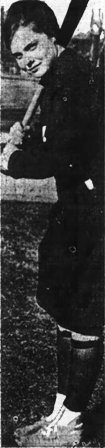
Dorothy Hodgens "The Feminine Babe Ruth."

Dorothy Hodgens “The Feminine Babe Ruth.”

While she said her real ambition was to become an actress, Hodgens said, “I never expect to give up baseball entirely though, and I certainly think that every girl should learn to play the game.”

The “Feminine Babe Ruth” disappeared from the public eye shortly afterward.

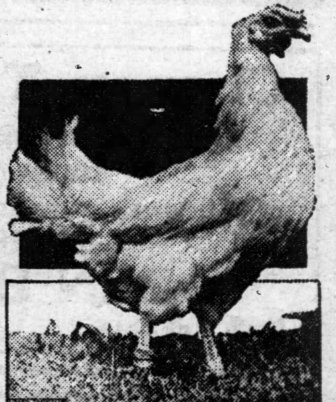
And finally, there was “Another Babe Ruth” who had a brief moment in the limelight in the fall of 1920.  This one was a three-and-a-half pound white Leghorn Chicken who was named “Babe Ruth,” and had just established a new record.

"Babe Ruth"

“Babe Ruth”

The AP said:

“(T)he home run king has a rival…She bats 326 eggs, and this beats the record of 314 (for a single year).  By experienced poultrymen, her record of 326 perfect eggs is considered the most remarkable in the history of the poultry industry.”

There was no report of how she performed the following season.

“Walsh? Ed Walsh? Who’s he?”

16 Mar

On May 1, 1912, as a result of a contract dispute, press operators walked off or were locked-out, of their jobs at 10 Chicago newspapers.  The following day, drivers and newsboys walked out in sympathy, and ultimately three more unions joined.

The dispute, which at times became violent, lasted until November.

The New York Times said at one point during the strike’s first week, less than 50,000 copies of the city’s four morning newspapers—limited to just four pages each– were distributed to a metropolitan area with a population of nearly four million.

Every Chicago paper, with the exception of The Day Book, Edward Willis Scripps’ advertisement free, pro-labor publication, suffered decreases in circulation and were forced to publish smaller editions for the first weeks of the strike.

The strike also had a negative impact on two other Chicago institutions.

The New York Tribune noted that during the first two weeks of May, while most of Chicago’s papers provided a minimum amount of baseball coverage, attendance at White Sox Park (renamed Comiskey Park the following season) and West Side Grounds “dropped off 30 percent.”

Writing in The Chicago Herald-Record after that paper had again begun publishing full-sizes editions in mid-May, sportswriter Hugh Fullerton was not surprised that less baseball news resulted in smaller crowds at the ballparks:

“Various major league club owners have, during their recent years of great prosperity, declared that baseball was independent of the newspapers.  Indeed such intellectual giants as C. Webb Murphy and Charles Ebbets have practically stated that the newspapers depended upon baseball for their circulation.  Of course, printing baseball news makes circulation for newspapers; else the newspapers would not print it.

“But during the last ten days Chicago has given the club owners and object lesson in the relative values.  There has been a strike of several trades allied with the newspaper printing business which resulted in crippling ten big dailies, restricting their circulation, besides cutting down the amount of baseball news and gossip printed.  The instantaneous result must have been a shock to the baseball magnates, who thought that the game was independent of the advertising.”

Hugh Fullerton

Hugh Fullerton

Fullerton, like the New York paper, said the attendance decline was “at least” 30 percent.

“I scouted around the city and discovered, rather to my amazement, that the lack of baseball news was received rather as a welcome relief from a necessary evil than as a bereavement.  A score of men told me they were glad they couldn’t get the news, that their employees could attend to business and that there was less waste of time…The town, which has been wild over the sensational race of the White Sox, cooled off in an instant.  I met fans who had been rooting wildly, who inquired whether or not the team was in town.”

Fullerton’s observations led him to the “startling proof that interest in baseball largely is manufactured by the papers.”

And, if the strike were to result in a further decrease in baseball news:

“I really believe that if the newspapers were to be suppressed for a couple of months, and one was to mention Walsh, people would say, ‘Walsh?  Ed Walsh?  Who’s he?’”

Ed Walsh

Ed Walsh

While the strike continued through the entire season, circulation and baseball coverage increased in June, giving no one the opportunity to forget Chicago’s best pitcher.

Attendance at Chicago’s ballparks rebounded as well.  By season’s end, Walsh’s White Sox drew more than 600,000 fans, despite a 20-34 swoon in June and July and a fourth place finish; while 514,000 fans  came out for the third place Cubs.

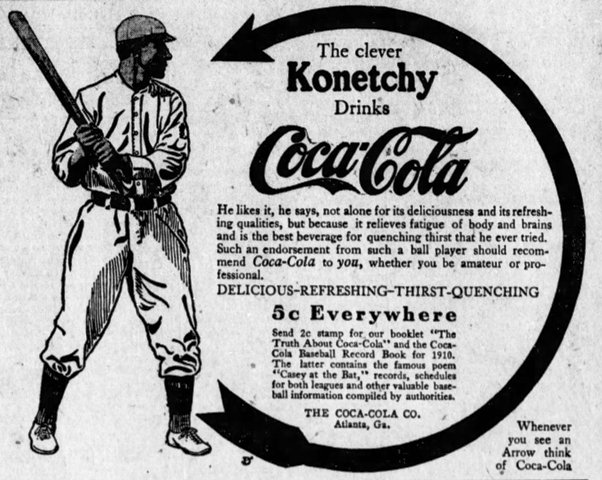
Lost Advertisements–“The Clever Konetchy Drinks Coca-Cola”

13 Mar

konetchy

A 1910 advertisement for Coca-Cola featuring St. Louis Cardinals first baseman Ed Konetchy:

“He likes it, he says, not alone for its deliciousness and its refreshing qualities, but because it relieves fatigue of body and brains and it is the best beverage for quenching thirst he’s ever tried.

“Such an endorsement from such a ballplayer should recommend Coca-cola to you, whether you be amateur or professional.”

Two years later, Konetchy shared his theories on batting and batting slumps, with The St. Louis Globe-Democrat:

“The ordinary person cannot for the life of him reason out why a ballplayer should be able to hit one part of the season and suddenly take a slump and act like a novice at the bat.  To one familiar with the playing of the game of baseball, the reason for this was a well-known fact.

“Good hitting, considering of course a natural player, generally depends upon the physical and mental condition of the man.  When he is in good shape, his eye is clear and his brain works quickly;  when he is out of condition his mind is dull and he loses his eye for the ball.”

[…]

“The other day as were leaving the field of St. Louis, I heard a fan, referring to one of our players, remark: ‘They ought to bench that fellow, he can’t hit anything.’  As a matter of fact, the man to whom he referred was one of the best stickers of our team and had merely been up against a little hard luck.  For three or four days, I have watched this player and almost every time he came to bat he had met the ball squarely but could not seem to place it into fair territory.  This is a fact that is not taken into consideration by a great many baseball lovers.  They judge a man’s ability to hit by reading the scores in the next day’s papers, not at all stopping to think that a man who has no hits credited to him may have done far more towards winning the game than the player who annexed two or three safeties.”

Congress Plays Ball

11 Mar

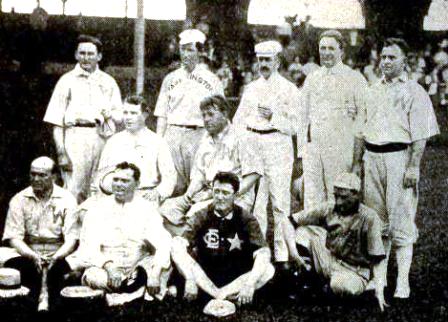
On July 16, 1909, the United States Congress took over Washington’s American League Park.  More than 1000 Washingtonians paid 75 cents to watch Democrats and Republicans in, what The Washington Post called an “affair (that) was advertised as a ball game.”

The Washington Herald said:

 “Hurrah for the Democratic party!

”No joking—the faithful followers of Jefferson, or whoever it was that gave (William Jennings) Bryan’s friends their principles, certainly did do things to the tried and true lieutenants of Speaker (Joseph Gurney) Cannon at the National Park yesterday afternoon, when two baseball teams composed of members of the House of Representatives fought it out for seven innings in some of the hottest rays Old Sol has dealt out to Washington this summer.”

[…]

“Republicans and Democrats alike were free traders, so far as errors and two or three base hits were concerned.”

The game ended after seven innings, the Democrats winning 26-16.

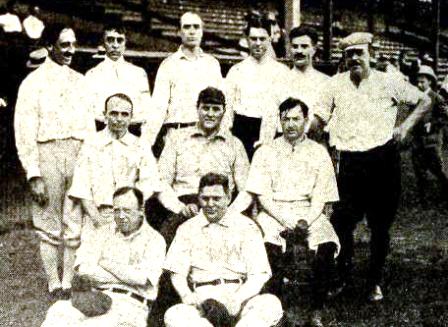
The Democrats

The Democrats

The Associated Press (AP) said:

“More varieties of baseball were played in that game than ever crowded into seven innings before and strange as it may seem not all of the varieties were bad.  The Democrats put up a rattling good game in the field—sometimes.”

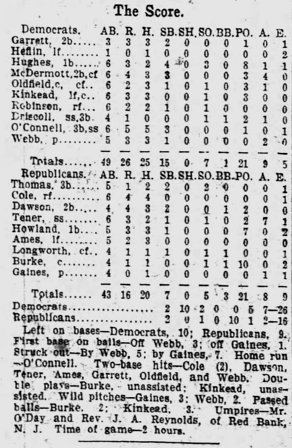
The Box Score

The Box Score

The AP said one of the highlights of the game was the collision between Republican catcher James F. Burke (PA) and pitcher Joseph H. Gaines (WV) in front of home plate on a pop up, “While (Burke) and the pitcher were doing the ‘Alphonse and Gaston,’ three Democrats with a warped idea of chivalrous courtesy raced home.”

The Republicans

The Republicans

The Washington Times was more critical of the abilities of the lawmakers, singling out several:

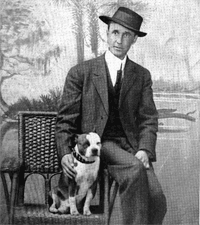
“Before going further it is necessary to state that for the Democrats the man who attracted the most unfavorable notice was Handsome (James Thomas) Heflin of Alabama, who, with the help of a collie dog, covered left field for his party in a lamentable, sad and sorrowful style.  Heflin is tall and stout, and not to say sebaceous, and he and the dog went on the principle that they could catch every fly and stop every grounder by simply staring the ball out of countenance.  Heflin played the position like a merycotherium.  He probably does not know what that mean, but a glance at the dictionary reveals it to be an animal like a rhinoceros, ruminant, contemplative and far from agile.”

Nick Longworth (OH), who was dressed in a golfing suit, and hit at the ball as if he thought it had been teed for him (he struck out twice) is suffering this afternoon from a wrenched erector spinae muscle, caused by continually looking up and seeing flies, which he had misjudged go sailing over his head in center field.”

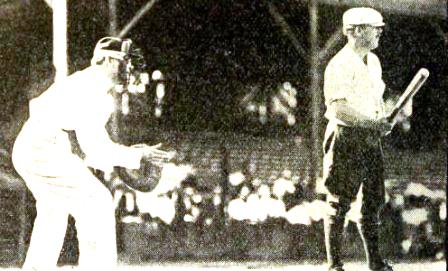
congressman Longworth at the plate.

Congressman Longworth at the plate, Congressman Kinkead is the catcher

The Times said, in general:

“Most of the players in trying to catch the ball held up their hand as if they expected someone to place in them very gently a salary check or a piece of pie.  On grounders they all had holes in their legs and could not stop a thing.”

Despite the overall criticism, the paper did mention three players on each team for being, at least, passable on the field.

Among the three Republicans was former big league pitcher, turned Pennsylvania Congressman, John Tener who played shortstop and had two hits and made just one of his team’s nine errors.  The other two Republican standouts were Albert F. Dawson of Iowa and Leonard Paul Howland of Ohio.

The three ”best fielders” among the  Democrats were Eugene F. Kinkead and William Hughes  of New Jersey and William Oldfield of Arkansas.

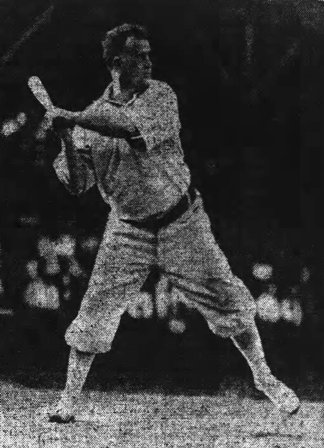
Congressman Hushes at the plate.

Congressman Hughes at the plate.

The game raised $320.55 to for the Washington Playgrounds Association “for the benefit of the children of Washington.”

The nation’s biggest baseball fan, President William Howard Taft skipped the game to play golf with Vice President James S. Sherman.

Lost Pictures–Pete Childs

9 Mar

A good detective story.

In February, I told the story of Peter Pierre Childs’ one-pitch triple play while he was the manager and occasional relief pitcher for the Portsmouth Cobblers in the Ohio State League in 1910.  While I was able to locate a picture of Childs with Portsmouth, I could not find a high-quality image of him in a major league uniform.  The only one I was aware of was a grainy photo included with Childs’ one-sentence biography in Wikipedia.

After I posted the story, I received an email from Mark Fimoff, co-chair SABR Pictorial History Committee. Mark is one of the foremost baseball photograph researchers and has helped me identify players in photographs in the past.

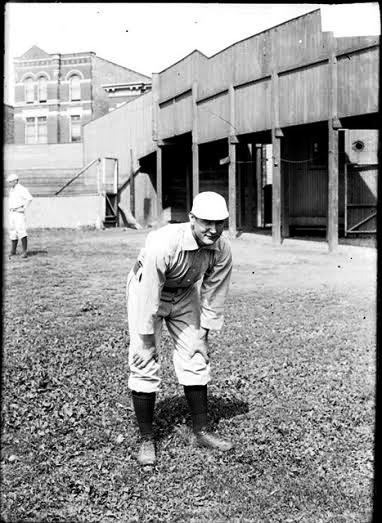
He has recently discovered two photographs of Childs that have been misidentified for more than 100 years.

petechilds petechildschidailynews2

The pictures are part of the collection from The Chicago Daily News.  The paper, and subsequently, the Library of Congress and the Chicago History Museum misidentified Childs (and also got the year wrong) until Mark discovered the error.

The listings for the pictures say:

“Baseball player Delhanty [sic] standing on a baseball field.”

And

“Baseball player Delhanty [sic] bending forward with hands on his knees standing on a baseball field.”

“Delhanty” is Jim Delahanty, who played with Childs on the 1901 Chicago Orphans.

jimdelahanty

Delahanty

pchilds

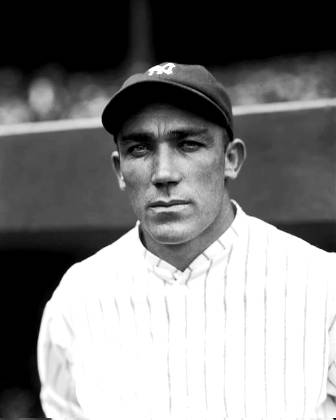
Pete Childs

Pete Childs

The listings for the photos also say they were taken in 1906.  Mark said, based on the uniform and the centerfield clubhouse visible in the photos—the wood structure pictured was replaced with a brick structure in 1905—the photos could not be from 1906.  Neither Childs nor Delahanty played with Chicago in any season other than 1901–so the photo was taken sometime between mid-July and October of 1901.

—–

 Childs was acquired by the Orphans in July after he was released by the St. Louis Cardinals.  He replaced Cupid Childs (no relation), who had been released by Chicago a week earlier, at second base.

Pete Childs was an upgrade in the field but hit just .229, 29 points lower than his predecessor, Cupid Childs.

The Chicago Inter Ocean said:

“Pete Childs is the best thing, in a fielding sense, Chicago has had since the days of (Fred) Pfeffer.  It is a mystery how a man who moves so fast after a grounder can move so slow in going down to first.  It is probable that Motionless Peter stands on his heels when batting, and that he thus heaves a mound of earth under his hoofs, blocking his passage, when he scoots, and materially jarring his batting average.”

Pete Childs was released by Chicago at the end of the 1901 season.

Lost Pictures–The Princeton Pitching Gun

6 Mar

princetonpitchinggun


The illustration above–from The Chicago Times-Herald in the summer of 1897–depicts the Princeton University team’s first use of The Pitching Gun–the invention of Mathematics Professor Charles Howard “Bull” Hinton, a member of the Princeton faculty.

The Times-Herald said of the gun:

“A test was recently made at Princeton in three games played on the college ball field, and the machine is said to have given satisfaction, although there was some delay caused by the necessity of loading the canon.”

The paper said there were no problems “regulating the speed of the ball, nor in causing it to curve or drop as if thrown by a human being.”

The illustration is inaccurate, the device was not fired like a gun, but rather, according to The New York Sun, it was “discharged by the batsman, who, when ready for the ball to be delivered, steps upon an electrical intercepting plate, connected by wires which trigger the cannon.”


The success of the new invention, which Hinton had been testing for more than a year, was likely overstated as well.

A trial of the gun in Newark, during an exhibition game between the Newark Field Club and the Orange Y.M.C.A., did not go as well.

The New York World said:

“Prof. Hinton and his so-called pitching gun were on exhibition at Newark yesterday…Fifty-seven persons were on hand to see the performance.”

The paper said it took Hinton more than an hour and a half to set up the gun, which used gunpowder to discharge the ball.  The players on both teams feared stepping up to the plate against the gun.

The World concluded:

“(Hinton) is thoroughly in earnest about the practicability of a pitching gun, although his experiences by this time should have convinced him that his invention, even if perfected, will never be of the slightest use to the world.”

Charles H. Hinton

Charles H. Hinton

Hinton moved from Princeton to the University of Minnesota in 1898 and continued trying to perfect his invention, but The Philadelphia Press declared it “impracticable for regular use.”

Hinton finally abandoned his quest to create the first viable pitching machine when he went to work at the United States Navel Observatory in 1900.

“A Pork Jinx on the Club”

4 Mar

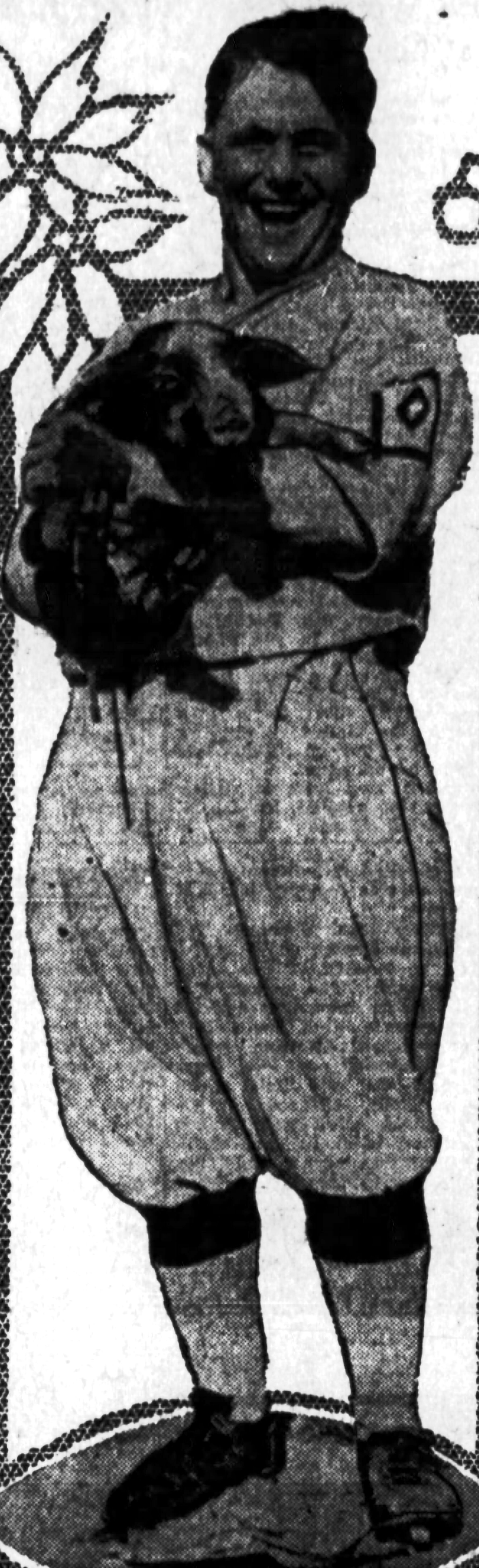
To mark the Oakland Oaks 1916 home opener, J. Cal Ewing, generally known as “The Godfather of the Pacific Coast League” presented Oakland Manager Harold “Rowdy” Elliott with a gift:  The Oakland Tribune said:

“Ewing gave to the Oaks a mascot in the shape of a real ‘rooter,’ a yearling pig, which was kept on the players’ bench throughout the game.”

The Oaks cruised to a 10-2 victory over the Portland Beavers in front 15,000 enthusiastic Oakland fans, and the superstitious among the ball club and their fans attributed the win to “Margaret,” the new mascot.

The Oaks played well in April, and were in first place until the end of the month, but by mid May they were 16-21, fifth place in the six-team league—and it was noticed that no one had seen “Margaret” for some time.

Rowdy Elliott with Margaret

Rowdy Elliott with Margaret

The Tribune was convinced the disappearance of the pig was responsible for the team’s decline:

“Suffering Pigs!  A Pork Jinx on the club!…The wrathful shade of a female porker is responsible for the Oaks’ slump.  Maggie the Pig was compelled to shuffle all her porcine coil to the accompaniment of roast apples and cranberry sauce, which is no nice way to treat an emblem of Good Fortune.”

The paper also noted that the club’s secretary also worked as a cook, and Ewing should have “had sense enough” to take that into account before presenting the team with a pig.

And, the paper composed a poem:

O Maggie, dear, and did ye hear

   The news that’s goin’ round?

The Oaks are losing day by day

   And soon they won’t be found.

They’ve ingestion badly.

   And they’re looking for the hook

They can’t play ball at all, at all

   Since you went to the cook.

It became a bit of a scandal.

The Oaks quickly denied that the pig had been eaten:

“They say the trouble is that they haven’t eaten her pigship.  Margaret was given to the ground keeper to preserve, and that personage refuses to produce the pig.”

Rowdy Elliott was quick to tell The Tribune the reason for the club’s slump had nothing to do with the team mascot.  He said the blame was clearly the result of another team’s mascot:

“Elliott says the Oaks’ slump can be attributed to no less a personage than Erasmus Pinckney Johnson.”

Johnson was the mascot for Frank Chance’s Los Angeles Angels—The Los Angeles Times said the young African American boy had been found, on Chance’s orders, in late April in order to break a week-long losing streak. The Times routinely described “the good luck charm” in the most racist terms.

Part of the “luck” Johnson brought was derived from rubbing the young mascot’s head.  Elliott claimed during the Oaks’ last series in Los Angeles he had rubbed the Johnson’s head “the wrong way.”

“Since that moment Rowdy has had little luck, winning only two games out of the last fourteen played.  Erasmus hasn’t been doing much for the Angles of late, for Chance’s crew has been in a slump, but he has at least succeeded in wrecking the Oakland club.”

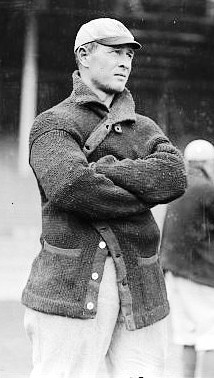
Frank Chance

Frank Chance

So desperate were the Oakland fans for answers that The Tribune enlisted two prominent fans, an Alameda County Circuit Court judge and a local doctor to do a “psychological study of the team.”

“Judge Wells…has come to the conclusion that the team has worked itself into a jinx, and needs the aid of the pig mascot they had in the opening game to pull them through.  Dr. Halsey agrees that hits, pitching fielding and psychology and all may have something to do with it, but the real reason, according to the doctor, is that the boys are suffering from a nervous breakdown that followed shortly after seeing such an enormous crowd at the opening game.”

Things quickly got worse for the Oaks. Elliott was suspended for several days for throwing a ball at umpire Jack Doyle, and the team continued to lose in June, and then for the rest of the season.

At the end of July Elliott was sold to the Chicago Cubs, George “Del” Howard, who had purchased the club during the season, replaced him as the Oaks’ manager.

Oakland finished 1916 in last place with a 73-136 record.  Chance’s Angels overcame their May slump and easily won the championship with a 119-79 record.

Margaret the pig was never heard from again.